REVIEW 5 major objections 6 minor 72 references
A differentially private federated learning architecture for cardiovascular risk prediction keeps clinical utility by using server-side momentum to average out privacy noise, reaching AUC 0.96 at a utility-prioritized privacy budget.
Reviewed by Pith at T0; open to challenge. T0 means a machine referee read the full paper against a public rubric. the ladder, T0–T4 →
T0 review · deepseek-v4-flash
2026-08-02 19:52 UTC pith:RKYM5K2Z
load-bearing objection The paper's headline numbers contradict each other and the statistical significance tests are invalid because all runs share one seed; the underlying idea is just FedAdam with a standard EMA argument, so the only real contribution is an untrustworthy benchmark. the 5 major comments →
A Robust Framework for Secure Cardiovascular Risk Prediction: An Architectural Case Study of Differentially Private Federated Learning
The pith
A machine-rendered reading of the paper's core claim, the machinery that carries it, and where it could break.
Core claim
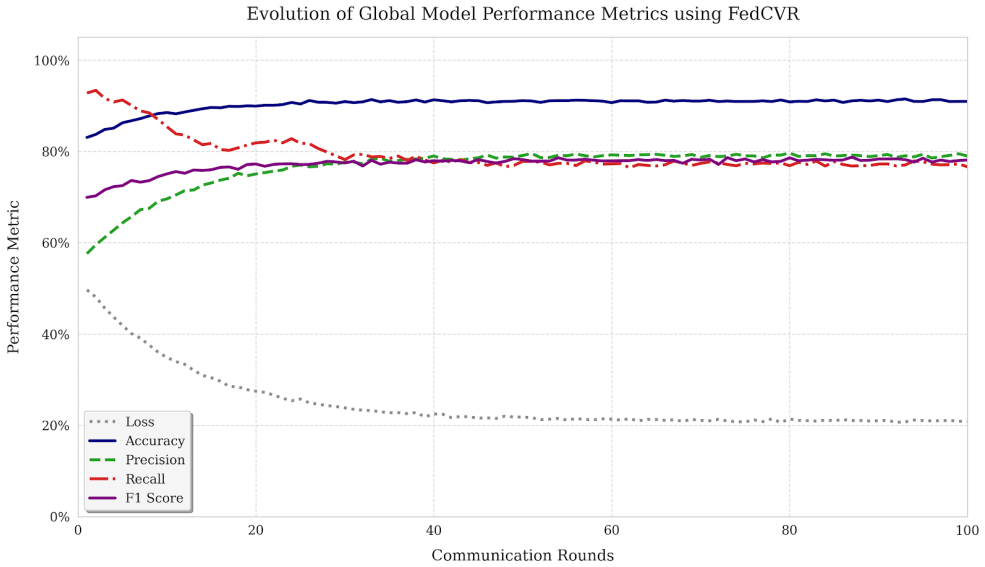
On its own terms, the paper's central claim is that server-side momentum is the operative mechanism for recovering clinical utility under differential privacy. In the FedCVR update rule, the server maintains first and second moment estimates of the aggregated pseudo-gradient and updates the global model with an adaptive learning rate; the first moment is a moving average that low-pass filters the DP noise superimposed on each client update. The reported validation shows a stable F1-score of about 0.78 and AUC of 0.96 at a cumulative privacy budget of epsilon≈13.4 (delta=1e-5), compared with an F1 of 0.84 for the non-private baseline, and statistically significant superiority over FedAvg, Fed
What carries the argument
The central object is the FedCVR server-side adaptive aggregation step, an Adam-style optimizer with bias-corrected first and second moments. The first moment, m_t = β1 m_{t-1} + (1-β1) g_t, is the temporal filter: since each DP-perturbed update g_t contains true gradient plus zero-mean Gaussian noise, the moving average approximates the expected gradient and damps the high-frequency noise while preserving the low-frequency signal. The second moment v_t and the update w_{t+1} = w_t - η m̂_t/(√v̂_t+τ) scale the step size per parameter. This stateful, low-pass filtering is the mechanism that distinguishes FedCVR from stateless aggregators and from non-momentum adaptive optimizers.
Load-bearing premise
The synthetic dataset, whose high-risk labels were assigned by a deterministic rule from the same six features the model is given, faithfully represents real clinical records; if real EHR noise and missingness change the ranking, the architectural conclusions can collapse.
What would settle it
Run the same five-way optimizer comparison on a real multi-site EHR cohort under the same DP settings (σ=1.0, 100 rounds, RDP accounting); if FedCVR's AUC gap over FedYogi and FedAvg narrows or reverses, the momentum-denoiser result is an artifact of the synthetic, rule-based benchmark.
If this is right
- A utility-prioritized privacy budget around epsilon 13.4 can sustain an AUC of 0.96 and F1 ≈0.78, only a small drop from the non-private F1 of 0.84, so formal DP does not automatically destroy clinical viability.
- Dropping server-side state (FedAvg, FedProx) costs roughly 0.06–0.08 in AUC under the same DP noise, so aggregation memory, not client regularization, is the key to robustness.
- Momentum-based aggregation outperforms other adaptive optimizers (FedAdagrad, FedYogi) under identical privacy constraints, indicating that the specific first-moment update—not adaptivity in general—is the noise-filtering component.
- Under a stricter budget (epsilon≈6.6), utility degrades gracefully (F1≈0.65) rather than collapsing, supporting deployment in trusted consortium settings.
- Communication cost is unchanged relative to FedAvg; only server memory grows (storing w, m, v), making the mechanism cheap to add to existing federated learning systems.
Where Pith is reading between the lines
- The temporal-denoiser view suggests a testable design rule: any server aggregator that keeps a sufficiently long exponential moving average of updates should recover most of the utility lost to DP noise; future work could systematically vary β1 to map the noise-versus-momentum trade-off.
- Because the synthetic labels were generated by a deterministic rule using the same six features the model sees, the AUC 0.96 partly measures rule recovery; on real EHR data with missingness, measurement error, and unmeasured confounders, the optimizer ranking reported here should be re-checked before generalizing to real networks.
- Independently recomputing the privacy accountant would strengthen the claim: with full participation (q=1.0) and 100 rounds, standard RDP composition for noise multiplier σ=1.0 may yield an epsilon well above 13.4, in which case the 'operational privacy budget' framing would need revision.
- The paper's universal phrasing that server-side adaptivity is a 'structural prerequisite' goes beyond the evidence of a single synthetic tabular setting; it should be read as a mechanism hypothesis, not a proven law.
Editorial analysis
A structured set of objections, weighed in public.
Referee Report
Summary. The paper presents FedCVR, a server-side adaptive (Adam-style) aggregation framework for differentially private federated learning (DP-FL) applied to cardiovascular risk prediction. It uses a synthetic 30,000-record dataset distributed across five clients under non-IID partitions, applies local DP-SGD via Opacus, and benchmarks against FedAvg, FedProx, FedCluster, FedAdagrad, and FedYogi. The paper reports an F1 score of 0.78 and AUC 0.96 at a privacy budget of ε≈13.4, claims that FedCVR statistically outperforms the baselines, and concludes that server-side adaptivity is a structural prerequisite for recovering clinical utility under DP noise. The full-text abstract, however, reports the DP F1 as 0.84, which matches the non-private baseline rather than the 0.78 value given in the results.
Significance. If the claims were supported, the paper would provide a useful engineering case study showing that server-side momentum can mitigate DP noise in tabular federated learning. The paper has strengths: it gives a concrete architecture, uses standard libraries (Flower, PyTorch, Opacus), reports hyperparameters in detail, and includes an explicit limitations section. However, the central statistical evidence is invalid because the 'N=5 independent runs' in Table 7 contradict the fixed random_state=42 policy stated in §7.2, and the headline F1 result is internally inconsistent across the abstract and the results sections. The synthetic-data limitation further restricts the scope of any clinical or architectural conclusion. As a result, the paper's significance is not currently established.
major comments (5)
- [§7.2 and Table 7] Table 7 reports means±std and p-values from 'N=5 independent runs' with a two-tailed t-test, but §7.2 states that 'random_state=42 was used throughout all stochastic processes, including synthetic data generation, partitioning, and model initialization.' If all runs share one seed, they are not independent replicates, so the reported standard deviations and p-values are not meaningful. This invalidates the central claim that FedCVR 'statistically outperforms' the baselines and the contribution titled 'Statistical Validation.' The experiments must be rerun with distinct seeds and the significance analysis redone.
- [Abstract vs. §8.3/Table 8] The full-text abstract states that 'integrating server-side momentum as a temporal denoiser allows the architecture to achieve a stable F1-score of 0.84 and an Area Under the Curve (AUC) of 0.96,' but §8.3 reports the F1 stabilizing at 78%, and Table 8 gives F1=0.78±0.03 for σ=1.0 (ε≈13.4), with the non-private baseline at 0.84. The arXiv abstract itself reports 0.78 versus a 0.84 baseline. Thus the full-text abstract reports the baseline value as the DP result. This direct self-contradiction must be corrected and all summaries harmonized.
- [§4.4, §9.1, Eq. (21), §10.1] The 'temporal denoiser' explanation is not established by the experiments. FedYogi also maintains a first moment, so the presence of momentum alone does not distinguish FedCVR from FedYogi. The paper attributes the advantage to the 'specific tuning' of the Adam-based update (§4.3) without an ablation (e.g., varying β1, removing momentum) or a theoretical analysis of the second-moment update rule. Consequently, the conclusion that 'server-side adaptivity is a structural prerequisite' (§10.1) is an overgeneralization from a single synthetic dataset and one privacy configuration.
- [§6.3, §9.4, §10.1] The synthetic dataset's target labels are assigned by rule-based logic derived from clinical guidelines, using the same six features that are given to the model. The paper concedes in §9.4 that the synthetic data 'does not fully capture the missing values and unstructured noise that are typical of raw EHRs.' The headline AUC≈0.96 and the optimizer ranking may therefore reflect recovery of the labeling rule rather than the optimizer's denoising property. The claims of a 'validated engineering blueprint' and clinical utility go beyond the evidence; at minimum the conclusions should be tempered, and ideally the framework should be validated on real EHR data.
- [§5.3.1 vs. §8.6] Section 5.3.1 states that Rényi Differential Privacy (RDP) accounting is used to track privacy loss, while §8.6 says 'Future iterations of this work will explore advanced composition techniques, such as Rényi Differential Privacy (RDP).' This contradiction leaves the derivation of ε≈13.4 unclear. The paper should state unambiguously which accounting method was actually used and provide the computation behind the reported privacy budget.
minor comments (6)
- [§7.2 vs. Table 8] The noise multipliers are reported as σ∈{0.8,1.1,1.5} in §7.2 but as {0.5,1.0,1.5} in Table 8 and in the abstract. Reconcile these values.
- [Table 2] Table 2 gives patient counts of 2,487 and 513, totaling 3,000, but the stated total is 30,000. The percentages (82.9%/17.1%) imply counts of 24,870 and 5,130. Correct the arithmetic.
- [§9.2] The statement that the model 'converged to a performance plateau nearly identical to the non-private baseline' is inconsistent with Table 8, which shows F1=0.78 vs. 0.84 at σ=1.0. This is a gap of 6 percentage points and should be described accurately.
- [Software and Data Availability] The statement that 'Data and source code will be made available on request' is insufficient for the reproducibility promised in the contributions, especially given the statistical validation claims. The code and data should be provided with the submission.
- [References] References [13] and [33] appear to be the same paper and are duplicated. Please merge or renumber.
- [Algorithm 1] Algorithm 1 uses 'ε' for the numerical stability constant (line 13) and in the Require line, which collides with the privacy budget notation ε used throughout the paper. Rename the stability constant to τ, consistent with Eq. (9).
Circularity Check
Central empirical results are measured, not derived; the only definitional circularity is the self-defined Utility-Prioritized privacy regime, which is non-load-bearing.
specific steps
-
self definitional
[Table 1 and §5.3.2]
"Utility-Prioritized 10.0 - 15.0 Balanced (Current Study) ... Our architectural choice of ϵ≈13.4 reflects a deliberate engineering trade-off that balances diagnostic precision with the prevention of trivial data leakage."
The paper first fixes σ=1.0 and reports a cumulative budget of ε≈13.4 (§5.3.1), then defines the 'Utility-Prioritized' regime in Table 1 as ε∈[10,15] and highlights it as 'Balanced (Current Study)'. The classification is constructed after the operating point is chosen, so the assertion that ε≈13.4 is 'balanced' is true by definition rather than an independent finding. This is rhetorical framing, not a load-bearing derivation: the headline F1/AUC and the baseline comparisons are measured values, not outputs of this definition.
full rationale
The paper's core claim (FedCVR with server-side momentum outperforms FedAvg/FedProx/FedAdagrad/FedYogi under DP, with F1≈0.78 and AUC≈0.96) is supported by direct benchmark measurements on a synthetic dataset; it is not obtained by deriving the results from the assumptions. The 'temporal denoiser' discussion is an after-the-fact explanation of momentum's averaging property, not a prediction derived from a fitted parameter. There are no load-bearing self-citations: the reference list contains no works by Tertulino/Alencar, and the cited FedOpt/Opacus results are standard external tools. The one definitional issue is the 'Utility-Prioritized' regime (10.0–15.0), which is defined after selecting ε≈13.4 and then used to label that choice 'balanced'; this is a self-fulfilling categorization but does not change the measured performance or the comparative ranking. Two non-circular concerns should be noted: (i) §7.2 fixes random_state=42 for 'all stochastic processes' while Table 7 reports N=5 independent runs and p-values, so the t-test claims are not statistically meaningful; (ii) the synthetic labels are generated by rule-based logic from the same six features (§6.3), so the high AUC partly reflects rule recovery rather than a real EHR transfer, a limitation the paper itself concedes in §9.4. These are validity/evidential weaknesses, not circularities under the rubric. Overall the derivation chain is self-contained and not definitionally circular beyond the minor regime label.
Axiom & Free-Parameter Ledger
free parameters (4)
- Noise multipliers σ∈{0.5,1.0,1.5}, operating point σ=1.0 =
1.0; reported ε≈13.4 at δ=10^-5
- Synthetic label-rule thresholds (age/BP/cholesterol/smoking/diabetes → High/Low risk) =
Unreported
- Server-side optimizer hyperparameters η_s=0.1, β1=0.9, β2=0.999, τ=1e-3 =
η_s=0.1; β1=0.9; β2=0.999; τ=1e-3
- Regime boundaries in Table 1 (Strict <1, Moderate 1–10, Utility 10–15, Weak >20) =
ε thresholds 1/10/15/20
axioms (5)
- standard math The Gaussian mechanism and RDP composition as implemented in Opacus give a valid (ε,δ)-DP guarantee for the client updates.
- domain assumption Honest-but-curious threat model; DP noise protects against inference/reconstruction but not poisoning or collusion.
- standard math The exponential moving average of zero-mean DP noise converges to 0 while preserving the signal direction (Eq. 21).
- ad hoc to paper N=5 runs with fixed random_state=42 are statistically independent replicates.
- domain assumption The synthetic dataset's feature distributions and rule-based labels are representative of real Framingham/Cleveland clinical settings.
Cite this review
Pith. "Pith review of A Robust Framework for Secure Cardiovascular Risk Prediction: An Architectural Case Study of Differentially Private Federated Learning." pith.science (2026). https://pith.science/paper/RKYM5K2Z
@misc{pith2026260313293,
  author       = {Pith},
  title        = {Pith review of: A Robust Framework for Secure Cardiovascular Risk Prediction: An Architectural Case Study of Differentially Private Federated Learning},
  year         = {2026},
  howpublished = {\url{https://pith.science/paper/RKYM5K2Z}},
  note         = {Machine review of arXiv:2603.13293}
}
read the original abstract
Accurate cardiovascular risk prediction is crucial for preventive healthcare; however, the development of robust Artificial Intelligence (AI) models is hindered by the fragmentation of clinical data across institutions due to stringent privacy regulations. This paper presents a comprehensive architectural case study validating the engineering robustness of FedCVR, a privacy-preserving Federated Learning framework applied to heterogeneous clinical networks. Rather than proposing a new theoretical optimizer, this work focuses on a systems engineering analysis to quantify the operational trade-offs of server-side adaptive optimization under utility-prioritized Differential Privacy (DP). By conducting a rigorous stress test in a high-fidelity synthetic environment that reflects the feature space and clinical context of real-world datasets (Framingham, Cleveland), we systematically evaluate the system's resilience to statistical noise. The validation results demonstrate that integrating server-side momentum as a temporal denoiser enables the architecture to achieve a stable F1 score of 0.78 and an Area Under the Curve (AUC) of 0.96 under the operational privacy budget (epsilon approximately 13.4), compared to a non-private baseline with an F1 score of 0.84. FedCVR statistically outperforms standard stateless baselines (FedAvg, FedProx) and other adaptive optimizers (FedAdagrad, FedYogi) under identical privacy constraints. Our findings confirm that server-side adaptivity is a structural prerequisite for recovering clinical utility under realistic privacy budgets, providing a validated engineering blueprint for secure multi-institutional collaboration.
Figures




Reference graph
Works this paper leans on
-
[1]
A. Gaber, H. Abdeltwab, T. Elbatt, Fedcvd: Towards a scalable, privacy-preserving federated learning model for cardiovascular diseases prediction, in: Proceedings of the 2024 8th International Conference on Machine Learning and Soft Computing, ICMLSC ’24, Association for Com- puting Machinery, New York, NY , USA, 2024, p. 7–11. doi:10.1145/3647750.3647752
arXiv 2024
-
[2]
L. J. Laslett, P. Alagona, B. A. Clark, J. P. Drozda, F. Sal- divar, S. R. Wilson, C. Poe, M. Hart, The worldwide en- vironment of cardiovascular disease: prevalence, diagno- sis, therapy, and policy issues: a report from the american college of cardiology, Journal of the American College of Cardiology 60 (25S) (2012) S1–S49
2012
-
[3]
E. O. Lopez, B. D. Ballard, A. Jan, Cardiovascular disease, in: StatPearls [Internet], StatPearls Publishing, 2023
2023
-
[4]
Abhishek, H. V . Bhagat, M. Singh, A machine learning model for the early prediction of cardiovascular disease in patients, in: 2023 Second International Conference on Advances in Computational Intelligence and Com- munication (ICACIC), 2023, pp. 1–5.doi:10.1109/ ICACIC59454.2023.10435210
arXiv 2023
-
[5]
Gupta, S
A. Gupta, S. Misra, N. Pathak, D. Das, Fedcare: Feder- ated learning for resource-constrained healthcare devices in iomt system, IEEE Transactions on Computational So- cial Systems 10 (4) (2023) 1587–1596
2023
-
[6]
A. Khimani, A. Hornback, N. Jain, P. Avula, A. Jais- hankar, M. D. Wang, Predicting cardiovascular disease risk in tobacco users using machine learning algorithms, in: 2024 46th Annual International Conference of the IEEE Engineering in Medicine and Biology Society (EMBC), 2024, pp. 1–5.doi:10.1109/EMBC53108. 2024.10782885
arXiv 2024
-
[7]
S. Mittal, S. Gupta, K. Bansal, G. Aggarwal, Democratiz- ing gdpr compliance: Ai-driven privacy policy interpreta- tion, in: Proceedings of the 2024 Sixteenth International Conference on Contemporary Computing, IC3-2024, As- sociation for Computing Machinery, New York, NY , USA, 2024, p. 735–743.doi:10.1145/3675888.3676142
arXiv 2024
-
[8]
B. K. Jensen, M. Cline, C. S. Guynes, Hippa, privacy and organizational change: a challenge for management, SIG- CAS Comput. Soc. 37 (1) (2007) 12–17.doi:10.1145/ 1273353.1273354
arXiv 2007
-
[9]
S. M. Shah, R. A. Khan, Secondary use of electronic health record: Opportunities and challenges, IEEE Ac- cess 8 (2020) 136947–136965.doi:10.1109/ACCESS. 2020.3011099
arXiv 2020
-
[10]
H. B. McMahan, E. Moore, D. Ramage, B. A. y Arcas, Federated learning of deep networks using model averag- ing, CoRR abs/1602.05629 (2016).arXiv:1602.05629. URLhttp://arxiv.org/abs/1602.05629
Pith/arXiv arXiv 2016
-
[11]
H. Wang, Z. Kaplan, D. Niu, B. Li, Optimizing federated learning on non-iid data with reinforcement learning, in: IEEE INFOCOM 2020 - IEEE Conference on Computer Communications, 2020, pp. 1698–1707.doi:10.1109/ INFOCOM41043.2020.9155494
arXiv 2020
-
[12]
K. Thumula, H. Holla, C. Gutti, A. A. Sasikumar, H. Gogineni, Privfed: Protecting user privacy in federated learning systems through differential privacy, in: 2025 8th International Conference on Electronics, Materials Engi- neering & Nano-Technology (IEMENTech), 2025, pp. 1– 6.doi:10.1109/IEMENTech65115.2025.10959665
arXiv 2025
- [13]
-
[14]
A. Silverio, P. Cavallo, R. De Rosa, G. Galasso, Big health data and cardiovascular diseases: A challenge for research, an opportunity for clinical care, Frontiers in Medicine V olume 6 - 2019 (2019). doi:10.3389/fmed.2019.00036. URLhttps://www.frontiersin.org/journals/ medicine/articles/10.3389/fmed.2019.00036
arXiv 2019
-
[15]
Z. Qu, X. Zhao, L. Sun, G. Muhammad, Daqfl: Dynamic aggregation quantum federated learning algorithm for in- telligent diagnosis in internet of medical things, IEEE In- ternet of Things Journal (2025) 1–1doi:10.1109/JIOT. 2025.3537614
arXiv 2025
-
[16]
L. Qiu, J. Cheng, H. Gao, W. Xiong, H. Ren, Federated semi-supervised learning for medical image segmentation via pseudo-label denoising, IEEE journal of biomedical and health informatics 27 (10) (2023) 4672–4683. 19
2023
-
[17]
Ullah, G
F. Ullah, G. Srivastava, H. Xiao, S. Ullah, J. C.-W. Lin, Y . Zhao, A scalable federated learning approach for collaborative smart healthcare systems with intermittent clients using medical imaging, IEEE Journal of Biomedi- cal and Health Informatics (2023)
2023
-
[18]
Benitez, B
K. Benitez, B. Malin, Evaluating re-identification risks with respect to the hipaa privacy rule, Journal of the Amer- ican Medical Informatics Association 17 (2) (2010) 169– 177
2010
-
[19]
S. Goto, D. Solanki, J. E. John, R. Yagi, M. Homilius, G. Ichihara, Y . Katsumata, H. K. Gaggin, Y . Itabashi, C. A. MacRae, R. C. Deo, Multinational federated learn- ing approach to train ecg and echocardiogram mod- els for hypertrophic cardiomyopathy detection, Cir- culation 146 (10) (2022) 755–769.doi:10.1161/ CIRCULATIONAHA.121.058696
2022
-
[20]
N. T. Madathil, F. K. Dankar, M. Gergely, A. N. Belka- cem, S. Alrabaee, Revolutionizing healthcare data ana- lytics with federated learning: A comprehensive survey of applications, systems, and future directions, Comput. Struct. Biotechnol. J. 28 (2025) 217–238
2025
-
[21]
M. J. Sheller, B. Edwards, G. A. Reina, J. Martin, S. Pati, A. Kotrotsou, M. Milchenko, W. Xu, D. Marcus, R. R. Colen, et al., Federated learning in medicine: facilitating multi-institutional collaborations without sharing patient data, Scientific reports 10 (1) (2020) 12598
2020
-
[22]
S. Pati, U. Baid, B. Edwards, M. Sheller, S.-H. Wang, G. A. Reina, P. Foley, A. Gruzdev, D. Karkada, C. Da- vatzikos, et al., Federated learning enables big data for rare cancer boundary detection, Nature communications 13 (1) (2022) 7346
2022
-
[23]
Linardos, K
A. Linardos, K. Kushibar, S. Walsh, P. Gkontra, K. Lekadir, Federated learning for multi-center imaging diagnostics: a simulation study in cardiovascular disease, Scientific Reports 12 (1) (2022) 3551
2022
-
[24]
K. Bharathi, Dhavamani, Niranjan, A federated learning based approach for heart disease prediction, in: 2022 6th International Conference on Computing Methodologies and Communication (ICCMC), 2022, pp. 1117–1121. doi:10.1109/ICCMC53470.2022.9754119
arXiv 2022
-
[25]
J. Wang, J. Gounley, H. Hanson, Cafe au lait: Compute- aware federated augmented low-rank ai training, in: Pro- ceedings of the Platform for Advanced Scientific Com- puting Conference, PASC ’25, Association for Comput- ing Machinery, New York, NY , USA, 2025, p. 1–12. doi:10.1145/3732775.3733580
arXiv 2025
-
[26]
P. J. Maliakel, S. Ilager, I. Brandic, Fligan: Enhancing federated learning with incomplete data using gan, in: Proceedings of the 7th International Workshop on Edge Systems, Analytics and Networking, EdgeSys ’24, Asso- ciation for Computing Machinery, New York, NY , USA, 2024, p. 1–6.doi:10.1145/3642968.3654813
arXiv 2024
-
[27]
A. Dhasade, Y . Ding, S. Guo, A.-M. Kermarrec, M. de V os, L. Wu, Quickdrop: Efficient federated unlearn- ing via synthetic data generation, in: Proceedings of the 25th International Middleware Conference, Middleware ’24, Association for Computing Machinery, New York, NY , USA, 2024, p. 266–278.doi:10.1145/3652892. 3700764
doi:10.1145/3652892 2024
-
[28]
S. Maddock, G. Cormode, C. Maple, Flaim: Aim-based synthetic data generation in the federated setting, in: Proceedings of the 30th ACM SIGKDD Conference on Knowledge Discovery and Data Mining, KDD ’24, Asso- ciation for Computing Machinery, New York, NY , USA, 2024, p. 2165–2176.doi:10.1145/3637528.3671990
arXiv 2024
-
[29]
A. R. Ghavamipour, F. Turkmen, R. Wang, K. Liang, Federated synthetic data generation with stronger security guarantees, in: Proceedings of the 28th ACM Symposium on Access Control Models and Technologies, SACMAT ’23, Association for Computing Machinery, New York, NY , USA, 2023, p. 31–42.doi:10.1145/3589608. 3593835
-
[30]
Rieke, J
N. Rieke, J. Hancox, W. Li, F. Milletari, H. R. Roth, S. Albarqouni, S. Bakas, M. N. Galtier, B. A. Landman, K. Maier-Hein, et al., The future of digital health with fed- erated learning, NPJ digital medicine 3 (1) (2020) 119
2020
-
[31]
Banerjee, S
S. Banerjee, S. Barik, D. Das, U. Ghosh, Ehr security and privacy aspects: A systematic review, in: IFIP Interna- tional Internet of Things Conference, Springer, 2023, pp. 243–260
2023
-
[32]
Hudaib, N
A. Hudaib, N. Obeid, A. Albashayreh, H. Mosleh, Y . Tashtoush, G. Hristov, Exploring the implementation of federated learning in healthcare: a comprehensive re- view, Cluster Comput. 28 (5) (Oct. 2025)
2025
-
[33]
Ahmed, M
S. Ahmed, M. S. Kaiser, S. Chaki, S. Aloteibi, M. A. Moni, Federated learning model with dynamic scoring- based client selection for diabetes diagnosis, Knowl. Based Syst. 320 (113662) (2025) 113662
2025
-
[34]
B. Yurdem, M. Kuzlu, M. K. Gullu, F. O. Catak, M. Tabas- sum, Federated learning: Overview, strategies, appli- cations, tools and future directions, Heliyon 10 (19) (2024) e38137.doi:https://doi.org/10.1016/j. heliyon.2024.e38137
doi:10.1016/j 2024
-
[35]
T. An, L. Ma, W. Wang, Y . Yang, J. Wang, Y . Chen, Con- sideration of fedprox in privacy protection, Electronics 12 (20) (2023).doi:10.3390/electronics12204364. URLhttps://www.mdpi.com/2079-9292/12/20/ 4364
-
[36]
C. You, Z. Lu, J. Wang, C. Yan, Fedddb: Clustered fed- erated learning based on data distribution difference, in: Proceedings of the 2022 5th International Conference on Algorithms, Computing and Artificial Intelligence, ACAI ’22, Association for Computing Machinery, New York, 20 NY , USA, 2023.doi:10.1145/3579654.3579732. URLhttps://doi.org/10.1145/35796...
arXiv 2022
-
[37]
S. Reddi, Z. Charles, M. Zaheer, Z. Garrett, K. Rush, J. Koneˇcný, S. Kumar, H. B. McMahan, Adaptive feder- ated optimization (2021).arXiv:2003.00295. URLhttps://arxiv.org/abs/2003.00295
Pith/arXiv arXiv 2021
-
[38]
Y . Luo, Z. Pan, Q. Fu, S. Qin, Fadagrad: Adaptive fed- erated learning with differential privacy, in: 2024 IEEE International Conference on High Performance Comput- ing and Communications (HPCC), 2024, pp. 508–515. doi:10.1109/HPCC64274.2024.00074
arXiv 2024
-
[39]
X. Xing, H. Liu, Adaptive federated learning with high- efficiency communication compression, in: 2024 43rd Chinese Control Conference (CCC), 2024, pp. 1903– 1909.doi:10.23919/CCC63176.2024.10661207
arXiv 2024
-
[40]
P. M. Mammen, Federated learning: Opportunities and challenges, CoRR abs/2101.05428 (2021).arXiv:2101. 05428. URLhttps://arxiv.org/abs/2101.05428
Pith/arXiv arXiv 2021
-
[41]
C. Beguier, J. O. du Terrail, I. Meah, M. Andreux, E. W. Tramel, Differentially private federated learning for can- cer prediction (2021).arXiv:2101.02997. URLhttps://arxiv.org/abs/2101.02997
Pith/arXiv arXiv 2021
- [42]
-
[43]
J. Tang, Fedacc algorithm based on client accuracy in federated learning, in: 2024 5th International Con- ference on Computer Engineering and Intelligent Con- trol (ICCEIC), 2024, pp. 256–260.doi:10.1109/ ICCEIC64099.2024.10775793
arXiv 2024
-
[44]
Y . Fu, T. Wang, Benchmarking secure sampling proto- cols for differential privacy, in: Proceedings of the 2024 on ACM SIGSAC Conference on Computer and Com- munications Security, CCS ’24, Association for Comput- ing Machinery, New York, NY , USA, 2024, p. 318–332. doi:10.1145/3658644.3690257
arXiv 2024
-
[45]
Q. Liu, R. Shakya, M. Khalil, J. Jovanovic, Advancing privacy in learning analytics using differential privacy, in: Proceedings of the 15th International Learning Analytics and Knowledge Conference, LAK ’25, Association for Computing Machinery, New York, NY , USA, 2025, p. 181–191.doi:10.1145/3706468.3706493
arXiv 2025
-
[46]
Birrell, R
J. Birrell, R. Ebrahimi, R. Behnia, J. Pacheco, Differen- tially private stochastic gradient descent with fixed-size minibatches: tighter rdp guarantees with or without re- placement, in: Proceedings of the 38th International Con- ference on Neural Information Processing Systems, NIPS ’24, Curran Associates Inc., Red Hook, NY , USA, 2025
2025
-
[47]
Y . Zhang, Q. Ye, H. Hu, Federated heavy hitter analytics with local differential privacy, Proc. ACM Manag. Data 3 (1) (Feb. 2025).doi:10.1145/3709739
-
[48]
A. Di Fazio, Enhancing privacy in recommender systems through differential privacy techniques, in: Proceedings of the 18th ACM Conference on Recommender Systems, RecSys ’24, Association for Computing Machinery, New York, NY , USA, 2024, p. 1348–1352.doi:10.1145/ 3640457.3688019
arXiv 2024
-
[49]
Koskela, J
A. Koskela, J. Jälkö, A. Honkela, Computing tight differ- ential privacy guarantees usingfft, in: International Con- ference on Artificial Intelligence and Statistics, PMLR, 2020, pp. 2560–2569
2020
-
[50]
A. Yousefpour, I. Shilov, A. Sablayrolles, D. Testug- gine, K. Prasad, M. Malek, J. Nguyen, S. Ghosh, A. Bharadwaj, J. Zhao, et al., Opacus: User-friendly differential privacy training in pytorch, arXiv preprint arXiv:2109.12298 (2022).doi:https://doi.org/10. 48550/arXiv.2109.12298
-
[51]
Dwork, A
C. Dwork, A. Roth, The algorithmic foundations of dif- ferential privacy, Foundations and Trends®in Theoretical Computer Science 9 (3–4) (2014) 211–407
2014
- [52]
-
[53]
Z. Ruan, X. Dong, J. Shen, Z. Cao, Mc-dqe fl: Ro- bust federated learning framework based on multi-criteria data quality evaluation, in: 2025 IEEE 6th International Seminar on Artificial Intelligence, Networking and Infor- mation Technology (AINIT), 2025, pp. 913–917.doi: 10.1109/AINIT65432.2025.11035735
arXiv 2025
-
[54]
K. Shivaprasad, A. Wadhawan, Deep learning-based plant leaf disease detection, in: 2023 7th International Conference on Intelligent Computing and Control Sys- tems (ICICCS), 2023, pp. 360–365.doi:10.1109/ ICICCS56967.2023.10142857
arXiv 2023
-
[55]
A. Ali, A. Arafa, Delay sensitive hierarchical federated learning with stochastic local updates, IEEE Transactions on Cognitive Communications and Networking (2025) 1– 1doi:10.1109/TCCN.2025.3527699
arXiv 2025
-
[56]
S. Savazzi, M. Nicoli, V . Rampa, S. Kianoush, Feder- ated learning with mutually cooperating devices: A con- sensus approach towards server-less model optimization, in: ICASSP 2020 - 2020 IEEE International Conference on Acoustics, Speech and Signal Processing (ICASSP), 2020, pp. 3937–3941.doi:10.1109/ICASSP40776. 2020.9054055. 21
arXiv 2020
-
[57]
Nezhadsistani, N
N. Nezhadsistani, N. S. Moayedian, B. Stiller, Blockchain-enabled federated learning in healthcare: Survey and state-of-the-art, IEEE Access (2025)
2025
-
[58]
M. Chen, Y . Hao, K. Hwang, L. Wang, L. Wang, Disease prediction by machine learning over big data from health- care communities, IEEE access 5 (2017) 8869–8879
2017
-
[59]
Y . Ruan, X. Zhang, C. Joe-Wong, How valuable is your data? optimizing client recruitment in federated learning, IEEE/ACM Trans. Netw. 32 (5) (2024) 4207–4221.doi: 10.1109/TNET.2024.3422264
arXiv 2024
-
[60]
Bhardwaj, Framingham heart study dataset,https: //www.kaggle.com/datasets/aasheesh200/ framingham-heart-study-dataset, accessed: Apr
A. Bhardwaj, Framingham heart study dataset,https: //www.kaggle.com/datasets/aasheesh200/ framingham-heart-study-dataset, accessed: Apr. 24, 2023 (Apr. 2022)
2023
-
[61]
Siddhartha, Heart disease dataset (comprehensive) (2020).doi:10.21227/dz4t-cm36
M. Siddhartha, Heart disease dataset (comprehensive) (2020).doi:10.21227/dz4t-cm36
-
[62]
Detrano, Cleveland heart disease dataset, https://archive.ics.uci.edu/ml/datasets/ Heart+Disease, uCI Machine Learning Repository
R. Detrano, Cleveland heart disease dataset, https://archive.ics.uci.edu/ml/datasets/ Heart+Disease, uCI Machine Learning Repository. Accessed: Jul. 26, 2024 (1988)
2024
-
[63]
Janosi, Hungarian heart disease dataset, https://archive.ics.uci.edu/ml/datasets/ Heart+Disease, uCI Machine Learning Repository
A. Janosi, Hungarian heart disease dataset, https://archive.ics.uci.edu/ml/datasets/ Heart+Disease, uCI Machine Learning Repository. Accessed: Jul. 26, 2024 (1988)
2024
-
[64]
A. A. Khan, The heart failure predic- tion dataset: Fic pakistan,https://www. kaggle.com/datasets/asgharalikhan/ mortality-rate-heart-patient-pakistan-hospital, accessed: Sep. 18, 2024 (2022)
2024
-
[65]
Dubey, J
M. Dubey, J. Tembhurne, R. Makhijani, Enhancing fed- erated learning through differential privacy: Introducing FedHybrid for multicenter diverse heart disease datasets, IEEE Trans. Emerg. Top. Comput. Intell. (2025) 1–14
2025
-
[66]
W. Zhang, Diabetes detection: Predicting type ii diabetes with machine learning algorithm, in: Proceedings of the 2025 International Conference on Health Big Data, HBD ’25, Association for Computing Machinery, New York, NY , USA, 2025, p. 16–22.doi:10.1145/3733006. 3733009
-
[67]
A. E. W. Johnson, T. J. Pollard, L. Shen, L.-W. H. Lehman, M. Feng, M. Ghassemi, B. Moody, P. Szolovits, L. A. Celi, R. G. Mark, MIMIC-III, a freely accessible critical care database, Sci. Data 3 (1) (2016) 160035
2016
-
[68]
F. K. Dankar, N. Madathil, Using synthetic data to re- duce model convergence time in federated learning, in: Proceedings of the 2022 IEEE/ACM International Con- ference on Advances in Social Networks Analysis and Mining, ASONAM ’22, IEEE Press, 2023, p. 293–297. doi:10.1109/ASONAM55673.2022.10068615
arXiv 2022
-
[69]
M. Naseri, J. Fernandez-Marques, Y . Gao, H. Pan, Privacy-preserving federated learning using flower frame- work, in: Proceedings of the 30th ACM SIGKDD Conference on Knowledge Discovery and Data Mining, KDD ’24, Association for Computing Machinery, New York, NY , USA, 2024, p. 6422–6423.doi:10.1145/ 3637528.3671447
arXiv 2024
-
[70]
Stevens, L
E. Stevens, L. P. G. Antiga, T. Viehmann, V ol. Electronic ISBN:9781617295263, 2020. [link]. URLhttp://ieeexplore.ieee.org/document/ 10280272
2020
-
[71]
Pedregosa, G
F. Pedregosa, G. Varoquaux, A. Gramfort, V . Michel, B. Thirion, O. Grisel, M. Blondel, P. Prettenhofer, R. Weiss, V . Dubourg, J. Vanderplas, A. Passos, D. Cour- napeau, M. Brucher, M. Perrot, E. Duchesnay, Scikit- learn: Machine learning in python, J. Mach. Learn. Res. 12 (null) (2011) 2825–2830
2011
-
[72]
C. R. Harris, K. J. Millman, S. J. van der Walt, R. Gom- mers, P. Virtanen, D. Cournapeau, E. Wieser, J. Tay- lor, S. Berg, N. J. Smith, R. Kern, M. Picus, S. Hoyer, M. H. van Kerkwijk, M. Brett, A. Haldane, J. F. Del Río, M. Wiebe, P. Peterson, P. Gérard-Marchant, K. Shep- pard, T. Reddy, W. Weckesser, H. Abbasi, C. Gohlke, T. E. Oliphant, Array programm...
discussion (0)
Sign in with ORCID, Apple, or X to comment. Anyone can read and Pith papers without signing in.