REVIEW 3 major objections 6 minor 6 cited by
Locality in quantum theory is Haag duality plus disjoint additivity.
Reviewed by Pith at T0; open to challenge. T0 means a machine referee read the full paper against a public rubric. the ladder, T0–T4 →
T0 review · deepseek-v4-flash
2026-08-05 10:50 UTC pith:RMXKBWYR
load-bearing objection A serious, well-built case for replacing additivity with disjoint additivity as the algebraic mark of locality—the lattice theorems are real and the examples are telling, but the universal continuum claim is a conjecture resting on an explicitly unproven bridge from finite lattice systems. the 3 major comments →
Disjoint additivity and local quantum physics
The pith
A machine-rendered reading of the paper's core claim, the machinery that carries it, and where it could break.
Core claim
The central claim is that a local quantum system is one whose region algebras obey two axioms: Haag duality, A(R)′ = A(R′), and disjoint additivity, A(R1∪R2) = A(R1)∨A(R2) whenever R1 and R2 are spatially disjoint. Ordinary additivity is dropped because topological higher-form symmetries create unbreakable extended operators that lie in the algebra of a non-contractible region but are not generated by the algebras of overlapping contractible pieces. The paper proves on the lattice that projecting a tensor-product Hilbert space onto the invariant subspace of a compact Lie group constraint preserves Haag duality, and preserves disjoint additivity for regions that are non-adjacent under a short
What carries the argument
The machinery is the pair of algebraic conditions — Haag duality, A(R)′ = A(R′), and disjoint additivity, A(R1∪R2) = A(R1)∨A(R2) for spatially disjoint R1,R2 — applied to von Neumann algebras assigned to causally complete regions. In the lattice proof, the load-bearing identity is the factorization of the group-averaged operator: for a compact Lie group S that factorizes as S = S1 × S2 × N relative to two non-adjacent regions, (O1O2)_S = (O1)_S (O2)_S, where (O)_S = ∫ ds U(s) O U(s)†. This makes the constraint projection factorize and forces the algebra of the union to be generated by the two subregion algebras. The short-range adjacency rule decides which pairs of regions the axiom is impos
Load-bearing premise
Every continuum local quantum field theory is assumed to arise as a continuum limit of a finite lattice system whose constraint group action factorizes between complementary regions and whose adjacency rule is short-range; the paper's theorems are proved exactly only for such lattice systems.
What would settle it
Compute the region algebras of free U(1) Maxwell theory on a spatial torus using covariant regions R = R′′ and check disjoint additivity for a pair of spatially disjoint regions whose union is a non-contractible annulus containing a Wilson loop. A single pair with A(R1∪R2) ≠ A(R1)∨A(R2) would refute the main claim; alternatively, find one ordinary local QFT with a short-range lattice definition whose continuum limit violates either axiom.
If this is right
- Free Maxwell theory and other continuum QFTs with topological higher-form global symmetries count as local: they violate ordinary additivity but satisfy Haag duality and disjoint additivity.
- The four classic microcausal but nonlocal constructions — hyperplane restrictions, generalized free fields, invariant sectors under a global symmetry, and Virasoro identity multiplets — are excluded because they violate at least one of the two axioms.
- Odd-numbered Majorana chains fail Haag duality because they secretly forget a fermion, while even chains satisfy both axioms, giving a sharp algebraic diagnosis of odd-chain nonlocality.
- Lattice gauge theories and stabilizer-code ground spaces with factorizing compact Lie constraints satisfy both axioms for non-adjacent regions, providing a large class of explicitly local models.
- Invariant-sector nonlocality is sometimes curable by realizing the system as the boundary of a topological theory in one higher dimension, restoring disjoint additivity through bulk Wilson lines.
Where Pith is reading between the lines
- The proposal suggests locality should be viewed as a property of the algebra-to-region assignment rather than of the Hamiltonian or path integral alone: two theories with the same Hilbert space but different region algebras can differ in locality.
- A testable extension would apply the two axioms to lattice systems with long-range or non-local adjacency rules; the paper's theorems predict disjoint additivity fails exactly when the constraint group is not locally generated.
- Following the paper's use of modular invariance as a completeness criterion, one could scan 2D CFT data: any sector whose torus partition function is not modular invariant must violate at least one of the two axioms.
- The SymTFT restoration implies that apparent nonlocalities can be dimensional illusions: a system that is nonlocal in d dimensions may be exactly local as a boundary theory in d+1, so spacetime dimension is part of the data of locality.
Editorial analysis
A structured set of objections, weighed in public.
Referee Report
Summary. The paper proposes a universal locality criterion for quantum systems: any local quantum theory must satisfy Haag duality together with a weaker replacement for additivity, called disjoint additivity. The motivation is that higher-form global symmetries, e.g. in free Maxwell theory, violate ordinary additivity while still being local. The paper defines disjoint additivity for lattice, nonrelativistic continuum, and relativistic regions, proves Haag duality and disjoint additivity for finite lattice systems with a compact Lie group constraint whose action factorizes as in Eq. (3.1), gives examples of nonlocal theories that violate one or both axioms (hyperplane restrictions, generalized free fields, invariant sectors, Virasoro identity multiplets, odd Majorana chains), and shows how invariant sectors can sometimes be reinterpreted as local boundary theories of a SymTFT in one higher dimension. Appendix A gives a detailed covariant definition of regions in Lorentzian spacetimes.
Significance. If the central proposal is correct, the paper resolves a long-standing tension between algebraic locality axioms and the physical locality of theories with higher-form symmetries, and it sharpens the algebraic diagnosis of nonlocal 'sub-theories' such as invariant sectors and generalized free fields. The lattice proofs in Secs. 3.2-3.3 and App. B are genuine derivations, not merely heuristic; the Majorana-chain analysis in App. C is explicit and checkable; and the covariant region definitions in App. A are a useful contribution independent of the main proposal. The main weakness is that the paper's universal claim extends considerably beyond the proved lattice statements, and the flagship continuum example, free Maxwell theory, is asserted but not directly verified.
major comments (3)
- [Sec. 3.3, after Eq. (3.36)] The central proposal (Sec. 1) is universal, but the proof of disjoint additivity is proved only for finite lattice systems with a factorized compact Lie group action and regions declared non-adjacent through subgroups S1,S2,N satisfying (i)-(iii). The text explicitly states that the theorem does not promise that continuum spatially disjoint regions arise as continuum limits of non-adjacent lattice regions, and that a finite lattice has no unambiguous spatial dimension. The added 'short-range' condition is an assumption, not a theorem about arbitrary local continuum QFTs. Thus the claim that every local continuum QFT obeys the two axioms is not established. This is load-bearing for the paper's main claim. Please either prove a continuum statement, or explicitly frame the continuum part as a conjecture and state what evidence or falsification would count.
- [Sec. 2.3] Free Maxwell theory is advertised in the introduction and abstract as the main positive example of a theory that violates ordinary additivity but obeys disjoint additivity. However, Sec. 2.3 only gives explicit verifications for the 1+1D Z2 gauge chain and the 2+1D toric code ground space. No argument is supplied for free Maxwell theory with the continuum definitions (2.14)-(2.16), either on R^4 or on a compact spatial manifold. Given that the additivity violation is topological, a direct check that closures-disjoint unions cannot create the relevant non-contractible cycles is needed for the flagship example.
- [Sec. 4.4] The argument that the Virasoro identity multiplet violates at least one of the two axioms relies on the assertion that the modular-invariance theorem of [10] only requires disjoint additivity, stated as 'straightforward to see' without proof. This is a nontrivial modification of a published theorem and is load-bearing for one of the four main violation examples. Please provide the argument, or restrict the claim to the explicitly analyzed RCFT cases where the violation of disjoint additivity/Haag duality is shown directly.
minor comments (6)
- [Sec. 2.3] Typo: 'operaotrs' should be 'operators'. Also, notation is inconsistent: Eq. (2.11) uses A[R1 ∪ R2] while Eqs. (2.14) and elsewhere use A(R1 ∪ R2).
- [Sec. 3.3] Typo: 'non-relavistic' should be 'non-relativistic'.
- [Sec. 4.2] The sentence 'A(R1 ∪ R2) is generated by field operators in R1 and R2 and thus by elements of A(R2) and A(R2)' presumably should end with 'A(R1) and A(R2)'.
- [References] References [15] and [31] are the same paper (Shao, Sorce, Srivastava, arXiv:2503.20863) and should be merged or cross-referenced.
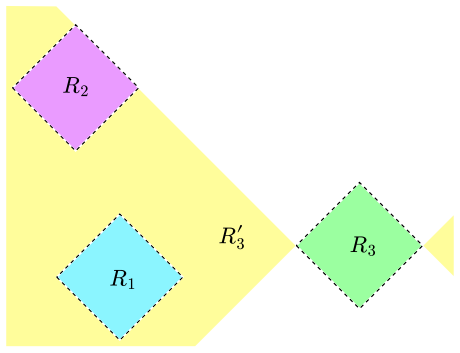
- [Fig. 6] The caption says 'The regions R1 and R3 are spatially disjoint,' but the figure labels are not fully legible; please clarify which shaded regions are R1, R2, R3 and their complements.
- [Sec. 6.2] The symbol e+1/2 is used in Eq. (6.16) before it is defined. Please define the 'vertical edge' notation explicitly.
Circularity Check
No significant circularity: the lattice theorems are genuine conditional derivations; the only self-citation is minor and non-load-bearing.
full rationale
The paper's central claim is explicitly a proposal, not a derivation from assumed conclusions. The main positive evidence is the lattice theorem in Secs. 3.2–3.3 and App. B, which derives Haag duality and disjoint additivity from explicit hypotheses: a compact Lie group S acting faithfully with factorization (3.1), and the non-adjacency conditions (i)–(iii). None of these hypotheses contains disjoint additivity; the proof uses Haar-measure manipulations and von Neumann algebra arguments to establish the factorization identity (3.36), which then yields disjoint additivity. The non-adjacency predicate is admittedly defined so that the proof works ('These are the most general conditions under which we are able to prove disjoint additivity'), but this is a normal conditional theorem, not a definitional circularity. The paper is also explicit that the continuum extrapolation is not proved: 'it does not promise that continuum regions which are spatially disjoint... arise as the continuum limits of non-adjacent regions on the lattice.' That is an acknowledged gap, a correctness risk, not a circular step. The only self-citation by the current authors is [15] in Sec. 4.4 for the Virasoro identity multiplet of rational CFTs; this supports one illustrative violation example, is corroborated for c>=1 by the external result [10], and is not the load-bearing core of the paper's central claim. No fitted data are renamed as predictions. Overall, the derivation chain is self-contained at the lattice level, and the universal continuum claim rests on an unproven bridge rather than on circular reasoning.
Axiom & Free-Parameter Ledger
axioms (8)
- standard math Local algebras are von Neumann algebras satisfying microcausality A(R') ⊆ A(R)' (eq. (2.4)).
- domain assumption The lattice symmetry group S is a faithful, strongly continuous unitary representation of a compact Lie group whose action factorizes between complementary regions: U(s) = U_R(s) ⊗ U_R'(s) (eq. (3.1)).
- domain assumption For non-adjacent regions R1, R2, S is generated by Lie subgroups S1, S2, N with U(S1) ⊆ A(R2)', U(S2) ⊆ A(R1)', S1,S2 commuting, and S1,S2,N generating S (conditions (i)-(iii) in §3.3).
- ad hoc to paper The lattice adjacency rule is short-range: regions whose minimal separation in lattice units goes to infinity with system size are non-adjacent for all but finitely many system sizes (§3.3).
- domain assumption Global symmetries are splittable: for each region R there is a localized symmetry operator U(g,R) acting like the global symmetry on R and as the identity on R' (§4.3).
- ad hoc to paper Haag duality and disjoint additivity are the correct axioms of locality: every local quantum system obeys both (Sec 1 proposal).
- domain assumption The [10] result that additivity plus Haag duality implies modular invariance in 2D CFT extends to disjoint additivity (§4.4, footnote 21).
- domain assumption The timelike tube theorem: the algebra of operators in a full hypersurface equals all of B(H) (§4.1).
Cite this review
Pith. "Pith review of Disjoint additivity and local quantum physics." pith.science (2026). https://pith.science/paper/RMXKBWYR
@misc{pith2026250903589,
  author       = {Pith},
  title        = {Pith review of: Disjoint additivity and local quantum physics},
  year         = {2026},
  howpublished = {\url{https://pith.science/paper/RMXKBWYR}},
  note         = {Machine review of arXiv:2509.03589}
}
read the original abstract
Quantum systems of physical interest are often local, but there are at least three competing perspectives on how "locality" should be formalized: an algebraic framework, a path-integral framework, and a lattice framework. One puzzle in this competition is that systems with higher-form symmetries, which are perfectly local from the path-integral and lattice perspectives, can violate the algebraic principle of "additivity". In this paper, we propose a resolution to this puzzle by introducing a weaker locality principle, "disjoint additivity", which together with Haag duality should always be satisfied in local quantum systems. As evidence, we give examples in which disjoint additivity is preserved when ordinary additivity is violated; we show that Haag duality and disjoint additivity are satisfied in rather general lattice systems with local symmetry constraints; we give examples of nonlocal theories in which either disjoint additivity or Haag duality is violated; and finally we give examples of systems with nonlocal symmetry constraints in which disjoint additivity is violated, but can be restored by passing to a local "SymTFT" system in one higher dimension.
Figures




Forward citations
Cited by 6 Pith papers
-
Algebraic locality and non-invertible Gauss laws
For non-invertible on-site symmetries on 2+1D lattices, Haag duality is preserved exactly only for cuspless regions (weak form with collar for cusped regions); disjoint additivity holds for group-based double models a...
-
Algebraic locality and non-invertible Gauss laws
Non-invertible Gauss laws on lattices preserve Haag duality exactly only on cuspless regions; cusped regions require a collar, and group double models satisfy disjoint additivity.
-
Wormholes as red herrings: reflection positivity and the reconstruction of unitary quantum field theories
Unitary QFTs are determined up to unitary isomorphism by closed-manifold partition functions; every reflection-positive partition function comes from a unitary QFT, so spatial wormholes do not break Hilbert-space fact...
-
Comments on Symmetry Operators, Asymptotic Charges and Soft Theorems
1-form symmetries in the QED soft sector generate asymptotic charges whose central extension implies soft photon theorems and fixes a two-soft-photon contact term.
-
Tori, Klein Bottles, and Modulo 8 Parity/Time-reversal Anomalies of 2+1d Staggered Fermions
Staggered fermions in 2+1d show modulo 8 parity/time-reversal anomalies that match between lattice and continuum when placed on tori and Klein bottles via a nontrivial symmetry map.
-
Global symmetries: locality, unitarity, and regularity
Authors introduce an observable measuring non-locality properties of symmetry operators that encodes fusion algebra information for a class of examples in QFT.
Reference graph
Works this paper leans on
-
[1]
R. F. Streater and A. S. Wightman, PCT, spin and statistics, and all that, vol. 30. Princeton University Press, 2000
2000
-
[2]
Haag and D
R. Haag and D. Kastler, An Algebraic approach to quantum field theory , J. Math. Phys. 5 (1964) 848–861
1964
-
[3]
J. L. Cardy, Operator Content of Two-Dimensional Conformally Invariant Theories , Nucl. Phys. B 270 (1986) 186–204
1986
-
[4]
G. W. Moore and N. Seiberg, Polynomial Equations for Rational Conformal Field Theories, Phys. Lett. B 212 (1988) 451–460
1988
-
[5]
G. W. Moore and N. Seiberg, Classical and Quantum Conformal Field Theory , Commun. Math. Phys. 123 (1989) 177
1989
-
[6]
G. B. Segal, The definition of conformal field theory , in Differential geometrical methods in theoretical physics, pp. 165–171. Springer, 1988
1988
-
[7]
Atiyah, Topological quantum field theories, Inst
M. Atiyah, Topological quantum field theories, Inst. Hautes Etudes Sci. Publ. Math. 68 (1989) 175–186
1989
-
[8]
Lurie, On the Classification of Topological Field Theories , arXiv:0905.0465
J. Lurie, On the Classification of Topological Field Theories , arXiv:0905.0465
-
[9]
Haag, Local Quantum Physics
R. Haag, Local Quantum Physics. Theoretical and Mathematical Physics. Springer, Berlin, 1996
1996
-
[10]
V. Benedetti, H. Casini, Y. Kawahigashi, R. Longo, and J. M. Magan, Modular invariance as completeness, Phys. Rev. D 110 (2024), no. 12 125004, [ arXiv:2408.04011]
Pith/arXiv arXiv 2024
-
[11]
Y. Kawahigashi, R. Longo, and M. Muger, Multiinterval subfactors and modularity of representations in conformal field theory , Commun. Math. Phys. 219 (2001) 631–669, [math/9903104]
Pith/arXiv arXiv 2001
-
[12]
Rehren, Locality and modular invariance in 2-D conformal QFT , Fields Inst
K.-H. Rehren, Locality and modular invariance in 2-D conformal QFT , Fields Inst. Commun. 30 (2001) 341–354, [ math-ph/0009004]
Pith/arXiv arXiv 2001
-
[13]
H. Casini, M. Huerta, J. M. Mag´ an, and D. Pontello, Entanglement entropy and superselection sectors. Part I. Global symmetries , JHEP 02 (2020) 014, [arXiv:1905.10487]
Pith/arXiv arXiv 2020
-
[14]
H. Casini, M. Huerta, J. M. Magan, and D. Pontello, Entropic order parameters for the phases of QFT , JHEP 04 (2021) 277, [ arXiv:2008.11748]. 53
Pith/arXiv arXiv 2021
-
[16]
H. Casini, J. M. Magan, and P. J. Martinez, Entropic order parameters in weakly coupled gauge theories, JHEP 01 (2022) 079, [ arXiv:2110.02980]
Pith/arXiv arXiv 2022
-
[17]
H. Casini and J. M. Magan, On completeness and generalized symmetries in quantum field theory, Mod. Phys. Lett. A 36 (2021), no. 36 2130025, [ arXiv:2110.11358]
Pith/arXiv arXiv 2021
-
[18]
D. Gaiotto, A. Kapustin, N. Seiberg, and B. Willett, Generalized Global Symmetries, JHEP 02 (2015) 172, [ arXiv:1412.5148]
Pith/arXiv arXiv 2015
-
[19]
McGreevy, Generalized Symmetries in Condensed Matter , Ann
J. McGreevy, Generalized Symmetries in Condensed Matter , Ann. Rev. Condensed Matter Phys. 14 (2023) 57–82, [ arXiv:2204.03045]
Pith/arXiv arXiv 2023
-
[20]
Cordova, T
C. Cordova, T. T. Dumitrescu, K. Intriligator, and S.-H. Shao, Snowmass White Paper: Generalized Symmetries in Quantum Field Theory and Beyond , in Snowmass 2021, 5,
2021
-
[21]
Schafer-Nameki, ICTP lectures on (non-)invertible generalized symmetries , Phys
S. Schafer-Nameki, ICTP lectures on (non-)invertible generalized symmetries , Phys. Rept. 1063 (2024) 1–55, [ arXiv:2305.18296]
Pith/arXiv arXiv 2024
-
[22]
T. D. Brennan and S. Hong, Introduction to Generalized Global Symmetries in QFT and Particle Physics , arXiv:2306.00912
-
[23]
L. Bhardwaj, L. E. Bottini, L. Fraser-Taliente, L. Gladden, D. S. W. Gould, A. Platschorre, and H. Tillim, Lectures on generalized symmetries, Phys. Rept. 1051 (2024) 1–87, [ arXiv:2307.07547]
Pith/arXiv arXiv 2024
-
[24]
Shao, What’s Done Cannot Be Undone: TASI Lectures on Non-Invertible Symmetries, arXiv:2308.00747
S.-H. Shao, What’s Done Cannot Be Undone: TASI Lectures on Non-Invertible Symmetries, arXiv:2308.00747
-
[25]
O. Aharony, N. Seiberg, and Y. Tachikawa, Reading between the lines of four-dimensional gauge theories, JHEP 08 (2013) 115, [ arXiv:1305.0318]
Pith/arXiv arXiv 2013
-
[26]
D. Harlow and H. Ooguri, Symmetries in quantum field theory and quantum gravity , Commun. Math. Phys. 383 (2021), no. 3 1669–1804, [ arXiv:1810.05338]
Pith/arXiv arXiv 2021
-
[27]
R. Bousso and G. Penington, Entanglement wedges for gravitating regions , Phys. Rev. D 107 (2023), no. 8 086002, [ arXiv:2208.04993]
Pith/arXiv arXiv 2023
-
[28]
E. Witten, APS Medal for Exceptional Achievement in Research: Invited article on entanglement properties of quantum field theory , Rev. Mod. Phys. 90 (2018), no. 4 045003, [arXiv:1803.04993]
Pith/arXiv arXiv 2018
-
[29]
Sorce, Notes on the type classification of von Neumann algebras , Rev
J. Sorce, Notes on the type classification of von Neumann algebras , Rev. Math. Phys. 36 (2024), no. 02 2430002, [ arXiv:2302.01958]
arXiv 2024
-
[30]
H. Casini, M. Huerta, and J. A. Rosabal, Remarks on entanglement entropy for gauge fields, Phys. Rev. D 89 (2014), no. 8 085012, [ arXiv:1312.1183]
Pith/arXiv arXiv 2014
-
[31]
S.-H. Shao, J. Sorce, and M. Srivastava, Additivity, Haag duality, and non-invertible symmetries, arXiv:2503.20863
-
[32]
T. Rudelius and S.-H. Shao, Topological Operators and Completeness of Spectrum in Discrete Gauge Theories , JHEP 12 (2020) 172, [ arXiv:2006.10052]. 54
Pith/arXiv arXiv 2020
-
[33]
B. Heidenreich, J. McNamara, M. Montero, M. Reece, T. Rudelius, and I. Valenzuela, Non-invertible global symmetries and completeness of the spectrum , JHEP 09 (2021) 203, [arXiv:2104.07036]
Pith/arXiv arXiv 2021
-
[34]
A. Y. Kitaev, Fault tolerant quantum computation by anyons , Annals Phys. 303 (2003) 2–30, [quant-ph/9707021]
Pith/arXiv arXiv 2003
-
[35]
Seiberg, Field Theories With a Vector Global Symmetry , SciPost Phys
N. Seiberg, Field Theories With a Vector Global Symmetry , SciPost Phys. 8 (2020), no. 4 050, [arXiv:1909.10544]
Pith/arXiv arXiv 2020
-
[36]
M. Qi, L. Radzihovsky, and M. Hermele, Fracton phases via exotic higher-form symmetry-breaking, Annals Phys. 424 (2021) 168360, [ arXiv:2010.02254]
Pith/arXiv arXiv 2021
-
[37]
Y.-T. Oh, S. D. Pace, J. H. Han, Y. You, and H.-Y. Lee, Aspects of ZN rank-2 gauge theory in (2+1) dimensions: Construction schemes, holonomies, and sublattice one-form symmetries, Phys. Rev. B 107 (2023), no. 15 155151, [ arXiv:2301.04706]
Pith/arXiv arXiv 2023
-
[38]
Y. Choi, Y. Sanghavi, S.-H. Shao, and Y. Zheng, Non-invertible and higher-form symmetries in 2+1d lattice gauge theories , SciPost Phys. 18 (2025) 008, [arXiv:2405.13105]
Pith/arXiv arXiv 2025
-
[39]
P. Gorantla, S.-H. Shao, and N. Tantivasadakarn, Tensor networks for non-invertible symmetries in 3+1d and beyond , arXiv:2406.12978
-
[40]
Haag duality and the distal split property for cones in the toric code
P. Naaijkens, Haag duality and the distal split property for cones in the toric code , Lett. Math. Phys. 101 (2012) 341–354, [ arXiv:1106.4171]
work page internal anchor Pith review Pith/arXiv arXiv 2012
-
[41]
Haag duality for Kitaev's quantum double model for abelian groups
L. Fiedler and P. Naaijkens, Haag duality for Kitaev’s quantum double model for abelian groups, Rev. Math. Phys. 27 (2015), no. 09 1550021, [ arXiv:1406.1084]
work page internal anchor Pith review Pith/arXiv arXiv 2015
-
[42]
Kitaev's quantum double model from a local quantum physics point of view
P. Naaijkens, Kitaev’s quantum double model from a local quantum physics point of view , in Advances in Algebraic Quantum Field Theory, pp. 365–395, 8, 2015. arXiv:1508.07170
work page internal anchor Pith review Pith/arXiv arXiv 2015
-
[43]
Y. Ogata, A derivation of braided C*-tensor categories from gapped ground states satisfying the approximate Haag duality , J. Math. Phys. 63 (2022), no. 1 011902, [arXiv:2106.15741]
Pith/arXiv arXiv 2022
-
[44]
C. Jones, DHR bimodules of quasi-local algebras and symmetric quantum cellular automata, arXiv:2304.00068
-
[45]
C. Jones, P. Naaijkens, D. Penneys, and D. Wallick, Local topological order and boundary algebras, arXiv:2307.12552
-
[46]
D. V. Else and C. Nayak, Classifying symmetry-protected topological phases through the anomalous action of the symmetry on the edge , Phys. Rev. B 90 (2014), no. 23 235137, [arXiv:1409.5436]
Pith/arXiv arXiv 2014
-
[47]
J. B. Kogut and L. Susskind, Hamiltonian Formulation of Wilson ’s Lattice Gauge Theories, Phys. Rev. D 11 (1975) 395–408
1975
-
[48]
Banks, L
T. Banks, L. Susskind, and J. B. Kogut, Strong Coupling Calculations of Lattice Gauge Theories: (1+1)-Dimensional Exercises , Phys. Rev. D 13 (1976) 1043
1976
-
[49]
Dixmier, von Neumann algebras, vol
J. Dixmier, von Neumann algebras, vol. 27. Elsevier, 2011
2011
-
[50]
Borchers, ¨Uber die Vollst¨ andigkeit lorentzinvarianter Felder in einer zeitartigen R¨ ohre, Il Nuovo Cimento (1955-1965) 19 (1961) 787–793
H. Borchers, ¨Uber die Vollst¨ andigkeit lorentzinvarianter Felder in einer zeitartigen R¨ ohre, Il Nuovo Cimento (1955-1965) 19 (1961) 787–793. 55
1955
-
[51]
A. Strohmaier and E. Witten, The Timelike Tube Theorem in Curved Spacetime , Commun. Math. Phys. 405 (2024), no. 7 153, [ arXiv:2303.16380]
Pith/arXiv arXiv 2024
-
[52]
S. Leutheusser and H. Liu, Superadditivity in large N field theories and performance of quantum tasks , Phys. Rev. D 112 (2025), no. 4 046001, [ arXiv:2411.04183]
Pith/arXiv arXiv 2025
-
[53]
W. R. Kelly, Bulk Locality and Entanglement Swapping in AdS/CFT , JHEP 03 (2017) 153, [arXiv:1610.00669]
work page internal anchor Pith review Pith/arXiv arXiv 2017
-
[54]
Faulkner, The holographic map as a conditional expectation , arXiv:2008.04810
T. Faulkner, The holographic map as a conditional expectation , arXiv:2008.04810
Pith/arXiv arXiv 2008
-
[55]
S. A. W. Leutheusser and H. Liu, Emergent Times in Holographic Duality , Phys. Rev. D 108 (2023), no. 8 086020, [ arXiv:2112.12156]
Pith/arXiv arXiv 2023
-
[56]
S. Leutheusser and H. Liu, Subregion-subalgebra duality: Emergence of space and time in holography, Phys. Rev. D 111 (2025), no. 6 066021, [ arXiv:2212.13266]
Pith/arXiv arXiv 2025
-
[57]
Symmetry, Symmetry Topological Field Theory and von Neumann Algebra
Q. Jia and J. Tian, Symmetry, Symmetry Topological Field Theory and von Neumann Algebra, arXiv:2507.17103
work page internal anchor Pith review Pith/arXiv arXiv
-
[58]
W. Ji and X.-G. Wen, Categorical symmetry and noninvertible anomaly in symmetry-breaking and topological phase transitions , Phys. Rev. Res. 2 (2020), no. 3 033417, [arXiv:1912.13492]
Pith/arXiv arXiv 2020
-
[59]
L. Kong, T. Lan, X.-G. Wen, Z.-H. Zhang, and H. Zheng, Algebraic higher symmetry and categorical symmetry – a holographic and entanglement view of symmetry , Phys. Rev. Res. 2 (2020), no. 4 043086, [ arXiv:2005.14178]
Pith/arXiv arXiv 2020
-
[60]
W. Ji and X.-G. Wen, A unified view on symmetry, anomalous symmetry and non-invertible gravitational anomaly , arXiv:2106.02069
-
[61]
A. Chatterjee and X.-G. Wen, Symmetry as a shadow of topological order and a derivation of topological holographic principle, Phys. Rev. B 107 (2023), no. 15 155136, [arXiv:2203.03596]
Pith/arXiv arXiv 2023
-
[62]
S. Liu and W. Ji, Towards non-invertible anomalies from generalized Ising models , SciPost Phys. 15 (2023), no. 4 150, [ arXiv:2208.09101]
Pith/arXiv arXiv 2023
-
[63]
A. Chatterjee, W. Ji, and X.-G. Wen, Emergent generalized symmetry and maximal symmetry-topological-order, arXiv:2212.14432
-
[64]
K. Inamura and X.-G. Wen, 2+1D symmetry-topological-order from local symmetric operators in 1+1D , arXiv:2310.05790
- [65]
-
[66]
Buchholz and E
D. Buchholz and E. H. Wichmann, Causal Independence and the Energy Level Density of States in Local Quantum Field Theory , Commun. Math. Phys. 106 (1986) 321
1986
-
[67]
Buchholz, K
D. Buchholz, K. Fredenhagen, and C. D’Antoni, The Universal Structure of Local Algebras , Commun. Math. Phys. 111 (1987) 123
1987
-
[68]
Buchholz, S
D. Buchholz, S. Doplicher, and R. Longo, On Noether’s Theorem in Quantum Field Theory, Annals Phys. 170 (1986) 1
1986
-
[69]
E. P. Verlinde, Fusion Rules and Modular Transformations in 2D Conformal Field Theory , Nucl. Phys. B 300 (1988) 360–376. 56
1988
-
[70]
V. B. Petkova and J. B. Zuber, Generalized twisted partition functions , Phys. Lett. B 504 (2001) 157–164, [ hep-th/0011021]
Pith/arXiv arXiv 2001
-
[71]
C.-M. Chang, Y.-H. Lin, S.-H. Shao, Y. Wang, and X. Yin, Topological Defect Lines and Renormalization Group Flows in Two Dimensions , JHEP 01 (2019) 026, [arXiv:1802.04445]
Pith/arXiv arXiv 2019
-
[72]
M. Oshikawa and I. Affleck, Boundary conformal field theory approach to the critical two-dimensional Ising model with a defect line , Nucl. Phys. B 495 (1997) 533–582, [cond-mat/9612187]
Pith/arXiv arXiv 1997
-
[73]
J. Frohlich, J. Fuchs, I. Runkel, and C. Schweigert, Kramers-Wannier duality from conformal defects, Phys. Rev. Lett. 93 (2004) 070601, [ cond-mat/0404051]
Pith/arXiv arXiv 2004
-
[74]
Y.-H. Lin and S.-H. Shao, Anomalies and Bounds on Charged Operators , Phys. Rev. D 100 (2019), no. 2 025013, [ arXiv:1904.04833]
Pith/arXiv arXiv 2019
-
[75]
R. Thorngren and Y. Wang, Fusion category symmetry. Part II. Categoriosities at c = 1 and beyond, JHEP 07 (2024) 051, [ arXiv:2106.12577]
Pith/arXiv arXiv 2024
-
[76]
M. Cheng and N. Seiberg, Lieb-Schultz-Mattis, Luttinger, and ’t Hooft - anomaly matching in lattice systems , SciPost Phys. 15 (2023), no. 2 051, [ arXiv:2211.12543]
Pith/arXiv arXiv 2023
-
[77]
S. D. Pace, A. Chatterjee, and S.-H. Shao, Lattice T-duality from non-invertible symmetries in quantum spin chains , SciPost Phys. 18 (2025), no. 4 121, [ arXiv:2412.18606]
Pith/arXiv arXiv 2025
-
[78]
Kitaev, Unpaired Majorana fermions in quantum wires , Phys
A. Kitaev, Unpaired Majorana fermions in quantum wires , Phys. Usp. 44 (2001), no. 10S 131–136, [cond-mat/0010440]
Pith/arXiv arXiv 2001
-
[79]
J. Lee and F. Wilczek, Algebra of Majorana Doubling , Phys. Rev. Lett. 111 (2013), no. 22 226402, [arXiv:1307.3245]
work page internal anchor Pith review Pith/arXiv arXiv 2013
-
[80]
D. Stanford and E. Witten, JT gravity and the ensembles of random matrix theory , Adv. Theor. Math. Phys. 24 (2020), no. 6 1475–1680, [ arXiv:1907.03363]
Pith/arXiv arXiv 2020
-
[81]
D. Delmastro, D. Gaiotto, and J. Gomis, Global anomalies on the Hilbert space , JHEP 11 (2021) 142, [ arXiv:2101.02218]
Pith/arXiv arXiv 2021
discussion (0)
Sign in with ORCID, Apple, or X to comment. Anyone can read and Pith papers without signing in.