Floquet-induced anisotropic magnetoresistance and anomalous Hall effect in 2D d-wave altermagnets with Rashba spin-orbit coupling
Pith reviewed 2026-06-26 13:47 UTC · model grok-4.3
The pith
Periodic light driving induces out-of-plane magnetization and forbidden transport effects in 2D d-wave altermagnets with Rashba coupling.
A machine-rendered reading of the paper's core claim, the machinery that carries it, and where it could break.
Core claim
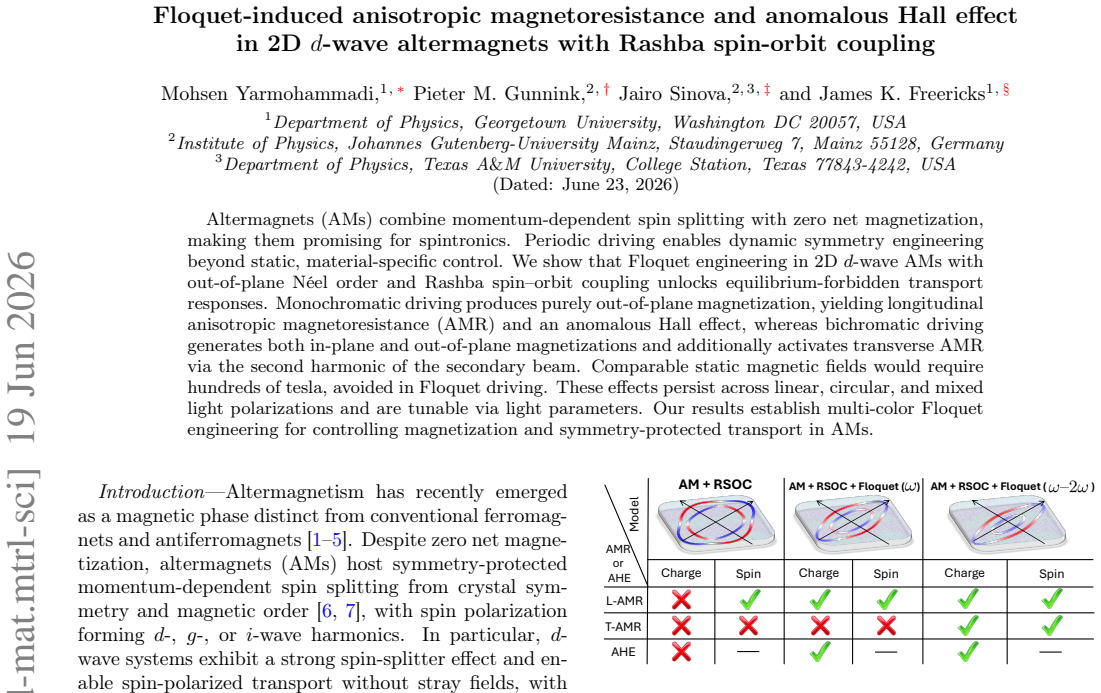
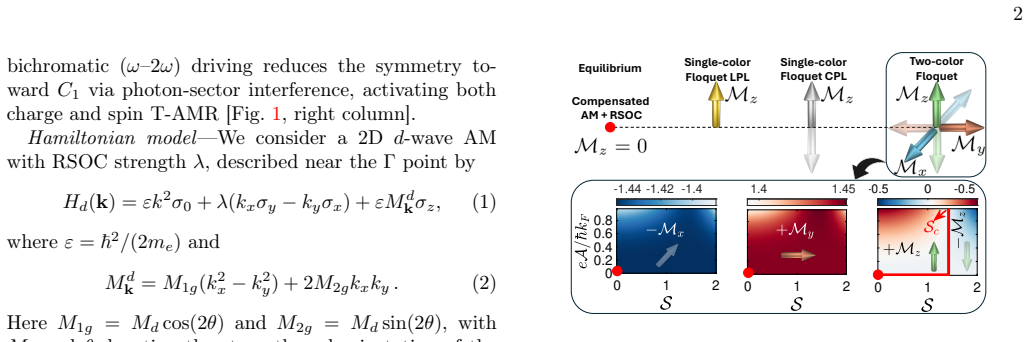
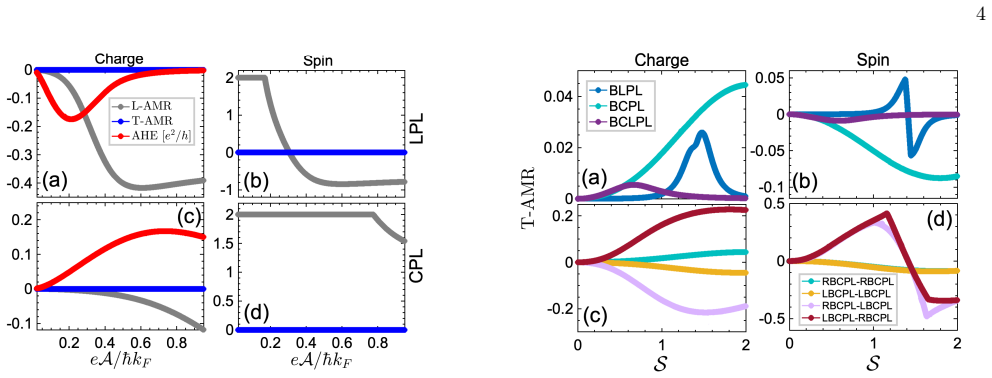
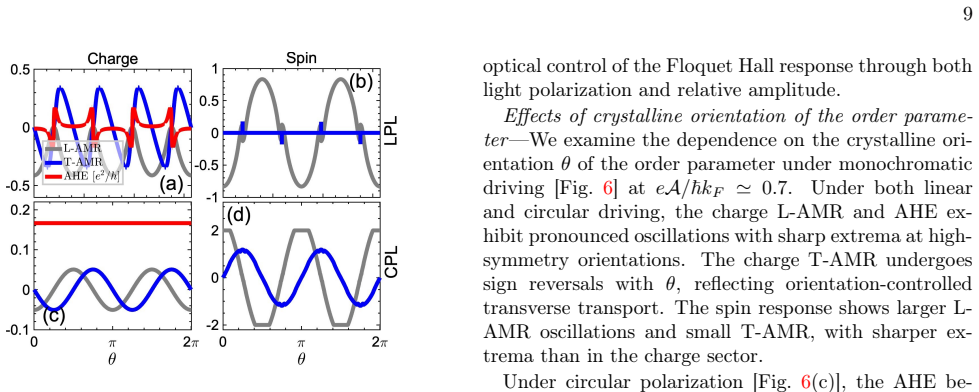
Monochromatic driving produces purely out-of-plane magnetization, yielding longitudinal anisotropic magnetoresistance (AMR) and an anomalous Hall effect, whereas bichromatic driving generates both in-plane and out-of-plane magnetizations and additionally activates transverse AMR via the second harmonic of the secondary beam.
What carries the argument
The Floquet formalism applied to the time-periodic Hamiltonian of the 2D d-wave altermagnet with out-of-plane Néel order and Rashba spin-orbit coupling, which generates the effective magnetizations responsible for the transport responses.
If this is right
- The induced transport responses are tunable by varying light frequency, intensity, and polarization.
- Comparable magnetizations and transport effects in equilibrium would require static magnetic fields of hundreds of tesla.
- The effects appear for linear, circular, and mixed light polarizations.
- Bichromatic driving supplies independent control over in-plane and out-of-plane magnetization components.
Where Pith is reading between the lines
- The same driving protocol could be tested in other altermagnet symmetries or in thin-film heterostructures to induce analogous symmetry-breaking transport.
- Light-controlled versions of these effects might enable ultrafast switching in spintronic devices that avoid permanent magnets.
- Measuring the second-harmonic transverse AMR under bichromatic illumination would provide a direct experimental signature of the multi-color mechanism.
Load-bearing premise
The 2D d-wave altermagnet model with out-of-plane Néel order and Rashba spin-orbit coupling remains valid under the applied periodic driving, and the Floquet formalism accurately captures the induced magnetizations and resulting transport without higher-order or non-perturbative corrections.
What would settle it
An experiment in which monochromatic or bichromatic driving produces no measurable out-of-plane magnetization, no longitudinal AMR or anomalous Hall effect, and no transverse AMR under bichromatic conditions, or in which the required light intensities exceed the regime where the Floquet description holds.
Figures
read the original abstract
Altermagnets (AMs) combine momentum-dependent spin splitting with zero net magnetization, making them promising for spintronics. Periodic driving enables dynamic symmetry engineering beyond static, material-specific control. We show that Floquet engineering in 2D $d$-wave AMs with out-of-plane N\'eel order and Rashba spin-orbit coupling unlocks equilibrium-forbidden transport responses. Monochromatic driving produces purely out-of-plane magnetization, yielding longitudinal anisotropic magnetoresistance (AMR) and an anomalous Hall effect, whereas bichromatic driving generates both in-plane and out-of-plane magnetizations and additionally activates transverse AMR via the second harmonic of the secondary beam. Comparable static magnetic fields would require hundreds of tesla, avoided in Floquet driving. These effects persist across linear, circular, and mixed light polarizations and are tunable via light parameters. Our results establish multi-color Floquet engineering for controlling magnetization and symmetry-protected transport in AMs.
Editorial analysis
A structured set of objections, weighed in public.
Referee Report
Summary. The manuscript claims that Floquet engineering in 2D d-wave altermagnets with out-of-plane Néel order and Rashba spin-orbit coupling induces equilibrium-forbidden transport responses: monochromatic driving produces purely out-of-plane magnetization yielding longitudinal AMR and AHE, while bichromatic driving generates both in-plane and out-of-plane magnetizations and activates transverse AMR via the second harmonic of the secondary beam. These effects hold across linear, circular, and mixed polarizations, are tunable by light parameters, and avoid the need for hundreds of tesla static fields.
Significance. If the central claims hold, the work demonstrates a practical route to dynamic symmetry engineering in altermagnets via multi-color driving, enabling control of magnetization and transport responses that are symmetry-forbidden at equilibrium. This could be relevant for spintronic applications by providing tunable, light-based alternatives to extreme static magnetic fields.
major comments (1)
- [Model and Floquet Formalism] The weakest assumption—that the 2D d-wave altermagnet model with out-of-plane Néel order and Rashba SOC remains valid under periodic driving and that the Floquet formalism accurately captures induced magnetizations and transport without higher-order or non-perturbative corrections—is load-bearing for all reported effects but receives no explicit bounds or regime-of-validity analysis in the abstract or model description.
minor comments (1)
- [Abstract] The abstract states clear outcomes but provides no derivation details, numerical methods, or error analysis, making it impossible to verify whether the transport calculations support the stated claims.
Simulated Author's Rebuttal
We thank the referee for their review and for identifying the need for an explicit regime-of-validity discussion. We address the single major comment below and will revise the manuscript accordingly.
read point-by-point responses
-
Referee: The weakest assumption—that the 2D d-wave altermagnet model with out-of-plane Néel order and Rashba SOC remains valid under periodic driving and that the Floquet formalism accurately captures induced magnetizations and transport without higher-order or non-perturbative corrections—is load-bearing for all reported effects but receives no explicit bounds or regime-of-validity analysis in the abstract or model description.
Authors: We agree that an explicit discussion of the validity regime is warranted. The Floquet treatment employed is the standard high-frequency Magnus expansion, which requires ħω larger than the electronic bandwidth and driving amplitudes small enough that higher-order corrections remain perturbative. In the revised manuscript we will insert a dedicated paragraph in the Model section that (i) states the high-frequency condition ħω ≫ bandwidth (with our parameters ħω = 3 eV versus ~1 eV bandwidth), (ii) quantifies the perturbative regime via the dimensionless drive strength A·v_F/ω < 0.2, and (iii) estimates that neglected O((bandwidth/ω)^2) and O(A^3) terms are suppressed below 10 % for the intensities considered. These bounds are consistent with prior Floquet studies on 2D Rashba systems and do not alter the reported transport responses. The abstract will remain unchanged as it already summarizes the physical regime implicitly through the cited light parameters. revision: yes
Circularity Check
No significant circularity detected
full rationale
The paper applies standard Floquet formalism to a 2D d-wave altermagnet model with Rashba SOC and out-of-plane Néel order to compute induced magnetizations and transport coefficients under monochromatic and bichromatic driving. The abstract and available description present these as direct numerical or perturbative outcomes of the time-periodic Hamiltonian without any fitted parameters renamed as predictions, self-definitional loops, or load-bearing self-citations that reduce the central claims to inputs by construction. The derivation chain remains self-contained once the model Hamiltonian and Floquet expansion are granted; no quoted equations exhibit the forbidden reductions.
Axiom & Free-Parameter Ledger
axioms (2)
- domain assumption The system is a 2D d-wave altermagnet with out-of-plane Néel order and Rashba spin-orbit coupling
- domain assumption Floquet theory accurately describes the light-induced magnetization and transport in the driven system
Reference graph
Works this paper leans on
-
[1]
Šmejkal, J
L. Šmejkal, J. Sinova, and T. Jungwirth, Beyond conven- tional ferromagnetism and antiferromagnetism: A phase with nonrelativistic spin and crystal rotation symmetry, Phys. Rev. X12, 031042 (2022)
2022
-
[2]
Šmejkal, J
L. Šmejkal, J. Sinova, and T. Jungwirth, Emerging re- search landscape of altermagnetism, Phys. Rev. X12, 040501 (2022)
2022
-
[3]
Mazin (The PRX Editors), Editorial: Altermagnetism—a new punch line of fundamental magnetism, Phys
I. Mazin (The PRX Editors), Editorial: Altermagnetism—a new punch line of fundamental magnetism, Phys. Rev. X12, 040002 (2022)
2022
-
[4]
Hayami, Y
S. Hayami, Y. Yanagi, and H. Kusunose, Momentum- dependent spin splitting by collinear antiferromagnetic ordering, Journal of the Physical Society of Japan88, 123702 (2019)
2019
-
[5]
Šmejkal, A
L. Šmejkal, A. B. Hellenes, R. González-Hernández, J. Sinova, and T. Jungwirth, Giant and tunneling mag- netoresistance in unconventional collinear antiferromag- nets with nonrelativistic spin-momentum coupling, Phys. Rev. X12, 011028 (2022)
2022
-
[6]
Krempaský, L
J. Krempaský, L. Šmejkal, S. W. D’Souza, M. Hajlaoui, G. Springholz, K. Uhlířová, F. Alarab, P. C. Constanti- nou, V. Strocov, D. Usanov,et al., Altermagnetic lifting of Kramers spin degeneracy, Nature626, 517 (2024)
2024
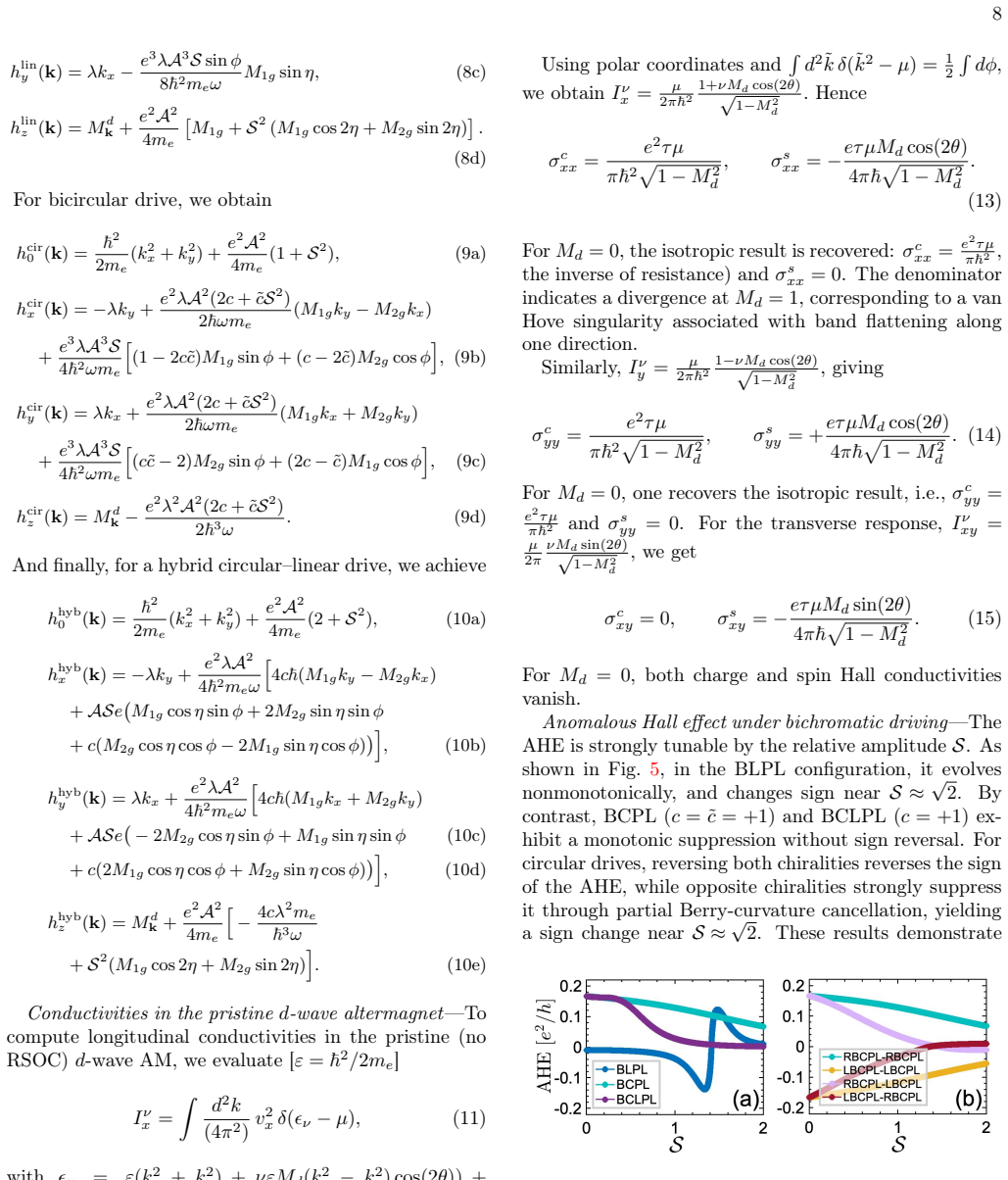
-
[7]
Reimers, L
S. Reimers, L. Odenbreit, L. Šmejkal, V. N. Strocov, P. Constantinou, A. B. Hellenes, R. Jaeschke Ubiergo, W. H. Campos, V. K. Bharadwaj, A. Chakraborty,et al., Direct observation of altermagnetic band splitting in crsb thin films, Nature Communications15, 2116 (2024)
2024
-
[8]
A. Bose, N. J. Schreiber, R. Jain, D.-F. Shao, H. P. Nair, J. Sun, X. S. Zhang, D. A. Muller, E. Y. Tsym- bal, D. G. Schlom,et al., Tilted spin current generated by the collinear antiferromagnet ruthenium dioxide, Na- ture Electronics5, 267 (2022)
2022
-
[9]
H. Bai, L. Han, X. Y. Feng, Y. J. Zhou, R. X. Su, Q. Wang, L. Y. Liao, W. X. Zhu, X. Z. Chen,et al., Observation of spin splitting torque in a collinear anti- ferromagnet RuO2, Phys. Rev. Lett.128, 197202 (2022)
2022
-
[10]
Karube, T
S. Karube, T. Tanaka, D. Sugawara, N. Kadoguchi, M. Kohda, and J. Nitta, Observation of spin-splitter torque in collinear antiferromagnetic RuO2, Phys. Rev. Lett.129, 137201 (2022)
2022
-
[11]
González-Hernández, L
R. González-Hernández, L. Šmejkal, K. Výborný, Y. Ya- hagi, J. Sinova, T. c. v. Jungwirth, and J. Železný, Efficient electrical spin splitter based on nonrelativis- 6 tic collinear antiferromagnetism, Phys. Rev. Lett.126, 127701 (2021)
2021
-
[12]
L. Han, X. Fu, R. Peng, X. Cheng, J. Dai, L. Liu, Y. Li, Y.Zhang, W.Zhu, H.Bai,et al.,Electrical180°switching of Néel vector in spin-splitting antiferromagnet, Science Advances10, eadn0479 (2024)
2024
-
[13]
Chakraborty, R
A. Chakraborty, R. González Hernández, L. Šmejkal, and J. Sinova, Strain-induced phase transition from antiferro- magnettoaltermagnet,Phys.Rev.B109,144421(2024)
2024
-
[14]
C. Song, H. Bai, Z. Zhou, L. Han, H. Reichlova, J. H. Dil, J. Liu, X. Chen, and F. Pan, Altermagnets as a new class of functional materials, Nature Reviews Materials 10, 473 (2025)
2025
-
[15]
T. Jungwirth, J. Sinova, P. Wadley, D. Kriegner, H. Re- ichlova, F. Krizek, H. Ohno, and L. Šmejkal, Altermag- netic spintronics, (2025), arXiv:2508.09748
arXiv 2025
-
[16]
Jiang, M
B. Jiang, M. Hu, J. Bai, Z. Song, C. Mu, G. Qu, W. Li, W. Zhu, H. Pi, Z. Wei,et al., A metallic room- temperatured-wave altermagnet, Nature Physics21, 754 (2025)
2025
-
[17]
P. A. McClarty and J. G. Rau, Landau theory of alter- magnetism, Phys. Rev. Lett.132, 176702 (2024)
2024
-
[18]
M. Naka, S. Hayami, H. Kusunose, Y. Yanagi, Y. Mo- tome, and H. Seo, Spin current generation in organic an- tiferromagnets, Nature Communications10, 4305 (2019)
2019
-
[19]
Zarzuela, R
R. Zarzuela, R. Jaeschke-Ubiergo, O. Gomonay, L. Šme- jkal, and J. Sinova, Transport theory and spin-transfer physics ind-wave altermagnets, Phys. Rev. B111, 064422 (2025)
2025
-
[20]
Žutić, J
I. Žutić, J. Fabian, and S. Das Sarma, Spintronics: Fun- damentals and applications, Rev. Mod. Phys.76, 323 (2004)
2004
-
[21]
Tserkovnyak, A
Y. Tserkovnyak, A. Brataas, G. E. W. Bauer, and B. I. Halperin, Nonlocal magnetization dynamics in ferromag- netic heterostructures, Rev. Mod. Phys.77, 1375 (2005)
2005
-
[22]
Sinova, S
J. Sinova, S. O. Valenzuela, J. Wunderlich, C. H. Back, and T. Jungwirth, Spin Hall effects, Rev. Mod. Phys.87, 1213 (2015)
2015
-
[23]
K. Ando, S. Takahashi, J. Ieda, Y. Kajiwara, H. Nakayama, T. Yoshino, K. Harii, Y. Fujikawa, M. Matsuo, S. Maekawa, and E. Saitoh, Inverse spin- Hall effect induced by spin pumping in metallic system, Journal of Applied Physics109, 103913 (2011)
2011
-
[24]
Kapri, Spin currents in Rashba altermagnets: From equilibrium to nonlinear regimes, Phys
P. Kapri, Spin currents in Rashba altermagnets: From equilibrium to nonlinear regimes, Phys. Rev. B112, 155422 (2025)
2025
-
[25]
M. Darvishi, F. S. Bergeret, and S. Ilić, Exploring the conventional and anomalous Josephson effects at arbi- trary disorder strength in systems with spin-dependent fields, (2026), arXiv:2604.08231
Pith/arXiv arXiv 2026
-
[26]
T. Mizoguchi and S. Ozaki, Orbital-Zeeman cross correlation inp- andd-wave altermagnets, (2026), arXiv:2603.09325
arXiv 2026
-
[27]
A. Fakhredine, G. Cuono, J. Skolimowski, S. Picozzi, and C.Autieri,Interplaybetweenrelativisticspin-momentum locking and breaking of inversion symmetry: conditions forp-wave magnetism, (2026), arXiv:2602.21871
Pith/arXiv arXiv 2026
-
[28]
M. Yarmohammadi, P.-H. Fu, and J. K. Freericks, Effi- cient two-color Floquet control of the RKKY interaction in altermagnets, (2026), arXiv:2602.20862
arXiv 2026
-
[29]
S.Acharjee, A.Dihingia, N.Sonowal,andA.A.Kashyap, Unconventional spin valve effect in altermagnets induced by Rashba spin orbit coupling and triplet superconduc- tivity, (2026), arXiv:2602.20838 [cond-mat.supr-con]
arXiv 2026
-
[30]
Marfoua and J
B. Marfoua and J. Hong, Strain-dependent Rashba effect, and spin Hall conductivity in the altermagnetic Janus V2SeTeO monolayer, Current Applied Physics69, 47 (2025)
2025
-
[31]
K. B. Hallberg, E. W. Hodt, and J. Linder, Visualization of the spin-splitter effect in altermagnets via nonequilib- rium Green’s functions on a lattice, Phys. Rev. B111, 174431 (2025)
2025
-
[32]
N. H. Aase, E. W. Hodt, K. B. Hallberg, A. Sudbø, and J. Linder, Orbital splitter effect and spatial resolution of current-induced orbital accumulation, Phys. Rev. B112, 014409 (2025)
2025
-
[33]
S. Sheoran and P. Dev, Tuning spin currents in collinear antiferromagnets and altermagnets, (2025), arXiv:2512.03654
arXiv 2025
-
[34]
Herasymchuk, K
A. Herasymchuk, K. B. Hallberg, E. W. Hodt, J. Linder, E. V. Gorbar, and P. Sukhachov, Electric and spin cur- rent vortices in altermagnets, Phys. Rev. B112, L220404 (2025)
2025
-
[35]
M. Q. Dong, Z.-X. Guo, and X.-G. Gong, Field-free per- pendicularmagnetizationswitchingbyaltermagnetswith collinear spin current, Phys. Rev. B112, 094447 (2025)
2025
-
[36]
M. Dou, X. Wang, and L. L. Tao, Anisotropic spin- polarized conductivity in collinear altermagnets, Phys. Rev. B111, 224423 (2025)
2025
-
[37]
Wang, K.-Y
Y.-X. Wang, K.-Y. Lyu, and Y.-X. Li, Spin-dependent photon-assisted transport properties in altermagnets, Phys. Rev. B113, 205404 (2026)
2026
-
[38]
Khodas, S
M. Khodas, S. Mu, I. I. Mazin, and K. D. Belashchenko, Tuning of altermagnetism by strain, Phys. Rev. B113, 104422 (2026)
2026
-
[39]
S. Li, Y. Zhang, A. Bahri, X. Zhang, and C. Jia, Alter- magnetism and strain induced altermagnetic transition in Cairo pentagonal monolayer, npj Quantum Materials 10, 83 (2025)
2025
-
[40]
Zhang, M
W. Zhang, M. Zheng, Y. Liu, Z. Zhang, R. Xiong, and Z. Lu, Strain-induced nonrelativistic altermagnetic spin splitting effect, Phys. Rev. B112, 024415 (2025)
2025
-
[41]
W. Zhang, Z. Zhang, R. Xiong, and Z. Lu, Nearly complete charge–spin conversion via strain-eliminated Fermi pockets ind-wave altermagnets, (2026), arXiv:2604.21779
Pith/arXiv arXiv 2026
-
[42]
B. D. Hoi, RKKY interaction in altermagnets with adiabatic electron-phonon coupling, (2026), arXiv:2604.23082
Pith/arXiv arXiv 2026
-
[43]
Yarmohammadi, J
M. Yarmohammadi, J. Linder, and J. K. Freericks, Slow- phonon control of spin Edelstein effect in Rashbad-wave altermagnets, Phys. Rev. B113, 184403 (2026)
2026
-
[44]
Z. Zhang, M. Anas, A. Kutepov, P. Kharel, and V. Antropov, Key role of charge disproportiona- tion in monoclinic semiconducting Fe 2PO5, a room- temperatured-wave altermagnet candidate, (2026), arXiv:2604.06114
Pith/arXiv arXiv 2026
-
[45]
J. Choi and K.-W. Kim, Orbital-driven emergent trans- port in altermagnets, (2026), arXiv:2604.05322
Pith/arXiv arXiv 2026
- [46]
-
[47]
Y. Zhao, B. Xiao, J. Liu, H. Zeng, and J. Zhao, Layer- dependent quantum transport in KV2Se2O-based alter- magnetic tunnel junctions, (2026), arXiv:2604.14817
Pith/arXiv arXiv 2026
- [48]
-
[49]
P. Sharma and N. Mohanta, Double-peak Majo- rana bound states in altermagnet–superconductor het- erostructures, (2026), arXiv:2603.25844
arXiv 2026
-
[50]
C. D. Woodgate, N. Menai, A. Ernst, and J. B. Staunton, Loss of altermagnetic order and smooth restoration of Kramers’ spin degeneracy with increasing temperature in CrSb and MnTe, (2026), arXiv:2603.15035
arXiv 2026
-
[51]
H. Varshney and A. Agarwal, Asymmetric scattering driveslargenonlinearNernstandSeebeckeffects, (2026), arXiv:2601.17775
arXiv 2026
-
[52]
D. Shaffer and A. Levchenko, Theories of superconduct- ing diode effects, (2025), arXiv:2510.25864
arXiv 2025
-
[53]
A. Kundu, RKKY interaction mediated by a spin- polarized 2D electron gas with Rashba and altermagnetic coupling, (2025), arXiv:2509.10778
arXiv 2025
-
[54]
Zhang, L.-H
S.-B. Zhang, L.-H. Hu, Q. Niu, and Z. Zhang, Spin-valley locking and pure spin-triplet superconductivity in non- collinear antiferromagnets proximitized to conventional superconductors, Newton , 100379 (2026)
2026
-
[55]
Sato and T
M. Sato and T. N. Ikeda, Floquet theory and applications in open quantum and classical systems, Journal of the Physical Society of Japan94, 111007 (2025)
2025
-
[56]
Oka and S
T. Oka and S. Kitamura, Floquet engineering of quantum materials, Annual Review of Condensed Matter Physics 10, 387 (2019)
2019
-
[57]
Castro, U
A. Castro, U. De Giovannini, S. A. Sato, H. Hübener, and A. Rubio, Floquet engineering the band structure of materials with optimal control theory, Phys. Rev. Res.4, 033213 (2022)
2022
-
[58]
M. S. Rudner and N. H. Lindner, Band structure engi- neering and non-equilibrium dynamics in Floquet topo- logical insulators, Nature Reviews Physics2, 229 (2020)
2020
-
[59]
U. D. Giovannini and H. Hübener, Floquet analysis of excitations in materials, Journal of Physics: Materials3, 012001 (2019)
2019
-
[60]
Yu, Tunable odd-parity spin splittings in altermag- nets, (2026), arXiv:2605.03026
Y. Yu, Tunable odd-parity spin splittings in altermag- nets, (2026), arXiv:2605.03026
Pith/arXiv arXiv 2026
-
[61]
Yarmohammadi, U
M. Yarmohammadi, U. Zülicke, J. Berakdar, J. Linder, and J. K. Freericks, Anisotropic light-tailored RKKY in- teraction in two-dimensionald-wave altermagnets, Phys. Rev. B111, 224412 (2025)
2025
-
[62]
D. Gill, R. Wu, P. Elliott, S. Sharma, and S. SHallcross, All optical ultrafast pure spin current in the altermagnet Cr2SO, (2026), arXiv:2604.12824
Pith/arXiv arXiv 2026
-
[63]
H.-Z.-X. Chen, L.-D. Yuan, W.-H. Liu, L.-W. Wang, J.- W. Luo, and Z. Wang, A route to nonrelativistic al- termagnetic spin splitting via ultrafast light, (2026), arXiv:2604.02790
Pith/arXiv arXiv 2026
-
[64]
Y. Tian, C.-H. Zhao, C.-B. Wang, B. Zhang, X. Kong, and W.-J. Gong, Optically driven orbital Hall transport in Floquet odd-parity collinear altermagnets with high chern numbers, (2026), arXiv:2603.11483
arXiv 2026
-
[65]
Y. Liu, T. Zhu, and H. Zhang, Linearly polarized light- induced anomalous Hall effect and topological phase transitions in an altermagnetic topological insulator, (2026), arXiv:2603.06486
Pith/arXiv arXiv 2026
-
[66]
Liu, Z.-Y
D. Liu, Z.-Y. Zhuang, D. Zhu, Z. Wu, and Z. Yan, Light- induced odd-parity altermagnets on dimerized lattices, Phys. Rev. B113, L060409 (2026)
2026
-
[67]
L. Yang and L. Liang, Nonlinear opto-magnetic signature ofd-wave altermagnets, (2025), arXiv:2509.08254
arXiv 2025
-
[68]
F. Qin and X.-B. Qiang, Anomalous thermoelectric and thermal Hall effects in irradiated altermagnets, (2026), arXiv:2602.05745
Pith/arXiv arXiv 2026
-
[69]
Li, D.-F
B. Li, D.-F. Shao, and A. A. Kovalev, Floquet spin split- ting and spin generation in antiferromagnets, Phys. Rev. Lett.136, 166701 (2026)
2026
-
[70]
See Supplemental Material at [URL will be inserted by publisher] for providing effective Hamiltonians of 2D d-wave altermagnets with Rashba spin-orbit coupling driven by two-color polarized light fields
-
[71]
Xiao, M.-C
D. Xiao, M.-C. Chang, and Q. Niu, Berry phase effects on electronic properties, Rev. Mod. Phys.82, 1959 (2010)
1959
-
[72]
Nagaosa, J
N. Nagaosa, J. Sinova, S. Onoda, A. H. MacDonald, and N. P. Ong, Anomalous hall effect, Rev. Mod. Phys.82, 1539 (2010)
2010
-
[73]
Ashcroft and N
N. Ashcroft and N. Mermin,Solid State Physics(Holt, Rinehart and Winston, 1976)
1976
-
[74]
Ziman,Electrons and Phonons(Oxford University Press, 1960)
J. Ziman,Electrons and Phonons(Oxford University Press, 1960)
1960
-
[75]
M. Weber, K. Leckron, L. F. Haag, R. Jaeschke-Ubiergo, L. Šmejkal, J. Sinova, and H. C. Schneider, Ultrafast elec- tron dynamics in a planard-wave altermagnet, Newton 1, 10.1016/j.newton.2025.100266 (2025)
-
[76]
Reichlova, R
H. Reichlova, R. Lopes Seeger, R. González-Hernández, I. Kounta, R. Schlitz, D. Kriegner, P. Ritzinger, M. Lam- mel, M. Leiviskä, A. Birk Hellenes,et al., Observation of a spontaneous anomalous Hall response in the Mn5Si3 d-wave altermagnet candidate, Nature Communications 15, 4961 (2024)
2024
-
[77]
J. W. McIver, B. Schulte, F.-U. Stein, T. Matsuyama, G. Jotzu, G. Meier, and A. Cavalleri, Light-induced anomalous Hall effect in graphene, Nature Physics16, 38 (2020)
2020
-
[78]
Stamm, C
C. Stamm, C. Murer, M. Berritta, J. Feng, M. Gabureac, P. M. Oppeneer, and P. Gambardella, Magneto-optical detection of the spin Hall effect in Pt and W thin films, Phys. Rev. Lett.119, 087203 (2017)
2017
-
[79]
M. Yarmohammadi, P. M. Gunnink, J. Sinova, and J. K. Freericks, [Data set], Zenodo https://doi.org/10.5281/zenodo.20758383 (2026). End Matter Effective Floquet Hamiltonian—In the off-resonant regime, following the detailed derivation provided in the SM [70], the effective Hamiltonian retains the form Heff(k) =h pol 0 (k)σ0 +hpol x (k)σx +hpol y (k)σy +hpo...
-
[80]
By contrast, BCPL (c= ˜c= +1) and BCLPL (c= +1) ex- hibit a monotonic suppression without sign reversal. For circular drives, reversing both chiralities reverses the sign of the AHE, while opposite chiralities strongly suppress it through partial Berry-curvature cancellation, yielding a sign change nearS ≈ √
discussion (0)
Sign in with ORCID, Apple, or X to comment. Anyone can read and Pith papers without signing in.