REVIEW 3 major objections 3 minor 1 cited by
A theorem about which 4d fermion anomalies can be canceled by symmetric TQFTs, applied to the Standard Model, forces the family number and color number to be equal to 3.
Reviewed by Pith at T0; open to challenge. T0 means a machine referee read the full paper against a public rubric. the ladder, T0–T4 →
T0 review · deepseek-v4-flash
2026-08-02 13:10 UTC pith:SBXXEZ4L
load-bearing objection The math is better than the physics: the extension trivialization theorems are new and checkable, but "3=3" is selected by a minimality stipulation, not derived from consistency. the 3 major comments →
Fermion Families and Pontryagin Class: Topological Field Theory via Colour Symmetry Extension
The pith
A machine-rendered reading of the paper's core claim, the machinery that carries it, and where it could break.
Core claim
On the paper's own terms, the discovery is a proof pattern. For every odd spacetime dimension d>=3 and every n>=2, the paper constructs an explicit (d-1)-cochain showing that any cocycle alpha_d in H^d(Z_n,U(1)) becomes a coboundary when pulled back through the cyclic extension Z_{n^2}->Z_n, making the associated anomaly cancelable by a symmetric anomalous boundary TQFT with Z_n gauge group. By contrast, the mixed class A_{Z_n}p_1, built from a Z_n-valued 1-cocycle and the first Pontryagin class, survives every finite-group pullback except n=2 and n=3; for n=3 the vanishing of A_{Z_3}p_1 mod 3 makes it harmless. Feeding these two facts into the anomaly index of N_f charge-1 Weyl fermions of
What carries the argument
The load-bearing mechanism is the symmetry extension 1->Z_n->Z_{n^2}->Z_n->1, a cyclic group extension used to trivialize an anomaly by pullback, together with the explicit splitting cochain that writes the pulled-back d-cocycle as a coboundary. The second ingredient is the first Pontryagin class p_1 combined with the generator A_{Z_n} of H^1(Z_n,U(1)): the class A_{Z_n}p_1 is shown to be nontrivial under every finite-group extension unless n=2,3, and for n=3 it vanishes mod 3 by a Steenrod-power argument. The two ingredients together determine which anomalies can be matched by a symmetric gapped TQFT and which cannot.
Load-bearing premise
The argument's load-bearing premise is that the physically correct choice is the one with the smallest nonzero positive N_c and N_f (minimality); nothing in anomaly matching or bordism theory itself rules out the consistent pairs (N_c,N_f)=(4,2),(4,4),(12,6), so the derivation of three families stands only if minimality is accepted as the selection principle.
What would settle it
Look for a finite group extension 1->K->H->Z_n->1 with odd n>3, say n=5, for which the pullback of the class A_{Z_n}p_1 becomes trivial in the Spin x H bordism group. Appendix B claims none exists; exhibiting one, or equivalently constructing a symmetric 4d TQFT with finite gauge group whose anomaly is exactly A_{Z_5}p_1, would falsify the core dichotomy and reopen the classification.
If this is right
- If the theorem is right, the observed three families are not an accident: they are forced by anomaly cancellation plus minimality of the topological response, with color number N_c=3 matching.
- The missing right-handed neutrinos can be replaced by a 4d Z_3-gauge TQFT preserving Spin x Z_3 symmetry, i.e., a gapped topological dark-matter sector.
- Any cocycle anomaly in odd dimension d>=3 of Z_n symmetry can be canceled by a symmetric anomalous boundary TQFT via the Z_{n^2} extension, with explicit cocycles making the construction algorithmic.
- The Pontryagin-class anomaly A_{Z_n}p_1 acts as a selection rule: it confines the allowed minimal color extensions to N_c=3,4,12 depending on divisibility of N_f, and with baryons fermionic only N_c=3 survives.
- The proof shows that no finite group extension can trivialize p_1-related anomalies for n>3, limiting the class of finite-group TQFTs that can cancel such anomalies.
Where Pith is reading between the lines
- A natural testable extension: run the same trivialization search for non-abelian finite groups K, not just Z_N; the paper's no-go argument in Appendix B is stated for finite group extensions generally, but the explicit constructive part in Appendix C only covers the cyclic case.
- If minimality is replaced by another selection principle, such as requiring the smallest number of anyons or the largest preserved symmetry, the allowed pairs (3,3), (4,2), (4,4), (12,6) might reshuffle; this is where the physical input would have to come from.
- The construction suggests a phenomenology: the Z_3-gauge TQFT replacing the right-handed neutrinos would be a strictly gapped, symmetric dark sector with no local operators, which could in principle be probed through its gravitational anomaly index in future lattice or quantum-simulation models of chiral fermions.
Editorial analysis
A structured set of objections, weighed in public.
Referee Report
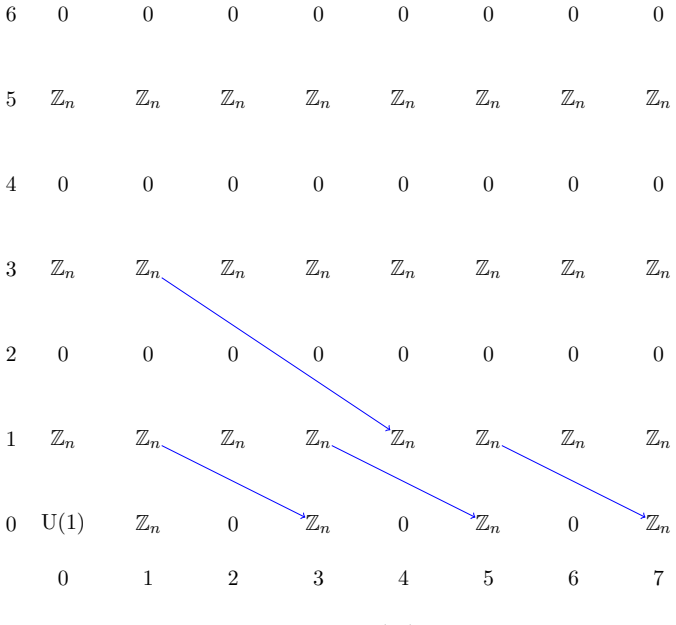
Summary. The paper studies 4d fermionic anomalies with discrete Z_n symmetry, viewed through 5d spin bordism. Its main mathematical results are: (i) any group-cohomology cocycle α_d ∈ H^d(Z_n,U(1)) in odd d ≥ 3 is trivialized by the central extension 1→Z_n→Z_{n^2}→Z_n→1, with an explicit splitting cochain (Apps. A, C) and a bulk-boundary coupled TQFT construction (App. D); (ii) the beyond-group-cohomology class A_{Z_n}p_1 is claimed not to be trivializable by any finite group extension except n=2,3 (App. B); and (iii) A_{Z_3}p_1=0 mod 3 (App. H). These tools are applied to the Standard Model: a Spin×Z_3-symmetric 4d Z_3-gauge TQFT is constructed to cancel the mixed (B+L)-gauge-gravitational anomaly of the SM without the three right-handed neutrinos, and a generalized N_c-color/N_f-family analysis (Theorem 4.1) concludes that N_c=N_f=3 is the unique minimal solution under explicit additional assumptions: minimality of N_f and N_c, and odd N_c (so the baryon is a fermion).
Significance. If the mathematics is correct, the paper makes a useful and partly explicit contribution to the symmetry-extension approach to global anomalies: the cocycle-splitting computations in App. C are concrete, the gauge-invariance check of the coupled boundary TQFT in Sec. 3 and App. D is written out, and the proof of A_{Z_3}p_1=0 mod 3 is a clean Steenrod-power argument. The distinction between group-cohomology classes and A_{Z_n}p_1 classes is a potentially valuable classification input. However, the physical conclusion that N_f=3 is selected is conditional on a stipulated minimality principle; the anomaly constraints alone admit infinitely many consistent pairs such as (3,9), (3,15), (4,2), and (12,6) (Eq. (64)). The paper's value is therefore primarily as a mathematical classification with an explicit selection principle, not as a derivation of N_f=3 from anomaly cancellation alone.
major comments (3)
- [Theorem 1.1(a), Theorem 4.1, Eq. (64)] The uniqueness of (N_c,N_f)=(3,3) is produced by the stipulated minimality of N_f and N_c and by the oddness of N_c, not by anomaly matching or bordism constraints. Equation (64) explicitly lists infinite families, e.g. N_c=3 with N_f=3^r s, r≥1, 2∤s, 3∤s, including (3,9) and (3,15). The theorem is internally consistent, but the abstract's phrase 'unique minimal solution' can be misread as deriving N_f=3 from consistency. The paper should state prominently that minimality is a separate simplicity postulate and discuss possible justifications, or soften the physical claim accordingly.
- [App. B, B.1, B.2] The sweeping claim that A_{Z_n}p_1 'cannot be trivialized by any finite group extension except n=2,3' is not established by the computations shown. The proof examines only specific central extensions: (76), (77), and the Spin→SO cover (79). For G=Spin×Z_n with odd n, extensions 1→Z_m→Spin×Z_{mn}→Spin×Z_n→1 exist for every m; the remark that 'there are no finite covers of Spin' does not rule these out because the finite cover can come from the Z_n factor. Similarly, for even n, kernels larger than Z_2^F are not analyzed. To support the 'any finite group extension' statement, a general argument over all K is needed.
- [Sec. 1.2, Eqs. (13)-(17); App. B] Even for the extensions that are considered, the obstruction is computed in ordinary group cohomology H^*(BH,Z_n), whereas the symmetry-extension trivialization criterion used in the paper is pullback in the spin bordism group, TP_5(G)=(Ω_5^G)_tors (Eqs. (15)-(17)). Nonvanishing of a cohomology class does not automatically imply a nonvanishing bordism invariant; one must show that the class is detected by Ω_5^{Spin}(BH) or give a bordism-level duality argument. If the theorem is only about cohomological trivialization, that should be stated, but then it does not directly imply the physical anomaly-cancellation claim.
minor comments (3)
- [Sec. 3 vs Table (62)] The text near Eq. (38) says beyond-group-cohomology classes 'allow no such symmetric TQFTs', but Table (62) reports that the N_f=2 anomaly, labeled 'BGC Z_8 subclass', is matched by a Z_4-gauge TQFT. This apparent tension needs a clarifying remark: which BGC classes are being excluded, and why the BGC class appearing in Table (62) is not of the A_{Z_n}p_1 type.
- [Theorem 4.1 proof] The proof relies on an external result from Ref. [36] for the 2-power factor (2^p · Z_{2^{p+3}} is trivialized by a Z_4-extension). Since this is load-bearing for the classification, please state the precise lemma and either prove it or reproduce the necessary statement in an appendix.
- [References and typos] Reference [28] is an unresolved placeholder 'arXiv:2xxx.xxxxx'. There are typos such as 'Fellowshop' in the acknowledgments, 'first quality' for 'first equality' in Sec. 2.1, and 'fundamentally different from' in the introduction.
Circularity Check
No significant circularity: the 3-family result is a conditional minimality theorem with independent anomaly computations; the salient assumptions are explicit stipulations, not outputs disguised as inputs.
full rationale
The paper's central claim is Theorem 4.1, a conditional statement: if N_f and N_c are minimal, if the N_f-family anomaly is trivialized by a minimal Z_Nc extension, and if N_c is odd, then N_c=N_f=3. The proof is not a circular reduction: it computes the anomaly index decomposition (65) from independent bordism classifications and perturbative anomaly data, proves in Appendix F that the 3-power factor is trivialized by a Z_3 extension, and then selects the minimum of the surviving branch N_f=3^r s with r>=1 and gcd(s,6)=1. The number 3 emerges as the minimum element of that explicitly derived set, not as a fitted parameter renamed as a prediction. The minimality and oddness conditions in Theorem 1.1 are stated assumptions; they limit the physical interpretation of the 'family puzzle' claim, but a theorem conditional on explicitly stated selection principles is not circular. The only same-author citation that plays a nontrivial role is [36] for the even-2-power branch (N_c=4 or 12), but that branch is not needed for the final odd-branch conclusion N_f=N_c=3, which is proved in the present paper. Thus no load-bearing step reduces by construction to its own input or to an unverified self-citation chain.
Axiom & Free-Parameter Ledger
axioms (8)
- domain assumption Bordism classifications: Ω^{Spin×_{Z_2^F}Z_{2N_f}}_5 ≅ Z_{2^{p+3}}⊕Z_{2^{p-1}}⊕Z_{3^{r+1}}⊕Z_{3^{r-1}}⊕Z_s⊕Z_s for N_f=2^p3^r s; Ω^{Spin×Z_3}_5 ≅ Z_9 (eqs. (36),(37),(60)).
- domain assumption The SM missing all ν_R has B+L-gauge-gravitational anomaly index −N_f + n_νR, with n_νR=0 (Sec. 2).
- ad hoc to paper Minimality of N_f and N_c (Theorem 1.1 condition (a); Sec. 4).
- domain assumption N_c odd so that baryons are fermions (Theorem 1.1 condition (c)).
- domain assumption 2^p·Z_{2^{p+3}} is trivialized by a Z_4-extension (Theorem 4.1 proof, eq. (65)).
- domain assumption Symmetry-extension anomaly-cancellation paradigm (Sec. 1.2): if the pulled-back anomaly class vanishes in G_Tot for 1→K→G_Tot→G→1, a (d−1)d anomalous K-gauge TQFT canceling the G-anomaly exists.
- standard math H^4(BSpin,Z)=Z⟨λ⟩ with p_1=2λ (Appendix B).
- standard math Wu-type identity P^1_3(x) = p_1⌣x and Theorem H.1 (P_q(s_q)=Σb_{q,j}) for odd primes q.
invented entities (1)
-
4d Z_{N_c}-gauge fermionic TQFT ('topologically ordered dark matter') replacing N_f families of ν_R
no independent evidence
read the original abstract
Family puzzle asks why the Standard Model (SM) features exactly 3 families of quarks and leptons. Motivated by topological constraints, we study 4d fermionic anomalies with discrete $Z_n$ symmetry, classified by the 5d spin bordism group. We show that only the group-cohomology subclass H$^5(Z_n,U(1))\cong Z_n$ can be canceled by an anomalous $Z_n$-symmetric 4d $Z_n$-gauge topological quantum field theory (TQFT), while beyond-group-cohomology $A_{Z_n}p_1$ involving the Pontryagin class $p_1$ cannot (except $n=2,3$). More generally, we prove that any cocycle $\alpha_d\in$H$^d(Z_n,U(1))$ in odd spacetime dimension $d\ge3$ is trivialised by the symmetry extension $1\to Z_n\to Z_{n^2}\to Z_n\to 1,$ and we construct the corresponding symmetric anomalous boundary TQFT. For $d=5$ and $n=3$, this yields a Spin$\times Z_3$-symmetric 4d $Z_3$-gauge TQFT that cancels the mixed discrete $(\bf B+L)$-gauge-gravitational anomaly of the SM in the absence of 3 "sterile" right-handed neutrinos $\nu_R$. We analyze a generalized SM with $N_c$ colors and $N_f$ families and argue that missing $N_f$ copies of the $\nu_R$ can be naturally replaced by a 4d anomalous $Spin\times_{Z_2^F}Z_{2 N_f,{\bf B + L}}$ symmetric $Z_N$-gauge TQFT under the anomaly cancellation, via a $Z_N$ symmetry extension construction $1\to Z_N\to Spin\times Z_{NN_f}\to Spin\times_{Z_2^F}Z_{2N_f}\to1$ of anomalous topological order. For minimal nonzero $(N,N_f)$, the allowed minimal extensions are $N=1,3,4,12$, depending on divisibility of $N_f$ by 2 and 3. Combining Witten anomaly and other constraints, we prove that $N=N_c=N_f=3$, with 3 families and 3 colors, is the unique minimal solution to match with the color-center baryon-to-quark symmetry extension $1\to Z_{N_c}\to Spin\times_{Z_2^F}Z_{2N_cN_f,{\bf Q}+N_c{\bf L}}\to Spin\times_{Z_2^F}Z_{2 N_f,{\bf B+L}}^F\to1$. We also prove that $A_{Z_3}p_1=0\mod3$ for the mod 3 cohomology class.
Figures
Forward citations
Cited by 1 Pith paper
-
Bosonic SPT and invertible phases and its relation to Steenrod's problem
Bosonic beyond-cohomology SPT phases are governed by a mod-3 Steenrod-power differential, and a new 6+1-dimensional Z3×Z3 Dijkgraaf-Witten phase is nontrivial on simplicial complexes but trivial on manifolds.
Reference graph
Works this paper leans on
-
[1]
J. Wang, X.-G. Wen and E. Witten,Symmetric Gapped Interfaces of SPT and SET States: Systematic Constructions,Phys. Rev.X8(2018) 031048, [arXiv:1705.06728]
Pith/arXiv arXiv 2018
-
[2]
Harari,Three generations of quarks and leptons, inPresented at 5th Intern
H. Harari,Three generations of quarks and leptons, inPresented at 5th Intern. Conf. on Exptl. Meson Spectry, pp. 29–30, July, 1977. [3]Particle Data Groupcollaboration, S. Navas et al.,Review of particle physics,Phys. Rev. D110 (2024) 030001. [4]OPALcollaboration, G. Abbiendi et al.,Precise determination of the Z resonance parameters at LEP: ’Zedometry’,E...
Pith/arXiv arXiv 1977
-
[7]
Steigman,Neutrinos And Big Bang Nucleosynthesis,Adv
G. Steigman,Neutrinos And Big Bang Nucleosynthesis,Adv. High Energy Phys.2012(2012) 268321, [arXiv:1208.0032]
Pith/arXiv arXiv 2012
-
[8]
B. D. Fields, P. Molaro and S. Sarkar,Big-Bang Nucleosynthesis,Chin. Phys. C38(2014) 339–344, [arXiv:1412.1408]. 36 [9]Planckcollaboration, N. Aghanim et al.,Planck 2018 results. VI. Cosmological parameters,Astron. Astrophys.641(2020) A6, [arXiv:1807.06209]
Pith/arXiv arXiv 2014
-
[10]
I. Garcia-Etxebarria and M. Montero,Dai-Freed anomalies in particle physics,JHEP08(2019) 003, [arXiv:1808.00009]
Pith/arXiv arXiv 2019
-
[11]
J. Wang,Family Puzzle, Framing Topology,c − = 24and 3(E8) 1 Conformal Field Theories: 48/16 = 45/15 = 24/8 =3,arXiv:2312.14928
-
[12]
Wang,Topological Quantum Dark Matter via Global Anomaly Cancellation,arXiv:2502.21319
J. Wang,Topological Quantum Dark Matter via Global Anomaly Cancellation,arXiv:2502.21319
-
[13]
Wen,Zoo of quantum-topological phases of matter,Rev
X.-G. Wen,Zoo of quantum-topological phases of matter,Rev. Mod. Phys.89(2017) 041004, [arXiv:1610.03911]
Pith/arXiv arXiv 2017
-
[14]
P. Di Francesco, P. Mathieu and D. Senechal,Conformal Field Theory. Graduate Texts in Contemporary Physics. Springer-Verlag, New York, 1997, 10.1007/978-1-4612-2256-9
-
[15]
J. W. Milnor and J. D. Stasheff,Characteristic classes. No. 76. Princeton university press, 1974
1974
-
[16]
Hirzebruch,Topological Methods in Algebraic Geometry
F. Hirzebruch,Topological Methods in Algebraic Geometry. Springer, 1966
1966
-
[17]
Pontrjagin,Characteristic cycles of smooth manifolds,Doklady Akademii Nauk SSSR52(1946) 297–300
L. Pontrjagin,Characteristic cycles of smooth manifolds,Doklady Akademii Nauk SSSR52(1946) 297–300
1946
-
[18]
Pontrjagin,Vector fields on manifolds,Matematicheskii Sbornik66(1947) 3–14
L. Pontrjagin,Vector fields on manifolds,Matematicheskii Sbornik66(1947) 3–14
1947
-
[19]
Rokhlin,New results in the theory of four-dimensional manifolds,Doklady Akademii Nauk SSSR84 (1952) 221–224
V. Rokhlin,New results in the theory of four-dimensional manifolds,Doklady Akademii Nauk SSSR84 (1952) 221–224
1952
-
[20]
Witten,Quantum Field Theory and the Jones Polynomial,Commun
E. Witten,Quantum Field Theory and the Jones Polynomial,Commun. Math. Phys.121(1989) 351–399
1989
-
[21]
Atiyah,On framings of 3-manifolds,Topology29(1990) 1–7
M. Atiyah,On framings of 3-manifolds,Topology29(1990) 1–7
1990
-
[22]
J. McNamara and C. Vafa,Cobordism Classes and the Swampland,arXiv:1909.10355
Pith/arXiv arXiv 1909
-
[23]
Koren,A Note on Proton Stability in the Standard Model,Universe8(2022) 308, [arXiv:2204.01741]
S. Koren,A Note on Proton Stability in the Standard Model,Universe8(2022) 308, [arXiv:2204.01741]
Pith/arXiv arXiv 2022
-
[24]
J. Wang, Z. Wan and Y.-Z. You,Proton stability: From the standard model to beyond grand unification, Phys. Rev. D106(2022) 025016, [arXiv:2204.08393]
Pith/arXiv arXiv 2022
-
[25]
Tong,Line Operators in the Standard Model,JHEP07(2017) 104, [arXiv:1705.01853]
D. Tong,Line Operators in the Standard Model,JHEP07(2017) 104, [arXiv:1705.01853]
Pith/arXiv arXiv 2017
-
[26]
B. A. Dobrescu and E. Poppitz,Number of fermion generations derived from anomaly cancellation,Phys. Rev. Lett.87(2001) 031801, [arXiv:hep-ph/0102010]
Pith/arXiv arXiv 2001
-
[27]
J. Davighi and N. Lohitsiri,Omega vs. pi, and 6d anomaly cancellation,JHEP05(2021) 267, [arXiv:2012.11693]
Pith/arXiv arXiv 2021
-
[28]
Z. Wan, J. Wang and et al.,Higher anomalies, higher symmetries, and cobordisms IV: Beyond Standard Models, Grand Unification, and Ultra Unification (202n),arXiv:2xxx.xxxxx
-
[29]
Hsieh,Discrete gauge anomalies revisited,arXiv:1808.02881
C.-T. Hsieh,Discrete gauge anomalies revisited,arXiv:1808.02881
-
[30]
Wan,Anomaly of 4d Weyl fermion with discrete symmetries,arXiv:2506.19710
Z. Wan,Anomaly of 4d Weyl fermion with discrete symmetries,arXiv:2506.19710. 37
-
[31]
M. Guo, K. Ohmori, P. Putrov, Z. Wan and J. Wang,Fermionic Finite-Group Gauge Theories and Interacting Symmetric/Crystalline Orders via Cobordisms,Commun. Math. Phys.376(2020) 1073, [arXiv:1812.11959]
Pith/arXiv arXiv 2020
-
[32]
C. Cordova and K. Ohmori,Anomaly Constraints on Gapped Phases with Discrete Chiral Symmetry, Phys. Rev. D102(2020) 025011, [arXiv:1912.13069]
Pith/arXiv arXiv 2020
- [33]
-
[34]
T. D. D´ ecoppet and M. Yu,The Classification of 3+1d Symmetry Enriched Topological Order, arXiv:2509.10603
- [35]
- [36]
- [37]
-
[38]
D. S. Freed, C. I. Scheimbauer and C. Teleman,Fully local Reshetikhin-Turaev theories,arXiv e-prints (Jan., 2026) arXiv:2601.05518, [arXiv:2601.05518]
Pith/arXiv arXiv 2026
-
[39]
D. S. Freed and C. Teleman,The role of p 1-structures in 3-dimensional Chern-Simons theories, arXiv:2603.11291
-
[40]
C. L. Douglas, C. Schommer-Pries and N. Snyder,Dualizable tensor categories,arXiv:1312.7188
-
[42]
Eguchi and P
T. Eguchi and P. G. O. Freund,Quantum Gravity and World Topology,Phys. Rev. Lett.37(1976) 1251
1976
-
[43]
Alvarez-Gaume and E
L. Alvarez-Gaume and E. Witten,Gravitational Anomalies,Nucl. Phys.B234(1984) 269
1984
-
[44]
Alvarez-Gaume and P
L. Alvarez-Gaume and P. H. Ginsparg,The Structure of Gauge and Gravitational Anomalies,Annals Phys.161(1985) 423
1985
-
[45]
P. Putrov and J. Wang,Categorical Symmetry of the Standard Model from Gravitational Anomaly,Phys. Rev. D110(2024) 125028, [arXiv:2302.14862]
Pith/arXiv arXiv 2024
-
[46]
Tomonaga,Mod 3 pontryagin class and indecomposability of differentiable manifolds,Tohoku Mathematical Journal, Second Series16(1964) 252–256
Y. Tomonaga,Mod 3 pontryagin class and indecomposability of differentiable manifolds,Tohoku Mathematical Journal, Second Series16(1964) 252–256
1964
-
[47]
Tomonaga,Some properties of pontryagin classes mod 3,Transactions of the American Mathematical Society117(1965) 37–48
Y. Tomonaga,Some properties of pontryagin classes mod 3,Transactions of the American Mathematical Society117(1965) 37–48
1965
-
[48]
J. Wang,Anomaly and Cobordism Constraints Beyond the Standard Model: Topological Force, arXiv:2006.16996
Pith/arXiv arXiv 2006
-
[49]
Wang,Anomaly and Cobordism Constraints Beyond Grand Unification: Energy Hierarchy, arXiv:2008.06499
J. Wang,Anomaly and Cobordism Constraints Beyond Grand Unification: Energy Hierarchy, arXiv:2008.06499. 38
Pith/arXiv arXiv 2008
-
[50]
J. Wang,Ultra Unification,Phys. Rev. D103(2021) 105024, [arXiv:2012.15860]
Pith/arXiv arXiv 2021
-
[51]
J. Wang, Z. Wan and Y.-Z. You,Cobordism and deformation class of the standard model,Phys. Rev. D 106(2022) L041701, [arXiv:2112.14765]
Pith/arXiv arXiv 2022
-
[52]
Wang,Topological leptogenesis,Phys
J. Wang,Topological leptogenesis,Phys. Rev. Res.8(2026) L022024, [arXiv:2501.00607]
Pith/arXiv arXiv 2026
-
[53]
S. L. Adler,Axial vector vertex in spinor electrodynamics,Phys. Rev.177(1969) 2426–2438
1969
-
[54]
J. S. Bell and R. Jackiw,A PCAC puzzle:π 0 →γγin theσmodel,Nuovo Cim.A60(1969) 47–61
1969
-
[55]
Belavin, A
A. Belavin, A. M. Polyakov, A. Schwartz and Y. Tyupkin,Pseudoparticle Solutions of the Yang-Mills Equations,Phys. Lett. B59(1975) 85–87
1975
-
[56]
’t Hooft,Symmetry Breaking Through Bell-Jackiw Anomalies,Phys
G. ’t Hooft,Symmetry Breaking Through Bell-Jackiw Anomalies,Phys. Rev. Lett.37(1976) 8–11
1976
-
[57]
Jackiw and C
R. Jackiw and C. Rebbi,Vacuum Periodicity in a Yang-Mills Quantum Theory,Phys. Rev. Lett.37 (1976) 172–175
1976
-
[58]
C. G. Callan, Jr., R. F. Dashen and D. J. Gross,The Structure of the Gauge Theory Vacuum,Phys. Lett. B63(1976) 334–340
1976
-
[59]
A. Kapustin, R. Thorngren, A. Turzillo and Z. Wang,Fermionic Symmetry Protected Topological Phases and Cobordisms,JHEP12(2015) 052, [arXiv:1406.7329]
Pith/arXiv arXiv 2015
-
[60]
D. S. Freed and M. J. Hopkins,Reflection positivity and invertible topological phases,arXiv e-prints (Apr, 2016) arXiv:1604.06527, [arXiv:1604.06527]
Pith/arXiv arXiv 2016
-
[61]
J. C. Wang, Z.-C. Gu and X.-G. Wen,Field theory representation of gauge-gravity symmetry-protected topological invariants, group cohomology and beyond,Phys. Rev. Lett.114(2015) 031601, [arXiv:1405.7689]
Pith/arXiv arXiv 2015
-
[62]
J. Wang, K. Ohmori, P. Putrov, Y. Zheng, Z. Wan, M. Guo et al.,Tunneling Topological Vacua via Extended Operators: (Spin-)TQFT Spectra and Boundary Deconfinement in Various Dimensions,PTEP 2018(2018) 053A01, [arXiv:1801.05416]
Pith/arXiv arXiv 2018
-
[63]
X. Yang and M. Cheng,Gapped boundary of (4+1)d beyond-cohomology bosonic SPT phase,Phys. Rev. B110(2024) 045137, [arXiv:2303.00719]
Pith/arXiv arXiv 2024
-
[64]
T. D. Brennan and K. Intriligator,Anomalies of 4d Spin G theories,JHEP07(2024) 157, [arXiv:2312.04756]
Pith/arXiv arXiv 2024
-
[65]
J. Davighi, B. Gripaios and N. Lohitsiri,Global anomalies in the Standard Model(s) and Beyond,JHEP 07(2020) 232, [arXiv:1910.11277]
Pith/arXiv arXiv 2020
-
[66]
Z. Wan and J. Wang,Beyond Standard Models and Grand Unifications: Anomalies, Topological Terms, and Dynamical Constraints via Cobordisms,JHEP07(2020) 062, [arXiv:1910.14668]
Pith/arXiv arXiv 2020
-
[67]
O. Bar and U. J. Wiese,Can one see the number of colors?,Nucl. Phys. B609(2001) 225–246, [arXiv:hep-ph/0105258]
Pith/arXiv arXiv 2001
-
[68]
Shrock,Implications of anomaly constraints in the N(c) extended standard model,Phys
R. Shrock,Implications of anomaly constraints in the N(c) extended standard model,Phys. Rev. D53 (1996) 6465–6476, [arXiv:hep-ph/9512430]
Pith/arXiv arXiv 1996
-
[69]
Witten,An SU(2) Anomaly,Phys
E. Witten,An SU(2) Anomaly,Phys. Lett.117B(1982) 324–328. 39
1982
-
[70]
M. Montero, C. Vafa and I. Valenzuela,Neutrinos, B-L Symmetry and the Dark Dimension, arXiv:2512.09052
-
[71]
Hatcher,Algebraic topology
A. Hatcher,Algebraic topology. Cambridge University Press, Cambridge, 2002
2002
-
[72]
H.-L. Huang, Z. Wan and Y. Ye,Explicit cocycle formulas on finite abelian groups with applications to braided linear Gr-categories and Dijkgraaf–Witten invariants,Proc. Roy. Soc. Edinburgh A150(2020) 1937–1964, [arXiv:1703.03266]
Pith/arXiv arXiv 2020
-
[73]
On steenrod reduced powers in oriented manifolds
F. Hirzebruch, “On steenrod reduced powers in oriented manifolds.” Princeton University, 1953. 40
1953
discussion (0)
Sign in with ORCID, Apple, or X to comment. Anyone can read and Pith papers without signing in.