REVIEW 4 major objections 4 minor 38 references
The paper identifies the excitation radius of Kerr black hole quasinormal modes with the intersection of the anti-Stokes line and the real axis of the WKB-reduced Teukolsky equation, reproducing r=2.556929M in Schwarzschild and finding spin
Reviewed by Pith at T0; open to challenge. T0 means a machine referee read the full paper against a public rubric. the ladder, T0–T4 →
T0 review · deepseek-v4-flash
2026-08-03 16:57 UTC pith:SLVNVEAS
load-bearing objection Genuinely useful Kerr extension of the QNM excitation-radius story, with honest numerics, but the central identification is a proposal and the near-extremal intersection choice needs more justification. the 4 major comments →
Excitation region of Kerr black hole quasinormal modes from Stokes geometry
The pith
A machine-rendered reading of the paper's core claim, the machinery that carries it, and where it could break.
Core claim
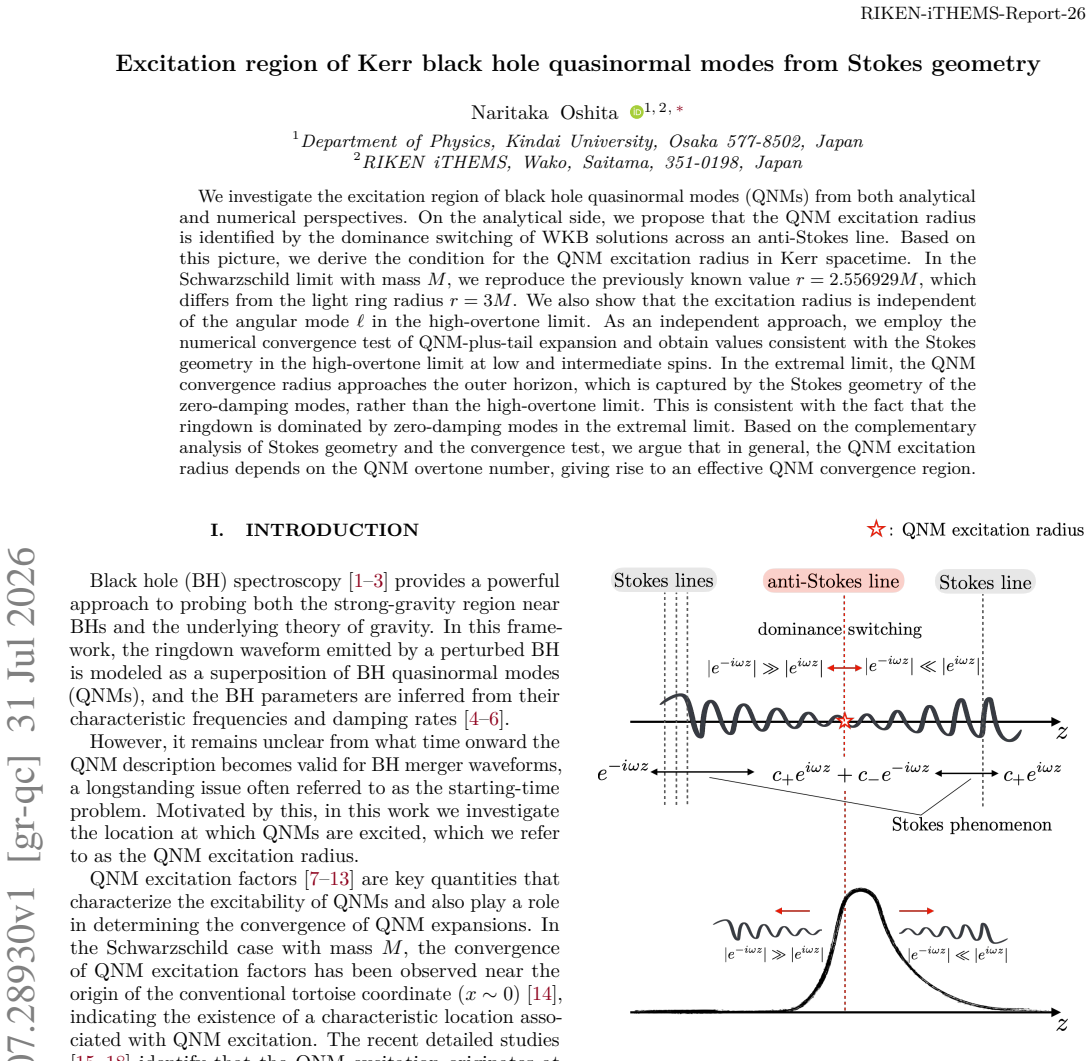
On the paper's own terms, the central discovery is that the QNM excitation radius rStokes is defined by the condition Re(iωz)=0 at the intersection of the anti-Stokes line with the real r-axis, where z=∫V dr is the WKB phase built from V=√(q0+O(ω⁻¹))/Δ. In the ωI→−∞ limit this reduces to Re∫√q0/Δ dr = 0; for Schwarzschild it becomes xSch(r)=0, giving r=2.5569291M, and it is independent of ℓ. The claim is supported by an independent numerical convergence test of the QNM-plus-tail expansion, which yields rcon consistent with rStokes for low and intermediate spins, and by the observation that in the extremal limit the relevant Stokes geometry is that of zero-damping modes, whose innermost anti-
What carries the argument
The central object is the Stokes geometry of the WKB-reduced Teukolsky equation: Stokes and anti-Stokes lines emanate from the complex turning points of the effective potential V. The anti-Stokes line, defined by Re(iωz)=0, is where the relative dominance of the two WKB solutions ψ± switches; its intersection with the real r-axis is proposed as the QNM excitation radius. The WKB phase z carries the logarithmic horizon structure that produces the excitation-radius condition, and the spin-dependence enters through q0=(r²+a²)²−a²Δ.
Load-bearing premise
The argument relies on the high-overtone reduction of the Teukolsky equation to the WKB form with V=√(q0+O(ω⁻¹))/Δ, i.e., that subleading terms in ω are negligible; for the finite overtones that actually dominate ringdown, especially near extremal spin, this approximation is knowingly invalid, and the paper must switch treatments.
What would settle it
A direct numerical computation of the exact Stokes geometry (without WKB approximations) for a finite overtone, or a nonlinear simulation of a perturbed Kerr black hole that measures the onset location of QNM radiation and finds it inconsistent with rStokes, would settle the claim.
If this is right
- The ringdown starting time can be tied to a definite radius in the spacetime, rather than to the light ring, giving a concrete answer to the starting-time problem.
- The excitation radius is overtone-dependent: different QNM frequencies produce different anti-Stokes geometries, so the effective excitation region is a band rather than a single surface.
- For near-extremal spins, the relevant excitation radius is set by zero-damping modes and lies close to the outer horizon, consistent with the dominance of long-lived modes in extremal ringdowns.
- The high-overtone excitation radius is independent of the angular mode ℓ in the Schwarzschild case, a prediction confirmed numerically for ℓ=2,3,4.
Where Pith is reading between the lines
- Because the WKB reduction that yields V assumes negligible angular and spin couplings at high damping, the method may be extendable to other wave equations (scalar, electromagnetic) to test whether the excitation radius is universal or species-dependent.
- If the anti-Stokes intersection truly marks the source of ringdown, then in extreme-mass-ratio inspirals a companion crossing rStokes should produce a sudden onset of QNM radiation; this is a testable prediction for waveform models.
- The overtone-dependent excitation radii imply that truncating a QNM expansion at a fixed overtone number changes the effective source region, which may need to be accounted for in black hole spectroscopy pipelines.
Editorial analysis
A structured set of objections, weighed in public.
Referee Report
Summary. The paper proposes that the QNM excitation radius in Kerr spacetime is identified with the intersection of an anti-Stokes line of the Teukolsky equation with the real radial axis. In the high-overtone limit, the condition reduces to Re∫√q0/Δ dr = 0, yielding r = 2.556929M for Schwarzschild, in agreement with earlier literature. The paper extends the calculation to general spin and to the zero-damping-mode (ZDM) limit near extremality. As an independent check, the author performs numerical ringdown reconstructions using QNM-plus-tail expansions and extracts a convergence radius rcon. The two are claimed to be consistent at low/intermediate spins, while in the near-extremal regime the ZDM Stokes geometry is argued to capture the behavior of rcon. The paper concludes that the excitation radius is overtone dependent.
Significance. If the proposed identification is correct, it offers an analytic handle on the starting-time problem of black hole ringdown and connects Stokes geometry to the region of QNM excitation in Kerr spacetime. The paper has clear strengths: it reproduces the known Schwarzschild value without fitting, it provides an independent MST-based numerical reconstruction, and it explicitly lists the approximations and limitations of the analysis. The central claim, however, is a proposal rather than a derivation, and the comparison with numerical data relies on a selection rule among multiple anti-Stokes intersections that is not derived from the boundary-value problem. The paper is of interest to the black-hole spectroscopy and QNM community, but the evidence for the central identification is not yet conclusive.
major comments (4)
- [Sec. II and Appendix A; Fig. 5] The mapping 'anti-Stokes intersection = excitation radius' is underdetermined for finite-frequency modes. At finite ω, anti-Stokes lines intersect the real axis multiple times (Appendix A). The paper selects the outermost intersection in the high-overtone branch and the innermost of three intersections in the ZDM analysis of Fig. 5 (r/M = 1.105, 1.136, 1.612). No criterion derived from the QNM boundary-value problem distinguishes these choices; the selection appears to be made to match rcon. This is an interpretive circularity: rStokes = rcon is the claim, not a test. Moreover, at χ = 0.99999 the chosen innermost point (1.105M) is farther from the reported rcon = 1.251M than the second intersection (1.136M), so the innermost-selection rule is not even the best match among the available candidates.
- [Sec. II, Eqs. (1)-(2), (6); Sec. III, Table II] The high-overtone reduction V = √(q0 + O(ω⁻¹))/Δ drops angular, spin, and m-dependent terms in the limit ωR/ωI → 0. This is an asymptotic statement about infinitely damped modes. However, the numerical comparison in Sec. III uses finite overtones (n up to 99, 171, 435 in Table II), for which |ωR/ωI| is not small. The paper does not estimate the size of the subleading Teukolsky terms at these finite overtones or demonstrate that they leave the anti-Stokes geometry unchanged. Without such an estimate, the claimed agreement between the asymptotic rStokes and the finite-overtone rcon is not quantitatively grounded.
- [Sec. III, Eq. (18), Table I, Fig. 4] The numerical criterion for rcon depends on the free threshold εth. For near-extremal spins the threshold is adjusted (10⁻² to 10⁻³ or 10⁻⁴) and the bars in Fig. 4 become large. At χ = 0.99 the discrepancy between rStokes (high-overtone) and rcon is ~15%, and at χ = 0.99999 the ZDM innermost rStokes (1.105M) differs from rcon (1.251M) by ~12%, with rcon still far from the horizon (r₊ ≈ 1.0045M). Calling this 'captured by the ZDM Stokes geometry' or 'remarkable agreement' overstates the quantitative match. A more precise statement of the expected disagreement and its scaling with χ is needed.
- [Sec. IV; Sec. III near-extremal analysis] A central conclusion is that the excitation radius depends on the overtone number. The evidence is that rStokes in the ωI → −∞ limit differs from rStokes for ZDMs. That only shows two asymptotic limits give different values; it does not demonstrate a well-defined overtone dependence for actual finite overtones. The convergence radius rcon is a single number extracted from a sum over many overtones, so it does not measure a per-overtone excitation radius. The paper would need to compute Stokes geometries for individual finite overtones and show a systematic trend, or provide a reconstruction that isolates overtone contributions, to support this conclusion.
minor comments (4)
- [Table I caption and footnote] The caption says bracketed values are rcon for ℓ = 3, 4, while footnote (a) says the bracketed values are rStokes/M for ℓ = 3, 4. These statements contradict each other; please clarify which quantity is quoted.
- [Eq. (8) and Appendix A, Eq. (A3)] Units are inconsistent: Eq. (8) is written with explicit 2M factors, while Eq. (A3) uses r + log(r−1) with M = 1. Please state the units in Appendix A explicitly.
- [Sec. III, near Fig. 3] Typo: 'Schowarzschild' should be 'Schwarzschild'.
- [Fig. 3 caption] The lower panel shows the relative error E(u) but does not define the horizontal axis; in the text it is u − xs, but the figure axis label is unclear. Please add a descriptive label.
Circularity Check
No significant circularity: rStokes is derived from the anti-Stokes condition and compared with an independently computed rcon.
full rationale
The paper's central quantity rStokes is obtained from the WKB/anti-Stokes condition Re(iωz)=0, not from the numerical convergence data. In the Schwarzschild case, Eqs. (6)-(8) explicitly derive rStokes as the root of xSch(r)=0, reproducing a known value; this is a derivation, not a fit. The numerical rcon is obtained from an independent MST-based ringdown reconstruction with a threshold criterion (Eq. 18), and the paper reports threshold-dependent bars rather than tuning a parameter to rStokes. The possible non-uniqueness of anti-Stokes intersections is acknowledged in Appendix A and Sec. IV; the paper gives branch-normalization and 'complete response' arguments for choosing the relevant intersection, and the overtone dependence is presented as a conclusion rather than a forced equality. Self-citations ([25,26]) are used for standard Stokes-phenomenon facts and logarithmic spirals, and Appendix A re-derives the spiral structure, so they are not load-bearing. The paper also explicitly lists limitations and leaves open the exact quantitative agreement. No enumerated circularity pattern is exhibited by a specific reduction of an output to an input.
Axiom & Free-Parameter Ledger
free parameters (3)
- convergence threshold ε_th =
10⁻², with 10⁻³–10⁻² in near-extremal cases
- QNM truncation N± =
99 for χ≤0.9; up to 435/10 for χ=0.99999
- branch-cut cutoff ωmin =
Mωmin = -15
axioms (5)
- domain assumption High-overtone Teukolsky reduction to Eq. (1) with V = √(q0 + O(ω⁻¹))/Δ
- ad hoc to paper Anti-Stokes line intersection with the real axis identifies the QNM excitation radius
- standard math WKB dominance switching and Stokes phenomenon apply to the Teukolsky QNM eigenfunction
- domain assumption Leaver's method and the MST method accurately compute QNM frequencies, eigenvalues, and excitation factors
- domain assumption Near-extremal ZDM/eikonal approximation of Eq. (21)
read the original abstract
We investigate the excitation region of black hole quasinormal modes (QNMs) from both analytical and numerical perspectives. On the analytical side, we propose that the QNM excitation radius is identified by the dominance switching of WKB solutions across an anti-Stokes line. Based on this picture, we derive the condition for the QNM excitation radius in Kerr spacetime. In the Schwarzschild limit with mass $M$, we reproduce the previously known value $r=2.556929 M$, which differs from the light ring radius $r=3M$. We also show that the excitation radius is independent of the angular mode $\ell$ in the high-overtone limit. As an independent approach, we employ the numerical convergence test of QNM-plus-tail expansion and obtain values consistent with the Stokes geometry in the high-overtone limit at low and intermediate spins. In the extremal limit, the QNM convergence radius approaches the outer horizon, which is captured by the Stokes geometry of the zero-damping modes, rather than the high-overtone limit. This is consistent with the fact that the ringdown is dominated by zero-damping modes in the extremal limit. Based on the complementary analysis of Stokes geometry and the convergence test, we argue that in general, the QNM excitation radius depends on the QNM overtone number, giving rise to an effective QNM convergence region.
Figures


Reference graph
Works this paper leans on
-
[1]
K. D. Kokkotas and B. G. Schmidt, Living Rev. Rel.2, 2 (1999), arXiv:gr-qc/9909058
Pith/arXiv arXiv 1999
-
[2]
E. Berti, V. Cardoso, and A. O. Starinets, Class. Quant. Grav.26, 163001 (2009), arXiv:0905.2975 [gr-qc]
Pith/arXiv arXiv 2009
-
[3]
E. Bertiet al., Class. Quant. Grav.43, 123001 (2026), arXiv:2505.23895 [gr-qc]
Pith/arXiv arXiv 2026
-
[4]
A. G. Abacet al.(LIGO Scientific, VIRGO, KAGRA), (2026), arXiv:2603.19021 [gr-qc]
Pith/arXiv arXiv 2026
-
[5]
A. G. Abacet al.(LIGO Scientific, Virgo, KAGRA), Phys. Rev. Lett.135, 111403 (2025), arXiv:2509.08054 [gr-qc]
Pith/arXiv arXiv 2025
-
[6]
A. G. Abacet al.(LIGO Scientific, Virgo, KAGRA), Phys. Rev. Lett.136, 041403 (2026), arXiv:2509.08099 [gr-qc]
Pith/arXiv arXiv 2026
-
[7]
E. W. Leaver, Phys. Rev. D34, 384 (1986)
1986
-
[8]
Sun and R
Y. Sun and R. H. Price, Phys. Rev. D38, 1040 (1988)
1988
-
[9]
Andersson, Phys
N. Andersson, Phys. Rev. D51, 353 (1995)
1995
-
[10]
K. Glampedakis and N. Andersson, Phys. Rev. D64, 104021 (2001), arXiv:gr-qc/0103054
Pith/arXiv arXiv 2001
-
[11]
K. Glampedakis and N. Andersson, Class. Quant. Grav. 20, 3441 (2003), arXiv:gr-qc/0304030
Pith/arXiv arXiv 2003
-
[12]
E. Berti and V. Cardoso, Phys. Rev. D74, 104020 (2006), arXiv:gr-qc/0605118
Pith/arXiv arXiv 2006
-
[13]
Z. Zhang, E. Berti, and V. Cardoso, Phys. Rev. D88, 044018 (2013), arXiv:1305.4306 [gr-qc]
Pith/arXiv arXiv 2013
- [14]
-
[15]
M. De Amicis, E. Cannizzaro, G. Carullo, and L. Sberna, Phys. Rev. D113, 024048 (2026), arXiv:2506.21668 [gr- qc]
arXiv 2026
-
[16]
P. Arnaudo, J. Carballo, and B. Withers, Phys. Rev. D 114, 024025 (2026), arXiv:2510.18956 [gr-qc]
arXiv 2026
- [17]
-
[18]
M. De Amicis, E. Cannizzaro, G. Carullo, A. Kuntz, and L. Sberna, (2026), arXiv:2605.16492 [gr-qc]
Pith/arXiv arXiv 2026
- [19]
-
[20]
L. Motl and A. Neitzke, Adv. Theor. Math. Phys.7, 307 (2003), arXiv:hep-th/0301173
Pith/arXiv arXiv 2003
-
[21]
N. Andersson and C. J. Howls, Class. Quant. Grav.21, 1623 (2004), arXiv:gr-qc/0307020
Pith/arXiv arXiv 2004
-
[22]
J. Natario and R. Schiappa, Adv. Theor. Math. Phys.8, 1001 (2004), arXiv:hep-th/0411267
Pith/arXiv arXiv 2004
-
[23]
U. Keshet and S. Hod, Phys. Rev. D76, 061501 (2007), arXiv:0705.1179 [gr-qc]
Pith/arXiv arXiv 2007
-
[24]
U. Keshet and A. Neitzke, Phys. Rev. D78, 044006 (2008), arXiv:0709.1532 [hep-th]
Pith/arXiv arXiv 2008
-
[25]
T. Miyachi, R. Namba, H. Omiya, and N. Oshita, Phys. Rev. D111, 124045 (2025), arXiv:2503.17245 [hep-th]
Pith/arXiv arXiv 2025
-
[26]
T. Miyachi, R. Namba, H. Omiya, and N. Oshita, Phys. Rev. D113, 124006 (2026), arXiv:2512.18631 [gr-qc]
Pith/arXiv arXiv 2026
- [27]
-
[28]
S. Mano, H. Suzuki, and E. Takasugi, Prog. Theor. Phys. 95, 1079 (1996), arXiv:gr-qc/9603020
Pith/arXiv arXiv 1996
-
[29]
H. Yang, A. Zimmerman, A. Zenginoğlu, F. Zhang, E. Berti, and Y. Chen, Phys. Rev. D88, 044047 (2013), arXiv:1307.8086 [gr-qc]
Pith/arXiv arXiv 2013
-
[30]
Sasaki and T
M. Sasaki and T. Nakamura, Prog. Theor. Phys.67, 1788 (1982)
1982
-
[31]
W. H. Press, Astrophys. J. Lett.170, L105 (1971)
1971
-
[32]
C. J. Goebel, ApJ172, L95 (1972)
1972
-
[33]
Ferrari and B
V. Ferrari and B. Mashhoon, Phys. Rev. D30, 295 (1984). 10
1984
-
[34]
Mashhoon, Phys
B. Mashhoon, Phys. Rev. D31, 290 (1985)
1985
-
[35]
V. Cardoso, A. S. Miranda, E. Berti, H. Witek, and V. T. Zanchin, Phys. Rev. D79, 064016 (2009), arXiv:0812.1806 [hep-th]
Pith/arXiv arXiv 2009
-
[36]
H. Yang, D. A. Nichols, F. Zhang, A. Zimmerman, Z. Zhang, and Y. Chen, Phys. Rev. D86, 104006 (2012), arXiv:1207.4253 [gr-qc]
Pith/arXiv arXiv 2012
-
[37]
E. W. Leaver, Proc. Roy. Soc. Lond. A402, 285 (1985)
1985
-
[38]
E. W. Leaver, J. Math. Phys.27, 1238 (1986)
1986
discussion (0)
Sign in with ORCID, Apple, or X to comment. Anyone can read and Pith papers without signing in.