REVIEW 4 major objections 4 minor 34 references
QFedPolyp claims that quantizing federated model updates to 8 bits cuts communication by about 4x while keeping polyp-segmentation Dice within roughly 0.01–0.02 of full precision, and that quantization-aware training also yields INT8 models
Reviewed by Pith at T0; open to challenge. T0 means a machine referee read the full paper against a public rubric. the ladder, T0–T4 →
T0 review · deepseek-v4-flash
2026-08-01 09:12 UTC pith:SMUYEEMA
load-bearing objection Useful application paper, but the headline 4x communication saving does not hold when the server broadcast stays full-precision: real saving at 8-bit is ~1.6x for total per-round traffic. the 4 major comments →
QFedPolyp: A Communication- and Inference-Efficient Federated Learning Framework for Polyp Segmentation
The pith
A machine-rendered reading of the paper's core claim, the machinery that carries it, and where it could break.
Core claim
The paper's central discovery is that quantization-aware training can be inserted into federated averaging so that hospitals exchange only 8-bit weights without sacrificing clinically meaningful accuracy. On four colonoscopy benchmarks — Kvasir-SEG, CVC-ClinicVideoDB, PolypGen, and BKAI-IGH NeoPolyp — uniform 8-bit communication reaches Dice scores of 0.895, 0.915, 0.825, and 0.885, compared with 0.910, 0.930, 0.845, and 0.905 for 32-bit exchange, while the per-round payload shrinks by about four times. The same low-precision weights translate into INT8 inference that runs up to 1.5x faster (400 vs 266 FPS on the tested GPU), so the communication saving and the deployment saving come from on
What carries the argument
The load-bearing mechanism is quantization-aware training with a uniform b-bit quantizer and a straight-through estimator during local optimization. The quantizer Q_b maps weights to 2^b levels using step Δ=(w_max−w_min)/(2^b−1); because the model trains against this simulated noise, the resulting parameters can be transmitted as b-bit integers and aggregated directly by federated averaging. The same operator produces an INT8-ready model, which is why a 4x communication cut and a 1.5x inference speedup come from the same design.
Load-bearing premise
The evaluation assumes that randomly splitting each public dataset into five disjoint chunks approximates five real hospitals; real hospitals have different scanners, protocols, and patient populations (non-IID data), and the paper lists non-IID data as future work.
What would settle it
Train the identical pipeline with K=5 clients where each client receives all images from a single acquisition site or protocol (a non-IID split), then compare 8-bit Dice against the 32-bit baseline; if the gap exceeds roughly 0.02–0.03 on the same datasets, the claim that QAT preserves accuracy under realistic multi-hospital conditions fails.
If this is right
- At 8-bit uniform communication, per-round payload shrinks by roughly 4x versus 32-bit, with Dice losses of about 0.005–0.02 on the four datasets (e.g., 0.915 vs 0.930 on CVC-ClinicVideoDB).
- Quantization-aware training delivers INT8-ready models: 400 FPS versus 266 FPS on the tested GPU (about 1.5x faster inference), and 13.97 versus 12.95 FPS on the tested CPU.
- Hospitals with different bandwidths can run mixed precision: the (8,16,16,16,16) configuration stays within roughly one Dice point of the 32-bit baseline while cutting communication by more than 2x.
- Uniform 4-bit communication drops Dice to 0.70–0.78, identifying 8 bits as the practical operating point for this task.
- The 8-bit federated model converges slightly later than the 32-bit model (roughly 70–80 vs 60 rounds) but stabilizes without oscillation.
Where Pith is reading between the lines
- The experiments random-split each benchmark into five clients, so the reported 8-bit accuracy is likely a best case; a non-IID partition (e.g., one acquisition site per client) is the natural stress test for whether the 4x communication claim survives in real multi-hospital practice.
- The 4x figure counts bits per weight; actual wall-clock bandwidth savings could be larger if combined with sparsification or error feedback, or smaller once encryption/secure-aggregation overhead is included — the paper does not measure end-to-end network time.
- Quantization is not itself a privacy mechanism; the framework's privacy guarantee comes from keeping images local, so hardening against gradient-inversion or membership-inference attacks (e.g., with secure aggregation or differential privacy) is the un-addressed next step.
- The recipe is architecture-agnostic: the same QAT-in-FedAvg pattern should transfer to other small U-Net-style medical segmentation tasks, where the communication saving and INT8 speedup would be similar.
Editorial analysis
A structured set of objections, weighed in public.
Referee Report
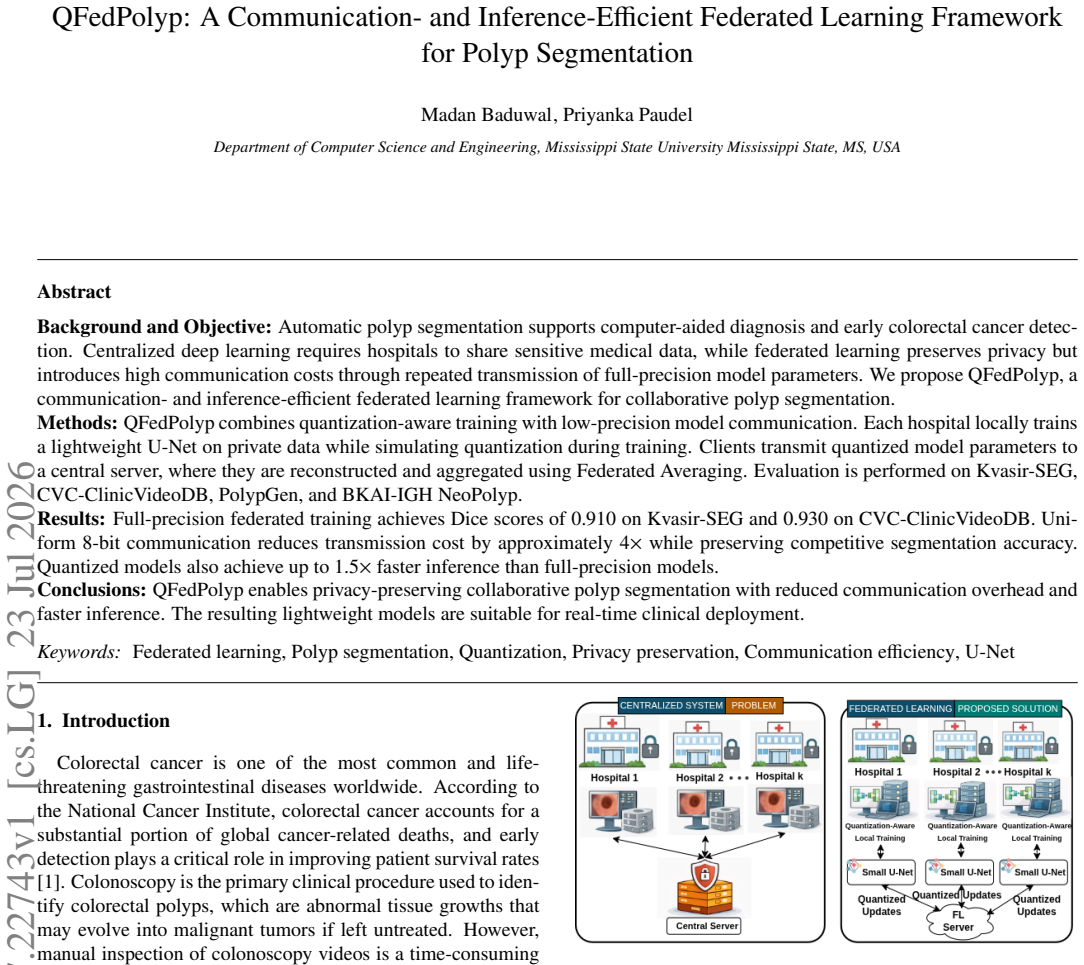
Summary. The paper proposes QFedPolyp, a federated learning framework for polyp segmentation that combines FedAvg with quantization-aware training and b-bit quantized parameter communication. A lightweight U-Net is trained locally at each of K simulated hospital clients, and quantized model updates are sent to a central server for aggregation. The authors evaluate on Kvasir-SEG, CVC-ClinicVideoDB, PolypGen, and BKAI-IGH NeoPolyp, reporting Dice/IoU for centralized training, full-precision FL, uniform 8-bit FL, and mixed-precision configurations, plus an inference latency comparison. The central claims are that uniform 8-bit communication yields roughly a 4× communication reduction while preserving segmentation accuracy, and that the resulting INT8 model gives up to 1.5× faster inference.
Significance. The problem is well motivated: communication cost is a real bottleneck for federated medical imaging, and the integration of QAT with model-parameter quantization is a sensible design that could be practically useful. The paper includes a systematic bit-width sweep, a code link, and a clear architectural description. If the claims hold, the contribution is a useful engineering result for privacy-preserving polyp segmentation. However, the headline communication-efficiency number as stated is not supported by the algorithm as written, and the paper contains a numerical inconsistency in the state-of-the-art comparison, so the efficiency claim requires substantive revision.
major comments (4)
- [§3.4, §4.6, Algorithm 1] The claimed 'approximately 4×' communication reduction (32/b at b=8) is not supported by the full algorithm. In Algorithm 1, line 3 sends the global model w^{t-1} to every client in full precision, and only the client uploads in line 7 are b-bit. Per communication round, QFedPolyp transfers K·32M bytes downlink and K·bM bytes uplink, versus 2K·32M bytes for full-precision FedAvg. The total-traffic ratio is therefore 64/(32+b), which at b=8 is about 1.6×, not 4×. This affects the abstract, §3.4, §4.6, Table 1, and the conclusions. The claim can be corrected by quantizing the server broadcast as well, or by explicitly restricting the 32/b factor to client-to-server uplink and reporting total per-round traffic separately.
- [Table 3 and §4.9] Table 3 lists QFedPolyp as achieving Dice 0.915 and IoU 0.840 on Kvasir-SEG, but Table 1 reports 0.895/0.81 for the uniform 8-bit configuration and 0.910/0.84 for the full-precision 32-bit configuration. No configuration in Table 1 reaches 0.915 Dice. This numerical inconsistency makes the state-of-the-art comparison in §4.9 unreliable. Please state which configuration Table 3 refers to and correct the values.
- [§4.1, §4.2, Table 1] No test split is specified. The datasets are partitioned into K=5 disjoint client subsets, but there is no description of a held-out test set, and the reported metrics in Table 1 appear to come from a single run without standard deviations or multiple seeds. The accuracy-preservation claim rests on differences of 0.01–0.02 Dice, so a single run is not sufficient evidence. Report mean ± std over several random seeds and define the exact train/test partition used for each dataset.
- [§4.1, §5] The federated evaluation partitions each dataset into K=5 subsets, which the authors treat as independent hospital clients. This is an IID-like split and does not reflect realistic multi-hospital data, where imaging equipment, protocols, and patient populations differ. The future-work section explicitly lists non-IID data as an open problem, so the central accuracy numbers should not be claimed as directly transferable to clinical collaborations. Please either temper the clinical-transfer language or add a non-IID experiment, e.g., partitioning by acquisition device or source domain.
minor comments (4)
- [§3.3 vs Algorithm 2] Section 3.3 states that 'intermediate activations may also be quantized,' but Algorithm 2 only applies Q(w) to weights and computes L(f(B; \tilde{w})). State explicitly which tensors are quantized during training.
- [§3.2 vs §4.1] Equation (7) describes SGD, while §4.1 states that the Adam optimizer was used. Please align the notation and the experimental description.
- [Figures 6–9 and Table 1] The convergence curves in Figures 6–9 stop at communication round 100, but Table 1 reports convergence rounds above 100 (e.g., 102–106). Extend the x-axis or explain why the table values exceed the plotted range.
- [§4.2] The text says metrics were 'computed on the test images,' but no test set is defined in §4.1. Clarify how test images are separated from client training partitions.
Circularity Check
No significant circularity: the central claims follow from arithmetic bit-width reduction and empirical comparisons, not from fitted inputs or self-citations.
full rationale
The paper's derivation chain is self-contained and does not reduce to its own inputs. The headline communication saving is presented as 32/b, which is the direct arithmetic ratio of bits per transmitted client model update (Section 3.4: 'the communication requirement per model update decreases by approximately a factor of 32/b'); this is not a fitted parameter or a prediction derived from the same quantity used to define it. The accuracy results in Table 1 and Sections 4.5-4.6 are empirical measurements comparing 32-bit, 8-bit, and mixed-precision federated training, with no parameter fitted to a target accuracy and then renamed as a prediction. The QAT component is a standard technique (straight-through estimator, Eq. 11), and its benefit is asserted and then empirically validated against the 32-bit baseline rather than assumed by construction. There are no load-bearing self-citations: references to FedAvg, U-Net, and QAT are standard external works, and the authors do not invoke a prior uniqueness theorem or prior framework of their own to force the design. The random IID partition into five hospitals is an experimental simplification acknowledged by the future-work note about non-IID data; it is a limitation of external validity, not circular reasoning. The possible discrepancy between the stated 4x communication reduction and the full two-way traffic including the server broadcast is an accounting/metrics issue, not a case where a result is equivalent to its inputs by definition. Therefore no circular step is identified.
Axiom & Free-Parameter Ledger
free parameters (4)
- local epochs E =
5
- learning rate η =
1e-3
- input resolution =
3×128×128
- default communication bit-width b =
8
axioms (4)
- domain assumption Keeping data local is equivalent to preserving patient privacy
- domain assumption Random IID partition of each dataset into K=5 clients approximates a multi-hospital collaboration
- domain assumption Quantization-aware training makes models robust to low-precision communication
- standard math Straight-through estimator approximates the gradient of the rounding function
read the original abstract
Background and Objective: Automatic polyp segmentation supports computer-aided diagnosis and early colorectal cancer detec- tion. Centralized deep learning requires hospitals to share sensitive medical data, while federated learning preserves privacy but introduces high communication costs through repeated transmission of full-precision model parameters. We propose QFedPolyp, a communication- and inference-efficient federated learning framework for collaborative polyp segmentation. Methods: QFedPolyp combines quantization-aware training with low-precision model communication. Each hospital locally trains a lightweight U-Net on private data while simulating quantization during training. Clients transmit quantized model parameters to a central server, where they are reconstructed and aggregated using Federated Averaging. Evaluation is performed on Kvasir-SEG, CVC-ClinicVideoDB, PolypGen, and BKAI-IGH NeoPolyp. Results: Full-precision federated training achieves Dice scores of 0.910 on Kvasir-SEG and 0.930 on CVC-ClinicVideoDB. Uni- form 8-bit communication reduces transmission cost by approximately 4 times while preserving competitive segmentation accuracy. Quantized models also achieve up to 1.5 times faster inference than full-precision models. Conclusions: QFedPolyp enables privacy-preserving collaborative polyp segmentation with reduced communication overhead and faster inference. The resulting lightweight models are suitable for real-time clinical deployment.
Figures


Reference graph
Works this paper leans on
-
[1]
URLhttps://seer.cancer.gov/statfacts/html/ colorect.html
National Cancer Institute, Seer cancer stat facts: Colorec- tal cancer (2025). URLhttps://seer.cancer.gov/statfacts/html/ colorect.html
2025
-
[2]
Ronneberger, P
O. Ronneberger, P. Fischer, T. Brox, U-net: Convolutional networks for biomedical image segmentation, in: Med- ical Image Computing and Computer-Assisted Interven- tion (MICCAI), Springer, 2015, pp. 234–241
2015
-
[3]
Fan, G.-P
D.-P. Fan, G.-P. Ji, T. Zhou, G. Chen, H. Fu, J. Shen, L. Shao, Pranet: Parallel reverse attention network for polyp segmentation, in: Medical Image Computing and Computer-Assisted Intervention (MIC- CAI), Springer, 2020, pp. 263–273.doi:10.1007/ 978-3-030-59725-2_26
2020
-
[4]
C.-H. Huang, H.-Y . Wu, Y .-L. Lin, Hardnet-mseg: A sim- ple encoder-decoder polyp segmentation neural network that achieves over 0.9 mean dice and 86 fps, arXiv preprint arXiv:2101.07172 (2021)
Pith/arXiv arXiv 2021
-
[5]
McMahan, E
B. McMahan, E. Moore, D. Ramage, S. Hampson, Communication-efficient learning of deep networks from decentralized data, in: AISTATS, 2017
2017
-
[6]
J. Kone ˇcný, et al., Federated learning: Strategies for improving communication efficiency, arXiv preprint arXiv:1610.05492 (2016)
Pith/arXiv arXiv 2016
-
[7]
M. Chen, N. Shlezinger, H. V . Poor, Y . C. Eldar, S. Cui, Communication-efficient federated learning, Proceedings of the National Academy of Sciences 118 (17) (2021) e2024789118.doi:10.1073/pnas.2024789118
-
[8]
Reisizadeh, A
A. Reisizadeh, A. Mokhtari, H. Hassani, A. Jadbabaie, R. Pedarsani, Fedpaq: A communication-efficient feder- ated learning method with periodic averaging and quan- tization, in: Proceedings of the 23rd International Con- ference on Artificial Intelligence and Statistics, PMLR, 2020, pp. 2021–2031
2020
-
[9]
Jacob, S
B. Jacob, S. Kligys, B. Chen, Quantization and training of neural networks for efficient integer-arithmetic-only infer- ence, in: Proceedings of the IEEE Conference on Com- puter Vision and Pattern Recognition, 2018
2018
-
[10]
Ronneberger, P
O. Ronneberger, P. Fischer, T. Brox, U-Net: Convolu- tional Networks for Biomedical Image Segmentation, in: International Conference on Medical Image Computing and Computer-Assisted Intervention (MICCAI), Springer, 2015, pp. 234–241
2015
-
[11]
Z. Zhou, M. M. R. Siddiquee, N. Tajbakhsh, J. Liang, UNet++: A Nested U-Net Architecture for Medical Im- age Segmentation, in: Deep Learning in Medical Image Analysis and Multimodal Learning for Clinical Decision Support (DLMIA), Springer, 2018, pp. 3–11
2018
-
[12]
D. Jha, M. A. Riegler, D. Johansen, P. Halvorsen, T. de Lange, A comprehensive study on colorectal polyp segmentation with resunet++, conditional random field and test-time augmentation, IEEE Journal of Biomedical and Health Informatics 25 (6) (2021) 2029–2040
2021
-
[13]
Fang, C.-W
Y . Fang, C.-W. Chen, Y . Yuan, K.-Y . Tong, Selective Feature Aggregation Network with Area-Boundary Con- straints for Polyp Segmentation, in: International Con- ference on Medical Image Computing and Computer- Assisted Intervention (MICCAI), Springer, 2019, pp. 302–310
2019
-
[14]
Fan, G.-P
D.-P. Fan, G.-P. Ji, T. Zhou, G. Chen, H. Fu, J. Shen, L. Shao, PraNet: Parallel Reverse Attention Network for Polyp Segmentation, in: International Conference on Medical Image Computing and Computer-Assisted Inter- vention (MICCAI), Springer, 2020, pp. 263–273. 12
2020
-
[15]
Zhang, G
R. Zhang, G. Li, Z. Li, S. Cui, D. Qian, Y . Yu, Adaptive context selection for polyp segmentation, in: International Conference on Medical Image Computing and Computer- Assisted Intervention (MICCAI), Springer, 2020, pp. 253–262
2020
-
[16]
M. J. Sheller, B. Edwards, G. A. Reina, J. Martin, S. Pati, A. Kotrotsou, M. Milchenko, W. Xu, D. Marcus, R. R. Colen, S. Bakas, Federated learning in medicine: Facil- itating multi-institutional collaborations without sharing patient data, Scientific Reports 10 (1) (2020) 12598
2020
-
[17]
Rieke, J
N. Rieke, J. Hancox, W. Li, F. Milletarì, H. R. Roth, S. Albarqouni, S. Bakas, M. N. Galtier, B. A. Landman, K. Maier-Hein, S. Ourselin, M. J. Sheller, R. M. Sum- mers, A. Trask, D. Xu, M. Baust, M. J. Cardoso, The fu- ture of digital health with federated learning, NPJ Digital Medicine 3 (2020) 119
2020
-
[18]
G. A. Kaissis, M. R. Makowski, D. Rückert, R. F. Braren, Secure, privacy-preserving and federated machine learn- ing in medical imaging, Nature Machine Intelligence 2 (2020) 305–311
2020
-
[19]
H. B. McMahan, E. Moore, D. Ramage, S. Hampson, B. A. y Arcas, Communication-efficient learning of deep networks from decentralized data, in: Proc. 20th Interna- tional Conference on Artificial Intelligence and Statistics (AISTATS), 2017, pp. 1273–1282
2017
-
[20]
W. Wen, C. Xu, F. Yan, C. Wu, Y . Wang, Y . Chen, H. Li, Terngrad: Ternary gradients to reduce communication in deep neural network training, in: Advances in Neu- ral Information Processing Systems (NeurIPS), 2017, pp. 1509–1519
2017
-
[21]
Alistarh, D
D. Alistarh, D. Grubi ´c, J. Li, R. Tomioka, M. V ojnovi ´c, Qsgd: Communication-efficient sgd via gradient quanti- zation and encoding, in: Advances in Neural Information Processing Systems (NeurIPS), 2017, pp. 1709–1720
2017
-
[22]
Bernstein, J
J. Bernstein, J. Zhao, K. Azizzadenesheli, A. Anandku- mar, signsgd with majority vote is communication effi- cient and fault tolerant, in: International Conference on Learning Representations (ICLR), 2019
2019
-
[23]
Y . Lin, S. Han, H. Mao, Y . Wang, W. J. Dally, Deep gradient compression: Reducing the communica- tion bandwidth for distributed training, arXiv preprint arXiv:1712.01887 (2018)
Pith/arXiv arXiv 2018
-
[24]
Jacob, S
B. Jacob, S. Kligys, B. Chen, M. Zhu, M. Tang, A. Howard, H. Adam, D. Kalenichenko, Quantization and training of neural networks for efficient integer- arithmetic-only inference, in: Proceedings of the IEEE Conference on Computer Vision and Pattern Recognition (CVPR), 2018, pp. 2704–2713
2018
-
[25]
A. M. Abdelmoniem, M. Canini, Towards mitigating device heterogeneity in federated learning via adaptive model quantization, in: Proceedings of the 1st Workshop on Machine Learning and Systems (EuroMLSys), 2021, pp. 96–103
2021
-
[26]
Y . Ji, L. Chen, FedQNN: A computation–communication- efficient federated learning framework for iot with low- bitwidth neural network quantization, IEEE Internet of Things Journal 10 (3) (2022) 2494–2507
2022
-
[27]
J. Yoon, G. Park, W. Jeong, S. J. Hwang, Bitwidth hetero- geneous federated learning with progressive weight de- quantization, in: Proceedings of the 39th International Conference on Machine Learning (ICML), PMLR, 2022, pp. 25552–25565
2022
-
[28]
H. Chen, H. Vikalo, Mixed-precision quantization for federated learning on resource-constrained heterogeneous devices, in: Proceedings of the IEEE/CVF Conference on Computer Vision and Pattern Recognition (CVPR), 2024
2024
-
[29]
McMahan, E
B. McMahan, E. Moore, D. Ramage, S. Hampson, Communication-efficient learning of deep networks from decentralized data, in: Artificial Intelligence and Statistics (AISTATS), 2017
2017
-
[30]
D. Jha, P. Smedsrud, D. Johansen, et al., Real-time polyp detection, localization and segmentation in colonoscopy, arXiv preprint arXiv:2011.07631 (2021)
Pith/arXiv arXiv 2011
-
[31]
N. Tomar, D. Jha, U. Bagci, S. Ali, Tganet: Text-guided attention network for polyp segmentation, arXiv preprint arXiv:2205.04280 (2022)
Pith/arXiv arXiv 2022
-
[32]
B. Dong, W. Wang, D.-P. Fan, et al., Polyp-pvt: Polyp segmentation with pyramid vision transformers, arXiv preprint arXiv:2108.06932 (2021)
Pith/arXiv arXiv 2021
-
[33]
L. Chen, X. Wang, M. Liu, Fedevi: Evidential federated learning for robust medical image segmentation, IEEE Transactions on Medical Imaging (2024)
2024
-
[34]
Stelter, V
L. Stelter, V . Corbetta, R. Beets-Tan, W. Silva, Assessing the impact of federated learning and differential privacy on multi-centre polyp segmentation, in: IEEE EMBC, 2024. 13
2024
discussion (0)
Sign in with ORCID, Apple, or X to comment. Anyone can read and Pith papers without signing in.