REVIEW 3 major objections 4 minor 65 references
This paper claims that in the Curci-Ferrari model, the non-Abelian Casimir energy for perfect magnetic conductor (PMC) and perfect electric conductor (PEC) plates differs by a fixed factor—3/2 in 3+1D and 2 in 2+1D—and that the PMC massless
Reviewed by Pith at T0; open to challenge. T0 means a machine referee read the full paper against a public rubric. the ladder, T0–T4 →
In the Curci-Ferrari model, the non-Abelian Casimir energy between magnetic-conductor plates is 3/2 times that for electric-conductor plates, and the massless limit is discontinuous (vDVZ-like), with the same pattern in 2+1D with factor 2.
T0 review reviewed 2026-08-04 challenge →
load-bearing objection A clean free-field calculation of non-Abelian Casimir ratios in the Curci-Ferrari model; the 3/2 is solid within the truncation, but the lattice comparison is weaker than the abstract suggests. the 3 major comments →
Non-Abelian Casimir energy in the Curci-Ferrari model through a functional approach
The pith
A machine-rendered reading of the paper's core claim, the machinery that carries it, and where it could break.
The reading
Core claim
The paper's central claim is that in the Curci-Ferrari model the non-Abelian Casimir energy depends on boundary condition type. PMC conditions (F n=0) and PEC conditions (dual F n=0) produce boundary effective actions whose determinants have different rank: the PMC operator is invertible with three boundary modes, while the PEC operator has a residual gauge symmetry and only two. Hence E_PMC = (3/2) E_PEC in 3+1D and E_PMC = 2 E_PEC in 2+1D. Since the massless PEC result equals the Maxwell Casimir energy times N^2−1, the PMC massless limit is discontinuous: lim_{m→0} E_PMC = 3/2 E_Maxwell, while the exactly massless theory gives E_Maxwell. The paper interprets this as a van Dam–Veltman–Zakha
What carries the argument
The load-bearing object is the boundary effective action for auxiliary fields b_± that enforce PMC or PEC boundary conditions as Lagrange multipliers. Starting from the quadratic Curci-Ferrari action with gluon mass m, the auxiliary fields couple to F n or dual F n, the gluon is integrated out, and one obtains a quadratic boundary action whose dynamical operator K encodes the plate separation L through e^{−ω_k L}. The determinant of K, evaluated with transverse and longitudinal projectors, gives the Casimir energy directly; the identical result emerges from the energy-momentum tensor once boundary fields are replaced by their two-point function K^{−1}. The factor 3/2 (or 2) comes from the ra
Load-bearing premise
The computation keeps only terms quadratic in the fields and drops ghosts and interactions, so the existence and size of the 3/2 and 2 factors assume that higher-order and ghost contributions do not alter the leading L-dependence of the boundary effective action.
What would settle it
A lattice simulation of the non-Abelian Casimir effect with perfect magnetic conductor plates in SU(3) Yang-Mills in 3+1D: if PMC and PEC energies come out equal (up to the N^2−1 color multiplicity) instead of PMC being 3/2 times PEC, the central claim is wrong.
If this is right
- PEC and PMC boundary conditions are not equivalent in the massive non-Abelian theory: their Casimir energies differ by a fixed factor (3/2 for plates, 2 for wires), in contrast to massless Abelian electrodynamics where duality makes them coincide.
- Taking m→0 in the PMC result does not reproduce the m=0 result: the limit is 3/2 times the Maxwell energy, a van Dam–Veltman–Zakharov-like discontinuity.
- The factor is explained by counting boundary degrees of freedom: PMC leaves an invertible boundary operator with three modes, while PEC has a residual gauge symmetry that removes one mode.
- The functional-determinant and energy-momentum tensor methods give identical Casimir energies, providing an internal consistency check.
- The analytic PEC plate result has the same Bessel-function shape as the lattice fit and, with a CF mass taken from the gluon propagator, matches lattice data up to a global factor; for 2+1D wires that factor is about 1.
Where Pith is reading between the lines
- My inference: the quadratic truncation is the least protected part of the argument; a one-loop computation including gluon self-interactions and ghosts could change both the 3/2 and 2 factors if interactions contribute L-dependent terms at leading order.
- My inference: the pole in the boundary-field propagator at ω_k = 0 suggests the auxiliary boundary fields behave like dynamical edge modes whose mass is set by m; computing the boundary two-point function near this pole would make the 'glueton' interpretation concrete.
- My inference: a lattice PMC calculation would settle whether the factor is a genuine nonperturbative feature or an artifact of the free-field approximation; the paper itself notes no such data exist.
- My inference: the very different global factors needed for plates (C≈5.6 for SU(3)) versus wires (C≈1) hint that missing contributions are geometry-dependent; comparing the same gauge group in both geometries at one loop would test this.
Editorial analysis
A structured set of objections, weighed in public.
Referee Report
Summary. The paper computes the non-Abelian Casimir energy for PEC and PMC boundary conditions in the Curci-Ferrari model, for parallel plates in 3+1D and parallel wires in 2+1D. The boundary conditions are imposed through auxiliary boundary fields, and the resulting boundary effective action is used to compute the vacuum energy both directly from the functional determinant and from the energy-momentum tensor; the two methods agree. The main findings are a constant ratio E_PMC = (3/2) E_PEC in 3+1D and E_PMC = 2 E_PEC in 2+1D, interpreted as a van Dam–Veltman–Zakharov-like discontinuity in the massless limit, and a comparison with recent lattice data using the gluon mass fitted from tree-level propagators plus a global normalization factor.
Significance. If the 3/2 and 2 ratios survive beyond the free-field truncation, this would be a novel, analytically tractable prediction for the non-Abelian Casimir effect and would provide a concrete signature distinguishing PEC from PMC boundaries in non-perturbative Yang-Mills. The paper is internally consistent, derives the determinant counting transparently, and recovers known Maxwell limits in the massless PEC case; the agreement between the two calculational methods is a genuine check. The wire lattice comparison with C ≈ 1 is encouraging. However, the central physical claim rests on a quadratic, g=0 truncation whose robustness is not quantified, and the plate lattice comparison is weakened by fitted prefactors ranging from 0.54 to 5.63.
major comments (3)
- [§II and §IX; Eqs. (2), (24)-(25), (35)-(38), (71)-(72), (79)-(84)] The 3/2 (resp. 2) ratio and the vDVZ-like discontinuity are derived entirely from the quadratic action (2), with all gluon self-interactions and ghost contributions dropped. This truncation is stated in Sec. II ('Since we will ignore interaction terms, we can safely neglect ghost contributions'), and Sec. IX explicitly defers loop effects to future work. Because the CF mass is an infrared-scale parameter and the effective coupling is not small in that regime, there is no parametric control over the neglected terms. The boundary effective action (24) could receive L-dependent corrections from interactions or ghost loops that alter the power of (1−e^{-2Lω}) in the determinant (35) and hence the ratio. Please provide a quantitative estimate—for example, a one-loop correction to the boundary effective action (24) or an explicit power-counting argument—or restrict the claim to the free-field
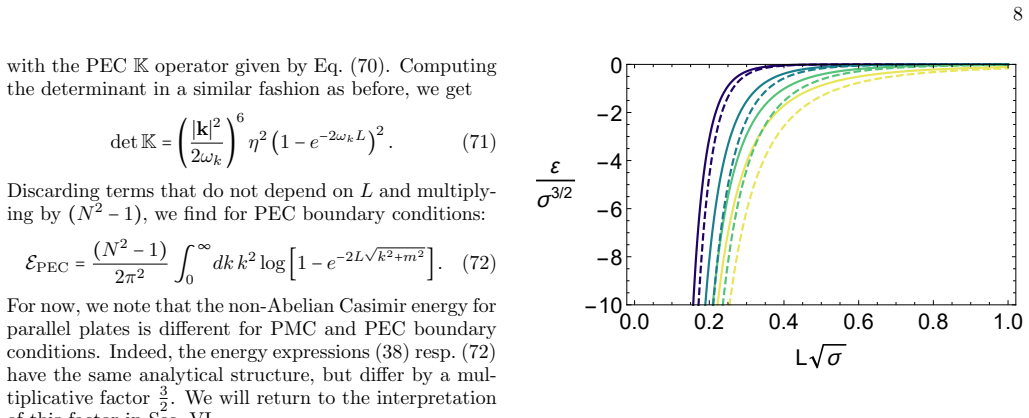
- [§VIII.A, Eq. (87), Figs. 3–4] The lattice compatibility claim for parallel plates is not a test of the 3/2 ratio, and the quantitative evidence is weak. With the mass fixed from the gluon propagator, the global factor needed to match the plate data is C = 5.63 for Ref. [42], C = 0.54 for Ref. [43], and C = 0.69 for SU(2), whereas tree level predicts C = 1. The text itself acknowledges that C≈5 'does not fit entirely well with a perturbatively stable analysis' and that C0 is a phenomenological factor absorbing 'all missing effects.' Thus the comparison largely matches the exponential shape of the lattice fit (86), which was already the fitting ansatz used in Ref. [42]. Please state precisely what the comparison establishes, provide uncertainties on the fitted C values, and specify what would distinguish the CF prediction from a massive-scalar fit.
- [§VI, Eqs. (35), (38), (71), (78)] The vDVZ-like discontinuity is derived by comparing the m→0 limit of the massive determinant with the exactly massless determinant. This is internally consistent: Eq. (35) contains m^4 and the m→0 limit of the PMC determinant, after discarding L-independent terms, gives a finite factor 3/2, while the exactly massless PMC operator coincides with the PEC operator (69) of rank 2. However, the identification of this order-of-limits issue with a vDVZ discontinuity needs more support. In the standard vDVZ effect the discontinuity is tied to the coupling of longitudinal modes to sources; here it is purely a boundary-mode counting effect in a free theory. Please either identify a physical observable that would distinguish lim_{m→0} E_PMC from E_{m=0,PMC}, or soften the claim so that it is explicitly a formal analogy rather than a physical discontinuity.
minor comments (4)
- [Appendix A and Fig. 7] The text states that the SU(3) 4D fit gives (Z=1.44, m=0.67 GeV), while the Fig. 7 caption gives (Z=2.93, m=0.54 GeV); Sec. VIII uses m=0.54 GeV. Please correct the inconsistent values.
- [§VIII.A, Eq. (87)] The relation between the fitted global factor C and the lattice-fit parameter C0 of Eq. (86) should be stated explicitly. Also, the figure captions for Figs. 3 and 4 describe curves by color; please ensure the color labeling is unambiguous in print.
- [§VII] Typo: 'symetry' should be 'symmetry'; also 'Ap´ery' should be 'Apéry' in the reference to Apéry's constant.
- [§III, Eq. (20)] It would be useful to state explicitly that the longitudinal term in Eq. (11) drops out because k_μ H^{μρ} k_ρ = 0, which is the symmetry argument used. This is correct but would improve readability.
Circularity Check
No significant circularity: the 3/2 (resp. 2) ratio is a determinant/mode-count from the quadratic CF model, and the lattice comparison uses an independently fitted mass with an explicitly admitted global normalization factor.
full rationale
The central PMC/PEC ratio is not circular: it follows from computing the boundary-operator determinants (35) and (71), whose L-dependent logarithms differ by a factor 3/2 in 3+1D (and by a factor 2 in 2+1D, from (79) and (82)). This ratio is a mode-counting consequence of the residual gauge symmetry of the PEC boundary action and does not depend on the fitted mass m; it is not introduced as an input. The vDVZ-like massless discontinuity (78) likewise follows directly by taking m→0 in Eq. (38), so the massive and exactly-massless determinants differ by polarization count. The lattice comparison in Sec. VIII uses m obtained from independent gluon-propagator fits (Appendix A) and adjusts only a global prefactor C, which the paper explicitly calls phenomenological and notes is close to 1 in the wire case; no fitted parameter is relabeled as a prediction. Self-citations are present (notably Ref. [9] for the boundary-QFT method), but the method is re-derived in Sec. III and benchmarked against the known Maxwell limits (Eqs. (56) and (85)), so the self-citation is not load-bearing. The acknowledged restriction to quadratic fields and neglect of interactions/ghosts (Sec. IX) is a correctness limitation, not circularity.
Axiom & Free-Parameter Ledger
free parameters (2)
- Curci-Ferrari mass m =
0.54 GeV (SU(3) 4D), 0.68 GeV (SU(2) 4D), 0.97 GeV (SU(2) 3D); 0.86, 0.78, 0.76 GeV when fit directly to Casimir data
- Global normalization C =
5.63, 0.54, 0.69 (plates); 1.07, 1.01 (wires)
axioms (6)
- domain assumption The Curci-Ferrari model with a tree-level massive gluon propagator is an adequate effective description of the infrared Yang-Mills vacuum.
- domain assumption Terms beyond quadratic order in the fields (interactions and ghosts) do not affect the leading Casimir energy.
- domain assumption Boundary conditions can be implemented by auxiliary Lagrange multiplier fields in the functional integral, and integrating out the bulk yields the vacuum energy through a functional determinant.
- standard math The residual gauge symmetry of the PEC boundary fields must be fixed, and the L-dependent part of the energy is independent of the gauge-fixing parameter.
- domain assumption The continuum PEC/PMC boundary conditions used here correspond to the 'perfect chromometallic' boundary conditions of the lattice simulations.
- domain assumption The mass m extracted from bulk gluon propagator fits remains the relevant mass scale in the presence of the boundaries.
invented entities (1)
-
Boundary auxiliary fields b_±^a_i
no independent evidence
Cite this review
Pith. "Pith review of Non-Abelian Casimir energy in the Curci-Ferrari model through a functional approach." pith.science (2026). https://pith.science/paper/SQDQ24WL
@misc{pith2026250907256,
  author       = {Pith},
  title        = {Pith review of: Non-Abelian Casimir energy in the Curci-Ferrari model through a functional approach},
  year         = {2026},
  howpublished = {\url{https://pith.science/paper/SQDQ24WL}},
  note         = {Machine review of arXiv:2509.07256}
}
read the original abstract
Using functional integral methods, we investigate the non-Abelian Casimir energy in the Curci-Ferrari model, which offers an effective description of the infrared regime of Yang-Mills theory. We consider a 3+1D (resp.\ 2+1D) system of two infinite parallel plates (resp.\ wires) at a fixed distance from each other, with either perfect magnetic conductor (PMC) or perfect electric conductor (PEC) boundary conditions. Imposing the boundary conditions directly in the functional integral by the introduction of suitable auxiliary fields that act as Lagrange multipliers, we obtain a boundary effective action that captures the dynamics of this system. The Casimir energy is then computed both directly from the functional integral and via the energy-momentum tensor, providing equivalent results. We find that the Casimir energy for PEC and PMC conditions differs by a constant factor, which can be traced back to a van Dam--Veltman--Zakharov-like discontinuity (both in 3+1D and 2+1D). Lastly, we show that our analytical results are compatible with a variety of recent numerical lattice simulations of the non-perturbative Yang-Mills Casimir energy, in which a novel non-perturbative mass scale emerges.
Figures


Reference graph
Works this paper leans on
-
[1]
H. B. G. Casimir, On the attraction between two per- fectly conducting plates, Indag. Math.10, 261 (1948)
work page 1948
-
[2]
F. London, Zur theorie und systematik der moleku- larkr¨ afte, Zeitschrift f¨ ur Physik 10.1007/BF01421741 (1930)
-
[3]
S. K. Lamoreaux, Demonstration of the casimir force in the 0.6 to 6µmrange, Phys. Rev. Lett.78, 5 (1997)
work page 1997
-
[4]
G. Bimonte, B. Spreng, P. A. Maia Neto, G.-L. Ingold, G. L. Klimchitskaya, V. M. Mostepanenko, and R. S. Decca, Measurement of the Casimir Force between 0.2 and 8µm: Experimental Procedures and Comparison with Theory, Universe7, 93 (2021), arXiv:2104.03857 [quant-ph]
work page internal anchor Pith review Pith/arXiv arXiv 2021
-
[5]
G. Plunien, B. Muller, and W. Greiner, The Casimir Ef- fect, Phys. Rept.134, 87 (1986)
work page 1986
-
[6]
M. Bordag, U. Mohideen, and V. M. Mostepanenko, New developments in the Casimir effect, Phys. Rept.353, 1 (2001), arXiv:quant-ph/0106045
Pith/arXiv arXiv 2001
- [7]
- [8]
-
[9]
The Casimir energy in terms of boundary quantum field theory: the QED case
D. Dudal, P. Pais, and L. Rosa, Casimir energy in terms of boundary quantum field theory: The QED case, Phys. Rev. D102, 016026 (2020), arXiv:2005.12693 [hep-th]
work page internal anchor Pith review Pith/arXiv arXiv 2020
- [10]
-
[11]
R. Golestanian and M. Kardar, Path-integral approach to the dynamic casimir effect with fluctuating boundaries, Physical Review A58, 1713–1722 (1998)
work page 1998
-
[12]
The Casimir effect in chiral media using path integral techniques
F. Canfora, D. Dudal, T. Oosthuyse, P. Pais, and L. Rosa, The Casimir effect in chiral media using path in- tegral techniques, JHEP09, 095, arXiv:2207.09175 [hep- th]
work page internal anchor Pith review Pith/arXiv arXiv
-
[13]
T. Oosthuyse and D. Dudal, Interplay between chiral me- dia and perfect electromagnetic conductor plates: Repul- sive vs. attractive Casimir force transitions, SciPost Phys. 15, 213 (2023), arXiv:2301.12870 [hep-th]. 15
work page internal anchor Pith review Pith/arXiv arXiv 2023
-
[14]
D. Dudal, A. Gobeyn, T. Oosthuyse, S. Stouten, and D. Vercauteren, Casimir energy with perfect electro- magnetic boundary conditions and duality: A field- theoretic approach, Phys. Rev. D110, 065015 (2024), arXiv:2406.19743 [hep-th]
work page internal anchor Pith review Pith/arXiv arXiv 2024
-
[15]
Scalar field theory under Robin boundary conditions: two-point function and energy-momentum tensor
D. Dudal, T. Oosthuyse, S. Stouten, A. Gobeyn, and B. W. Mintz, Scalar field theory under Robin boundary conditions: Two-point function and en- ergy–momentum tensor, Annals Phys.470, 169827 (2024), arXiv:2409.07060 [hep-th]
work page internal anchor Pith review Pith/arXiv arXiv 2024
-
[16]
F. Canfora, D. Dudal, T. Oosthuyse, L. Rosa, and S. Stouten, Dynamical edge modes in Maxwell theory from a BRST perspective, with an application to the Casimir energy, JHEP03, 161, arXiv:2412.04270 [hep- th]
-
[17]
Greensite,An introduction to the confinement problem, Vol
J. Greensite,An introduction to the confinement problem, Vol. 821 (2011)
work page 2011
-
[18]
K. G. Wilson, Confinement of Quarks, Phys. Rev. D10, 2445 (1974)
1974
-
[19]
G. S. Bali, QCD forces and heavy quark bound states, Phys. Rept.343, 1 (2001), arXiv:hep-ph/0001312
Pith/arXiv arXiv 2001
-
[20]
B. Lucini and M. Teper, Confining strings in SU(N) gauge theories, Phys. Rev. D64, 105019 (2001), arXiv:hep- lat/0107007
-
[21]
M. Luscher and P. Weisz, Quark confinement and the bosonic string, JHEP07, 049, arXiv:hep-lat/0207003
-
[22]
Mandelstam, Vortices and Quark Confinement in Non- abelian Gauge Theories, Phys
S. Mandelstam, Vortices and Quark Confinement in Non- abelian Gauge Theories, Phys. Rept.23, 245 (1976)
work page 1976
-
[23]
Nambu, Strings, monopoles, and gauge fields, Phys
Y. Nambu, Strings, monopoles, and gauge fields, Phys. Rev. D10, 4262 (1974)
1974
-
[24]
G. ’t Hooft, Topology of the Gauge Condition and New Confinement Phases in Nonabelian Gauge Theories, Nucl. Phys. B190, 455 (1981)
work page 1981
- [25]
-
[26]
Chodos, R
A. Chodos, R. L. Jaffe, K. Johnson, C. B. Thorn, and V. F. Weisskopf, New extended model of hadrons, Phys. Rev. D9, 3471 (1974)
1974
-
[27]
T. H. Boyer, Quantum electromagnetic zero-point energy of a conducting spherical shell and the casimir model for a charged particle, Phys. Rev.174, 1764 (1968)
work page 1968
-
[28]
B. Davies, Quantum electromagnetic zero- point energy of a conducting spherical shell, Journal of Mathematical Physics13, 1324 (1972), https://pubs.aip.org/aip/jmp/article- pdf/13/9/1324/19091624/1324 1 online.pdf
work page 1972
-
[29]
C. M. Bender and P. Hays, Zero-point energy of fields in a finite volume, Phys. Rev. D14, 2622 (1976)
work page 1976
-
[30]
L. E. Oxman, N. F. Svaiter, and R. L. P. G. Amaral, Attractive casimir effect in an infrared modified gluon bag model, Phys. Rev. D72, 125007 (2005)
work page 2005
-
[31]
F. Canfora and L. Rosa, Casimir energy in the gribov- zwanziger approach to qcd, Phys. Rev. D88, 045025 (2013)
work page 2013
-
[32]
M. Pel´ aez, U. Reinosa, J. Serreau, M. Tissier, and N. Wschebor, A window on infrared qcd with small ex- pansion parameters, Reports on Progress in Physics84, 124202 (2021)
work page 2021
-
[33]
Infrared propagators of Yang-Mills theory from perturbation theory
M. Tissier and N. Wschebor, Infrared propagators of Yang-Mills theory from perturbation theory, Phys. Rev. D82, 101701 (2010), arXiv:1004.1607 [hep-ph]
work page internal anchor Pith review Pith/arXiv arXiv 2010
-
[34]
An Infrared Safe perturbative approach to Yang-Mills correlators
M. Tissier and N. Wschebor, An Infrared Safe pertur- bative approach to Yang-Mills correlators, Phys. Rev. D 84, 045018 (2011), arXiv:1105.2475 [hep-th]
work page internal anchor Pith review Pith/arXiv arXiv 2011
-
[35]
G. Curci and R. Ferrari, On a Class of Lagrangian Models for Massive and Massless Yang-Mills Fields, Nuovo Cim. A32, 151 (1976)
work page 1976
-
[36]
The infrared-safe Minkowskian Curci-Ferrari model
S. Oribe, M. Pel´ aez, and U. Reinosa, Infrared-safe Minkowskian Curci-Ferrari model, Phys. Rev. D112, 014005 (2025), arXiv:2503.14291 [hep-ph]
work page internal anchor Pith review Pith/arXiv arXiv 2025
-
[37]
Four-gluon vertex from the Curci-Ferrari model at one-loop order
N. Barrios, P. De Fabritiis, and M. Pel´ aez, Four-gluon vertex from the Curci-Ferrari model at one-loop order, Phys. Rev. D109, L091502 (2024), arXiv:2403.17056 [hep-th]
work page internal anchor Pith review Pith/arXiv arXiv 2024
-
[38]
Small parameters in infrared QCD: The pion decay constant
M. Pel´ aez, U. Reinosa, J. Serreau, and N. Wsche- bor, Small parameters in infrared QCD: The pion decay constant, Phys. Rev. D107, 054025 (2023), arXiv:2212.10089 [hep-ph]
work page internal anchor Pith review Pith/arXiv arXiv 2023
-
[39]
N. Barrios, M. Pel´ aez, and U. Reinosa, Two-loop three- gluon vertex from the Curci-Ferrari model and its leading infrared behavior to all loop orders, Phys. Rev. D106, 114039 (2022), arXiv:2207.10704 [hep-ph]
work page internal anchor Pith review Pith/arXiv arXiv 2022
-
[40]
Two-loop corrections to the QCD propagators within the Curci-Ferrari model
N. Barrios, J. A. Gracey, M. Pel´ aez, and U. Reinosa, Two-loop corrections to the QCD propagators within the Curci-Ferrari model, Phys. Rev. D104, 094019 (2021), arXiv:2103.16218 [hep-th]
work page internal anchor Pith review Pith/arXiv arXiv 2021
-
[41]
Three lectures on the Curci-Ferrari model
U. Reinosa, Three lectures on the Curci-Ferrari model, in3rd Joint ICTP-SAIFR/ICTP-Trieste Summer School on Particle Physics(2024) arXiv:2403.10702 [hep-ph]
work page internal anchor Pith review Pith/arXiv arXiv 2024
-
[42]
also from an analytical perspective. This being said, the effective action for our boundary fields, see Eqs. (24)- (28), does imply a singularity atω k = √ ∣⃗k∣2+m 2 =0 in the boundary fields propagator matrix, which might sug- gest that the boundary fields are perhaps closely related to these “gluetons”, with their mass scale dictated bym. Finally, we no...
work page 2024
-
[43]
M. N. Chernodub, V. A. Goy, A. V. Molochkov, and A. S. Tanashkin, Boundary states and non-Abelian Casimir effect in lattice Yang-Mills theory, Phys. Rev. D108, 014515 (2023), arXiv:2302.00376 [hep-lat]
Pith/arXiv arXiv 2023
- [44]
-
[45]
B. A. Ngwenya,The Casimir Effect in Non-Abelian Gauge Theories on the Lattice, Other thesis (2025), arXiv:2505.02875 [hep-lat]
work page internal anchor Pith review Pith/arXiv arXiv 2025
-
[46]
M. N. Chernodub, V. A. Goy, A. V. Molochkov, and H. H. Nguyen, Casimir Effect in Yang-Mills Theory in D=2+1, Phys. Rev. Lett.121, 191601 (2018), arXiv:1805.11887 [hep-lat]
Pith/arXiv arXiv 2018
-
[47]
M. N. Chernodub, V. A. Goy, and A. V. Molochkov, Nonperturbative Casimir Effects in Field Theories: as- pects of confinement, dynamical mass generation and chiral symmetry breaking, PoSConfinement2018, 006 (2019), arXiv:1901.04754 [hep-th]
work page internal anchor Pith review Pith/arXiv arXiv 2019
-
[48]
M. N. Chernodub, V. A. Goy, and A. V. Molochkov, Nonperturbative Casimir effect and monopoles: compact Abelian gauge theory in two spatial dimensions, Phys. Rev. D95, 074511 (2017), arXiv:1703.03439 [hep-lat]
work page internal anchor Pith review Pith/arXiv arXiv 2017
-
[49]
M. N. Chernodub, V. A. Goy, A. V. Molochkov, and A. S. Tanashkin, Casimir boundaries, monopoles, and deconfinement transition in (3+1)- dimensional com- pact electrodynamics, Phys. Rev. D105, 114506 (2022), arXiv:2203.14922 [hep-lat]
work page internal anchor Pith review Pith/arXiv arXiv 2022
-
[50]
Noether, Invariante variationsprobleme, Nachr
E. Noether, Invariante variationsprobleme, Nachr. d. K¨ onig. Gesellsch. d. Wiss. zu G¨ ottingen, Math-phys. Klasse , 235 (1918)
work page 1918
-
[51]
J. C. Collins,Renormalization: An Introduction to Renormalization, The Renormalization Group, and the Operator Product Expansion, Cambridge Monographs on Mathematical Physics, Vol. 26 (Cambridge University Press, Cambridge, 1986)
work page 1986
-
[52]
Zinn-Justin,Quantum field theory and critical phe- nomena, 5th ed., Int
J. Zinn-Justin,Quantum field theory and critical phe- nomena, 5th ed., Int. Ser. Monogr. Phys., Vol. 171 (Ox- 16 ford University Press, 2021)
work page 2021
-
[53]
H. van Dam and M. J. G. Veltman, Massive and massless Yang-Mills and gravitational fields, Nucl. Phys. B22, 397 (1970)
work page 1970
-
[54]
V. I. Zakharov, Linearized gravitation theory and the graviton mass, JETP Lett.12, 312 (1970)
work page 1970
-
[55]
Casimir Effect in (2+1)-dimensional Yang-Mills Theory as a Probe of the Magnetic Mass
D. Karabali and V. P. Nair, Casimir effect in (2+1)- dimensional Yang-Mills theory as a probe of the magnetic mass, Phys. Rev. D98, 105009 (2018), arXiv:1808.07979 [hep-th]
work page internal anchor Pith review Pith/arXiv arXiv 2018
-
[56]
M. V. Cougo-Pinto, C. Farina, and A. J. Segui-Santonja, Schwinger’s method for the massive Casimir effect, Lett. Math. Phys.31, 309 (1994), arXiv:hep-th/9401123
work page internal anchor Pith review Pith/arXiv arXiv 1994
-
[57]
A. Athenodorou and M. Teper, The glueball spectrum of SU(3) gauge theory in 3 + 1 dimensions, JHEP11, 172, arXiv:2007.06422 [hep-lat]
Pith/arXiv arXiv 2007
-
[58]
A. G. Duarte, O. Oliveira, and P. J. Silva, Lattice Gluon and Ghost Propagators, and the Strong Coupling in Pure SU(3) Yang-Mills Theory: Finite Lattice Spacing and Volume Effects, Phys. Rev. D94, 014502 (2016), arXiv:1605.00594 [hep-lat]
Pith/arXiv arXiv 2016
-
[59]
A. Cucchieri, D. Dudal, T. Mendes, and N. Van- dersickel, Modeling the Gluon Propagator in Landau Gauge: Lattice Estimates of Pole Masses and Dimension- Two Condensates, Phys. Rev. D85, 094513 (2012), arXiv:1111.2327 [hep-lat]
Pith/arXiv arXiv 2012
- [60]
-
[61]
Deser and C
S. Deser and C. Teitelboim, Duality Transformations of Abelian and Nonabelian Gauge Fields, Phys. Rev. D13, 1592 (1976)
1976
-
[62]
Gribov, Quantization of non-abelian gauge theories, Nuclear Physics B139, 1 (1978)
V. Gribov, Quantization of non-abelian gauge theories, Nuclear Physics B139, 1 (1978)
work page 1978
-
[63]
Zwanziger, Local and renormalizable action from the gribov horizon, Nuclear Physics B323, 513 (1989)
D. Zwanziger, Local and renormalizable action from the gribov horizon, Nuclear Physics B323, 513 (1989)
work page 1989
-
[64]
Dudal, J
D. Dudal, J. A. Gracey, S. P. Sorella, N. Vandersickel, and H. Verschelde, Refinement of the gribov-zwanziger approach in the landau gauge: Infrared propagators in harmony with the lattice results, Phys. Rev. D78, 065047 (2008)
2008
-
[65]
J. Serreau and M. Tissier, Lifting the Gribov ambigu- ity in Yang-Mills theories, Phys. Lett. B712, 97 (2012), arXiv:1202.3432 [hep-th]
Pith/arXiv arXiv 2012
This paper was first reviewed by deepseek-v4-flash on August 4, 2026.
discussion (0)
Sign in with ORCID, Apple, or X to comment. Anyone can read and Pith papers without signing in.