REVIEW 2 minor 1 cited by
Reviewed by Pith at T0; open to challenge.
T0 means a machine referee read the full paper against a public rubric. The mark states how deep the mechanical check went, never who wrote it. the ladder, T0–T4 →
T0 review · grok-4.3
The DBI model for planar domain walls prevents caustic formation from smooth waves in the hyperbolic regime.
2026-05-10 18:05 UTC pith:T7FPKUZH
load-bearing objection DBI waves on domain walls stay shock-free from smooth data while hyperbolic, with characteristics non-intersecting even when non-parallel in spherical, cosmological, and deformed cases.
Caustic formation in DBI models: Wave propagation on planar domain walls
The pith
A machine-rendered reading of the paper's core claim, the machinery that carries it, and where it could break.
Core claim
Generic waves propagating on planar domain walls in the DBI scalar model do not develop singularities from smooth initial conditions in the hyperbolic case. Although characteristic curves are parallel only in the simplest 2D flat setup and become non-parallel in D greater than 2, expanding cosmologies, and deformed DBI, they never cross. This implies that caustics appear solely when hyperbolicity is lost, producing a cusp profile, and that the detailed structure of characteristics influences cusp formation.
What carries the argument
The characteristic curves of the quasilinear PDE for DBI wave dynamics, which do not intersect in the hyperbolic regime.
Load-bearing premise
The analysis assumes the DBI effective theory remains a valid description and the system stays within the regime where the equations are hyperbolic.
What would settle it
A numerical simulation starting from smooth initial data for the DBI wave equation in one of the extended setups that produces a crossing of characteristics or a shock while the equation is still hyperbolic would contradict the result.
Editorial analysis
A structured set of objections, weighed in public.
Referee Report
Summary. The paper analyzes wave propagation on planar domain walls in the scalar DBI model, with emphasis on caustic formation. In 2D flat spacetime the relevant characteristic family remains parallel for smooth initial data in the hyperbolic regime, precluding shocks. The analysis is extended to D>2 spherical waves, expanding cosmological backgrounds, and a minimal DBI deformation; in each case the characteristics are shown to be non-parallel yet non-intersecting while hyperbolicity is preserved. The authors conclude that caustics on such walls arise only upon loss of hyperbolicity and exhibit cusp profiles, and that the non-trivial characteristic structure beyond 2D flat space affects cusp formation.
Significance. If the central claim holds, the work supplies a concrete, characteristic-based criterion linking shock formation in DBI domain walls specifically to the breakdown of hyperbolicity rather than to generic nonlinearity. The explicit treatment of characteristic families in spherical, cosmological, and deformed settings is a technical strength that clarifies the robustness of the DBI effective description inside its hyperbolic domain and has direct relevance to cosmological domain-wall dynamics and possible particle emission.
minor comments (2)
- The abstract states that characteristics 'cease to be parallel' beyond 2D flat space but 'DBI remains shock free'; a brief parenthetical reference to the relevant section or equation defining the characteristic ODEs would help readers locate the explicit verification for the D>2 and cosmological cases.
- In the discussion of the minimal deformation, the precise form of the added term and its effect on the principal symbol of the PDE could be stated explicitly (e.g., by quoting the modified Lagrangian or the resulting characteristic speed) to make the non-intersection argument fully self-contained.
Simulated Author's Rebuttal
We thank the referee for their positive and insightful report, which accurately captures the main results of our work on wave propagation and caustic formation in DBI domain walls. We are pleased that the referee recognizes the technical analysis of characteristic families across different setups and the implications for the robustness of the DBI effective description.
Circularity Check
No significant circularity; derivation self-contained
full rationale
The paper's central result follows from direct derivation of the characteristic equations for the DBI scalar PDE in the hyperbolic regime, followed by explicit analysis showing non-intersection of characteristics (parallel in 2D flat space; non-parallel but non-crossing in D>2, expanding, and deformed cases). No step reduces a prediction to a fitted input, self-citation, or definitional tautology; the proofs are internal to the PDE structure obtained from the Lagrangian and hold under the stated assumptions without external load-bearing references or renamings.
Axiom & Free-Parameter Ledger
axioms (2)
- domain assumption The DBI action produces a hyperbolic system of PDEs in the regime under study.
- domain assumption Initial data are smooth.
read the original abstract
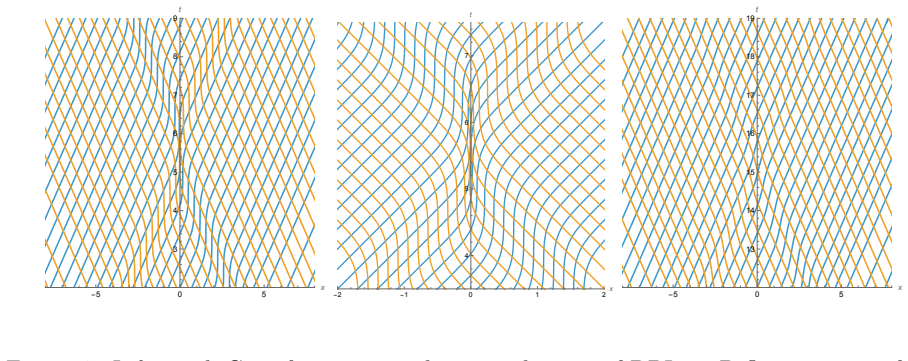
We investigate propagation of generic waves on thin planar domain walls effectively described by the scalar Dirac-Born-Infeld model (DBI). We pay a particular attention to the possibility of caustic formation - the process, which may lead to intensive particle emission by domain walls. It is demonstrated that no singularities arise in DBI in 2D flat spacetime in the hyperbolic case, if one starts from smooth initial conditions. Technically, this happens because the same family characteristics of the relevant partial differential equation remain parallel at all the times, albeit not being straight lines generically. Crucially, characteristic curves cease to be parallel beyond the simplified setup of DBI in 2D flat spacetime. In particular, this is shown to be the case in $D>2$ for spherical waves, in an expanding Universe, and in the case of a minimal deformation of DBI necessary for avoiding the domain wall problem in cosmology. However, we prove that DBI remains caustic free in the hyperbolic case in all these physically relevant situations. This strongly suggests that caustics can form on planar domain walls only due to the loss of hyperbolicity, and they have a cusp profile. We demonstrate, how the non-trivial structure of DBI characteristics beyond the 2D flat spacetime setup uncovered in this work can significantly affect cusp formation.
Figures


Forward citations
Cited by 1 Pith paper
-
Cuspidal Singularities in Collapsing Domain Walls
Collapsing domain walls generically form cuspidal edge and vertex singularities captured by Nambu-Goto and eikonal approximations and reproduced in field theory simulations.
discussion (0)
Sign in with ORCID, Apple, or X to comment. Anyone can read and Pith papers without signing in.