REVIEW 4 major objections 4 minor 63 references
PBa-LLM: Privacy- and Bias-aware NLP using Named-Entity Recognition (NER)
T0 review · 4 major / 4 minor · reviewed 2026-08-06 · deepseek-v4-flash
Pith's one-line read This paper claims that NER-based removal of person and location entities from resume biographies preserves—and sometimes improves—occupancy prediction and scoring accuracy, while adding a bias-reduction step balances the top-100 gender…
desk verdict A useful empirical comparison of NER anonymizers for resume scoring, but the privacy claims outrun the measurements. read the letter →
The pith
A machine-rendered reading of the paper's core claim, the machinery that carries it, and where it could break.
The reading
What carries the argument
The central machinery is a Named-Entity Recognition (NER) anonymization module that detects and masks sensitive tokens in resume biographies before training. Six different NER engines are compared—Presidio, FLAIR, a BERT model fine-tuned on CoNLL-2003, GPT-3.5, GPT-4, and GPT-4o-mini—and each one removes person (PER) and location (LOC) entities. The downstream model freezes a Transformer encoder's weights, averages its token embeddings into a text feature vector, fuses that vector with the candidate's structured competency attributes, and then predicts both occupational sector and an expert-style score.
What would settle it
Manually scan a random sample of the anonymized FairCVdb biographies for surviving person and location names, and compute the miss rate per anonymizer; if the miss rate is nontrivial, the tools have not fully removed the sensitive information regardless of downstream accuracy. A complementary test is a re-identification or membership-inference attempt on the masked texts.
Extended reading notes
Core claim
On the paper's own terms, the discovery is that masking person and location entities detected by NER preserves, and sometimes slightly improves, the performance of occupation-prediction and candidate-scoring models built on BERT and RoBERTa, while adding a bias-reduction step produces PBa-LLMs whose top-100 gender split becomes approximately balanced even when trained on gender-biased labels. The paper states that in the worst case performance remains unchanged, while in the best case privacy increases without compromising accuracy.
Load-bearing premise
The privacy guarantee rests on the assumption that the six NER modules catch nearly every name and location in resume-style biographies, since the paper reports benchmark scores on CoNLL-2003 but never measures what fraction of entities is actually missed on its 24,000-resume testbed.
Editorial extensions
If this is right
- If correct, NER-based masking is a viable low-cost privacy layer for LLM pipelines in high-stakes domains, since it does not force a privacy/accuracy tradeoff.
- Because the results hold across two encoders and six anonymizers, the performance-preservation effect is not tied to a single NER tool; even imperfect NER models appear sufficient on the utility side.
- Adding the bias-aware step to anonymized text changes the gender composition of top-100 shortlists from roughly 67/33 to roughly 50/50 without hurting occupancy prediction, so privacy and bias mitigation can be combined in one pipeline.
- The authors state that the framework is generally applicable beyond recruitment, making the two-stage recipe—entity masking plus representation-level debiasing—a candidate template for other LLM-based text domains.
Reading between the lines
- A direct test the paper leaves implicit is to compute recall and precision of each NER module on the FairCVdb biographies themselves, since CoNLL-2003 benchmark scores do not guarantee in-domain coverage; if recall is low, the confidentiality claim is only as strong as the entities that were missed.
- Even if the text is fully anonymized, the structured attribute vector still includes gender and ethnicity, so the privacy-aware models continue to receive demographic signals through a non-textual channel; a stricter privacy reading would require masking or dropping those attributes too.
- The gender-balance improvement may partly follow from removing gendered language through NER plus the debiasing step; a useful extension would measure how much of the 67/33 to 50/50 shift is caused by each component alone.
- The performance-neutrality result could be domain-sensitive: in healthcare or legal texts, news-trained NER models may miss entity types that are rare in CoNLL-2003, so the same experiment should be repeated where entity distributions differ.
Editorial analysis
A structured set of objections, weighed in public.
Referee Report
Summary. The paper proposes a framework for privacy-preserving NLP based on named-entity recognition (NER). In the recruitment use case, short resume biographies from the FairCVdb dataset are anonymized by masking PER and LOC entities using six NER tools (Presidio, FLAIR, BERT-CoNLL2003, GPT-3.5, GPT-4, GPT-4o-mini). Two Transformer backbones (BERT and RoBERTa) are then trained on the original and anonymized biographies for two tasks: four-way occupancy prediction and scalar candidate scoring. The paper reports that NER-based anonymization maintains or slightly improves occupancy prediction accuracy, and that combining anonymization with the bias-aware training objective of Peña et al. [40] yields PBa-LLMs that keep gender proportions in top-100 candidate shortlists close to 50/50. The central claims are that NER anonymization preserves downstream task performance while safeguarding candidate confidentiality, and that PBa-LLMs do not degrade scoring performance while reducing gender bias.
Significance. If the performance-preservation result is reliable, the paper would provide a useful empirical comparison of six NER anonymizers in a high-stakes recruitment setting, covering two transformer architectures and two tasks. The use of an established multimodal benchmark (FairCVdb) and the breadth of anonymizers are strengths, and the paper is clear about the pipeline it evaluates. However, the privacy claim is not directly tested: the authors never measure in-domain NER recall/precision, they mask only PER and LOC while their own definition of sensitive information includes companies, and the structured attribute vector still carries gender and ethnicity into the model. The bias results are also largely inherited from the bias-aware objective of [40] by construction, and the scoring task is evaluated only through top-100 gender proportions without any scoring error metric. The empirical core is useful but the paper currently overstates its privacy guarantees.
major comments (4)
- [§3.1, §3.2, §4.2] The privacy claim is not supported by the reported experiments. Section 4.2 reports entity counts and CoNLL-2003 F1 scores above 80%, but neither measure establishes that the anonymized biographies are actually free of personally identifiable information. The paper never measures in-domain recall or precision on the FairCVdb biographies, so missed PER and LOC entities could remain in the text. Moreover, Section 3.1 defines sensitive information as including names, locations, and companies, while Section 3.2 and Section 4.2 state that the anonymizer masks only PER and LOC entities; therefore the formal condition z_i not in t_i^- is not achieved for company names, and the conclusion that the framework 'safeguards candidate confidentiality' goes beyond what is measured.
- [§4.1, Fig. 2] Even perfect NER removal from the biography would not remove demographic attributes from the model input, because the candidate competencies vector v_i includes gender and ethnicity (Section 4.1) and is fused with the text embedding in the scoring model (Fig. 2). The claim that anonymization 'increases privacy' is therefore only about one modality and should be stated as such; as written, the abstract and Section 5.1 imply a confidentiality guarantee that the architecture does not provide.
- [§5.2, Table 3] The paper claims that PBa-LLMs 'do not degrade the performance of occupation prediction models' and that the combined approach is useful for candidate scoring, but Table 3 reports only gender proportions in the top-100 shortlist. No RMSE, MAE, or equivalent error metric is given for the scoring task, and Table 2 covers only occupancy prediction. The scoring-performance claim is therefore unsupported and needs a direct evaluation on the scoring output y_hat.
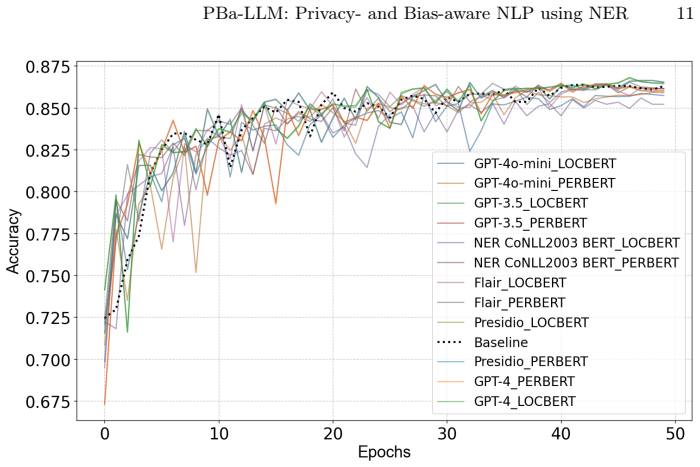
- [§5.1, Tables 1-2] The occupancy results are computed on a single fixed 80/20 split with no confidence intervals, significance tests, or multiple runs. Most anonymized-versus-baseline differences are a few accuracy points, so the statement that 'in the worst case, performance remains unchanged' is not established; the observed fluctuations could be within run-to-run or split-to-split variability. Reporting mean and standard deviation over several seeds or splits is needed to support the performance-preservation claim.
minor comments (4)
- [Table 2] The caption says 'Gender (all rows except None (Baseline))' but the table has no gender column; the caption appears to be a leftover from an earlier draft and should be corrected.
- [Fig. 2] The sample biography contains the typo '20014-2017' for the employment period.
- [§4.2] The paper reports that all six NER modules exceed 80% on CoNLL-2003 but does not give the per-module F1 values or their standard deviations; a small table would make the anonymizer comparison more informative.
- [Reference list] Reference [14] contains a typo ('Europen Union') and the citation formatting for some entries (e.g., [31] as a bare arXiv ID) is inconsistent with the rest of the bibliography.
Circularity Check
Fairness result is inherited from the authors' own debiasing objective; privacy gain is definitional, but the core performance benchmark is independent.
-
self definitional
[Sec. 3.1, Sec. 4.2, Sec. 5.1]
"Assume that there is sensitive information zi within ti that we want to protect. We use the anonymization function N to generate t−i, so zi ∉ t−i. ... The number of entities removed varies from 28,000 to 66,000 ... This information represents approximately between 4% and 9% of the total words ... In the worst case, performance remains unchanged, while in the best case, privacy is increased without compromising accuracy."
By the paper's own formalization, privacy is defined as the removal of sensitive entities: the stated goal is the condition z_i ∉ t−_i, and the only evidence adduced about privacy is the count of removed entities. Therefore 'privacy is increased' is a restatement of the intervention itself, not an empirical measurement of confidentiality. No in-domain recall/precision on FairCVdb, no re-identification test, and no independent privacy metric are reported. Moreover, Sec. 3.1 defines z_i as including 'companies', while Fig. 2 and Sec. 4.2 state that only PER and LOC are masked, so even the paper's own formal condition z_i ∉ t−_i is not satisfied for ORG entities. The phrase 'safeguarding candidate confidentiality' goes beyond what the definitional entity-removal counts can support.
-
self citation load bearing
[Sec. 5.2, Table 3]
"To address this, we will employ the bias-aware learning framework introduced in [39] and further detailed in [40], which represents a method to systematically remove gender characteristics from the model's internal representations. ... None (Bias-aware) 47.80% 52.20%"
The gender-balance result of PBa-LLM is produced by the debiasing objective of [40], which by design 'systematically remove[s] gender characteristics'. Table 3 makes this explicit: the row 'None (Bias-aware)' already reaches 47.80/52.20 male/female without any NER anonymization, and every NER-based row lands at approximately the same 50/50 split. Thus the fairness outcome is not a discovery of the proposed NER-plus-debiasing combination; it is a construction-level consequence of applying the same authors' earlier method. Since [39,40] are prior works with overlapping authorship and the paper presents this inherited outcome as the fairness component of PBa-LLM, the load-bearing support for the fairness claim is a self-citation chain rather than an independently derived prediction.
full rationale
The core performance result of the paper is genuinely empirical and self-contained: it compares six external NER tools (Presidio, FLAIR, BERT-CoNLL2003, GPT-3.5, GPT-4, GPT-4o-mini) against a non-anonymized baseline on 24,000 resume biographies, and the occupancy/scoring accuracy tables stand as independent evidence that masking PER and LOC entities does not degrade the downstream tasks. That part is not circular. The circularity is concentrated in two softer claims. First, the conclusion that 'privacy is increased' is a definitional restatement of the entity-removal intervention; the paper never measures whether the anonymized biographies are actually free of re-identifying information or whether the NER modules perform well in the resume domain. Second, the PBa-LLM fairness result is inherited from the bias-aware objective of [40], which is by the same research group and is explicitly designed to remove gender characteristics; Table 3's 'None (Bias-aware)' row shows the same 50/50 gender split without any NER anonymization, so the fairness contribution reduces to the imported objective. Because the accuracy claim is independently grounded in external tools and a public benchmark, the overall circularity is moderate rather than total. Score 4 reflects that the central performance claim has independent content while the privacy and fairness components are partly self-definitional or self-citation-loaded.
Assumptions & free parameters
free parameters (3)
- Bias-reduction strength parameter from Peña et al. [40] =
not reported in this paper
- Choice of entity types PER and LOC =
PER, LOC only
- Top-100 shortlist threshold =
100
assumptions (3)
- domain assumption Frozen pretrained transformer features are sufficient for the downstream tasks
- ad hoc to paper CoNLL-2003 metrics transfer to resume biographies
- domain assumption The bias-aware method of [40] is valid and correctly implemented
Cite this review
Pith. "Pith review of PBa-LLM: Privacy- and Bias-aware NLP using Named-Entity Recognition (NER)." pith.science (2026). https://pith.science/paper/TA5GXZTH
@misc{pith2026250702966,
  author       = {Pith},
  title        = {Pith review of: PBa-LLM: Privacy- and Bias-aware NLP using Named-Entity Recognition (NER)},
  year         = {2026},
  howpublished = {\url{https://pith.science/paper/TA5GXZTH}},
  note         = {Machine review of arXiv:2507.02966}
}
read the original abstract
The use of Natural Language Processing (NLP) in highstakes AI-based applications has increased significantly in recent years, especially since the emergence of Large Language Models (LLMs). However, despite their strong performance, LLMs introduce important legal/ ethical concerns, particularly regarding privacy, data protection, and transparency. Due to these concerns, this work explores the use of Named- Entity Recognition (NER) to facilitate the privacy-preserving training (or adaptation) of LLMs. We propose a framework that uses NER technologies to anonymize sensitive information in text data, such as personal identities or geographic locations. An evaluation of the proposed privacy-preserving learning framework was conducted to measure its impact on user privacy and system performance in a particular high-stakes and sensitive setup: AI-based resume scoring for recruitment processes. The study involved two language models (BERT and RoBERTa) and six anonymization algorithms (based on Presidio, FLAIR, BERT, and different versions of GPT) applied to a database of 24,000 candidate profiles. The findings indicate that the proposed privacy preservation techniques effectively maintain system performance while playing a critical role in safeguarding candidate confidentiality, thus promoting trust in the experimented scenario. On top of the proposed privacy-preserving approach, we also experiment applying an existing approach that reduces the gender bias in LLMs, thus finally obtaining our proposed Privacyand Bias-aware LLMs (PBa-LLMs). Note that the proposed PBa-LLMs have been evaluated in a particular setup (resume scoring), but are generally applicable to any other LLM-based AI application.
Figures


Figures from the paper (2 more)

Reference graph
Works this paper leans on
-
[40]
Peña, A., Fierrez, J., Morales, A., Mancera, G., Lopez, M., Tolosana, R.: Ad- dressing bias in LLMs: Strategies and application to fair AI-based recruitment. arXiv:2506.11880 (2025)
arXiv 2025
-
[1]
Achiam, J., Adler, S., Agarwal, S., Ahmad, L., Akkaya, I., Aleman, F.L., Almeida, D., Altenschmidt, J., Altman, S., Anadkat, S., et al.: GPT-4 technical report. arXiv:2303.08774 (2023)
arXiv 2023
-
[2]
Science347(6221), 509–514 (2015)
Acquisti, A., Brandimarte, L., Loewenstein, G.: Privacy and human behavior in the age of information. Science347(6221), 509–514 (2015)
work page 2015
-
[3]
Akbik, A., Bergmann, T., Blythe, D., Rasul, K., Schweter, S., Vollgraf, R.: FLAIR: An easy-to-use framework for state-of-the-art NLP. In: Proceedings of the Confer- ence of the North American Chapter of the Association for Computational Lin- guistics (Demonstrations). pp. 54–59 (2019)
work page 2019
-
[4]
In: 2021 International Conference on Decision Aid Sciences and Application (DASA)
Al-Alawi, A.I., Naureen, M., AlAlawi, E.I., Al-Hadad, A.A.N.: The role of arti- ficial intelligence in recruitment process decision-making. In: 2021 International Conference on Decision Aid Sciences and Application (DASA). pp. 197–203. IEEE (2021)
work page 2021
-
[5]
Babych, B., Hartley, A.: Improving machine translation quality with automatic namedentityrecognition.In:Proceedingsofthe7thInternationalEAMTworkshop onMTandotherlanguagetechnologytools,ImprovingMTthroughotherlanguage technology tools, Resource and tools for building MT at EACL 2003 (2003)
work page 2003
-
[6]
AI-based Multimodal Biometrics for Detecting Smartphone Distractions: Application to Online Learning
Becerra, A., Daza, R., Cobos, R., Morales, A., Cukurova, M., Fierrez, J.: AI-based multimodal biometrics for detecting smartphone distractions: Application to online learning. arXiv:2506.17364 (2025)
work page Pith review arXiv 2025
-
[7]
Journal of Artificial Intelligence Research71, 1137–1181 (2021)
Cheng, L., Varshney, K.R., Liu, H.: Socially responsible AI algorithms: Issues, purposes, and challenges. Journal of Artificial Intelligence Research71, 1137–1181 (2021)
work page 2021
Show all 63 references
-
[8]
In: AAAI Conf
Daza, R., Morales, A., Tolosana, R., Gomez, L.F., Fierrez, J., Ortega-Garcia, J.: edBB-Demo: Biometrics and behavior analysis for online educational platforms. In: AAAI Conf. on Artificial Intelligence (AAAI). vol. 37, pp. 16422–1642 (February 2023)
2023
-
[9]
In: Proceedings of the Conference on Fairness, Accountability, and Transparency
De-Arteaga, M., Romanov, A., Wallach, H., Chayes, J., Borgs, C., Chouldechova, A., Geyik, S., Kenthapadi, K., Kalai, A.T.: Bias in bios: A case study of semantic representation bias in a high-stakes setting. In: Proceedings of the Conference on Fairness, Accountability, and Tr...
2019
-
[10]
arXiv:2402.09225 (2024)
DeAlcala, D., Morales, A., Mancera, G., Fierrez, J., Tolosana, R., Ortega-Garcia, J.: Is my data in your AI model? membership inference test with application to face images. arXiv:2402.09225 (2024)
2024
-
[11]
In: IEEE Conf
DeAlcala, D., Serna, I., Morales, A., Fierrez, J., Ortega-Garcia, J.: Measuring bias in AI models: An statistical approach introducing n-sigma. In: IEEE Conf. on Computers, Software, and Applications (COMPSAC). pp. 1167–1172 (June 2023)
2023
-
[12]
Digital Journalism3(3), 398–415 (2015) 16 Mancera et al
Diakopoulos, N.: Algorithmic accountability: Journalistic investigation of compu- tational power structures. Digital Journalism3(3), 398–415 (2015) 16 Mancera et al
2015
-
[13]
In: Proceedings of the 3rd International Workshop on Emotion Awareness in Software Engineering
Ding, J., Sun, H., Wang, X., Liu, X.: Entity-level sentiment analysis of issue com- ments. In: Proceedings of the 3rd International Workshop on Emotion Awareness in Software Engineering. pp. 7–13 (2018)
2018
-
[14]
European Parliament: European Parlia- mentary Research Service2024/1689 (2024)
Europen Union: Artificial intelligence act. European Parliament: European Parlia- mentary Research Service2024/1689 (2024)
2024
-
[15]
Journal of Web Semantics9(4), 434–452 (2011)
Fernández, M., Cantador, I., López, V., Vallet, D., Castells, P., Motta, E.: Se- mantically enhanced information retrieval: An ontology-based approach. Journal of Web Semantics9(4), 434–452 (2011)
2011
-
[16]
In: Proceedings of the 59th Annual Meeting of the ACL
Fu, J., Huang, X.J., Liu, P.: Spanner: Named entity re-/recognition as span pre- diction. In: Proceedings of the 59th Annual Meeting of the ACL. pp. 7183–7195 (2021)
2021
-
[17]
International Journal of Mechanical Engineering and Technology9(7), 63–70 (2018)
Geetha, R., Bhanu, S.R.D.: Recruitment through artificial intelligence: a concep- tual study. International Journal of Mechanical Engineering and Technology9(7), 63–70 (2018)
2018
-
[18]
In: IEEE Conf
Ghafourian, M., Fierrez, J., Gomez, L.F., Vera-Rodriguez, R., Morales, A., Rezgui, Z., Veldhuis, R.: Toward face biometric de-identification using adversarial exam- ples. In: IEEE Conf. on Computers, Software, and Applications (COMPSAC). pp. 723–728 (June 2023), also presented...
2023
-
[19]
In: 2024 IEEE International Conference on Image Processing Challenges and Workshops (ICIPCW)
Ghafourian, M., Fierrez, J., Vera-Rodriguez, R., Tolosana, R., Morales, A.: SaFL: Sybil-aware federated learning with application to face recognition. In: 2024 IEEE International Conference on Image Processing Challenges and Workshops (ICIPCW). pp. 4050–4056 (2024)
2024
-
[20]
arXiv:2302.10883 (2025)
Ghafourian, M., Vera-Rodriguez, R., Fierrez, J., Sumer, B., Tolosana, R., Moralez, A., Kindt, E.: Blockchain and biometrics: Survey, GDPR elements, and future directions. arXiv:2302.10883 (2025)
2025
-
[21]
IEEE Access 5, 8606–8619 (June 2017)
Gomez-Barrero, M., Galbally, J., Morales, A., Fierrez, J.: Privacy-preserving com- parison of variable-length data with application to biometric template protection. IEEE Access 5, 8606–8619 (June 2017)
2017
-
[22]
IEEE Access10 (Febru- ary 2022)
Hassanpour,A.,Moradikia,M.,Yang,B.,Abdelhadi,A.,Busch,C.,Fierrez,J.:Dif- ferential privacy preservation in robust continual learning. IEEE Access10 (Febru- ary 2022)
2022
-
[23]
arXiv:2310.06825 (2023)
Jiang, A.Q., Sablayrolles, A., Mensch, A., Bamford, C., Chaplot, D.S., Casas, D.d.l., Bressand, F., Lengyel, G., Lample, G., Saulnier, L., et al.: Mistral 7b. arXiv:2310.06825 (2023)
2023 arXiv
-
[24]
Journal of Sys- tems and Software104, 82–89 (2015)
Jurado, F., Rodriguez, P.: Sentiment analysis in monitoring software development processes: An exploratory case study on GitHub’s project issues. Journal of Sys- tems and Software104, 82–89 (2015)
2015
-
[25]
Journal of Network and Computer Applications171, 102807 (2020)
Kaaniche, N., Laurent, M., Belguith, S.: Privacy enhancing technologies for solving the privacy-personalization paradox: Taxonomy and survey. Journal of Network and Computer Applications171, 102807 (2020)
2020
-
[26]
In: Proceedings of naacL-HLT
Kenton, J.D.M.W.C., Toutanova, L.K.: Bert: Pre-training of deep bidirectional transformers for language understanding. In: Proceedings of naacL-HLT. vol. 1, p. 2 (2019)
2019
-
[27]
Clinical Nutrition48, 80– 89 (2025)
Lacruz-Pleguezuelos, B., Bazán, G.X., Romero-Tapiador, S., et al.: AI4Food, a feasibility study for the implementation of automated devices in the nutritional advice and follow up within a weight loss intervention. Clinical Nutrition48, 80– 89 (2025)
2025
-
[28]
IScience24(3) (2021) PBa-LLM: Privacy- and Bias-aware NLP using NER 17
Lepri, B., Oliver, N., Pentland, A.: Ethical Machines: The Human-centric Use of Artificial Intelligence. IScience24(3) (2021) PBa-LLM: Privacy- and Bias-aware NLP using NER 17
2021
-
[29]
IEEE Transactions on Knowledge and Data Engineering34(1), 50–70 (2022)
Li, J., Sun, A., Han, J., Li, C.: A survey on deep learning for named entity recogni- tion. IEEE Transactions on Knowledge and Data Engineering34(1), 50–70 (2022)
2022
-
[30]
Computers & Industrial Engineering149, 106854 (2020)
Li, L., Fan, Y., Tse, M., Lin, K.Y.: A review of applications in federated learning. Computers & Industrial Engineering149, 106854 (2020)
2020
-
[31]
arXiv:1907.11692 (2019)
Liu, Y.: RoBERTa: A robustly optimized bert pretraining approach. arXiv:1907.11692 (2019)
2019 arXiv
-
[32]
arXiv preprint arXiv:2503.07384 (2025)
Mancera, G., DeAlcala, D., Fierrez, J., Tolosana, R., Morales, A.: Is my text in your ai model? gradient-based membership inference test applied to llms. arXiv preprint arXiv:2503.07384 (2025)
2025 arXiv
-
[33]
In: Proceedings of the Australasian Language Technology Association Workshop
Mollá, D., Van Zaanen, M., Smith, D.: Named entity recognition for question an- swering. In: Proceedings of the Australasian Language Technology Association Workshop. pp. 51–58 (2006)
2006
-
[34]
IEEE Transactions on Pattern Analysis and Machine Intelligence43(6), 2158–2164 (2020)
Morales, A., Fierrez, J., Vera-Rodriguez, R., Tolosana, R.: SensitiveNets: Learning agnostic representations with application to face images. IEEE Transactions on Pattern Analysis and Machine Intelligence43(6), 2158–2164 (2020)
2020
-
[35]
Mumtaz, R.: Extracting Named Entities and Relations From Text for Populating Knowledge Graph. Ph.D. thesis, Capital University (2023)
2023
-
[36]
ACM Computing Surveys (CSUR)54(1), 1–39 (2021)
Nasar, Z., Jaffry, S.W., Malik, M.K.: Named entity recognition and relation ex- traction: State-of-the-art. ACM Computing Surveys (CSUR)54(1), 1–39 (2021)
2021
-
[37]
Journal of Internet Services and Applications 10(1), 1 (2019)
Neumann,G.K.,Grace,P.,Burns,D.,Surridge,M.:Pseudonymizationriskanalysis in distributed systems. Journal of Internet Services and Applications 10(1), 1 (2019)
2019
-
[38]
Proceedings of Advances in Neural Information Processing Systems35, 27730–27744 (2022)
Ouyang, L., Wu, J., Jiang, X., Almeida, D., et al.: Training Language Models to Follow Instructions with Human Feedback. Proceedings of Advances in Neural Information Processing Systems35, 27730–27744 (2022)
2022
-
[39]
SN Computer Science4(5), 434 (2023)
Peña,A.,Serna,I.,Morales,A.,Fierrez,J.,Ortega,A.,Herrarte,A.,Alcantara,M., Ortega-Garcia, J.: Human-centric multimodal machine learning: Recent advances and testbed on AI-based recruitment. SN Computer Science4(5), 434 (2023)
2023
-
[41]
Information Fusion 108, 102398 (2024)
Peña, A., Morales, A., Fierrez, J., Ortega-Garcia, J., Puente, I., Cordova, J., Cor- dova, G.: Continuous document layout analysis: Human-in-the-loop AI-based data curation, database, and evaluation in the domain of public affairs. Information Fusion 108, 102398 (2024)
2024
-
[42]
In: IAPR Intl
Peña, A., Morales, A., Fierrez, J., Serna, I., Ortega-Garcia, J., Puente, I., Cordova, J., Cordova, G.: Leveraging large language models for topic classification in the do- main of public affairs. In: IAPR Intl. Conf. on Document Analysis and Recognition Workshops (ICDARw). LN...
2023
-
[43]
In: IEEE/CVF Conf
Peña, A., Serna, I., Morales, A., Fierrez, J.: Bias in multimodal AI: Testbed for fair automatic recruitment. In: IEEE/CVF Conf. on Computer Vision and Pat- tern Recognition Workshops (CVPRw) (June 2020), also presented at ICML 2020 Workshop on Human-in-the-Loop Learning
2020
-
[44]
In: ACM Intl
Peña, A., Serna, I., Morales, A., Fierrez, J.: FairCVtest Demo: Understanding bias in multimodal learning with a testbed in fair automatic recruitment. In: ACM Intl. Conf. on Multimodal Interaction (ICMI). pp. 760–761 (October 2020), also presented at European Conf. on Compute...
2020
-
[45]
Pfitzmann, A., Hansen, M.: A terminology for talking about privacy by data minimization: Anonymity, unlinkability, undetectability, unobservability, pseudonymity, and identity management (2010) 18 Mancera et al
2010
-
[46]
In: Proceedings of the Conference on Empirical Methods in Natural Language Processing
Ritter, A., Clark, S., Etzioni, O., et al.: Named entity recognition in tweets: an experimental study. In: Proceedings of the Conference on Empirical Methods in Natural Language Processing. pp. 1524–1534 (2011)
2011
-
[47]
IEEE Commu- nications Magazine 32(9), 40–48 (1994)
Sandhu, R.S., Samarati, P.: Access control: principle and practice. IEEE Commu- nications Magazine 32(9), 40–48 (1994)
1994
-
[48]
In: Proceedings of the Confer- ence on Natural Language Learning at HLT-NAACL 2003
Sang, E.F., De Meulder, F.: Introduction to the CoNLL-2003 shared task: Language-independent named entity recognition. In: Proceedings of the Confer- ence on Natural Language Learning at HLT-NAACL 2003. pp. 142–147 (2003)
2003
-
[49]
NYUL rev.86, 1814 (2011)
Schwartz, P.M., Solove, D.J.: The PII problem: Privacy and a new concept of personally identifiable information. NYUL rev.86, 1814 (2011)
2011
-
[50]
In: AAAI Workshop on Artificial Intelligence Safety (SafeAI)
Serna, I., DeAlcala, D., Morales, A., Fierrez, J., Ortega-Garcia, J.: IFBiD: Inference-free bias detection. In: AAAI Workshop on Artificial Intelligence Safety (SafeAI). CEUR-WS, vol. 3087 (February 2022)
2022
-
[51]
Artificial Intelligence 305, 103682 (April 2022)
Serna, I., Morales, A., Fierrez, J., Obradovich, N.: Sensitive loss: Improving accu- racy and fairness of face representations with discrimination-aware deep learning. Artificial Intelligence 305, 103682 (April 2022)
2022
-
[52]
Decision Support Sys- tems 107, 78–87 (2018)
Serrano-Silva, Y.O., Villuendas-Rey, Y., Yánez-Márquez, C.: Automatic feature weighting for improving financial decision support systems. Decision Support Sys- tems 107, 78–87 (2018)
2018
-
[53]
arXiv preprint arXiv:2402.13846 (2024)
Staab, R., Vero, M., Balunović, M., Vechev, M.: Large language models are ad- vanced anonymizers. arXiv preprint arXiv:2402.13846 (2024)
2024 arXiv
-
[54]
Wisconsin International Law Journal34(2), 284–322 (2017)
Stalla-Bourdillon,S.,Knight,A.:Anonymousdatav.personaldata-falsedebate:an eu perspective on anonymization, pseudonymization and personal data. Wisconsin International Law Journal34(2), 284–322 (2017)
2017
-
[55]
In: European Conf
Tello, J., de la Cruz, M., Ribeiro, T., Fierrez, J., Morales, A., Tolosana, R., Alonso, C.L., Ortega, A.: Symbolic AI (LFIT) for XAI to handle biases. In: European Conf. on Artificial Intelligence Workshops (ECAIw). CEUR-WS, vol. 3523 (Octo- ber 2023)
2023
-
[56]
IEEE Trans
Terhorst, P., Kolf, J.N., Huber, M., Kirchbuchner, F., Damer, N., Morales, A., Fierrez, J., Kuijper, A.: A comprehensive study on face recognition biases beyond demographics. IEEE Trans. on Technology and Society3(1), 16–30 (March 2022)
2022
-
[57]
(2024), https://www.whitehouse.gov/briefing- room/presidential-actions/2024/10/24/
The White House: Memorandum on Advancing the United States’ Lead- ership in Artificial Intelligence. (2024), https://www.whitehouse.gov/briefing- room/presidential-actions/2024/10/24/
2024
-
[58]
arXiv:2302.13971 (2023)
Touvron, H., Lavril, T., Izacard, G., Martinet, X., Lachaux, M.A., Lacroix, T., Rozière, B., Goyal, N., Hambro, E., Azhar, F., et al.: LLaMA: Open and efficient foundation language models. arXiv:2302.13971 (2023)
2023 arXiv
-
[59]
arXiv:2307.09288 (2023)
Touvron, H., Martin, L., Stone, K., Albert, P., Almahairi, A., Babaei, Y., Bash- lykov, N., Batra, S., Bhargava, P., Bhosale, S., et al.: LLaMA 2: Open foundation and fine-tuned chat models. arXiv:2307.09288 (2023)
2023 arXiv
-
[60]
Proceedings of Advances in Neural Infor- mation Processing Systems (2017)
Vaswani, A.: Attention is all you need. Proceedings of Advances in Neural Infor- mation Processing Systems (2017)
2017
-
[61]
Springer (2025)
Veldhuis, R., et al.: Privacy and Security Matters in Biometric Technologies. Springer (2025)
2025
-
[62]
Springer (2017)
Voigt, P., Von dem Bussche, A.: The EU General Data Protection Regulation (GDPR) - A Practical Guide. Springer (2017)
2017
-
[63]
Journal of Chemical Information and Modeling59(9), 3692–3702 (2019)
Weston, L., Tshitoyan, V., Dagdelen, J., Kononova, O., Trewartha, A., Persson, K.A., Ceder, G., Jain, A.: Named entity recognition and normalization applied to large-scale information extraction from the materials science literature. Journal of Chemical Information and Modelin...
2019
Reviewed August 6, 2026 · model on record in the stance chip above.
Discussion (0). Sign in to comment.