REVIEW 5 minor 2 cited by
Predicting Features of Quantum Systems from Very Few Measurements
T0 review · 0 major / 5 minor · reviewed 2026-08-14 · deepseek-v4-flash
Pith's one-line read Random Clifford measurements, stored as a classical shadow, predict an exponential number of quantum features from only logarithmically many copies.
desk verdict The classical-shadow protocol is solid: the sample-complexity proof checks out, the lower bound is right up to a presentation-level overstatement, and the paper deserves a full referee. read the letter →
The pith
A machine-rendered reading of the paper's core claim, the machinery that carries it, and where it could break.
The reading
What carries the argument
The central object is the classical shadow: a list of stabilizer states obtained from random Clifford measurements. The load-bearing identity is that qubit stabilizer states form a complex projective 3-design, which means sampling uniformly from them reproduces the first three moments of the Haar measure on pure states. This makes the mean and variance of the single-copy estimator exactly computable: for any observable O, the estimator o_hat = (2^n + 1)<s|O|s> - tr(O) has expectation tr(O rho) and variance at most 3 tr($O^{2}$). Median-of-means estimation then converts this bounded variance into a high-probability guarantee with only logarithmic dependence on the number of target functions.
What would settle it
Numerically sample the single-copy estimator (2^n + 1)<s|O|s> - tr(O) over uniformly random Clifford unitaries for a fixed traceless observable with tr($O^{2}$) = 1; if the empirical variance ever exceeds 3, Lemma 1 fails and the sample-complexity bound collapses. More directly, run the median-of-means protocol for M random rank-one projectors and test whether accuracy epsilon is reached with C log(M)/$epsilon^{2}$ copies for a fixed constant C.
Extended reading notes
Core claim
The central claim is that a classical shadow of size O(log(M) max_i tr($O_i^{2}$)/$epsilon^{2}$) suffices to predict M linear target functions tr(O_i rho) up to accuracy epsilon, for any n-qubit state rho. Each measurement is performed by applying a random Clifford circuit, measuring in the computational basis, and storing the resulting stabilizer state; prediction is then done by splitting the shadow into batches and taking the median of linear inversion estimates. Because the shadow size is independent of the dimension D = 2^n, the paper achieves an exponential compression in both the system size and the number of target functions for observables with bounded Hilbert-Schmidt norm. A matching lower bound shows that no prediction procedure based on fixed independent measurements can do substantially better, so the scaling is not an artifact of the method but a fundamental restriction.
Load-bearing premise
The entire sample-count guarantee rests on the mathematical fact that Clifford orbits reproduce the first three moments of the uniform Haar measure on pure states, so the variance of a single shadow estimate is bounded by 3 tr($O^{2}$); if that 3-design property failed, the advertised scaling would not hold.
Editorial extensions
If this is right
- Fidelity to an exponentially large set of pure target states can be estimated simultaneously from O(log(M)/epsilon^2) copies, independent of the number of qubits.
- Entanglement verification can check exponentially many witnesses at once without adapting the measurement procedure to any specific witness.
- The sample complexity O(log(M) max tr(O_i^2)/epsilon^2) is optimal: any prediction method that uses fixed independent measurements must use at least that many copies.
- For observables with exponentially large Hilbert-Schmidt norm, such as global Pauli strings, classical shadows require exponentially many copies, though they still give a square-root improvement over direct measurement of every Pauli term.
- The protocol is classically tractable because stabilizer states are stored with O(n^2) bits and overlaps between stabilizer states are computed in O(n^2) time.
Reading between the lines
- The 3-design argument suggests that classical shadows can be built from any unitary 3-design, not necessarily the full Clifford group, with the constant in the sample bound depending on the design's fourth-moment properties.
- The classical shadow is a convenient data format for downstream machine-learning tasks: once the shadow is stored, predicting any linear feature is just a median of linear functions of stabilizer overlaps, which could be combined with trained models.
- For few-body observables, a shadow based on random single-qubit Clifford rotations may achieve logarithmic scaling in the number of target features with a smaller constant than global Clifford measurements, though this is not analyzed here.
- The lower-bound proof technique, which uses a random rotation inserted between the state preparation and the measurement, likely extends to other estimation tasks where the measurement is agnostic to the target function.
Signed reviews
Editorial analysis
A structured set of objections, weighed in public.
Referee Report
Summary. The paper introduces and analyzes a 'classical shadow' protocol for predicting linear features tr(O_i rho) of an unknown n-qubit state rho from independent random Clifford measurements. The protocol stores the classical descriptions of the resulting stabilizer states and uses median-of-means estimation to predict M features. The main formal result (Theorem 4, Appendix A) states that N = O(log(M/delta) max_i tr(O_i^2)/eps^2) single-copy measurements suffice to predict all M features to accuracy eps with failure probability at most delta, a bound independent of the Hilbert space dimension D = 2^n. Theorem 5 gives improved bounds for very large M, and Theorem 6 (Appendix B) provides a matching information-theoretic lower bound for any prediction procedure based on a fixed set of independent measurements, up to logarithmic factors. The paper also reports numerical experiments for GHZ states, toric-code ground states, and tripartite entanglement witnesses, comparing favorably with neural-network quantum state tomography.
Significance. If the central claim holds, the paper establishes an exponential compression in both the system dimension and the number of target functions for observables with bounded Hilbert-Schmidt norm, while using only tractable Clifford measurements. The main proof is complete and verifiable: Lemma 1 derives unbiasedness and the variance bound Var <= 3 tr(O^2) from the stabilizer-state 3-design property, and the median-of-means argument with a union bound yields the advertised scaling. The lower bound in Appendix B is a careful adaptation of the Flammia et al. communication argument to feature prediction, and it is not circular: it does not rely on the upper-bound construction. The paper is also commendably honest about limitations, explicitly discussing the unfavorable scaling for observables such as Pauli strings and the distinction between classical and quantum fidelity in the numerical comparisons. The numerical experiments extend to 162 qubits and support the theoretical claims in the tested regimes.
minor comments (5)
- [Section I.E, Theorem 2 (informal)] The informal statement that any prediction procedure based on a fixed set of independent measurements 'requires at least log(M) max_i tr(O_i^2)/eps^2 state copies' overstates the formal Theorem 6, whose proven bound is the minimum of three terms. The B log(M)/eps^2 term is not the operative bound when M is super-exponential in D, so the informal statement should be qualified to match Theorem 6.
- [Appendix B, case 1 (around Eq. (B1) and Lemma 2)] The case-1 construction assumes M <= exp(D/32), but Lemma 2 requires M <= exp(rD/32) = exp(BD/128); for B < 4 these assumptions differ. Since cases 2 and 3 alone cover all parameter regimes, this gap does not affect the formal theorem, but the exposition should either impose the stronger condition or explicitly note that the gap is covered by cases 2 and 3.
- [Theorem 5 proof, Appendix A] There is a typo in the error-bound chain: '|ˆo = tr(Oρ)|' should read '|\hat o - tr(Oρ)|'.
- [Abstract and Introduction] The phrase 'order of log(M) measurements' could be misread as a statement about distinct measurement settings; it refers to the number of single-copy measurements, i.e., state copies, and should be made explicit.
- [Theorem 6, Appendix B] The formal lower-bound statement says the machine predicts 'with high probability' without specifying the failure probability or explicitly stating that the epsilon guarantee is uniform over the M features and all states. The proof assumes such a uniform guarantee; the statement should be aligned with the proof.
Circularity Check
No significant circularity: the classical-shadow sample-complexity bound and matching lower bound are derived from independent mathematical facts, with no fitted inputs or self-citational forcing.
full rationale
The central claim (Theorem 4) is derived, not fitted: Lemma 1 bounds the single-copy estimator variance by 3 tr(O^2) using the stabilizer-state 3-design property, and Theorem 3's median-of-means concentration plus a union bound over M yields N = 204 log(2M/delta) max tr(O_i^2)/eps^2. No parameter is calibrated to data, and the 'predictions' are bounded from an a priori variance estimate rather than from any fitted value. The only self-citation is the 3-design fact [39], but the paper also cites independent proofs by Webb [56] and Zhu [58], and the fact is an external mathematical theorem whose assumptions do not include the target sample-complexity result. The lower bound (Theorem 6) is an independent communication argument via Fano and data-processing inequalities with an explicit codebook construction; it does not invoke the upper bound. The informal overstatement in Theorem 2 and the technical condition in the case-1 portion of Lemma 2 are presentation/correctness issues, not circularity. The numerical experiments are illustrative and not load-bearing. Thus the derivation chain is self-contained against external results and warrants a score of 0.
Assumptions & free parameters
assumptions (5)
- standard math Stabilizer states form a complex projective 3-design (equivalently, the Clifford group is a unitary 3-design).
- standard math Chernoff's inequality governs the median-of-means estimator.
- standard math Fano's inequality and the data processing inequality for mutual information.
- standard math The probabilistic method guarantees the existence of rank-r subspace projectors with low overlap (Lemma 2).
- domain assumption Learning parity with error (LWE-type) is computationally hard.
Cite this review
Pith. "Pith review of Predicting Features of Quantum Systems from Very Few Measurements." pith.science (2026). https://pith.science/paper/TDAMYZMW
@misc{pith2026190808909,
  author       = {Pith},
  title        = {Pith review of: Predicting Features of Quantum Systems from Very Few Measurements},
  year         = {2026},
  howpublished = {\url{https://pith.science/paper/TDAMYZMW}},
  note         = {Machine review of arXiv:1908.08909}
}
read the original abstract
Predicting features of complex, large-scale quantum systems is essential to the characterization and engineering of quantum architectures. We present an efficient approach for constructing an approximate classical description, called the classical shadow, of a quantum system from very few quantum measurements that can later be used to predict a large collection of features. This approach is guaranteed to accurately predict M linear functions with bounded Hilbert-Schmidt norm from only order of log(M) measurements. This is completely independent of the system size and saturates fundamental lower bounds from information theory. We support our theoretical findings with numerical experiments over a wide range of problem sizes (2 to 162 qubits). These highlight advantages compared to existing machine learning approaches.
Figures


Figures from the paper (3 more)


Forward citations
Cited by 2 Pith papers
-
Efficiently learning fermionic unitaries with few non-Gaussian gates
An efficient learning algorithm reconstructs fermionic circuits built from Gaussian unitaries plus a constant number of parity-preserving non-Gaussian gates, up to small diamond-norm error.
-
Reducing the sampling complexity of energy estimation in quantum many-body systems using empirical variance information
An adaptive estimator based on empirical Bernstein stopping reduces the number of measurements needed to estimate ground-state energies with rigorous error bounds, by up to an order of magnitude in numerical benchmarks.
Reference graph
Works this paper leans on
-
[1]
In this case, a classical shadow of exponential size is required to accurately predict a single expectation value
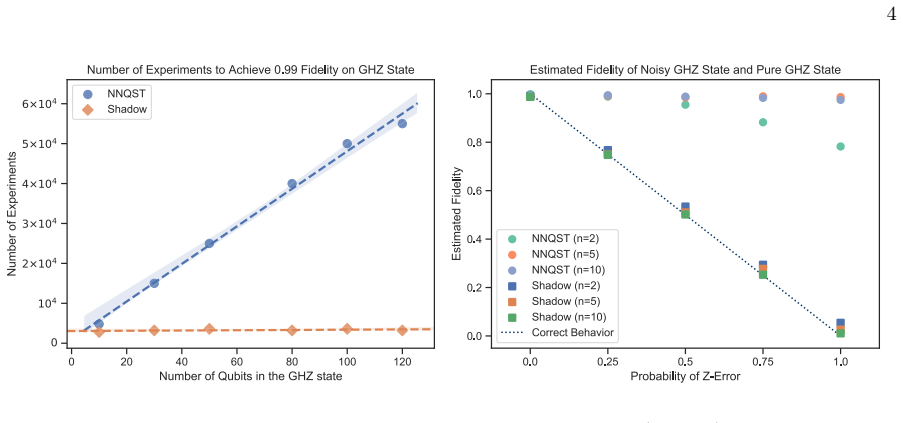
= tr (I⊗n) = 2n. In this case, a classical shadow of exponential size is required to accurately predict a single expectation value. In contrast, a direct spin measurement achieves the same accuracy with an order of1/ϵ2 copies of the stateρ only. 4 Figure 2: Comparison between classical shadow and neural network tomography (NNQST); GHZ states. Left: Number...
-
[2]
The stabilizer formalism Clifford circuits were introduced by Gottesman [24] and form an indispensable tool in quantum in- formation processing. Applications range from quantum error correction [46], to measurement-based quantum computation [9, 49] and randomized benchmarking [15, 37, 43]. For systems comprised ofn qubits, the Clifford group is generated by...
-
[3]
A single stabilizer sam- ple, i.e
Median of means estimation Lemma 1 sets the stage for successful feature estimation via classical shadows. A single stabilizer sam- ple, i.e. a classical shadow of sizeN = 1, correctly predicts any linear feature in expectation. Convergence to this desired expectation value can be boosted by forming empirical averages of multiple independent repetitions. ...
-
[4]
Feature prediction using classical shadows and median of means According to Fact 1, classical shadows are synonymous with independent repetitions of the stabilizer measurement (A1). We choose to rephrase our first main result in this language to maintain coherence with the previous two subsections. Theorem 4 (Detailed restatement of Theorem 1). Fix a colle...
-
[5]
Fix a sequence of POVMsF (1),...,F (N )
Detailed statement and proof idea Theorem 6 (Detailed restatement of Theorem 2). Fix a sequence of POVMsF (1),...,F (N ). Suppose that given anyM features 0≼ O1,O 2,...,O M ≼ I with maxi ( ‖Oi‖2 2 ) ≤ B, there exists a machine (with arbitrary runtime as long as it always terminates) that can use the measurement outcomes of F (1),...,F (N ) on N copies of ...
-
[6]
Description of the communication protocol For now, assumeM≤ exp(D/32) and show how Alice can communicate any integer in{1,...,M } to Bob. Alice and Bob first agree on a codebook for encoding any integer selected from{1,...,M } in a quantum state of dimensionD. The quantum states in the codebook areρ1,...,ρ M. Alice and Bob also 13 … N copies … N copies … M...
-
[7]
Alice randomly selects an integerX from{1,...,M }
-
[8]
Alice preparesN copies of the code-stateρX according associated toX and sends them to Bob
Show all 81 references
-
[9]
Bob performs POVMsF (i) on individual states and receives a string of measurement outcomesY
-
[10]
Bob inputsY into the feature prediction machine to estimatetr(O1ρX),..., tr(OMρX)
-
[11]
The working assumption is that the feature prediction machine can estimatetr(O1ρX),..., tr(OMρX) withinϵ-error and high success probability
Bob findsX that has the largesttr(OXρX). The working assumption is that the feature prediction machine can estimatetr(O1ρX),..., tr(OMρX) withinϵ-error and high success probability. This in turn ensures that this plain communication protocol is mostly successful, i.e.X =X with ...
-
[12]
We refer to standard textbooks for details
Information-theoretic analysis The following arguments are based on basic concepts from information theory. We refer to standard textbooks for details. 14 Thecommunicationprotocolisguaranteedtoworkwithhighprobability, ensuringthatBob’srecovered message ˆX equals Alice’s inputX...
-
[13]
Detailed construction of quantum encoding and linear prediction decoding We now construct a codebook ρ1,...,ρ M and linear features 0 ≼ O1,O 2,...,O M ≼ I with maxi ( ‖Oi‖2 2 ) ≤B that obey two key properties:
-
[14]
(B1) holds
the code statesρ1,...,ρ M obey the technical requirement displayed in Eq. (B1) holds
-
[15]
(B2) The second condition requires eachρi to be distinguishable fromρ1,...,ρ M via linear featuresOi
the linear featuresO1,...,O M are capable of identifying concrete code states: tr(Oiρi)≥ max j⁄=i tr(Ojρi) + 3ϵ for all 1≤i≤M. (B2) The second condition requires eachρi to be distinguishable fromρ1,...,ρ M via linear featuresOi. The first condition, on the contrary, requiresρX ...
-
[16]
Sample a Clifford unitaryU from the Clifford group using the algorithm proposed in [38]. This Clifford unitary is parameterized by(α,β,γ,δ,r,s ) which fully characterize its action on Pauli operators: UXjU† = (−1)rjΠn i=1Xαji i Zβji i and UZjU† = (−1)sjΠn i=1Xγji i Zδji i for all...
-
[17]
Given a unitaryU parameterized by (α,β,γ,δ,r,s ), we can applyU on any stabilizer state by changing the stabilizer generators and the destabilizers as defined in [2]
-
[18]
The operational definition of mixed states allows us to extend this formalism
Measurement in the Z-basis can be done using the standard algorithm provided in [2]. The operational definition of mixed states allows us to extend this formalism. Mixed states arise from sampling a pure state ensemble:ρ =∑ ipi|ψi⟩⟨ψi|. For neural network quantum state tomograp...
-
[19]
Aaronson
S. Aaronson. Shadow tomography of quantum states. InProceedings of the 50th Annual ACM SIGACT Symposium on Theory of Computing, STOC 2018, pages 325–338, New York, NY, USA, 2018. ACM
2018
-
[20]
Aaronson and D
S. Aaronson and D. Gottesman. Improved simulation of stabilizer circuits.Phys. Rev. A, 70:052328, Nov 2004
2004
-
[21]
Aaronson and G
S. Aaronson and G. N. Rothblum. Gentle measurement of quantum states and differential privacy. InTo appear on the 51th Annual ACM SIGACT Symposium on Theory of Computing. ACM, 2019. 19
2019
-
[22]
A. Acín, D. Bruß, M. Lewenstein, and A. Sanpera. Classification of mixed three-qubit states.Phys. Rev. Lett., 87:040401, Jul 2001
2001
-
[23]
Banaszek, M
K. Banaszek, M. Cramer, and D. Gross. Focus on quantum tomography.New J. Phys., 15(12):125020, dec 2013
2013
-
[24]
A. Blum, A. Kalai, and H. Wasserman. Noise-tolerant learning, the parity problem, and the statistical query model. Journal of the ACM (JACM), 50(4):506–519, 2003
2003
-
[25]
Blume-Kohout
R. Blume-Kohout. Optimal, reliable estimation of quantum states.New J. Phys., 12(4):043034, apr 2010
2010
-
[26]
F. G. Brandão, A. Kalev, T. Li, C. Y.-Y. Lin, K. M. Svore, and X. Wu. Quantum sdp solvers: Large speed-ups, optimality, and applications to quantum learning.arXiv preprint arXiv:1710.02581, 2017
2017 arXiv
-
[27]
H. J. Briegel, D. E. Browne, W. Dür, R. Raussendorf, and M. Van den Nest. Measurement-based quantum computation. Nat. Phys., 5:19 EP –, Jan 2009
2009
-
[28]
Carrasquilla, G
J. Carrasquilla, G. Torlai, R. G. Melko, and L. Aolita. Reconstructing quantum states with generative models. Nat. Mach. Intell., 1(3):155, 2019
2019
-
[29]
H. Chernoff. A measure of asymptotic efficiency for tests of a hypothesis based on the sum of observations. Ann. Math. Statistics, 23:493–507, 1952
1952
-
[30]
M.Cramer, M.B.Plenio, S.T.Flammia, R.Somma, D.Gross, S.D.Bartlett, O.Landon-Cardinal, D.Poulin, and Y.-K. Liu. Efficient quantum state tomography.Nat. Comm., 1:149, 2010
2010
-
[31]
Crawford, B
O. Crawford, B. van Straaten, D. Wang, T. Parks, E. Campbell, and S. Brierley1. Efficient quantum measurement of pauli operators.arXiv preprint arXiv:1908.06942, 2019
1908 arXiv
-
[32]
Dennis, A
E. Dennis, A. Kitaev, and J. Preskill. Topological quantum memory. volume 43, pages 4452–4505. 2002. Quantum information theory
2002
-
[33]
Emerson, R
J. Emerson, R. Alicki, and K. Życzkowski. Scalable noise estimation with random unitary operators.J. Opt. B Quantum Semiclass. Opt., 7(10):S347–S352, 2005
2005
-
[34]
R. M. Fano. Transmission of information: A statistical theory of communications. The M.I.T. Press, Cambridge, Mass.; John Wiley & Sons, Inc., New York-London, 1961
1961
-
[35]
S. T. Flammia, D. Gross, Y.-K. Liu, and J. Eisert. Quantum tomography via compressed sensing: error bounds, sample complexity and efficient estimators.New J. Phys., 14(9):095022, sep 2012
2012
-
[36]
S. T. Flammia, D. Gross, Y.-K. Liu, and J. Eisert. Quantum tomography via compressed sensing: error bounds, sample complexity and efficient estimators.New J. Phys., 14(9):095022, 2012
2012
-
[37]
S. T. Flammia and Y.-K. Liu. Direct fidelity estimation from few pauli measurements.Phys. Rev. Lett., 106:230501, Jun 2011
2011
-
[38]
Friis, G
N. Friis, G. Vitagliano, M. Malik, and M. Huber. Entanglement certification from theory to experiment. Nat. Rev. Phys., 1(1):72–87, 2019
2019
-
[39]
Gao and L.-M
X. Gao and L.-M. Duan. Efficient representation of quantum many-body states with deep neural networks. Nat. Commun., 8(1):662, 2017
2017
-
[40]
H. J. Garcia, I. L. Markov, and A. W. Cross. Efficient inner-product algorithm for stabilizer states.arXiv preprint arXiv:1210.6646, 2012
2012 arXiv
-
[41]
Gosset and J
D. Gosset and J. Smolin. A compressed classical description of quantum states. arXiv preprint arXiv:1801.05721, 2018
2018 arXiv
-
[42]
Gottesman
D. Gottesman. Stabilizer codes and quantum error correction. Caltech Ph. D. PhD thesis, Thesis, eprint: quant-ph/9705052, 1997
1997 arXiv
-
[43]
D. M. Greenberger, M. A. Horne, and A. Zeilinger.Going Beyond Bell’s Theorem, pages 69–72. Springer Netherlands, Dordrecht, 1989
1989
-
[44]
D. Gross. Hudson’s theorem for finite-dimensional quantum systems.J. Math. Phys., 47(12):122107, 25, 2006
2006
-
[45]
Gross, F
D. Gross, F. Krahmer, and R. Kueng. A partial derandomization of PhaseLift using spherical designs.J. Fourier Anal. Appl., 21(2):229–266, 2015
2015
-
[46]
Gross, Y.-K
D. Gross, Y.-K. Liu, S. T. Flammia, S. Becker, and J. Eisert. Quantum state tomography via compressed sensing. Phys. Rev. Lett., 105:150401, Oct 2010
2010
-
[47]
M. Guta, J. Kahn, R. Kueng, and J. A. Tropp. Fast state tomography with optimal error bounds.arXiv preprint arXiv:1809.11162, 2018
2018 arXiv
-
[48]
Gühne and G
O. Gühne and G. Tóth. Entanglement detection.Phys. Rep., 474(1):1 – 75, 2009
2009
-
[49]
J. Haah, A. W. Harrow, Z. Ji, X. Wu, and N. Yu. Sample-optimal tomography of quantum states.IEEE T. Inform. Theory, 63(9):5628–5641, 2017
2017
-
[50]
M. Hein, W. Dür, J. Eisert, R. Raussendorf, M. Van den Nest, and H.-J. Briegel. Entanglement in graph states and its applications. In Quantum computers, algorithms and chaos, volume 162 ofProc. Internat. School Phys. Enrico Fermi, pages 115–218. IOS, Amsterdam, 2006
2006
-
[51]
Z. Hradil. Quantum-state estimation.Phys. Rev. A, 55:R1561–R1564, Mar 1997
1997
-
[52]
W. J. Huggins, J. McClean, N. Rubin, Z. Jiang, N. Wiebe, K. B. Whaley, and R. Babbush. Efficient and noise resilient measurements for quantum chemistry on near-term quantum computers.arXiv preprint arXiv:1907.13117, 2019
1907 arXiv
-
[53]
A. Jena, S. Genin, and M. Mosca. Pauli partitioning with respect to gate sets. arXiv preprint arXiv:1907.07859, 2019
1907 arXiv
-
[54]
M. R. Jerrum, L. G. Valiant, and V. V. Vazirani. Random generation of combinatorial structures from a uniform distribution. Theoret. Comput. Sci., 43(2-3):169–188, 1986
1986
-
[55]
Knill, D
E. Knill, D. Leibfried, R. Reichle, J. Britton, R. B. Blakestad, J. D. Jost, C. Langer, R. Ozeri, S. Seidelin, 20 and D. J. Wineland. Randomized benchmarking of quantum gates.Phys. Rev. A, 77:012307, Jan 2008
2008
-
[56]
Koenig and J
R. Koenig and J. A. Smolin. How to efficiently select an arbitrary Clifford group element.J. Math. Phys., 55(12):122202, 12, 2014
2014
-
[57]
Kueng and D
R. Kueng and D. Gross. Qubit stabilizer states are complex projective 3-designs. arXiv preprint arXiv:1510.02767, 2015
2015 arXiv
-
[58]
Kueng, H
R. Kueng, H. Rauhut, and U. Terstiege. Low rank matrix recovery from rank one measurements.Appl. Comput. Harmon. Anal., 42(1):88–116, 2017
2017
-
[59]
Kueng, H
R. Kueng, H. Zhu, and D. Gross. Low rank matrix recovery from clifford orbits. arXiv preprint arXiv:1610.08070, 2016
2016 arXiv
-
[60]
B. P. Lanyon, C. Maier, M. Holzäpfel, T. Baumgratz, C. Hempel, P. Jurcevic, I. Dhand, A. S. Buyskikh, A. J. Daley, M. Cramer, M. B. Plenio, R. Blatt, and C. F. Roos. Efficient tomography of a quantum many-body system. Nat. Phys., 13:1158 EP –, Sep 2017
2017
-
[61]
Magesan, J
E. Magesan, J. M. Gambetta, and J. Emerson. Scalable and robust randomized benchmarking of quantum processes. Phys. Rev. Lett., 106:180504, May 2011
2011
-
[62]
A. S. Nemirovsky and D. B. a. Yudin.Problem complexity and method efficiency in optimization. A Wiley- Interscience Publication. John Wiley & Sons, Inc., New York, 1983. Translated from the Russian and with a preface by E. R. Dawson, Wiley-Interscience Series in Discrete Mathematics
1983
-
[63]
M. A. Nielsen. Cluster-state quantum computation.Rep. Math. Phys., 57(1):147–161, 2006
2006
-
[64]
M. A. Nielsen and I. L. Chuang.Quantum computation and quantum information. Cambridge University Press, Cambridge, 2000
2000
-
[65]
O’Donnell and J
R. O’Donnell and J. Wright. Efficient quantum tomography. InProceedings of the Forty-eighth Annual ACM Symposium on Theory of Computing, STOC ’16, pages 899–912, New York, NY, USA, 2016. ACM
2016
-
[66]
Preskill
J. Preskill. Quantum computing in the nisq era and beyond.Quantum, 2:79, 2018
2018
-
[67]
Raussendorf and H
R. Raussendorf and H. J. Briegel. A one-way quantum computer.Phys. Rev. Lett., 86:5188–5191, May 2001
2001
-
[68]
O. Regev. On lattices, learning with errors, random linear codes, and cryptography.Journal of the ACM (JACM), 56(6):34, 2009
2009
-
[69]
J. M. Renes, R. Blume-Kohout, A. J. Scott, and C. M. Caves. Symmetric informationally complete quantum measurements. J. Math. Phys., 45(6):2171–2180, 2004
2004
-
[70]
I. Roth, R. Kueng, S. Kimmel, Y.-K. Liu, D. Gross, J. Eisert, and M. Kliesch. Recovering quantum gates from few average gate fidelities.Phys. Rev. Lett., 121:170502, Oct 2018
2018
-
[71]
Shalev-Shwartz, O
S. Shalev-Shwartz, O. Shamir, and S. Shammah. Failures of gradient-based deep learning. InProceedings of the 34th International Conference on Machine Learning-Volume 70, pages 3067–3075. JMLR. org, 2017
2017
-
[72]
Sugiyama, P
T. Sugiyama, P. S. Turner, and M. Murao. Precision-guaranteed quantum tomography.Phys. Rev. Lett., 111:160406, Oct 2013
2013
-
[73]
Torlai, G
G. Torlai, G. Mazzola, J. Carrasquilla, M. Troyer, R. Melko, and G. Carleo. Neural-network quantum state tomography. Nat. Phys., 14(5):447, 2018
2018
-
[74]
Z. Webb. The clifford group forms a unitary 3-design.arXiv preprint arXiv:1510.02769, 2015
2015 arXiv
-
[75]
T.-C. Yen, V. Verteletsky, and A. F. Izmaylov. Measuring all compatible operators in one series of a single- qubit measurements using unitary transformations.arXiv preprint arXiv:1907.09386, 2019
1907 arXiv
-
[76]
H. Zhu. Multiqubit clifford groups are unitary 3-designs.Phys. Rev. A, 96:062336, Dec 2017
2017
-
[77]
[1] it was actually S.T.˜Flammia who originally suggested the name shadow tomography
According to Ref. [1] it was actually S.T.˜Flammia who originally suggested the name shadow tomography
-
[78]
If|ψ⟩ is a stabilizer state, the Gottsman-Knill theorem allows for evaluation inO(n2)-time only
The runtime of Algorithm 1 is dominated by the cost of computing squared inner products|⟨ψ|Ui|ˆbi⟩|2 in 2n dimensions. If|ψ⟩ is a stabilizer state, the Gottsman-Knill theorem allows for evaluation inO(n2)-time only
-
[79]
Av is the product of four Pauli-X operators around a vertexv, while Bp is the product of four Pauli-Z operators around the plaquettep
-
[80]
The scaling symbol ˜O suppresses logarithmic expressions in other problem-specific parameters
-
[81]
However, not entirely malicious, he often comes around and tries to remedy dire consequences of his actions in the last minute
In Norse mythology, Loki is infamous for mischief and trickery. However, not entirely malicious, he often comes around and tries to remedy dire consequences of his actions in the last minute
Reviewed August 14, 2026 · model on record in the stance chip above.
Discussion (0). Continue with ORCID to comment.