REVIEW 2 major objections 4 minor 2 cited by
Two of the seven 'Qi-Xiu' parity-violating terms act only on scalar-induced gravitational waves, producing circular polarization even when linear waves propagate at light speed.
Reviewed by Pith at T0; open to challenge. T0 means a machine referee read the full paper against a public rubric. the ladder, T0–T4 →
T0 review · deepseek-v4-flash
2026-08-03 03:37 UTC pith:TM5AHNBR
load-bearing objection The structural observation about L3/L4 is worth attention, but the numerical section is internally inconsistent: the scalar transfer function used does not solve the paper's own background equations. the 2 major comments →
Circularly polarized gravitational waves from parity-violating scalar-tensor theory
The pith
A machine-rendered reading of the paper's core claim, the machinery that carries it, and where it could break.
Core claim
The central discovery is a decoupling: in the PVST framework, the parity-violating coefficients c1 and c2 that govern linear tensor propagation come only from L1, L2, L5, L6, and L7, while L3 and L4 contribute exclusively to the cubic scalar-scalar-tensor interaction that sources SIGWs. After deriving the second-order equation of motion, the paper isolates the parity-violating source terms proportional to the couplings b3 and b4, neglects the other PV channels, and computes the kernel for SIGWs. In the radiation era with φ' = ±2/(κ η) and constant b3, b4, the resulting fractional energy density Ω_GW exceeds the GR prediction near the peak scale, and the right- and left-handed power spectra s
What carries the argument
The 'Qi-Xiu' Lagrangians: seven ghost-free parity-violating scalar-tensor monomials classified by derivative count. Linear tensor dynamics are governed by two time-dependent coefficients c1 and c2 built from L1, L2, L5, L6, and L7; L3 and L4 appear only in the second-order source as coefficients in the parity-violating source term. Their role is to make the right- and left-handed SIGW kernels unequal while leaving the linear Green's function identical to GR, so a net circular polarization of the stochastic background emerges from the source rather than from propagation.
Load-bearing premise
The numerical predictions assume that during the radiation-dominated era the scalar field obeys φ' = ±2/(κ η) (Eq. 65), which requires a specific relation between the scalar kinetic energy and a potential term that the paper does not spell out; if the actual scalar-field evolution differs, the computed Ω_GW and Π curves do not follow.
What would settle it
Recompute the L3/L4 kernel integrals using a different radiation-era scalar background, such as a canonical free scalar with φ' ∝ η^{-2}, and check whether the right-left asymmetry survives the integration; if the parity-violating source integrals vanish or change sign, the central claim fails. Observationally, a sufficiently sensitive measurement of the induced background's circular-polarization Stokes V parameter that finds Π consistent with zero at the predicted peak would falsify the plotted scenarios.
If this is right
- If a stochastic gravitational-wave background of scalar origin is observed with circular polarization but GR-like tensor propagation, it points to L3- and L4-type parity-violating source terms.
- Primordial gravitational-wave spectra in PVST gravity are chiral, with a degree of circular polarization proportional to (9c2 - c1)ε*, while L3 and L4 leave those linear spectra unchanged.
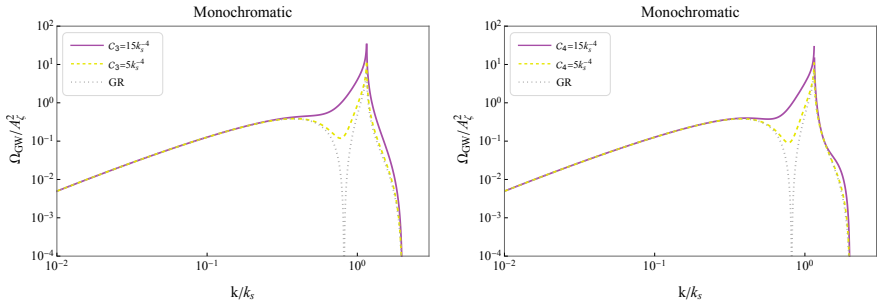
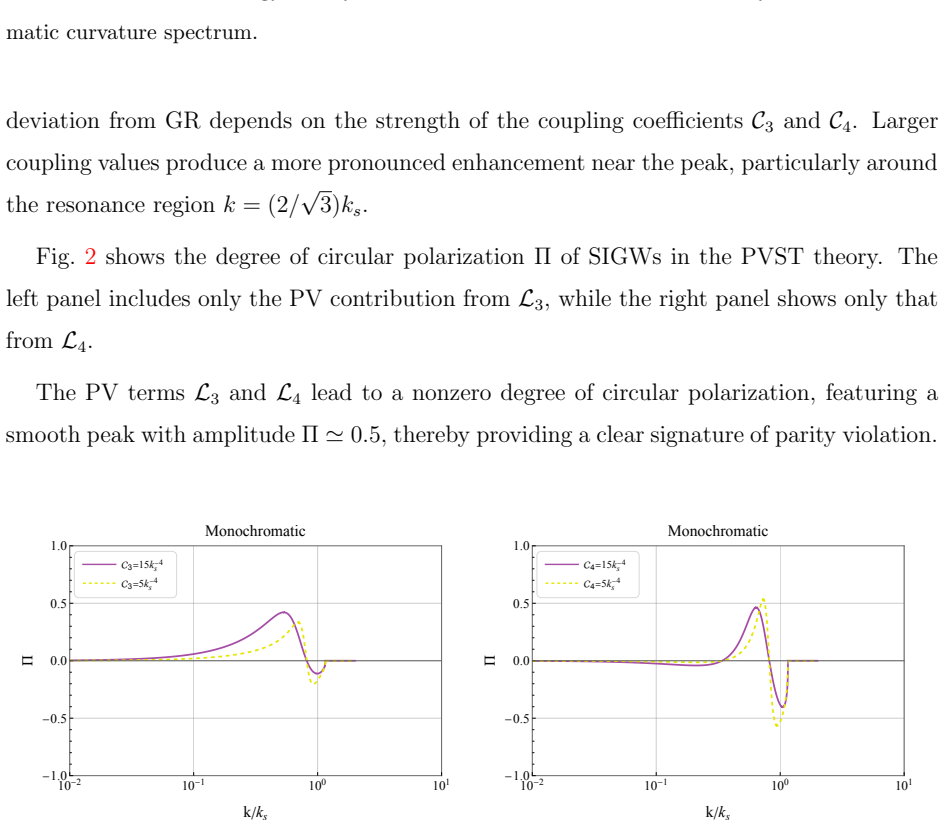
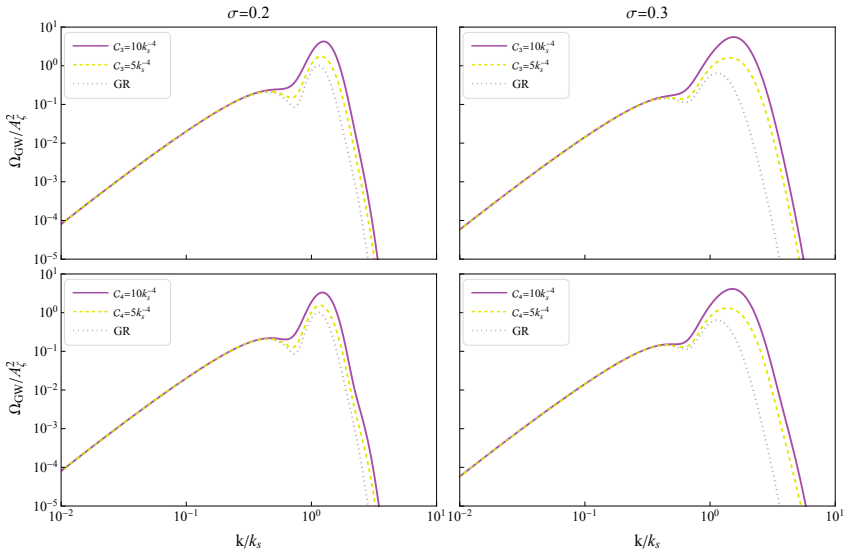
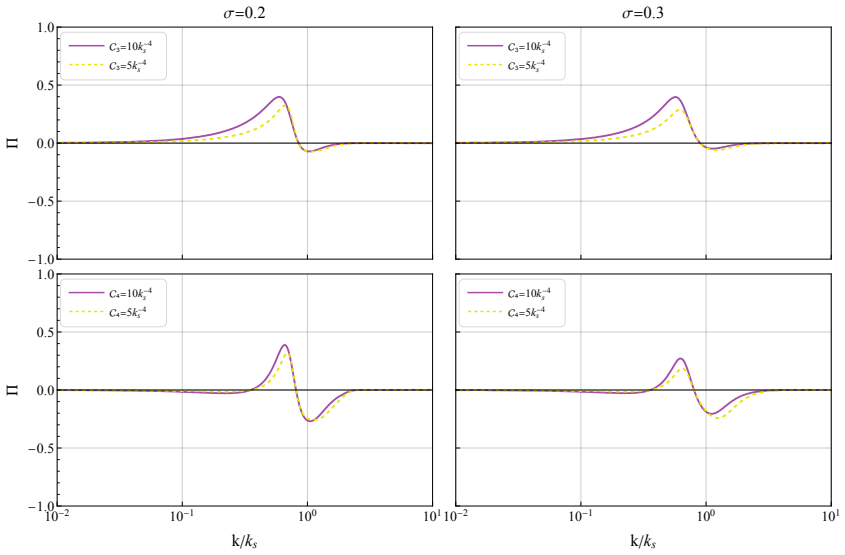
- Around the peak or resonance frequency, Ω_GW is enhanced relative to general relativity and Π reaches about 0.5 for monochromatic spectra; lognormal spectra show a smoother, similar signature.
- Future space-based detectors that can measure the cross-correlation of the stochastic background could detect or constrain this circular-polarization signal.
- A complete second-order calculation including all seven Lagrangians and non-constant couplings remains open; the present numerical results assume constant b3, b4 in a radiation-dominated era.
Where Pith is reading between the lines
- Because the L3 and L4 source terms scale with k^4 times the couplings, the polarization effect is strongest at high frequencies; searches should prioritize high-frequency scalar peaks over nanohertz bands.
- The same source-term mechanism should apply to other second-order tensor-generation channels, suggesting a broader class of chiral gravitational-wave backgrounds in PVST gravity.
- The c_T = 1 constraints involve only five coefficients, leaving b3 and b4 unconstrained; a polarization measurement of SIGWs could separately bound these two couplings even where linear gravitational-wave speed is tightly constrained.
- To turn the radiation-era prediction into a complete model, one would add an explicit potential realizing φ' = ±2/(κ η) and verify the background's stability.
Editorial analysis
A structured set of objections, weighed in public.
Referee Report
Summary. The paper studies parity-violating scalar-tensor (PVST) theory built from the seven ghost-free Qi-Xiu Lagrangians. At linear order, it derives the quadratic tensor action and shows that L1, L2, L5, L6, L7 modify GW propagation and produce chiral primordial spectra, while L3 and L4 are absent. At second order, it derives the SIGW equation of motion and identifies L3 and L4 as entering only through the source term, so parity-violating SIGWs can arise even when linear tensor propagation is GR-like. The paper then computes the SIGW energy density and circular polarization during a radiation-dominated era for monochromatic and lognormal curvature spectra, reporting a degree of circular polarization up to about 0.5. The main technical content is in the detailed appendices, which give the cubic actions, source coefficients, and kernels.
Significance. If the results hold, the paper would establish a distinctive phenomenological signature: parity violation in scalar-induced gravitational waves without any modification of linear GW propagation speed. The derivation of the second-order SIGW equation in a PVST framework and the explicit classification of L3 and L4 as pure source-term contributions are useful and nontrivial. The paper also includes detailed appendices and cleanly reduces to GR in the zero-coupling limit. However, the quantitative results of Section V are undermined by an internal inconsistency in the radiation-era scalar dynamics, so the specific predictions, including the claimed Π≃0.5, are not currently supported.
major comments (2)
- [§V, Eqs. (65)–(67); Appendix B] The radiation-era calculation uses the wrong scalar transfer function for the model's own scalar sector. For the background (65), eliminating δφ from the linear perturbation equations (B4)–(B7) via (B5) yields ψ'' + 4Hψ' + k²ψ = 0, i.e. c_s² = 1, not ψ'' + 4Hψ' + (k²/3)ψ = 0. Hence Eq. (67) is not a solution of the paper's own equations. Consequently, the source terms fPV3 and fPV4 in Eqs. (74)–(78), the kernels in Appendix C, and all ΩGW and Π curves in Figs. 1–6 are computed with the radiation-fluid transfer function rather than the scalar-field transfer function of the PVST theory. This internal inconsistency directly undermines the central quantitative claim Π≃0.5 in Sec. V.B.1.
- [§V, background setup] The paper does not specify the potential V(φ) realizing Eq. (65), nor does it state whether the radiation era is supported by the scalar field alone or by an additional radiation component. If the scalar field is the only matter, its perturbations propagate at c_s²=1, contradicting the use of Eq. (67); if a radiation fluid dominates instead, φ is a spectator and φ' = ±2/(κη) is not the free-field solution (which would give φ' ∝ η^{-2}) without a tuned potential. In either reading, the numerical evaluation of Sec. V does not implement a consistent physical model. The authors should recompute the SIGW kernels and figures with a specified, consistent matter content and the corresponding scalar transfer function, or add a radiation fluid and treat the scalar field as a spectator with the correct background dynamics.
minor comments (4)
- [Eq. (65)] The expression is typographically ambiguous: 'φ′ = ± 2/κ η−1' should read 'φ′ = ±2/(κη)' or similar.
- [Figures 1–6] The figures contain rendering errors: symbols such as '3' and '4' appear instead of C3 and C4. Please correct the fonts/glyphs.
- [§V, after Eq. (71)] The sentence 'Substituting Eq. (67) into Eqs. (72)-(74)' is confusing because Eq. (74) already contains Tψ; the intended substitution is into the explicit integral expressions. Please rephrase.
- [§IV, Eq. (58)] The notation X is used both for the kinetic term X = -1/2 ∇^a φ ∇_a φ and as a subscript in coefficients like b_nX. This is understandable but should be explicitly noted to avoid confusion.
Circularity Check
No significant circularity: L3/L4 source-term derivation is self-contained; self-citations are contextual.
full rationale
No circular steps found. The quadratic tensor action and the SIGW EOM are obtained by direct variation of the explicit Lagrangian (1)-(10). The identification of L3 and L4 as source-only terms follows from the absence of b3,b4 in c1,c2 (15)-(16) and from the explicit PV cubic actions (A1)-(A7); this is a derived property, not an input. The c_T=1 conditions (22)-(25) are derived in the paper, with [49] cited only as 'also consistent,' so not load-bearing. The Qi-Xiu basis is taken from [92], a self-citation by author X. Gao, but the present calculations use only the monomial forms and do not depend on the ghost-freeness proof; the classification is external published work, not an unverified uniqueness claim that forces the results. No parameters are fitted to the target outputs: C3 and C4 are chosen freely, and the GR limit (76) reproduces the known kernel [10]. The numerical computations in Sec. V are parameter-dependent predictions, not constructions. As a correctness caveat (not circularity), Eq. (65) sets a canonical-scalar radiation-like background (φ'=±2/(κη)), but Eq. (67) imports the perfect-fluid radiation transfer function from [10]; from (B4)-(B7) the scalar-field sound speed is 1, so ψ''+4Hψ'+k^2ψ=0, not the k^2/3 version solved by (67). This internal inconsistency affects the quantitative curves, but it does not constitute a circular reduction.
Axiom & Free-Parameter Ledger
free parameters (5)
- b1...b7 coupling functions
- M_PV
- C3 = b3/a0^2, C4 = b4/a0^2 =
5, 10, 15 k_s^{-4} in figures
- A_ζ, k_s, σ =
σ = 0.2, 0.3 in lognormal plots
- slow-roll parameters ϵ1, ϵ2, ϵ3
axioms (7)
- domain assumption The seven Qi-Xiu Lagrangians form the complete ghost-free basis of PVST monomials up to d=4.
- domain assumption PV terms do not change the background or linear scalar dynamics; ϕ=ψ and no anisotropic stress.
- domain assumption Slow-roll inflation with small PV corrections for the primordial GW spectrum.
- ad hoc to paper Radiation era is supported by a scalar field with φ' = ±2/(κ η), which requires a tuned potential with K = 2V (or an extra radiation component).
- ad hoc to paper b3 and b4 are treated as constant in the kernel evaluation.
- standard math The uniform asymptotic approximation of [93-95] gives the Bunch-Davies normalized tensor solution used in Eq. (41).
- domain assumption At the present epoch x→∞ and time averaging are valid for Ω_GW.
read the original abstract
We study both primordial gravitational waves (GWs) and scalar-induced gravitational waves (SIGWs) in a class of the parity-violating scalar-tensor (PVST) theory, of which the Lagrangian is the linear combination of seven ghost-free parity-violating scalar-tensor monomials dubbed the "Qi-Xiu" Lagrangians. At linear order, we obtain the quadratic action for tensor perturbations and show that parity-violating terms associated with L_1, L_2, L_5, L_6, and L_7 render the tensor propagation polarization dependent, leading to chiral primordial spectra and a nonvanishing degree of circular polarization. At second order, we derive the equation of motion for SIGWs and identify the explicit parity-violating source terms. In particular, L_3 and L_4 enter exclusively through the source term for SIGWs, allowing parity violation to arise even when the linear GWs' propagation remains effectively general-relativity-like. During the radiation-dominated era, we compute the fractional energy density of SIGWs for both monochromatic and log-normal curvature power spectra. We find that, around the peak frequency, SIGWs in PVST gravity exhibit characteristic deviations from those in general relativity, resulting in a nonzero degree of circular polarization.
Figures


Forward citations
Cited by 2 Pith papers
-
Parity-violating spatially covariant gravity at total derivative order $d=5$
At total derivative order five, parity-violating spatially covariant gravity has exactly 59 independent monomials, and their tensor-perturbation response is controlled by four coefficient combinations producing helici...
-
Spatially covariant gravity with two degrees of freedom: A perturbative analysis up to cubic order
Five explicit polynomial spatially covariant gravity Lagrangians up to total derivative order three are identified that propagate only two degrees of freedom up to cubic order in perturbations around a cosmological ba...
Reference graph
Works this paper leans on
-
[1]
The analytical solution of EOM for primordial GWs Primordial GWs correspond to tensor perturbations on a homogeneous and isotropic background, with their EOM given by Eq. (20). To compute the power spectra, we adopt the uniform asymptotic approximation method [93–95] to obtain an analytical solution. For convenience, Eq. (20) can be rewritten as ˜γA′′ k +...
-
[2]
The power spectra and degree of circular polarization of primordial GWs With the approximate solution of primordial GWs derived above, the corresponding power spectraP R,L T in the superhorizon limity→0 are given by P R T = 2k3 π2 ˜γR BR 2 ,P L T = 2k3 π2 ˜γL BL 2 .(39) In this limit, the approximate form of ˜γA reads ˜γA(y)≃ i√ 2k 1 g(y) 1 4 exp Z y0 y p...
-
[3]
Parity-conserving contributions The PC parts coincide with those in GR. The quadratic PC action takes the standard form S(PC) hh = 1 2κ2 Z d4x a2 16 (h′ ij)2 −(∂ khij)2 ,(50) and the cubic PC term describing the scalar–tensor interaction is given by S(PC) ssh = 1 2κ2 Z d4x a2 2 2∂iψ∂jψ+κ 2∂iδφ∂jδφ hij,(51) Therefore, the PC dynamics are identical to those in GR
-
[4]
(15)-(16)
Parity-violating contributions The PV part of the quadratic action can be written as S(PV) hh = 1 2κ2 Z d4x a2 16 c1(η) aMPV ϵijkh′ il∂jh′ k l + c2(η) aMPV ϵijk∂2hil∂jh l k ,(52) wherec 1 andc 2 (arising fromL 1,2,5,6,7) are defined in Eqs. (15)-(16). The PV cubic action, which describes the interaction between two scalar perturbations and one tensor mode...
-
[5]
Monochromatic spectrum We consider a monochromatic curvature perturbations [7, 97], Pζ(k) =A ζδ(log(k/k s)).(81) wherek s is the peak scale, andA ζ is the amplitude. After straightforward calculations, the fractional energy density of SIGWs is found to be ΩGW(k) = A2 ζ 12˜k2 4− ˜k2 4 !2 X A=R,L ˜I A(k, ˜k−1, ˜k−1, x→ ∞)2Θ(2− ˜k),(82) where ˜k=k/k s. The d...
-
[6]
Qi-Xiu” Lagrangians) were identified. By analyzing both primordial GWs and SIGWs, we disentangle the contributions of the “Qi-Xiu
The lognormal spectrum To study a more realistic scenario, we consider a lognormal primordial spectrum for the curvature perturbation [11, 97], Pζ(k) = Aζ√ 2πσ exp − log2(k/ks) 2σ2 ,(86) whereσcharacterizes the width of the peak. In the limitσ→0, the lognormal power spectrum reduces to the monochromatic form. For this spectrum, the energy density of SIGWs...
-
[7]
B. P. Abbott et al. (LIGO Scientific, Virgo), Phys. Rev. Lett.116, 061102 (2016), arXiv:1602.03837 [gr-qc]
Pith/arXiv arXiv 2016
-
[8]
B. P. Abbott et al. (LIGO Scientific, Virgo), Phys. Rev. Lett.119, 161101 (2017), arXiv:1710.05832 [gr-qc]
Pith/arXiv arXiv 2017
-
[9]
B. P. Abbott et al. (LIGO Scientific, Virgo), Phys. Rev. X9, 031040 (2019), arXiv:1811.12907 [astro-ph.HE]
Pith/arXiv arXiv 2019
-
[10]
R. Abbott et al. (LIGO Scientific, Virgo), Phys. Rev. X11, 021053 (2021), arXiv:2010.14527 [gr-qc]
Pith/arXiv arXiv 2021
-
[11]
R. Abbott et al. (LIGO Scientific, VIRGO), Phys. Rev. D109, 022001 (2024), arXiv:2108.01045 [gr-qc]
Pith/arXiv arXiv 2024
-
[12]
R. Abbott et al. (KAGRA, VIRGO, LIGO Scientific), Phys. Rev. X13, 041039 (2023), arXiv:2111.03606 [gr-qc]. 29 -1.0 -0.5 0.0 0.5 1.0 Π σ=0.2 3=10ks -4 3=5ks -4 σ=0.3 3=10ks -4 3=5ks -4 10-2 10-1 100 101-1.0 -0.5 0.0 0.5 1.0 k/ks Π 4=10ks -4 4=5ks -4 10-2 10-1 100 101 k/ks 4=10ks -4 4=5ks -4 FIG. 6. The degree of circular polarization of SIGWs with ...
Pith/arXiv arXiv 2023
-
[13]
K. N. Ananda, C. Clarkson, and D. Wands, Phys. Rev. D75, 123518 (2007), arXiv:gr- qc/0612013
arXiv 2007
-
[14]
D. Baumann, P. J. Steinhardt, K. Takahashi, and K. Ichiki, Phys. Rev. D76, 084019 (2007), arXiv:hep-th/0703290
Pith/arXiv arXiv 2007
-
[15]
R. Saito and J. Yokoyama, Phys. Rev. Lett.102, 161101 (2009), [Erratum: Phys.Rev.Lett. 107, 069901 (2011)], arXiv:0812.4339 [astro-ph]
Pith/arXiv arXiv 2009
-
[16]
K. Kohri and T. Terada, Phys. Rev. D97, 123532 (2018), arXiv:1804.08577 [gr-qc]
Pith/arXiv arXiv 2018
-
[17]
J. R. Espinosa, D. Racco, and A. Riotto, JCAP09, 012, arXiv:1804.07732 [hep-ph]
-
[18]
Dom` enech, Universe7, 398 (2021), arXiv:2109.01398 [gr-qc]
G. Dom` enech, Universe7, 398 (2021), arXiv:2109.01398 [gr-qc]
Pith/arXiv arXiv 2021
-
[19]
C. Yuan and Q.-G. Huang, iScience24, 102860 (2021), arXiv:2103.04739 [astro-ph.GA]
Pith/arXiv arXiv 2021
- [20]
-
[21]
G. Agazie et al. (NANOGrav), Astrophys. J. Lett.951, L8 (2023), arXiv:2306.16213 [astro- ph.HE]. 30
Pith/arXiv arXiv 2023
-
[22]
G. Agazie et al. (NANOGrav), Astrophys. J. Lett.951, L9 (2023), arXiv:2306.16217 [astro- ph.HE]
Pith/arXiv arXiv 2023
-
[23]
A. Zic et al., Publ. Astron. Soc. Austral.40, e049 (2023), arXiv:2306.16230 [astro-ph.HE]
Pith/arXiv arXiv 2023
-
[24]
J. Antoniadis et al. (EPTA), Astron. Astrophys.678, A48 (2023), arXiv:2306.16224 [astro- ph.HE]
Pith/arXiv arXiv 2023
-
[25]
J. Antoniadis et al. (EPTA, InPTA:), Astron. Astrophys.678, A50 (2023), arXiv:2306.16214 [astro-ph.HE]
Pith/arXiv arXiv 2023
-
[26]
H. Xu et al., Res. Astron. Astrophys.23, 075024 (2023), arXiv:2306.16216 [astro-ph.HE]
Pith/arXiv arXiv 2023
-
[27]
A. Afzal et al. (NANOGrav), Astrophys. J. Lett.951, L11 (2023), [Erratum: Astrophys.J.Lett. 971, L27 (2024), Erratum: Astrophys.J. 971, L27 (2024)], arXiv:2306.16219 [astro-ph.HE]
Pith/arXiv arXiv 2023
-
[28]
J. Antoniadis et al. (EPTA, InPTA), Astron. Astrophys.685, A94 (2024), arXiv:2306.16227 [astro-ph.CO]
Pith/arXiv arXiv 2024
-
[29]
Y.-F. Cai, X.-C. He, X.-H. Ma, S.-F. Yan, and G.-W. Yuan, Sci. Bull.68, 2929 (2023), arXiv:2306.17822 [gr-qc]
Pith/arXiv arXiv 2023
-
[30]
Z. Yi, Q. Gao, Y. Gong, Y. Wang, and F. Zhang, Sci. China Phys. Mech. Astron.66, 120404 (2023), arXiv:2307.02467 [gr-qc]
Pith/arXiv arXiv 2023
- [31]
-
[32]
S. Wang, Z.-C. Zhao, J.-P. Li, and Q.-H. Zhu, Phys. Rev. Res.6, L012060 (2024), arXiv:2307.00572 [astro-ph.CO]
Pith/arXiv arXiv 2024
-
[33]
L. Liu, Z.-C. Chen, and Q.-G. Huang, Phys. Rev. D109, L061301 (2024), arXiv:2307.01102 [astro-ph.CO]
Pith/arXiv arXiv 2024
-
[34]
L. Liu, Y. Wu, and Z.-C. Chen, JCAP04, 011, arXiv:2310.16500 [astro-ph.CO]
-
[35]
Z.-C. Chen, J. Li, L. Liu, and Z. Yi, Phys. Rev. D109, L101302 (2024), arXiv:2401.09818 [gr-qc]
Pith/arXiv arXiv 2024
-
[36]
Danzmann, Class
K. Danzmann, Class. Quant. Grav.14, 1399 (1997)
1997
-
[37]
P. Amaro-Seoane et al. (LISA), (2017), arXiv:1702.00786 [astro-ph.IM]
Pith/arXiv arXiv 2017
-
[38]
Hu and Y.-L
W.-R. Hu and Y.-L. Wu, Natl. Sci. Rev.4, 685 (2017)
2017
-
[39]
W.-H. Ruan, Z.-K. Guo, R.-G. Cai, and Y.-Z. Zhang, Int. J. Mod. Phys. A35, 2050075 (2020), arXiv:1807.09495 [gr-qc]
Pith/arXiv arXiv 2020
-
[40]
J. Luo et al. (TianQin), Class. Quant. Grav.33, 035010 (2016), arXiv:1512.02076 [astro- ph.IM]. 31
Pith/arXiv arXiv 2016
-
[41]
Y. Gong, J. Luo, and B. Wang, Nature Astron.5, 881 (2021), arXiv:2109.07442 [astro-ph.IM]
Pith/arXiv arXiv 2021
-
[42]
Kawamura et al., PTEP2021, 05A105 (2021), arXiv:2006.13545 [gr-qc]
S. Kawamura et al., PTEP2021, 05A105 (2021), arXiv:2006.13545 [gr-qc]
Pith/arXiv arXiv 2021
-
[43]
M. Maggiore et al. (ET), JCAP03, 050, arXiv:1912.02622 [astro-ph.CO]
Pith/arXiv arXiv 1912
-
[44]
T. D. Lee and C.-N. Yang, Phys. Rev.104, 254 (1956)
1956
-
[45]
C. S. Wu, E. Ambler, R. W. Hayward, D. D. Hoppes, and R. P. Hudson, Phys. Rev.105, 1413 (1957)
1957
-
[46]
Y. Minami and E. Komatsu, Phys. Rev. Lett.125, 221301 (2020), arXiv:2011.11254 [astro- ph.CO]
Pith/arXiv arXiv 2020
-
[47]
J. R. Eskilt and E. Komatsu, Phys. Rev. D106, 063503 (2022), arXiv:2205.13962 [astro- ph.CO]
Pith/arXiv arXiv 2022
-
[48]
O. H. E. Philcox, Phys. Rev. D106, 063501 (2022), arXiv:2206.04227 [astro-ph.CO]
Pith/arXiv arXiv 2022
-
[49]
J. Hou, Z. Slepian, and R. N. Cahn, Mon. Not. Roy. Astron. Soc.522, 5701 (2023), arXiv:2206.03625 [astro-ph.CO]
Pith/arXiv arXiv 2023
-
[50]
N. Seto, Phys. Rev. Lett.125, 251101 (2020), arXiv:2009.02928 [gr-qc]
Pith/arXiv arXiv 2020
-
[51]
G. Orlando, M. Pieroni, and A. Ricciardone, JCAP03, 069, arXiv:2011.07059 [astro-ph.CO]
Pith/arXiv arXiv 2011
-
[52]
R. Jackiw and S. Y. Pi, Phys. Rev. D68, 104012 (2003), arXiv:gr-qc/0308071
Pith/arXiv arXiv 2003
-
[53]
P. Horava, Phys. Rev. D79, 084008 (2009), arXiv:0901.3775 [hep-th]
Pith/arXiv arXiv 2009
-
[54]
M. Crisostomi, K. Noui, C. Charmousis, and D. Langlois, Phys. Rev. D97, 044034 (2018), arXiv:1710.04531 [hep-th]
Pith/arXiv arXiv 2018
-
[55]
X. Gao and X.-Y. Hong, Phys. Rev. D101, 064057 (2020), arXiv:1906.07131 [gr-qc]
Pith/arXiv arXiv 2020
-
[56]
Y.-M. Hu and X. Gao, Phys. Rev. D105, 044023 (2022), arXiv:2111.08652 [gr-qc]
Pith/arXiv arXiv 2022
-
[57]
Y.-M. Hu and X. Gao, Phys. Rev. D104, 104007 (2021), arXiv:2104.07615 [gr-qc]
Pith/arXiv arXiv 2021
-
[58]
R.-G. Cai, C. Fu, and W.-W. Yu, Phys. Rev. D105, 103520 (2022), arXiv:2112.04794 [astro- ph.CO]
Pith/arXiv arXiv 2022
-
[59]
Q. Wu, T. Zhu, R. Niu, W. Zhao, and A. Wang, Phys. Rev. D105, 024035 (2022), arXiv:2110.13870 [gr-qc]
Pith/arXiv arXiv 2022
-
[60]
M. Li, H. Rao, and D. Zhao, JCAP11, 023, arXiv:2007.08038 [gr-qc]
Pith/arXiv arXiv 2007
-
[61]
M. Li, H. Rao, and Y. Tong, Phys. Rev. D104, 084077 (2021), arXiv:2104.05917 [gr-qc]
Pith/arXiv arXiv 2021
- [62]
-
[63]
M. Li and D. Zhao, Phys. Lett. B827, 136968 (2022), arXiv:2108.01337 [gr-qc]
Pith/arXiv arXiv 2022
-
[64]
M. Li, Z. Li, and H. Rao, Phys. Lett. B834, 137395 (2022), arXiv:2201.02357 [gr-qc]. 32
Pith/arXiv arXiv 2022
-
[65]
M. Li, Y. Tong, and D. Zhao, Phys. Rev. D105, 104002 (2022), arXiv:2203.06912 [gr-qc]
Pith/arXiv arXiv 2022
-
[66]
M. Hohmann and C. Pfeifer, Phys. Lett. B834, 137437 (2022), arXiv:2203.01856 [gr-qc]
Pith/arXiv arXiv 2022
- [67]
-
[68]
Z. Chen, Y. Yu, and X. Gao, JCAP06, 001, arXiv:2212.14362 [gr-qc]
-
[69]
M. Satoh, S. Kanno, and J. Soda, Phys. Rev. D77, 023526 (2008), arXiv:0706.3585 [astro-ph]
Pith/arXiv arXiv 2008
-
[70]
S. Saito, K. Ichiki, and A. Taruya, JCAP09, 002, arXiv:0705.3701 [astro-ph]
-
[71]
N. Yunes, R. O’Shaughnessy, B. J. Owen, and S. Alexander, Phys. Rev. D82, 064017 (2010), arXiv:1005.3310 [gr-qc]
Pith/arXiv arXiv 2010
-
[72]
T. Takahashi and J. Soda, Phys. Rev. Lett.102, 231301 (2009), arXiv:0904.0554 [hep-th]
Pith/arXiv arXiv 2009
-
[73]
Y. S. Myung, Phys. Lett. B684, 1 (2010), arXiv:0911.0724 [hep-th]
Pith/arXiv arXiv 2010
-
[74]
A. Wang, Q. Wu, W. Zhao, and T. Zhu, Phys. Rev. D87, 103512 (2013), arXiv:1208.5490 [astro-ph.CO]
Pith/arXiv arXiv 2013
-
[75]
T. Zhu, W. Zhao, Y. Huang, A. Wang, and Q. Wu, Phys. Rev. D88, 063508 (2013), arXiv:1305.0600 [hep-th]
Pith/arXiv arXiv 2013
-
[76]
D. Cannone, J.-O. Gong, and G. Tasinato, JCAP08, 003, arXiv:1505.05773 [hep-th]
-
[77]
W. Zhao, T. Liu, L. Wen, T. Zhu, A. Wang, Q. Hu, and C. Zhou, Eur. Phys. J. C80, 630 (2020), arXiv:1909.13007 [gr-qc]
Pith/arXiv arXiv 2020
-
[78]
W. Zhao, T. Zhu, J. Qiao, and A. Wang, Phys. Rev. D101, 024002 (2020), arXiv:1909.10887 [gr-qc]
Pith/arXiv arXiv 2020
-
[79]
J. Qiao, T. Zhu, W. Zhao, and A. Wang, Phys. Rev. D101, 043528 (2020), arXiv:1911.01580 [astro-ph.CO]
Pith/arXiv arXiv 2020
-
[80]
J. Qiao, T. Zhu, W. Zhao, and A. Wang, Phys. Rev. D100, 124058 (2019), arXiv:1909.03815 [gr-qc]
Pith/arXiv arXiv 2019
discussion (0)
Sign in with ORCID, Apple, or X to comment. Anyone can read and Pith papers without signing in.