REVIEW 4 major objections 6 minor 3 cited by
Hybrid Color Glass Condensate and hydrodynamic description of the Relativistic Heavy Ion Collider small system scan
T0 review · 4 major / 6 minor · reviewed 2026-08-14 · deepseek-v4-flash
Pith's one-line read The flow seen in small collision systems at RHIC can only be reproduced with final-state hydrodynamic interactions, and the CGC initial-state momentum anisotropy leaves an imprint on v2 that grows at low multiplicity.
desk verdict A serious, well-executed hybrid CGC+hydro study of RHIC small systems with genuine predictions, but the central 'only final-state interactions' claim outruns the evidence without a full no-hydro baseline. read the letter →
The pith
A machine-rendered reading of the paper's core claim, the machinery that carries it, and where it could break.
The reading
What carries the argument
The load-bearing object is the full classical Yang-Mills energy-momentum tensor $T^{\mu\nu}_{\mathrm{CYM}}$ computed event by event at a proper time $\tau_{\mathrm{init}} = 0.4$ fm/c and fed directly into the hydrodynamic initial conditions. This tensor carries the initial-state momentum anisotropy, and the paper isolates its role by decomposing it into energy density, flow velocity $u^\mu$, shear stress $\pi^{\mu\nu}$, and an effective bulk pressure $\Pi = \varepsilon/3 - P_{\mathrm{lat}}$. Removing any one of these pieces changes the final $v_2$, with the largest effect in p+Au collisions, where $v_2$ changes by up to 90% when initial flow and shear are dropped.
What would settle it
Measure $v_2\{2\}$ in d+Au and Au+Au at $\sqrt{s} = 200$ GeV at the same charged-hadron multiplicity, using the same forward-rapidity event plane and mid-rapidity $p_T$ cuts. If d+Au is not systematically above Au+Au at equal multiplicity, the proposed signature of initial momentum anisotropy is refuted. A cheaper test is to rerun this hybrid with initial flow and shear removed; the paper predicts $v_2$ changes by up to 90% in p+Au, so a much smaller change would contradict the model.
Extended reading notes
Core claim
The paper claims that both initial-state CGC momentum anisotropy and final-state hydrodynamic response are needed to describe the RHIC small-system scan, but that final-state interactions are indispensable: no purely initial-state picture reproduces the observed v2 trends. Within the hybrid calculation, the initial momentum anisotropy epsilon_p, defined from the classical Yang-Mills energy-momentum tensor, is anticorrelated with multiplicity while the final v2 rises with multiplicity, showing that hydrodynamics reverses the initial-state trend. The paper also finds that the magnitude and orientation of epsilon_p are correlated with the final v2 in all small systems, with the correlation increasing toward low multiplicity and essentially vanishing in central Au+Au collisions. At equal multiplicity, the calculation predicts d+Au v2 to exceed Au+Au v2, an effect the authors attribute to the initial momentum anisotropy rather than to geometry or mean transverse momentum differences.
Load-bearing premise
The calculation assumes that the classical energy-momentum tensor from the CGC, matched to hydrodynamics at $\tau_{\mathrm{init}} = 0.4$ fm/c, carries all the initial-state momentum anisotropy that matters for the final $v_2$, while the quantum interference pieces of genuine two-particle CGC correlations are set aside.
Editorial extensions
If this is right
- Final-state hydrodynamic response is necessary to reproduce the qualitative system and centrality dependence of the measured momentum anisotropies in small systems.
- Any initial-state model for small collision systems must include the CGC momentum anisotropy, not just the spatial energy-density distribution, if quantitative v2 is the goal.
- At multiplicities below roughly ten charged hadrons per unit rapidity, initial momentum anisotropy magnitude and direction are correlated with final elliptic flow; in Au+Au collisions above about 50% centrality the correlation disappears.
- A same-multiplicity comparison of v2 in d+Au and Au+Au at RHIC should show d+Au above Au+Au if this framework is correct, providing a testable signature of initial-state momentum anisotropy.
- The v2(pT) ordering between p+Au, d+Au, and Au+Au at matched multiplicity follows the expected geometric ordering, but the integrated v2 difference between d+Au and Au+Au is attributed to the initial momentum anisotropy.
Reading between the lines
- The paper itself notes that direct CGC two-particle correlation calculations include quantum interference contributions that are lost when only the energy-momentum tensor is inserted into hydrodynamics; if those contributions are significant at low multiplicity, the quantitative correlation values could shift even if the qualitative picture holds.
- The proposed same-multiplicity d+Au versus Au+Au measurement would also discriminate between CGC-style initial momentum correlations and purely geometric hydrodynamic explanations, since the two systems have similar eccentricities but ordered opposite to the predicted v2 difference.
- At LHC energies the paper argues hydrodynamics gains relative importance because fireballs live longer, so an extension to p+Pb at 5.02 TeV would likely predict a smaller same-multiplicity initial-state imprint than at RHIC.
- The strong sensitivity of v2 to initial flow and shear in p+Au suggests that simpler energy-density-only initial conditions used in many event generators understate the role of early-time dynamics in small collision systems.
Signed reviews
Editorial analysis
A structured set of objections, weighed in public.
Referee Report
Summary. This paper presents a hybrid IP-Glasma + MUSIC hydrodynamics + UrQMD transport calculation of multiparticle correlation observables (v2, v3, c2{4}, mean pT, multiplicity distributions) for the RHIC small-system scan: p+p, p+Au, d+Au, and 3He+Au at sqrt(s)=200 GeV. The initial state is the classical Yang-Mills energy-momentum tensor from IP-Glasma, matched to hydrodynamics at tau_init=0.4 fm/c with all parameters previously fixed from Au+Au and HERA constraints. The authors report that the qualitative system/centrality dependence of the measured anisotropies requires final-state hydrodynamic interactions, that the initial CGC momentum anisotropy is correlated with the final v2 (with stronger correlation at low multiplicity), and that d+Au v2 exceeds Au+Au v2 at equal multiplicity, proposed as a discriminating signature.
Significance. If the central claim holds, this is a valuable step in the small-system collectivity debate: it is the first estimate, in a framework with no small-system tuning, of how much of the observed anisotropy can originate in CGC initial-state momentum anisotropy when final-state interactions are described by realistic hydrodynamics. The paper is honest about several of its own limitations (loss of quantum-interference contributions, non-conserving sensitivity tests), and the proposed d+Au vs Au+Au equal-multiplicity measurement is a concrete, falsifiable prediction. The use of publicly available codes (MUSIC, iSS) and the fact that small-system results are genuine predictions rather than fits are additional strengths. However, the 'can only be reproduced when final state interactions are present' statement is stronger than the evidence actually presented, and the same-multiplicity ordering issue with STAR data needs to be resolved before the signature claim is quantitative.
major comments (4)
- [Role of geometry and initial momentum anisotropy (Eq. (3), Fig. 6)] The central claim that the qualitative features of the data 'can only be reproduced when final state interactions are present' is not fully supported, because the only initial-state-only benchmark considered is the classical anisotropic stress epsilon_p of Eq. (3). The paper itself states near Eq. (3) that the direct CGC two-particle correlation 'also includes contributions to the anisotropy from quantum interference effects, which are lost when taking T^{\mu\nu} and inserting it into hydrodynamics.' Since a no-hydro baseline containing those quantum-interference terms is never computed, the opposite multiplicity trends of epsilon_p and v2 do not rule out an initial-state-only explanation of the observed increasing v2 with multiplicity. A direct CGC two-particle calculation at the same kinematics (e.g., along the lines of refs. [11,12,16-20]) is the appropriate baseline; without it, the 'only' claim should be weakened, or the baseline must be supplied.
- [Role of geometry and initial momentum anisotropy (Fig. 6(a); Fig. 4)] The model predicts v2{2}(d+Au) > v2{2}(Au+Au) at equal multiplicity, whereas the STAR data shown in Fig. 6(a) display the opposite ordering. The paper attributes this to non-flow in the STAR data but provides no quantitative estimate of that non-flow. Since this ordering is presented as the key testable signature ('a means to reveal effects of the initial state momentum anisotropy'), the tension with existing STAR data must be addressed: either compute non-flow in the model (e.g., through UrQMD or a template-fitted v2{2}) or specify kinematic/rapidity-gap conditions under which the prediction is expected to survive. As written, the signature claim is not yet supported against the available data.
- [Effects of initial flow and viscous stress (Fig. 7)] The 90% change in p+Au v2{2} when removing initial flow and/or shear stress comes from initialization schemes that, as the paper states, do not conserve energy and momentum at the switching surface. The magnitude of this change is therefore not a clean measure of the physical importance of the initial flow and viscous stress; it conflates genuine physics with the inconsistency of the matching. The abstract's claim that 'neglecting the initial transverse flow profile or the initial shear stress tensor ... has dramatic effects' should be either backed by a consistent, energy-momentum-conserving projection (e.g., rescaling or re-thermalizing the truncated tensor) or explicitly labeled as a sensitivity test of the implementation rather than a physical estimate. This also affects the interpretation of the 35% change in Au+Au.
- [Azimuthal anisotropies (Fig. 5)] The model produces a negative c2{4} in p+Au collisions at multiplicities where the PHENIX data are positive (Fig. 5). Since c2{4} is specifically designed to suppress non-flow, this is a qualitative disagreement for one of the systems in the small-system scan. Combined with the overestimate of v2(pT) and v3(pT) in Fig. 3, the abstract's claim of reproducing 'qualitative features' is too broad; the claim should be qualified to specify which observables and systems are well described. The conclusions already acknowledge the overestimate, but the wording in the abstract and conclusions should be tightened accordingly.
minor comments (6)
- [Fig. 6(a) caption and text] The text cites STAR data as [76,77] while the Fig. 6(a) caption cites [75]; please unify the references for the v2{2} vs multiplicity data.
- [Footnote 2 (N_FVTX conversion)] The conversion N_FVTX_tracks = 1.96 dNch/deta is used to compare with PHENIX c2{4} data; please provide a justification or a reference for this factor, since the comparison in Fig. 5 depends on it.
- [Abstract] The statement that 'all parameters of the calculation were previously constrained using experimental data on Au+Au collisions' is not literally correct: the IPSat color-charge-density parameters are constrained by HERA data (ref. [57]) and the nucleon-substructure parameters by HERA-informed studies (refs. [71,72]). Please qualify the statement to distinguish parameters constrained by Au+Au data from those inherited from the IP-Glasma/HERA setup.
- [Fig. 5] The y-axis label '105C2{4}' should read '10^5 c2{4}' for clarity.
- [Framework (Eq. (1))] In Eq. (1), the metric signature and the meaning of g^{\mu\nu} are not defined; also the text should state explicitly that u^\mu is timelike and normalized, for readers outside the heavy-ion hydrodynamics subfield.
- [Role of geometry and initial momentum anisotropy] The text says 'for 3He we use the same configurations as in [54]'; please clarify whether these configurations include the nucleon hot-spot substructure or only the nucleon positions from the Green's function Monte Carlo wave function.
Circularity Check
No significant circularity: small-system anisotropies are genuine predictions from parameters fixed by independent Au+Au and HERA data, with at most a non-load-bearing self-citation burden.
full rationale
The small-system results are un-tuned predictions: the only data used to set model parameters are Au+Au spectra and flow at the same collision energy [47] and HERA DIS structure functions for the IPSat dipole [56,57]. The paper states: 'All free parameters of the model were constrained by Au+Au collisions previously [47].' The epsilon_p-v2 correlation is a genuine emergent output of the hybrid evolution: epsilon_p is defined from the CYM energy-momentum tensor in Eq. (3), while v2 is obtained only after hydrodynamic and hadronic evolution, and the two are not algebraically linked. The paper even flags that the full CGC two-particle anisotropy includes quantum interference pieces that are 'lost when taking T^{mu nu} and inserting it into hydrodynamics,' which undercuts any claim that epsilon_p is merely v2 renamed. The 'only final-state interactions' statement is an inference from comparing the hybrid calculation with data rather than a controlled test against a CGC-only no-hydro baseline; the same-multiplicity d+Au versus Au+Au ordering is opposite to STAR and attributed to non-flow without a calculation. Those are scientific limitations and overclaims, not circular derivations, so they do not raise the circularity score. Self-citations to the authors' IP-Glasma/MUSIC/UrQMD framework are numerous, but the load-bearing numerical input is externally benchmarked by Au+Au and HERA data; no uniqueness claim or ansatz is imported from prior work to force the central conclusion.
Assumptions & free parameters
free parameters (7)
- Specific shear viscosity eta/s(T) =
as in [47]
- Specific bulk viscosity zeta/s(T) =
as in [47]
- Switching temperature T_sw =
145 MeV
- Initial proper time tau_init =
0.4 fm/c
- Second-order transport coefficients =
as in [47] (Boltzmann-gas values)
- Nucleon hot-spot substructure parameters =
as constrained in [71,72]
- Forward multiplicity conversion factor =
1.96
assumptions (6)
- domain assumption IP-Glasma/CGC effective theory provides the correct initial state for small systems
- domain assumption Classical Yang-Mills Tmu-nu at tau=0.4 fm/c can be mapped to hydrodynamic epsilon, u^mu, pi^mu-nu
- ad hoc to paper Quantum interference contributions to two-particle correlations are negligible after matching
- domain assumption Boost-invariance is a valid approximation
- domain assumption Relativistic viscous hydrodynamics with the lattice QCD equation of state applies to these small systems
- domain assumption Cooper-Frye freeze-out with viscous corrections and UrQMD faithfully describes hadronization
Cite this review
Pith. "Pith review of Hybrid Color Glass Condensate and hydrodynamic description of the Relativistic Heavy Ion Collider small system scan." pith.science (2026). https://pith.science/paper/TQNEUDGO
@misc{pith2026190806212,
  author       = {Pith},
  title        = {Pith review of: Hybrid Color Glass Condensate and hydrodynamic description of the Relativistic Heavy Ion Collider small system scan},
  year         = {2026},
  howpublished = {\url{https://pith.science/paper/TQNEUDGO}},
  note         = {Machine review of arXiv:1908.06212}
}
abstract
Multi-particle correlation observables in the Relativistic Heavy Ion Collider small system scan are computed in a framework that contains both initial state momentum anisotropies from the Color Glass Condensate effective theory and final state hydrodynamic evolution. The initial state is computed using the IP-Glasma model and coupled to viscous relativistic hydrodynamic simulations, which are followed by microscopic hadronic transport. All parameters of the calculation were previously constrained using experimental data on Au+Au collisions at the same center of mass energy. We find that the qualitative features of the experimental data, such as the system and centrality dependence of the charged hadron momentum anisotropy, can only be reproduced when final state interactions are present. On the other hand, we also demonstrate that the details of the initial state are crucially important for the quantitative description of observables in the studied small systems, as neglecting the initial transverse flow profile or the initial shear stress tensor, which contain information on the momentum anisotropy from the Color Glass Condensate, has dramatic effects on the produced final state anisotropy. We further show that the initial state momentum anisotropy is correlated with the observed elliptic flow in all small systems, with the effect increasing with decreasing multiplicity. We identify the precise measurement of $v_2$ in d+Au and Au+Au collisions at RHIC energy at the same multiplicity as a means to reveal effects of the initial state momentum anisotropy.
Figures


Figures from the paper (4 more)


Forward citations
Cited by 3 Pith papers
-
Necessary and sufficient conditions of nonlinear causality in viscous anisotropic hydrodynamics
The leading-order VAH equations stay causal exactly when the three dimensionless ratios in Eq. (21) satisfy the stated chain inequalities.
-
Initial-State Charge Density Predicts Final-State Net Charge Flow in Heavy-Ion Collisions
Initial baryon density, through a charge-odd cumulant estimator with a fitted coupling, predicts final net-proton elliptic flow in event-by-event hydrodynamic simulations.
-
Elliptic and triangular flows in dAu collisions at 200 GeV in the fusing color string model
The fusing color string model, calibrated to Pb-Pb with one quenching coefficient, reproduces the d-Au over p-Au ordering of v2 at 200 GeV but predicts too much triangular flow.
Reference graph
Works this paper leans on
-
[1]
K. Dusling, W. Li, and B. Schenke, Int. J. Mod. Phys. E25, 1630002 (2016), arXiv:1509.07939 [nucl-ex]
arXiv 2016
-
[2]
[11, 12, 78–80], where the anisotropy is suppressed in larger systems
and the final v2 (with ψv2 2 obtained from the flow vector). [11, 12, 78–80], where the anisotropy is suppressed in larger systems. The effect of the hydrodynamic final state interactions reverses this trend, leading to increasing v2 with increasing multiplicity. The initial anisotropy εp for p+Au collisions is larger than that for d+Au and Au+Au collisions a...
-
[3]
A. Dumitru, F. Gelis, L. McLerran, and R. Venugopalan, (2008), arXiv:0804.3858 [hep-ph]
arXiv 2008
-
[4]
Schlichting and P
S. Schlichting and P. Tribedy, Adv. High Energy Phys. 2016, 8460349 (2016)
2016
-
[5]
A. Dumitru, K. Dusling, F. Gelis, J. Jalilian-Marian, T. Lappi, and R. Venugopalan, Phys. Lett. B697, 21 (2011), arXiv:1009.5295 [hep-ph]
arXiv 2011
-
[6]
A. Kovner and M. Lublinsky, Phys. Rev. D83, 034017 (2011), arXiv:1012.3398 [hep-ph]
arXiv 2011
-
[7]
K. Dusling and R. Venugopalan, Phys.Rev.Lett. 108, 262001 (2012), arXiv:1201.2658 [hep-ph]
work page Pith review arXiv 2012
-
[8]
On Angular Correlations and High Energy Evolution
A. Kovner and M. Lublinsky, Phys. Rev. D84, 094011 (2011), arXiv:1109.0347 [hep-ph]
work page Pith review arXiv 2011
Show all 93 references
-
[9]
Dusling and R
K. Dusling and R. Venugopalan, Phys. Rev. D87, 054014 (2013), arXiv:1211.3701 [hep-ph]
2013 arXiv
-
[10]
Levin and A
E. Levin and A. H. Rezaeian, Phys. Rev. D84, 034031 (2011), arXiv:1105.3275 [hep-ph]
2011 arXiv
-
[11]
Dumitru and A
A. Dumitru and A. V. Giannini, Nucl. Phys. A933, 212 (2015), arXiv:1406.5781 [hep-ph]
2015 arXiv
-
[12]
Dusling and R
K. Dusling and R. Venugopalan, Phys. Rev. D87, 094034 (2013), arXiv:1302.7018 [hep-ph]
2013 arXiv
-
[13]
Schenke, S
B. Schenke, S. Schlichting, and R. Venugopalan, Phys. Lett. B747, 76 (2015), arXiv:1502.01331 [hep-ph]
2015 arXiv
-
[14]
Dumitru, L
A. Dumitru, L. McLerran, and V. Skokov, Phys. Lett. B743, 134 (2015), arXiv:1410.4844 [hep-ph]
2015 arXiv
-
[15]
Schenke, S
B. Schenke, S. Schlichting, P. Tribedy, and R. Venugopalan, Phys. Rev. Lett. 117, 162301 (2016), arXiv:1607.02496 [hep-ph]
2016 arXiv
-
[16]
McLerran and V
L. McLerran and V. Skokov, Nucl. Phys. A947, 142 (2016), arXiv:1510.08072 [hep-ph]
2016 arXiv
-
[17]
Dusling, M
K. Dusling, M. Mace, and R. Venugopalan, Phys. Rev. D97, 016014 (2018), arXiv:1706.06260 [hep-ph]
2018 arXiv
-
[18]
Dusling, M
K. Dusling, M. Mace, and R. Venugopalan, Phys. Rev. Lett. 120, 042002 (2018), arXiv:1705.00745 [hep-ph]
2018 arXiv
-
[19]
M. Mace, V. V. Skokov, P. Tribedy, and R. Venugopalan, Phys. Lett. B788, 161 (2019), arXiv:1807.00825 [hep-ph]
2019 arXiv
-
[20]
M. Mace, V. V. Skokov, P. Tribedy, and R. Venugopalan, Phys. Rev. Lett. 121, 052301 (2018), [Erratum: Phys. Rev. Lett.123,no.3,039901(2019)], arXiv:1805.09342 [hep-ph]
2018 arXiv
-
[21]
L. D. McLerran and R. Venugopalan, Phys. Rev. D49, 2233 (1994)
1994
-
[22]
Kovner and V
A. Kovner and V. V. Skokov, Phys. Lett. B785, 372 (2018), arXiv:1805.09297 [hep-ph]
2018 arXiv
-
[23]
Iancu and R
E. Iancu and R. Venugopalan, in Quark gluon plasma , edited by R. Hwa and X. N. Wang (World Scientific,
-
[24]
L. D. McLerran and R. Venugopalan, Phys. Rev. D49, 3352 (1994)
1994
-
[25]
Bozek and W
P. Bozek and W. Broniowski, Phys.Lett. B718, 1557 (2013), arXiv:1211.0845 [nucl-th]
2013 arXiv
- [26]
-
[27]
Bozek and W
P. Bozek and W. Broniowski, Phys.Rev. C88, 014903 (2013), arXiv:1304.3044 [nucl-th]
2013 arXiv
- [28]
-
[29]
Bzdak, B
A. Bzdak, B. Schenke, P. Tribedy, and R. Venugopalan, (2013), arXiv:1304.3403 [nucl-th]
2013 arXiv
-
[30]
Bozek, W
P. Bozek, W. Broniowski, and G. Torrieri, Phys.Rev.Lett. 111, 172303 (2013)
2013
-
[31]
Werner, M
K. Werner, M. Bleicher, B. Guiot, I. Karpenko, and T. Pierog, Phys. Rev. Lett. 112, 232301 (2014), arXiv:1307.4379 [nucl-th]
2014 arXiv
-
[32]
Qin and B
G.-Y. Qin and B. Muller, Phys.Rev. C89, 044902 (2014), arXiv:1306.3439 [nucl-th]
2014 arXiv
-
[33]
Schenke and R
B. Schenke and R. Venugopalan, Phys.Rev.Lett. 113, 102301 (2014), arXiv:1405.3605 [nucl-th]
2014 arXiv
-
[34]
Kozlov, M
I. Kozlov, M. Luzum, G. Denicol, S. Jeon, and C. Gale, (2014), arXiv:1405.3976 [nucl-th]
2014 arXiv
-
[35]
Shen, J.-F
C. Shen, J.-F. Paquet, G. S. Denicol, S. Jeon, and C. Gale, Phys. Rev. C95, 014906 (2017), arXiv:1609.02590 [nucl-th]
2017 arXiv
- [36]
-
[37]
M¨ antysaari, B
H. M¨ antysaari, B. Schenke, C. Shen, and P. Tribedy, Phys. Lett. B772, 681 (2017), arXiv:1705.03177 [nucl- th]
2017 arXiv
-
[38]
R. D. Weller and P. Romatschke, (2017), arXiv:1701.07145 [nucl-th]. 8
2017 arXiv
-
[39]
Schenke, P
B. Schenke, P. Tribedy, and R. Venugopalan, Phys. Rev. C86, 034908 (2012), arXiv:1206.6805 [hep-ph]
2012 arXiv
-
[40]
Schenke, P
B. Schenke, P. Tribedy, and R. Venugopalan, Phys. Rev. Lett. 108, 252301 (2012), arXiv:1202.6646 [nucl-th]
2012 arXiv
-
[41]
Schenke, S
B. Schenke, S. Jeon, and C. Gale, Phys. Rev. C82, 014903 (2010), arXiv:1004.1408 [hep-ph]
2010 arXiv
-
[42]
Greif, C
M. Greif, C. Greiner, B. Schenke, S. Schlichting, and Z. Xu, Phys. Rev. D96, 091504 (2017), arXiv:1708.02076 [hep-ph]
2017 arXiv
-
[43]
Schenke, S
B. Schenke, S. Jeon, and C. Gale, Phys. Rev. C85, 024901 (2012), arXiv:1109.6289 [hep-ph]
2012 arXiv
-
[44]
See text for details
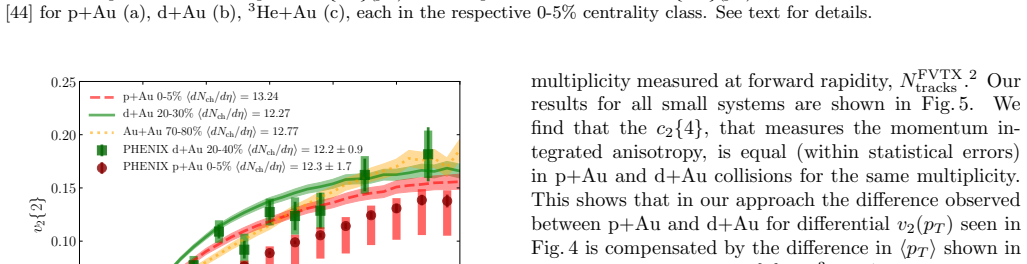
for p+Au (a), d+Au (b), 3He+Au (c), each in the respective 0-5% centrality class. See text for details. 0.0 0.5 1.0 1.5 2.0 2.5 3.0 pT (GeV) 0.00 0.05 0.10 0.15 0.20 0.25 v2{2} p+Au 0-5% ⟨dNch/dη⟩ = 13.24 d+Au 20-30% ⟨dNch/dη⟩ = 12.27 Au+Au 70-80% ⟨dNch/dη⟩ = 12.77 PHENIX d+Au...
-
[45]
Schenke, S
B. Schenke, S. Jeon, and C. Gale, Phys. Rev. Lett. 106, 042301 (2011), arXiv:1009.3244 [hep-ph]
2011 arXiv
-
[46]
Aidala et al
C. Aidala et al. (PHENIX), Nature Phys. 15, 214 (2019), arXiv:1805.02973 [nucl-ex]
2019
-
[47]
S. A. Bass et al. , Prog. Part. Nucl. Phys. 41, 255 (1998), [Prog. Part. Nucl. Phys.41,225(1998)], arXiv:nucl-th/9803035 [nucl-th]
1998 arXiv
-
[48]
Bleicher et al., J
M. Bleicher et al., J. Phys. G25, 1859 (1999), arXiv:hep- ph/9909407 [hep-ph]
1999
-
[49]
Schenke, C
B. Schenke, C. Shen, and P. Tribedy, Phys. Rev. C99, 044908 (2019), arXiv:1901.04378 [nucl-th]
2019 arXiv
-
[50]
J. L. Nagle and W. A. Zajc, (2018), arXiv:1808.01276 [nucl-th]
2018 arXiv
-
[51]
S. H. Lim, J. Carlson, C. Loizides, D. Lonardoni, J. E. Lynn, J. L. Nagle, J. D. Orjuela Koop, and J. Ouellette, (2018), arXiv:1812.08096 [nucl-th]
2018 arXiv
-
[52]
M. D. Sievert and J. Noronha-Hostler, (2019), arXiv:1901.01319 [nucl-th]
2019 arXiv
-
[53]
J. S. Moreland, J. E. Bernhard, and S. A. Bass, Phys. Rev. C92, 011901 (2015), arXiv:1412.4708 [nucl-th]
2015 arXiv
-
[54]
Hulthen and M
L. Hulthen and M. Sagawara, Handbuch der Physik 39, 14 (1957)
1957
-
[55]
M. L. Miller, K. Reygers, S. J. Sanders, and P. Steinberg, Ann. Rev. Nucl. Part. Sci. 57, 205 (2007)
2007
-
[56]
J. L. Nagle, A. Adare, S. Beckman, T. Koblesky, J. Or- juela Koop, D. McGlinchey, P. Romatschke, J. Carlson, J. E. Lynn, and M. McCumber, Phys. Rev. Lett. 113, 112301 (2014), arXiv:1312.4565 [nucl-th]
2014 arXiv
-
[57]
Carlson and R
J. Carlson and R. Schiavilla, Rev. Mod. Phys. 70, 743 (1998)
1998
-
[58]
Kowalski and D
H. Kowalski and D. Teaney, Phys. Rev. D68, 114005 (2003)
2003
-
[59]
A. H. Rezaeian, M. Siddikov, M. Van de Klundert, and R. Venugopalan, Phys.Rev. D87, 034002 (2013), arXiv:1212.2974 [hep-ph]
2013 arXiv
-
[60]
Krasnitz and R
A. Krasnitz and R. Venugopalan, Nucl. Phys. B557, 237 (1999)
1999
-
[61]
Bazavov et al
A. Bazavov et al. (HotQCD), Phys. Rev. D90, 094503 (2014), arXiv:1407.6387 [hep-lat]
2014 arXiv
-
[62]
J. S. Moreland and R. A. Soltz, Phys. Rev. C93, 044913 (2016), arXiv:1512.02189 [nucl-th]
2016 arXiv
-
[63]
G. S. Denicol, H. Niemi, E. Molnar, and D. H. Rischke, Phys. Rev. D85, 114047 (2012), [Erratum: Phys. Rev.D91,no.3,039902(2015)], arXiv:1202.4551 [nucl-th]
2012 arXiv
-
[64]
G. S. Denicol, S. Jeon, and C. Gale, Phys. Rev. C90, 024912 (2014), arXiv:1403.0962 [nucl-th]
2014 arXiv
-
[65]
Cooper and G
F. Cooper and G. Frye, Phys. Rev. D10, 186 (1974)
1974
-
[66]
Dusling, G
K. Dusling, G. D. Moore, and D. Teaney, Phys. Rev. C81, 034907 (2010)
2010
- [67]
-
[68]
Paquet, C
J.-F. Paquet, C. Shen, G. S. Denicol, M. Luzum, B. Schenke, S. Jeon, and C. Gale, Phys. Rev. C93, 044906 (2016), arXiv:1509.06738 [hep-ph]
2016 arXiv
-
[69]
B. I. Abelev et al. (STAR), Phys. Rev. C79, 034909 (2009), arXiv:0808.2041 [nucl-ex]
2009 arXiv
-
[70]
Ansorge et al
R. Ansorge et al. (UA5 Collaboration), Zeitschrift f¨ ur Physik C Particles and Fields 43, 357 (1989)
1989
-
[71]
Aidala et al
C. Aidala et al. (PHENIX), Phys. Rev. Lett. 120, 062302 (2018), arXiv:1707.06108 [nucl-ex]
2018
-
[72]
Luzum and J.-Y
M. Luzum and J.-Y. Ollitrault, Phys. Rev. C87, 044907 (2013), arXiv:1209.2323 [nucl-ex]
2013 arXiv
-
[73]
M¨ antysaari and B
H. M¨ antysaari and B. Schenke, Phys. Rev. Lett. 117, 052301 (2016), arXiv:1603.04349 [hep-ph]
2016 arXiv
-
[74]
M¨ antysaari and B
H. M¨ antysaari and B. Schenke, Phys. Rev.D94, 034042 (2016), arXiv:1607.01711 [hep-ph]
2016 arXiv
-
[75]
Aidala et al
C. Aidala et al. (PHENIX), Phys. Rev. C96, 064905 (2017), arXiv:1708.06983 [nucl-ex]
2017 arXiv
-
[76]
Krasnitz, Y
A. Krasnitz, Y. Nara, and R. Venugopalan, Phys. Lett. B554, 21 (2003)
2003
-
[77]
Adam et al
J. Adam et al. (STAR), Phys. Rev. Lett. 122, 172301 (2019), arXiv:1901.08155 [nucl-ex]
2019 arXiv
- [78]
-
[79]
Adams et al
J. Adams et al. (STAR), Phys. Rev. C72, 014904 (2005)
2005
-
[80]
Dumitru and V
A. Dumitru and V. Skokov, Phys. Rev. D91, 074006 (2015), arXiv:1411.6630 [hep-ph]
2015 arXiv
- [81]
-
[82]
Lappi, B
T. Lappi, B. Schenke, S. Schlichting, and R. Venu- gopalan, JHEP 01, 061 (2016), arXiv:1509.03499 [hep- ph]
2016 arXiv
-
[83]
Chatrchyan et al
S. Chatrchyan et al. (CMS Collaboration), Phys.Lett. B724, 213 (2013), arXiv:1305.0609 [nucl-ex]
2013 arXiv
-
[84]
B. B. Abelev et al. (ALICE), Phys. Rev. C90, 054901 (2014), arXiv:1406.2474 [nucl-ex]
2014 arXiv
-
[85]
Adam et al
J. Adam et al. (ALICE), Phys. Rev. Lett. 116, 132302 (2016), arXiv:1602.01119 [nucl-ex]
2016 arXiv
-
[86]
M. Nie, L. Yi, J. Jia, and G. Ma, (2019), arXiv:1906.01422 [nucl-th]
2019 arXiv
-
[87]
Schenke and S
B. Schenke and S. Schlichting, Phys. Rev. C94, 044907 (2016), arXiv:1605.07158 [hep-ph]
2016 arXiv
-
[88]
McDonald, S
S. McDonald, S. Jeon, and C. Gale, Nucl. Phys. A982, 239 (2019), arXiv:1807.05409 [nucl-th]
2019 arXiv
-
[89]
Shen and B
C. Shen and B. Schenke, Phys. Rev. C97, 024907 (2018), arXiv:1710.00881 [nucl-th]
2018 arXiv
-
[90]
Kurkela, A
A. Kurkela, A. Mazeliauskas, J.-F. Paquet, S. Schlicht- ing, and D. Teaney, Phys. Rev. Lett. 122, 122302 (2019), arXiv:1805.01604 [hep-ph]
2019 arXiv
-
[91]
Kurkela, A
A. Kurkela, A. Mazeliauskas, J.-F. Paquet, S. Schlicht- ing, and D. Teaney, Phys. Rev. C99, 034910 (2019), arXiv:1805.00961 [hep-ph]
2019 arXiv
- [92]
-
[93]
Singh, C
M. Singh, C. Shen, S. McDonald, S. Jeon, and C. Gale, Nucl. Phys. A982, 319 (2019), arXiv:1807.05451 [nucl- th]
2019 arXiv
Reviewed August 14, 2026 · model on record in the stance chip above.
Discussion (0). Continue with ORCID to comment.