REVIEW 3 major objections 5 minor 136 references
Latent Thermodynamic Flows: Unified Representation Learning and Generative Modeling of Temperature-Dependent Behaviors from Limited Data
T0 review · 3 major / 5 minor · reviewed 2026-08-06 · deepseek-v4-flash
Pith's one-line read The paper claims that representation learning and generative modeling should be trained as one, and that the resulting latent model turns data from two simulated temperatures into free energy surfaces at any temperature, including an RNA…
desk verdict A genuinely useful integration of SPIB and normalizing flows with strong benchmarks, but the temperature-extrapolation claim has a concrete qualitative miss on LJ7 and the SI loss derivation contains an algebraic error. read the letter →
The pith
A machine-rendered reading of the paper's core claim, the machinery that carries it, and where it could break.
The reading
What carries the argument
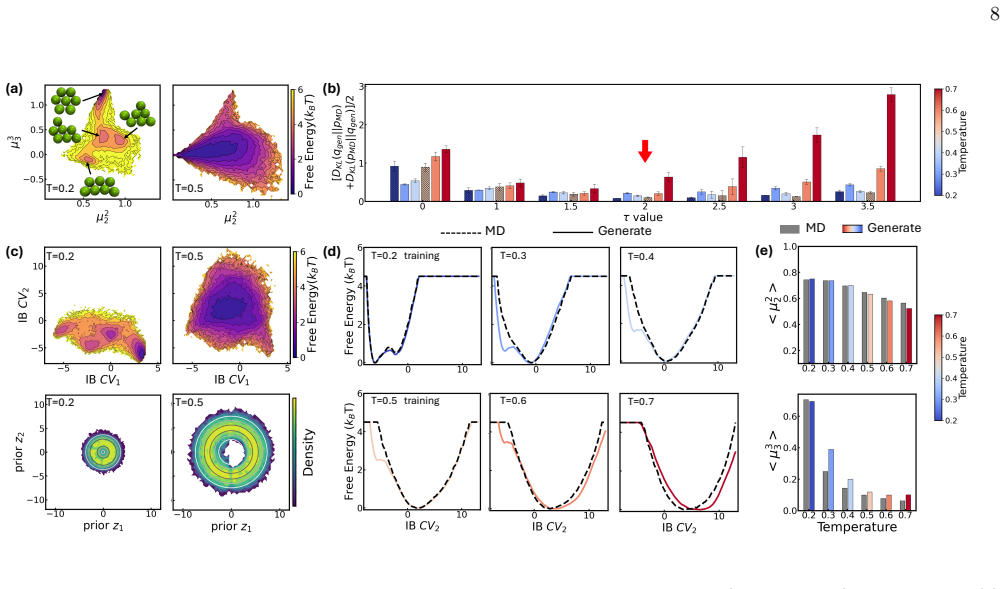
The load-bearing object is the exponentially tilted Gaussian prior $r_T(z,\tau) \propto \exp(\tau\|z\|)\,\exp(-\|z\|^2/2T)$, whose completed square reads $(\|z\| - T\tau)^2/(2T)$: the most-probable radius $T\tau$ and the variance $T$ both grow linearly with temperature, so every temperature is a different ring in the same two-dimensional latent plane, and the ring geometry is what lets priors at different temperatures overlap without one swallowing the other. This prior replaces the standard Gaussian (the $\tau = 0$ case) used by earlier generative samplers for temperature transfer. The rest of the machinery is the joint loss of Eq. 3, which couples a RealNVP normalizing flow $F_\theta$ to the State Predictive Information Bottleneck: the first term rewards predicting the future metastable state $y_{t+\Delta t}$ from flowed samples, while the second and third terms penalize mismatch between the flowed latent distribution and the tilted prior, with the flow's Jacobian making latent densities and hence free energies exactly computable.
What would settle it
Train LaTF at two temperatures, run a relatively short unbiased simulation at an intermediate temperature, encode that trajectory with the frozen encoder, and compare the encoded free-energy surface against the LaTF-generated surface at the same temperature using the paper's symmetric KL metric; the temperature-invariance premise predicts agreement as close as at the training temperatures. The paper already reports one instance of what failure looks like: in the Lennard-Jones cluster, LaTF only gradually melts the most-populated hexagonal state with rising temperature, whereas long MD simulations show it is sharply suppressed, a mismatch the authors attribute to the choice of tilt parameter.
Extended reading notes
Core claim
On its own terms, the paper establishes that a single two-dimensional latent space can carry both a kinetically meaningful representation and a generative model that is accurate at the trained temperatures and transferable across temperature. The encoder projects molecular configurations into the latent space, the decoder assigns them to long-lived metastable states, and a real-valued non-volume-preserving (RealNVP) normalizing flow relates the encoded distribution to a temperature-steerable tilted Gaussian prior $r_T(z,\tau)$. Because that prior is radially symmetric with its density concentrated on a ring of radius $T\tau$ and variance $T$, raising the temperature both inflates and shifts the high-density region of latent space, which is the mechanism by which the model predicts how free-energy basins broaden, shift, and repopulate at unseen temperatures. The benchmarks on Chignolin and the Lennard-Jones cluster show generated free-energy surfaces and state populations tracking long unbiased simulations across a range of temperatures, and the RNA GCAA tetraloop result is presented as the payoff: trained on 300 K and 400 K data alone, LaTF reconstructs the temperature-dependent structural ensemble and yields a melting temperature of about 88 °C, against 84 ± 10 °C from simulated tempering and about 71 °C from experiment.
Load-bearing premise
The prediction at unseen temperatures assumes that the same learned latent coordinates and the same map between latent space and prior space stay valid at every temperature, leaving the tilted Gaussian prior $r_T(z,\tau)$ to carry all temperature dependence; the authors state in the conclusion that there is no theoretical guarantee the learned representations remain unchanged with temperature.
Editorial extensions
If this is right
- Two-temperature training replaces multi-temperature sampling: equilibrium distributions, free energy surfaces, and state populations at any temperature in the trained range are obtained by drawing from the tilted prior at that temperature and mapping back through the inverse flow.
- One trained model simultaneously labels metastable states, interpolates transition pathways between basins, and back-maps generated latent samples to all-atom structures, so representation, generation, and interpretation no longer require separate pipelines.
- The tilted Gaussian prior outperforms the standard temperature-scaled Gaussian on every benchmark, so the ring-shaped prior is essential to temperature transfer rather than a cosmetic choice.
- Data efficiency persists under scarcity: training on 1 µs segments at two temperatures still captures the temperature-dependent free energy landscape of Chignolin, and training at two high temperatures still generates correct low-temperature ensembles.
- For the RNA GCAA tetraloop, training at 300 K and 400 K reconstructs the continuous unfolding transition, giving a melting temperature of about 88 °C, close to the simulated tempering estimate of 84 ± 10 °C and somewhat above the experimental 71 °C.
Reading between the lines
- If the temperature-invariance premise holds, the same tilt mechanism should extend to other thermodynamic knobs such as pressure, chemical potential, or salt concentration by making each an axis of the prior; nothing in the architecture is specific to temperature.
- Making the tilt parameter a learned function of temperature, rather than a constant chosen by validation error, is the natural next test: it would drop the paper's implicit assumption that one optimal tilt serves all temperatures and might correct known mismatches such as the Lennard-Jones cluster's over-populated hexagonal state at high temperature.
- The framework inverts the compute tradeoff of molecular simulation: instead of converging simulations at every temperature, one invests once in a faithful latent representation and then re-samples it at nearly zero marginal cost, which pays off most on rough, glassy landscapes such as RNA where per-temperature sampling is the expensive step.
- Because the prior's most-probable latent radius grows as $T\tau$, the model predicts that the radius of the encoded data cloud in latent space is close to linear in temperature; encoding unconverged intermediate-temperature data and checking that radius is a cheap, direct test of the premise.
Editorial analysis
A structured set of objections, weighed in public.
Referee Report
Summary. The manuscript introduces Latent Thermodynamic Flows (LaTF), a framework that couples the State Predictive Information Bottleneck (SPIB) representation learning method with a normalizing flow (NF) and an exponentially tilted Gaussian prior. The central claim is that LaTF, trained on molecular dynamics data from only two temperatures, can generate equilibrium distributions and free energy surfaces at unseen temperatures by varying a temperature-steerable parameter in the tilted prior. The method is applied to a 2D potential, the Chignolin protein, a Lennard-Jones 7 cluster, and an RNA GCAA tetraloop, with benchmarks against long unbiased MD simulations, Markov state models, simulated tempering, and experiment. The paper emphasizes joint optimization of representation learning and generative modeling, improved metastable-state separation, physically realistic pathway interpolation, and data efficiency.
Significance. If the central claims hold, LaTF would be a valuable contribution: it provides an end-to-end pipeline that both learns interpretable collective variables and generates equilibrium ensembles at temperatures not directly simulated, potentially replacing expensive multi-temperature sampling for thermodynamic interpolation. The manuscript benefits from extensive empirical evaluation, including cross-validated KL divergences, GMRQ/MSM comparisons, out-of-sample temperature checks, and publicly released code. The temperature-extrapolation claim, however, rests on a strong structural assumption that is acknowledged by the authors but not validated, and one of the paper's own benchmark results provides a qualitative counterexample. The derivation of the unified loss also contains a technical error in dropping a θ-dependent term.
major comments (3)
- [SI §I.C, Eq. (12)-(13)] The derivation of the unified LaTF loss treats the encoder density p_θ(u|X) as a constant when moving from Eq. (11) to Eq. (12). Specifically, Eq. (11) contains the term −β log p_θ(u|X_n) inside the expectation over p_θ(u|X_n); this term is the differential entropy of the Gaussian encoder and depends on the network parameters θ, so it cannot be absorbed into the constant. Consequently, the claimed equivalence between L_LaTF in Eq. (3) of the main text and the original SPIB objective is not established. The actual objective being optimized omits an encoder-entropy regularization term (−β E[log p_θ(u|X)]), which may alter the balance between prediction accuracy and prior regularization. The authors should either correct the derivation, state the modified objective explicitly, or explain why the omitted term is benign in practice.
- [§II.C, Fig. 5(d) and Conclusion] The temperature-extrapolation mechanism assumes that the encoder and normalizing flow are temperature-invariant and that all temperature dependence of the equilibrium distribution is captured by the tilted Gaussian prior r_T(z,τ) in Eq. (5). The authors explicitly acknowledge in the Conclusion that there is no theoretical guarantee that learned representations remain unchanged with temperature. The LJ7 results provide a concrete falsification case: the main text states that the hexagonal metastable state 'is gradually diminished as temperature rises, whereas MD simulations show it should be sharply suppressed.' This is a qualitative failure of the predicted temperature trend in one of the benchmark systems, and the suggestion that refining τ would resolve it is not supported by any systematic τ-sensitivity analysis at unseen temperatures. This issue directly affects the central claim of predicting temperature-dependent behaviors at unseen temperatures and needs to be addressed, either by demonstrating when the assumption holds, by proposing a more general temperature-dependent transformation, or by restricting the claim to systems where the assumption is empirically verified.
- [§II.D, Fig. 6(e)] The validation of the RNA melting-curve prediction is presented largely through a single scalar quantity, the melting temperature (88°C for LaTF versus 84±10°C for simulated tempering and 71°C experimental). Since the predicted and reference curves are not compared quantitatively over the full temperature range (e.g., via overlapping confidence intervals or a mean-absolute-error metric), a correct Tm can coexist with substantial errors in the free energy surface at intermediate temperatures. In addition, the folded/unfolded classification depends on the nearest-neighbor backmapping in the latent space, whose accuracy at unseen temperatures is not separately quantified. Please provide a quantitative comparison of the full melting curves, including uncertainties propagated from the cross-validation, and clarify the effect of the backmapping approximation on the reported unfolded fractions.
minor comments (5)
- [Eq. (1) and Eq. (3)] The sign convention is confusing: Eq. (1) defines L_IB as a quantity to be maximized (with a leading minus), and Eq. (3) has a similar structure, but the text later refers to 'reconstruction loss' and 'generation error' as quantities to be minimized. Please clarify the optimization direction consistently.
- [§II.B, first sentence of 'Setting up LaTF'] Typo: 'the the IB latent dimension' should read 'the IB latent dimension'.
- [§II.C, 'Temperature-steerable tilted Gaussian prior'] The parameter τ is called both 'tilting factor' and 'temperature-steerable parameter' in different places. Since Eq. (5) also introduces the temperature T, it would help to reserve 'tilting factor' for τ and use a distinct name for the temperature input.
- [Methods, Eq. (8)] The normalization constant Z_{τ,T} is written with a factor τ√(2T); the corresponding expression in the SI (Eq. 26) appears to lack a factor of 2 in the numerator of the volume element. Please verify the consistency of these formulas.
- [§II.D, 'Exploring Temperature-Dependent RNA Free Energy Landscapes'] The sentence 'the discrepancy likely arises from factors such as force-field limitations, state definitions, or ionic conditions, etc.' is speculative; since the simulated-tempering reference uses the same force field, it would be more informative to quantify the systematic bias relative to experiment in a controlled way rather than listing possible causes.
Circularity Check
No significant circularity: the temperature dependence of the predicted ensembles is a stated forward-modeling assumption, and the paper's key benchmarks are external to the fitted parameters.
full rationale
The central claim is that LaTF, trained at two temperatures, can generate equilibrium distributions and free energy surfaces at unseen temperatures. The mechanism is explicit: the encoder and normalizing flow are trained once, and only the analytically defined tilted Gaussian prior r_T(z, tau) in Eq. 5 changes with temperature. This is a transparent modeling assumption, not a circular derivation: the predicted FES is, by construction, the prior pulled back through the fixed flow, but the prior is not fitted to the unseen-temperature data. The hyperparameter tau is selected using only KL divergence at the training temperatures (e.g., Fig. 4(b), Fig. 5(b), Fig. 6(b)), and the evaluations at unseen temperatures use full MD data only as a benchmark, not for parameter selection. For the RNA tetraloop, the predicted melting curve is compared against external experimental data and independent simulated tempering simulations using the same force field, which provides external falsifiability. The paper's own admission that 'there is no theoretical guarantee that the learned representations themselves should remain unchanged with temperature' is an honest statement of a scope limitation, not evidence of circularity. Self-citations to SPIB and to the authors' earlier Thermodynamic Maps work are used as building blocks and inspiration, but the unified loss is derived in the SI and the central benchmarks are external; no load-bearing reduction to a self-citation chain is present. The LJ7 hexagon-population discrepancy is an empirical failure of the temperature-invariance assumption, which further confirms that the predictions are not trivially enforced by construction. Under the stated rules, this is a non-finding: no circular step is identifiable.
Assumptions & free parameters
free parameters (5)
- tilting factor tau =
tau = 3 (2D potential), 2.5-3.5 (Chignolin), 2 (LJ7), 4.5 (RNA)
- Information bottleneck trade-off beta =
1e-4 to 5e-4 depending on system
- lag time Delta t =
5 ns (Chignolin), 200 ns (RNA), 100 steps (LJ7), 1500 steps (model potential)
- latent dimension d_z =
2
- temperature normalization T =
lowest training temperature set to 1; others proportional
assumptions (4)
- ad hoc to paper Tilted Gaussian prior ansatz: r_T(z, tau) captures all temperature dependence, with variance and most-probable radius linear in T
- domain assumption Latent representation and normalizing flow mapping are temperature-invariant
- domain assumption Nearest-neighbor matching in IB space is a valid backmapping to all-atom structures
- standard math RealNVP transformations are bijective with tractable Jacobians
Cite this review
Pith. "Pith review of Latent Thermodynamic Flows: Unified Representation Learning and Generative Modeling of Temperature-Dependent Behaviors from Limited Data." pith.science (2026). https://pith.science/paper/TRGOZMFC
@misc{pith2026250703174,
  author       = {Pith},
  title        = {Pith review of: Latent Thermodynamic Flows: Unified Representation Learning and Generative Modeling of Temperature-Dependent Behaviors from Limited Data},
  year         = {2026},
  howpublished = {\url{https://pith.science/paper/TRGOZMFC}},
  note         = {Machine review of arXiv:2507.03174}
}
read the original abstract
Accurate characterization of the equilibrium distributions of complex molecular systems and their dependence on environmental factors such as temperature is essential for understanding thermodynamic properties and transition mechanisms. Projecting these distributions onto meaningful low-dimensional representations enables interpretability and downstream analysis. Recent advances in generative AI, particularly flow models such as Normalizing Flows (NFs), have shown promise in modeling such distributions, but their scope is limited without tailored representation learning. In this work, we introduce Latent Thermodynamic Flows (LaTF), an end-to-end framework that tightly integrates representation learning and generative modeling. LaTF unifies the State Predictive Information Bottleneck (SPIB) with NFs to simultaneously learn low-dimensional latent representations, referred to as Collective Variables (CVs), classify metastable states, and generate equilibrium distributions across temperatures beyond the training data. The two components of representation learning and generative modeling are optimized jointly, ensuring that the learned latent features capture the system's slow, important degrees of freedom while the generative model accurately reproduces the system's equilibrium behavior. We demonstrate LaTF's effectiveness across diverse systems, including a model potential, the Chignolin protein, and cluster of Lennard Jones particles, with thorough evaluations and benchmarking using multiple metrics and extensive simulations. Finally, we apply LaTF to a RNA tetraloop system, where despite using simulation data from only two temperatures, LaTF reconstructs the temperature-dependent structural ensemble and melting behavior, consistent with experimental and prior extensive computational results.
Figures


Figures from the paper (3 more)


Reference graph
Works this paper leans on
-
[1]
State predictive information bottleneck
Dedi Wang and Pratyush Tiwary. State predictive information bottleneck. The Journal of Chemical Physics , 154(13), 2021
work page 2021
-
[2]
) (19) =M(d 2, 1 2, 1 2τ 2) +τ √ 2Γ(d+1 2 ) Γ(d
-
[3]
Suemin Lee, Dedi Wang, Markus A Seeliger, and Pratyush Tiwary. Calculating protein–ligand residence times through state predictive information bottleneck based enhanced sampling. Journal of Chemical Theory and Computation , 20(14):6341–6349, 2024
work page 2024
-
[4]
Alphafold2-rave: From sequence to boltzmann ranking
Bodhi P Vani, Akashnathan Aranganathan, Dedi Wang, and Pratyush Tiwary. Alphafold2-rave: From sequence to boltzmann ranking. Journal of chemical theory and computation , 19(14):4351–4354, 2023
work page 2023
-
[5]
The information bottleneck method
Naftali Tishby, Fernando C Pereira, and William Bialek. The information bottleneck method. arXiv preprint physics/0004057, 2000
arXiv 2000
-
[6]
Deep variational information bottleneck
Alexander A Alemi, Ian Fischer, Joshua V Dillon, and Kevin Murphy. Deep variational information bottleneck. arXiv preprint arXiv:1612.00410, 2016
arXiv 2016
-
[7]
Auto-encoding variational bayes, 2013
Diederik P Kingma, Max Welling, et al. Auto-encoding variational bayes, 2013
2013
-
[8]
f-VAEs: Improve VAEs with Conditional Flows
Jianlin Su and Guang Wu. f-vaes: Improve vaes with conditional flows. arXiv preprint arXiv:1809.05861 , 2018
work page Pith review arXiv 2018
Show all 136 references
-
[9]
Score-based generative modeling in latent space
Arash Vahdat, Karsten Kreis, and Jan Kautz. Score-based generative modeling in latent space. Advances in neural information processing systems , 34:11287–11302, 2021
2021
-
[10]
Flow matching in latent space
Quan Dao, Hao Phung, Binh Nguyen, and Anh Tran. Flow matching in latent space. arXiv preprint arXiv:2307.08698 , 2023
2023 arXiv
-
[11]
The tilted variational autoencoder: Improving out-of-distribution detec- tion
Griffin Floto, Stefan Kremer, and Mihai Nica. The tilted variational autoencoder: Improving out-of-distribution detec- tion. In The Eleventh International Conference on Learning Representations , 2023
2023
-
[12]
Boltzmann generators: Sampling equilibrium states of many-body systems with deep learning
Frank No´ e, Simon Olsson, Jonas K¨ ohler, and Hao Wu. Boltzmann generators: Sampling equilibrium states of many-body systems with deep learning. Science, 365(6457):eaaw1147, 2019
2019
-
[13]
Inferring phase transitions and critical exponents from limited observations with thermodynamic maps
Lukas Herron, Kinjal Mondal, John S Schneekloth Jr, and Pratyush Tiwary. Inferring phase transitions and critical exponents from limited observations with thermodynamic maps. Proceedings of the National Academy of Sciences , 121(52):e2321971121, 2024
2024
-
[14]
From data to noise to data for mixing physics across temperatures with generative artificial intelligence
Yihang Wang, Lukas Herron, and Pratyush Tiwary. From data to noise to data for mixing physics across temperatures with generative artificial intelligence. Proceedings of the National Academy of Sciences , 119(32):e2203656119, 2022
2022
-
[15]
Density estimation using real nvp
Laurent Dinh, Jascha Sohl-Dickstein, and Samy Bengio. Density estimation using real nvp. arXiv preprint arXiv:1605.08803, 2016
2016 arXiv
-
[16]
Masked autoregressive flow for density estimation
George Papamakarios, Theo Pavlakou, and Iain Murray. Masked autoregressive flow for density estimation. Advances in neural information processing systems , 30, 2017
2017
-
[17]
Stochastic normalizing flows.Advances in neural information processing systems , 33:5933–5944, 2020
Hao Wu, Jonas K¨ ohler, and Frank No´ e. Stochastic normalizing flows.Advances in neural information processing systems , 33:5933–5944, 2020
2020
-
[18]
Glow: Generative flow with invertible 1x1 convolutions
Durk P Kingma and Prafulla Dhariwal. Glow: Generative flow with invertible 1x1 convolutions. Advances in neural information processing systems , 31, 2018
2018
-
[19]
Neural spline flows
Conor Durkan, Artur Bekasov, Iain Murray, and George Papamakarios. Neural spline flows. Advances in neural infor- mation processing systems , 32, 2019
2019
-
[20]
Efficient molecular dynamics using geodesic integration and solvent–solute splitting
Benedict Leimkuhler and Charles Matthews. Efficient molecular dynamics using geodesic integration and solvent–solute splitting. Proceedings of the Royal Society A: Mathematical, Physical and Engineering Sciences , 472(2189):20160138, 2016
2016
-
[21]
10 residue folded peptide designed by segment statistics
Shinya Honda, Kazuhiko Yamasaki, Yoshito Sawada, and Hisayuki Morii. 10 residue folded peptide designed by segment statistics. Structure, 12(8):1507–1518, 2004
2004
-
[22]
Structure and dynamics of the tip3p, spc, and spc/e water models at 298 k
Pekka Mark and Lennart Nilsson. Structure and dynamics of the tip3p, spc, and spc/e water models at 298 k. The Journal of Physical Chemistry A , 105(43):9954–9960, 2001
2001
-
[23]
Development and testing of the opls all-atom force field on conformational energetics and properties of organic liquids
William L Jorgensen, David S Maxwell, and Julian Tirado-Rives. Development and testing of the opls all-atom force field on conformational energetics and properties of organic liquids. Journal of the american chemical society , 118(45):11225– 11236, 1996
1996
-
[24]
Improved peptide and protein torsional energetics with the opls-aa force field
Michael J Robertson, Julian Tirado-Rives, and William L Jorgensen. Improved peptide and protein torsional energetics with the opls-aa force field. Journal of chemical theory and computation , 11(7):3499–3509, 2015
2015
-
[25]
An evaluation of force field accuracy for the mini-protein chignolin using markov state models
Tim Marshall, Robert Raddi, and Vincent Voelz. An evaluation of force field accuracy for the mini-protein chignolin using markov state models. Biophysical Journal, 122(3):420a, 2023
2023
-
[26]
Particle mesh ewald: An n log (n) method for ewald sums in large systems
Tom Darden, Darrin York, Lee Pedersen, et al. Particle mesh ewald: An n log (n) method for ewald sums in large systems. Journal of chemical physics , 98:10089–10089, 1993
1993
-
[27]
Lincs: A linear constraint solver for molecular simulations
Berk Hess, Henk Bekker, Herman JC Berendsen, and Johannes GEM Fraaije. Lincs: A linear constraint solver for molecular simulations. Journal of computational chemistry , 18(12):1463–1472, 1997
1997
-
[28]
Molecular dynamics with coupling to an external bath
Herman JC Berendsen, JPM van Postma, Wilfred F Van Gunsteren, ARHJ DiNola, and Jan R Haak. Molecular dynamics with coupling to an external bath. The Journal of chemical physics , 81(8):3684–3690, 1984. 25
1984
-
[29]
Strain fluctuations and elastic constants
M Parrinello and A Rahman. Strain fluctuations and elastic constants. The Journal of Chemical Physics , 76(5):2662– 2666, 1982
1982
-
[30]
Gromacs: High performance molecular simulations through multi-level parallelism from laptops to supercomputers
Mark James Abraham, Teemu Murtola, Roland Schulz, Szil´ ard P´ all, Jeremy C Smith, Berk Hess, and Erik Lindahl. Gromacs: High performance molecular simulations through multi-level parallelism from laptops to supercomputers. SoftwareX, 1:19–25, 2015
2015
-
[31]
T. Löhr, K. Kohlhoff, G. T. Heller, C. Camilloni, and M. Vendruscolo, A kinetic ensemble of the alzheimer’s aβ peptide, Nature Computational Science1, 71 (2021)
2021
-
[32]
S. M. Marques, P. Kouba, A. Legrand, J. Sedlar, L. Disson, J. Planas-Iglesias, Z. Sanusi, A. Kunka, J. Damborsky, T. Pajdla, et al., Covampnet: com- parative markov state analysis for studying effects of drug candidates on disordered biomolecules, JACS Au 4, 2228 (2024)
2024
-
[33]
Y. Qiu, I. Jang, X. Huang, and A. Yethiraj, Unsuper- vised learning of structural relaxation in supercooled liquids from short-term fluctuations, Proceedings of the National Academy of Sciences122, e2427246122 (2025)
2025
-
[34]
W. Chen, H. Sidky, and A. L. Ferguson, Nonlinear discovery of slow molecular modes using state-free re- versible vampnets, The Journal of chemical physics150 (2019)
2019
-
[35]
D. Wang, Y. Qiu, E. R. Beyerle, X. Huang, and P. Tiwary, Information bottleneck approach for markov 14 model construction, Journal of chemical theory and computation 20, 5352 (2024)
2024
-
[36]
Pengmei, C
Z. Pengmei, C. Lorpaiboon, S. C. Guo, J. Weare, and A. R. Dinner, Using pretrained graph neural networks with token mixers as geometric featurizers for confor- mational dynamics, The Journal of Chemical Physics 162 (2025)
2025
-
[37]
Wu and F
H. Wu and F. Noé, Reaction coordinate flows for model reduction of molecular kinetics, The Journal of Chemi- cal Physics 160 (2024)
2024
-
[38]
D. Teng, V. J. Meraz, A. Aranganathan, X. Gu, and P. Tiwary, AlphaFold2-RAVE: Protein Ensemble Generation with Physics-Based Sampling, ChemRxiv 10.26434/chemrxiv-2025-q3mwr-v2 (2025), preprint. This content has not been peer-reviewed
2025 doi
-
[39]
X. Gu, A. Aranganathan, and P. Tiwary, Empowering alphafold2 for protein conformation selective drug dis- covery with alphafold2-rave, Elife13, RP99702 (2024)
2024
-
[40]
F. Noé, S. Olsson, J. Köhler, and H. Wu, Boltzmann generators: Sampling equilibrium states of many-body systems with deep learning, Science 365, eaaw1147 (2019)
2019
-
[41]
Köhler, L
J. Köhler, L. Klein, and F. Noé, Equivariant flows: ex- act likelihood generative learning for symmetric densi- ties, International conference on machine learning , 5361 (2020)
2020
-
[42]
Dibak, L
M. Dibak, L. Klein, A. Krämer, and F. Noé, Tempera- ture steerable flows and boltzmann generators, Physical Review Research 4, L042005 (2022)
2022
-
[43]
Klein and F
L. Klein and F. Noé, Transferable boltzmann genera- tors, arXiv preprint arXiv:2406.14426 (2024)
2024 arXiv
-
[44]
Zheng, J
S. Zheng, J. He, C. Liu, Y. Shi, Z. Lu, W. Feng, F. Ju, J. Wang, J. Zhu, Y. Min,et al., Predicting equilibrium distributions for molecular systems with deep learning, Nature Machine Intelligence6, 558 (2024)
2024
-
[45]
Moqvist, W
S. Moqvist, W. Chen, M. Schreiner, F. Nüske, and S. Olsson, Thermodynamic interpolation: A generative approach to molecular thermodynamics and kinetics, Journal of Chemical Theory and Computation21, 2535 (2025)
2025
-
[46]
Y. Wang, L. Herron, and P. Tiwary, From data to noise to data for mixing physics across temperatures with generative artificial intelligence, Proceedings of the Na- tional Academy of Sciences119, e2203656119 (2022)
2022
-
[47]
Herron, K
L. Herron, K. Mondal, J. S. Schneekloth Jr, and P. Ti- wary, Inferring phase transitions and critical exponents from limited observations with thermodynamic maps, Proceedings of the National Academy of Sciences121, e2321971121 (2024)
2024
-
[48]
S. Lee, R. Wang, L. Herron, and P. Tiwary, Expo- nentially tilted thermodynamic maps (exptm): Predict- ing phase transitions across temperature, pressure, and chemical potential, arXiv preprint arXiv:2503.15080 (2025)
2025 arXiv
-
[49]
E. R. Beyerle and P. Tiwary, Inferring the isotropic- nematic phase transition with generative machine learn- ing, arXiv preprint arXiv:2410.21034 (2024)
2024 arXiv
-
[50]
A. B. Tsybakov and A. B. Tsybakov, Nonparametric estimators, Introduction to Nonparametric Estimation , 1 (2009)
2009
-
[51]
Biroli, T
G. Biroli, T. Bonnaire, V. De Bortoli, and M. Mézard, Dynamical regimes of diffusion models, Nature Commu- nications 15, 9957 (2024)
2024
-
[52]
R. John, L. Herron, and P. Tiwary, A comparison of probabilistic generative frameworks for molecular simu- lations, The Journal of Chemical Physics162 (2025)
2025
-
[53]
Vahdat, K
A. Vahdat, K. Kreis, and J. Kautz, Score-based genera- tive modeling in latent space, Advances in neural infor- mation processing systems34, 11287 (2021)
2021
-
[54]
Rombach, A
R. Rombach, A. Blattmann, D. Lorenz, P. Esser, and B. Ommer, High-resolution image synthesis with latent diffusion models, Proceedings of the IEEE/CVF confer- ence on computer vision and pattern recognition , 10684 (2022)
2022
-
[57]
Papamakarios, E
G. Papamakarios, E. Nalisnick, D. J. Rezende, S. Mo- hamed, and B. Lakshminarayanan, Normalizing flows for probabilistic modeling and inference, Journal of Ma- chine Learning Research22, 1 (2021)
2021
-
[59]
Wirnsberger, A
P. Wirnsberger, A. J. Ballard, G. Papamakar- ios, S. Abercrombie, S. Racanière, A. Pritzel, D. Jimenez Rezende, and C. Blundell, Targeted free en- ergy estimation via learned mappings, The Journal of Chemical Physics 153 (2020)
2020
-
[60]
Rizzi, P
A. Rizzi, P. Carloni, and M. Parrinello, Targeted free energy perturbation revisited: Accurate free energies from mapped reference potentials, The journal of phys- ical chemistry letters12, 9449 (2021)
2021
-
[61]
Olehnovics, Y
E. Olehnovics, Y. M. Liu, N. Mehio, A. Y. Sheikh, M. R. Shirts, and M. Salvalaglio, Assessing the accuracy and efficiency of free energy differences obtained from reweighted flow-based probabilistic generative models, Journal of Chemical Theory and Computation20, 5913 (2024)
2024
-
[62]
van Leeuwen, A
S. van Leeuwen, A. P. d. A. Ortíz, and M. Dijkstra, A boltzmann generator for the isobaric-isothermal ensem- ble, arXiv preprint arXiv:2305.08483 (2023)
2023 arXiv
-
[63]
V. J. Meraz, Z. Zou, and P. Tiwary, Simulating crys- tallization in a colloidal system using state predictive information bottleneck based enhanced sampling, The Journal of Physical Chemistry B128, 8207 (2024)
2024
-
[64]
Floto, S
G. Floto, S. Kremer, and M. Nica, The tilted variational autoencoder: Improving out-of-distribution detection, The Eleventh International Conference on Learning Representations (2023)
2023
-
[65]
Prinz, H
J.-H. Prinz, H. Wu, M. Sarich, B. Keller, M. Senne, M.Held, J.D.Chodera, C.Schütte,andF.Noé,Markov models of molecular kinetics: Generation and valida- tion, The Journal of chemical physics134 (2011)
2011
-
[66]
R. T. McGibbon and V. S. Pande, Variational cross- validation of slow dynamical modes in molecular kinet- ics, The Journal of chemical physics142 (2015)
2015
-
[67]
Shoemake, Animating rotation with quaternion curves, Proceedings of the 12th annual conference on Computer graphics and interactive techniques , 245 (1985)
K. Shoemake, Animating rotation with quaternion curves, Proceedings of the 12th annual conference on Computer graphics and interactive techniques , 245 (1985)
1985
-
[68]
Honda, K
S. Honda, K. Yamasaki, Y. Sawada, and H. Morii, 10 residue folded peptide designed by segment statistics, Structure 12, 1507 (2004). 15
2004
-
[69]
Vanden-Eijnden, Transition path theory, Computer Simulations in Condensed Matter Systems: From Ma- terials to Chemical Biology Volume 1 , 453 (2006)
E. Vanden-Eijnden, Transition path theory, Computer Simulations in Condensed Matter Systems: From Ma- terials to Chemical Biology Volume 1 , 453 (2006)
2006
-
[70]
F. Noé, C. Schütte, E. Vanden-Eijnden, L. Reich, and T. R. Weikl, Constructing the equilibrium ensemble of folding pathways from short off-equilibrium simulations, Proceedings of the National Academy of Sciences106, 19011 (2009)
2009
-
[71]
Y. Qiu, M. S. O’Connor, M. Xue, B. Liu, and X. Huang, An efficient path classification algorithm based on varia- tional autoencoder to identify metastable path channels for complex conformational changes, Journal of chemi- cal theory and computation19, 4728 (2023)
2023
-
[72]
Trizio, P
E. Trizio, P. Kang, and M. Parrinello, Everything every- where all at once: a probability-based enhanced sam- pling approach to rare events, Nature Computational Science , 1 (2025)
2025
-
[73]
P. Kang, E. Trizio, and M. Parrinello, Computing the committor with the committor to study the transition state ensemble, Nature Computational Science 4, 451 (2024)
2024
-
[74]
Metzner, F
P. Metzner, F. Noé, and C. Schütte, Estimating the sampling error: Distribution of transition matrices and functions of transition matrices for given trajectory data, Physical Review E—Statistical, Nonlinear, and Soft Matter Physics80, 021106 (2009)
2009
-
[75]
Janson, A
G. Janson, A. Jussupow, and M. Feig, Deep generative modeling of temperature-dependent structural ensem- bles of proteins, bioRxiv , 2025 (2025)
2025
-
[76]
G. A. Tribello, M. Ceriotti, and M. Parrinello, A self- learning algorithm for biased molecular dynamics, Pro- ceedings of the National Academy of Sciences 107, 17509 (2010)
2010
-
[77]
Schwerdtfeger and D
P. Schwerdtfeger and D. J. Wales, 100 years of the lennard-jones potential, Journal of Chemical Theory and Computation 20, 3379 (2024)
2024
-
[78]
J. P. Sheehy, A. R. Davis, and B. M. Znosko, Ther- modynamic characterization of naturally occurring rna tetraloops, Rna 16, 417 (2010)
2010
-
[79]
D. Tan, S. Piana, R. M. Dirks, and D. E. Shaw, Rna force field with accuracy comparable to state-of-the- art protein force fields, Proceedings of the National Academy of Sciences115, E1346 (2018)
2018
-
[80]
Frauenfelder, S
H. Frauenfelder, S. G. Sligar, and P. G. Wolynes, The energy landscapes and motions of proteins, Science254, 1598 (1991)
1991
-
[81]
J. N. Onuchic, Z. Luthey-Schulten, and P. G. Wolynes, Theory of protein folding: the energy landscape per- spective, Annual review of physical chemistry48, 545 (1997)
1997
-
[82]
Chen and K
S.-J. Chen and K. A. Dill, Rna folding energy land- scapes, Proceedings of the National Academy of Sci- ences 97, 646 (2000)
2000
-
[83]
Kuhrova, R
P. Kuhrova, R. B. Best, S. Bottaro, G. Bussi, J. Sponer, M. Otyepka, and P. Banas, Computer folding of rna tetraloops: identification of key force field deficiencies, Journal of chemical theory and computation12, 4534 (2016)
2016
-
[84]
Pagnani, G
A. Pagnani, G. Parisi, and F. Ricci-Tersenghi, Glassy transition in a disordered model for the rna secondary structure, Physical review letters84, 2026 (2000)
2000
-
[85]
Chakraborty, R
D. Chakraborty, R. Collepardo-Guevara, and D. J. Wales, Energy landscapes, folding mechanisms, and ki- netics of rna tetraloop hairpins, Journal of the American Chemical Society 136, 18052 (2014)
2014
-
[86]
G. H. Zerze, P. M. Piaggi, and P. G. Debenedetti, A computational study of rna tetraloop thermodynam- ics, including misfolded states, The Journal of Physical Chemistry B 125, 13685 (2021)
2021
-
[87]
Rahimi, P
K. Rahimi, P. M. Piaggi, and G. H. Zerze, Comparison of on-the-fly probability enhanced sampling and paral- lel tempering combined with metadynamics for atom- istic simulations of rna tetraloop folding, The Journal of Physical Chemistry B127, 4722 (2023)
2023
-
[88]
Boccalini, Y
M. Boccalini, Y. Berezovska, G. Bussi, M. Paloni, and A. Barducci, Exploring rna destabilization mechanisms in biomolecular condensates through atomistic simula- tions, Proceedings of the National Academy of Sciences 122, e2425261122 (2025)
2025
-
[89]
Bottaro, A
S. Bottaro, A. Gil-Ley, and G. Bussi, Rna folding path- ways in stop motion, Nucleic acids research 44, 5883 (2016)
2016
-
[90]
F. M. Jucker, H. A. Heus, P. F. Yip, E. H. Moors, and A. Pardi, A network of heterogeneous hydrogen bonds in gnra tetraloops, Journal of molecular biology 264, 968 (1996)
1996
-
[91]
Vangaveti, S
S. Vangaveti, S. V. Ranganathan, and A. A. Chen, Ad- vances in rna molecular dynamics: a simulator’s guide to rna force fields, Wiley Interdisciplinary Reviews: RNA 8, e1396 (2017)
2017
-
[92]
Sponer, G
J. Sponer, G. Bussi, M. Krepl, P. Banáš, S. Bottaro, R. A. Cunha, A. Gil-Ley, G. Pinamonti, S. Poblete, P. Jurecka,et al., Rna structural dynamics as captured by molecular simulations: a comprehensive overview, Chemical reviews 118, 4177 (2018)
2018
-
[93]
Y. I. Yang and M. Parrinello, Refining collective coordi- nates and improving free energy representation in vari- ational enhanced sampling, Journal of chemical theory and computation 14, 2889 (2018)
2018
-
[94]
Frassek, A
M. Frassek, A. Arjun, and P. Bolhuis, An extended au- toencoder model for reaction coordinate discovery in rare event molecular dynamics datasets, The Journal of Chemical Physics155 (2021)
2021
-
[95]
Lemke and C
T. Lemke and C. Peter, Encodermap: Dimensional- ity reduction and generation of molecule conformations, Journal of chemical theory and computation15, 1209 (2019)
2019
-
[96]
Lipman, R
Y. Lipman, R. T. Chen, H. Ben-Hamu, M. Nickel, and M. Le, Flow matching for generative modeling, arXiv preprint arXiv:2210.02747 (2022)
2022 arXiv
-
[97]
J. Ho, A. Jain, and P. Abbeel, Denoising diffusion prob- abilistic models, Advances in neural information pro- cessing systems 33, 6840 (2020)
2020
-
[98]
J.Song, C.Meng,andS.Ermon,Denoisingdiffusionim- plicit models, arXiv preprint arXiv:2010.02502 (2020)
2020 arXiv
-
[99]
Metzner, C
P. Metzner, C. Schütte, and E. Vanden-Eijnden, Illus- trationoftransitionpaththeoryonacollectionofsimple examples, The Journal of chemical physics125 (2006)
2006
-
[100]
W. L. Jorgensen, D. S. Maxwell, and J. Tirado-Rives, Development and testing of the opls all-atom force field on conformational energetics and properties of organic liquids, Journal of the american chemical society118, 11225 (1996)
1996
-
[101]
M. J. Robertson, J. Tirado-Rives, and W. L. Jorgensen, Improved peptide and protein torsional energetics with the opls-aa force field, Journal of chemical theory and computation 11, 3499 (2015). 16
2015
-
[102]
Mark and L
P. Mark and L. Nilsson, Structure and dynamics of the tip3p, spc, and spc/e water models at 298 k, The Jour- nal of Physical Chemistry A105, 9954 (2001)
2001
-
[103]
I. L. Hofacker, W. Fontana, P. F. Stadler, L. S. Bonho- effer, M. Tacker, P. Schuster,et al., Fast folding and comparison of rna secondary structures, Monatshefte fur chemie 125, 167 (1994)
1994
-
[104]
Lorenz, S
R. Lorenz, S. H. Bernhart, C. Höner zu Siederdissen, H. Tafer, C. Flamm, P. F. Stadler, and I. L. Hofacker, Viennarna package 2.0, Algorithms for molecular biol- ogy 6, 1 (2011)
2011
-
[105]
Das and D
R. Das and D. Baker, Macromolecular modeling with rosetta, Annu. Rev. Biochem.77, 363 (2008)
2008
-
[106]
R. Das, J. Karanicolas, and D. Baker, Atomic accuracy in predicting and designing noncanonical rna structure, Nature methods 7, 291 (2010)
2010
-
[107]
A. M. Watkins, R. Rangan, and R. Das, Farfar2: im- proved de novo rosetta prediction of complex global rna folds, Structure 28, 963 (2020)
2020
-
[108]
J. L. Abascal and C. Vega, A general purpose model for the condensed phases of water: Tip4p/2005, The Journal of chemical physics123 (2005)
2005
-
[109]
NaritomiandS
Y. NaritomiandS. Fuchigami,Slow dynamicsin protein fluctuations revealed by time-structure based indepen- dent component analysis: the case of domain motions, The Journal of chemical physics134 (2011)
2011
-
[110]
Noé and C
F. Noé and C. Clementi, Kinetic distance and kinetic maps from molecular dynamics simulation, Journal of chemical theory and computation11, 5002 (2015)
2015
-
[111]
S.Bottaro, F.DiPalma,andG.Bussi,Theroleofnucle- obase interactions in rna structure and dynamics, Nu- cleic acids research42, 13306 (2014). Supplementary Information: Latent Thermodynamic Flows: Unified Representation Learning and Generative Modeling of Temperature-Dependent B...
2014
-
[112]
When training generative models on data collected at different temperatures, the prior distribution should be designed to reflect temperature dependence
M(d + 1 2 , 3 2, 1 2τ 2) (20) where M(a,b,z ) = ∑∞ n=0 a(n) b(n) zn n! denotes the Kummer confluent hypergeometric function, while a(n) = a(a + 1)··· (a +n− 1) represents the rising factorial. When training generative models on data collected at different temperatures, the pri...
-
[113]
(26) 7 III
M(d + 1 2 , 3 2,T 2τ 2). (26) 7 III. NORMALIZING FLOWS AND REAL NVP TRANSFORMA TIONS Probabilistic generative models seek to approximate a target probability distribution from a finite number of samples and quickly generate new samples obeying this estimated density. Normalizi...
-
[114]
Information bottleneck approach for markov model construction
Dedi Wang, Yunrui Qiu, Eric R Beyerle, Xuhui Huang, and Pratyush Tiwary. Information bottleneck approach for markov model construction. Journal of chemical theory and computation , 20(12):5352–5367, 2024
2024
-
[115]
A self-learning algorithm for biased molecular dynamics
Gareth A Tribello, Michele Ceriotti, and Michele Parrinello. A self-learning algorithm for biased molecular dynamics. Proceedings of the National Academy of Sciences , 107(41):17509–17514, 2010
2010
-
[116]
100 years of the lennard-jones potential
Peter Schwerdtfeger and David J Wales. 100 years of the lennard-jones potential. Journal of Chemical Theory and Computation, 20(9):3379–3405, 2024
2024
-
[117]
A graph neural network-state predictive information bottleneck (gnn-spib) approach for learning molecular thermodynamics and kinetics
Ziyue Zou, Dedi Wang, and Pratyush Tiwary. A graph neural network-state predictive information bottleneck (gnn-spib) approach for learning molecular thermodynamics and kinetics. Digital Discovery, 4(1):211–221, 2025
2025
-
[118]
Plumed 2: New feathers for an old bird
Gareth A Tribello, Massimiliano Bonomi, Davide Branduardi, Carlo Camilloni, and Giovanni Bussi. Plumed 2: New feathers for an old bird. Computer physics communications , 185(2):604–613, 2014
2014
-
[119]
Fast folding and comparison of rna secondary structures
Ivo L Hofacker, Walter Fontana, Peter F Stadler, L Sebastian Bonhoeffer, Manfred Tacker, Peter Schuster, et al. Fast folding and comparison of rna secondary structures. Monatshefte fur chemie , 125:167–167, 1994
1994
-
[120]
Viennarna package 2.0
Ronny Lorenz, Stephan H Bernhart, Christian H¨ oner zu Siederdissen, Hakim Tafer, Christoph Flamm, Peter F Stadler, and Ivo L Hofacker. Viennarna package 2.0. Algorithms for molecular biology , 6:1–14, 2011
2011
-
[121]
Macromolecular modeling with rosetta
Rhiju Das and David Baker. Macromolecular modeling with rosetta. Annu. Rev. Biochem. , 77(1):363–382, 2008
2008
-
[122]
Atomic accuracy in predicting and designing noncanonical rna structure
Rhiju Das, John Karanicolas, and David Baker. Atomic accuracy in predicting and designing noncanonical rna structure. Nature methods, 7(4):291–294, 2010
2010
-
[123]
Farfar2: improved de novo rosetta prediction of complex global rna folds
Andrew Martin Watkins, Ramya Rangan, and Rhiju Das. Farfar2: improved de novo rosetta prediction of complex global rna folds. Structure, 28(8):963–976, 2020
2020
-
[124]
The role of nucleobase interactions in rna structure and dynamics
Sandro Bottaro, Francesco Di Palma, and Giovanni Bussi. The role of nucleobase interactions in rna structure and dynamics. Nucleic acids research , 42(21):13306–13314, 2014
2014
-
[125]
Rna force field with accuracy comparable to state-of- the-art protein force fields
Dazhi Tan, Stefano Piana, Robert M Dirks, and David E Shaw. Rna force field with accuracy comparable to state-of- the-art protein force fields. Proceedings of the National Academy of Sciences , 115(7):E1346–E1355, 2018
2018
-
[126]
ff14sb: improving the accuracy of protein side chain and backbone parameters from ff99sb
James A Maier, Carmenza Martinez, Koushik Kasavajhala, Lauren Wickstrom, Kevin E Hauser, and Carlos Simmerling. ff14sb: improving the accuracy of protein side chain and backbone parameters from ff99sb. Journal of chemical theory and computation, 11(8):3696–3713, 2015
2015
-
[127]
Development of force field parameters for the simulation of single-and double-stranded dna molecules and dna–protein complexes
Maxwell R Tucker, Stefano Piana, Dazhi Tan, Michael V LeVine, and David E Shaw. Development of force field parameters for the simulation of single-and double-stranded dna molecules and dna–protein complexes. The Journal of Physical Chemistry B , 126(24):4442–4457, 2022
2022
-
[128]
A general purpose model for the condensed phases of water: Tip4p/2005
Jose LF Abascal and Carlos Vega. A general purpose model for the condensed phases of water: Tip4p/2005. The Journal of chemical physics , 123(23), 2005
2005
-
[129]
All-atom empirical potential for molecular modeling and dynamics studies of proteins
Alex D MacKerell Jr, Donald Bashford, MLDR Bellott, Roland Leslie Dunbrack Jr, Jeffrey D Evanseck, Martin J Field, Stefan Fischer, Jiali Gao, Houyang Guo, Sookhee Ha, et al. All-atom empirical potential for molecular modeling and dynamics studies of proteins. The journal of ph...
1998
-
[130]
Slow dynamics in protein fluctuations revealed by time-structure based inde- pendent component analysis: the case of domain motions
Yusuke Naritomi and Sotaro Fuchigami. Slow dynamics in protein fluctuations revealed by time-structure based inde- pendent component analysis: the case of domain motions. The Journal of chemical physics , 134(6), 2011
2011
-
[131]
Kinetic distance and kinetic maps from molecular dynamics simulation
Frank No´ e and Cecilia Clementi. Kinetic distance and kinetic maps from molecular dynamics simulation. Journal of chemical theory and computation , 11(10):5002–5011, 2015
2015
-
[132]
Variational cross-validation of slow dynamical modes in molecular kinetics
Robert T McGibbon and Vijay S Pande. Variational cross-validation of slow dynamical modes in molecular kinetics. The Journal of chemical physics , 142(12), 2015
2015
-
[133]
Variational approach for learning markov processes from time series data.Journal of Nonlinear Science, 30(1):23–66, 2020
Hao Wu and Frank No´ e. Variational approach for learning markov processes from time series data.Journal of Nonlinear Science, 30(1):23–66, 2020
2020
-
[134]
Markov models of molecular kinetics: Generation and validation
Jan-Hendrik Prinz, Hao Wu, Marco Sarich, Bettina Keller, Martin Senne, Martin Held, John D Chodera, Christof Sch¨ utte, and Frank No´ e. Markov models of molecular kinetics: Generation and validation. The Journal of chemical physics, 134(17), 2011
2011
-
[135]
Identification of slow molecular order parameters for markov model construction
Guillermo P´ erez-Hern´ andez, Fabian Paul, Toni Giorgino, Gianni De Fabritiis, and Frank No´ e. Identification of slow molecular order parameters for markov model construction. The Journal of chemical physics , 139(1), 2013
2013
-
[136]
Animating rotation with quaternion curves
Ken Shoemake. Animating rotation with quaternion curves. In Proceedings of the 12th annual conference on Computer graphics and interactive techniques , pages 245–254, 1985
1985
-
[137]
Transition path theory
Eric Vanden-Eijnden. Transition path theory. In Computer Simulations in Condensed Matter Systems: From Materials to Chemical Biology Volume 1 , pages 453–493. Springer, 2006
2006
-
[138]
Constructing the equilibrium ensemble of folding pathways from short off-equilibrium simulations
Frank No´ e, Christof Sch¨ utte, Eric Vanden-Eijnden, Lothar Reich, and Thomas R Weikl. Constructing the equilibrium ensemble of folding pathways from short off-equilibrium simulations. Proceedings of the National Academy of Sciences , 106(45):19011–19016, 2009
2009
-
[139]
Estimating the sampling error: Distribution of transition matrices and functions of transition matrices for given trajectory data
Philipp Metzner, Frank No´ e, and Christof Sch¨ utte. Estimating the sampling error: Distribution of transition matrices and functions of transition matrices for given trajectory data. Physical Review E—Statistical, Nonlinear, and Soft Matter Physics, 80(2):021106, 2009
2009
Reviewed August 6, 2026 · model on record in the stance chip above.
Discussion (0). Sign in to comment.