REVIEW 4 major objections 6 minor 9 cited by
Token Assorted: Mixing Latent and Text Tokens for Improved Language Model Reasoning
T0 review · 4 major / 6 minor · reviewed 2026-08-09 · deepseek-v4-flash
Pith's one-line read Training language models on reasoning traces that mix compressed latent codes with text beats text-only chain-of-thought on math, planning, and logic benchmarks while cutting average trace length by 17 percent.
desk verdict The method is a genuinely new hybrid representation, but the missing dummy-latent control and single-seed results leave the headline accuracy gains unattributed. read the letter →
The pith
A machine-rendered reading of the paper's core claim, the machinery that carries it, and where it could break.
The reading
What carries the argument
The load-bearing object is the hybrid trace $\tilde{X} = P \oplus [z_1, \ldots, z_{m/r}, c_{m+1}, \ldots, c_{t_c}] \oplus S$: a prompt, a prefix of discrete latent tokens, the remaining text chain-of-thought, and the solution. The latent tokens are codebook indices of a VQ-VAE that compresses chunks of $L = 16$ text tokens into one code at rate $r = 16$, and the number $m$ of replaced tokens is randomized over the set $\{0, 72, 128, 160, 192, 224, 256\}$ during training. This random mixing carries the argument: it exposes the model to many latent-text ratios in a single stage, and the surviving text tokens act as anchors that let the model align the new latent vocabulary with its pretrained linguistic structure, which is why partial replacement beats full replacement and why left-to-right replacement beats random chunk subsampling.
What would settle it
Use the identical training scheme but with the codebook indices shuffled after VQ-VAE training, so each latent token is a random symbol unrelated to its text chunk while the trace structure is unchanged. If accuracy and token savings persist, the benefit is not from semantic compression of the reasoning steps; if accuracy drops back toward CoT levels, the latent abstraction itself is carrying the effect.
Extended reading notes
Core claim
The paper's claim is that a reasoning trace does not have to be fully textual to teach a model to reason, and that a deliberately compressed trace can teach it better. Training proceeds in two stages: first a VQ-VAE learns to map chunks of 16 text tokens to single discrete codes; then an LLM is fine-tuned on samples where the first $m$ tokens of the chain-of-thought are replaced left-to-right by such codes, wrapped in delimiter tokens, with $m$ drawn randomly per sample. The randomized replacement is what lets a pretrained model pick up the unseen latent vocabulary in a single stage, where a curriculum would otherwise be needed. Empirically the approach outperforms the CoT, iCoT, and pause-token baselines on Keys-Finding Maze, ProntoQA, and ProsQA, and on the MATH, GSM8K, and out-of-domain math suite for Llama-3.2-1B, Llama-3.2-3B, and Llama-3.1-8B, with the largest single gain on Fresh-Gaokao-Math-2023 (+13.3 points) and an average 17 percent reduction in response length. The authors interpret this as evidence that much chain-of-thought text is fluency filler, and that compressing the verbose early steps focuses the model's attention on the numbers and operations that carry the solution.
Load-bearing premise
The method assumes the VQ-VAE's reconstructions preserve the logical content the model needs, even though the compression is trained only to reconstruct text and the paper measures no task-relevant information retention directly.
Editorial extensions
If this is right
- On the math suite, hybrid-trace fine-tuning beats the CoT baseline by 3.7, 2.9, and 4.5 average points at the 1B, 3B, and 8B scales.
- Generated responses are on average 17 percent shorter than CoT responses, with up to 34 percent savings on some out-of-domain sets, directly reducing inference cost.
- Randomized partial replacement beats both full latent replacement and curriculum-style gradual replacement, so no staged training schedule is needed to introduce the new tokens.
- The same recipe lifts Keys-Finding Maze feasibility from 43 percent to 62.8 percent and ProsQA accuracy from 77.5 percent to 96.2 percent in models trained from scratch.
- Training on the Dart-MATH dataset reproduces the trend, roughly matching or slightly beating CoT accuracy while using 16 percent fewer tokens.
Reading between the lines
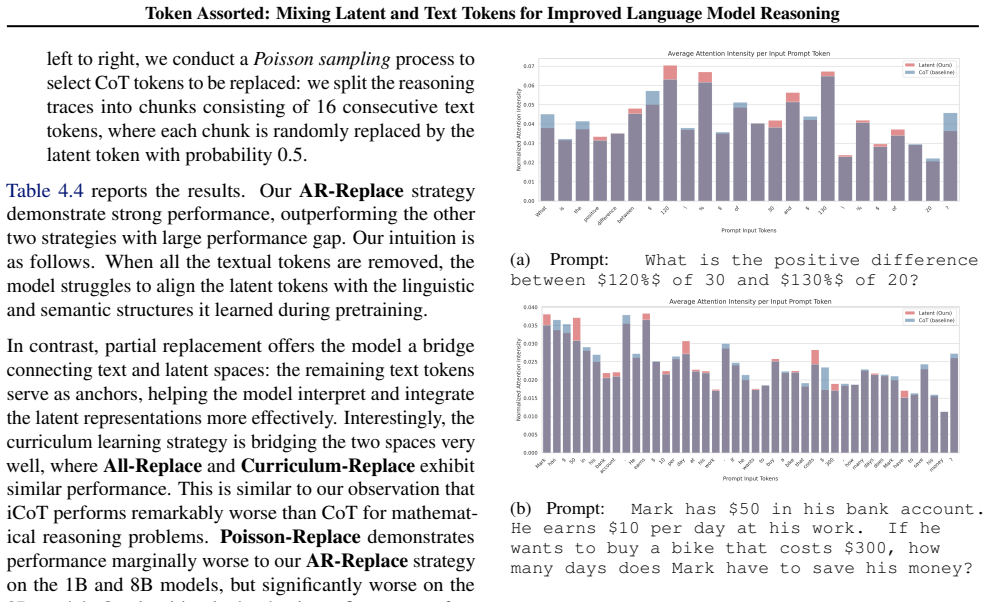
- If the effect is driven by the latent codes' content, the results imply that a large fraction of chain-of-thought tokens are fluency filler, since the paper's attention maps show hybrid models concentrating on numbers and arithmetic words rather than connective language.
- The randomized replacement schedule effectively trains one model across a spectrum of abstraction levels, so a natural untested extension is per-instance adaptive compression, letting the model choose how many leading tokens to emit as latent codes based on problem difficulty.
- Because the VQ-VAE decoder turns latent codes back into imperfect text, the scheme offers an interpretability handle for post-hoc auditing of model reasoning, although the decoded fragments shown in the paper are sometimes grammatically broken and would need cleaner decoding to be a reliable audit tool.
- The reported gains come from single-epoch fine-tuning of 1B-8B models on math traces, so whether the advantage survives larger scales, longer training, and non-mathematical domains such as code generation is a direct, untested extension of the paper's claims.
Editorial analysis
A structured set of objections, weighed in public.
Referee Report
Summary. The paper proposes a hybrid reasoning-trace representation in which the initial portion of a chain-of-thought is replaced by discrete latent tokens produced by a VQ-VAE, while the remaining steps stay in text. The method is evaluated by training or fine-tuning transformers (T5, GPT-2, Llama-3.1/3.2) on the mixed traces, with the number of replaced tokens randomized per sample. The authors report accuracy gains over text-only CoT baselines on maze navigation, ProntoQA, ProsQA, and several mathematical reasoning benchmarks, together with an average 17% reduction in generated trace length.
Significance. If the central claim is robust, the paper offers a practical contribution: discrete latent abstractions of early reasoning steps can improve both accuracy and token efficiency without changing inference-time architecture. The work has several strengths: the VQ-VAE is used only for data preparation, the paper ablates replacement strategies and compression rates, and the evaluation covers in-domain and out-of-domain math benchmarks. However, the evidence as presented does not isolate the semantic contribution of the latent codes from the randomized-mixing curriculum, and all headline numbers are single-seed point estimates. The claim of consistent outperformance is also contradicted by some cells of the paper's own tables. These issues need to be addressed before the central claim can be considered established.
major comments (4)
- [§4.2, Table 4.2; Appendix F, Table F.1] The abstract and Section 4.2 state that the approach 'consistently outperforms' the baselines, but the reported numbers contradict this. On Llama-3.1-8B Math, Latent scores 37.2 versus Pause Token's 39.6; on Llama-3.2-1B Olympia-Math, Latent scores 1.8 versus iCoT's 2.1. In the DART-MATH experiment (Table F.1), Latent is below CoT on GSM8K (83.9 vs. 84.5) and only +0.1 on Math. The wording should be softened to 'often improves' or similar, and the main text should acknowledge the negative cells.
- [§4.3, Table 4.4] The attribution of the gains to the semantic content of VQ-VAE latent codes is not supported by the ablations. Table 4.4 shows that Poisson-Replace, which substitutes random chunks of text with real latent codes, nearly matches Latent-AR on the 1B model (15.1 vs. 17.8) and on the 8B model (36.3 vs. 37.9). There is no control that uses the same randomized replacement procedure but with random, fixed, or dummy latent tokens. Without such a control, the headline improvements over CoT could stem from the randomized chunk-replacement curriculum rather than from the information carried by the latent codes. This is a load-bearing missing experiment because the central claim is specifically about latent abstraction.
- [Tables 4.1–4.4] All reported accuracies are single-seed point estimates with no error bars, confidence intervals, or significance tests. Many of the claimed gains are 2–4 accuracy points for one-epoch fine-tuning of 1B–8B models, which is within plausible run-to-run noise. The authors should report multiple seeds, or at minimum paired bootstrap confidence intervals, for the main comparison tables, especially for the cells used in the abstract.
- [§3.1, Eq. (2)] The method assumes that VQ-VAE compression preserves the task-critical logical content of the early reasoning steps, but the paper provides no quantitative measure of information preservation beyond reconstruction loss. The authors should report reconstruction quality on held-out reasoning traces (for example, token-level accuracy of the decoded text, or a downstream probe), and ideally show that errors in the decoded latent content are not correlated with final-answer mistakes.
minor comments (6)
- [§4.2, text after Table 4.2] The text reports a '+5.3 points improvement for the 8B model', but Table 4.2 shows 37.9 vs. 33.4 (second best), which is +4.5, and vs. CoT 32.9, which is +5.0. Please correct the number.
- [§4.2, Table 4.3 and abstract] The abstract says 'an average reduction of 17%' in trace length. Table 4.3 gives reductions of 21%, 20%, and 10% for the 1B, 3B, and 8B models, so the 17% is an average across model sizes rather than a per-model figure. Please state this explicitly to avoid implying each model has a 17% reduction.
- [§4.2.1] The introduction to Section 4 says the synthetic experiments 'pretrain T5 or GPT-2 models from scratch', but §4.2.1 says the ProntoQA/ProsQA models 'fine-tune the pretrained GPT-2 model'. This is contradictory and should be clarified.
- [§4.2, 'Randomized Latent Code Replacement'] The set M = {0, 72, 128, 160, 192, 224, 256} is said to contain 'multipliers of L = 16', but 72 is not a multiple of 16. If m = 72 is actually sampled, then m/r = 72/16 = 4.5 latent tokens, which is not an integer. Please correct the set or the sampling description.
- [§4.2.1, Keys-Finding Maze discussion] The text says 'the absolute improvement is 15%' for Keys-Finding Maze, but Table 4.1 reports 62.8 vs. 43 for CoT, an improvement of +19.8. The 15% figure appears to be an error.
- [Throughout] There are several typos: 'Possion-Replace' in Table 4.4, 'Collegue-Math' in §4.3, 'VQV AE' in §3.2, and 'The Table blow' in §4.4. Please proofread the final version.
Circularity Check
No significant circularity: the reported gains are empirical comparisons on held-out benchmarks and do not reduce to the VQ-VAE fit or to any self-citation.
full rationale
The claimed derivation chain is: (1) train a VQ-VAE to map text chunks to discrete latent codes; (2) build hybrid training sequences by replacing a randomized prefix of the CoT with these codes (Eq. 1); (3) fine-tune an LLM on the hybrid sequences; (4) evaluate on held-out Math, GSM8K, ProntoQA, ProsQA, and maze test splits. None of the reported accuracies or token counts is defined as a function of the VQ-VAE's training loss or of a parameter fitted to the test sets; the learning rate is selected on validation error, and r and M are fixed or ablated rather than tuned to the test numbers. The VQ-VAE is used only for data preparation and is not part of inference, so the LLM's generations are not scored against the compressor that produced the training labels. The paper's self-citations (Jiang et al. 2022/2023 for chunked VQ-VAE encoding, Su et al. 2024 and Lehnert et al. 2024 for maze-search trace generation) supply implementation conventions for data formatting and architecture, but the central claim that hybrid latent-text traces improve accuracy is tested against external baselines and external benchmark suites. The closest concern is attribution rather than circularity: the Poisson-Replace ablation nearly matches Latent-AR on the 1B and 8B models, so the gains may partly come from randomized replacement rather than from the semantics of the VQ-VAE codes; that is a missing-control or validity issue, not a case where the result is equivalent to its input by construction.
Assumptions & free parameters
free parameters (4)
- compression rate r =
16
- randomization step set M =
{0, 72, 128, 160, 192, 224, 256}
- VQ-VAE codebook size |E| =
1024 for math, 512 for maze, 64 for ProntoQA/ProsQA
- learning rate =
1e-5 (8B), 2.5e-5 (1B/3B)
assumptions (3)
- domain assumption VQ-VAE latent codes preserve the semantic content needed for reasoning (Section 3.1).
- domain assumption Randomly mixing latent and text tokens during fine-tuning lets pretrained LLMs adapt to new latent tokens without a curriculum (Section 3.2).
- domain assumption Evaluation metrics (greedy decoding exact match, 1-Feasible-10) reflect reasoning quality (Section 4.2.1).
invented entities (1)
-
Discrete latent tokens (VQ-VAE code indices) with <boLatent>/<eoLatent> delimiters
Cite this review
Pith. "Pith review of Token Assorted: Mixing Latent and Text Tokens for Improved Language Model Reasoning." pith.science (2026). https://pith.science/paper/U24MI4Y4
@misc{pith2026250203275,
  author       = {Pith},
  title        = {Pith review of: Token Assorted: Mixing Latent and Text Tokens for Improved Language Model Reasoning},
  year         = {2026},
  howpublished = {\url{https://pith.science/paper/U24MI4Y4}},
  note         = {Machine review of arXiv:2502.03275}
}
read the original abstract
Large Language Models (LLMs) excel at reasoning and planning when trained on chainof-thought (CoT) data, where the step-by-step thought process is explicitly outlined by text tokens. However, this results in lengthy inputs where many words support textual coherence rather than core reasoning information, and processing these inputs consumes substantial computation resources. In this work, we propose a hybrid representation of the reasoning process, where we partially abstract away the initial reasoning steps using latent discrete tokens generated by VQ-VAE, significantly reducing the length of reasoning traces. We explore the use of latent trace abstractions in two scenarios: 1) training the model from scratch for the Keys-Finding Maze problem, 2) fine-tuning LLMs on this hybrid data with an extended vocabulary including unseen latent tokens, for both logical and mathematical reasoning problems. To facilitate effective learning, we introduce a simple training procedure that randomly mixes latent and text tokens, which enables fast adaptation to new latent tokens. Our approach consistently outperforms the baselines methods in various benchmarks.
Figures


Figures from the paper (2 more)

Forward citations
Cited by 9 Pith papers
-
Dynamics Within Latent Chain-of-Thought: An Empirical Study of Causal Structure
Latent CoT steps are causally heterogeneous and non-local: a few steps dominate, influence skips adjacent steps, and output commitment precedes representational commitment.
-
System-1.5 Reasoning: Traversal in Language and Latent Spaces with Dynamic Shortcuts
System-1.5 Reasoning lets LLMs reason in latent space with early exits and step-skipping, matching chain-of-thought accuracy at over 20x speedup on GSM8K and StrategyQA.
-
Not All LLM Reasoning is Visible in the Chain-of-Thought
Semantically empty filler tokens improve accuracy across several frontier LLMs on synthetic math tasks and let Claude Opus 4.5 satisfy a hidden modular constraint, evidence of computation invisible in output tokens.
-
Is Your Model Thinking or Just Stagnating? PUMA: Diagnosing Reasoning Pathology via Phase-Momentum Alignment
PUMA detects when a reasoning model's entropy drop aligns with hidden-state momentum, truncates at that point, and reports improved accuracy-efficiency on 1.5B-32B reasoning models.
-
Implicit Reasoning in Large Language Models: A Comprehensive Survey
A survey organizing implicit (silent) reasoning in LLMs into three execution paradigms, plus evidence, benchmarks, and challenges.
-
Long or short CoT? Investigating Instance-level Switch of Large Reasoning Models
A fine-tuned selector can pick long or short chain-of-thought per question and per token budget, cutting reasoning-model inference cost by roughly 50 percent without sacrificing accuracy.
-
A Survey on Latent Reasoning
A survey that organizes latent reasoning methods into vertical recurrence, horizontal recurrence, and infinite-depth diffusion, arguing that silent reasoning can beat explicit chain-of-thought.
-
PREMISE: Scalable and Strategic Prompt Optimization for Efficient Mathematical Reasoning in Large Models
The paper reports that a concise optimized prompt reduces reasoning tokens by up to 87.5% while roughly preserving accuracy on GSM8K, SVAMP, and MATH-500.
-
Towards Concise and Adaptive Thinking in Large Reasoning Models: A Survey
A comprehensive review that categorizes methods for shortening and adaptively triggering chain-of-thought reasoning in large language models.
Reference graph
Works this paper leans on
-
[1]
write newline
" write newline "" before.all 'output.state := FUNCTION n.dashify 't := "" t empty not t #1 #1 substring "-" = t #1 #2 substring "--" = not "--" * t #2 global.max substring 't := t #1 #1 substring "-" = "-" * t #2 global.max substring 't := while if t #1 #1 substring * t #2 global.max substring 't := if while FUNCTION format.date year duplicate empty "emp...
-
[2]
Azerbayev, Z., Schoelkopf, H., Paster, K., Santos, M. D., McAleer, S., Jiang, A. Q., Deng, J., Biderman, S., and Welleck, S. Llemma: An open language model for mathematics. arXiv preprint arXiv:2310.10631, 2023
arXiv 2023
-
[3]
Barrault, L., Duquenne, P.-A., Elbayad, M., Kozhevnikov, A., Alastruey, B., Andrews, P., Coria, M., Couairon, G., Costa-juss \`a , M. R., Dale, D., et al. Large concept models: Language modeling in a sentence representation space. arXiv e-prints, pp.\ arXiv--2412, 2024
work page 2024
-
[5]
Chen, W., Ma, X., Wang, X., and Cohen, W. W. Program of thoughts prompting: Disentangling computation from reasoning for numerical reasoning tasks. arXiv preprint arXiv:2211.12588, 2022 b
arXiv 2022
-
[6]
Theoremqa: A theorem-driven question answering dataset
Chen, W., Yin, M., Ku, M., Lu, P., Wan, Y., Ma, X., Xu, J., Wang, X., and Xia, T. Theoremqa: A theorem-driven question answering dataset. In Proceedings of the 2023 Conference on Empirical Methods in Natural Language Processing, pp.\ 7889--7901, 2023
work page 2023
-
[7]
W., Hou, L., Longpre, S., Zoph, B., Tay, Y., Fedus, W., Li, Y., Wang, X., Dehghani, M., Brahma, S., et al
Chung, H. W., Hou, L., Longpre, S., Zoph, B., Tay, Y., Fedus, W., Li, Y., Wang, X., Dehghani, M., Brahma, S., et al. Scaling instruction-finetuned language models. Journal of Machine Learning Research, 25 0 (70): 0 1--53, 2024
2024
-
[9]
Training verifiers to solve math word problems
Cobbe, K., Kosaraju, V., Bavarian, M., Chen, M., Jun, H., Kaiser, L., Plappert, M., Tworek, J., Hilton, J., Nakano, R., et al. Training verifiers to solve math word problems. arXiv preprint arXiv:2110.14168, 2021 b
arXiv 2021
-
[10]
Implicit chain of thought reasoning via knowledge distillation
Deng, Y., Prasad, K., Fernandez, R., Smolensky, P., Chaudhary, V., and Shieber, S. Implicit chain of thought reasoning via knowledge distillation. arXiv preprint arXiv:2311.01460, 2023
arXiv 2023
Show all 53 references
-
[11]
From explicit cot to implicit cot: Learning to internalize cot step by step
Deng, Y., Choi, Y., and Shieber, S. From explicit cot to implicit cot: Learning to internalize cot step by step. arXiv preprint arXiv:2405.14838, 2024
2024 arXiv
-
[12]
The llama 3 herd of models
Dubey, A., Jauhri, A., Pandey, A., Kadian, A., Al-Dahle, A., Letman, A., Mathur, A., Schelten, A., Yang, A., Fan, A., et al. The llama 3 herd of models. arXiv preprint arXiv:2407.21783, 2024
2024 arXiv
-
[13]
L., Jian, L., Lin, B
Dziri, N., Lu, X., Sclar, M., Li, X. L., Jian, L., Lin, B. Y., West, P., Bhagavatula, C., Bras, R. L., Hwang, J. D., Sanyal, S., Welleck, S., Ren, X., Ettinger, A., Harchaoui, Z., and Choi, Y. Faith and fate: Limits of transformers on compositionality. Advances in Neural Infor...
2024
-
[14]
Towards revealing the mystery behind chain of thought: a theoretical perspective
Feng, G., Zhang, B., Gu, Y., Ye, H., He, D., and Wang, L. Towards revealing the mystery behind chain of thought: a theoretical perspective. Advances in Neural Information Processing Systems, 36, 2024
2024
-
[15]
Gandhi, K., Lee, D., Grand, G., Liu, M., Cheng, W., Sharma, A., and Goodman, N. D. Stream of search (sos): Learning to search in language. arXiv preprint arXiv:2404.03683, 2024
2024 arXiv
-
[16]
S., Menon, A
Goyal, S., Ji, Z., Rawat, A. S., Menon, A. K., Kumar, S., and Nagarajan, V. Think before you speak: Training language models with pause tokens. arXiv preprint arXiv:2310.02226, 2023
2023 arXiv
-
[17]
Training large language models to reason in a continuous latent space
Hao, S., Sukhbaatar, S., Su, D., Li, X., Hu, Z., Weston, J., and Tian, Y. Training large language models to reason in a continuous latent space. arXiv preprint arXiv:2412.06769, 2024
2024 arXiv
-
[18]
E., Nilsson, N
Hart, P. E., Nilsson, N. J., and Raphael, B. A formal basis for the heuristic determination of minimum cost paths. IEEE transactions on Systems Science and Cybernetics, 4 0 (2): 0 100--107, 1968
1968
-
[19]
L., Shen, J., Hu, J., Han, X., Huang, Y., Zhang, Y., et al
He, C., Luo, R., Bai, Y., Hu, S., Thai, Z. L., Shen, J., Hu, J., Han, X., Huang, Y., Zhang, Y., et al. Olympiadbench: A challenging benchmark for promoting agi with olympiad-level bilingual multimodal scientific problems. arXiv preprint arXiv:2402.14008, 2024
2024 arXiv
-
[20]
Measuring mathematical problem solving with the math dataset
Hendrycks, D., Burns, C., Kadavath, S., Arora, A., Basart, S., Tang, E., Song, D., and Steinhardt, J. Measuring mathematical problem solving with the math dataset. In Thirty-fifth Conference on Neural Information Processing Systems Datasets and Benchmarks Track (Round 2)
-
[21]
Measuring mathematical problem solving with the math dataset
Hendrycks, D., Burns, C., Kadavath, S., Arora, A., Basart, S., Tang, E., Song, D., and Steinhardt, J. Measuring mathematical problem solving with the math dataset. NeurIPS, 2021
2021
-
[22]
Forward-backward reasoning in large language models for mathematical verification
Jiang, W., Shi, H., Yu, L., Liu, Z., Zhang, Y., Li, Z., and Kwok, J. Forward-backward reasoning in large language models for mathematical verification. In Findings of the Association for Computational Linguistics ACL 2024, pp.\ 6647--6661, 2024
2024
-
[23]
Efficient planning in a compact latent action space
Jiang, Z., Zhang, T., Janner, M., Li, Y., Rockt \"a schel, T., Grefenstette, E., and Tian, Y. Efficient planning in a compact latent action space. arXiv preprint arXiv:2208.10291, 2022
2022 arXiv
-
[24]
H-gap: Humanoid control with a generalist planner
Jiang, Z., Xu, Y., Wagener, N., Luo, Y., Janner, M., Grefenstette, E., Rockt \"a schel, T., and Tian, Y. H-gap: Humanoid control with a generalist planner. arXiv preprint arXiv:2312.02682, 2023
2023 arXiv
-
[25]
J., Kim, D., Jang, J., Ye, S., Shin, J., and Seo, M
Kim, S., Joo, S. J., Kim, D., Jang, J., Ye, S., Shin, J., and Seo, M. The cot collection: Improving zero-shot and few-shot learning of language models via chain-of-thought fine-tuning. arXiv preprint arXiv:2305.14045, 2023
2023 arXiv
-
[26]
S., Reid, M., Matsuo, Y., and Iwasawa, Y
Kojima, T., Gu, S. S., Reid, M., Matsuo, Y., and Iwasawa, Y. Large language models are zero-shot reasoners. Advances in neural information processing systems, 35: 0 22199--22213, 2022
2022
-
[27]
Beyond a*: Better planning with transformers via search dynamics bootstrapping
Lehnert, L., Sukhbaatar, S., Su, D., Zheng, Q., McVay, P., Rabbat, M., and Tian, Y. Beyond a*: Better planning with transformers via search dynamics bootstrapping. In First Conference on Language Modeling, 2024. URL https://openreview.net/forum?id=SGoVIC0u0f
2024
-
[28]
Chain of thought empowers transformers to solve inherently serial problems, 2024
Li, Z., Liu, H., Zhou, D., and Ma, T. Chain of thought empowers transformers to solve inherently serial problems, 2024. URL https://arxiv.org/abs/2402.12875
2024 arXiv
-
[29]
Y., Bras, R
Lin, B. Y., Bras, R. L., and Choi, Y. Zebralogic: Benchmarking the logical reasoning ability of language models, 2024. URL https://huggingface.co/spaces/allenai/ZebraLogic
2024
-
[30]
Deliberation in latent space via differentiable cache augmentation
Liu, L., Pfeiffer, J., Wu, J., Xie, J., and Szlam, A. Deliberation in latent space via differentiable cache augmentation. 2024. URL https://arxiv.org/abs/2412.17747
2024 arXiv
-
[31]
Finemath: the finest collection of mathematical content, 2024
Lozhkov, A., Ben Allal, L., Bakouch, E., von Werra, L., and Wolf, T. Finemath: the finest collection of mathematical content, 2024. URL https://huggingface.co/datasets/HuggingFaceTB/finemath
2024
-
[33]
J., Gur-Ari, G., Michalewski, H., Austin, J., Bieber, D., Dohan, D., Lewkowycz, A., Bosma, M., Luan, D., et al
Nye, M., Andreassen, A. J., Gur-Ari, G., Michalewski, H., Austin, J., Bieber, D., Dohan, D., Lewkowycz, A., Bosma, M., Luan, D., et al. Show your work: Scratchpads for intermediate computation with language models. arXiv preprint arXiv:2112.00114, 2021 b
2021 arXiv
-
[34]
Byte latent transformer: Patches scale better than tokens
Pagnoni, A., Pasunuru, R., Rodriguez, P., Nguyen, J., Muller, B., Li, M., Zhou, C., Yu, L., Weston, J., Zettlemoyer, L., Ghosh, G., Lewis, M., Holtzman, A., and Iyer, S. Byte latent transformer: Patches scale better than tokens. 2024. URL https://arxiv.org/abs/2412.09871
2024 arXiv
-
[35]
Pfau, J., Merrill, W., and Bowman, S. R. Let's think dot by dot: Hidden computation in transformer language models. arXiv preprint arXiv:2404.15758, 2024
2024 arXiv
-
[36]
Language models are unsupervised multitask learners
Radford, A., Wu, J., Child, R., Luan, D., Amodei, D., Sutskever, I., et al. Language models are unsupervised multitask learners. OpenAI blog, 1 0 (8): 0 9, 2019
2019
-
[37]
Raffel, C., Shazeer, N., Roberts, A., Lee, K., Narang, S., Matena, M., Zhou, Y., Li, W., and Liu, P. J. Exploring the limits of transfer learning with a unified text-to-text transformer. Journal of Machine Learning Research, 21 0 (140): 0 1--67, 2020. URL http://jmlr.org/paper...
2020
-
[38]
and He, H
Saparov, A. and He, H. Language models are greedy reasoners: A systematic formal analysis of chain-of-thought. arXiv preprint arXiv:2210.01240, 2022
2022 arXiv
-
[39]
Analysing mathematical reasoning abilities of neural models
Saxton, D., Grefenstette, E., Hill, F., and Kohli, P. Analysing mathematical reasoning abilities of neural models. arXiv preprint arXiv:1904.01557, 2019
1904 arXiv
-
[40]
Dualformer: Controllable fast and slow thinking by learning with randomized reasoning traces
Su, D., Sukhbaatar, S., Rabbat, M., Tian, Y., and Zheng, Q. Dualformer: Controllable fast and slow thinking by learning with randomized reasoning traces. arXiv preprint arXiv:2410.09918, 2024
2024 arXiv
-
[41]
Galore 2: Large-scale llm pre-training by gradient low-rank projection
Su, D., Gu, A., Xu, J., Tian, Y., and Zhao, J. Galore 2: Large-scale llm pre-training by gradient low-rank projection. arXiv preprint arXiv:2504.20437, 2025
2025 arXiv
-
[42]
Mathscale: Scaling instruction tuning for mathematical reasoning
Tang, Z., Zhang, X., Wang, B., and Wei, F. Mathscale: Scaling instruction tuning for mathematical reasoning. arXiv preprint arXiv:2403.02884, 2024
2024 arXiv
-
[43]
Dart-math: Difficulty-aware rejection tuning for mathematical problem-solving
Tong, Y., Zhang, X., Wang, R., Wu, R., and He, J. Dart-math: Difficulty-aware rejection tuning for mathematical problem-solving. arXiv preprint arXiv:2407.13690, 2024
2024 arXiv
-
[44]
Neural discrete representation learning
Van Den Oord, A., Vinyals, O., et al. Neural discrete representation learning. Advances in neural information processing systems, 30, 2017
2017
-
[45]
and Zhou, D
Wang, X. and Zhou, D. Chain-of-thought reasoning without prompting. 2024. URL https://arxiv.org/abs/2402.10200
2024 arXiv
-
[46]
Self-consistency improves chain of thought reasoning in language models
Wang, X., Wei, J., Schuurmans, D., Le, Q., Chi, E., Narang, S., Chowdhery, A., and Zhou, D. Self-consistency improves chain of thought reasoning in language models. arXiv preprint arXiv:2203.11171, 2022
2022 arXiv
-
[47]
Y., and Sordoni, A
Wang, X., Caccia, L., Ostapenko, O., Yuan, X., Wang, W. Y., and Sordoni, A. Guiding language model reasoning with planning tokens. arXiv preprint arXiv:2310.05707, 2023
2023 arXiv
-
[48]
V., Zhou, D., et al
Wei, J., Wang, X., Schuurmans, D., Bosma, M., Xia, F., Chi, E., Le, Q. V., Zhou, D., et al. Chain-of-thought prompting elicits reasoning in large language models. Advances in neural information processing systems, 35: 0 24824--24837, 2022 a
2022
-
[49]
V., Zhou, D., et al
Wei, J., Wang, X., Schuurmans, D., Bosma, M., Xia, F., Chi, E., Le, Q. V., Zhou, D., et al. Chain-of-thought prompting elicits reasoning in large language models. Advances in neural information processing systems, 35: 0 24824--24837, 2022 b
2022
-
[50]
From sparse dependence to sparse attention: Unveiling how chain-of-thought enhances transformer sample efficiency
Wen, K., Zhang, H., Lin, H., and Zhang, J. From sparse dependence to sparse attention: Unveiling how chain-of-thought enhances transformer sample efficiency. arXiv preprint arXiv:2410.05459, 2024
2024 arXiv
-
[51]
Yang, A., Yang, B., Zhang, B., Hui, B., Zheng, B., Yu, B., Li, C., Liu, D., Huang, F., Wei, H., et al. Qwen2. 5 technical report. arXiv preprint arXiv:2412.15115, 2024
2024 arXiv
-
[52]
Tree of thoughts: Deliberate problem solving with large language models
Yao, S., Yu, D., Zhao, J., Shafran, I., Griffiths, T., Cao, Y., and Narasimhan, K. Tree of thoughts: Deliberate problem solving with large language models. Advances in Neural Information Processing Systems, 36, 2024
2024
-
[53]
T., Li, Z., Weller, A., and Liu, W
Yu, L., Jiang, W., Shi, H., Yu, J., Liu, Z., Zhang, Y., Kwok, J. T., Li, Z., Weller, A., and Liu, W. Metamath: Bootstrap your own mathematical questions for large language models. arXiv preprint arXiv:2309.12284, 2023
2023 arXiv
-
[54]
Distilling system 2 into system 1
Yu, P., Xu, J., Weston, J., and Kulikov, I. Distilling system 2 into system 1. arXiv preprint arXiv:2407.06023, 2024
2024 arXiv
-
[55]
Mammoth: Building math generalist models through hybrid instruction tuning
Yue, X., Qu, X., Zhang, G., Fu, Y., Huang, W., Sun, H., Su, Y., and Chen, W. Mammoth: Building math generalist models through hybrid instruction tuning. arXiv preprint arXiv:2309.05653, 2023
2023 arXiv
-
[56]
Towards a theoretical understanding of the'reversal curse'via training dynamics
Zhu, H., Huang, B., Zhang, S., Jordan, M., Jiao, J., Tian, Y., and Russell, S. Towards a theoretical understanding of the'reversal curse'via training dynamics. arXiv preprint arXiv:2405.04669, 2024
2024 arXiv
Reviewed August 9, 2026 · model on record in the stance chip above.
Discussion (0). Continue with ORCID to comment.