Finite-temperature formation of magnetic plateaus and simplex liquid states on the frustrated ruby lattice
Pith reviewed 2026-06-28 21:01 UTC · model grok-4.3
The pith
The ruby lattice Heisenberg antiferromagnet forms magnetic plateaus hosting a simplex liquid state at low temperatures without a phase transition.
A machine-rendered reading of the paper's core claim, the machinery that carries it, and where it could break.
Core claim
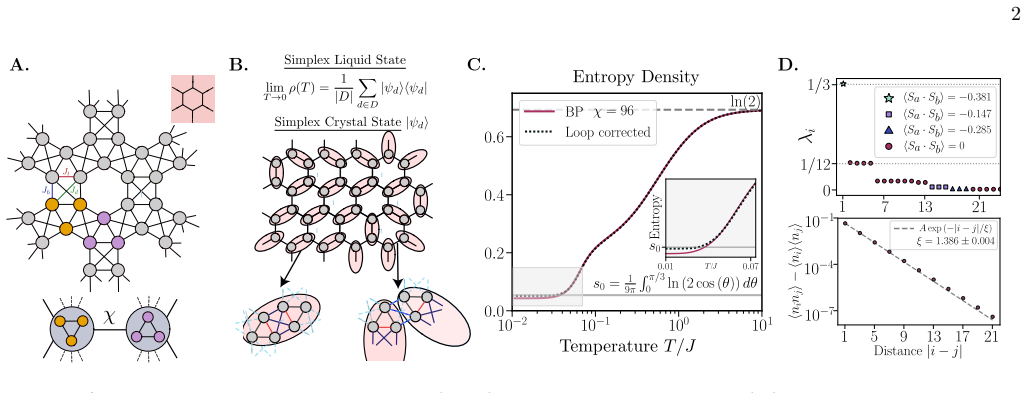
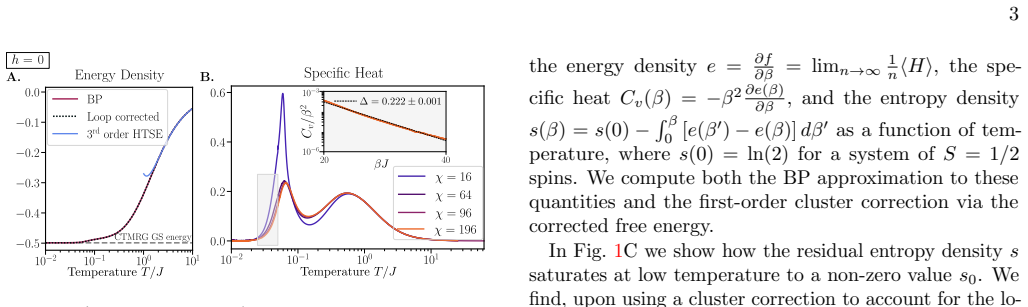
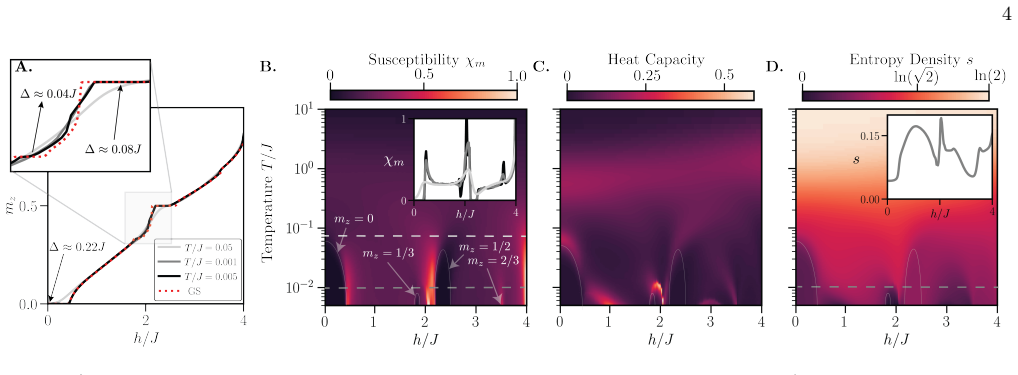
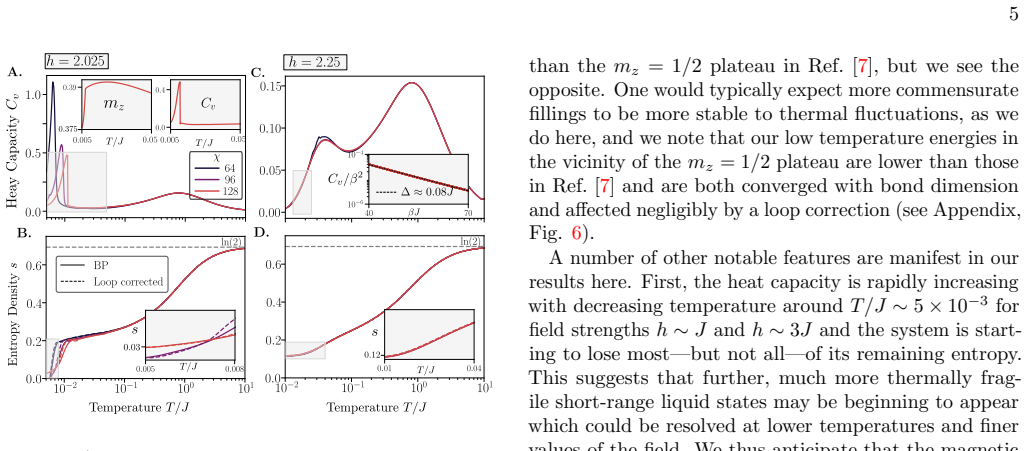
Using infinite tensor network states optimized and measured with belief propagation and corrections to belief propagation, the study shows that the frustrated ruby lattice model develops magnetic plateaus at low temperatures. These plateaus host a simplex liquid state featuring strongly paired spin simplices in a disordered phase that supports non-zero residual entropy due to an exponentially large number of crystalline configurations. The energy gaps of the states are quantified, and the states are accessed without a thermodynamic phase transition because the heat capacity stays finite and continuous down to the lowest temperatures studied.
What carries the argument
The simplex liquid state, a disordered phase of strongly paired spin simplices retaining non-zero residual entropy from an exponentially large subspace of crystalline configurations.
If this is right
- Stable magnetic plateaus form at multiple magnetic field strengths at low temperature.
- The simplex liquid states retain non-zero residual entropy.
- The heat capacity remains finite and continuous with no phase transition.
- The energy gaps associated with the plateaus can be quantified accurately.
- Belief propagation tensor network methods enable study of finite-temperature properties in frustrated magnets.
Where Pith is reading between the lines
- Similar simplex liquid states could appear on other lattices built from simplices under comparable frustration.
- Specific-heat measurements on candidate materials might detect the continuous onset without jumps or latent heat.
- The residual entropy could produce distinctive low-temperature thermodynamic responses if the states persist closer to zero temperature.
- The same numerical approach could be applied to compute dynamical quantities or response functions inside the plateaus.
Load-bearing premise
The infinite tensor network states with belief propagation and corrections accurately represent the true finite-temperature physics without approximation errors that would change the reported plateaus or entropy values.
What would settle it
A calculation or measurement that finds a discontinuity in the heat capacity at the temperatures where the plateaus form or that finds zero residual entropy inside the plateaus.
Figures
read the original abstract
Geometric frustration in quantum systems can stabilize unconventional phases of matter that avoid traditional magnetic ordering at low temperatures. Here, we observe this phenomenon while mapping out the finite temperature phase diagram of the spin-1/2 Heisenberg antiferromagnet on the ruby lattice with next-nearest-neighbor interactions. Using an infinite tensor network state (iTNS) optimized and measured with belief propagation (BP) and corrections to BP, we observe the low temperature formation of stable magnetic plateaus at various magnetic field strengths. We find these plateaus host a novel `simplex liquid state' -- a disordered phase involving strongly paired spin simplices that retains non-zero residual entropy due to an exponentially large subspace of crystalline configurations. We accurately quantify the energy gap associated with these states and show that, as the temperature of the system is lowered, it does not go through a phase transition to reach them: the heat capacity remains finite and continuous at all observed temperatures. Our work demonstrates how BP-based tensor network techniques provide a powerful route to understanding frustrated quantum magnets at finite temperature.
Editorial analysis
A structured set of objections, weighed in public.
Referee Report
Summary. The manuscript maps the finite-temperature phase diagram of the spin-1/2 Heisenberg antiferromagnet on the ruby lattice with next-nearest-neighbor interactions using infinite tensor network states (iTNS) optimized and measured via belief propagation (BP) and BP corrections. It reports the low-temperature formation of stable magnetic plateaus that host a novel 'simplex liquid state'—a disordered phase of strongly paired spin simplices retaining non-zero residual entropy from an exponentially large subspace of crystalline configurations—reached without a phase transition because the heat capacity remains finite and continuous at all simulated temperatures. The work also quantifies associated energy gaps.
Significance. If the iTNS/BP results are accurate, the simplex liquid state would constitute a new example of a finite-temperature disordered phase stabilized by geometric frustration, distinct from conventional spin liquids by its simplex pairing and residual entropy mechanism. The methodological demonstration that BP-based tensor networks can access such physics at finite T without apparent transitions would be a useful technical contribution for the study of frustrated magnets.
major comments (2)
- [Abstract and numerical methods section] Abstract and § on numerical methods: the central claim that the simplex liquid states are reached without a phase transition rests on the heat capacity remaining finite and continuous at all observed temperatures and on a non-zero residual entropy. No convergence checks with respect to BP truncation, bond dimension, or correction order, nor comparisons to exact limits (e.g., high-T series or small-cluster exact diagonalization), are described; uncontrolled variational errors in BP for this frustrated model can suppress discontinuities in C(T) or bias low-T entropy extrapolations, directly affecting both claims.
- [Abstract] Abstract: the definition and characterization of the 'simplex liquid state' as a distinct phase relies on the observation of strongly paired simplices and an exponentially large configuration subspace. Without reported order parameters, correlation functions, or explicit counting of the configuration subspace in the iTNS data, it is unclear how this state is distinguished from a conventional paramagnetic or partially polarized regime.
minor comments (1)
- [Abstract] The abstract refers to 'various magnetic field strengths' and 'accurately quantify the energy gap' but provides no specific field values or gap magnitudes; these should be stated explicitly with the corresponding iTNS data.
Simulated Author's Rebuttal
We thank the referee for their careful reading of our manuscript and for highlighting important points regarding methodological validation and the characterization of the simplex liquid state. We address each major comment below and will incorporate revisions to strengthen the presentation.
read point-by-point responses
-
Referee: [Abstract and numerical methods section] Abstract and § on numerical methods: the central claim that the simplex liquid states are reached without a phase transition rests on the heat capacity remaining finite and continuous at all observed temperatures and on a non-zero residual entropy. No convergence checks with respect to BP truncation, bond dimension, or correction order, nor comparisons to exact limits (e.g., high-T series or small-cluster exact diagonalization), are described; uncontrolled variational errors in BP for this frustrated model can suppress discontinuities in C(T) or bias low-T entropy extrapolations, directly affecting both claims.
Authors: We agree that explicit convergence checks and comparisons to exact methods would strengthen the claims. While the original work included some internal consistency tests with the BP corrections, systematic studies varying bond dimension, truncation, and correction order, as well as direct comparisons to high-temperature series expansions and small-cluster exact diagonalization, were not reported. We will add a dedicated subsection in the numerical methods section with these checks, including data showing that C(T) remains continuous across the tested parameters and that the low-T entropy extrapolation is stable. This addresses the concern about potential suppression of discontinuities. revision: yes
-
Referee: [Abstract] Abstract: the definition and characterization of the 'simplex liquid state' as a distinct phase relies on the observation of strongly paired simplices and an exponentially large configuration subspace. Without reported order parameters, correlation functions, or explicit counting of the configuration subspace in the iTNS data, it is unclear how this state is distinguished from a conventional paramagnetic or partially polarized regime.
Authors: The simplex liquid is identified in the iTNS via the local tensor structure showing strong simplex pairing together with the computed residual entropy indicating an exponentially large subspace. However, we acknowledge that explicit order parameters (e.g., simplex-pairing correlations) and a direct count of the configuration subspace were not presented in the manuscript. We will add these quantities in the revised version, including correlation functions extracted from the iTNS and a quantitative link between the entropy value and the size of the crystalline configuration subspace, to better distinguish the state from paramagnetic or partially polarized regimes. revision: yes
Circularity Check
No significant circularity; direct numerical simulation of Hamiltonian
full rationale
The paper reports results from iTNS optimization and measurement via belief propagation on the ruby lattice Heisenberg model. Quantities such as plateaus, heat capacity continuity, and residual entropy are computed outputs, not quantities that reduce by the paper's equations or self-citations to fitted inputs or prior claims. No self-definitional steps, fitted predictions, or load-bearing self-citation chains are present; the derivation chain consists of standard tensor-network contraction applied to the model Hamiltonian.
Axiom & Free-Parameter Ledger
invented entities (1)
-
simplex liquid state
no independent evidence
Forward citations
Cited by 1 Pith paper
-
SU(4) Heisenberg model on the hyperhoneycomb lattice
3D PEPS simulations of the SU(4) Heisenberg model on the hyperhoneycomb lattice extrapolate to a gapless spin-liquid ground state.
Reference graph
Works this paper leans on
-
[1]
4.A)Specific heat versus temperature at the interface between the mz = 1 /3 and mz = 1 /2 plateaus for various bond dimensions
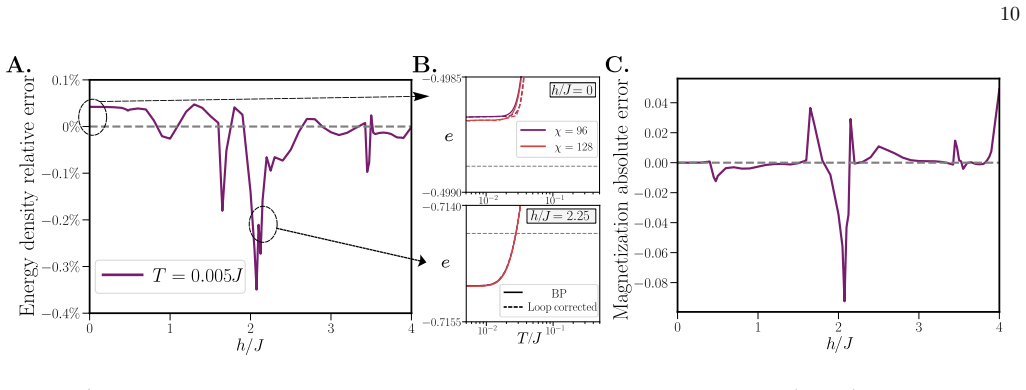
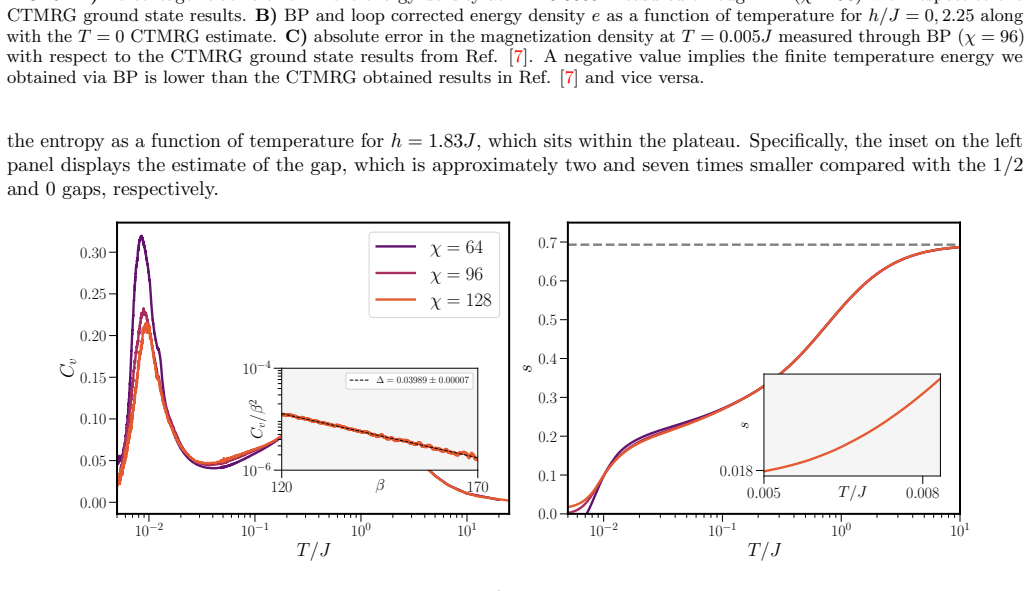
and an independent ground-state calculation we per- 5 FIG. 4.A)Specific heat versus temperature at the interface between the mz = 1 /3 and mz = 1 /2 plateaus for various bond dimensions. Insets: magnetization density and specific heat on a linear temperature scale near the switching point. B)Entropy versus temperature and low temperature inset. C)Specific...
-
[2]
for simulating quantum systems with tensor networks of arbitrary topology
-
[3]
Wen, Quantum field theory of many-body systems (Oxford University Press, 2004)
X.-G. Wen, Quantum field theory of many-body systems (Oxford University Press, 2004)
2004
-
[4]
Savary and L
L. Savary and L. Balents, Quantum spin liquids: a review, Reports on Progress in Physics80, 016502 (2017)
2017
-
[5]
Read and S
N. Read and S. Sachdev, Large-n expansion for frustrated quantum antiferromagnets, Phys. Rev. Lett.66, 1773 (1991)
1991
-
[6]
Sachdev, Kagom´ e- and triangular-lattice Heisenberg antiferromagnets: Ordering from quantum fluctuations and quantum-disordered ground states with unconfined bosonic spinons, Phys
S. Sachdev, Kagom´ e- and triangular-lattice Heisenberg antiferromagnets: Ordering from quantum fluctuations and quantum-disordered ground states with unconfined bosonic spinons, Phys. Rev. B45, 12377 (1992)
1992
-
[7]
P. W. Anderson, The resonating valence bond state in La 2CuO4 and superconductivity, Science235, 1196 (1987)
1987
-
[8]
L. S. Balents, M. P. A. Fisher, and C. Nayak, Nodal liquid theory of the pseudo-gap phase of high- tc superconduc- tors, International Journal of Modern Physics B12, 1033 (1998)
1998
-
[9]
P. Ghosh and F. Mila, Simplex crystal ground state and magnetization plateaus in the spin-1 /2 Heisenberg model on the Ruby lattice (2025), arXiv:2512.14173 [cond- mat.str-el]
arXiv 2025
- [10]
-
[11]
P. Schmoll, J. Naumann, E. L. Weerda, J. Eisert, and Y. Iqbal, Bathing in a sea of candidate quantum spin liquids: From the gapless ruby to the gapped maple-leaf lattice (2024), arXiv:2407.07145 [cond-mat.str-el]
Pith/arXiv arXiv 2024
-
[12]
D. J. J. Farnell, R. Darradi, R. Schmidt, and J. Richter, Spin-half Heisenberg antiferromagnet on two Archimedean lattices: From the bounce lattice to the maple-leaf lattice and beyond, Physical Review B84, 104406 (2011)
2011
-
[13]
Sch¨ afer, B
R. Sch¨ afer, B. Placke, O. Benton, and R. Moessner, Abun- dance of hard-hexagon crystals in the quantum pyrochlore antiferromagnet, Physical Review Letters131, 096702 (2023)
2023
-
[14]
Moessner and J
R. Moessner and J. T. Chalker, Properties of a classical spin liquid: The Heisenberg pyrochlore antiferromagnet, Phys. Rev. Lett.80, 2929 (1998)
1998
-
[15]
J. S. Gardner, M. J. P. Gingras, and J. E. Greedan, Magnetic pyrochlore oxides, Reviews of Modern Physics 82, 53 (2010)
2010
-
[16]
Iqbal, T
Y. Iqbal, T. M¨ uller, P. G. Ghosh, M. J. P. Gingras, H. O. Jeschke, S. Rachel, J. Reuther, and R. Thomale, Quantum and classical phases of the pyrochlore Heisenberg model with competing interactions, Physical Review X9, 011005 (2019)
2019
-
[17]
Semeghini, H
G. Semeghini, H. Levine, A. Keesling, S. Ebadi, T. T. Wang, D. Bluvstein, R. Verresen, H. Pichler, M. w. Kali- nowski, R. Samajdar, et al., Probing topological spin liquids on a programmable quantum simulator, Science 374, 1242 (2021)
2021
-
[18]
Giudici, M
G. Giudici, M. D. Lukin, and H. Pichler, Dynamical preparation of quantum spin liquids in Rydberg atom arrays, Physical Review Letters129, 090401 (2022)
2022
-
[19]
P. S. Tarabunga, F. M. Surace, R. Andreoni, A. An- gelone, and M. Dalmonte, Gauge-theoretic origin of Ryd- berg quantum spin liquids, Physical Review Letters129, 195301 (2022)
2022
-
[20]
Verresen, M
R. Verresen, M. D. Lukin, and A. Vishwanath, Prediction of toric code topological order from Rydberg blockade, Physical Review X11, 031005 (2021)
2021
-
[21]
H. O. Jeschke, D. Guterding, and P. Ghosh, Realization of the ruby lattice antiferromagnet in layered transition- metal fluorides (2026), arXiv:2605.28821 [cond-mat.str-el]
Pith/arXiv arXiv 2026
-
[22]
Jiang, Z.-Y
H.-C. Jiang, Z.-Y. Weng, and T. Xiang, Accurate determi- nation of tensor network state of quantum lattice models in two dimensions, Physical Review Letters101, 090603 (2008)
2008
-
[23]
Nishino and K
T. Nishino and K. Okunishi, Corner transfer matrix renor- malization group method, Journal of the Physical Society of Japan65, 891 (1996)
1996
-
[24]
Or´ us and G
R. Or´ us and G. Vidal, Simulation of two-dimensional quantum systems on an infinite lattice revisited: Corner transfer matrix for tensor contraction, Physical Review B 80, 094403 (2009)
2009
-
[25]
Q. Yang and P. Corboz, Efficient iPEPS simulation on the honeycomb lattice via QR-based corner transfer matrix renormalization group, Physical Review B113, 10.1103/9gmp-byx8 (2026)
-
[26]
P. W. Kasteleyn, The statistics of dimers on a lattice: I. the number of dimer arrangements on a quadratic lattice, Physica27, 1209 (1961)
1961
-
[27]
H. N. V. Temperley and M. E. Fisher, Dimer problem in statistical mechanics—an exact result, The Philosophical Magazine: A Journal of Theoretical Experimental and Applied Physics6, 1061 (1961)
1961
-
[28]
Alkabetz and I
R. Alkabetz and I. Arad, Tensor networks contraction and the belief propagation algorithm, Physical Review Research3, 023073 (2021)
2021
-
[29]
Tindall and M
J. Tindall and M. Fishman, Gauging tensor networks with belief propagation, SciPost Phys.15, 222 (2023)
2023
-
[30]
Evenbly, N
G. Evenbly, N. Pancotti, A. Milsted, J. Gray, and G. K.-L. Chan, Loop series expansions for tensor networks, Physi- cal Review Research8, 013245 (2026)
2026
-
[31]
G. Evenbly, J. Gray, and G. K.-L. Chan, Partitioned expansions for approximate tensor network contractions (2025), arXiv:2512.10910 [quant-ph]
arXiv 2025
-
[32]
C. Guo, D. Poletti, and I. Arad, Block belief propagation algorithm for two-dimensional tensor networks, Physical 7 Review B108, 125111 (2023)
2023
-
[33]
S. Midha and Y. F. Zhang, Beyond Belief Propagation: Cluster-corrected tensor network contraction with expo- nential convergence (2025), arXiv:2510.02290 [quant-ph]
arXiv 2025
-
[34]
S. Midha, G. M. Sommers, J. Tindall, and D. A. Abanin, Belief Propagation and tensor network expansions for many-body quantum systems: Rigorous results and fun- damental limits (2026), arXiv:2604.03228 [quant-ph]
Pith/arXiv arXiv 2026
-
[35]
J. Tindall, A. F. Mello, M. Fishman, E. M. Stoudenmire, and D. Sels, Dynamics of disor- dered quantum systems with two- and three- dimensional tensor networks, Science392, 868 (2026), https://www.science.org/doi/pdf/10.1126/science.adx2728
-
[36]
R. Sch¨ afer, P. L. Ebert, N. Hassan, J. Reuther, D. J. Luitz, and A. Wietek, Thermodynamics of the Heisenberg antiferromagnet on the maple-leaf lattice, Zeitschrift f¨ ur Naturforschung A 10.1515/zna-2025-0382 (2026)
-
[37]
P. L. Ebert, Y. Iqbal, and A. Wietek, Incommensurate spin-density waves in a frustrated maple-leaf lattice ferro- magnet (2026), arXiv:2605.12592 [cond-mat.str-el]
Pith/arXiv arXiv 2026
-
[38]
All derivatives in this work are computed using a second- order finite-difference scheme
-
[39]
Pierre, B
L. Pierre, B. Bernu, and L. Messio, High temperature series expansions of s = 1 /2 Heisenberg spin models: algorithm to include the magnetic field with optimized complexity, SciPost Physics17, 105 (2024)
2024
-
[40]
Kond´ akor and K
M. Kond´ akor and K. Penc, Crystalline phases and devil’s staircase in qubit spin ice, Physical Review Research5, 043172 (2023)
2023
-
[41]
Pal and S
S. Pal and S. Lal, Magnetization plateaus of the quantum pyrochlore Heisenberg antiferromagnet, Physical Review B100, 104421 (2019)
2019
-
[42]
com/JoeyT1994/TensorNetworkQuantumSimulator (2026)
TensorNetworkQuantumSimulator.jl, https://github. com/JoeyT1994/TensorNetworkQuantumSimulator (2026)
2026
-
[43]
Fishman, S
M. Fishman, S. White, and E. Stoudenmire, The ITensor software library for tensor network calculations, SciPost Physics Codebases , 004 (2022)
2022
-
[44]
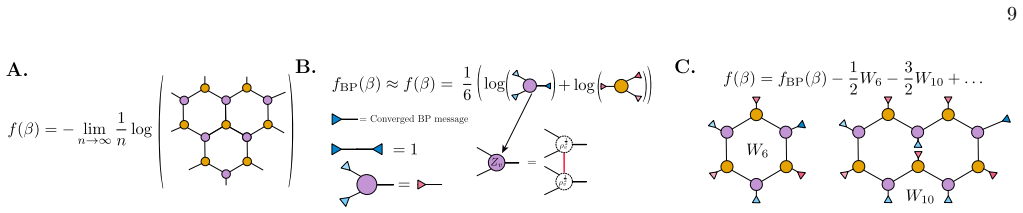
M. X. Cao and P. O. Vontobel, Double-edge fac- tor graphs: Definition, properties, and examples, in 2017 IEEE Information Theory Workshop (ITW) (IEEE, 2017) pp. 136–140. 8 APPENDIX Belief Propagation for iTNS at finite temperature We here provide an extended explanation of the use of the belief propagation (BP) algorithm on the finite temperature iTNS dep...
2017
discussion (0)
Sign in with ORCID, Apple, or X to comment. Anyone can read and Pith papers without signing in.