REVIEW 2 major objections 4 minor 36 references
Determination of the Angular Momentum of Radiated Gravitons, Scalars, and Dark Photons from Binary Orbits
T0 review · 2 major / 4 minor · reviewed 2026-08-07 · deepseek-v4-flash
Pith's one-line read Each graviton radiated by a binary orbit carries about 2ħ of angular momentum; scalar and vector quanta carry about ħ.
desk verdict Elliptical and scalar/vector parts are solid, but the hyperbolic 2ħ claim is undercut by an unregulated IR divergence in the graviton number. read the letter →
The pith
A machine-rendered reading of the paper's core claim, the machinery that carries it, and where it could break.
The reading
What carries the argument
The machinery is a mode-by-mode angular-momentum-to-quantum-number ratio $\dot{J}/\dot{N}$. The binary stress tensor is expanded in Fourier harmonics: Bessel functions $J_n(ne)$ for elliptical orbits with harmonics $n\omega_0$, and Hankel functions for hyperbolic encounters with continuous parameter $\nu\omega_0$. Angular-momentum flux is split into orbital and spin pieces using the graviton field operators, with only the sum invariant under coordinate changes. The quantum number rate is defined as the classical energy rate in each mode divided by $\hbar$ times the mode frequency, so the central ratio is the classical ratio $\dot{J}/\dot{E}$ multiplied by $\hbar\omega$. The physical load is carried by the source's lowest multipole: quadrupole (graviton) emission gives $2\hbar$ per quantum, dipole (scalar and vector) emission gives $\hbar$ per quantum.
What would settle it
Take a precisely timed eccentric binary pulsar, measure the secular derivatives of its orbital period and eccentricity, convert those into energy-loss and angular-momentum-loss rates, define the quantum count as $\dot{N} = \dot{E}/(\hbar\omega_0)$, and check whether $|\dot{J}|/\dot{N}$ equals $2\hbar$ after subtracting any known scalar or vector contributions. The central claim would fail if a clean gravitational-wave system showed a total ratio reliably different from $2\hbar$, or if the mode-resolved spectra at high harmonics did not saturate to $2\hbar$; for the dipole rule, an extra radiation channel inferred from orbital decay with a per-quantum ratio near $2\hbar$ rather than $\hbar$ would be decisive.
Extended reading notes
Core claim
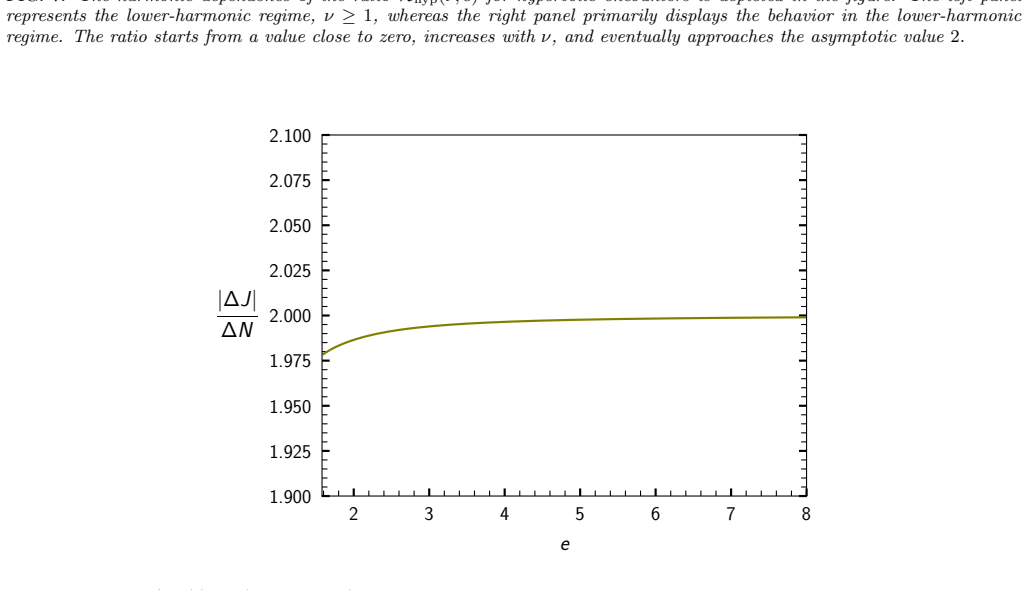
On the paper's own terms, the central discovery is that the ratio of radiated angular momentum to radiated quantum number is fixed by multipole order, not by orbital geometry. For gravitons from elliptical orbits the total ratio is $|\dot{J}|/\dot{N} \simeq 2\hbar$, reproducing and extending a previously noted result for bound orbits; the same calculation for hyperbolic encounters gives the same $\simeq 2\hbar$ for the integrated spectrum. For scalar and vector emission from elliptical binaries the ratio is $\simeq \hbar$, reflecting the dipole nature of the source current. The paper also finds that the graviton angular momentum splits into an orbital part of about $(2/3)\hbar$ and a spin part of about $(4/3)\hbar$ per quantum, but that only the sum is gauge invariant, so binary observations cannot separately determine the spin. In hyperbolic encounters the zero-frequency memory mode carries finite angular momentum while the quantum number diverges, so the per-quantum ratio tends to zero at zero frequency even though the integrated ratio stays near $2\hbar$.
Load-bearing premise
The paper counts quanta by dividing the classical energy loss by $\hbar$ times the orbital frequency; if that classical-to-quantum dictionary is wrong for a given radiation mode, the ratio $\dot{J}/\dot{N}$ has no physical meaning.
Editorial extensions
If this is right
- For both bound and unbound binaries, gravitational-wave losses give $|\dot{J}|/\dot{N}\simeq 2\hbar$, so the graviton emission rate can be inferred from the observed orbital decay of a binary without detecting individual gravitons.
- A measured deviation of the total angular-momentum-to-energy loss from the gravitational pattern would signal an extra radiation channel; scalar and vector quanta contribute about $\hbar$ per quantum, making a dipole channel distinguishable from the quadrupole gravitational one.
- Because the split into orbital and spin angular momentum is gauge dependent, binary timing alone cannot prove that the graviton's spin is quantized; only the total angular momentum per quantum is observable from orbital dynamics.
- The time derivatives of orbital frequency and eccentricity directly determine the energy and angular-momentum loss rates, and the sign of the fifth-force parameter $\alpha$ distinguishes a scalar-mediated force from a vector-mediated one.
- In hyperbolic encounters, the memory mode at zero frequency has divergent quantum number, so the per-quantum ratio vanishes at $\nu\to 0$ while the integrated ratio remains near $2\hbar$; any quantum-counting test must handle that infrared limit separately.
Reading between the lines
- The paper's pattern suggests a rule it does not state: a source whose radiation is dominated by azimuthal harmonic $m$ should radiate about $m\hbar$ of angular momentum per quantum, so the next harmonic $m=3$ would be expected to give $3\hbar$ per quantum; computing the ratio for higher harmonics in the same formalism would test this directly.
- Because $\dot{N}$ is constructed from classical fluxes, the $2\hbar$ and $\hbar$ ratios are best read as a bookkeeping of classical radiation into quanta, not as a measurement of intrinsic particle spin; an actual spin measurement would need a detector sensitive to rotations of the field, not just the binary's orbital evolution.
- If the rule is robust, the $\dot{J}/\dot{N}$ ratio can serve as a particle-spin diagnostic for ultralight dark-matter radiation from binaries even before the particle mass and coupling are known, since the multipole order determines the ratio independently of coupling strength.
Editorial analysis
A structured set of objections, weighed in public.
Referee Report
Summary. The paper computes the energy and angular momentum radiated by compact binaries in elliptical and hyperbolic orbits via gravitational, scalar, and vector fields, using a field-theoretic frequency-domain approach. For elliptical orbits, the authors reproduce the classical Peters-Mathews energy-loss formula and the Peters angular-momentum-loss formula, and then define a graviton number flux N_dot = E_dot/(ℏω0) to obtain J_dot/N_dot ≈ 2ℏ per mode at large harmonic number. For hyperbolic orbits, they derive continuous frequency spectra and claim that the total ratio |ΔJ|/ΔN also saturates to 2ℏ. They extend the analysis to scalar and vector radiation, obtaining |J_dot|/N_dot ≈ ℏ, and discuss how measurements of orbital eccentricity and frequency evolution could distinguish the spins of radiated fields.
Significance. If the hyperbolic claim were valid, the paper would extend Page's observation to unbound binaries and provide a compact rule: quadrupole radiation carries 2ℏ per quantum and dipole radiation carries ℏ. The elliptical calculation is a useful and clean reproduction of the classical Peters/Peters-Mathews results in a quantum-field-theory language, and the scalar/vector formulas are new closed-form results. The paper is also transparent about the gauge non-invariance of the spin/orbital split and about the definitional nature of the graviton number. However, the hyperbolic central claim is undermined by an infrared divergence that the authors themselves describe in their figures, making the claimed saturation internally inconsistent as it stands.
major comments (2)
- [§IV, Eqs. (75)-(84), Fig. 8] The hyperbolic claim |ΔJ|/ΔN ≈ 2ℏ is internally inconsistent. From Eq. (77), dN/dω' = (dE/dω')/(ℏω') = (E0/ℏω0) ν^3 f(ν,e). Since the energy spectrum dE/dω' = E0 ν^4 f(ν,e) is nonzero at ν=0 (the memory signal, as stated in §IV and Fig. 4), dN/dω' ∝ 1/ν, so ΔN diverges logarithmically as the lower limit of integration approaches zero. In contrast, Eq. (79) and Fig. 6 show that dJ/dω' remains finite as ν→0, so ΔJ is finite. Therefore |ΔJ|/ΔN → 0 as the infrared cutoff is removed, contradicting Fig. 8 and the hyperbolic row of Table I. The authors' own Fig. 7 shows R_hyp(ν,e) → 0 in this limit. The claim must either be restricted to a frequency band with an explicit, stated infrared cutoff (making the ratio cutoff-dependent) or the hyperbolic row of Table I must be withdrawn.
- [§I and §III, Eqs. (48) and (77)] The per-quantum ratio is constructed, not measured: the graviton number is defined by N ≡ E/(ℏω) in Eqs. (48) and (77). Consequently J/N = (J/E)ℏω by construction, so the statement 'each emitted graviton carries away 2ℏ' is a restatement of the classical ratio J/E multiplied by ℏω. The authors acknowledge this in the introduction, but the abstract and conclusions present the result as a property of individual quanta. This is an interpretive caveat that should be stated more prominently, and it means the paper does not provide an independent quantum measurement of graviton angular momentum.
minor comments (4)
- [§IV, Eq. (77)] The prefactor N_hyp is defined as (4G/5) μ^2 a^2 ω_0^3 π^2, but the preceding expression contains μ^2 a^4 ω_0^3; this is a typo that should be corrected to a^4.
- [§IV, Figs. 5 and 6] The figure captions state eccentricities e=1.4, e=2, and e=2.4, while the legends in the left panels show e=1.6, e=2.0, and e=2.4; please make the captions and legends consistent.
- [Throughout] The paper uses the symbol 'ι' for the imaginary unit, which is unconventional; replacing it with 'i' would improve readability.
- [References] Reference [4] is cited as 'Schive, Fuzzy dark matter simulations, Liv. Rev. Comput. Astrophys. 12 (2026) 1' with arXiv 2509.23231; please verify this citation is complete and accurate.
Circularity Check
The per-graviton angular-momentum results are constructed from the definition N=E/(ℏω), and the hyperbolic 2ℏ claim is internally inconsistent with the paper's own IR-divergent number spectrum.
-
self definitional
[Sec. I and Sec. III, Eq. (48)]
"Here, the graviton number is a secondary quantity derived from the primary observable, the rate of energy radiated as Ṅ ≡ Ė/(ℏω0), where ω0 = p GM/a3 is the fundamental angular frequency of the elliptical orbit. ... which is obtained by dividing each term in the energy mode sum in (44) by nℏω0"
By construction, the n-th harmonic contributes N_n = E_n/(nℏω0). Therefore the ratio J/N = (J/E)ℏω0. Equations (47) and (61) reproduce the Peters/Peters-Mathews classical energy and angular-momentum losses, whose ratio is J/E = 2/ω0 (Page's observation). Multiplying by ℏω0 gives 2ℏ. The 'angular momentum per graviton' is thus a renaming of the classical J/E ratio; no independent count of gravitons enters.
-
self definitional
[Sec. V.A and V.B, Eqs. (100)-(101), (122)-(123), (107), (130)]
"Accordingly, the number of radiated massless scalar quanta is obtained by dividing each term in the energy mode sum of Eq. (100) by nℏω0, yielding"
The same normalization convention is used for scalars and vectors: dN = dE/(ℏω). The derived value J/N ≃ ℏ is therefore the dipole radiation ratio J/E ≃ 1/ω multiplied by ℏω. The result is fixed by the definition of N rather than by an independent measurement or counting of emitted quanta.
1 more flagged steps
-
other
[Sec. IV, Eqs. (77), (79) and Figs. 5, 6, 8]
"As ν→0, d ˜Nhyp/dω′ diverges, indicating that low-frequency modes dominate the graviton number ... In the zero frequency limit (ν→0), d ˜Jhyp dω′ remains finite."
The hyperbolic claim is not itself a circular restatement, but it is internally inconsistent. With dN/dω′ = ν^3 f̃(ν,e) (up to constants) diverging as ν→0 while dJ/dω′ = 4ν^3 l̃(ν,e) remains finite at ν=0, ΔN = ∫(dN/dω′)dω′ diverges in the infrared while ΔJ stays finite. Hence |ΔJ|/ΔN tends to zero as the low-frequency cutoff is removed, yet Fig. 8 and Table I claim a total ratio saturating to 2ℏ. No regulator is specified, so the headline hyperbolic result is unsupported by the paper's own equations.
full rationale
The paper is transparent: it repeatedly states that the graviton number is a secondary quantity obtained by dividing the energy radiation rate by ℏω. For elliptical orbits, the per-quantum ratio 2ℏ is exactly the classical Peters/Peters-Mathews relation J/E = 2/ω0 multiplied by ℏω0, so the central claim reduces to a known classical ratio under a chosen normalization. The scalar and vector results reduce in the same way, with J/E ≃ 1/ω for dipole radiation. This is a definitional restatement rather than an independent quantum prediction. The hyperbolic extension, which is the paper's main novelty, fails for a different reason: the paper's own spectra make ΔN infrared-divergent while ΔJ is finite, so the plotted |ΔJ|/ΔN ≈ 2ℏ cannot follow from Eqs. (77)-(79). Because the central advertised result is forced by the definition N = E/(ℏω), and the novel hyperbolic claim is contradicted by the paper's own formulas, a circularity score of 8 is warranted. The paper does re-derive the classical energy and angular momentum losses correctly against known formulas, but those derivations do not support the per-graviton interpretation without the definitional identification.
Assumptions & free parameters
assumptions (6)
- domain assumption Linearized gravity with a canonically normalized graviton field hμν coupled to matter via Lint = (κ/2) hμν Tμν.
- domain assumption Quadrupole approximation for gravitational radiation and dipole approximation for scalar and vector radiation, assuming the source size is much smaller than the radiation wavelength.
- domain assumption The number flux of emitted quanta is defined as N_dot = E_dot/(ħω), i.e., each quantum carries energy ħω for the mode at frequency ω.
- domain assumption The orbit is treated as a fixed Keplerian ellipse or hyperbola during the radiation calculation, the adiabatic approximation.
- domain assumption For scalar and vector emission, the source has non-zero dipole moment, requiring N1/m1 ≠ N2/m2 and Q1/m1 ≠ Q2/m2.
- standard math Current conservation ∂μ Jμ = 0 for the vector source, enforcing the massive vector completeness relation.
Cite this review
Pith. "Pith review of Determination of the Angular Momentum of Radiated Gravitons, Scalars, and Dark Photons from Binary Orbits." pith.science (2026). https://pith.science/paper/UDBGTP27
@misc{pith2026260802742,
  author       = {Pith},
  title        = {Pith review of: Determination of the Angular Momentum of Radiated Gravitons, Scalars, and Dark Photons from Binary Orbits},
  year         = {2026},
  howpublished = {\url{https://pith.science/paper/UDBGTP27}},
  note         = {Machine review of arXiv:2608.02742}
}
abstract
We compute the energy and angular momentum radiated by compact binaries through gravitational waves, scalar and vector fields, using the field-theoretic approach. We observe that each emitted graviton carries away an angular momentum of $\dot{J}/\dot {N}\simeq 2\hbar$, not only for elliptical orbits (as has already been pointed out by Page [arXiv:2409.00305]) but also for hyperbolic orbits. We extend the analysis to scalar and vector radiation and find that the angular momentum carried by each emitted quantum of radiation is approximately $\hbar$, i.e., $\dot{J}/\dot{N}\simeq \hbar$ for both types of radiation. We demonstrate that the radiated energy and angular momentum of binary systems can be determined from the evolution of the orbital angular frequency and the eccentricity of the quasi-Kepler orbit. However, a gauge-invariant decomposition of the angular momentum carried by the emitted particles into the spin and orbital components is not possible.
Figures


Figures from the paper (6 more)



Reference graph
Works this paper leans on
-
[1]
To quantify the contribution of individual modes, we introduce a quantity ˜N(n, e) =n g(n, e).(49) We now compute the mode sum ˜n(e)≡ ∞X n=1 n g(n, e).(50) And this does not have a closed form solution as the Bessel sums ofJ 2 n(ne) andJ ′2 n (ne) with odd powers ofncannot be computed in the same way as the remaining sums in Appendix IX B, as has been not...
-
[2]
To isolate the contribution of each harmonic, we define the quantity ˜E(hyp) =ν 4 ˜f(ν, e).(74) The total energy radiated in a single hyperbolic encounter is given by ∆E=E hyp 0 ω0 Z ∞ 0 dν ν4 ˜f(ν, e).(75) The energy spectrum associated with the graviton emission, and the dependence of total radiated energy normalized byE hyp 0 ω0 on the hyperbolic eccen...
work page 2024
-
[3]
Page,Graviton number radiated during binary inspiral and its link to angular momentum radiation,Phys
D.N. Page,Graviton number radiated during binary inspiral and its link to angular momentum radiation,Phys. Rev. D 111(2025) 024055
work page 2025
-
[4]
W. Hu, R. Barkana and A. Gruzinov,Cold and fuzzy dark matter,Phys. Rev. Lett.85(2000) 1158 [astro-ph/0003365]. 25
arXiv 2000
- [5]
-
[6]
Schive,Fuzzy dark matter simulations,Liv
H.-Y. Schive,Fuzzy dark matter simulations,Liv. Rev. Comput. Astrophys.12(2026) 1 [2509.23231]
arXiv 2026
-
[7]
R.A. Hulse and J.H. Taylor,Discovery of a pulsar in a binary system,Astrophys. J. Lett.195(1975) L51
work page 1975
-
[8]
J.M. Weisberg, D.J. Nice and J.H. Taylor,Timing Measurements of the Relativistic Binary Pulsar PSR B1913+16, Astrophys. J.722(2010) 1030 [1011.0718]
arXiv 2010
Show all 36 references
-
[9]
Peters and J
P.C. Peters and J. Mathews,Gravitational radiation from point masses in a Keplerian orbit,Phys. Rev.131(1963) 435
1963
-
[10]
Mohanty and P
S. Mohanty and P. Kumar Panda,Particle physics bounds from the Hulse-Taylor binary,Phys. Rev. D53(1996) 5723 [hep-ph/9403205]
1996 arXiv
-
[11]
Kumar Poddar, S
T. Kumar Poddar, S. Mohanty and S. Jana,Constraints on ultralight axions from compact binary systems,Phys. Rev. D 101(2020) 083007 [1906.00666]
2020 arXiv
-
[12]
Poddar, A
T.K. Poddar, A. Ghoshal and G. Lambiase,Listening to dark sirens from gravitational waves : Combined effects of fifth force, ultralight particle radiation, and eccentricity,Phys. Dark Univ.46(2024) 101651 [2302.14513]
2024 arXiv
-
[13]
Kumar Poddar, S
T. Kumar Poddar, S. Mohanty and S. Jana,Vector gauge boson radiation from compact binary systems in a gauged Lµ −L τ scenario,Phys. Rev. D100(2019) 123023 [1908.09732]
2019 arXiv
-
[14]
Peters,Gravitational Radiation and the Motion of Two Point Masses,Phys
P.C. Peters,Gravitational Radiation and the Motion of Two Point Masses,Phys. Rev.136(1964) B1224
1964
-
[15]
Maggiore,Gravitational Waves
M. Maggiore,Gravitational Waves. Vol. 1: Theory and Experiments, Oxford University Press (2007), 10.1093/acprof:oso/9780198570745.001.0001
2007
-
[16]
Manohar, A.K
A.V. Manohar, A.K. Ridgway and C.-H. Shen,Radiated Angular Momentum and Dissipative Effects in Classical Scattering,Phys. Rev. Lett.129(2022) 121601 [2203.04283]
2022 arXiv
-
[17]
Britto, R
R. Britto, R. Gonzo and G.R. Jehu,Graviton particle statistics and coherent states from classical scattering amplitudes, JHEP03(2022) 214 [2112.07036]
2022 arXiv
-
[18]
Kanno, J
S. Kanno, J. Soda and A. Taniguchi,Coherent State Description of Gravitational Waves from Binary Black Holes,Phys. Rev. Lett.136(2026) 061404 [2508.17947]
2026
-
[19]
Heitler,The quantum theory of radiation, vol
W. Heitler,The quantum theory of radiation, vol. 5 ofInternational Series of Monographs on Physics, Oxford University Press, Oxford (1936)
1936
-
[20]
Harris,A Pedestrian Approach to Quantum Field Theory, Dover Books on Physics, Dover Publications (2014)
E. Harris,A Pedestrian Approach to Quantum Field Theory, Dover Books on Physics, Dover Publications (2014)
2014
-
[21]
Weinberg,Gravitation and Cosmology: Principles and Applications of the General Theory of Relativity, John Wiley and Sons, New York (1972)
S. Weinberg,Gravitation and Cosmology: Principles and Applications of the General Theory of Relativity, John Wiley and Sons, New York (1972)
1972
-
[22]
Di Vecchia, C
P. Di Vecchia, C. Heissenberg and R. Russo,Angular momentum of zero-frequency gravitons,JHEP08(2022) 172 [2203.11915]
2022 arXiv
-
[23]
Poddar, S
T.K. Poddar, S. Mohanty and S. Jana,Gravitational radiation from binary systems in massive graviton theories,JCAP 03(2022) 019 [2105.13335]
2022 arXiv
-
[24]
A. Hait, S. Mohanty and S. Prakash,Frequency space derivation of linear and nonlinear memory gravitational wave signals from eccentric binary orbits,Phys. Rev. D109(2024) 084037 [2211.13120]
2024 arXiv
-
[25]
Forseth, C.R
E. Forseth, C.R. Evans and S. Hopper,Eccentric-orbit extreme-mass-ratio inspiral gravitational wave energy fluxes to 7PN order,Phys. Rev. D93(2016) 064058 [1512.03051]
2016 arXiv
-
[26]
Chung and H.S
Y. Chung and H.S. Yang,Exact results on the number of gravitons radiated during binary inspiral,JCAP01(2025) 078 [2409.14808]
2025 arXiv
-
[27]
Brans and R.H
C. Brans and R.H. Dicke,Mach’s principle and a relativistic theory of gravitation,Phys. Rev.124(1961) 925
1961
-
[28]
Dicke,Mach’s principle and invariance under transformation of units,Phys
R.H. Dicke,Mach’s principle and invariance under transformation of units,Phys. Rev.125(1962) 2163
1962
-
[29]
Fujii,Dilaton and possible non-newtonian gravity,Nature234(1971) 5
Y. Fujii,Dilaton and possible non-newtonian gravity,Nature234(1971) 5
1971
-
[30]
Seymour and K
B.C. Seymour and K. Yagi,Probing massive scalar and vector fields with binary pulsars,Phys. Rev. D102(2020) 104003 [2007.14881]
2020 arXiv
-
[31]
Chen and Y
M.-C. Chen and Y. Cao,Effects of dark dipole radiation on eccentric supermassive black hole binary inspirals,Phys. Rev. D113(2026) 063060 [2510.08514]
2026
-
[32]
Baral, A
P. Baral, A. Ray, R. Koley and P. Majumdar,Gravitational Waves with Orbital Angular Momentum,Eur. Phys. J. C80 (2020) 326 [1901.08804]
2020 arXiv
-
[33]
Krause, H.T
D. Krause, H.T. Kloor and E. Fischbach,Multipole radiation from massive fields: Application to binary pulsar systems, Phys. Rev. D49(1994) 6892
1994
-
[34]
Cheng, W.-H
Y.-Z. Cheng, W.-H. Wu and Y. Cao,Electromagnetic radiation from binary stars mediated by ultralight scalar,Int. J. Mod. Phys. D34(2025) 2550022 [2401.00204]
2025 arXiv
-
[35]
Palmerduca and H
E. Palmerduca and H. Qin,Photon topology,Phys. Rev. D109(2024) 085005 [2308.11147]
2024 arXiv
-
[36]
Palmerduca and H
E. Palmerduca and H. Qin,Graviton topology,JHEP11(2024) 150 [2404.11696]
2024 arXiv
Reviewed August 7, 2026 · model on record in the stance chip above.
Discussion (0). Sign in to comment.