REVIEW 3 major objections 5 minor 12 references
Sparse regression generally outperforms symbolic regression for inferring biomedical digital twins, with Bayesian frameworks strongest.
Reviewed by Pith at T0; open to challenge. T0 means a machine referee read the full paper against a public rubric. the ladder, T0–T4 →
Sparse regression, especially Bayesian approaches, generally outperform symbolic regression for ODE-based digital twin discovery in biology, though the evidence is qualitative and non-systematic.
T0 review reviewed 2026-08-05 challenge →
load-bearing objection Useful survey and taxonomy, but the headline sparse-vs-symbolic verdict rests on a non-representative selection and unaudited codings. the 3 major comments →
Data-driven Discovery of Digital Twins in Biomedical Research
The pith
A machine-rendered reading of the paper's core claim, the machinery that carries it, and where it could break.
The reading
Core claim
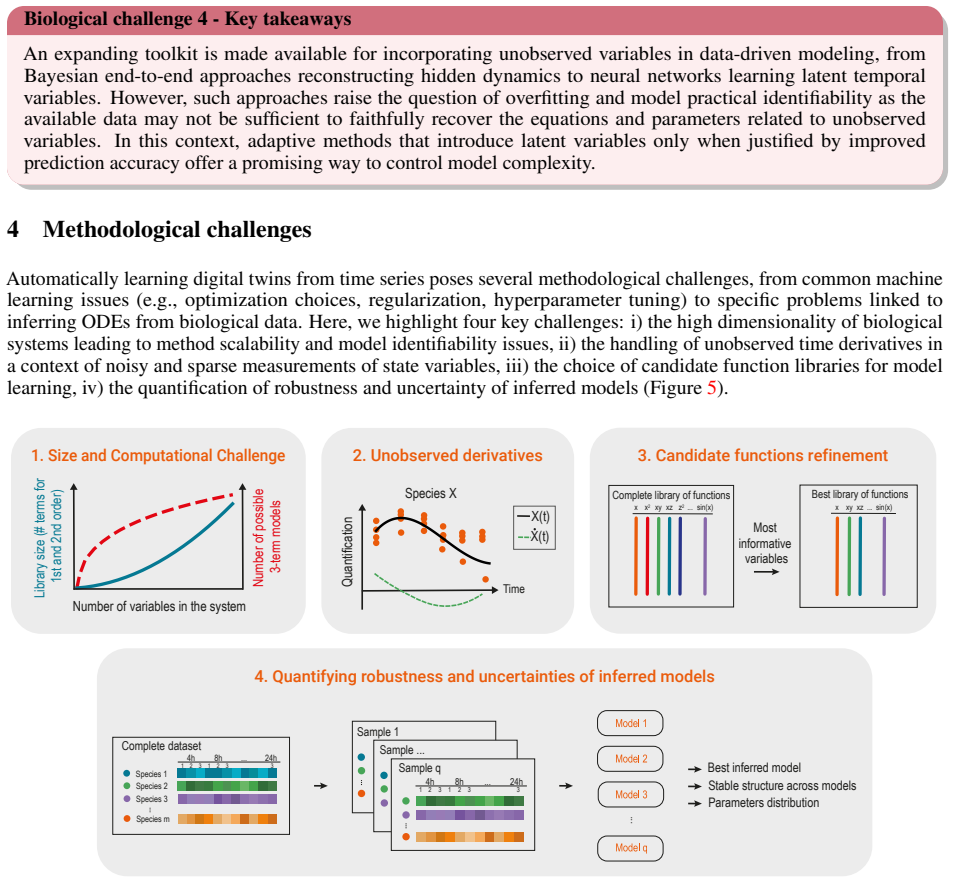
Scored against eight challenges (noisy/incomplete data, multiple conditions, prior knowledge, latent variables, high dimensionality, unobserved derivatives, candidate library design, uncertainty quantification), sparse regression methods meet more of these than symbolic regression methods, and the most complete pipelines are Bayesian sparse regression frameworks combining trajectory interpolation, sparsity-promoting priors, numerical ODE solving, and posterior uncertainty. Only a few symbolic methods address more than three challenges, and none handles multiple conditions. The authors propose hybrid mechanistic, Bayesian, deep-learning/LLM pipelines and a benchmark for reliable comparison.
What carries the argument
The comparison is carried by the eight-challenge rubric: Tables 1 and 2 give binary yes/no codes for each of 104 methods on each challenge, and the count of addressed challenges per method supports the ranking. The chemical reaction network (CRN) formalism is the mechanistic anchor—restricting inference to reactants, products, and rate functions yields stoichiometrically consistent, interpretable dynamics. Bayesian sparse regression is the family that pairs this structure with sparsity-promoting priors, derivative-free formulations, and posterior uncertainty, which explains its dominance at the top. The proposed benchmark design—controlled noise, condition shifts, misleading priors, and part
Load-bearing premise
The review's central comparison rests on the authors' own non-systematic selection of papers and their binary coding of which challenges each method meets; because the selection criteria kept about one symbolic-regression paper in five but most sparse-regression papers, an independent reviewer could reasonably code differently and reverse the ranking.
What would settle it
Re-code all 104 methods in Tables 1 and 2 by an independent reviewer using the same challenge definitions, or run the proposed benchmark on curated biological ODE models with fixed noise, missingness, condition shifts, and partial observability; if sparse regression no longer addresses more challenges than symbolic regression, the central claim fails.
If this is right
- New digital-twin projects should start from Bayesian sparse regression rather than symbolic search when the goal is a mechanistic ODE from biological time series.
- The lack of any method addressing more than six of eight challenges means fully automated model inference is not yet safe for clinical or pharmacological decisions.
- Progress will be driven by modular pipelines that combine CRN grounding, Bayesian uncertainty quantification, and deep-learning/LLM-based prior integration, rather than by single new algorithms.
- Adding candidate-library selection or refinement to sparse regression is a low-cost improvement, since only six of 55 sparse methods currently use it.
- A standardized benchmark with realistic biological challenges would replace the current practice of comparing new methods against one or two baselines.
Where Pith is reading between the lines
- My inference: because the selection was non-systematic and kept about 20% of symbolic regression papers but most sparse regression papers, the 'generally outperformed' verdict is a hypothesis to test, not an established fact; a quantitative meta-analysis could reverse it.
- My inference: the multiple-conditions gap is the most actionable bottleneck, since group-sparse and personalized-parameter strategies already exist and could be integrated into Bayesian sparse regression with modest effort.
- My inference: the benchmark proposal is the paper's most durable contribution, and running it on curated biological ODE models with standardized noise, missingness, and observability settings would give the field its first objective comparison.
Editorial analysis
A structured set of objections, weighed in public.
Referee Report
Summary. This manuscript is a review of computational methods for automatically inferring ODE-based digital twins of biological systems from time-series data. The authors categorize methods into symbolic regression and sparse regression, define four biological challenges (noisy/incomplete data, multiple experimental conditions, prior knowledge integration, unobserved variables) and four methodological challenges (high dimensionality, unobserved derivatives, candidate library design, uncertainty quantification), and code 49 symbolic and 55 sparse-regression papers against these challenges in Tables 1 and 2. On the basis of these codings, they claim that sparse regression generally outperforms symbolic regression, especially in Bayesian formulations, and they advocate hybrid frameworks combining chemical reaction network grounding, Bayesian uncertainty quantification, and deep learning/LLM-based knowledge integration. They also propose a benchmarking framework and provide an interactive Shiny application for exploring the reviewed methods.
Significance. If its central comparative claim were well supported, this review would be a valuable resource for method selection in data-driven biological model discovery. The paper has genuine strengths: a broad and current bibliography, a clear taxonomy of symbolic and sparse regression families, an explicit list of eight challenges specific to biomedical applications, a publicly accessible Shiny application, and a thoughtful discussion of hybrid and Bayesian approaches. The proposed benchmark agenda is timely. However, the load-bearing assertion that sparse regression generally outperforms symbolic regression is not established by the evidence presented, because the literature selection is non-systematic and the binary challenge codings are not validated. The manuscript is therefore best viewed as an expert-scoping review and a proposal for future evaluation, not as a quantitative comparative claim.
major comments (3)
- [Section 8, Tables 1–2] The central comparative claim is undermined by the selection procedure. Section 8 states that the review was non-systematic and that only about 20% of symbolic regression papers met the inclusion criteria while the majority of sparse regression papers did. Since criteria (i)–(iii) include relevance to the challenges and originality, the two families are filtered under different effective standards. The aggregate counts (3/49 vs 18/55 methods addressing more than three challenges) therefore reflect differential filtering as much as genuine method capability. A comparative claim requires either a systematic search with transparent reporting or a clearly framed descriptive statement restricted to the selected methods.
- [Tables 1–2, Sections 5.1–5.2] The binary coding in Tables 1 and 2 is the quantitative basis for the paper's main conclusion, but no coding rubric, inter-rater reliability measure, or sensitivity analysis is provided. For example, 'uncertainty quantification' appears to count empirical ensembling in some methods and full Bayesian posteriors in others, and 'missing data' could mean interpolation, observation masking, or joint reconstruction. Different coders could plausibly assign different values to borderline methods, changing the per-family counts and potentially eroding the claimed advantage. The authors should provide operational definitions for each of the eight columns, ideally with independent double-coding and a robustness check showing the conclusion is stable to plausible recodings.
- [Abstract; Sections 5–6] The claim that sparse regression, especially Bayesian variants, 'generally outperformed' symbolic regression is based on the number of challenge columns satisfied by selected papers, not on comparative performance on matched tasks. Counting covered challenges is not equivalent to evaluating accuracy, data efficiency, scalability, or robustness. The authors themselves call for benchmarks in Section 7.2, which implicitly acknowledges that the comparative verdict is provisional. The abstract and Section 6 should be reworded to present the comparison as a coverage analysis under the authors' coding, and to state explicitly that relative performance on common benchmarks remains unquantified.
minor comments (5)
- [Title] The title contains a typo: 'DATA-D RIVEN' should read 'DATA-DRIVEN'.
- [Table 1] The table lists 'Guimerà et al. (2014)' but the reference list and text cite Guimerà et al. (2020). Please correct the year and ensure all citation keys match the bibliography.
- [Tables 1–2] The colored disks indicating method categories are hard to decode in black-and-white print and may be inaccessible to color-blind readers. Use explicit category labels or a printer-friendly legend in addition to color.
- [Section 3.2, Table 2] Several citations are ambiguous or inconsistent: 'Schaeffer et al. (2017)' in the text has multiple entries in the reference list, and 'Huang et al. (2025)' appears as 'Huang et al. (2025b)' elsewhere. Please disambiguate all such references.
- [Section 7.2] The proposed benchmarking framework is only a high-level sketch. Specifying concrete metrics, baselines, data-generation protocols, and a timeline would strengthen the proposal and make it actionable.
Circularity Check
No circular derivation: the review's comparative claim is a qualitative synthesis, and the acknowledged selection limitations are correctness risks, not constructional circularity.
full rationale
The paper contains no formal derivation, prediction, or first-principles result that reduces to its own inputs. The central claim that sparse regression generally outperformed symbolic regression (abstract, Sections 5.1-5.2) is a qualitative summary of the authors' binary challenge codings in Tables 1 and 2, not a quantity fitted to data and then renamed as a prediction. Section 8 explicitly discloses a non-systematic selection strategy and an asymmetric inclusion rate: 'For symbolic regression, only about 20% met these criteria while the majority of the reviewed sparse regression methods met these criteria.' This is a real threat to the external validity and reproducibility of the comparison, but it is not circular in the sense defined here: the inclusion criteria (ability to learn structure and parameters, biological relevance, originality) do not themselves encode the number of challenges each method addresses, and the conclusion is not forced by definition. The authors also explicitly call for benchmarks (Section 7.2), acknowledging the comparison is provisional rather than a necessary consequence of the review design. Self-citations (e.g., Martinelli et al. 2021, 2022; Hesse et al. 2021) are descriptive and not load-bearing for the comparative verdict; no uniqueness theorem or ansatz is imported from the authors' prior work. The subjective nature of the challenge codings and the absence of inter-rater reliability measures are methodological weaknesses, but under the provided criteria they fall under correctness/reliability risk rather than circularity. Therefore the honest finding is no significant circularity.
Axiom & Free-Parameter Ledger
axioms (4)
- domain assumption ODE-based mechanistic models are the right representation for biological digital twins.
- domain assumption Biological systems have parsimonious representations (few active reactions).
- ad hoc to paper The eight challenges identified are the relevant axes for evaluating digital twin discovery.
- ad hoc to paper Binary coding of method capacities is reliable and comparable across papers.
Cite this review
Pith. "Pith review of Data-driven Discovery of Digital Twins in Biomedical Research." pith.science (2026). https://pith.science/paper/UEHA2JUZ
@misc{pith2026250821484,
  author       = {Pith},
  title        = {Pith review of: Data-driven Discovery of Digital Twins in Biomedical Research},
  year         = {2026},
  howpublished = {\url{https://pith.science/paper/UEHA2JUZ}},
  note         = {Machine review of arXiv:2508.21484}
}
read the original abstract
Recent technological advances have expanded the availability of high-throughput biological datasets, enabling the reliable design of digital twins of biomedical systems or patients. Such computational tools represent key reaction networks driving perturbation or drug response and can guide drug discovery and personalized therapeutics. Yet, their development still relies on laborious data integration by the human modeler, so that automated approaches are critically needed. The success of data-driven system discovery in Physics, rooted in clean datasets and well-defined governing laws, has fueled interest in applying similar techniques in Biology, which presents unique challenges. Here, we reviewed methodologies for automatically inferring digital twins from biological time series, which mostly involve symbolic or sparse regression. We evaluate algorithms according to eight biological and methodological challenges, associated to noisy/incomplete data, multiple conditions, prior knowledge integration, latent variables, high dimensionality, unobserved variable derivatives, candidate library design, and uncertainty quantification. Upon these criteria, sparse regression generally outperformed symbolic regression, particularly when using Bayesian frameworks. We further highlight the emerging role of deep learning and large language models, which enable innovative prior knowledge integration, though the reliability and consistency of such approaches must be improved. While no single method addresses all challenges, we argue that progress in learning digital twins will come from hybrid and modular frameworks combining chemical reaction network-based mechanistic grounding, Bayesian uncertainty quantification, and the generative and knowledge integration capacities of deep learning. To support their development, we further propose a benchmarking framework to evaluate methods across all challenges.
Figures


Reference graph
Works this paper leans on
-
[1]
Abdullah, F., Wu, Z., and Christofides, P. D. (2022a). Handling noisy data in sparse model identification using subsampling and co-teaching. Computers & Chemical Engineering, 157, 107628. Abdullah, F., Alhajeri, M. S., and Christofides, P. D. (2022b). Modeling and Control of Nonlinear Processes Using Sparse Identification: Using Dropout to Handle Noisy Da...
work page internal anchor Pith review Pith/arXiv arXiv 2020
-
[7]
25 Cui, H., Wang, C., Maan, H., Pang, K., Luo, F., Duan, N., and Wang, B. (2024). scgpt: toward building a foundation model for single-cell multi-omics using generative ai. Nature Methods, 21(8), 1470–1480. Daniels, B. C. and Nemenman, I. (2015). Automated adaptive inference of phenomenological dynamical models. Nature Communications, 6(1),
work page 2024
-
[10]
Learning Dynamical Systems and Bifurcation via Group Sparsity
Schaeffer, H. and McCalla, S. G. (2017). Sparse model selection via integral terms. Physical Review. E, 96(2-1), 023302. Schaeffer, H., Tran, G., and Ward, R. (2017). Learning dynamical systems and bifurcation via group sparsity. arXiv preprint arXiv:1709.01558. Schaeffer, H., Tran, G., and Ward, R. (2018). Extracting sparse high-dimensional dynamics from...
work page internal anchor Pith review Pith/arXiv arXiv 2017
-
[13]
O., Virgolin, M., Kommenda, M., Majumder, M
de Franca, F. O., Virgolin, M., Kommenda, M., Majumder, M. S., Cranmer, M., Espada, G., Ingelse, L., Fonseca, A., Landajuela, M., Petersen, B., Glatt, R., Mundhenk, N., Lee, C. S., Hochhalter, J. D., Randall, D. L., Kamienny, P., Zhang, H., Dick, G., Simon, A., Burlacu, B., Kasak, J., Machado, M., Wilstrup, C., and Cavaz, W. G. L. (2024). SRBench++: Princ...
Pith/arXiv arXiv 2024
-
[22]
Fages, F., Gay, S., and Soliman, S. (2015). Inferring reaction systems from ordinary differential equations. Theoretical Computer Science, 599, 64–78. Advances in Computational Methods in Systems Biology. Fasel, U., Kutz, J. N., Brunton, B. W., and Brunton, S. L. (2022). Ensemble-SINDy: Robust sparse model discovery in the low-data, high-noise limit, with...
work page internal anchor Pith review Pith/arXiv arXiv 2015
-
[71]
Large Language Models for Extrapolative Modeling of Manufacturing Processes
Keener, J. and Sneyd, J. (2008). Mathematical physiology. I: Cellular physiology. 2nd ed. Khanghah, K. N., Patel, A., Malhotra, R., and Xu, H. (2025). Large language models for extrapolative modeling of manufacturing processes. arXiv preprint arXiv:2502.12185. Kim, S., Lu, P. Y ., Mukherjee, S., Gilbert, M., Jing, L., Ceperic, V ., and Soljacic, M. (2021)...
work page internal anchor Pith review Pith/arXiv arXiv 2008
-
[119]
Nayek, R., Fuentes, R., Worden, K., and Cross, E. J. (2021). On spike-and-slab priors for Bayesian equation discovery of nonlinear dynamical systems via sparse linear regression. Mechanical Systems and Signal Processing , 161, 107986. Nicolaou, Z. G., Huo, G., Chen, Y ., Brunton, S. L., and Kutz, J. N. (2023). Data-driven discovery and extrapolation of pa...
work page 2021
-
[149]
SpReME: Sparse Regression for Multi-Environment Dynamic Systems
North, J. S., Wikle, C. K., and Schliep, E. M. (2022). A Bayesian approach for data-driven dynamic equation discovery. Journal of Agricultural, Biological and Environmental Statistics, 27(4), 728–747. Publisher: Springer. North, J. S., Wikle, C. K., and Schliep, E. M. (2023). A Review of Data-Driven Discovery for Dynamic Systems. International Statistical...
work page internal anchor Pith review Pith/arXiv arXiv 2022
-
[2024]
MetaPhysiCa: OOD Robustness in Physics-informed Machine Learning
Nucleic Acids Research, 52(D1), D672–D678. Mouli, S. C., Alam, M. A., and Ribeiro, B. (2023). Metaphysica: Ood robustness in physics-informed machine learning. arXiv preprint arXiv:2303.03181. Mower, C. E. and Bou-Ammar, H. (2025). Al-Khwarizmi: Discovering Physical Laws with Foundation Models. arXiv preprint arXiv:2502.01702. Mundhenk, T., Landajuela, M....
work page internal anchor Pith review Pith/arXiv arXiv 2023
-
[2104]
Smits, G. F. and Kotanchek, M. (2005). Pareto-Front Exploitation in Symbolic Regression. In U.-M. O’Reilly, T. Yu, R. Riolo, and B. Worzel, editors,Genetic Programming Theory and Practice II, pages 283–299. Springer US, Boston, MA. Somacal, A., Barrera, Y ., Boechi, L., Jonckheere, M., Lefieux, V ., Picard, D., and Smucler, E. (2022). Uncovering different...
Pith/arXiv arXiv 2005
-
[3930]
32 Tibshirani, R. (1996). Regression shrinkage and selection via the lasso. Journal of the Royal Statistical Society. Series B (Methodological), 58(1), 267–288. Tohme, T., Liu, D., and Youcef-Toumi, K. (2023). GSR: A Generalized Symbolic Regression Approach. arXiv:2205.15569 [cs]. Tran, G. and Ward, R. (2017). Exact recovery of chaotic systems from highly...
Pith/arXiv arXiv 1996
-
[8133]
d’Ascoli, S., Becker, S., Schwaller, P., Mathis, A., and Kilbertus, N
Publisher: Nature Publishing Group. d’Ascoli, S., Becker, S., Schwaller, P., Mathis, A., and Kilbertus, N. (2024). ODEFormer: Symbolic regression of dynamical systems with transformers. In The Twelfth International Conference on Learning Representations. Davidson, J. W., Savic, D. A., and Walters, G. A. (2003). Symbolic and numerical regression: experimen...
work page 2024
This paper was first reviewed by deepseek-v4-flash on August 5, 2026.
discussion (0)
Sign in with ORCID, Apple, or X to comment. Anyone can read and Pith papers without signing in.