Designing topological edge currents in chiral active matter
Pith reviewed 2026-07-01 02:25 UTC · model grok-4.3
The pith
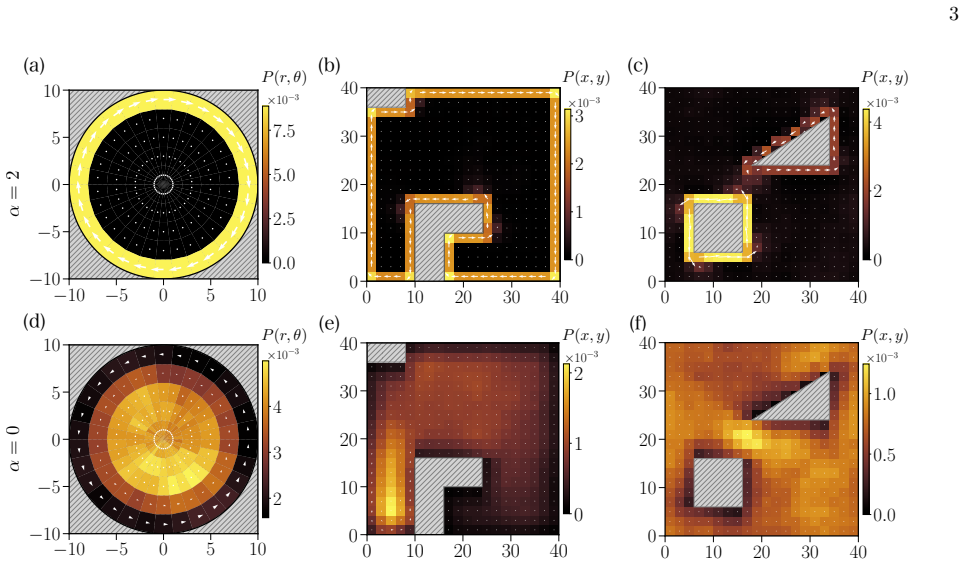
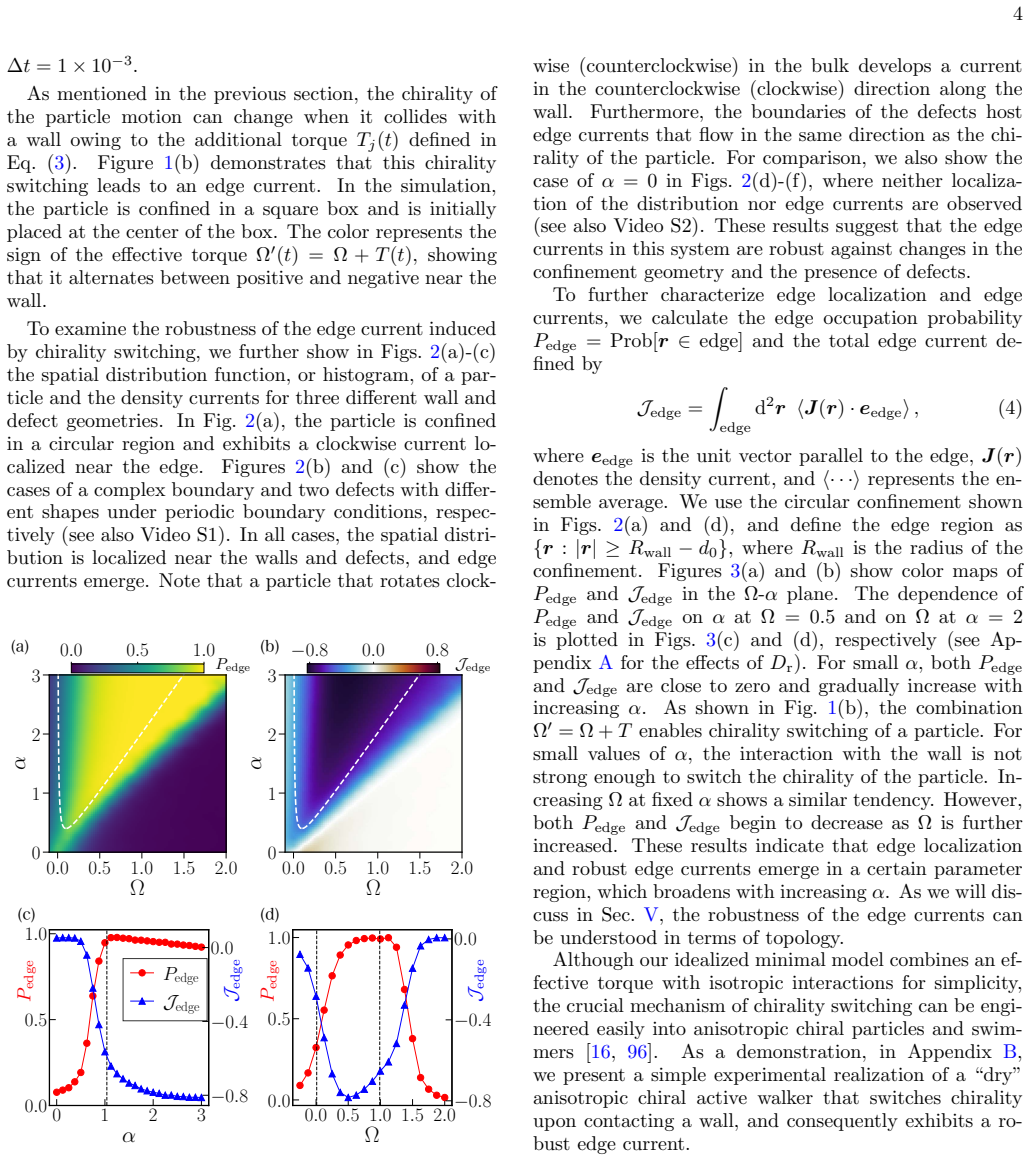
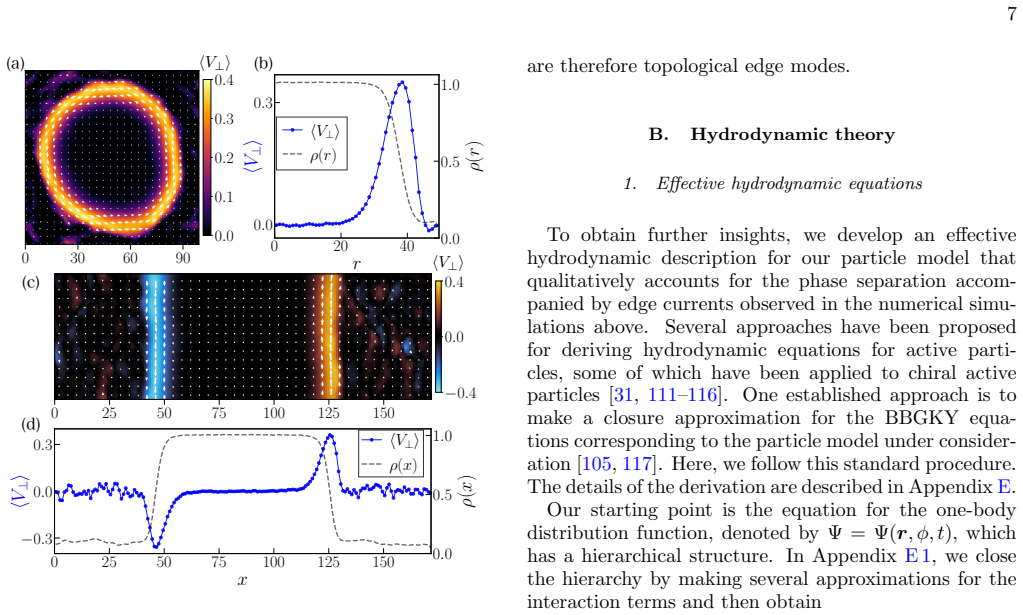
A model of chiral active swimmers with chirality switching produces robust topological edge currents along boundaries and interfaces.
A machine-rendered reading of the paper's core claim, the machinery that carries it, and where it could break.
Core claim
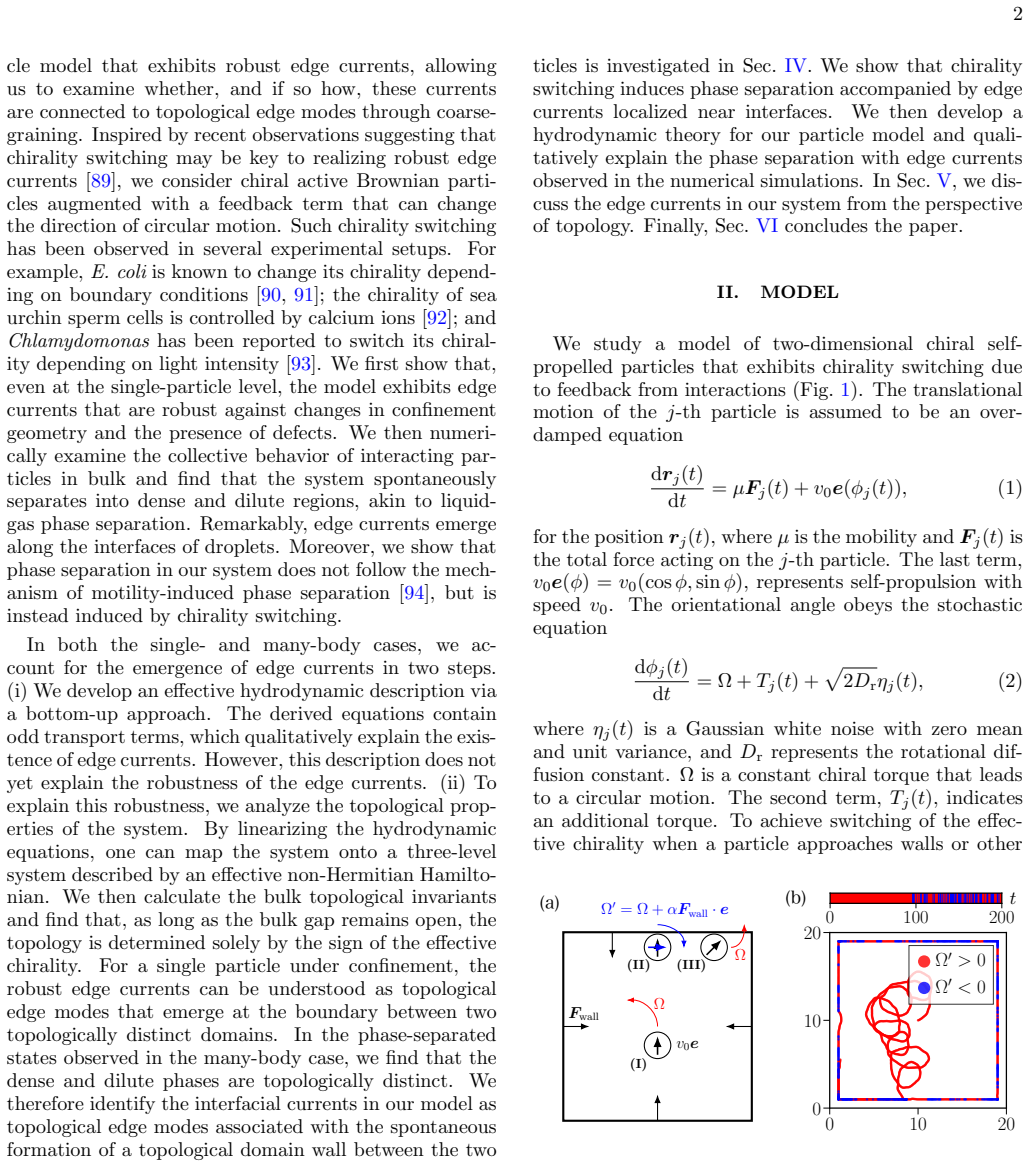
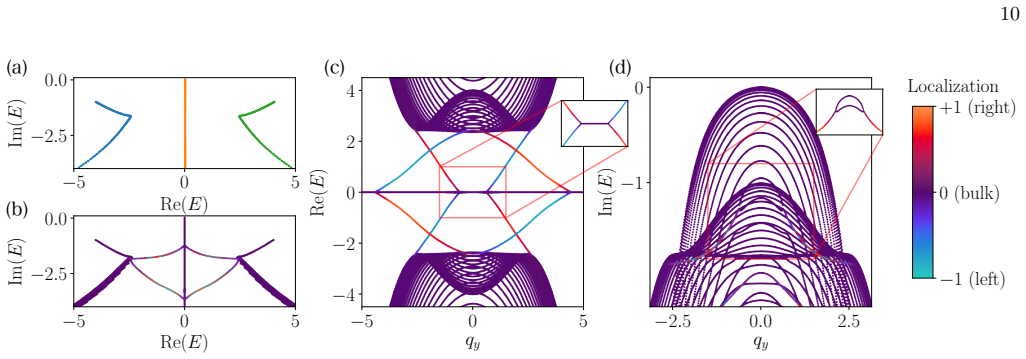
The edge currents in the system are genuine topological edge modes because chirality switching creates an effective coexistence of two topologically distinct domains whose interfaces support protected transport, as established by the topological classification of the linearized hydrodynamic equations.
What carries the argument
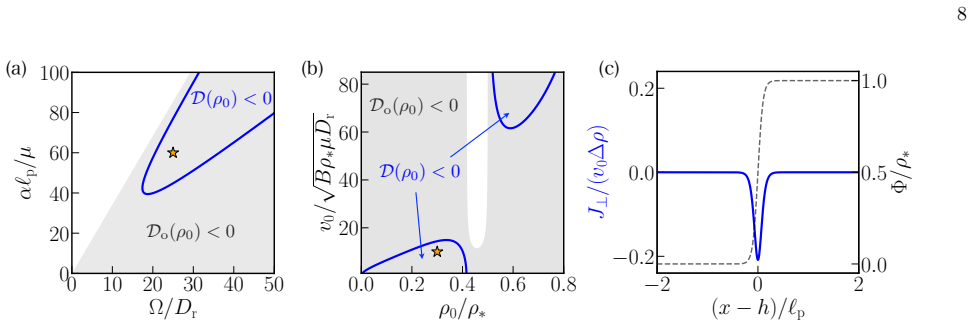
The linearized hydrodynamic equations obtained from bottom-up coarse-graining of the particle model; their topological properties classify the edge modes.
If this is right
- Single-particle edge currents arise regardless of wall shape or defects.
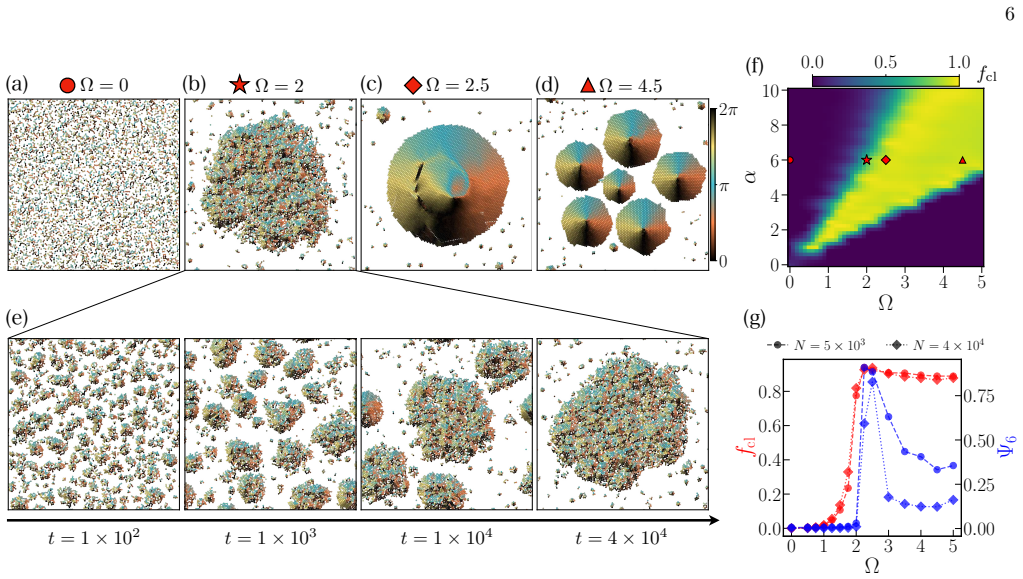
- Collective phase separation occurs with currents along the resulting interfaces.
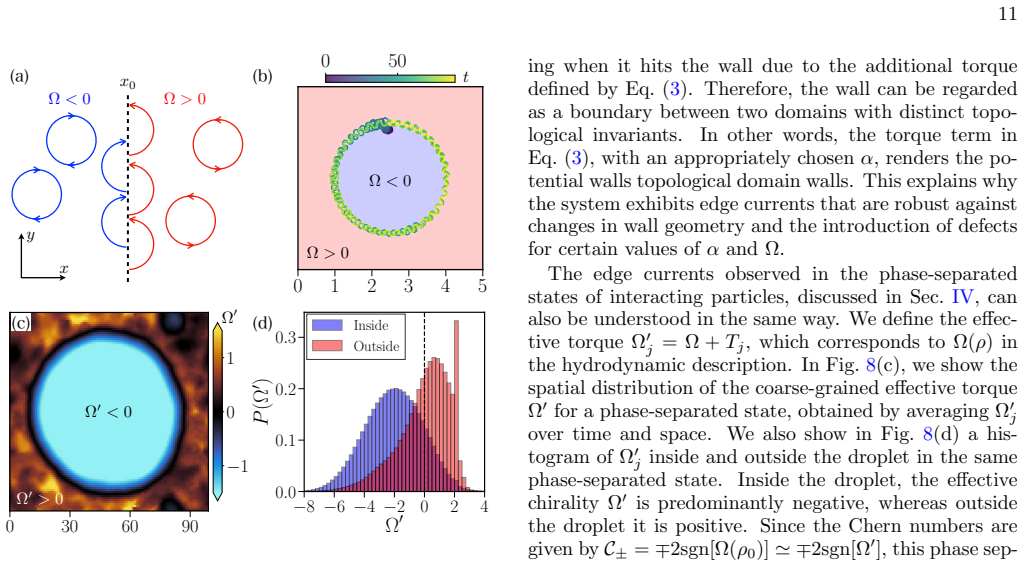
- The separation is explained as coexistence of topologically distinct domains.
- The model supplies design rules for robust edge currents in active matter.
Where Pith is reading between the lines
- The topological character could protect currents against additional weak perturbations not included in the current model.
- Tuning the switching rate experimentally might allow direct control over the presence or direction of the currents.
- The domain-coexistence picture could be tested by measuring local topological markers at interfaces in simulations or experiments.
Load-bearing premise
The bottom-up coarse-graining procedure produces a hydrodynamic theory whose linearized equations correctly capture the topological character of the microscopic dynamics without omitted terms that would alter the edge-mode classification.
What would settle it
Checking whether edge currents persist or reverse when the chirality switching rate is varied across a threshold that changes the sign of the relevant topological invariant extracted from the hydrodynamic equations.
Figures
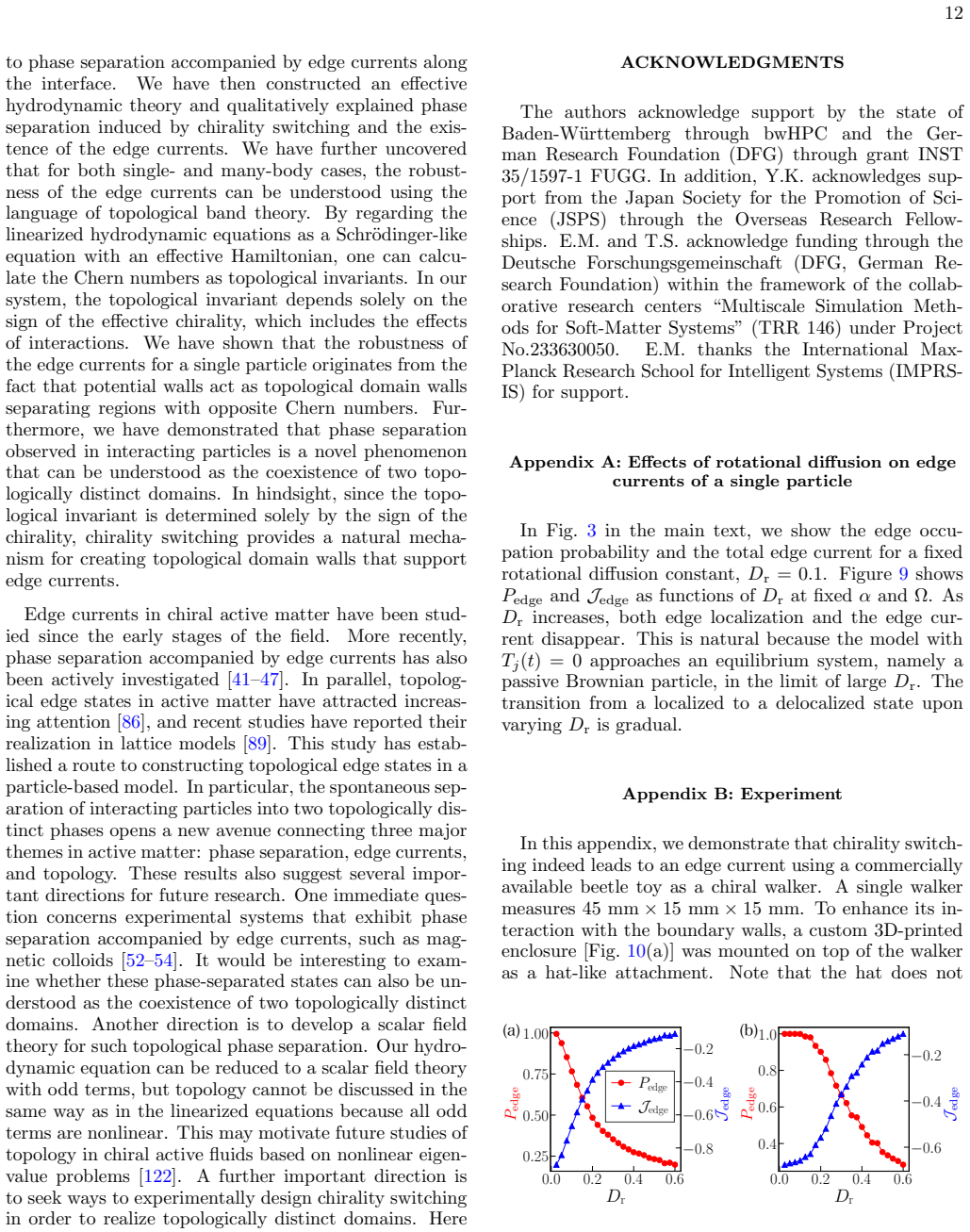
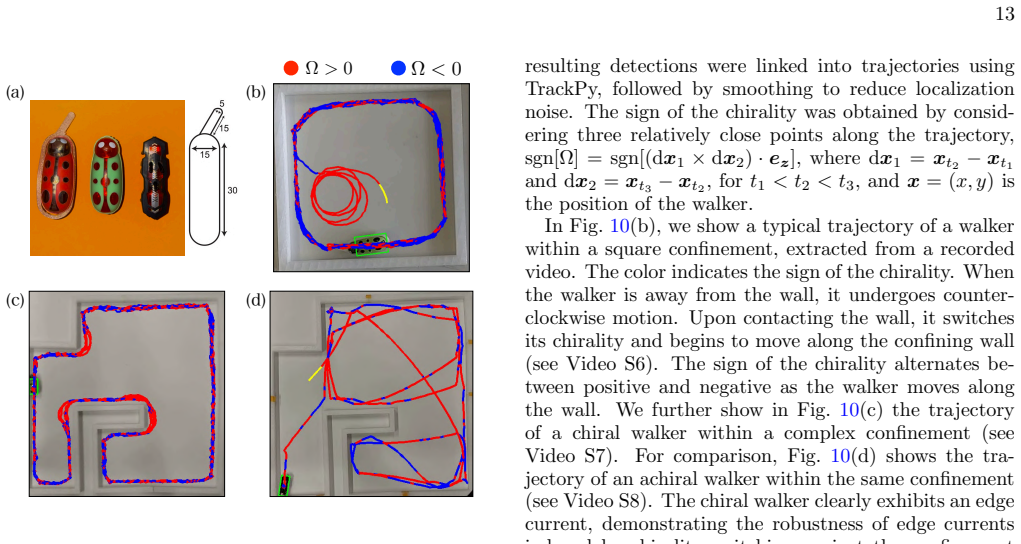
read the original abstract
Achieving robust functionality in active matter driven away from thermal equilibrium is a current theoretical and experimental challenge. Several recent studies have reported edge currents--persistent transport along walls and density inhomogeneities--in chiral active matter. Yet, the microscopic rules that render these edge currents robust with respect to the confinement geometry and defects remain elusive. Here, we introduce a simple particle model of two-dimensional chiral active swimmers that undergo chirality switching and demonstrate that the model exhibits robust edge currents, i.e., when a single particle is confined, edge currents arise regardless of the confinement geometry or the presence of defects. We also investigate the collective behavior of interacting particles in bulk and find that chirality switching induces phase separation accompanied by edge currents along interfaces. This phase separation is distinct from motility-induced phase separation and is qualitatively explained by an effective hydrodynamic theory derived via bottom-up coarse-graining. Furthermore, by analyzing the topological properties of the linearized hydrodynamic equations, we show that the edge currents in our system are genuine topological edge modes. Notably, phase separation induced by chirality switching can be regarded as the coexistence of two topologically distinct domains. Our results provide guidelines for designing robust edge currents in active matter systems.
Editorial analysis
A structured set of objections, weighed in public.
Referee Report
Summary. The manuscript introduces a 2D particle model of chiral active swimmers that undergo chirality switching. Simulations show robust edge currents for single particles independent of confinement geometry or defects. In the collective regime, chirality switching induces phase separation accompanied by edge currents along interfaces, distinct from motility-induced phase separation. A bottom-up coarse-graining procedure yields an effective hydrodynamic theory that qualitatively accounts for the phase separation. Linearization of the hydrodynamic equations followed by topological analysis is used to argue that the observed edge currents are genuine topological edge modes and that the phase-separated state corresponds to the coexistence of two topologically distinct domains.
Significance. If the topological classification survives the approximations inherent to the coarse-graining, the work would supply a concrete microscopic mechanism for engineering protected edge transport in active matter via chirality switching. The bottom-up link between particle rules and a hydrodynamic topological invariant is a strength that could inform both theory and experiment in non-equilibrium soft matter.
major comments (2)
- [Hydrodynamic theory derivation] The section deriving the hydrodynamic equations via bottom-up coarse-graining provides no quantitative validation (e.g., moment matching, correlation-function comparison, or truncation-error estimates) that the retained terms preserve the topological invariants of the microscopic dynamics. Because the subsequent claim that edge currents are topological edge modes rests entirely on the linearized hydro equations, omitted higher-order spatial derivatives or closure approximations could shift the winding number or non-Hermitian invariant and invalidate the classification.
- [Topological properties of the linearized equations] In the topological analysis of the linearized hydrodynamic equations, the classification of the edge modes and the interpretation of phase separation as coexistence of two topologically distinct domains are presented without a sensitivity test showing that the invariant remains unchanged when small neglected terms (consistent with the coarse-graining) are restored. This directly affects the central assertion that the edge currents are protected topological modes.
minor comments (1)
- [Results on collective behavior] Figure captions for the collective simulations should explicitly state the system size, number of independent runs, and error estimation method used for the reported interface currents.
Simulated Author's Rebuttal
We thank the referee for their careful reading of the manuscript and for highlighting important points regarding the hydrodynamic derivation and topological analysis. Below we respond to each major comment. We agree that additional discussion of the approximation's robustness would strengthen the presentation and will revise accordingly.
read point-by-point responses
-
Referee: [Hydrodynamic theory derivation] The section deriving the hydrodynamic equations via bottom-up coarse-graining provides no quantitative validation (e.g., moment matching, correlation-function comparison, or truncation-error estimates) that the retained terms preserve the topological invariants of the microscopic dynamics. Because the subsequent claim that edge currents are topological edge modes rests entirely on the linearized hydro equations, omitted higher-order spatial derivatives or closure approximations could shift the winding number or non-Hermitian invariant and invalidate the classification.
Authors: The coarse-graining retains the leading-order terms in density and polarization that encode the chirality-switching mechanism responsible for the non-reciprocal coupling. While we did not include explicit moment-matching or truncation-error estimates in the original manuscript, the resulting hydrodynamic equations reproduce the qualitative features of the microscopic simulations, including the emergence of edge currents at interfaces. The topological classification follows from the structure of these leading terms (specifically the antisymmetric coupling that opens a gap in the dispersion). Higher-order gradient terms are expected to be irrelevant for the long-wavelength edge modes. We will add a supplementary discussion clarifying the regime of validity of the truncation and why the retained terms suffice to protect the invariant. revision: partial
-
Referee: [Topological properties of the linearized equations] In the topological analysis of the linearized hydrodynamic equations, the classification of the edge modes and the interpretation of phase separation as coexistence of two topologically distinct domains are presented without a sensitivity test showing that the invariant remains unchanged when small neglected terms (consistent with the coarse-graining) are restored. This directly affects the central assertion that the edge currents are protected topological modes.
Authors: The linearization is performed around the uniform state, and the winding number is determined by the leading-order matrix whose off-diagonal terms arise directly from chirality switching. Small higher-order corrections consistent with the coarse-graining would shift eigenvalues continuously but leave the gap open and the winding number unchanged within the parameter range where phase separation occurs. Nevertheless, to address the concern directly we will include a short sensitivity check in the revised manuscript by adding a representative higher-order term to the linearized operator and recomputing the invariant. revision: yes
Circularity Check
No significant circularity; derivation is self-contained bottom-up
full rationale
The paper introduces a microscopic particle model with chirality switching, derives an effective hydrodynamic theory via explicit bottom-up coarse-graining, linearizes the resulting PDEs, and computes topological invariants on those linearized equations. No quoted step shows a parameter fitted to data then relabeled as a prediction, a self-definitional loop, or a load-bearing claim that reduces to a prior self-citation whose content is unverified. The topological classification is performed on the output of the coarse-graining step rather than being presupposed by it; omitted higher-order terms are an accuracy concern, not a circularity mechanism. The central claim therefore rests on independent content generated from the microscopic rules.
Axiom & Free-Parameter Ledger
axioms (1)
- domain assumption Linearized hydrodynamic equations derived from the particle model possess well-defined topological invariants that classify edge modes.
Reference graph
Works this paper leans on
-
[1]
fOgAZ4mnHlbUAexwlMHmq3PdJp8=
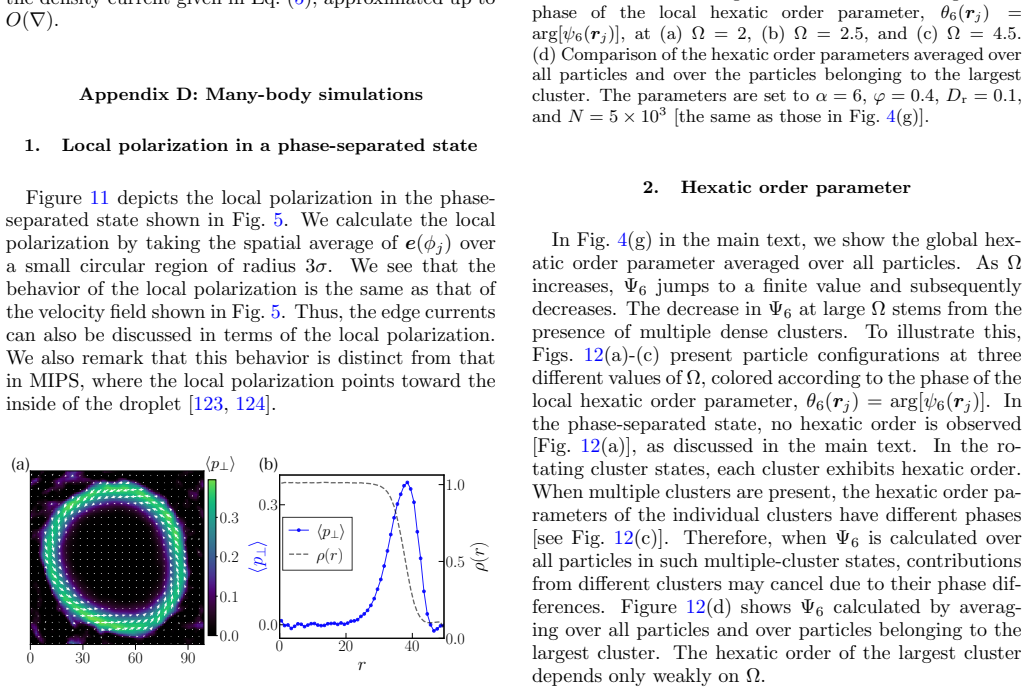
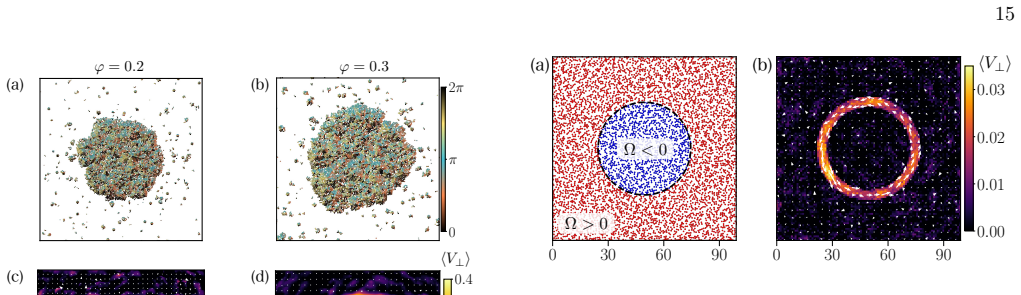
Local polarization in a phase-separated state Figure 11 depicts the local polarization in the phase- separated state shown in Fig. 5. We calculate the local polarization by taking the spatial average ofe(ϕ j) over a small circular region of radius 3σ. We see that the behavior of the local polarization is the same as that of the velocity field shown in Fig...
-
[2]
4(g) in the main text, we show the global hex- atic order parameter averaged over all particles
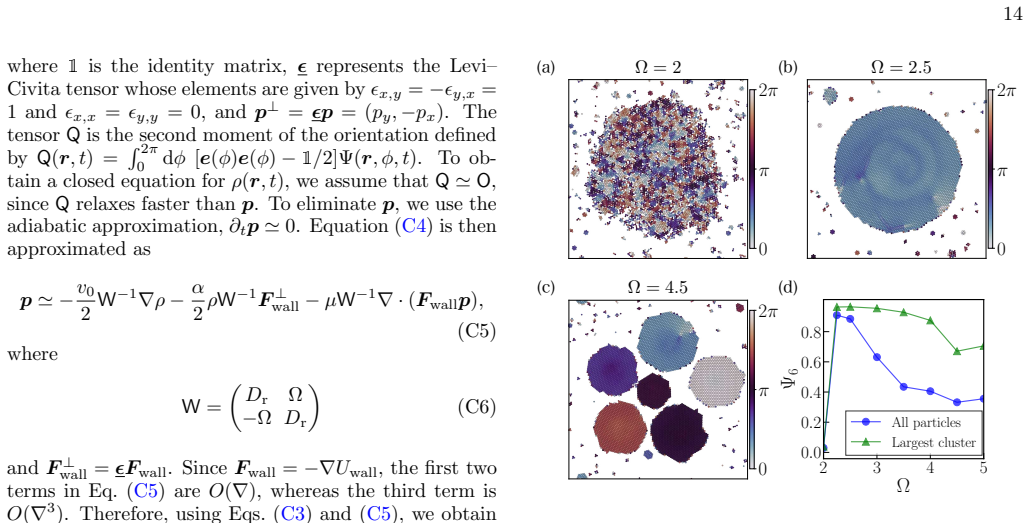
Hexatic order parameter In Fig. 4(g) in the main text, we show the global hex- atic order parameter averaged over all particles. As Ω increases, Ψ 6 jumps to a finite value and subsequently decreases. The decrease in Ψ 6 at large Ω stems from the presence of multiple dense clusters. To illustrate this, Figs. 12(a)-(c) present particle configurations at th...
-
[3]
Xp+5F/5ZDKOuB+nqKTh+hoKyr64=
Density dependence of phase separation with edge currents In Sec. IV, we primarily discuss phase separation at the packing fractionφ= 0.4. In Fig. 13, we show that 15 0 º 2º B C <latexit sha1_base64="Xp+5F/5ZDKOuB+nqKTh+hoKyr64=">AAAEzHichVNNb9NAEJ0UA6V8NIULEpeIqIhTtIlQQRxQVS5cQG1K0kpJZK3NJljxx8p2XILlKwf+AAe4gFQkxM/gwhmJQ38C4lgkLhx4uzEtENXeKPbsmzczb8a7lnS...
-
[4]
Xp+5F/5ZDKOuB+nqKTh+hoKyr64=
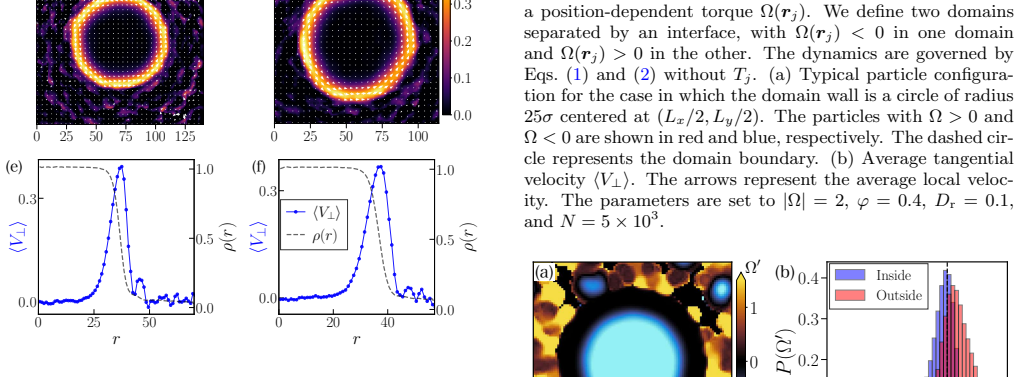
Current along a domain wall in interacting particles In Fig. 8(b) in the main text, we show that a single chi- ral active Brownian particle exhibits edge currents along the domain boundary in a system composed of two do- mains with opposite signs of chirality. The same behav- ior is observed even for interacting particles. To demon- 0 30 60 90 B 0 30 60 9...
-
[5]
8(c) and (d) in the main text, we show the lo- cal effective chirality Ω′ in a phase-separated state, where the inside of the droplet exhibits a liquid-like structure
Local effective chiral torque in a clustering state In Figs. 8(c) and (d) in the main text, we show the lo- cal effective chirality Ω′ in a phase-separated state, where the inside of the droplet exhibits a liquid-like structure. As discussed in Sec. IV, the system also exhibits cluster- ing states, in which multiple dense clusters coexist and 16 their int...
-
[6]
OauuOyif6Ctlv2+ieA3q33d77Ho=
Closure approximation In this section, we derive Eq. (14) in the main text. Here, we roughly follow Refs. [105, 117]. The one-body distribution function is defined by Ψ(r, ϕ, t) = * NX j=1 δ(r−r j(t))δ2π(ϕ−ϕ j(t)) + ,(E1) whereδ 2π(ϕ) =P n∈Z δ(ϕ+ 2nπ). Using the Itˆ o formula and Eqs. (1) and (2), the time derivative of Ψ(r, ϕ, t) reads ∂tΨ =− ∇ ·[µG+v 0e...
-
[7]
(E17) In the main text, we used Eq
Approximation for nematic tensor The nematic tensorQis defined by Q(r, t) = * NX j=1 e(ϕj(t))e(ϕj(t))− 1 2 1 δ(r−r j(t)) + . (E17) In the main text, we used Eq. (18) to expressQin terms of the polarization and density field. We here derive this approximated formula. To systematically address the hierarchy in the orienta- tion, we first expand the one-body...
-
[8]
(14) is based on a closure approximation
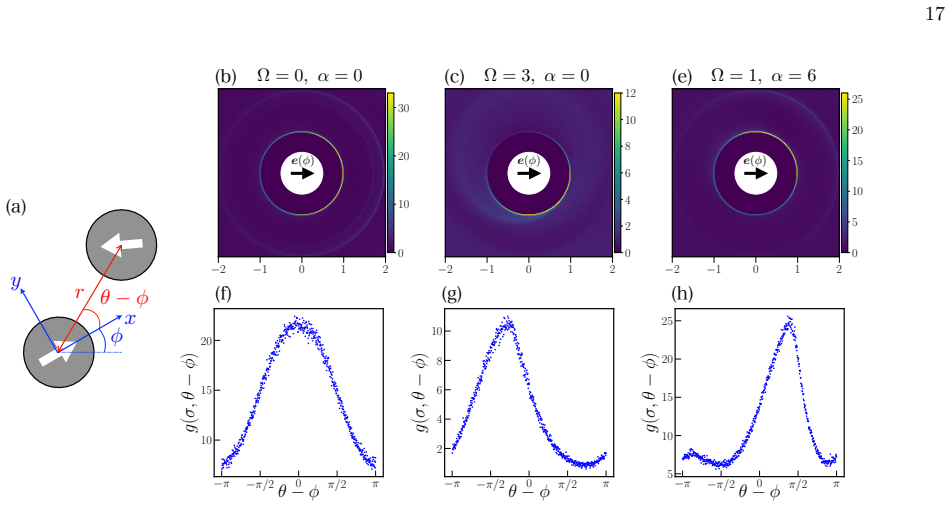
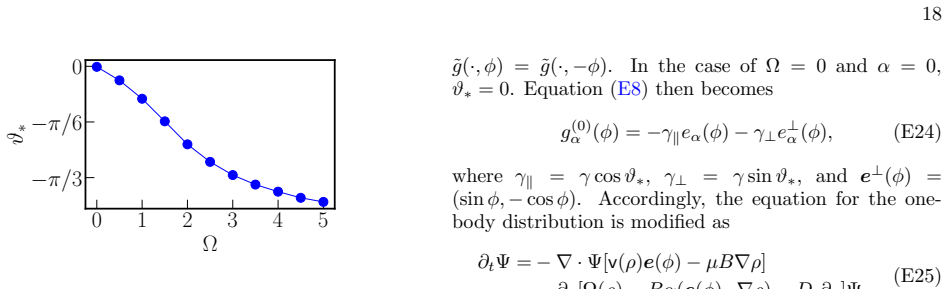
Modified equations As discussed in Appendix E 1, the derivation of Eq. (14) is based on a closure approximation. In this approximation, we used the fact that the pair distribu- tion function is axisymmetric with respect to the orienta- tione(ϕ), at least for small Ω. However, this assumption should be modified if Ω orαis large. Here, we briefly dis- cuss ...
-
[9]
free- energy
Scalar field theory for odd fluids Here, we briefly discuss a possible connection between our hydrodynamic equations and a scalar field theory for odd fluids. For active fluids, scalar field theories, such as active Model B(+), have often been used to study large- scale collective behavior [129–132]. Even for chiral active fluids, several studies have pro...
-
[10]
type I” and “type II,
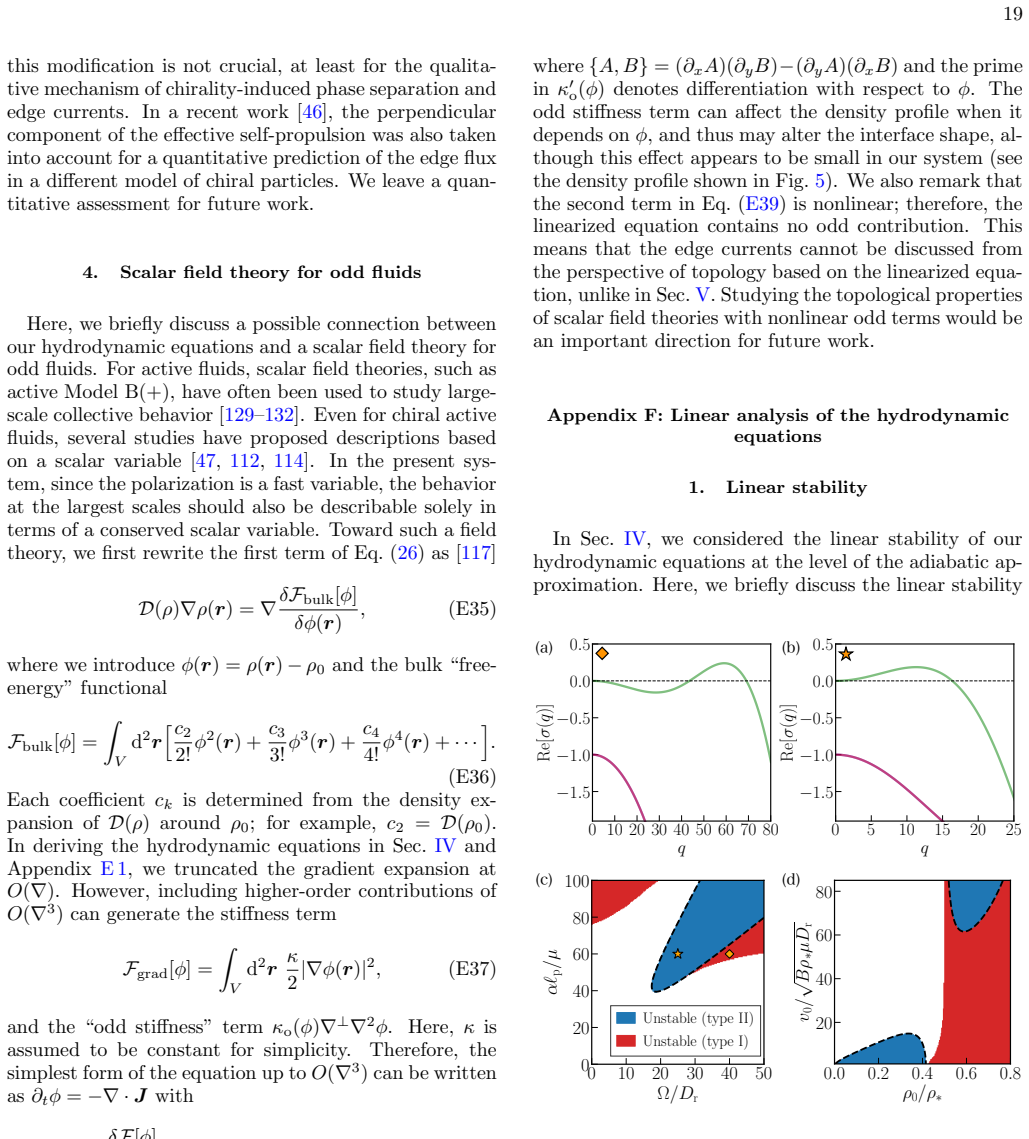
Linear stability In Sec. IV, we considered the linear stability of our hydrodynamic equations at the level of the adiabatic ap- proximation. Here, we briefly discuss the linear stability 0 10 20 30 40 50 ≠/Dr 0 20 40 60 80 100Æ`p/µ Unstable (type II) Unstable (type I) 0.0 0.2 0.4 0.6 0.8 Ω0/Ω§ 20 40 60 80v0/p BΩ§µDr 0 10 20 30 40 50 60 70 80 q °1.5 °1.0 °...
-
[11]
(F4) We now rescale the field variable as ˆψ(q) =S ˆψ′(q) with S= diag(1, s, s)
Effective Hamiltonian Equation (F2) (without the Helmholtz decomposition) can be rewritten asi∂ t ˆψ(q, t) =H(q) ˆψ(q, t) with the Hamiltonian-like matrixH(q) =iG(q): H(q) = −ibq2 λqx λqy λ2qx −λ ⊥qy −i(1 +νq 2)−i(W −ν oq2) λ2qy +λ ⊥qx i(W −ν oq2)−i(1 +νq 2) . (F4) We now rescale the field variable as ˆψ(q) =S ˆψ′(q) with S= diag(1, s, s). The equa...
-
[12]
[79, 118], the Chern numbers were calculated for systems described by the Hermitian matrix given by Eq
Chern numbers In Refs. [79, 118], the Chern numbers were calculated for systems described by the Hermitian matrix given by Eq. (F6). In this section, we calculate the Chern numbers from the effective Hamiltonian, Eq. (F4), and show that they are identical to those calculated from the Hermitian part in Eq. (F6). Our effective Hamiltonian is non-Hermitian, ...
-
[13]
7 in the main text
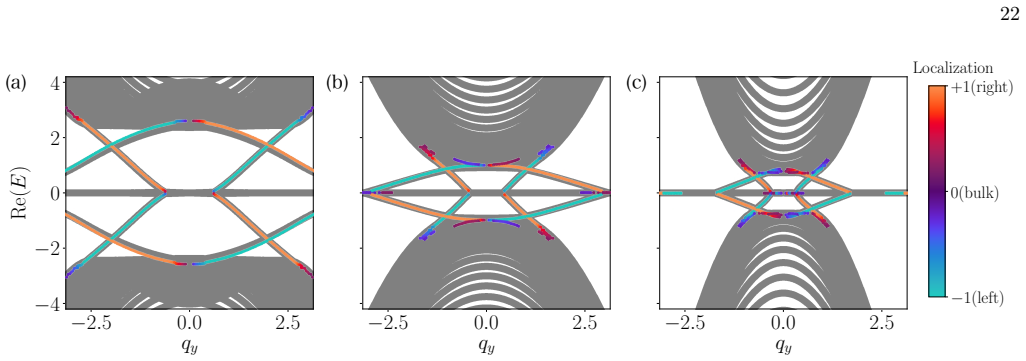
Band structure Here, we provide the technical details of the numerical calculation of the band structure shown in Fig. 7 in the main text. To obtain the band structure, we consider a system that is periodic in they-direction and open in thex-direction, following Ref. [81]. The effective Hamil- tonian in real space reads H= ib∇2 −ivs∂x −ivs∂y −ivs∂x +i...
-
[14]
Here, we show that the edge modes can also be obtained semi-analytically by starting from an ansatz for the edge solutions and imposing appropriate boundary conditions
Edge modes In the main text, we obtain the topological edge modes by discretizing the matrixHunder half-periodic bound- ary conditions. Here, we show that the edge modes can also be obtained semi-analytically by starting from an ansatz for the edge solutions and imposing appropriate boundary conditions. We consider the eigenvalue prob- lemHφ(x, y) =Eφ(x, ...
-
[15]
We introduce this rescaling to improve the numerical stability of the computation described be- low
We also rescale coefficients asA ′ α =A αe−καL and B′ α =B αe−καL. We introduce this rescaling to improve the numerical stability of the computation described be- low. Applying the boundary conditions then yields six equations, which can be written in the following matrix form: MBC A′ B′ := M− L M− R M+ L M+ R A′ B′ =O,(F31) whereA ′ = (A′ 1, A′ 2, A′ 3)⊤...
-
[16]
Qian, Phosphorylation Energy Hypothesis: Open Chemical Systems and Their Biological Functions, Annu
H. Qian, Phosphorylation Energy Hypothesis: Open Chemical Systems and Their Biological Functions, Annu. Rev. Phys. Chem.58, 113 (2007)
2007
-
[17]
M. C. Marchetti, J. F. Joanny, S. Ramaswamy, T. B. Liverpool, J. Prost, M. Rao, and R. A. Simha, Hydrody- namics of soft active matter, Rev. Mod. Phys.85, 1143 (2013)
2013
-
[18]
Ramaswamy, The Mechanics and Statistics of Ac- tive Matter, Annu
S. Ramaswamy, The Mechanics and Statistics of Ac- tive Matter, Annu. Rev. Condens. Matter Phys.1, 323 (2010)
2010
-
[19]
Bechinger, R
C. Bechinger, R. Di Leonardo, H. L¨ owen, C. Reichhardt, G. Volpe, and G. Volpe, Active particles in complex and crowded environments, Rev. Mod. Phys.88, 045006 (2016)
2016
-
[20]
Tailleur, G
J. Tailleur, G. Gompper, M. C. Marchetti, J. M. Yeo- mans, and C. Salomon,Active Matter and Nonequi- librium Statistical Physics: Lecture Notes of the Les Houches Summer School: Volume 112, September 2018 (Oxford University Press, 2022)
2018
-
[21]
Vicsek, A
T. Vicsek, A. Czir´ ok, E. Ben-Jacob, I. Cohen, and O. Shochet, Novel Type of Phase Transition in a Sys- tem of Self-Driven Particles, Phys. Rev. Lett.75, 1226 (1995)
1995
-
[22]
Cavagna and I
A. Cavagna and I. Giardina, Bird flocks as condensed matter, Annual Review of Condensed Matter Physics5, 183 (2014)
2014
-
[23]
Dombrowski, L
C. Dombrowski, L. Cisneros, S. Chatkaew, R. E. Gold- stein, and J. O. Kessler, Self-Concentration and Large- Scale Coherence in Bacterial Dynamics, Phys. Rev. Lett.93, 098103 (2004)
2004
-
[24]
Sanchez, D
T. Sanchez, D. T. N. Chen, S. J. DeCamp, M. Heymann, and Z. Dogic, Spontaneous motion in hierarchically as- sembled active matter, Nature491, 431 (2012)
2012
-
[25]
Volpe, I
G. Volpe, I. Buttinoni, D. Vogt, H.-J. K¨ ummerer, and C. Bechinger, Microswimmers in patterned environ- ments, Soft Matter7, 8810 (2011)
2011
-
[26]
Buttinoni, J
I. Buttinoni, J. Bialk´ e, F. K¨ ummel, H. L¨ owen, C. Bechinger, and T. Speck, Dynamical clustering and phase separation in suspensions of self-propelled col- loidal particles, Phys. Rev. Lett.110, 238301 (2013)
2013
-
[27]
Nishiguchi and M
D. Nishiguchi and M. Sano, Mesoscopic turbulence and local order in janus particles self-propelling under an ac electric field, Phys. Rev. E92, 052309 (2015)
2015
-
[28]
Kitano, Biological robustness, Nat
H. Kitano, Biological robustness, Nat. Rev. Genet.5, 826 (2004)
2004
-
[29]
L¨ owen, Chirality in microswimmer motion: From cir- cle swimmers to active turbulence, The European Phys- ical Journal Special Topics225, 2319 (2016)
H. L¨ owen, Chirality in microswimmer motion: From cir- cle swimmers to active turbulence, The European Phys- ical Journal Special Topics225, 2319 (2016)
2016
-
[30]
Liebchen and D
B. Liebchen and D. Levis, Chiral active matter, EPL 139, 67001 (2022)
2022
-
[31]
K¨ ummel, B
F. K¨ ummel, B. ten Hagen, R. Wittkowski, I. Buttinoni, R. Eichhorn, G. Volpe, H. L¨ owen, and C. Bechinger, Circular motion of asymmetric self-propelling particles, Phys. Rev. Lett.110, 198302 (2013)
2013
-
[32]
Zhang, A
B. Zhang, A. Sokolov, and A. Snezhko, Reconfigurable emergent patterns in active chiral fluids, Nature Com- munications11, 4401 (2020)
2020
-
[33]
Mano, J.-B
T. Mano, J.-B. Delfau, J. Iwasawa, and M. Sano, Op- timal run-and-tumble–based transportation of a janus particle with active steering, Proceedings of the Na- tional Academy of Sciences114, E2580 (2017)
2017
-
[34]
I. H. Riedel, K. Kruse, and J. Howard, A self-organized vortex array of hydrodynamically entrained sperm cells, Science309, 300 (2005)
2005
-
[35]
Patra, K
P. Patra, K. Beyer, A. Jaiswal, A. Battista, K. Rohr, F. Frischknecht, and U. S. Schwarz, Collective migra- 24 tion reveals mechanical flexibility of malaria parasites, Nature Physics18, 586 (2022)
2022
-
[36]
W. R. DiLuzio, L. Turner, M. Mayer, P. Garstecki, D. B. Weibel, H. C. Berg, and G. M. Whitesides, Es- cherichia coli swim on the right-hand side, Nature435, 1271 (2005)
2005
-
[37]
Di Leonardo, D
R. Di Leonardo, D. Dell’Arciprete, L. Angelani, and V. Iebba, Swimming with an image, Phys. Rev. Lett. 106, 038101 (2011)
2011
-
[38]
Siebers, A
F. Siebers, A. Jayaram, P. Bl¨ umler, and T. Speck, Ex- ploiting compositional disorder in collectives of light- driven circle walkers, Science Advances9, eadf5443 (2023)
2023
-
[39]
Liebchen and D
B. Liebchen and D. Levis, Collective behavior of chiral active matter: Pattern formation and enhanced flock- ing, Phys. Rev. Lett.119, 058002 (2017)
2017
-
[40]
N. Kruk, J. A. Carrillo, and H. Koeppl, Traveling bands, clouds, and vortices of chiral active matter, Phys. Rev. E102, 022604 (2020)
2020
-
[41]
Ventejou, H
B. Ventejou, H. Chat´ e, R. Montagne, and X.-q. Shi, Susceptibility of orientationally ordered active matter to chirality disorder, Phys. Rev. Lett.127, 238001 (2021)
2021
-
[42]
Liao and S
G.-J. Liao and S. H. L. Klapp, Emergent vortices and phase separation in systems of chiral active particles with dipolar interactions, Soft Matter17, 6833 (2021)
2021
-
[43]
Q.-L. Lei, M. P. Ciamarra, and R. Ni, Nonequilibrium strongly hyperuniform fluids of circle active particles with large local density fluctuations, Science Advances 5, eaau7423 (2019)
2019
-
[44]
Huang, W
M. Huang, W. Hu, S. Yang, Q.-X. Liu, and H. P. Zhang, Circular swimming motility and disordered hyperuni- form state in an algae system, Proceedings of the Na- tional Academy of Sciences118, e2100493118 (2021)
2021
-
[45]
Zhang and A
B. Zhang and A. Snezhko, Hyperuniform active chiral fluids with tunable internal structure, Phys. Rev. Lett. 128, 218002 (2022)
2022
-
[46]
Kuroda and K
Y. Kuroda and K. Miyazaki, Microscopic theory for hyperuniformity in two-dimensional chiral active fluid, Journal of Statistical Mechanics: Theory and Experi- ment , 103203 (2023)
2023
-
[47]
Kuroda, T
Y. Kuroda, T. Kawasaki, and K. Miyazaki, Singular density correlations in chiral active fluids in three di- mensions, Phys. Rev. E112, 045426 (2025)
2025
-
[48]
V. E. Debets, H. L¨ owen, and L. M. C. Janssen, Glassy dynamics in chiral fluids, Phys. Rev. Lett.130, 058201 (2023)
2023
-
[49]
Kuroda, T
Y. Kuroda, T. Kawasaki, and K. Miyazaki, Long- range translational order and hyperuniformity in two- dimensional chiral active crystal, Phys. Rev. Res.7, L012048 (2025)
2025
-
[50]
Jeong, Y
K. Jeong, Y. Kuroda, Y. Asatani, T. Kawasaki, and K. Miyazaki, Crystallization of chiral active brownian particles at low densities, Phys. Rev. Res.7, 043212 (2025)
2025
-
[51]
Caprini, B
L. Caprini, B. Liebchen, and H. L¨ owen, Self-reverting vortices in chiral active matter, Commun. Phys.7, 153 (2024)
2024
-
[52]
Fruchart, C
M. Fruchart, C. Scheibner, and V. Vitelli, Odd viscosity and odd elasticity, Annual Review of Condensed Matter Physics14, 471 (2023)
2023
-
[53]
B. C. van Zuiden, J. Paulose, W. T. M. Irvine, D. Bar- tolo, and V. Vitelli, Spatiotemporal order and emergent edge currents in active spinner materials, Proceedings of the National Academy of Sciences113, 12919 (2016)
2016
-
[54]
A. Negi, K. Beppu, and Y. T. Maeda, Geometry-induced dynamics of confined chiral active matter, Phys. Rev. Res.5, 023196 (2023)
2023
-
[55]
F. Alsallom and D. T. Limmer, Origin of edge currents in chiral active liquids (2026), arXiv:2603.18159 [cond- mat.soft]
-
[56]
C. B. Caporusso, G. Gonnella, and D. Levis, Phase co- existence and edge currents in the chiral lennard-jones fluid, Phys. Rev. Lett.132, 168201 (2024)
2024
-
[57]
Adorj´ ani, A
B. Adorj´ ani, A. Lib´ al, C. Reichhardt, and C. J. O. Re- ichhardt, Phase separation, edge currents, and hall ef- fect for active matter with magnus dynamics, The Eu- ropean Physical Journal E47, 40 (2024)
2024
-
[58]
Siebers, R
F. Siebers, R. Bebon, A. Jayaram, and T. Speck, Col- lective hall current in chiral active fluids: Coupling of phase and mass transport through traveling bands, Proceedings of the National Academy of Sciences121, e2320256121 (2024)
2024
-
[59]
Y. Zhou, Q. Yin, S. Nayak, P. Bag, P. K. Ghosh, Y. Li, and F. Marchesoni, Visual quorum sensing in chiral sus- pensions: Hyperuniformity and edge currents, PNAS Nexus4, pgaf373 (2025)
2025
-
[60]
Caprini and U
L. Caprini and U. Marini Bettolo Marconi, Bubble phase induced by odd interactions in chiral systems, The Journal of Chemical Physics162, 161101 (2025)
2025
-
[61]
Equation of state for the edge flow of chiral colloidal fluids
J. Metzger, C. Hargus, J. Tailleur, and F. van Wijland, Equation of state for the edge flow of chiral colloidal fluids (2026), arXiv:2604.18708 [cond-mat.soft]
work page internal anchor Pith review Pith/arXiv arXiv 2026
- [62]
-
[63]
J.-C. Tsai, F. Ye, J. Rodriguez, J. P. Gollub, and T. C. Lubensky, A chiral granular gas, Phys. Rev. Lett.94, 214301 (2005)
2005
-
[64]
L. Caprini, U. M. B. Marconi, B. Liebchen, and H. L¨ owen, Active thermodynamics of inertial chiral ac- tive gases: equation of state and edge currents (2025), arXiv:2509.05053 [cond-mat.soft]
-
[65]
A particle-resolved rheological study of chirality transfer and odd transport
R. Goerlich, A. P. Antonov, K. S. Olsen, L. Caprini, C. Scholz, H. L¨ owen, and Y. Roichman, A particle- resolved rheological study of chirality transfer and odd transport (2026), arXiv:2605.25136 [cond-mat.stat- mech]
work page internal anchor Pith review Pith/arXiv arXiv 2026
-
[66]
Tierno, R
P. Tierno, R. Muruganathan, and T. M. Fischer, Vis- coelasticity of dynamically self-assembled paramagnetic colloidal clusters, Phys. Rev. Lett.98, 028301 (2007)
2007
-
[67]
V. Soni, E. S. Bililign, S. Magkiriadou, S. Sacanna, D. Bartolo, M. J. Shelley, and W. T. M. Irvine, The odd free surface flows of a colloidal chiral fluid, Nature Physics15, 1188 (2019)
2019
-
[68]
Massana-Cid, D
H. Massana-Cid, D. Levis, R. J. H. Hern´ andez, I. Pag- onabarraga, and P. Tierno, Arrested phase separation in chiral fluids of colloidal spinners, Phys. Rev. Res.3, L042021 (2021)
2021
-
[69]
Katuri, N
J. Katuri, N. Kaur, W. Uspal, A. Cornelius, D. Quashie, and J. Ali, Control of colloidal cohesive states in active chiral fluids, Communications Physics7, 291 (2024)
2024
-
[70]
Bricard, J.-B
A. Bricard, J.-B. Caussin, D. Das, C. Savoie, V. Chikkadi, K. Shitara, O. Chepizhko, F. Peruani, D. Saintillan, and D. Bartolo, Emergent vortices in pop- ulations of colloidal rollers, Nature Communications6, 7470 (2015)
2015
-
[71]
Workamp, G
M. Workamp, G. Ramirez, K. E. Daniels, and J. A. Dijksman, Symmetry-reversals in chiral active matter, 25 Soft Matter14, 5572 (2018)
2018
-
[72]
P. Liu, H. Zhu, Y. Zeng, G. Du, L. Ning, D. Wang, K. Chen, Y. Lu, N. Zheng, F. Ye, and M. Yang, Oscil- lating collective motion of active rotors in confinement, Proceedings of the National Academy of Sciences117, 11901 (2020)
2020
-
[73]
X. Yang, C. Ren, K. Cheng, and H. P. Zhang, Robust boundary flow in chiral active fluid, Phys. Rev. E101, 022603 (2020)
2020
-
[74]
Beppu, Z
K. Beppu, Z. Izri, T. Sato, Y. Yamanishi, Y. Sumino, and Y. T. Maeda, Edge current and pairing order tran- sition in chiral bacterial vortices, Proc. Natl. Acad. Sci. U.S.A.118, e2107461118 (2021)
2021
-
[75]
H. Li, H. Chat´ e, M. Sano, X.-q. Shi, and H. P. Zhang, Robust Edge Flows in Swarming Bacterial Colonies, Phys. Rev. X14, 041006 (2024)
2024
-
[76]
Yashunsky, D
V. Yashunsky, D. J. G. Pearce, C. Blanch-Mercader, F. Ascione, P. Silberzan, and L. Giomi, Chiral edge current in nematic cell monolayers, Phys. Rev. X12, 041017 (2022)
2022
-
[77]
K. v. Klitzing, G. Dorda, and M. Pepper, New method for high-accuracy determination of the fine-structure constant based on quantized hall resistance, Phys. Rev. Lett.45, 494 (1980)
1980
-
[78]
D. J. Thouless, M. Kohmoto, M. P. Nightingale, and M. den Nijs, Quantized hall conductance in a two- dimensional periodic potential, Phys. Rev. Lett.49, 405 (1982)
1982
-
[79]
Kohmoto, Topological invariant and the quantiza- tion of the hall conductance, Annals of Physics160, 343 (1985)
M. Kohmoto, Topological invariant and the quantiza- tion of the hall conductance, Annals of Physics160, 343 (1985)
1985
-
[80]
M. Z. Hasan and C. L. Kane, Colloquium: Topological insulators, Rev. Mod. Phys.82, 3045 (2010)
2010
discussion (0)
Sign in with ORCID, Apple, or X to comment. Anyone can read and Pith papers without signing in.