REVIEW 5 major objections 4 minor 33 references
Learning Model Predictive Control for Connected Autonomous Vehicles
T0 review · 5 major / 4 minor · reviewed 2026-08-14 · deepseek-v4-flash
Pith's one-line read This paper proposes an extension of Learning Model Predictive Control that lets a connected autonomous vehicle plan its motion around predicted wireless-communication dropouts, converging to an optimal strategy over both model-driven and…
desk verdict A communication-aware LMPC extension with a real new idea, but the MINLP-to-NLP relaxation breaks the core guarantee, so the paper does not stand as written. read the letter →
The pith
A machine-rendered reading of the paper's core claim, the machinery that carries it, and where it could break.
The reading
What carries the argument
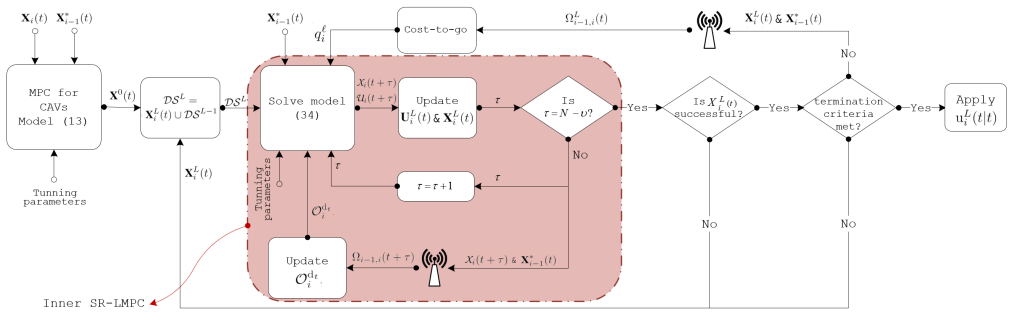
The central object is SR-LMPC, which nests a short-horizon iterative LMPC inside a nominal outer-loop MPC. It maintains a dynamic sampled safe set $D^{SL}$ of previously successful trajectories, a cost-to-go $q$ that now includes the packet-delivery-time cost $\omega_{i-1,i}$, and a terminal-state selection variable $\zeta$ that is relaxed from binary to continuous via the constraint $\zeta(1-\zeta)=0$, turning a mixed-integer nonlinear program into a nonlinear program. The data-driven channel prediction enters as a decision-dependent cost and as a time-varying dead-zone constraint $O^{dt}_i$, so the optimizer can trade following distance and control effort against expected communication quality.
What would settle it
Compare SR-LMPC against a nominal MPC on a real V2V trace from a bridge overpass, using the measured packet delivery rate as the oracle: if prediction errors are large enough, SR-LMPC should enter the dead zone and its control cost should match or exceed the baseline, contradicting the claimed improvement.
Extended reading notes
Core claim
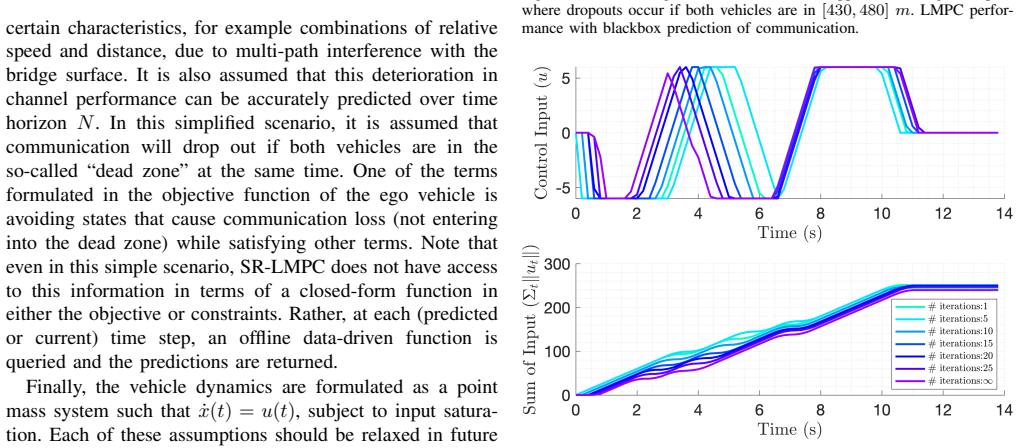
The central claim is that a two-layer controller, called SR-LMPC, converges to an optimal strategy over both model-driven and data-driven decision variables, and that this lets a connected autonomous vehicle choose a motion plan that improves the wireless channel. In the leader-follower scenario, the follower uses predictions of packet delivery time as the data-driven variable inside the cost-to-go and a dynamic state constraint, so it learns to brake before the bridge overpass where communication would drop. The simulation reports that the learning controller avoids input saturation and saves control cost compared with a nominal MPC that does not use channel prediction.
Load-bearing premise
The controller's advantage collapses if the black-box predictor cannot accurately forecast wireless channel quality over the time horizon $N$, an assumption the paper states explicitly in Section V.
Editorial extensions
If this is right
- A following vehicle can learn to decelerate before a predicted communication dropout, preserving packet delivery and reducing total control effort relative to a controller blind to channel forecasts.
- The recursive safe-set construction carries over from standard LMPC: each successful inner iteration adds trajectories to the dynamic safe set, keeping the problem recursively feasible and the iteration cost nonincreasing.
- Shortening the inner horizon from $N$ to $\nu$ while iterating more frequently explores the solution space with greater coverage, reducing the number of outer iterations needed to converge.
- The MINLP formulation can be rewritten as an NLP with the same exponential worst-case complexity $O(2^{LN})$, making the method more tractable to solve.
- The formulation extends to other dynamic-environment tasks such as autonomous intersection management, where obstacles or constraints evolve over time.
Reading between the lines
- If the black-box channel predictor is imperfect, the benefit may shrink or vanish; a natural extension is to wrap the LMPC in robust or stochastic constraints that use prediction uncertainty rather than point estimates.
- The same outer/inner architecture applies to any state-dependent unknown cost, such as traffic-signal timing, pedestrian intent, or energy prices, provided a predictor can be queried along a candidate trajectory.
- The binary-relaxation trick via $\zeta(1-\zeta)=0$ could be applied to other learning-based MPC formulations that select terminal states from a sampled set, potentially giving a general recipe for converting MINLP selection layers into NLP form.
- A direct experimental test would use a recorded V2V channel trace from a real overpass and compare SR-LMPC's closed-loop cost against a clairvoyant MPC with perfect channel knowledge.
Signed reviews
Editorial analysis
A structured set of objections, weighed in public.
Referee Report
Summary. The manuscript proposes an extension of Learning Model Predictive Control (LMPC), called SR-LMPC, for connected autonomous vehicle platooning. The main idea is to couple a nominal outer-loop trajectory with an inner-loop LMPC that selects terminal states from a stored safe set, while also treating the predicted quality of the wireless communication channel as a data-driven decision variable. The authors claim that the resulting scheme converges to an optimal strategy over both model-driven and data-driven variables, and they support this with a qualitative simulation of a leader-follower pair approaching a bridge overpass with a communication dead zone.
Significance. The problem addressed is timely: using predicted wireless channel quality as a decision variable in motion planning could let connected vehicles avoid communication dead zones and improve safety. The two-loop architecture is clearly described, and the computational-complexity discussion is useful. However, the central technical claims are not supported. The proposed relaxation of the mixed-integer problem is not equivalent to the original problem, the communication-aware cost-to-go contains an algebraic error, and no convergence proof is supplied for the modified scheme. If the equivalence and convergence were established, this would be a meaningful contribution to CAV control under imperfect communication; as written, the paper does not provide the needed correctness arguments.
major comments (5)
- [Section IV-C, Eq. (34f)] The claim that the NLP relaxation is equivalent to the original MINLP is false. With L=2 and N_i(t)=0, setting ζ_0(0)=ζ_1(0)=0.5 satisfies (34d)-(34g), so the terminal state in (34d) is a convex combination of two stored safe states, which is generally not an element of the dynamic safe set DSL and on which the LMPC sampled-safe-set argument does not apply. Constraint (34f) couples only indices within the same stored trajectory l and imposes no restriction across different l; when N_i(t)>0, fractional assignments at the maximal time index across different l remain feasible. The solver therefore solves a different, relaxed problem, and the claimed convergence to an optimal strategy over model- and data-driven variables is unsupported.
- [Section IV-C, Eq. (34f)] Even under a binary interpretation, the direction of the monotonicity constraint is incorrect. If ζ_l(η)=1 for some η<N_i(t), then for any η'>η the constraint forces ζ_l(η')=1, which together with the sum constraint (34e) makes every positive selection except the final index infeasible. Thus the feasible set of the relaxation is not the binary feasible set of (21a)-(21c). The authors need either a correct integrality-preserving relaxation with a proof of equivalence or an explicit statement of which relaxed problem is actually being solved.
- [Section IV-B, Eq. (31)] The algebraic simplification in Eq. (31) is incorrect. Substituting the recursive definition into the claimed closed form yields, for j>k, a coefficient of ω_{i-1,i}(j) equal to α^{j-k-1}(α^2-α+1), not α^{j-k} as claimed. Consequently the reformulated cost-to-go is not the discounted communication cost plus stage cost, and the subsequent discussion of the communication-aware objective is based on an invalid formula.
- [Section IV and Algorithm 1] No proof is provided that the proposed SR-LMPC converges to an optimal strategy over both model-driven and data-driven variables. The formal properties cited in Section II-C belong to the original LMPC of [21] with a static environment and an infinite-horizon setting; the modifications made here, including the dynamic-environment constraint (32), the shrinking horizon N_i(t), and the inner/outer-loop receding-horizon structure, break those assumptions, and no new theorem, invariant, or Lyapunov-style argument is established for the modified algorithm.
- [Section V] The simulation section rests on a load-bearing assumption that is stated only informally: 'it is assumed that this deterioration in channel performance can be accurately predicted over time horizon N.' If the black-box predictor is inaccurate, the controller cannot avoid the dead zone and the central benefit of the method disappears. The paper provides no robustness analysis, no sensitivity study with respect to prediction error, and only a qualitative description of a single idealized scenario; no numerical performance metrics or baseline comparisons are reported.
minor comments (4)
- [Section IV-A, Eq. (20)] The constraint set in the sentence following Eq. (20) contains a typo: 'k∈{t+τ,...,t+τ−ν}' should presumably be 'k∈{t+τ,...,t+τ+ν}'.
- [Section IV-B, Eqs. (28)-(31)] The notation for the communication horizon Ni(t) is used inconsistently: sometimes it is a length in the objective sum, and sometimes it is used as the upper index in the cost-to-go and terminal constraint, which makes the role of the stale portion of the leader trajectory unclear.
- [Section IV-C, Eq. (34)] The statement that constraint (34f) 'limits them to be just one or zero' is not supported by the displayed inequality; the authors should either correct the constraint or revise this sentence to describe the actual feasible set.
- [Section V and Figures 3-4] The discussion of the simulation results is qualitative; the text refers to figures but provides no numerical values for headway, control effort, packet loss, or convergence iteration counts, so the claimed improvements cannot be assessed quantitatively.
Circularity Check
No circularity: SR-LMPC builds on the external LMPC framework of Rosolia and Borrelli and treats the communication-channel predictor as a given black-box input.
full rationale
The paper's derivation chain is not circular. The base LMPC construction (sampled safe set, iteration cost, recursive feasibility, nonincreasing cost) is explicitly imported from the independent prior work of Rosolia and Borrelli [21], as stated in Section II: 'This section is based on the original work of [21]' and 'It can be shown [21] that ... the LMPC formulation is recursively feasible.' The paper's own contributions are presented as modifications to that external framework: dynamic-environment constraints, a communication-delay term in the cost-to-go, and a MINLP-to-NLP relaxation in Section IV-C. The wireless-channel predictor is treated as an external black box rather than fitted to the target outcome; Section V says 'it is assumed that this deterioration in channel performance can be accurately predicted over time horizon N,' which is a load-bearing accuracy assumption but not a fitted parameter or a definitional equivalence. The self-citations [26], [28], and [29] are used only for path-planning initialization and for examples of other application domains; they do not carry the optimality or convergence argument. Therefore, no prediction reduces by construction to its inputs. Possible mathematical-validity concerns, such as whether constraints (34f)-(34g) really enforce integrality or whether the algebra in Eq. (31) is correct, are correctness issues rather than circularity and do not affect this score.
Assumptions & free parameters
free parameters (3)
- Cost weights P1_i, P2_i, P3_i =
not specified
- Discount factor alpha =
not specified
- Dead zone boundaries =
435 m to 480 m
assumptions (4)
- domain assumption Existence of a feasible initial trajectory
- domain assumption Preceding vehicle trajectory is known over the horizon
- domain assumption Accurate prediction of communication channel over horizon N
- standard math LMPC recursive feasibility and nonincreasing cost from [21]
Cite this review
Pith. "Pith review of Learning Model Predictive Control for Connected Autonomous Vehicles." pith.science (2026). https://pith.science/paper/ULMUNEHA
@misc{pith2026190802879,
  author       = {Pith},
  title        = {Pith review of: Learning Model Predictive Control for Connected Autonomous Vehicles},
  year         = {2026},
  howpublished = {\url{https://pith.science/paper/ULMUNEHA}},
  note         = {Machine review of arXiv:1908.02879}
}
read the original abstract
A Learning Model Predictive Controller (LMPC) is presented and tailored to platooning and Connected Autonomous Vehicles (CAVs) applications. The proposed controller builds on previous work on nonlinear LMPC, adapting its architecture and extending its capability to (a) handle dynamic environments and (b) account for data-driven decision variables that derive from an unknown or unknowable function. The paper presents the control design approach, and shows how to recursively construct an outer loop candidate trajectory and an inner iterative LMPC controller that converges to an optimal strategy over both model-driven and data-driven variables. Simulation results show the effectiveness of the proposed control logic.
Figures


Figures from the paper (1 more)
Reference graph
Works this paper leans on
-
[21]
Learning model predictive control for iterative tasks. a data-driven control framework,
U. Rosolia and F. Borrelli, “Learning model predictive control for iterative tasks. a data-driven control framework,” IEEE Transactions on Automatic Control , vol. 63, no. 7, pp. 1883–1896, 2018
work page 2018
-
[1]
Distributed event-triggered coordination for average consensus on weight-balanced digraphs,
C. Nowzari and J. Cort ´es, “Distributed event-triggered coordination for average consensus on weight-balanced digraphs,” Automatica, vol. 68, pp. 237–244, 2016
work page 2016
-
[2]
Distributed event-triggered control for multi-agent systems,
D. V . Dimarogonas, E. Frazzoli, and K. H. Johansson, “Distributed event-triggered control for multi-agent systems,” IEEE Transactions on Automatic Control , vol. 57, no. 5, pp. 1291–1297, 2012
work page 2012
-
[3]
L. Wang, A. D. Ames, and M. Egerstedt, “Multi-objective composi- tions for collision-free connectivity maintenance in teams of mobile robots,” in Decision and Control (CDC), 2016 IEEE 55th Conference on. IEEE, 2016, pp. 2659–2664
work page 2016
-
[4]
Safety barrier certificates for heterogeneous multi-robot systems,
L. Wang, A. Ames, and M. Egerstedt, “Safety barrier certificates for heterogeneous multi-robot systems,” in American Control Conference (ACC), 2016. IEEE, 2016, pp. 5213–5218
work page 2016
-
[5]
L.-h. Luo, H. Liu, P. Li, and H. Wang, “Model predictive control for adaptive cruise control with multi-objectives: comfort, fuel-economy, safety and car-following,” Journal of Zhejiang University SCIENCE A, vol. 11, no. 3, pp. 191–201, 2010
work page 2010
-
[6]
Adaptive cruise control for a smart car: A comparison benchmark for mpc-pwa control methods,
D. Corona and B. De Schutter, “Adaptive cruise control for a smart car: A comparison benchmark for mpc-pwa control methods,” IEEE Transactions on Control Systems Technology , vol. 16, no. 2, pp. 365– 372, 2008
work page 2008
-
[7]
Smart cars on smart roads: problems of control,
P. Varaiya, “Smart cars on smart roads: problems of control,” IEEE Transactions on automatic control , vol. 38, no. 2, pp. 195–207, 1993
work page 1993
Show all 33 references
-
[8]
Vehicle platoon control system,
A. Iihoshi, S. Kobayashi, and Y . Furukawa, “Vehicle platoon control system,” Feb. 29 2000, uS Patent 6,032,097
2000
-
[9]
Longitu- dinal vehicle controller design for ivhs systems,
J. Hedrick, D. McMahon, V . Narendran, and D. Swaroop, “Longitu- dinal vehicle controller design for ivhs systems,” in American Control Conference, 1991. IEEE, 1991, pp. 3107–3112
1991
-
[10]
Vehicle control algorithms for cooperative driving with automated vehicles and intervehicle communications,
S. Kato, S. Tsugawa, K. Tokuda, T. Matsui, and H. Fujii, “Vehicle control algorithms for cooperative driving with automated vehicles and intervehicle communications,” IEEE Transactions on Intelligent Transportation Systems, vol. 3, no. 3, pp. 155–161, 2002
2002
-
[11]
Nonlinear mpc for emission efficient cooperative adaptive cruise control,
R. Schmied, H. Waschl, R. Quirynen, M. Diehl, and L. del Re, “Nonlinear mpc for emission efficient cooperative adaptive cruise control,” IF AC-PapersOnLine, vol. 48, no. 23, pp. 160–165, 2015
2015
-
[12]
A model predictive cooperative adaptive cruise control approach,
T. Stanger and L. del Re, “A model predictive cooperative adaptive cruise control approach,” in 2013 American Control Conference . IEEE, 2013, pp. 1374–1379
2013
-
[13]
Mpc based collaborative adaptive cruise control with rear end collision avoidance,
F. E. Sancar, B. Fidan, J. P. Huissoon, and S. L. Waslander, “Mpc based collaborative adaptive cruise control with rear end collision avoidance,” in 2014 IEEE Intelligent V ehicles Symposium Proceedings . IEEE, 2014, pp. 516–521
2014
-
[14]
On accurate measurement of link quality in multi-hop wireless mesh networks,
K.-H. Kim and K. G. Shin, “On accurate measurement of link quality in multi-hop wireless mesh networks,” in Proceedings of the 12th annual international conference on Mobile computing and networking . ACM, 2006, pp. 38–49
2006
-
[15]
A high- throughput path metric for multi-hop wireless routing,
D. S. De Couto, D. Aguayo, J. Bicket, and R. Morris, “A high- throughput path metric for multi-hop wireless routing,” Wireless net- works, vol. 11, no. 4, pp. 419–434, 2005
2005
-
[16]
Col- lection tree protocol,
O. Gnawali, R. Fonseca, K. Jamieson, D. Moss, and P. Levis, “Col- lection tree protocol,” in Proceedings of the 7th ACM conference on embedded networked sensor systems . ACM, 2009, pp. 1–14
2009
-
[17]
Pattern matching based link quality prediction in wireless mobile ad hoc networks,
K. Farkas, T. Hossmann, L. Ruf, and B. Plattner, “Pattern matching based link quality prediction in wireless mobile ad hoc networks,” in Proceedings of the 9th ACM international symposium on Modeling analysis and simulation of wireless and mobile systems . ACM, 2006, pp. 239–246
2006
-
[18]
Foresee (4c): Wireless link prediction using link features,
T. Liu and A. E. Cerpa, “Foresee (4c): Wireless link prediction using link features,” in Information Processing in Sensor Networks (IPSN), 2011 10th International Conference on . IEEE, 2011, pp. 294–305
2011
-
[19]
The triangle metric: Fast link quality estimation for mobile wireless sensor networks,
C. A. Boano, M. Zuniga, T. V oigt, A. Willig, and K. R ¨omer, “The triangle metric: Fast link quality estimation for mobile wireless sensor networks,” in International Conference on Computer Communication Networks, 2010, Zurich, Switzerland , 2010
2010
-
[20]
Bayesian wireless channel prediction for safety-critical connected autonomous vehicles
M. Elnaggar, K. Whitehouse, and C. H. Fleming, “Bayesian wireless channel prediction for safety-critical connected autonomous vehicles.”
-
[22]
Repetitive learning model predictive control: An autonomous racing example,
M. Brunner, U. Rosolia, J. Gonzales, and F. Borrelli, “Repetitive learning model predictive control: An autonomous racing example,” in 2017 IEEE 56th Annual Conference on Decision and Control (CDC) . IEEE, 2017, pp. 2545–2550
2017
-
[23]
Robust learning model pre- dictive control for iterative tasks: Learning from experience,
U. Rosolia, X. Zhang, and F. Borrelli, “Robust learning model pre- dictive control for iterative tasks: Learning from experience,” in 2017 IEEE 56th Annual Conference on Decision and Control (CDC) . IEEE, 2017, pp. 1157–1162
2017
-
[24]
Safe adaptive cruise control with road grade preview and v2v communica- tion,
R. Firoozi, S. Nazari, J. Guanetti, R. O’Gorman, and F. Borrelli, “Safe adaptive cruise control with road grade preview and v2v communica- tion,” arXiv preprint arXiv:1810.09000 , 2018
2018 arXiv
-
[25]
Learning model predictive control for iterative tasks: A computationally efficient approach for linear system,
U. Rosolia and F. Borrelli, “Learning model predictive control for iterative tasks: A computationally efficient approach for linear system,” IF AC-PapersOnLine, vol. 50, no. 1, pp. 3142–3147, 2017
2017
-
[26]
An exact geometry–based algorithm for path planning,
H. Jafarzadeh and C. H. Fleming, “An exact geometry–based algorithm for path planning,” International Journal of Applied Mathematics and Computer Science , vol. 28, no. 3, pp. 493–504, 2018
2018
-
[27]
An extension of karmarkar’s projective algorithm for convex quadratic programming,
Y . Ye and E. Tse, “An extension of karmarkar’s projective algorithm for convex quadratic programming,” Mathematical programming, vol. 44, no. 1-3, pp. 157–179, 1989
1989
-
[28]
A platoon-based intersection man- agement system for autonomous vehicles,
M. Bashiri and C. H. Fleming, “A platoon-based intersection man- agement system for autonomous vehicles,” in 2017 IEEE Intelligent V ehicles Symposium (IV). IEEE, 2017, pp. 667–672
2017
-
[29]
Paim: Platoon-based autonomous intersection management,
M. Bashiri, H. Jafarzadeh, and C. H. Fleming, “Paim: Platoon-based autonomous intersection management,” in 2018 21st International Conference on Intelligent Transportation Systems (ITSC). IEEE, 2018, pp. 374–380
2018
-
[30]
Directional analysis of multipath propagation in vehicle-2-vehicle channels,
C. Schneider, M. K ¨aske, G. Sommerkorn, R. S. Thom ¨a, A. Roivainen, J. Meinil¨a, and V . Tervo, “Directional analysis of multipath propagation in vehicle-2-vehicle channels,” in 2016 10th European Conference on Antennas and Propagation (EuCAP) . IEEE, 2016, pp. 1–5
2016
-
[31]
A roadside scattering model for the vehicle-to-vehicle communication channel,
L. Cheng, D. D. Stancil, and F. Bai, “A roadside scattering model for the vehicle-to-vehicle communication channel,” IEEE Journal on Selected Areas in Communications , vol. 31, no. 9, pp. 449–459, 2013
2013
-
[32]
Vehicle Safety Communications Project - Final Report,
D. O. T. Hs, “Vehicle Safety Communications Project - Final Report,” Communications, no. April, p. 44, 2006
2006
-
[33]
V12. 1: Users manual for cplex,
I. I. CPLEX, “V12. 1: Users manual for cplex,” International Business Machines Corporation, vol. 46, no. 53, p. 157, 2009
2009
Reviewed August 14, 2026 · model on record in the stance chip above.
Discussion (0). Continue with ORCID to comment.