Quantum Simulation of Gauge Theories for Particle and Nuclear Physics
Pith reviewed 2026-05-21 06:31 UTC · model grok-4.3
The pith
Quantum simulation provides polynomially efficient algorithms for lattice gauge theory problems that scale exponentially on classical computers.
A machine-rendered reading of the paper's core claim, the machinery that carries it, and where it could break.
Core claim
The author establishes that quantum simulation, enabled by quantum-computing algorithms and hardware, supplies polynomially efficient methods for lattice gauge theories and thereby overcomes the exponential scaling barrier that limits classical lattice field theory when addressing dense matter and dynamical phenomena in particle and nuclear physics.
What carries the argument
Quantum algorithms that simulate the real-time evolution and observables of lattice gauge theories, replacing classical exponential resource costs with polynomial scaling through quantum operations.
If this is right
- Dense nuclear matter and finite-density QCD become computationally accessible without exponential cost blow-up.
- Real-time dynamical processes and non-equilibrium gauge-theory evolution can be simulated directly.
- Co-design between quantum hardware and lattice-gauge algorithms accelerates progress toward useful system sizes.
- New classes of hadronic reactions and decays that involve strong time dependence fall within reach.
Where Pith is reading between the lines
- Similar polynomial scaling advantages might transfer to gauge-theory simulations in condensed-matter systems that share the same local symmetry structure.
- Hybrid classical-quantum workflows could serve as stepping stones while full fault-tolerant quantum hardware is still developing.
- Success on gauge theories could encourage analogous quantum approaches for other exponentially hard problems in high-energy physics such as real-time scattering.
Load-bearing premise
That continued work on algorithms, error control, and hardware will reach the maturity needed for practical quantum advantage on lattice gauge theory problems.
What would settle it
A controlled demonstration in which a quantum device computes a gauge-theory observable for a lattice size where any classical algorithm requires resources that grow exponentially beyond the capacity of existing supercomputers.
Figures


read the original abstract
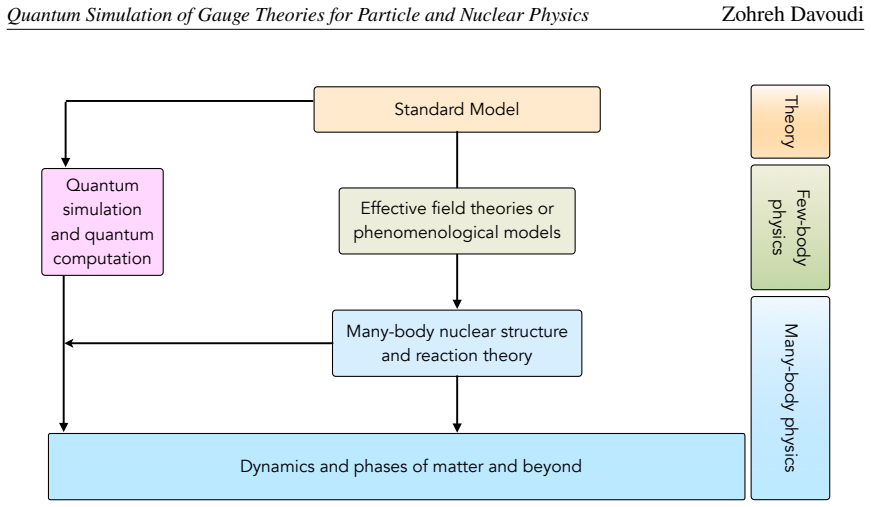
Lattice field theory, along with its algorithmic and hardware ecosystems, has been at the forefront of computational particle and nuclear physics. It continues to deliver impressive results on the hadronic spectrum, structure, decays, and reactions. Yet, this vigorous campaign has fallen short in addressing a range of problems involving dense matter and general dynamical phenomena. The reason is that such problems require an exponential scaling of computing time and space in system size. Quantum simulation, enabled by quantum-computing algorithms and hardware technology, promises a way forward by offering several polynomially efficient algorithms compared with their inefficient classical counterparts. Lattice gauge theorists have engaged in a multi-pronged program to leverage such new possibilities, and have steadily advanced the state of theory, algorithm, and hardware implementations and co-design. In this talk, I motivate the quantum-computational lattice-field-theory program; introduce the questions such a program is expected to address and the strategies it involves; report on recent progress; and end with a note on challenges and opportunities ahead.
Editorial analysis
A structured set of objections, weighed in public.
Referee Report
Summary. The manuscript is a conference talk that motivates the quantum-computational lattice-field-theory program for particle and nuclear physics. It notes the successes of classical lattice field theory while identifying its exponential scaling limitations for dense matter and general dynamical phenomena, and positions quantum simulation as offering polynomially efficient alternatives drawn from the broader literature. The talk introduces the questions and strategies of the program, reports on recent progress across theory, algorithms, and hardware co-design, and closes with challenges and opportunities.
Significance. If the multi-pronged program described matures, it could enable simulations of regimes currently intractable on classical hardware, such as dense matter and real-time dynamics. The manuscript provides a clear high-level roadmap and correctly credits collaborative advances, but its significance as a standalone contribution is limited because it presents no new derivations, algorithms, benchmarks, or quantitative results.
major comments (1)
- Abstract: the central claim that quantum simulation supplies 'several polynomially efficient algorithms' for dense matter and dynamical phenomena is asserted without any concrete algorithm, complexity analysis, or reference to a specific result inside the manuscript, leaving the promise unsupported at the level of detail required to assess its load-bearing role for the overall motivation.
Simulated Author's Rebuttal
We thank the referee for their careful reading and constructive feedback on this conference talk manuscript. We address the single major comment below and have incorporated a revision to strengthen the abstract.
read point-by-point responses
-
Referee: Abstract: the central claim that quantum simulation supplies 'several polynomially efficient algorithms' for dense matter and dynamical phenomena is asserted without any concrete algorithm, complexity analysis, or reference to a specific result inside the manuscript, leaving the promise unsupported at the level of detail required to assess its load-bearing role for the overall motivation.
Authors: We agree that the abstract states the claim at a high level without an explicit pointer. The manuscript body introduces algorithmic strategies for lattice gauge theories and reports recent progress, including references to specific polynomial-time approaches in the literature for dense matter and real-time dynamics. To make the abstract self-contained and directly responsive to the referee's concern, we will add a brief parenthetical reference to one such established result. revision: yes
Circularity Check
No significant circularity; high-level overview without derivations
full rationale
The manuscript is a conference talk that motivates a research program in quantum simulation for lattice gauge theories. It states high-level promises drawn from the broader literature (e.g., polynomial efficiency of quantum algorithms versus exponential classical scaling) without presenting any new equations, derivations, fitted parameters, or technical results. No load-bearing steps reduce to self-definition, self-citation chains, or fitted inputs called predictions. The text is self-contained as an external motivation and progress report, with no internal derivation chain to inspect for circularity.
Axiom & Free-Parameter Ledger
Lean theorems connected to this paper
-
IndisputableMonolith/Cost/FunctionalEquation.leanwashburn_uniqueness_aczel unclear?
unclearRelation between the paper passage and the cited Recognition theorem.
Quantum simulation... polynomially efficient algorithms compared with their inefficient classical counterparts... Kogut–Susskind Hamiltonian... Trotterization... qubitization... resource estimates O(N_c^4 V T polylog...)
-
IndisputableMonolith/Foundation/RealityFromDistinction.leanreality_from_one_distinction unclear?
unclearRelation between the paper passage and the cited Recognition theorem.
Hamiltonian H = H_I + H_M + H_E + H_B... truncation... Gauss-law constraints... real-time dynamics
What do these tags mean?
- matches
- The paper's claim is directly supported by a theorem in the formal canon.
- supports
- The theorem supports part of the paper's argument, but the paper may add assumptions or extra steps.
- extends
- The paper goes beyond the formal theorem; the theorem is a base layer rather than the whole result.
- uses
- The paper appears to rely on the theorem as machinery.
- contradicts
- The paper's claim conflicts with a theorem or certificate in the canon.
- unclear
- Pith found a possible connection, but the passage is too broad, indirect, or ambiguous to say the theorem truly supports the claim.
Reference graph
Works this paper leans on
-
[1]
Davoudi et al., inSnowmass 2021, 9, 2022 [2209.10758]
Z. Davoudi et al., inSnowmass 2021, 9, 2022 [2209.10758]
- [2]
-
[3]
X. Ji,Phys. Rev. Lett.110(2013) 262002 [1305.1539]
work page internal anchor Pith review Pith/arXiv arXiv 2013
-
[4]
Holographic Derivation of Entanglement Entropy from AdS/CFT
S. Ryu and T. Takayanagi,Phys. Rev. Lett.96(2006) 181602 [hep-th/0603001]
work page internal anchor Pith review Pith/arXiv arXiv 2006
-
[5]
Building up spacetime with quantum entanglement,
M. Van Raamsdonk,Gen. Rel. Grav.42(2010) 2323 [1005.3035]
-
[6]
Topological entanglement entropy
A. Kitaev and J. Preskill,Phys. Rev. Lett.96(2006) 110404 [hep-th/0510092]
work page internal anchor Pith review Pith/arXiv arXiv 2006
- [7]
-
[8]
H. Li and F.D.M. Haldane,Phys. Rev. Lett.101(2008) 010504 [0805.0332]. 14 Quantum Simulation of Gauge Theories for Particle and Nuclear PhysicsZohreh Davoudi
work page internal anchor Pith review Pith/arXiv arXiv 2008
-
[9]
N. Mueller, T.V. Zache and R. Ott,Phys. Rev. Lett.129(2022) 011601 [2107.11416]
-
[10]
Z. Davoudi, C. Jarzynski, N. Mueller, G. Oruganti, C. Powers and N.Y. Halpern,Phys. Rev. Lett.133(2024) 250402 [2404.02965]
-
[11]
Feynman,International Journal of Theoretical Physics21(1982) 467
R.P. Feynman,International Journal of Theoretical Physics21(1982) 467
work page 1982
- [12]
-
[13]
Altman et al.,PRX Quantum2(2021) 017003 [1912.06938]
E. Altman et al.,PRX Quantum2(2021) 017003 [1912.06938]
-
[14]
Quantum Computing in the NISQ era and beyond
J. Preskill,Quantum2(2018) 79 [1801.00862]
work page internal anchor Pith review Pith/arXiv arXiv 2018
- [15]
- [16]
- [17]
-
[18]
M. Aidelsburger et al.,Phil. Trans. Roy. Soc. Lond. A380(2021) 20210064 [2106.03063]
-
[19]
E. Zohar,Phil. Trans. Roy. Soc. Lond. A380(2022) 20210069 [2106.04609]
-
[20]
J.C. Halimeh, M. Aidelsburger, F. Grusdt, P. Hauke and B. Yang,Nature Phys.21(2025) 25 [2310.12201]
- [21]
-
[22]
Quantum simulation of out-of-equilibrium dynamics in gauge theories
J.C. Halimeh, N. Mueller, J. Knolle, Z. Papić and Z. Davoudi,2509.03586
work page internal anchor Pith review Pith/arXiv arXiv
- [23]
-
[24]
A.N. Ciavarella, S. Hariprakash, J.C. Halimeh and C.W. Bauer,2508.00061
-
[25]
Tightening energy-based boson truncation bound using Monte Carlo-assisted methods
J. Yang, C.F. Kane and S. Jabeen,2604.24896
work page internal anchor Pith review Pith/arXiv arXiv
- [26]
-
[27]
Bauer et al.,PRX Quantum4(2023) 027001 [2204.03381]
C.W. Bauer et al.,PRX Quantum4(2023) 027001 [2204.03381]
- [28]
-
[29]
Simulating lattice gauge theories on a quantum computer
T. Byrnes and Y. Yamamoto,Phys. Rev. A73(2006) 022328 [quant-ph/0510027]
work page internal anchor Pith review Pith/arXiv arXiv 2006
-
[30]
Quantum Algorithms for Quantum Field Theories
S.P. Jordan, K.S.M. Lee and J. Preskill,Science336(2012) 1130 [1111.3633]
work page internal anchor Pith review Pith/arXiv arXiv 2012
- [31]
- [32]
- [33]
-
[34]
A. Ciavarella, N. Klco and M.J. Savage,Phys. Rev. D103(2021) 094501 [2101.10227]
- [35]
-
[36]
Z. Davoudi, A.F. Shaw and J.R. Stryker,Quantum7(2023) 1213 [2212.14030]
-
[37]
E.M. Murairi, M.J. Cervia, H. Kumar, P.F. Bedaque and A. Alexandru,Phys. Rev. D106 (2022) 094504 [2208.11789]
- [38]
-
[39]
H. Lamm, Y.-Y. Li, J. Shu, Y.-L. Wang and B. Xu,Phys. Rev. D110(2024) 054505 [2405.12890]
- [40]
- [41]
-
[42]
H. Froland, D.M. Grabowska and Z. Li,2512.22782. 15 Quantum Simulation of Gauge Theories for Particle and Nuclear PhysicsZohreh Davoudi
- [43]
- [44]
-
[45]
Real-time dynamics of lattice gauge theories with a few-qubit quantum computer
E.A. Martinez et al.,Nature534(2016) 516 [1605.04570]
work page internal anchor Pith review Pith/arXiv arXiv 2016
- [46]
- [47]
-
[48]
A.N. Ciavarella and C.W. Bauer,Phys. Rev. Lett.133(2024) 111901 [2402.10265]
-
[49]
A.N. Ciavarella, I.M. Burbano and C.W. Bauer,Phys. Rev. D112(2025) 054514 [2503.11888]
-
[50]
N. Mueller, T. Wang, O. Katz, Z. Davoudi and M. Cetina,Nature Commun.16(2025) 5492 [2408.00069]
-
[51]
J. Vodeb, J.-Y. Desaules, A. Hallam, A. Rava, G. Humar, D. Willsch et al.,Nature Phys.21 (2025) 386 [2406.14718]
- [52]
-
[53]
Cochran et al.,Nature642(2025) 315 [2409.17142]
T.A. Cochran et al.,Nature642(2025) 315 [2409.17142]
-
[54]
Gonzalez-Cuadra et al.,Nature642(2025) 321 [2410.16558]
D. Gonzalez-Cuadra et al.,Nature642(2025) 321 [2410.16558]
- [55]
- [56]
-
[57]
R.C. Farrell, M. Illa, A.N. Ciavarella and M.J. Savage,Phys. Rev. D109(2024) 114510 [2401.08044]
-
[58]
Z. Davoudi, C.-C. Hsieh and S.V. Kadam,Quantum8(2024) 1520 [2402.00840]
- [59]
- [60]
-
[61]
J. Schuhmacher, G.-X. Su, J.J. Osborne, A. Gandon, J.C. Halimeh and I. Tavernelli, 2505.20387
- [62]
-
[63]
R.C. Farrell, I.A. Chernyshev, S.J.M. Powell, N.A. Zemlevskiy, M. Illa and M.J. Savage, Phys. Rev. D107(2023) 054513 [2209.10781]
-
[64]
Chernyshev et al.,Nature Commun.17(2026) 1826 [2506.05757]
I.A. Chernyshev et al.,Nature Commun.17(2026) 1826 [2506.05757]
-
[65]
E.O. Rosanowski, A. Crippa, L. Funcke, P.V. Itaborai, K. Jansen and S. Singh,2509.20558
-
[66]
Than et al.,Nature Commun.16(2025) 10288 [2501.00579]
A.T. Than et al.,Nature Commun.16(2025) 10288 [2501.00579]
- [67]
-
[68]
Z. Davoudi, N.M. Linke and G. Pagano,Phys. Rev. Res.3(2021) 043072 [2104.09346]
- [69]
- [70]
- [71]
-
[72]
M. Illa, C.E.P. Robin and M.J. Savage,Phys. Rev. D110(2024) 014507 [2403.14537]
- [73]
-
[74]
D. González-Cuadra, T.V. Zache, J. Carrasco, B. Kraus and P. Zoller,Phys. Rev. Lett.129 (2022) 160501 [2203.15541]
-
[75]
Meth et al.,Nature Phys.21(2025) 570 [2310.12110]
M. Meth et al.,Nature Phys.21(2025) 570 [2310.12110]. 16
discussion (0)
Sign in with ORCID, Apple, or X to comment. Anyone can read and Pith papers without signing in.