REVIEW 1 major objections 1 cited by
Trapping 11,000 Atoms in a Tweezer Array Generated by a Single Metasurface
T0 review · 1 major / 0 minor · reviewed 2026-06-28 · grok-4.3
Pith's one-line read A single metasurface generates a tweezer array that traps 11,000 individual atoms.
desk verdict Metasurface gets to 11k atoms but the abstract gives no trap data or uniformity numbers to support the scale claim. read the letter →
The pith
A machine-rendered reading of the paper's core claim, the machinery that carries it, and where it could break.
The reading
What carries the argument
The single metasurface that generates the entire tweezer array without microscope objectives.
What would settle it
An experiment that finds far fewer than 11,000 stably trapped and individually addressable atoms, or that shows rapid atom loss from insufficient trap depth or nonuniformity, would disprove the central claim.
Extended reading notes
Core claim
We robustly trap 11,000 individual atoms in a tweezer array generated by a single metasurface approximately 2 cm in diameter, thereby enabling the available qubit resource to reach the tens-of-thousands scale for the first time among all quantum computation platforms. This advance is enabled by a single metasurface that generates the entire tweezer array without the need for microscope objectives, maximizing laser-power efficiency and providing a working distance of about 1.5 cm that allows placement outside the vacuum cell.
Load-bearing premise
The metasurface must produce traps with enough depth, uniformity, and stability to hold 11,000 atoms as separate, resolvable qubits without major loss or crosstalk.
Editorial extensions
If this is right
- The available qubit resource reaches the tens-of-thousands scale for the first time on any platform.
- Laser power is used more efficiently because microscope objectives are not required.
- The metasurface sits outside the vacuum cell, avoiding in-vacuum technical complications.
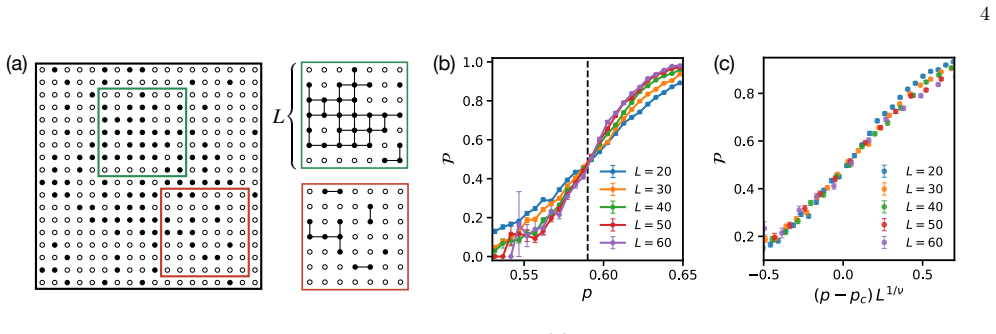
- The loaded atom array can be characterized with the statistical theory of percolation phase transitions.
- The work supplies a first step toward a quantum computer at the 10,000-qubit scale.
Reading between the lines
- Metasurfaces of larger diameter could increase the trapped atom count beyond 11,000.
- The trapping method could be paired with existing laser addressing and readout tools to run algorithms on the full array.
- The same metasurface principle might simplify large-scale trap arrays in other neutral-atom or trapped-ion systems.
- Direct measurements of trap uniformity across the whole 11,000-atom array would test whether the scaling holds under real operating conditions.
Editorial analysis
A structured set of objections, weighed in public.
Referee Report
Summary. The manuscript reports an experimental demonstration in which a single ~2 cm metasurface generates a tweezer array that traps 11,000 individual atoms. The work emphasizes the metasurface's efficiency, large working distance (~1.5 cm), and placement outside the vacuum cell, and applies percolation theory to characterize the randomly loaded array, claiming this advances neutral-atom quantum computing toward the 10,000-qubit scale.
Significance. If the trapping performance is quantitatively verified, the result would represent a substantial increase in the number of available atomic qubits compared with existing platforms, enabled by a compact, high-efficiency optical element that avoids in-vacuum optics.
major comments (1)
- Abstract: the central claim of robustly trapping 11,000 individual atoms is asserted without accompanying trap-depth measurements, atom-number histograms, loss-rate data, or error analysis. These quantities are required to substantiate that the metasurface produces traps of sufficient depth, uniformity, and stability for the stated scale.
Simulated Author's Rebuttal
We thank the referee for the careful review and constructive comment. We address the major comment below.
read point-by-point responses
-
Referee: Abstract: the central claim of robustly trapping 11,000 individual atoms is asserted without accompanying trap-depth measurements, atom-number histograms, loss-rate data, or error analysis. These quantities are required to substantiate that the metasurface produces traps of sufficient depth, uniformity, and stability for the stated scale.
Authors: The main text provides the requested supporting data: trap depths are characterized via fluorescence and power-dependent measurements (Section III), atom-number histograms appear in Figure 2 together with the percolation analysis, loss rates are quantified in Section IV, and error analysis is included in the atom-count statistics. The abstract summarizes these results concisely, as is conventional. To directly address the concern, we will revise the abstract to explicitly reference that the trapping performance has been verified through these quantitative measurements. revision: yes
Circularity Check
No significant circularity; experimental result with no derivation chain
full rationale
The paper is an experimental demonstration of trapping 11,000 atoms in a metasurface-generated tweezer array. No derivation, fitting, or predictive equations are present. Percolation theory is invoked only for post-experiment statistical characterization of random site occupancy, a standard external tool that does not reduce to any paper-specific input by construction. No self-citations are load-bearing on the central empirical claim, and the work is self-contained against external benchmarks of atom trapping.
Assumptions & free parameters
assumptions (1)
- standard math Standard optical physics of metasurface beam shaping and atom-light interaction in optical tweezers
Cite this review
Pith. "Pith review of Trapping 11,000 Atoms in a Tweezer Array Generated by a Single Metasurface." pith.science (2026). https://pith.science/paper/UQG5QGTI
@misc{pith2026260602715,
  author       = {Pith},
  title        = {Pith review of: Trapping 11,000 Atoms in a Tweezer Array Generated by a Single Metasurface},
  year         = {2026},
  howpublished = {\url{https://pith.science/paper/UQG5QGTI}},
  note         = {Machine review of arXiv:2606.02715}
}
read the original abstract
The scalability of physical qubit numbers is a central challenge toward a universal fault-tolerant quantum computer. The inherent scalability of atom array quantum computers stems from the identical nature of atomic qubits, so the available qubit resource is primarily limited by the number of atoms that can be trapped and controlled. Here, we robustly trap 11,000 individual atoms in a tweezer array, thereby enabling the available qubit resource to reach the tens-of-thousands scale for the first time among all quantum computation platforms. This advance is enabled by a single metasurface, approximately 2 cm in diameter, that generates the entire tweezer array without the need for microscope objectives, thereby maximizing laser-power efficiency. The large aperture ensures a working distance of about 1.5 cm, allowing the metasurface to be placed outside the vacuum cell and avoiding the technical complications of in-vacuum operation. We further characterize the randomly loaded atom array using the statistical theory of percolation phase transitions. This work takes an important first step toward a quantum computer at the 10,000-qubit scale.
Figures


Forward citations
Cited by 1 Pith paper
-
Neutral Atom Quantum Computing: Principles, Routes, Progress, and Challenges
A broad review of neutral atom quantum computing covering principles, technical routes, 2000-2026 achievements, industry status, and bottlenecks.
Reference graph
Works this paper leans on
-
[1]
R. Babbush, R. King, S. Boixo, W. Huggins, T. Khattar, G. H. Low, J. R. McClean, T. O’Brien, and N. C. Ru- bin, The grand challenge of quantum applications, arXiv preprint arXiv:2511.09124 (2025)
-
[2]
M. E. Beverland, P. Murali, M. Troyer, K. M. Svore, T. Hoefler, V. Kliuchnikov, G. H. Low, M. Soeken, A. Sundaram, and A. Vaschillo, Assessing requirements to scale to practical quantum advantage, arXiv preprint arXiv:2211.07629 (2022)
work page Pith review arXiv 2022
-
[3]
H. J. Manetsch, G. Nomura, E. Bataille, X. Lv, K. H. Leung, and M. Endres, A tweezer array with 6,100 highly coherent atomic qubits, Nature647, 60 (2025)
2025
-
[4]
N.-C. Chiu, E. C. Trapp, J. Guo, M. H. Abobeih, L. M. Stewart, S. Hollerith, P. L. Stroganov, M. Kalinowski, A. A. Geim, S. J. Evered, S. H. Li, X. Lyu, L. M. Peters, D. Bluvstein, T. T. Wang, M. Greiner, V. Vuleti´ c, and M. D. Lukin, Continuous operation of a coherent 3, 000- qubit system, Nature646, 1075–1080 (2025)
2025
-
[5]
Lin, H.-S
R. Lin, H.-S. Zhong, Y. Li, Z.-R. Zhao, L.-T. Zheng, T.-R. Hu, H.-M. Wu, Z. Wu, W.-J. Ma, Y. Gao, Y.-K. Zhu, Z.-F. Su, W.-L. Ouyang, Y.-C. Zhang, J. Rui, M.- C. Chen, C.-Y. Lu, and J.-W. Pan, Ai-enabled parallel assembly of thousands of defect-free neutral atom arrays, Physical Review Letters135(2025)
2025
-
[6]
S. J. Evered, M. Xu, S. H. Li, A. A. Geim, J. P. B. Ataides, M. Kalinowski, D. Bluvstein, N. Maskara, C. Kokail, M. Greiner, V. Vuleti´ c, and M. D. Lukin, High-fidelity entangling gates and nonlocal circuits with neutral atoms, arXiv preprint arXiv:2604.25987 (2026)
work page Pith review arXiv 2026
-
[7]
J. A. Muniz, M. Stone, D. T. Stack, M. Jaffe, J. M. Kindem, L. Wadleigh, E. Zalys-Geller, X. Zhang, C.-A. Chen, M. A. Norcia, J. Epstein, E. Halperin, F. Hum- mel, T. Wilkason, M. Li, K. Barnes, P. Battaglino, T. C. Bohdanowicz, G. Booth, A. Brown, M. O. Brown, W. B. Cairncross, K. Cassella, R. Coxe, D. Crow, M. Feldkamp, C. Griger, A. Heinz, A. M. W. Jon...
2025
-
[8]
Peper, Y
M. Peper, Y. Li, D. Y. Knapp, M. Bileska, S. Ma, G. Liu, P. Peng, B. Zhang, S. P. Horvath, A. P. Burgers, and J. D. Thompson, Spectroscopy and modeling of 171Yb Rydberg states for high-fidelity two-qubit gates, Physical 6 Review X15(2025)
2025
Show all 27 references
-
[9]
S. J. Evered, D. Bluvstein, M. Kalinowski, S. Ebadi, T. Manovitz, H. Zhou, S. H. Li, A. A. Geim, T. T. Wang, N. Maskara, H. Levine, G. Semeghini, M. Greiner, V. Vuleti´ c, and M. D. Lukin, High-fidelity parallel entan- gling gates on a neutral-atom quantum computer, Nature 622...
2023
-
[10]
S. Ma, G. Liu, P. Peng, B. Zhang, S. Jandura, J. Claes, A. P. Burgers, G. Pupillo, S. Puri, and J. D. Thompson, High-fidelity gates and mid-circuit erasure conversion in an atomic qubit, Nature622, 279 (2023)
2023
-
[11]
Bluvstein, A
D. Bluvstein, A. A. Geim, S. H. Li, S. J. Evered, J. P. Bonilla Ataides, G. Baranes, A. Gu, T. Manovitz, M. Xu, M. Kalinowski, S. Majidy, C. Kokail, N. Maskara, E. C. Trapp, L. M. Stewart, S. Hollerith, H. Zhou, M. J. Gul- lans, S. F. Yelin, M. Greiner, V. Vuleti´ c, M. Cain, ...
2026
-
[12]
Bluvstein, S
D. Bluvstein, S. J. Evered, A. A. Geim, S. H. Li, H. Zhou, T. Manovitz, S. Ebadi, M. Cain, M. Kali- nowski, D. Hangleiter, J. P. Bonilla Ataides, N. Maskara, I. Cong, X. Gao, P. Sales Rodriguez, T. Karolyshyn, G. Semeghini, M. J. Gullans, M. Greiner, V. Vuleti´ c, and M. D. Lu...
2023
-
[13]
M. Cain, Q. Xu, R. King, L. R. Picard, H. Levine, M. En- dres, J. Preskill, H.-Y. Huang, and D. Bluvstein, Shor’s algorithm is possible with as few as 10,000 reconfigurable atomic qubits, arXiv preprint arXiv:2603.28627 (2026)
2026 arXiv
-
[14]
A. V. Kildishev, A. Boltasseva, and V. M. Shalaev, Pla- nar photonics with metasurfaces, Science339, 1232009 (2013)
2013
-
[15]
Khorasaninejad, W
M. Khorasaninejad, W. T. Chen, R. C. Devlin, J. Oh, A. Y. Zhu, and F. Capasso, Metalenses at visible wave- lengths: Diffraction-limited focusing and subwavelength resolution imaging, Science352, 1190 (2016)
2016
-
[16]
Holman, Y
A. Holman, Y. Xu, X. Sun, J. Wu, M. Wang, Z. Zhu, B. Seo, N. Yu, and S. Will, Trapping of single atoms in metasurface optical tweezer arrays, Nature649, 859 (2026)
2026
-
[17]
Y. Wang, Y. Liao, T. Zhang, Y. Tian, Y. Wu, W. Zhang, W. Zhang, Y. Huang, H. Zhai, W. Chen, X. Feng, and Z. Zhang, Direct generation of an array with 78400 opti- cal tweezers using a single metasurface, Chinese Physics Letters43, 010606 (2025)
2025
-
[18]
G. Chen, D. Zhao, Z. Wang, Z. Li, J. Zhang, L. Chen, Y. Zhang, X. Xu, A. Liu, C. Dong, G. Guo, K. Huang, and C. Zou, Multifunctional metalens for trapping and characterizing single atoms, Laser & Photonics Reviews 19(2024)
2024
-
[19]
D. Li, Q. Liao, B. Xu, T. Zentgraf, E. Narvaez Castaneda, Y. Zhou, K. Qin, Z. Xu, H. Shen, and L. Huang, In vac- uum metasurface for optical microtrap array, Optics Ex- press33, 51085 (2025)
2025
-
[20]
T.-W. Hsu, W. Zhu, T. Thiele, M. O. Brown, S. B. Papp, A. Agrawal, and C. A. Regal, Single-atom trapping in a metasurface-lens optical tweezer, PRX Quantum3, 030316 (2022)
2022
-
[21]
Huang, F
R. Huang, F. Zhou, X. Li, P. Xu, Y. Wang, and M. Zhan, Metasurface optical trap array for single atoms, Optics Express32, 21293 (2024)
2024
-
[22]
Stauffer and A
D. Stauffer and A. Aharony,Introduction to Percolation Theory, 2nd ed. (Taylor & Francis, London, 1994)
1994
-
[23]
R. M. Ziff, Spanning probability in 2D percolation, Phys- ical Review Letters69, 2670 (1992)
1992
-
[24]
Cardy,Scaling and Renormalization in Statistical Physics(Cambridge University Press, Cambridge, 1996)
J. Cardy,Scaling and Renormalization in Statistical Physics(Cambridge University Press, Cambridge, 1996)
1996
-
[25]
Stauffer, Scaling theory of percolation clusters, Physics Reports54, 1 (1979)
D. Stauffer, Scaling theory of percolation clusters, Physics Reports54, 1 (1979)
1979
-
[26]
M. B. Isichenko, Percolation, statistical topography, and transport in random media, Reviews of Modern Physics 64, 961 (1992)
1992
-
[27]
Zhang, X
T. Zhang, X. Li, H. Zhai, and L. Chen, An algorithm for fast assembling large-scale defect-free atom arrays, arXiv preprint arXiv:2604.08669 (2026)
2026 arXiv
Reviewed June 28, 2026 · model on record in the stance chip above.
Discussion (0). Sign in to comment.