REVIEW 4 major objections 4 minor 35 references
Monocular One-Shot Metric-Depth Alignment for RGB-Based Robot Grasping
T0 review · 4 major / 4 minor · reviewed 2026-08-15 · deepseek-v4-flash
Pith's one-line read The paper claims that a robot can recover metric depth from a single RGB image by applying a one-shot scale–rotation–shift correction to a monocular depth model's output, calibrated with sparse ground-truth depth points, and demonstrates…
desk verdict A practical one-shot linear alignment for RGB-only grasping that works in real robot trials, but it is closer to a reparameterized scale-shift fit than the 'rotation' framing suggests, and the evaluation protocol needs tightening before the one-shot claim is fully supported. read the letter →
The pith
A machine-rendered reading of the paper's core claim, the machinery that carries it, and where it could break.
The reading
What carries the argument
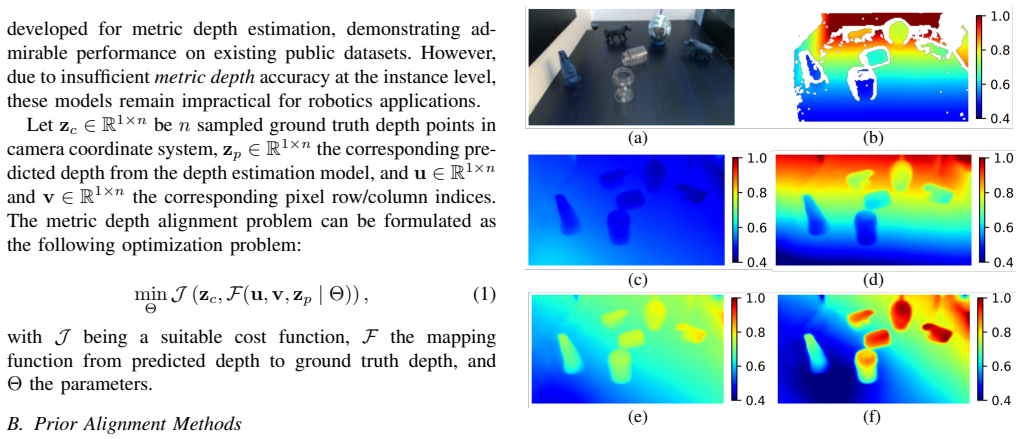
The load-bearing object is the scale–rotation–shift alignment map $F(u,v,z_p|\Theta)$, the depth component of a Euclidean transform applied to the point cloud unprojected from the depth model's depth map under a learned pseudo-intrinsic. Concretely, $F = s(-x_p \sin\phi + y_p \sin\theta\cos\phi + z_p \cos\theta\cos\phi) + T_3$, with $x_p,y_p$ obtained from pixel coordinates and pseudo-intrinsics. Solving the optimization over $\Theta$ fits the transform to sparse ground-truth depth points once; the same $\hat\Theta$ then converts every later depth-model output into metric depth. Min-max normalization of the predicted depth precedes the fit, because the raw depth range fluctuates with scene content even when camera and background are fixed.
What would settle it
Measure the aligned depth error on object masks across many scene variations using a single calibration, and compare with re-fitting the transform per frame; a large gap would mean the one-shot transform does not transfer to novel objects.
Extended reading notes
Core claim
The central discovery is that the affine-invariant depth produced by a modern monocular depth estimator can be promoted to metric depth by a global transform that accounts for scale, rotation of the predicted point cloud, and shift—not just scale and shift. After min-max normalizing the raw depth map, the method solves a nonlinear least-squares problem over $\Theta=[s,\theta,\phi,T_3,c_x^p,c_y^p,f_p]^\top$ to minimize $\sum_k \|z_{c,k} - F(u_k,v_k,z_{p,k}|\Theta)\|^2$, where $F$ is the depth component of an $s R X_p + T$ rigid alignment under a pinhole model. With one calibration image and roughly tens to hundreds of ground-truth depth samples, the fitted transform stays valid across later images, giving $\delta_{1.10}>0.85$ and MAE below 0.03 meters on object masks. The method also extends to transparent objects after fine-tuning the underlying depth model on transparent-object datasets.
Load-bearing premise
The method assumes that a transform fitted once to sparse points on the fixed background still corrects the depth model's output on objects that appear later, even though the model's raw depth values shift with scene content.
Editorial extensions
If this is right
- Fixed-camera industrial settings such as bin picking can use a single RGB camera and a one-time calibration to obtain depth accurate enough for grasping.
- The alignment fits any monocular depth model, so swapping the underlying model only changes the fitted parameters, not the pipeline.
- Fine-tuning the depth model on transparent-object data lets the one-shot calibration extend to transparent objects, which structured-light and time-of-flight sensors fail on.
- Calibration takes a few seconds and runtime alignment takes under 10 milliseconds per frame, so the approach is compatible with real-time control loops.
- Accuracy saturates at a few hundred ground-truth samples, making calibration data collection inexpensive.
Reading between the lines
- A natural stress test is to sample calibration points from objects rather than the fixed background; if the fitted transform changes sharply, the one-shot transfer is relying on the background being a good proxy for object depth errors.
- Extending the one-shot fit to a few calibration scenes should reduce sensitivity to scene-dependent depth fluctuations; the paper suggests this direction but does not quantify how many scenes are needed.
- Because the fitted parameters include pseudo-intrinsics, the rotation terms may be absorbing a systematic bias in the depth model's virtual camera rather than a physical scene rotation; isolating the dominant parameter could lead to cheaper calibration.
Signed reviews
Editorial analysis
A structured set of objections, weighed in public.
Referee Report
Summary. The paper proposes MOMA, a framework for recovering metric depth from a single RGB image by aligning the output of a monocular depth estimation model (MDEM) to sparse ground-truth depth points through a one-shot scale-shift-rotation alignment, instantiated as SSRA. The alignment parameters are fit on one calibration image and then applied to subsequent images in a fixed camera setup. The authors evaluate SSRA against global scale-shift alignment (GSSA), locally weighted linear regression (LWLR), and raw DAM output on opaque and transparent objects under multiple camera poses, report ablation studies on the number of calibration points, normalization, and MDEM choice, and present real-robot two-finger grasping and suction-based bin-picking experiments.
Significance. If the one-shot transfer claim holds, the contribution is practically valuable: it offers a simple, low-cost route to metric depth for fixed-camera robot manipulation without a continuously operating depth sensor. The method is straightforward, the paper includes real-robot experiments, and the authors make code and data available. The positive aspects are the clear formulation of the alignment problem, the explicit treatment of MDEM output fluctuation via normalization, and the demonstration that even a simple calibrated affine model can substantially improve raw MDEM depth. However, the evaluation protocol currently leaves the central transfer claim under-supported, and there are several concrete errors in the reported formulas and results that need correction before the claims can be accepted.
major comments (4)
- [§IV-C, §V-A, Table I] The one-shot transfer protocol is underspecified. Section IV-C states that calibration relies on a static portion of the scene (e.g., the table), while Section V-A says calibration uses "an RGB/D image" with "100 samples from the depth image" but does not state whether that image is disjoint from the 100 evaluation images or whether the samples lie only on the static background. Since the metrics in Table I are computed on object masks, the current description cannot rule out that the reported numbers partly reflect within-scene fitting rather than transfer to new scenes. Please specify the exact scene/object split and rerun Table I with a calibration image and calibration point set that are disjoint from the evaluation images, and report results for calibration points restricted to the static background versus points sampled over the full scene, to substantiate the one-shot generalization claim.
- [§IV-C, Eq. (12)] Equation (12) as printed is not a min-max normalization to a fixed range: it reads \hat z_p = (z_p - z_min)/(z_max - z_min) + z_min, which maps the data to [z_min, z_min+1] rather than [0,1]. This contradicts the stated purpose of stabilizing MDEM output fluctuations and the interpretation of the ablation in Table II. Please correct the equation (presumably removing the final + z_min) and verify that the implementation matches the corrected formula.
- [§V-E, Table IV] The text states that for the tote scenario "the δ1.05 score is above 0.85 and the mean absolute error (MAE) for the tote scenario is 0.0242," but Table IV reports SSRA in the tote scenario with δ1.05 = 0.5708, δ1.10 = 0.8547, and MAE = 0.0242. The sentence appears to conflate δ1.05 and δ1.10. Please correct the text to match the table.
- [§V-F, Table V] The 50-trial success rates in Table V are reported without confidence intervals or significance tests. For n=50, the standard error of a proportion is roughly 5-7 percentage points, so differences such as 82% vs 72% for opaque two-finger grasping and 86% vs 86% for suction grasping are not clearly distinguishable from sampling noise. Please report binomial confidence intervals or repeated-run statistics, and temper the claims that SSRA "beats" the baselines accordingly.
minor comments (4)
- [§V-A] The sentence "For GSSA, b=100 is used in the evaluation" appears to be a typo: the bandwidth b is a parameter of LWLR in Eq. (3), not of GSSA. Please correct.
- [§IV-B, Eq. (3)] In Eq. (3), the notation Z_p = [z_p,1]^T is not dimensionally consistent with the subsequent weighted least-squares expression; Z_p should be an n×2 design matrix with a column of ones. Please fix the notation.
- [§I, Abstract] The abstract says MOMA works "without additional data collection or model retraining," but Section V-E describes fine-tuning DAM on roughly 500K transparent-object images. Please clarify that the one-shot calibration applies to the target setup, while the optional transparent-object fine-tuning is a separate training stage.
- [§V-A] The phrase "using 100 samples from the depth image" is ambiguous about whether the samples are random, uniformly spaced, or selected from a particular scene region; please specify the sampling procedure.
Circularity Check
No circularity found: SSRA parameters are fit on one calibration image and applied to held-out evaluation images, so reported metrics are out-of-sample predictions.
full rationale
The derivation chain is self-contained. The alignment parameters are obtained by solving Eq. (6) on a sparse set of ground-truth depth samples from one RGB-D image; Section V-A states 'we first use an RGB/D image to compute alignment parameters Θ, using 100 samples from the depth image. The parameters Θ are used for the rest of the evaluations,' and the robot experiments calibrate with a single RGB-D image before running 50 trials with randomly placed objects. The evaluation metrics are computed on object masks, while the calibration samples are described as coming from the fixed portion of the scene (Section IV-C), so the evaluation targets are not the calibration inputs by construction. There are no load-bearing self-citations: the cited prior alignment methods (GSSA, LWLR) are external and used as baselines. The min-max normalization in Eq. (12) is a preprocessing choice, not a renamed prediction; even though the printed formula appears to add z_min back, which is a typo that should be corrected, this affects correctness rather than circularity. The claim that SSRA 'recovers' metric depth is a fitted mapping evaluated out-of-sample, which is a legitimate empirical prediction. The transparent-object evaluation uses pseudo-ground-truth obtained by substituting opaque replicas, an independent measurement procedure, not the MDEM output. No step in the paper reduces equationally to its own inputs.
Assumptions & free parameters
free parameters (3)
- SSRA alignment coefficients (effective: a, b, c, T3) =
not reported; fit per camera pose from about 100 ground-truth depth points
- LWLR Gaussian bandwidth b =
100
- LoRA rank and training hyperparameters for transparent-object fine-tuning =
rank 256, learning rate 5e-4, 20 epochs
assumptions (4)
- domain assumption MDEM output is affine-invariant depth, related to metric depth by an unknown scale and shift that a global alignment can fix.
- domain assumption A pinhole camera model with pseudo-intrinsics (cx_p, cy_p, fp) can describe the MDEM's depth map (Eq. 5).
- domain assumption A fixed portion of the scene, such as the table surface, remains visible and stable, and ground-truth depth points from it can be reused across trials.
- ad hoc to paper Min-max normalization of the predicted depth stabilizes MDEM output fluctuations across scenes.
Cite this review
Pith. "Pith review of Monocular One-Shot Metric-Depth Alignment for RGB-Based Robot Grasping." pith.science (2026). https://pith.science/paper/UT2BHSD4
@misc{pith2026250617110,
  author       = {Pith},
  title        = {Pith review of: Monocular One-Shot Metric-Depth Alignment for RGB-Based Robot Grasping},
  year         = {2026},
  howpublished = {\url{https://pith.science/paper/UT2BHSD4}},
  note         = {Machine review of arXiv:2506.17110}
}
read the original abstract
Accurate 6D object pose estimation is a prerequisite for successfully completing robotic prehensile and non-prehensile manipulation tasks. At present, 6D pose estimation for robotic manipulation generally relies on depth sensors based on, e.g., structured light, time-of-flight, and stereo-vision, which can be expensive, produce noisy output (as compared with RGB cameras), and fail to handle transparent objects. On the other hand, state-of-the-art monocular depth estimation models (MDEMs) provide only affine-invariant depths up to an unknown scale and shift. Metric MDEMs achieve some successful zero-shot results on public datasets, but fail to generalize. We propose a novel framework, Monocular One-shot Metric-depth Alignment (MOMA), to recover metric depth from a single RGB image, through a one-shot adaptation building on MDEM techniques. MOMA performs scale-rotation-shift alignments during camera calibration, guided by sparse ground-truth depth points, enabling accurate depth estimation without additional data collection or model retraining on the testing setup. MOMA supports fine-tuning the MDEM on transparent objects, demonstrating strong generalization capabilities. Real-world experiments on tabletop 2-finger grasping and suction-based bin-picking applications show MOMA achieves high success rates in diverse tasks, confirming its effectiveness.
Figures


Figures from the paper (5 more)


Reference graph
Works this paper leans on
-
[1]
Anygrasp: Robust and efficient grasp perception in spatial and temporal domains,
H.-S. Fang, C. Wang, H. Fang, M. Gou, J. Liu, H. Yan, W. Liu, Y . Xie, and C. Lu, “Anygrasp: Robust and efficient grasp perception in spatial and temporal domains,”IEEE Transactions on Robotics, 2023
2023
-
[2]
Suctionnet-1billion: A large- scale benchmark for suction grasping,
H. Cao, H.-S. Fang, W. Liu, and C. Lu, “Suctionnet-1billion: A large- scale benchmark for suction grasping,”IEEE Robotics and Automation Letters, vol. 6, no. 4, pp. 8718–8725, 2021
work page 2021
-
[3]
Contact- graspnet: Efficient 6-dof grasp generation in cluttered scenes,
M. Sundermeyer, A. Mousavian, R. Triebel, and D. Fox, “Contact- graspnet: Efficient 6-dof grasp generation in cluttered scenes,” in2021 IEEE International Conference on Robotics and Automation (ICRA). IEEE, 2021, pp. 13 438–13 444
2021
-
[4]
6-dof graspnet: Variational grasp generation for object manipulation,
A. Mousavian, C. Eppner, and D. Fox, “6-dof graspnet: Variational grasp generation for object manipulation,” inProceedings of the IEEE/CVF international conference on computer vision, 2019, pp. 2901–2910
work page 2019
-
[5]
Midas v3. 1–a model zoo for robust monocular relative depth estimation,
R. Birkl, D. Wofk, and M. M ¨uller, “Midas v3. 1–a model zoo for robust monocular relative depth estimation,”arXiv preprint arXiv:2307.14460, 2023
arXiv 2023
-
[6]
Learning to recover 3d scene shape from a single image,
W. Yin, J. Zhang, O. Wang, S. Niklaus, L. Mai, S. Chen, and C. Shen, “Learning to recover 3d scene shape from a single image,” inProceedings of the IEEE/CVF Conference on Computer Vision and Pattern Recognition, 2021, pp. 204–213
2021
-
[7]
Depth anything: Unleashing the power of large-scale unlabeled data,
L. Yang, B. Kang, Z. Huang, X. Xu, J. Feng, and H. Zhao, “Depth anything: Unleashing the power of large-scale unlabeled data,”ArXiv, vol. abs/2401.10891, 2024
arXiv 2024
-
[8]
Zoedepth: Zero-shot transfer by combining relative and metric depth,
S. F. Bhat, R. Birkl, D. Wofk, P. Wonka, and M. M ¨uller, “Zoedepth: Zero-shot transfer by combining relative and metric depth,”arXiv preprint arXiv:2302.12288, 2023
arXiv 2023
Show all 35 references
-
[9]
Adabins: Depth estimation using adaptive bins,
S. F. Bhat, I. Alhashim, and P. Wonka, “Adabins: Depth estimation using adaptive bins,” inProceedings of the IEEE/CVF conference on computer vision and pattern recognition, 2021, pp. 4009–4018
2021
-
[10]
Depth anything v2,
L. Yang, B. Kang, Z. Huang, Z. Zhao, X. Xu, J. Feng, and H. Zhao, “Depth anything v2,”arXiv preprint arXiv:2406.09414, 2024
2024 arXiv
-
[11]
Monoc- ular relative depth perception with web stereo data supervision,
K. Xian, C. Shen, Z. Cao, H. Lu, Y . Xiao, R. Li, and Z. Luo, “Monoc- ular relative depth perception with web stereo data supervision,” in Proceedings of the IEEE Conference on Computer Vision and Pattern Recognition, 2018, pp. 311–320
2018
-
[12]
Structure- guided ranking loss for single image depth prediction,
K. Xian, J. Zhang, O. Wang, L. Mai, Z. Lin, and Z. Cao, “Structure- guided ranking loss for single image depth prediction,” inProceedings of the IEEE/CVF Conference on Computer Vision and Pattern Recog- nition, 2020, pp. 611–620
2020
-
[13]
Oasis: A large-scale dataset for single image 3d in the wild,
W. Chen, S. Qian, D. Fan, N. Kojima, M. Hamilton, and J. Deng, “Oasis: A large-scale dataset for single image 3d in the wild,” in Proceedings of the IEEE/CVF Conference on Computer Vision and Pattern Recognition, 2020, pp. 679–688
2020
-
[14]
Single-image depth perception in the wild,
W. Chen, Z. Fu, D. Yang, and J. Deng, “Single-image depth perception in the wild,”Advances in neural information processing systems, vol. 29, 2016
2016
-
[15]
Metric3d: Towards zero-shot metric 3d prediction from a single image,
W. Yin, C. Zhang, H. Chen, Z. Cai, G. Yu, K. Wang, X. Chen, and C. Shen, “Metric3d: Towards zero-shot metric 3d prediction from a single image,” inProceedings of the IEEE/CVF International Conference on Computer Vision, 2023, pp. 9043–9053
2023
-
[16]
Vision meets robotics: The kitti dataset,
A. Geiger, P. Lenz, C. Stiller, and R. Urtasun, “Vision meets robotics: The kitti dataset,”The International Journal of Robotics Research, vol. 32, no. 11, pp. 1231–1237, 2013
2013
-
[17]
Indoor seg- mentation and support inference from rgbd images,
N. Silberman, D. Hoiem, P. Kohli, and R. Fergus, “Indoor seg- mentation and support inference from rgbd images,” inComputer Vision–ECCV 2012: 12th European Conference on Computer Vision, Florence, Italy, October 7-13, 2012, Proceedings, Part V 12. Springer, 2012, pp. 746–760
2012
-
[18]
Depth anything: Unleashing the power of large-scale unlabeled data,
L. Yang, B. Kang, Z. Huang, X. Xu, J. Feng, and H. Zhao, “Depth anything: Unleashing the power of large-scale unlabeled data,” in Proceedings of the IEEE/CVF Conference on Computer Vision and Pattern Recognition, 2024, pp. 10 371–10 381
2024
-
[19]
Graspnet-1billion: A large- scale benchmark for general object grasping,
H.-S. Fang, C. Wang, M. Gou, and C. Lu, “Graspnet-1billion: A large- scale benchmark for general object grasping,” inProceedings of the IEEE/CVF conference on computer vision and pattern recognition, 2020, pp. 11 444–11 453
2020
-
[20]
Clear grasp: 3d shape estimation of transparent objects for manipulation,
S. Sajjan, M. Moore, M. Pan, G. Nagaraja, J. Lee, A. Zeng, and S. Song, “Clear grasp: 3d shape estimation of transparent objects for manipulation,” in2020 IEEE international conference on robotics and automation (ICRA). IEEE, 2020, pp. 3634–3642
2020
-
[21]
Transcg: A large-scale real- world dataset for transparent object depth completion and a grasping baseline,
H. Fang, H.-S. Fang, S. Xu, and C. Lu, “Transcg: A large-scale real- world dataset for transparent object depth completion and a grasping baseline,”IEEE Robotics and Automation Letters, vol. 7, no. 3, pp. 7383–7390, 2022
2022
-
[22]
Asgrasp: Generalizable transparent object reconstruction and 6-dof grasp detection from rgb-d active stereo camera,
J. Shi, A. Yong, Y . Jin, D. Li, H. Niu, Z. Jin, and H. Wang, “Asgrasp: Generalizable transparent object reconstruction and 6-dof grasp detection from rgb-d active stereo camera,” in2024 IEEE International Conference on Robotics and Automation (ICRA). IEEE, 2024, pp. 5441–5447
2024
-
[23]
Monograspnet: 6-dof grasping with a single rgb image,
G. Zhai, D. Huang, S.-C. Wu, H. Jung, Y . Di, F. Manhardt, F. Tombari, N. Navab, and B. Busam, “Monograspnet: 6-dof grasping with a single rgb image,” in2023 IEEE International Conference on Robotics and Automation (ICRA). IEEE, 2023, pp. 1708–1714
2023
-
[24]
Graspnerf: Multiview-based 6-dof grasp detection for transparent and specular ob- jects using generalizable nerf,
Q. Dai, Y . Zhu, Y . Geng, C. Ruan, J. Zhang, and H. Wang, “Graspnerf: Multiview-based 6-dof grasp detection for transparent and specular ob- jects using generalizable nerf,” in2023 IEEE International Conference on Robotics and Automation (ICRA). IEEE, 2023, pp. 1757–1763
2023
-
[25]
Evo-nerf: Evolving nerf for sequen- tial robot grasping of transparent objects,
J. Kerr, L. Fu, H. Huang, Y . Avigal, M. Tancik, J. Ichnowski, A. Kanazawa, and K. Goldberg, “Evo-nerf: Evolving nerf for sequen- tial robot grasping of transparent objects,” in6th annual conference on robot learning, 2022
2022
-
[26]
Rgbgrasp: Image-based object grasping by capturing multiple views during robot arm movement with neural radiance fields,
C. Liu, K. Shi, K. Zhou, H. Wang, J. Zhang, and H. Dong, “Rgbgrasp: Image-based object grasping by capturing multiple views during robot arm movement with neural radiance fields,”IEEE Robotics and Automation Letters, 2024
2024
-
[27]
Towards robust monocular depth estimation: Mixing datasets for zero- shot cross-dataset transfer,
R. Ranftl, K. Lasinger, D. Hafner, K. Schindler, and V . Koltun, “Towards robust monocular depth estimation: Mixing datasets for zero- shot cross-dataset transfer,”IEEE transactions on pattern analysis and machine intelligence, vol. 44, no. 3, pp. 1623–1637, 2020
2020
-
[28]
Toward 3d scene reconstruction from locally scale-aligned monocular video depth,
G. Xu and F. Zhao, “Toward 3d scene reconstruction from locally scale-aligned monocular video depth,”JUSTC, vol. 54, no. 4, pp. 0402–1, 2024
2024
-
[29]
Garc ´ıa, J
S. Garc ´ıa, J. Luengo, F. Herrera,et al.,Data preprocessing in data mining. Springer, 2015, vol. 72
2015
-
[30]
Clearpose: Large-scale transparent object dataset and benchmark,
X. Chen, H. Zhang, Z. Yu, A. Opipari, and O. Chadwicke Jenkins, “Clearpose: Large-scale transparent object dataset and benchmark,” in European conference on computer vision. Springer, 2022, pp. 381– 396
2022
-
[31]
Rgb-d local implicit function for depth completion of transparent objects,
L. Zhu, A. Mousavian, Y . Xiang, H. Mazhar, J. van Eenbergen, S. Debnath, and D. Fox, “Rgb-d local implicit function for depth completion of transparent objects,” inProceedings of the IEEE/CVF Conference on Computer Vision and Pattern Recognition, 2021, pp. 4649–4658
2021
-
[32]
Lora: Low-rank adaptation of large language models,
E. J. Hu, Y . Shen, P. Wallis, Z. Allen-Zhu, Y . Li, S. Wang, L. Wang, and W. Chen, “Lora: Low-rank adaptation of large language models,” arXiv preprint arXiv:2106.09685, 2021
2021 arXiv
-
[33]
Localbins: Improving depth estimation by learning local distributions,
S. F. Bhat, I. Alhashim, and P. Wonka, “Localbins: Improving depth estimation by learning local distributions,” inEuropean Conference on Computer Vision. Springer, 2022, pp. 480–496
2022
-
[34]
Segment anything,
A. Kirillov, E. Mintun, N. Ravi, H. Mao, C. Rolland, L. Gustafson, T. Xiao, S. Whitehead, A. C. Berg, W.-Y . Lo,et al., “Segment anything,” inProceedings of the IEEE/CVF International Conference on Computer Vision, 2023, pp. 4015–4026
2023
-
[35]
Metric3d v2: A versatile monocular geometric foundation model for zero-shot metric depth and surface normal estimation,
M. Hu, W. Yin, C. Zhang, Z. Cai, X. Long, H. Chen, K. Wang, G. Yu, C. Shen, and S. Shen, “Metric3d v2: A versatile monocular geometric foundation model for zero-shot metric depth and surface normal estimation,”arXiv preprint arXiv:2404.15506, 2024
2024 arXiv
Reviewed August 15, 2026 · model on record in the stance chip above.
Discussion (0). Continue with ORCID to comment.