A grid of fast-rotating, chemically-homogeneous, supernova and/or long-GRB progenitors
Pith reviewed 2026-06-26 12:11 UTC · model grok-4.3
The pith
A grid of 113 fast-rotating massive star models reaches core collapse with structured angular momentum that can support accretion disks.
A machine-rendered reading of the paper's core claim, the machinery that carries it, and where it could break.
Core claim
We present a grid of 113 single-star models with initial masses M_ZAMS=30-90 M_sun and initial rigid rotation omega_ZAMS=0.5-0.99 omega_crit computed at Z=0.001 with MESA. By construction, these models experience rotationally-induced chemically-homogeneous evolution, and reach the onset of collapse with large and structured amounts of angular momentum, possibly sufficient to form accretion disks on a proto-compact object. Therefore, these progenitor structures provide a homogeneous set of models with updated input physics and improved algorithmic accuracy to understand stellar explosions of some types of stripped-envelope supernovae, possibly jetted and/or broad-lined, collapsars or magnetar
What carries the argument
The grid of 113 MESA models that experience rotationally-induced chemically-homogeneous evolution and retain large structured angular momentum at collapse.
If this is right
- The models supply consistent initial conditions for core-collapse simulations that include rotation and magnetic fields.
- They enable direct comparisons among different explosion mechanisms such as collapsars and magnetar-powered events using the same set of progenitors.
- The structured angular momentum at collapse can be mapped onto the conditions required for jet formation or broad-lined supernova features.
Where Pith is reading between the lines
- Extending the grid to neighboring metallicities would clarify how sensitive long-GRB production is to the low-Z environment.
- Running explosion simulations from these specific models could test whether the retained angular momentum distribution produces observable asymmetries in the ejecta.
- Matching the final core masses and rotation profiles against any future detections of pre-collapse stars in low-metallicity galaxies would provide an external check on the mixing prescription.
Load-bearing premise
The chosen initial rotation rates together with the code's treatment of rotationally induced mixing produce chemically homogeneous evolution that matches real stellar interiors at these masses and metallicities.
What would settle it
A calculation or observation showing that stars with these masses and rotation rates do not remain chemically homogeneous or that the angular momentum retained at collapse falls below the threshold needed for disk formation.
Figures
read the original abstract
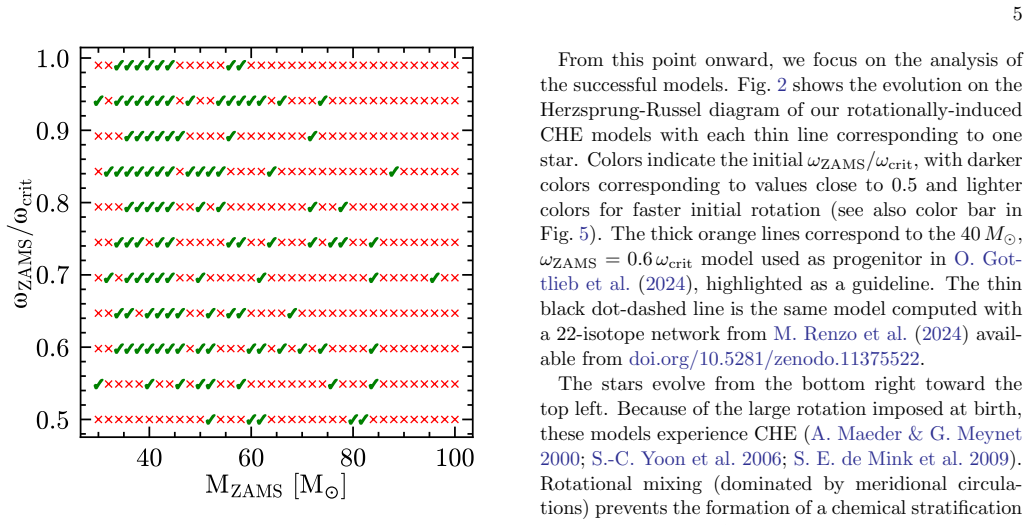
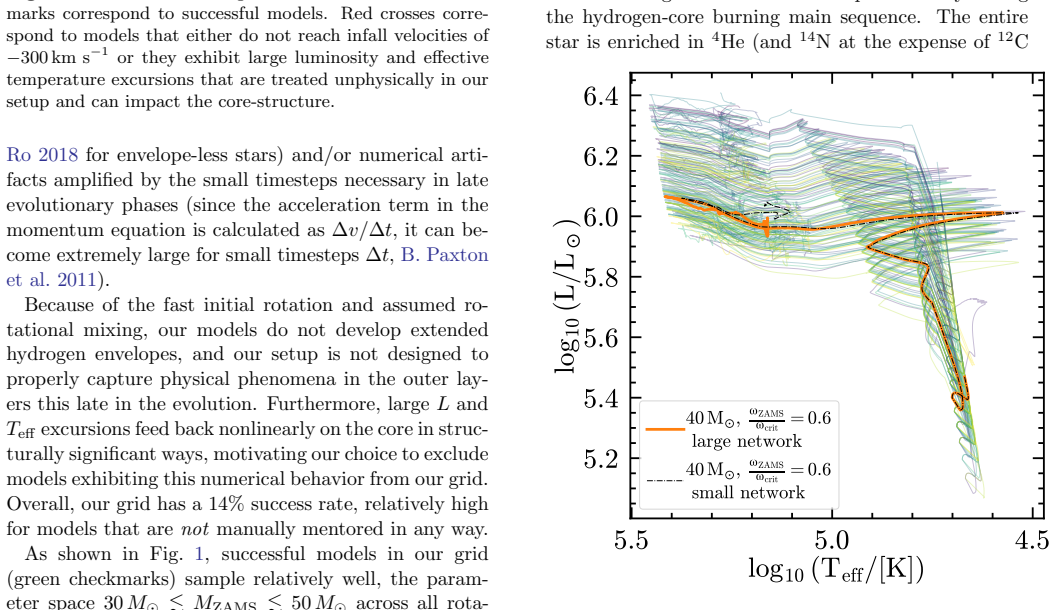
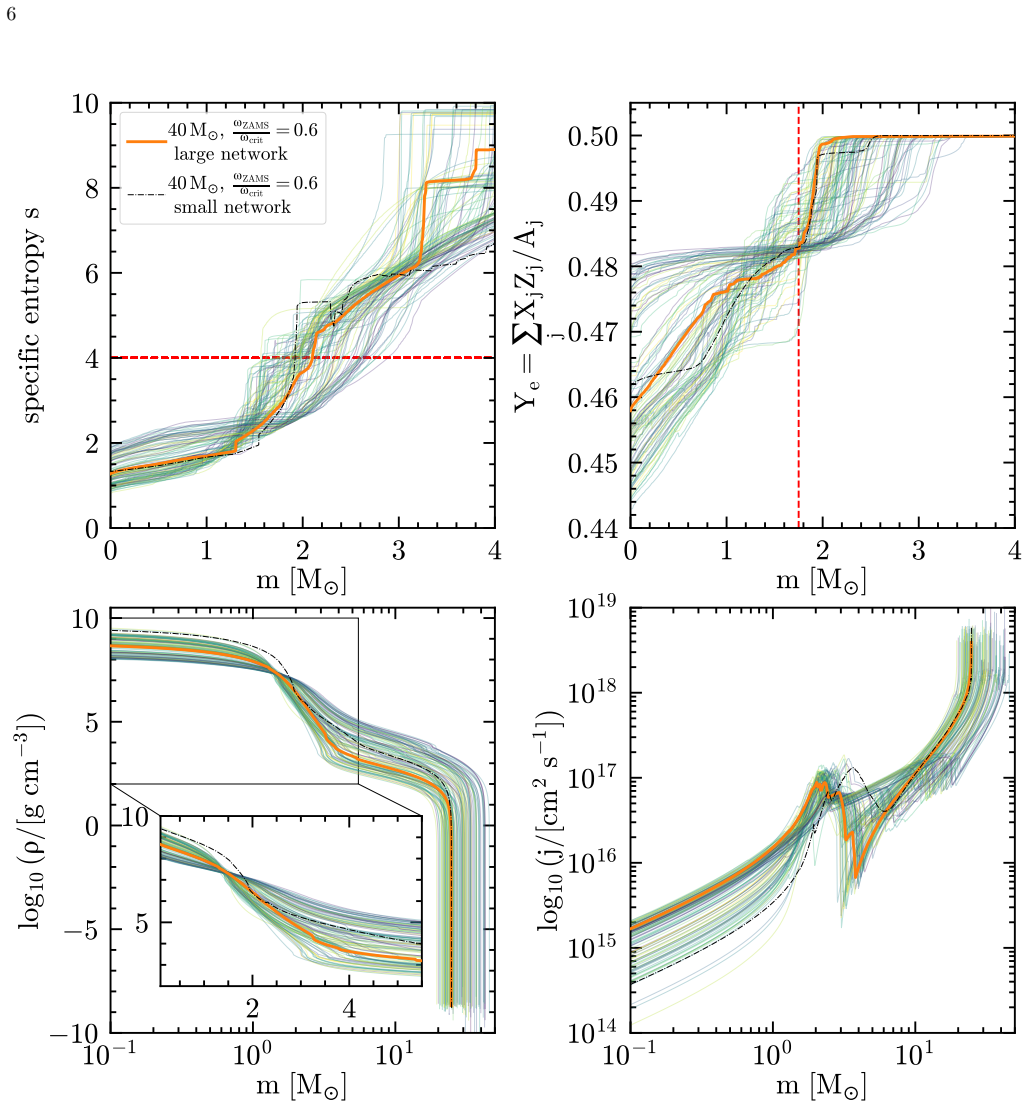
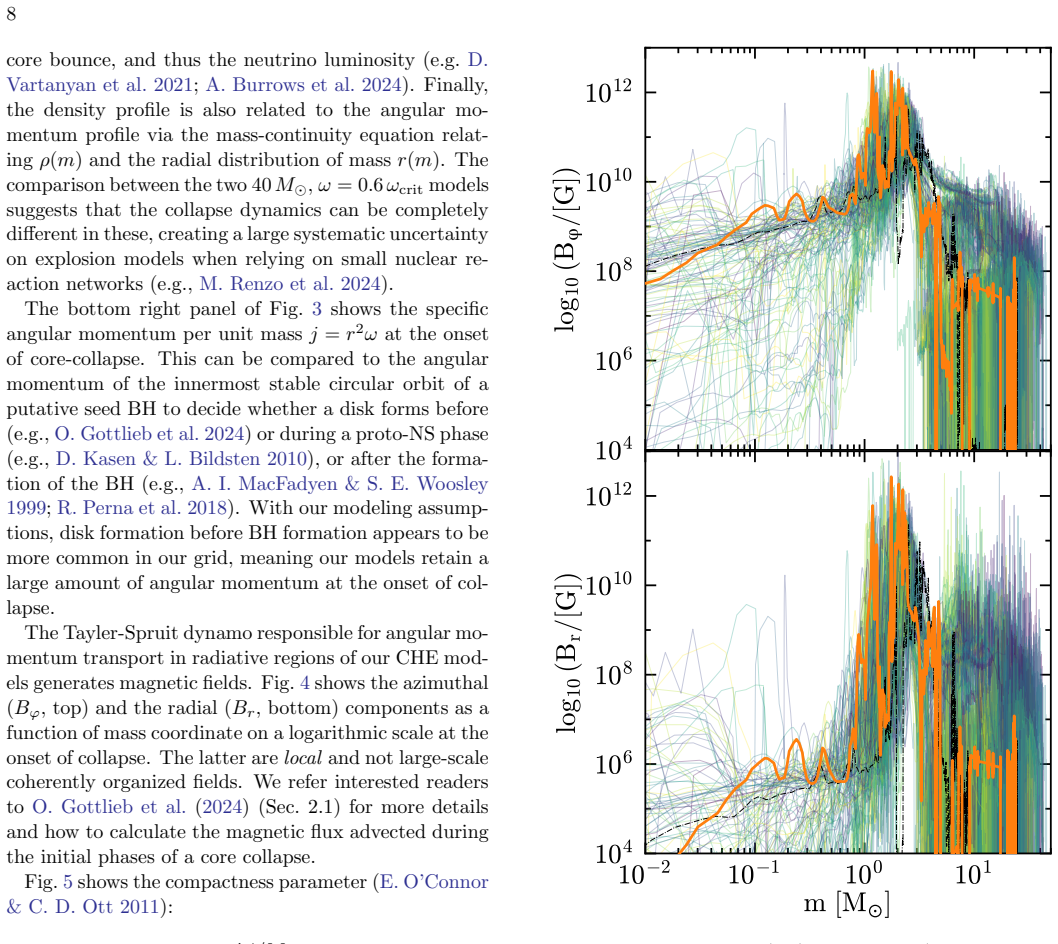
The understanding of the mechanism(s) by which massive stars collapse and possibly explode is rapidly maturing. Uncertainties in the structure of the stellar core at the onset of collapse are often dominant in numerical simulations, and a limited number of progenitor grids are available. This is especially true for explosions where rotation and magnetic fields play a significant or primary role. We present a grid of 113 single-star models with initial masses $M_{\rm ZAMS}=30-90\,M_{\odot}$ and initial rigid rotation $\omega_{\rm ZAMS}=0.5-0.99\,\omega_{\rm crit}$ computed at $Z=0.001$ with the open-source stellar evolution code \textsc{MESA}. We adopt a 128-isotope nuclear reaction network capable of following the weak reactions deleptonizing the core during and after silicon core burning. By construction, these models experience rotationally-induced chemically-homogeneous evolution, and reach the onset of collapse ($v_{\rm infall}\lesssim -300\,\mathrm{km\ s^{-1}}$) with large and structured amounts of angular momentum, possibly sufficient to form accretion disks on a proto-compact object. Therefore, these progenitor structures provide a homogeneous set of models with updated input physics and improved algorithmic accuracy to understand stellar explosions of (some types of) stripped-envelope supernovae, possibly jetted and/or broad-lined, collapsars or magnetar-powered, and/or long $\gamma$-ray bursts.
Editorial analysis
A structured set of objections, weighed in public.
Referee Report
Summary. The paper presents a grid of 113 single-star MESA models with initial masses 30-90 M⊙ and initial rigid rotations ω_ZAMS = 0.5-0.99 ω_crit at Z=0.001. By construction these models undergo rotationally-induced chemically-homogeneous evolution and reach core collapse (v_infall ≲ -300 km s⁻¹) with large structured angular momentum, providing a homogeneous set of progenitors with a 128-isotope network for modeling certain stripped-envelope supernovae, collapsars, magnetar-powered events, or long GRBs.
Significance. If the interior angular-momentum and composition profiles are representative of real stars, the grid supplies a reproducible, open-source resource with updated input physics and an extended nuclear network that follows core deleptonization; this would be useful for explosion simulations where rotation is important.
major comments (2)
- [Abstract] Abstract: the claim that the models supply progenitors 'possibly sufficient to form accretion disks on a proto-compact object' is load-bearing for the stated applications to collapsars and long GRBs, yet rests entirely on MESA's implementation of rotationally-induced mixing and angular-momentum transport without any external calibration against observed surface abundances of low-Z Wolf-Rayet stars or against other stellar-evolution codes.
- [Abstract] Abstract: the statement that the models reach collapse 'with large and structured amounts of angular momentum' is presented without quantitative measures (specific angular momentum profiles, comparison to critical values for disk formation, or error estimates on the profiles), which is required to assess the central claim that the grid is suitable for the listed explosion channels.
minor comments (1)
- [Abstract] The abstract refers to 'improved algorithmic accuracy' relative to prior grids but does not identify the specific algorithmic changes or input-physics updates that constitute the improvement.
Simulated Author's Rebuttal
We thank the referee for their thorough review and constructive feedback on our manuscript. We address each major comment below and will revise the abstract accordingly to improve clarity and precision.
read point-by-point responses
-
Referee: [Abstract] Abstract: the claim that the models supply progenitors 'possibly sufficient to form accretion disks on a proto-compact object' is load-bearing for the stated applications to collapsars and long GRBs, yet rests entirely on MESA's implementation of rotationally-induced mixing and angular-momentum transport without any external calibration against observed surface abundances of low-Z Wolf-Rayet stars or against other stellar-evolution codes.
Authors: We agree that the abstract's phrasing implies potential applicability to collapsars and long GRBs based solely on the MESA models' angular-momentum profiles. This paper does not introduce new calibrations against low-Z WR observations or inter-code comparisons; it presents a homogeneous grid computed with established MESA prescriptions for chemically homogeneous evolution. To address this, we will revise the abstract to qualify the claim, stating that the models reach core collapse with angular momentum profiles that, within the adopted physics, are potentially sufficient for disk formation, while noting that further validation against observations or other codes would be needed for direct application to specific explosion channels. revision: yes
-
Referee: [Abstract] Abstract: the statement that the models reach collapse 'with large and structured amounts of angular momentum' is presented without quantitative measures (specific angular momentum profiles, comparison to critical values for disk formation, or error estimates on the profiles), which is required to assess the central claim that the grid is suitable for the listed explosion channels.
Authors: The manuscript body provides specific angular momentum profiles versus mass coordinate at collapse (see Section 3 and associated figures), along with comparisons to disk-formation thresholds. The abstract is qualitative by design for brevity. We will revise the abstract to incorporate quantitative measures, for example by noting the typical specific angular momentum in the inner ~3-5 M⊙ exceeding ~10^16 cm² s⁻¹ (above the critical value for disk formation around a proto-neutron star) and highlighting the structured nature arising from the chemically homogeneous evolution. As these are single deterministic runs, formal error estimates on profiles are not included, but we can add a brief statement on numerical convergence with respect to spatial and temporal resolution. revision: yes
Circularity Check
No circularity: forward MESA simulations from explicit initial conditions
full rationale
The paper computes a grid of 113 MESA stellar models from stated ZAMS masses (30-90 Msun), rigid rotations (0.5-0.99 omega_crit), and Z=0.001. It explicitly states that CHE occurs 'by construction' via the chosen initial rotation and MESA's rotationally-induced mixing prescriptions, with no subsequent fitting, renaming, or prediction step that reduces to those inputs. No load-bearing self-citations, uniqueness theorems, or ansatze are invoked to justify the central output. The models are self-contained forward integrations; the claim is simply that the resulting structures exist and have the reported properties at collapse. This matches the default non-circular case.
Axiom & Free-Parameter Ledger
axioms (2)
- domain assumption MESA's implementation of rotationally-induced mixing produces chemically-homogeneous evolution for the stated initial conditions
- domain assumption The 128-isotope network accurately follows deleptonization during and after silicon burning
Reference graph
Works this paper leans on
-
[1]
She's Got Her Mother's Hair: Unveiling the Origin of Black Hole Magnetic Fields through Stellar to Collapsar Simulations. , keywords =. doi:10.3847/2041-8213/ad8563 , archivePrefix =. 2407.16745 , primaryClass =
-
[2]
Jets from Scratch: A 3D Dynamo Origin of Long Gamma-Ray Burst Jets
Jets from Scratch: A 3D Dynamo Origin of Long Gamma-Ray Burst Jets. arXiv e-prints , keywords =. doi:10.48550/arXiv.2605.12931 , archivePrefix =. 2605.12931 , primaryClass =
work page internal anchor Pith review Pith/arXiv arXiv doi:10.48550/arxiv.2605.12931
-
[3]
Collapsars - Gamma-Ray Bursts and Explosions in "Failed Supernovae"
Collapsars: Gamma-Ray Bursts and Explosions in ``Failed Supernovae''. , keywords =. doi:10.1086/307790 , archivePrefix =. astro-ph/9810274 , primaryClass =
work page internal anchor Pith review Pith/arXiv arXiv doi:10.1086/307790
-
[4]
Gamma-Ray Bursts from Stellar Mass Accretion Disks around Black Holes. , keywords =. doi:10.1086/172359 , adsurl =
-
[5]
On Variations Of Pre-Supernova Model Properties
On Variations Of Pre-supernova Model Properties. , keywords =. doi:10.3847/1538-4365/227/2/22 , archivePrefix =. 1611.01207 , primaryClass =
work page internal anchor Pith review Pith/arXiv arXiv doi:10.3847/1538-4365/227/2/22
-
[6]
Research Notes of the American Astronomical Society , keywords =
Progenitor Stars Calculated with Small Reaction Networks should not be Used as Initial Conditions for Core Collapse. Research Notes of the American Astronomical Society , keywords =. doi:10.3847/2515-5172/ad530e , archivePrefix =. 2406.02590 , primaryClass =
-
[7]
Proceedings of the National Academy of Science , year = 1934, month = may, volume =
On Super-novae. Proceedings of the National Academy of Science , year = 1934, month = may, volume =. doi:10.1073/pnas.20.5.254 , adsurl =
-
[8]
A Successful 3D Core-Collapse Supernova Explosion Model
A successful 3D core-collapse supernova explosion model. , keywords =. doi:10.1093/mnras/sty2585 , archivePrefix =. 1809.05106 , primaryClass =
work page internal anchor Pith review Pith/arXiv arXiv doi:10.1093/mnras/sty2585
-
[9]
Explosion Mechanisms of Core-Collapse Supernovae
Explosion Mechanisms of Core-Collapse Supernovae. Annual Review of Nuclear and Particle Science , keywords =. doi:10.1146/annurev-nucl-102711-094901 , archivePrefix =. 1206.2503 , primaryClass =
work page internal anchor Pith review Pith/arXiv arXiv doi:10.1146/annurev-nucl-102711-094901
-
[10]
Hydrodynamic evolution and protoneutron star properties
Three-dimensional magnetohydrodynamic simulations of core-collapse supernovae - I. Hydrodynamic evolution and protoneutron star properties. , keywords =. doi:10.1093/mnras/stae2611 , archivePrefix =. 2405.08367 , primaryClass =
-
[11]
The Open Journal of Astrophysics , keywords =
Supernovae in 2023 (review): possible breakthroughs by late observations. The Open Journal of Astrophysics , keywords =. doi:10.33232/001c.117147 , archivePrefix =. 2311.17732 , primaryClass =
-
[12]
The Most Luminous Supernovae. , keywords =. doi:10.3847/2041-8205/820/2/L38 , archivePrefix =. 1602.04865 , primaryClass =
work page internal anchor Pith review Pith/arXiv arXiv doi:10.3847/2041-8205/820/2/l38 2041
-
[13]
LSST: from Science Drivers to Reference Design and Anticipated Data Products
LSST: From Science Drivers to Reference Design and Anticipated Data Products. , keywords =. doi:10.3847/1538-4357/ab042c , archivePrefix =. 0805.2366 , primaryClass =
work page internal anchor Pith review Pith/arXiv arXiv doi:10.3847/1538-4357/ab042c
-
[14]
GWTC-4.0: An Introduction to Version 4.0 of the Gravitational-Wave Transient Catalog
GWTC-4.0: An Introduction to Version 4.0 of the Gravitational-Wave Transient Catalog. , keywords =. doi:10.3847/2041-8213/ae0c06 , archivePrefix =. 2508.18080 , primaryClass =
work page internal anchor Pith review Pith/arXiv arXiv doi:10.3847/2041-8213/ae0c06 2041
-
[15]
Presupernova evolution of massive stars. , keywords =. doi:10.1086/156569 , adsurl =
-
[16]
Reviews of Modern Physics , keywords =
The evolution and explosion of massive stars. Reviews of Modern Physics , keywords =. doi:10.1103/RevModPhys.74.1015 , adsurl =
-
[17]
Nature Physics , year = 2007, month = dec, volume =
Nuclear astrophysics: The first 50 years. Nature Physics , year = 2007, month = dec, volume =. doi:10.1038/nphys804 , adsurl =
-
[18]
Evolution, Explosion and Nucleosynthesis of Core Collapse Supernovae
Evolution, Explosion, and Nucleosynthesis of Core-Collapse Supernovae. , keywords =. doi:10.1086/375703 , archivePrefix =. astro-ph/0304185 , primaryClass =
work page internal anchor Pith review Pith/arXiv arXiv doi:10.1086/375703
-
[19]
Evolution of progenitors for electron capture supernovae
Evolution of Progenitors for Electron Capture Supernovae. , keywords =. doi:10.1088/0004-637X/771/1/28 , archivePrefix =. 1302.6402 , primaryClass =
work page internal anchor Pith review Pith/arXiv arXiv doi:10.1088/0004-637x/771/1/28
-
[20]
Modules for Experiments in Stellar Astrophysics (MESA)
Modules for Experiments in Stellar Astrophysics (MESA). , keywords =. doi:10.1088/0067-0049/192/1/3 , archivePrefix =. 1009.1622 , primaryClass =
work page internal anchor Pith review Pith/arXiv arXiv doi:10.1088/0067-0049/192/1/3
-
[21]
Modules for Experiments in Stellar Astrophysics (MESA): Planets, Oscillations, Rotation, and Massive Stars. , keywords =. doi:10.1088/0067-0049/208/1/4 , archivePrefix =. 1301.0319 , primaryClass =
work page internal anchor Pith review Pith/arXiv arXiv doi:10.1088/0067-0049/208/1/4
-
[22]
, year = 2016, month = mar, volume =
Erratum: Modules for Experiments in Stellar Astrophysics (MESA): Binaries, Pulsations, and Explosions <A href=``/abs/2015ApJS..220...15P''>(2015, ApJS, 220, 15)</A>. , year = 2016, month = mar, volume =. doi:10.3847/0067-0049/223/1/18 , adsurl =
-
[23]
Modules for Experiments in Stellar Astrophysics (MESA): Binaries, Pulsations, and Explosions
Modules for Experiments in Stellar Astrophysics (MESA): Binaries, Pulsations, and Explosions. , keywords =. doi:10.1088/0067-0049/220/1/15 , archivePrefix =. 1506.03146 , primaryClass =
work page internal anchor Pith review Pith/arXiv arXiv doi:10.1088/0067-0049/220/1/15
-
[24]
Modules for Experiments in Stellar Astrophysics (MESA): Pulsating Variable Stars, Rotation, Convective Boundaries, and Energy Conservation. , keywords =. doi:10.3847/1538-4365/ab2241 , archivePrefix =. 1903.01426 , primaryClass =
work page internal anchor Pith review Pith/arXiv arXiv doi:10.3847/1538-4365/ab2241 1903
-
[25]
Modules for Experiments in Stellar Astrophysics (MESA): Time-dependent Convection, Energy Conservation, Automatic Differentiation, and Infrastructure. , keywords =. doi:10.3847/1538-4365/acae8d , archivePrefix =. 2208.03651 , primaryClass =
-
[26]
Systematic survey of the effects of wind mass loss algorithms on the evolution of single massive stars. , keywords =. doi:10.1051/0004-6361/201730698 , archivePrefix =. 1703.09705 , primaryClass =
work page internal anchor Pith review Pith/arXiv arXiv doi:10.1051/0004-6361/201730698
-
[27]
The Effect of Mass Loss and Convective Overshooting on the Pre-Collapse Structure, Composition, and Neutrino Emission of Red Supergiants. arXiv e-prints , keywords =. doi:10.48550/arXiv.2604.22605 , archivePrefix =. 2604.22605 , primaryClass =
work page internal anchor Pith review Pith/arXiv arXiv doi:10.48550/arxiv.2604.22605
-
[28]
Nucleosynthesis of Binary-stripped Stars. , keywords =. doi:10.3847/1538-4357/acc315 , archivePrefix =. 2303.04520 , primaryClass =
-
[29]
Different to the core: The pre-supernova structures of massive single and binary-stripped stars. , keywords =. doi:10.1051/0004-6361/202140506 , archivePrefix =. 2102.05036 , primaryClass =
-
[30]
It's written in the massive stars: The role of stellar physics in the formation of black holes. , keywords =. doi:10.1051/0004-6361/202451077 , archivePrefix =. 2409.02058 , primaryClass =
-
[31]
Stellar Nucleosynthesis , year = 1984, editor =
Type-II Supernovae from 8-10-SOLAR-MASS Progenitors. Stellar Nucleosynthesis , year = 1984, editor =. doi:10.1007/978-94-009-6348-1_20 , adsurl =
-
[32]
Stellar Nucleosynthesis , year = 1984, editor =
Massive Objects and the First Stars. Stellar Nucleosynthesis , year = 1984, editor =. doi:10.1007/978-94-009-6348-1_23 , adsurl =
-
[33]
Spinning into the Gap: Direct-horizon Collapse as the Origin of GW231123 from End-to-end General-relativistic Magnetohydrodynamic Simulations. , keywords =. doi:10.3847/2041-8213/ae0d81 , archivePrefix =. 2508.15887 , primaryClass =
-
[34]
American Astronomical Society Meeting Abstracts , year = 1993, series =
Silicon Burning: Formation of the Iron Peak Nuclei. American Astronomical Society Meeting Abstracts , year = 1993, series =
1993
-
[35]
Silicon Burning. II. Quasi-Equilibrium and Explosive Burning. , keywords =. doi:10.1086/306692 , archivePrefix =. astro-ph/9808203 , primaryClass =
work page internal anchor Pith review Pith/arXiv arXiv doi:10.1086/306692
-
[36]
Nuclear Neural Networks: Emulating Late Burning Stages in Core-collapse Supernova Progenitors. , keywords =. doi:10.3847/1538-4365/ade717 , archivePrefix =. 2503.00115 , primaryClass =
-
[37]
An Inexpensive Nuclear Energy Generation Network for Stellar Hydrodynamics. , keywords =. doi:10.1086/313407 , adsurl =
-
[38]
Advanced evolution of massive stars. VII. Silicon burning. , keywords =. doi:10.1086/190472 , adsurl =
-
[39]
Pre-supernova evolution and final fate of stellar mergers and accretors of binary mass transfer. , keywords =. doi:10.1051/0004-6361/202347854 , archivePrefix =. 2403.03984 , primaryClass =
-
[40]
Related progenitor models for long-duration gamma ray bursts and Type Ic superluminous supernovae
Related Progenitor Models for Long-duration Gamma-Ray Bursts and Type Ic Superluminous Supernovae. , keywords =. doi:10.3847/1538-4357/aabfc1 , archivePrefix =. 1804.07317 , primaryClass =
work page internal anchor Pith review Pith/arXiv arXiv doi:10.3847/1538-4357/aabfc1
-
[41]
Convective boundary mixing in a post-He core burning massive star model
Convective boundary mixing in a post-He core burning massive star model. , keywords =. doi:10.1093/mnras/sty3415 , archivePrefix =. 1712.00114 , primaryClass =
work page internal anchor Pith review Pith/arXiv arXiv doi:10.1093/mnras/sty3415
-
[42]
Explodability criteria for the neutrino-driven supernova mechanism. , keywords =. doi:10.1051/0004-6361/202554931 , archivePrefix =. 2503.23856 , primaryClass =
-
[43]
On Stellar Evolution in a Neutrino Hertzsprung-Russell Diagram. , keywords =. doi:10.3847/1538-4357/ab7f2c , archivePrefix =. 2003.05844 , primaryClass =
-
[44]
The Landscape of Collapsar Outflows: Structure, Signatures, and Origins of Einstein Probe Relativistic Supernova Transients. , keywords =. doi:10.3847/2041-8213/ae09af , archivePrefix =. 2509.04551 , primaryClass =
-
[45]
The spins of compact objects born from helium stars in binary systems. , keywords =. doi:10.1093/mnras/stac317 , archivePrefix =. 2201.08407 , primaryClass =
-
[46]
Slowing the Spins of Stellar Cores
Slowing the spins of stellar cores. , keywords =. doi:10.1093/mnras/stz514 , archivePrefix =. 1902.08227 , primaryClass =
work page internal anchor Pith review Pith/arXiv arXiv doi:10.1093/mnras/stz514 1902
-
[47]
Updated and Expanded OPAL Equation-of-State Tables: Implications for Helioseismology. , keywords =. doi:10.1086/341894 , adsurl =
-
[48]
, keywords =. 1995 , month =. doi:10.1086/192204 , adsurl =
-
[49]
The FreeEOS Code for Calculating the Equation of State for Stellar Interiors , url =
-
[50]
, keywords =. 2000 , month =. doi:10.1086/313304 , adsurl =
-
[51]
Thermodynamic functions of dense plasmas: analytic approximations for astrophysical applications
Contributions to Plasma Physics , archiveprefix =. 2010 , month =. doi:10.1002/ctpp.201010017 , adsurl =. 1001.0690 , primaryclass =
work page internal anchor Pith review Pith/arXiv arXiv doi:10.1002/ctpp.201010017 2010
-
[53]
, keywords =. 1993 , month =. doi:10.1086/172958 , adsurl =
-
[54]
, keywords =. 1996 , month =. doi:10.1086/177381 , adsurl =
-
[55]
, eprint =. 2005 , month =. doi:10.1086/428642 , adsurl =
-
[56]
Rosseland and flux mean opacities for Compton scattering
Rosseland and Flux Mean Opacities for Compton Scattering. , keywords =. doi:10.3847/1538-4357/835/2/119 , archiveprefix =. 1606.09466 , primaryclass =
work page internal anchor Pith review Pith/arXiv arXiv doi:10.3847/1538-4357/835/2/119
-
[57]
Updated Electron-Conduction Opacities: The Impact on Low-Mass Stellar Models. , eprint =. doi:10.1086/516819 , adsurl =
-
[58]
New Conductive Opacities for White Dwarf Envelopes. , keywords =. doi:10.3847/1538-4357/ab9e75 , archiveprefix =. 2006.16390 , primaryclass =
-
[59]
, keywords =. 2010 , month =. doi:10.1088/0067-0049/189/1/240 , adsurl =
-
[60]
1999, NuPhA, 656, 3, doi: 10.1016/S0375-9474(99)00030-5 Astropy Collaboration, Price-Whelan, A
A compilation of charged-particle induced thermonuclear reaction rates. , year = 1999, month = aug, volume =. doi:10.1016/S0375-9474(99)00030-5 , adsurl =
-
[61]
, keywords =. 1985 , month =. doi:10.1086/163208 , adsurl =
-
[62]
Atomic Data and Nuclear Data Tables , year =. doi:10.1006/adnd.1994.1007 , adsurl =
-
[63]
2000, NuPhA, 673, 481, doi: 10.1016/S0375-9474(00)00131-7
Nuclear Physics A , eprint =. 2000 , month =. doi:10.1016/S0375-9474(00)00131-7 , adsurl =
-
[64]
Coulomb tunneling for fusion reactions in dense matter: Path integral Monte Carlo versus mean field
, archiveprefix =. 2007 , month =. doi:10.1103/PhysRevD.76.025028 , adsurl =. 0707.3500 , keywords =
work page internal anchor Pith review Pith/arXiv arXiv doi:10.1103/physrevd.76.025028 2007
-
[65]
, keywords =. 1996 , month =. doi:10.1086/192264 , adsurl =
-
[66]
, keywords =. 1983 , month =. doi:10.1086/160960 , adsurl =
-
[67]
1988 , month =
, keywords =. 1988 , month =
1988
-
[68]
arXiv e-prints , keywords =
Streamlining and standardizing software citations with The Software Citation Station. arXiv e-prints , keywords =
-
[69]
doi:10.5281/zenodo.17654855 , url =
Tom Wagg and Floor Broekgaarden and Phil Van-Lane and Kai Wu and Kayhan Gültekin , title =. doi:10.5281/zenodo.17654855 , url =
-
[70]
New Theoretical Mass-Loss Rates of
Vink, J. New Theoretical Mass-Loss Rates of. 2000 , month = oct, journal =
2000
-
[71]
J. S. Vink and A. de Koter and H. J. G. L. M. Lamers. Mass-loss predictions for O and B stars as a function of metallicity. 2001. doi:10.1051/0004-6361:20010127. astro-ph/0101509
work page internal anchor Pith review Pith/arXiv arXiv doi:10.1051/0004-6361:20010127 2001
-
[72]
Nugis and H
T. Nugis and H. J. G. L. M. Lamers. Mass-loss rates of Wolf-Rayet stars as a function of stellar parameters. 2000
2000
-
[73]
Rotating Massive Main-Sequence Stars I: Grids of Evolutionary Models and Isochrones
Brott, I and. Rotating Massive Main-Sequence Stars. 2011 , month = jun, journal =. doi:10.1051/0004-6361/201016113 , archiveprefix =. 1102.0530 , pages =
work page internal anchor Pith review Pith/arXiv arXiv doi:10.1051/0004-6361/201016113 2011
-
[74]
, keywords =
Coupled mass and angular momentum loss of massive main sequence stars. , keywords =
-
[75]
Presupernova
Heger, A and Langer, N and Woosley, S. Presupernova. 2000 , month = jan, journal =
2000
-
[76]
H. C. Spruit. Dynamo action by differential rotation in a stably stratified stellar interior. 2002. doi:10.1051/0004-6361:20011465. arXiv:astro-ph/0108207
work page internal anchor Pith review Pith/arXiv arXiv doi:10.1051/0004-6361:20011465 2002
-
[77]
O. H. Ram \'i rez-Agudelo and H. Sana and S. E. de Mink and V. H \'e nault-Brunet and A. de Koter and N. Langer and F. Tramper and G. Gr \"a fener and C. J. Evans and J. S. Vink and P. L. Dufton and W. D. Taylor. The VLT-FLAMES Tarantula Survey. XXI. Stellar spin rates of O-type spectroscopic binaries. 2015. doi:10.1051/0004-6361/201425424. arXiv:1507.02286
work page internal anchor Pith review Pith/arXiv arXiv doi:10.1051/0004-6361/201425424 2015
-
[78]
The. , volume = 560, eprint =. doi:10.1051/0004-6361/201321986 , abstract =
-
[79]
Skye: A Differentiable Equation of State. , keywords =. doi:10.3847/1538-4357/abf48e , archivePrefix =. 2104.00691 , primaryClass =
-
[80]
Tracing the evolution of short-period binaries with super-synchronous fast rotators. , keywords =. doi:10.1051/0004-6361/202348484 , archivePrefix =. 2401.11304 , primaryClass =
-
[81]
Extreme mass ratios and fast rotation in three massive binaries. , keywords =. doi:10.1093/mnras/stad2280 , archivePrefix =. 2308.02368 , primaryClass =
discussion (0)
Sign in with ORCID, Apple, or X to comment. Anyone can read and Pith papers without signing in.