REVIEW 5 major objections 4 minor 54 references
Synonymous Variational Inference for Perceptual Image Compression
T0 review · 5 major / 4 minor · reviewed 2026-08-07 · deepseek-v4-flash
Pith's one-line read Viewing each image as a member of a set of perceptually synonymous images, this paper proves that the minimum rate for perceptual compression is a triple tradeoff among rate, distortion, and expected KL divergence, and that this bound…
desk verdict Solid progressive codec engineering, but the SVI proof rests on a circular invariance assumption and Jensen bounds treated as equivalences, so the central theorem does not stand as written. read the letter →
The pith
A machine-rendered reading of the paper's core claim, the machinery that carries it, and where it could break.
The reading
What carries the argument
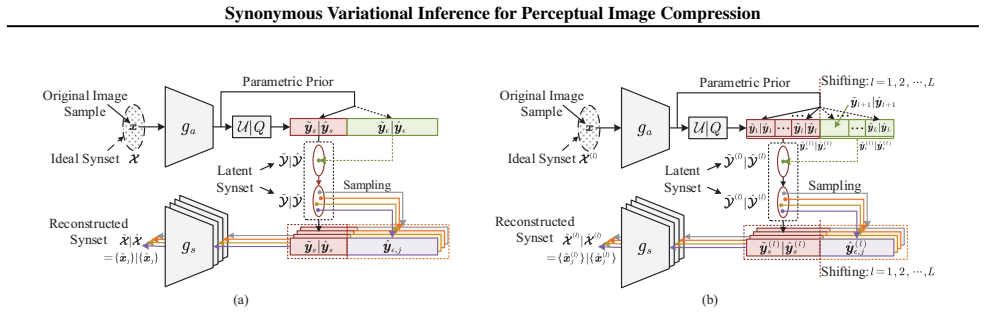
The load-bearing object is the ideal Synset $\mathcal{X}$, the set of images that share meaning with the source image under a perceptual criterion, together with the partial semantic KL divergence $D_{\mathrm{KL},s}[q\|p_s]$, which measures the distance between a syntactic parametric density and a semantic distribution. The latent representation is split into a synonymous part $\tilde{y}_s$, which must be coded and transmitted, and a detailed part $\tilde{y}_\epsilon$, which the decoder samples rather than receives, so only the synonymous part contributes to the rate. Lemma 3.2 converts the synonymous likelihood term into an expected-distortion plus expected-KL objective, and Theorem 3.3 packages that equivalence into the rate bound whose rate term is semantic mutual information $I(X;\hat{\mathring{X}}) = H_s(\hat{\mathring{X}}) - H_s(\hat{\mathring{X}}|X)$. The unification claim is carried by two degenerations: a single-member reconstructed synset reproduces the rate-distortion-perception tradeoff, and a single-member ideal synset reproduces classical rate-distortion.
What would settle it
Test equation (20) directly on a source whose synonym structure is known: train a SIC-style codec, generate several reconstructions from one code by sampling details, re-encode those reconstructions, and measure the dispersion of the recovered synonymous representations. If different synset members yield materially different reconstruction distributions, or if re-encoding different reconstructions gives significantly different $\hat{y}_s$, the equivalence in Lemma 3.2 fails and the rate bound of Theorem 3.3 is not established. A quantitative companion check on the same synthetic source is to compute the claimed minimum rate and verify that a codec that ignores the synset violates it.
Extended reading notes
Core claim
On its own terms, the paper's discovery is that perceptual image compression should be optimized against a set of synonymous reconstructions rather than a single reconstruction, and that this shift turns the optimization objective into a synonymous rate-distortion-perception tradeoff. Theorem 3.3 states that the minimum achievable rate is $$R(X) = \min_{p(\hat{X}|x)} I(X;\hat{\mathring{X}}) \quad \text{s.t.} \quad \mathbb{E}[d(x,\hat{x}_i)] \le D,\; \mathbb{E}[D_{\mathrm{KL}}[p_x \| p_{\hat{x}_i}]] \le P,$$ where the rate is the semantic mutual information between the source and the reconstructed synset. The load-bearing step is Lemma 3.2: minimizing the expected negative log synonymous-likelihood term is equivalent to minimizing a weighted expected distortion plus a weighted expected KL divergence, because the likelihood of the whole synset integrates over its members. The paper claims this is the first theoretical explanation of why a divergence measure must appear in perceptual image compression: the E-KLD term measures the gap between the reconstructed distribution and the ideal synset, and it disappears only when the ideal synset collapses to the original image. Both existing bounds then fall out as degenerations.
Load-bearing premise
The derivation assumes, in equation (20), that every image in the ideal Synset already maps to the same reconstruction distribution under the current encoder — the very invariance the training is meant to create — so the proof leans on its target property before that property exists.
Editorial extensions
If this is right
- If Theorem 3.3 is right, the classical rate-distortion bound and the existing rate-distortion-perception bound are the two degenerate edges of a single synonymous tradeoff, obtained by collapsing the ideal synset or the reconstructed synset to one sample.
- Because only the synonymous representation is coded, the achievable rate satisfies $I(X;\hat{\mathring{X}}) \le I(X;\hat{X})$, so a synonymity-aware codec can beat a symbol-level codec at the same rate whenever the decoder is free to sample details rather than receive them.
- A single progressive codec with $L$ split levels yields $L$ rate points from one generator; the implemented $L=16$ codec covers the full rate range on Kodak, CLIC2020, and DIV2K, with each rate sharing one analysis and synthesis transform.
- The bound identifies the role of the perceptual loss term: it is the expected-KL constraint that drives the reconstructed synset toward the ideal synset, so divergence-based perceptual measures such as LPIPS, DISTS, and adversarial losses are all proxies for the same underlying term.
Reading between the lines
- Editorial inference: the framework predicts that the benefit of synonymity-aware coding grows as the perceptual criterion becomes more resampling-tolerant (DISTS over LPIPS over MSE), a ranking that could be tested by training the same codec under each criterion and comparing the measured rate gap against the bound.
- Editorial inference: the limited FID gains the paper reports point to its own next bottleneck — the detail sampler draws from a scalar uniform distribution instead of the conditional vector prior assumed by the derivation, so replacing the sampler is a direct and testable upgrade path.
- Editorial inference: the synonymous idempotence constraint, which re-encodes reconstructions and penalizes $\|\hat{y}'_s - \hat{y}_s\|^2$, gives a practical, human-free measure of how close a codec is to overlapping the ideal synset, and could serve as a convergence criterion in future training.
- Editorial inference: the same set-level reasoning should apply to other image restoration tasks whose success is judged by perceptual similarity, predicting that their optimal objectives also contain a divergence term of exactly this form.
Editorial analysis
A structured set of objections, weighed in public.
Referee Report
Summary. The paper proposes a semantic-information-theoretic analysis of perceptual image compression. It defines an 'ideal synset' of perceptually synonymous images, introduces synonymous variational inference (SVI), and states Lemma 3.2 and Theorem 3.3, claiming that the minimum achievable rate of perceptual compression follows a 'synonymous rate-distortion-perception tradeoff' that contains the existing rate-distortion-perception tradeoff as a special case. It then presents synonymous image compression (SIC), a progressive codec that encodes only the 'synonymous' latent part and samples the remaining detail latents, with experiments comparing DISTS, PSNR, LPIPS, and FID against HiFiC and MS-ILLM. The appendix contains the detailed proofs of the two central results.
Significance. The paper is unusually detailed in its implementation documentation, providing architecture choices, hyperparameter tables, training schedules, and additional GAN fine-tuning experiments, and it is transparent about the preliminary nature of the experimental results. If the theoretical claims were correct, the work would offer a unified semantic-information explanation for the appearance of distribution-divergence terms in perceptual compression and would introduce a practical single-model variable-rate codec. However, the central proof contains load-bearing gaps: the key invariance assumption is circular, Jensen's inequality steps are treated as equivalences, the E-KLD term is identified with a constant rather than derived, and the rate identity is not justified. The main theorem is therefore not established, and the claimed theoretical significance is not currently realized.
major comments (5)
- [A.1, Eq. (20)] The proof of Lemma 3.2 assumes p_{\tilde x_j|x_i}(\tilde x_j|x_i)=p_{\tilde x_j|x}(\tilde x_j|x) for every x_i in the ideal synset, justified by an ideal encoder \phi^*_g. This invariance is precisely what the training objective is supposed to learn (Figure 1); before convergence the equality is generically false. Using it as a premise to derive the training objective is therefore circular. Without Eq. (20), the subsequent Bayes manipulation leading to Eq. (21) cannot be performed, so Lemma 3.2 is unproved.
- [A.1, Eqs. (21)(d)-(e)] The derivation applies Jensen's inequality twice to obtain upper bounds on the negative log expected likelihood, then absorbs the slack into scalar weights \lambda_d and \lambda_p (Eqs. (23) and (29)). The slack is a function of the distributions p_{x|\tilde x_j}, p_{\tilde x_j}, and p_{x_i}, not merely of the synset sizes |X| and |\tilde X|, so it cannot be absorbed into a constant hyperparameter. Minimizing an upper bound is not equivalent to minimizing the original objective; consequently the claimed equivalence in Eq. (17) is not established.
- [A.1, Eqs. (25)-(28)] Eq. (25) shows that the sum of the second and third terms in Eq. (21) equals f(x,X), which the paper identifies as a constant for given x and X. The subsequent split introduces the E-KLD term and the \delta_p term, and Eq. (28) states E-KLD - \delta_p = f(x,X). This means the E-KLD is not derived as part of the objective; it is an additional quantity that the authors propose to minimize to 'approximate' a constant. This is not an equivalence and cannot support Lemma 3.2.
- [A.2, Eq. (35)] The identification of the rate term with I(X;\hat{\tilde X}) relies on H_s(\hat{\tilde X}|X)=0, justified by log q(\tilde y_s|x)=0 and a 'determined encoder.' However, reconstruction is not determined by x because the decoder samples \hat y_{\epsilon,j}; conditional semantic entropy is not generally zero. Moreover, Theorem 3.3 is stated as a 'minimum achievable rate' without an operational coding theorem (achievability, converse, block-length definitions); the proof only manipulates the variational objective. The central rate-distortion-perception theorem is therefore not proven.
- [3.1 and A.2] Because the ideal synset is defined by a perceptual-similarity criterion, the appearance of a distribution-divergence perception term in the objective is an input of the model rather than an independent prediction. The paper's repeated claim to be the first work to 'theoretically explain the fundamental reason for the divergence measure's existence' is stronger than what the derivation supports; at best it shows that a synset defined by perceptual similarity leads to a perceptual penalty.
minor comments (4)
- [2.1, Eq. (2); 3.2, Eq. (10)] The statement that the first term 'equals 0 under the assumption of a uniform density on the unit interval' is inaccurate; a uniform density has a constant log-density value, and the KL term is not itself zero. The text should say the term is constant and can be absorbed.
- [3.2 and A.2] The notation for the reconstructed synset is inconsistent: Lemma 3.2 uses \tilde X, Theorem 3.3 uses \hat X, and the mutual information I(X;\hat{\tilde X}) is not formally defined. Please unify the notation.
- [A.1, after Eq. (28)] The reference to 'Eq. (3.2)(d)' should be to Eq. (21)(d); there are also several typos, including 'appplied' in Section 3.1 and 'Kodat' in Figure 17.
- [C.2] The authors describe the reported experimental results as 'preliminary results' and note insufficient hyperparameter exploration; this caveat should be stated in the main text, as it tempers the claim that the experiments verify the analysis.
Circularity Check
The E-KLD 'prediction' is built in: Eq. (20) assumes the synset invariance the loss is meant to create, the Jensen-bound slack is hidden in fitted lambdas, and Theorem 3.3's rate/distance vocabulary is imported from the authors' own prior semantic-information paper.
-
self definitional
[Appendix A.1, Eq. (20) (used in Eq. (21)(a)-(b)); cf. Sec. 3.1 Fig. 1]
"Furthermore, since any sample xi in the ideal synset (including the original image sample x) shares the same synonymous representation ~ys by the ideal parametric SIC encoder with phi*_g, the posterior term in the (19) satisfy the following equations: p~xj|xi (~xj|xi) = p~xj|~ys (~xj|~ys) = p~xj|x (~xj|x). (20)"
Lemma 3.2's equivalence—the paper's central derivation that the perception loss equals weighted E-MSE plus E-KLD—substitutes p~xj|xi = p~xj|x for every synset member (Eq. 21(a)). The only justification is 'the ideal parametric SIC encoder', whose defining property is that all synset members share one synonymous representation. But that invariance is exactly the convergence state the derived objective is supposed to create (Fig. 1: the reconstructed synset approaches the ideal synset 'until complete overlap occurs'). Before convergence, p~xj|xi and p~xj|x are generically distinct, so the proof fails precisely where the training loss is applied; granting Eq. (20) makes the E-KLD prediction an assumption of its own conclusion.
-
other
[Appendix A.1, Eqs. (21)(d)-(e), (25)-(30)]
"If these two factors at the source are determined, the result of the function will be constant. ... although f(x,X) is a constant when x and X are determined, we can approximate it by minimizing the E-KLD term ... the multiplier alpha_d(|~X|) is a scaling factor influenced by the size of the reconstructed synset ~X, and it can be implicitly incorporated into the value of the hyperparameter lambda_d thus it does not need to be explicitly assigned."
Steps (d)-(e) of Eq. (21) are Jensen upper bounds, yet Eq. (17)/(30) assert an equivalence to the weighted E-MSE + E-KLD objective. The bound slack is absorbed into alpha_d and alpha_p, 'implicitly incorporated into the value of the hyperparameter', so the weights are fitted, not fixed. Moreover, Eq. (25) shows the second and third terms jointly equal a model-independent constant f(x,X) = (1/|X|) integral_DKL[px||pxi]; the paper then declines to keep it constant and re-introduces the E-KLD as a minimizable proxy to 'determine the meaning of the constant value'. The perception term is therefore an input decision, not a forced consequence, so the claimed theoretical explanation of the divergence measure's existence is built into the construction.
1 more flagged steps
-
self citation load bearing
[Sec. 2.3 Eq. (6), Sec. 3.2 Eq. (7), Appendix A.2 Eqs. (34)-(35)]
"As the foundation of the synonymous variational inference proposed in this paper, a new form of KL divergence needs to be introduced from (Niu & Zhang, 2024), referred to as partial semantic KL divergence ... (a) is achieved based on the definition of semantic entropy in Niu and Zhang's paper (2024), with the help of the weak law of large numbers."
Theorem 3.3's rate term I(X;~X) = H_s(~X) - H_s(~X|X) and the minimized divergence D_KL,s are imported from Niu & Zhang (2024), whose authors include the present authors (K. Niu and P. Zhang). The central novelty claim—'the first work that can theoretically explain the fundamental reason for the divergence measure's existence'—rests on this self-cited framework: the KL-type input D_KL,s already fixes the divergence-type output, and the semantic rate identity comes from the prior work's semantic entropy. Since the prior paper is peer-reviewed and its grouping argument is elementary, this is load-bearing self-citation rather than a black-box uniqueness import, but it means the semantic content of the tradeoff is not independently derived here.
full rationale
The experimental contribution is self-contained: a working progressive codec is compared against external benchmarks (HiFiC, MS-ILLM, BPG, VTM), and the authors are candid about limitations (Section 6 replaces the 'derived' E-KLD with LPIPS; Section C.1 admits the detail-sampling mechanism 'cannot fit the ideal conditional distribution' of Eq. (18), and that the rate-representation mapping is a compromise). Those parts are not circular. The circularity is concentrated in the theoretical derivation billed as the main result. (i) Eq. (20) assumes p~xj|xi = p~xj|x for all ideal-synset members, justified by 'the ideal parametric SIC encoder'—the invariance the training objective is supposed to create—so Lemma 3.2's E-KLD term is assumed rather than derived. (ii) The Jensen steps in Eq. (21)(d)-(e) produce upper bounds whose slack is hidden in fitted scale factors alpha_d/alpha_p, and the combined second+third terms are a model-independent constant f(x,X) that the paper re-splits into an E-KLD proxy; the perception term is thus reinstated by choice. (iii) The rate identity and the partial semantic KL divergence come from the authors' own Niu & Zhang (2024) framework, so the semantic tradeoff in Theorem 3.3 is substantially a re-expression in the authors' own vocabulary: the paper itself shows R(X) reduces to the Blau-Michaeli R(D,P) when the reconstructed synset has one sample (Eq. (37)). The claimed 'theoretical explanation of the fundamental reason for the divergence measure's existence' therefore reduces to the definition of the synset via perceptual similarity plus a proxy choice plus a self-cited divergence input. Score 6: the key perception prediction reduces by construction, while the codec engineering and external benchmarks retain independent content.
Assumptions & free parameters
free parameters (6)
- lambda_r^(l) for l=1..16 =
128 to 2048 in steps
- lambda_d^(l) for l=1..16 =
2^(39/8) down to 2^(24/8)
- lambda_p^(l) for l=1..16 =
2^(45/8) down to 2^0
- alpha =
0.5
- detail sampling range =
U(-2,2)
- warm-up weights a and b =
a=4, b=64
assumptions (6)
- ad hoc to paper An ideal synset X exists for each source image, containing all images that share a given perceptual meaning.
- ad hoc to paper All samples x_i in the ideal synset satisfy p_{tilde x_j|x_i} = p_{tilde x_j|x} under the current encoder.
- domain assumption The partial semantic KL divergence and semantic entropy from Niu and Zhang (2024) are valid measures for variational inference.
- ad hoc to paper The coding rate of the synonymous representation equals the semantic mutual information I(X; hat dot X).
- domain assumption The size |X| of the ideal synset is finite and well-defined in the continuous image space.
- domain assumption LPIPS or adversarial loss is a valid surrogate for the E-KLD term in the practical loss.
invented entities (2)
-
Ideal Synset X and reconstructed Synset hat X
-
Latent synonymous representation y_s and detailed representation y_epsilon
Cite this review
Pith. "Pith review of Synonymous Variational Inference for Perceptual Image Compression." pith.science (2026). https://pith.science/paper/UYSVFQ3P
@misc{pith2026250522438,
  author       = {Pith},
  title        = {Pith review of: Synonymous Variational Inference for Perceptual Image Compression},
  year         = {2026},
  howpublished = {\url{https://pith.science/paper/UYSVFQ3P}},
  note         = {Machine review of arXiv:2505.22438}
}
read the original abstract
Recent contributions of semantic information theory reveal the set-element relationship between semantic and syntactic information, represented as synonymous relationships. In this paper, we propose a synonymous variational inference (SVI) method based on this synonymity viewpoint to re-analyze the perceptual image compression problem. It takes perceptual similarity as a typical synonymous criterion to build an ideal synonymous set (Synset), and approximate the posterior of its latent synonymous representation with a parametric density by minimizing a partial semantic KL divergence. This analysis theoretically proves that the optimization direction of perception image compression follows a triple tradeoff that can cover the existing rate-distortion-perception schemes. Additionally, we introduce synonymous image compression (SIC), a new image compression scheme that corresponds to the analytical process of SVI, and implement a progressive SIC codec to fully leverage the model's capabilities. Experimental results demonstrate comparable rate-distortion-perception performance using a single progressive SIC codec, thus verifying the effectiveness of our proposed analysis method.
Figures


Figures from the paper (17 more)


Reference graph
Works this paper leans on
-
[1]
write newline
" write newline "" before.all 'output.state := FUNCTION n.dashify 't := "" t empty not t #1 #1 substring "-" = t #1 #2 substring "--" = not "--" * t #2 global.max substring 't := t #1 #1 substring "-" = "-" * t #2 global.max substring 't := while if t #1 #1 substring * t #2 global.max substring 't := if while FUNCTION format.date year duplicate empty "emp...
-
[2]
Agustsson, E. and Timofte, R. Ntire 2017 challenge on single image super-resolution: Dataset and study. In Proceedings of the IEEE Conference on Computer Vision and Pattern Recognition (CVPR) Workshops, July 2017
work page 2017
-
[3]
Agustsson, E., Tschannen, M., Mentzer, F., Timofte, R., and Gool, L. V. Generative adversarial networks for extreme learned image compression. In Proceedings of the IEEE/CVF International Conference on Computer Vision (ICCV), October 2019
work page 2019
-
[4]
Multi-realism image compression with a conditional generator
Agustsson, E., Minnen, D., Toderici, G., and Mentzer, F. Multi-realism image compression with a conditional generator. In Proceedings of the IEEE/CVF Conference on Computer Vision and Pattern Recognition (CVPR), pp.\ 22324--22333, June 2023
work page 2023
-
[5]
Al-Sharhan, S., Karray, F., Gueaieb, W., and Basir, O. Fuzzy entropy: a brief survey. In 10th IEEE international conference on fuzzy systems.(Cat. No. 01CH37297), volume 3, pp.\ 1135--1139. IEEE, 2001
work page 2001
-
[6]
Ball \'e , J., Laparra, V., and Simoncelli, E. P. End-to-end optimized image compression. In International Conference on Learning Representations (ICLR), 2017
work page 2017
-
[7]
Ball \'e , J., Minnen, D., Singh, S., Hwang, S. J., and Johnston, N. Variational image compression with a scale hyperprior. In International Conference on Learning Representations (ICLR), 2018
work page 2018
-
[8]
A., Minnen, D., Singh, S., Johnston, N., Agustsson, E., Hwang, S
Ball \'e , J., Chou, P. A., Minnen, D., Singh, S., Johnston, N., Agustsson, E., Hwang, S. J., and Toderici, G. Nonlinear transform coding. IEEE Journal of Selected Topics in Signal Processing, 15 0 (2): 0 339--353, 2020
work page 2020
Show all 54 references
-
[9]
Bao, J., Basu, P., Dean, M., Partridge, C., Swami, A., Leland, W., and Hendler, J. A. Towards a theory of semantic communication. In 2011 IEEE Network Science Workshop, pp.\ 110--117. IEEE, 2011
2011
-
[10]
and Carnap, R
Bar-Hillel, Y. and Carnap, R. Semantic information. The British Journal for the Philosophy of Science, 4 0 (14): 0 147--157, 1953
1953
-
[11]
and Perry, J
Barwise, J. and Perry, J. Situations and attitudes. The Journal of Philosophy, 78 0 (11): 0 668--691, 1981
1981
-
[12]
BPG image format, 2015
Bellard, F. BPG image format, 2015. URL https://bellard.org/bpg
2015
-
[13]
and Michaeli, T
Blau, Y. and Michaeli, T. The perception-distortion tradeoff. In Proceedings of the IEEE Conference on Computer Vision and Pattern Recognition (CVPR), June 2018
2018
-
[14]
and Michaeli, T
Blau, Y. and Michaeli, T. Rethinking lossy compression: The rate-distortion-perception tradeoff. In Chaudhuri, K. and Salakhutdinov, R. (eds.), Proceedings of the 36th International Conference on Machine Learning (ICML), pp.\ 675--685. PMLR, 2019
2019
-
[15]
J., Verbeek, J., and Lathuili \`e re, S
Careil, M., Muckley, M. J., Verbeek, J., and Lathuili \`e re, S. Towards image compression with perfect realism at ultra-low bitrates. In The Twelfth International Conference on Learning Representations (ICLR), 2024
2024
-
[16]
and Bar-Hillel, Y
Carnap, R. and Bar-Hillel, Y. An outline of a theory of semantic information. 1952
1952
-
[17]
Learned image compression with discretized gaussian mixture likelihoods and attention modules
Cheng, Z., Sun, H., Takeuchi, M., and Katto, J. Learned image compression with discretized gaussian mixture likelihoods and attention modules. In Proceedings of the IEEE/CVF Conference on Computer Vision and Pattern Recognition (CVPR), June 2020
2020
-
[18]
and Termini, S
De Luca, A. and Termini, S. A definition of a nonprobabilistic entropy in the setting of fuzzy sets theory. Information and Control, 20 0 (4): 0 301--312, 1972
1972
-
[19]
and Termini, S
De Luca, A. and Termini, S. Entropy of L -fuzzy sets. Information and Control, 24 0 (1): 0 55--73, 1974
1974
-
[20]
Ding, K., Ma, K., Wang, S., and Simoncelli, E. P. Image quality assessment: Unifying structure and texture similarity. IEEE transactions on pattern analysis and machine intelligence, 44 0 (5): 0 2567--2581, 2020
2020
-
[21]
Outline of a theory of strongly semantic information
Floridi, L. Outline of a theory of strongly semantic information. Minds and machines, 14: 0 197--221, 2004
2004
-
[22]
J., Pouget-Abadie, J., Mirza, M., Xu, B., Warde-Farley, D., Ozair, S., Courville, A., and Bengio, Y
Goodfellow, I. J., Pouget-Abadie, J., Mirza, M., Xu, B., Warde-Farley, D., Ozair, S., Courville, A., and Bengio, Y. Generative adversarial nets. In Advances in Neural Information Processing Systems (NIPS). Curran Associates, Inc., 2014
2014
-
[23]
B., and Gunduz, D
Hamdi, Y., Wagner, A. B., and Gunduz, D. The rate-distortion-perception trade-off with algorithmic realism, 2025
2025
-
[24]
Checkerboard context model for efficient learned image compression
He, D., Zheng, Y., Sun, B., Wang, Y., and Qin, H. Checkerboard context model for efficient learned image compression. In Proceedings of the IEEE/CVF Conference on Computer Vision and Pattern Recognition (CVPR), pp.\ 14771--14780, June 2021
2021
-
[25]
ELIC : Efficient learned image compression with unevenly grouped space-channel contextual adaptive coding
He, D., Yang, Z., Peng, W., Ma, R., Qin, H., and Wang, Y. ELIC : Efficient learned image compression with unevenly grouped space-channel contextual adaptive coding. In Proceedings of the IEEE/CVF Conference on Computer Vision and Pattern Recognition (CVPR), pp.\ 5718--5727, Ju...
2022
-
[26]
PO-ELIC : Perception-oriented efficient learned image coding
He, D., Yang, Z., Yu, H., Xu, T., Luo, J., Chen, Y., Gao, C., Shi, X., Qin, H., and Wang, Y. PO-ELIC : Perception-oriented efficient learned image coding. In Proceedings of the IEEE/CVF Conference on Computer Vision and Pattern Recognition (CVPR) Workshops, pp.\ 1764--1769, Ju...
2022
-
[27]
GANs trained by a two time-scale update rule converge to a local nash equilibrium
Heusel, M., Ramsauer, H., Unterthiner, T., Nessler, B., and Hochreiter, S. GANs trained by a two time-scale update rule converge to a local nash equilibrium. In Guyon, I., Luxburg, U. V., Bengio, S., Wallach, H., Fergus, R., Vishwanathan, S., and Garnett, R. (eds.), Advances i...
2017
-
[28]
Denoising diffusion probabilistic models
Ho, J., Jain, A., and Abbeel, P. Denoising diffusion probabilistic models. In Larochelle, H., Ranzato, M., Hadsell, R., Balcan, M., and Lin, H. (eds.), Advances in Neural Information Processing Systems (NeurIPS), pp.\ 6840--6851. Curran Associates, Inc., 2020
2020
-
[29]
High-fidelity image compression with score-based generative models
Hoogeboom, E., Agustsson, E., Mentzer, F., Versari, L., Toderici, G., and Theis, L. High-fidelity image compression with score-based generative models. arXiv preprint arXiv:2305.18231, 2023
2023 arXiv
-
[30]
Kingma, D. P. and Welling, M. Auto-encoding variational bayes. arXiv preprint arXiv:1312.6114, 2013
2013 arXiv
-
[31]
The open images dataset v4: Unified image classification, object detection, and visual relationship detection at scale
Kuznetsova, A., Rom, H., Alldrin, N., Uijlings, J., Krasin, I., Pont-Tuset, J., Kamali, S., Popov, S., Malloci, M., Kolesnikov, A., et al. The open images dataset v4: Unified image classification, object detection, and visual relationship detection at scale. International jour...
1956
-
[32]
Spatial-channel context-based entropy modeling for end-to-end optimized image compression
Li, C., Luo, J., Dai, W., Li, C., Zou, J., and Xiong, H. Spatial-channel context-based entropy modeling for end-to-end optimized image compression. In 2020 IEEE International Conference on Visual Communications and Image Processing (VCIP), pp.\ 222--225, 2020
2020
-
[33]
Frequency-aware transformer for learned image compression
Li, H., Li, S., Dai, W., Li, C., Zou, J., and Xiong, H. Frequency-aware transformer for learned image compression. In The Twelfth International Conference on Learning Representations (ICLR), 2024
2024
-
[34]
Swin transformer: Hierarchical vision transformer using shifted windows
Liu, Z., Lin, Y., Cao, Y., Hu, H., Wei, Y., Zhang, Z., Lin, S., and Guo, B. Swin transformer: Hierarchical vision transformer using shifted windows. In Proceedings of the IEEE/CVF International Conference on Computer Vision (ICCV), pp.\ 10012--10022, October 2021
2021
-
[35]
D., Tschannen, M., and Agustsson, E
Mentzer, F., Toderici, G. D., Tschannen, M., and Agustsson, E. High-fidelity generative image compression. In Larochelle, H., Ranzato, M., Hadsell, R., Balcan, M., and Lin, H. (eds.), Advances in Neural Information Processing Systems (NeurIPS), pp.\ 11913--11924. Curran Associ...
2020
-
[36]
Minnen, D., Ball\' e , J., and Toderici, G. D. Joint autoregressive and hierarchical priors for learned image compression. In Bengio, S., Wallach, H., Larochelle, H., Grauman, K., Cesa-Bianchi, N., and Garnett, R. (eds.), Advances in Neural Information Processing Systems (Neur...
2018
-
[37]
J., El-Nouby, A., Ullrich, K., Jegou, H., and Verbeek, J
Muckley, M. J., El-Nouby, A., Ullrich, K., Jegou, H., and Verbeek, J. Improving statistical fidelity for neural image compression with implicit local likelihood models. In Krause, A., Brunskill, E., Cho, K., Engelhardt, B., Sabato, S., and Scarlett, J. (eds.), Proceedings of t...
2023
-
[38]
and Zhang, P
Niu, K. and Zhang, P. A mathematical theory of semantic communication. Journal on Communications, 45 0 (6): 0 7--59, 2024. URL https://www.joconline.com.cn/en/article/doi/10.11959/j.issn.1000-436x.2024111/
2024 doi
-
[39]
A rate-distortion-perception theory for binary sources
Qian, J., Zhang, G., Chen, J., and Khisti, A. A rate-distortion-perception theory for binary sources. In International Zurich Seminar on Information and Communication (IZS 2022). Proceedings, pp.\ 34--38. ETH Zurich, 2022
2022
-
[40]
Generative compression
Santurkar, S., Budden, D., and Shavit, N. Generative compression. In 2018 Picture Coding Symposium (PCS), pp.\ 258--262, 2018
2018
-
[41]
Shannon, C. E. A mathematical theory of communication. The Bell system technical journal, 27 0 (3): 0 379--423, 1948
1948
-
[42]
Shannon, C. E. et al. Coding theorems for a discrete source with a fidelity criterion. IRE Nat. Conv. Rec, 4 0 (142-163): 0 1, 1959
1959
-
[43]
Position: What makes an image realistic? In Proceedings of the 41st International Conference on Machine Learning (ICML), 2024
Theis, L. Position: What makes an image realistic? In Proceedings of the 41st International Conference on Machine Learning (ICML), 2024
2024
-
[44]
and Agustsson, E
Theis, L. and Agustsson, E. On the advantages of stochastic encoders. In Neural Compression: From Information Theory to Applications -- Workshop @ ICLR 2021, 2021
2021
-
[45]
and Wagner, A
Theis, L. and Wagner, A. B. A coding theorem for the rate-distortion-perception function. In Neural Compression: From Information Theory to Applications -- Workshop @ ICLR 2021, 2021
2021
-
[46]
D., and Mentzer, F
Theis, L., Salimans, T., Hoffman, M. D., and Mentzer, F. Lossy compression with gaussian diffusion. arXiv preprint arXiv:2206.08889, 2022
2022 arXiv
-
[47]
and Joy, A
Thomas, M. and Joy, A. T. Elements of information theory. Wiley-Interscience, 2006
2006
-
[48]
CLIC 2020: Challenge on learned image compression, 2020, 2020
Toderici, G., Theis, L., Johnston, N., Agustsson, E., Mentzer, F., Ball \'e , J., Shi, W., and Timofte, R. CLIC 2020: Challenge on learned image compression, 2020, 2020
2020
-
[49]
Wallace, G. K. The JPEG still picture compression standard. Communications of the ACM, 34 0 (4): 0 30--44, 1991
1991
-
[50]
Recent contributions to the mathematical theory of communication
Weaver, W. Recent contributions to the mathematical theory of communication. ETC: a review of general semantics, pp.\ 261--281, 1953
1953
-
[51]
Conditional perceptual quality preserving image compression
Xu, T., Zhang, Q., Li, Y., He, D., Wang, Z., Wang, Y., Qin, H., Wang, Y., Liu, J., and Zhang, Y.-Q. Conditional perceptual quality preserving image compression. arXiv preprint arXiv:2308.08154, 2023
2023 arXiv
-
[52]
Idempotence and perceptual image compression
Xu, T., Zhu, Z., He, D., Li, Y., Guo, L., Wang, Y., Wang, Z., Qin, H., Wang, Y., Liu, J., and Zhang, Y.-Q. Idempotence and perceptual image compression. In The Twelfth International Conference on Learning Representations (ICLR), 2024
2024
-
[53]
On perceptual lossy compression: The cost of perceptual reconstruction and an optimal training framework
Yan, Z., Wen, F., Ying, R., Ma, C., and Liu, P. On perceptual lossy compression: The cost of perceptual reconstruction and an optimal training framework. In Meila, M. and Zhang, T. (eds.), Proceedings of the 38th International Conference on Machine Learning (ICML), pp.\ 11682-...
2021
-
[54]
A., Shechtman, E., and Wang, O
Zhang, R., Isola, P., Efros, A. A., Shechtman, E., and Wang, O. The unreasonable effectiveness of deep features as a perceptual metric. In Proceedings of the IEEE Conference on Computer Vision and Pattern Recognition (CVPR), June 2018
2018
Reviewed August 7, 2026 · model on record in the stance chip above.
Discussion (0). Sign in to comment.