The Chirp-Mass Ladder: A New Rung Emerges
Pith reviewed 2026-06-26 23:06 UTC · model grok-4.3
The pith
An intermediate peak at 19 solar masses has emerged in the chirp-mass distribution of binary black holes, as predicted for second- and third-generation mergers.
A machine-rendered reading of the paper's core claim, the machinery that carries it, and where it could break.
Core claim
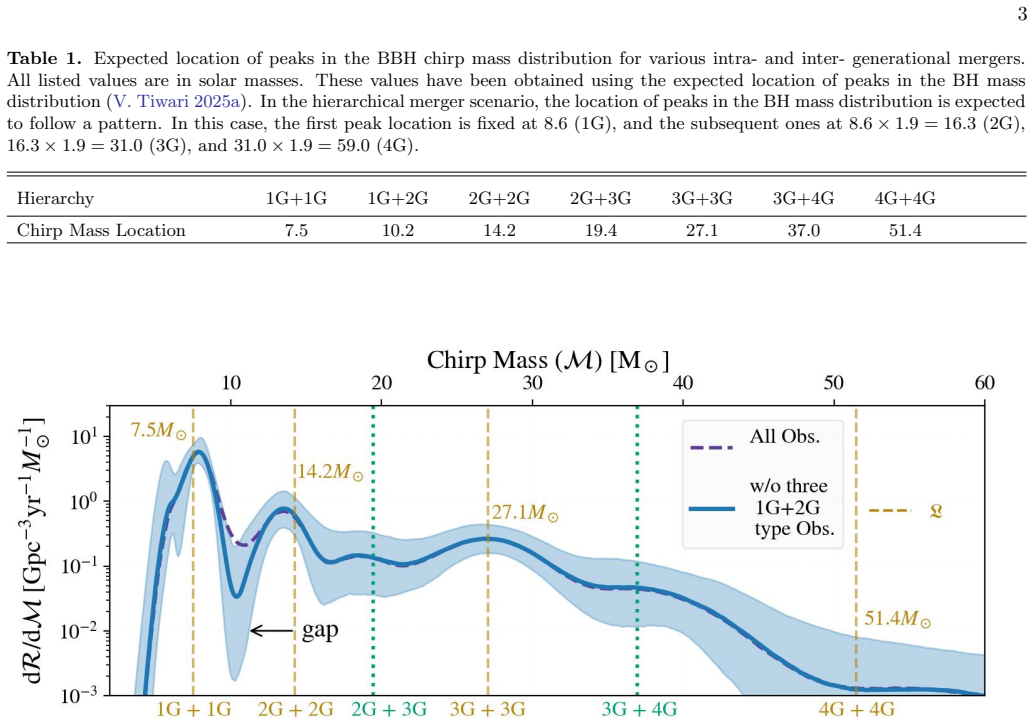
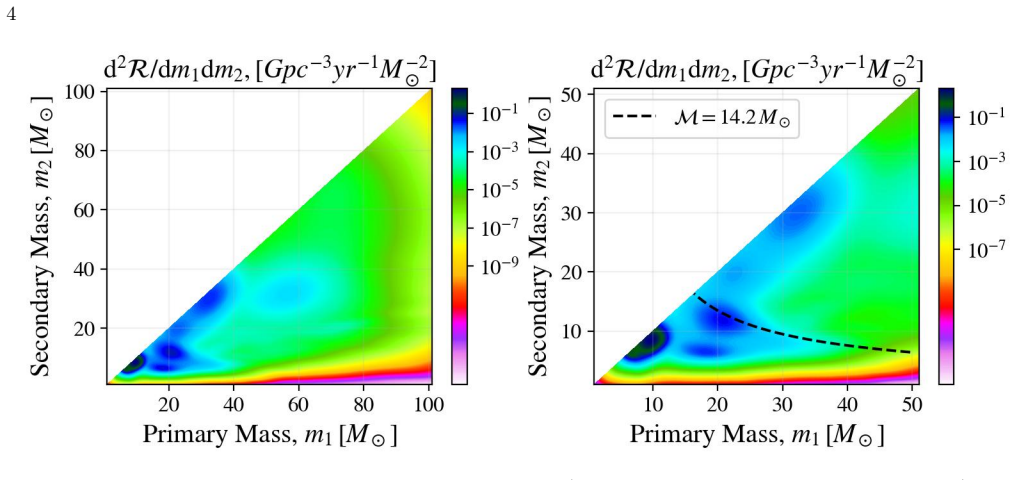
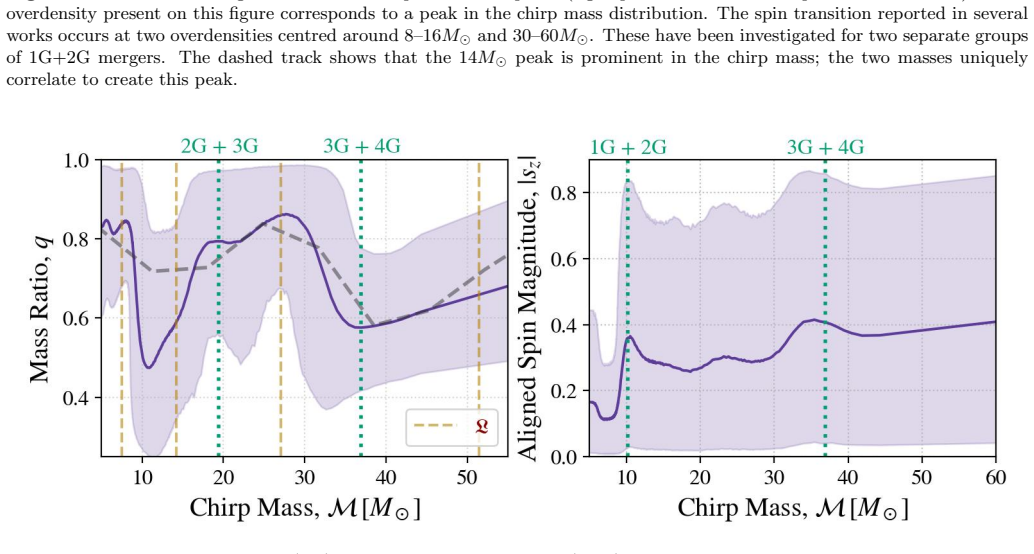
With the release of GWTC-5.0, the chirp-mass distribution of binary black holes reveals peaks at approximately 7.5, 14, 27, and now 19 solar masses, where each subsequent peak is roughly twice the previous. The hierarchical merger interpretation posits that the first peak comes from stellar-origin black holes, and higher peaks from repeated mergers of previous generations. The emergence of the 19 solar mass peak was specifically anticipated as arising from 2G+3G mergers, and the model also accounts for distinct groups of 1G+2G mergers as separate rungs, explaining spin transitions uniformly.
What carries the argument
The chirp-mass ladder, a sequence of peaks in the chirp-mass distribution separated by a factor of approximately two, arising from successive generations of hierarchical black hole mergers.
Load-bearing premise
The peaks in the chirp-mass distribution correspond to distinct generational populations of black holes rather than being artifacts of selection effects or measurement errors in the catalog.
What would settle it
Detailed population synthesis simulations or additional gravitational wave observations that fail to produce or detect a peak near 19 solar masses under the hierarchical merger assumptions would challenge the claim.
Figures
read the original abstract
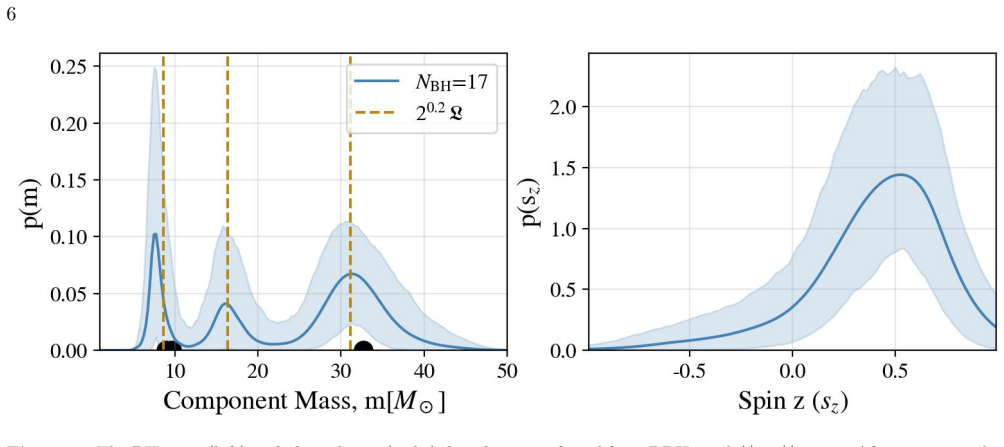
The population of binary black holes (BBHs) observed through gravitational waves (GWs) now includes around 250 events with the release of GWTC-5.0, enabling more detailed studies. The inferred chirp-mass distribution shows prominent peaks at approximately $7.5M_{\odot}$, $14M_{\odot}$, and $27M_{\odot}$, where the locations of subsequent peaks increase by approximately a factor of two. A parsimonious explanation for this structured distribution is a hierarchical merger scenario, in which the first peak arises from mergers of black holes of stellar origin, and higher-mass peaks arise from repeated mergers. Notably, with the addition of new observations, an intermediate peak near $19M_{\odot}$ emerges. This feature had been anticipated in earlier work as a consequence of intergenerational mergers involving second- and third-generation (G) black holes, thereby highlighting the predictive power of the hierarchical-merger interpretation. Furthermore, two groups of $1G+2G$ mergers recently reported in separate studies can be understood as distinct rungs -- $1G+2G$ and $3G+4G$ -- within this hierarchical chirp-mass ladder, a unification that describes both spin transitions with a single mechanism. Although expected correlations between mass ratios and spins are observed in multiple events across the mass range, the lack of clear signatures across all rungs invites investigation into the role of hierarchical mergers in shaping the \ac{BBH} population.
Editorial analysis
A structured set of objections, weighed in public.
Referee Report
Summary. The manuscript analyzes the chirp-mass distribution of ~250 binary black hole events in GWTC-5.0, reporting prominent peaks near 7.5, 14, 19, and 27 M⊙ that scale by a factor of ~2. It interprets the structure as a hierarchical-merger ladder in which the first peak corresponds to 1G stellar-origin black holes and higher peaks to repeated mergers, with the newly visible 19 M⊙ feature matching an earlier prediction for 2G+3G mergers. The work also unifies two reported 1G+2G groups as distinct rungs (1G+2G and 3G+4G) and notes observed mass-ratio–spin correlations across the mass range.
Significance. If the four-peak structure is shown to be statistically preferred over a smooth distribution after marginalizing over selection effects and measurement uncertainties, the result would constitute direct evidence that hierarchical mergers contribute measurably to the observed population and would demonstrate genuine predictive power of the ladder model. The unification of previously separate 1G+2G reports under a single mechanism would also be a notable organizational advance.
major comments (2)
- [Abstract and peak-identification section] The central claim that the 19 M⊙ feature confirms a prior prediction for 2G+3G mergers is load-bearing, yet the manuscript provides no quantitative model comparison, bootstrap, or posterior-predictive check demonstrating that a four-peak model is favored over a smooth distribution once GW selection biases (higher-mass events are easier to detect) and the 10–30 % fractional uncertainties on individual chirp masses are included. Without such a test the apparent rung could arise from binning choices or prior assumptions in the population inference.
- [Introduction and discussion of prior prediction] The claim of predictive power rests on the 19 M⊙ location matching an earlier forecast, but the text does not clarify whether that forecast was derived from an independent, parameter-free calculation or was informed by the same GWTC data used to identify the original peaks at 7.5, 14, and 27 M⊙; this distinction is required to assess circularity.
minor comments (2)
- Notation for generational labels (1G, 2G, …) should be defined explicitly on first use and used consistently.
- Figure showing the chirp-mass histogram or posterior should include the detection-efficiency curve or selection-function weighting to allow visual assessment of bias.
Simulated Author's Rebuttal
We thank the referee for their careful reading and constructive comments, which highlight important aspects of statistical rigor and clarity. We address each major comment below and outline revisions to strengthen the manuscript.
read point-by-point responses
-
Referee: [Abstract and peak-identification section] The central claim that the 19 M⊙ feature confirms a prior prediction for 2G+3G mergers is load-bearing, yet the manuscript provides no quantitative model comparison, bootstrap, or posterior-predictive check demonstrating that a four-peak model is favored over a smooth distribution once GW selection biases (higher-mass events are easier to detect) and the 10–30 % fractional uncertainties on individual chirp masses are included. Without such a test the apparent rung could arise from binning choices or prior assumptions in the population inference.
Authors: We agree that a formal statistical demonstration is needed to establish the preference for the four-peak structure. The current manuscript relies on visual identification in the inferred distribution but does not include bootstrap or posterior-predictive checks that marginalize over selection effects and chirp-mass uncertainties. In the revised manuscript we will add such analyses, including bootstrap resampling of the GWTC-5.0 catalog and posterior predictive checks that incorporate the known detection biases and 10–30% fractional uncertainties, to quantify the significance of the peaks relative to a smooth model. revision: yes
-
Referee: [Introduction and discussion of prior prediction] The claim of predictive power rests on the 19 M⊙ location matching an earlier forecast, but the text does not clarify whether that forecast was derived from an independent, parameter-free calculation or was informed by the same GWTC data used to identify the original peaks at 7.5, 14, and 27 M⊙; this distinction is required to assess circularity.
Authors: The 19 M⊙ prediction was generated from a parameter-free hierarchical-merger calculation applied to the peaks identified in earlier data releases (GWTC-2/GWTC-3) and published prior to the availability of GWTC-5.0; it did not use the events or population inference from the current catalog. We will revise the introduction and discussion sections to explicitly document the timeline and independence of this forecast, thereby removing any ambiguity regarding circularity. revision: yes
Circularity Check
19 M⊙ peak presented as independent prediction but follows by construction from the same ~2 scaling fitted to the 7.5/14/27 M⊙ peaks in prior work
specific steps
-
fitted input called prediction
[Abstract]
"Notably, with the addition of new observations, an intermediate peak near 19M⊙ emerges. This feature had been anticipated in earlier work as a consequence of intergenerational mergers involving second- and third-generation (G) black holes, thereby highlighting the predictive power of the hierarchical-merger interpretation."
The hierarchical model is fitted to the observed peaks at ~7.5, 14, and 27 M⊙ whose locations 'increase by approximately a factor of two.' The 19 M⊙ location is then the direct arithmetic interpolation (roughly halfway in log-space between 14 and 27) under the same scaling; calling its appearance a 'prediction' from earlier work therefore reduces to re-applying the already-fitted relation rather than an independent forecast.
full rationale
The paper's central claim of predictive power rests on the 19 M⊙ feature matching an earlier anticipation for 2G+3G mergers. However, the locations of all peaks are stated to increase by a factor of approximately two, so the intermediate rung is a direct arithmetic consequence of the same scaling relation already fitted to the original three peaks. No parameter-free derivation or external benchmark is shown that would make the 19 M⊙ location an independent test rather than a retrodiction of the fitted ladder. This matches the 'fitted input called prediction' pattern and raises the circularity score to 6; the remainder of the manuscript (spin correlations, unification of reported groups) does not introduce additional circular steps.
Axiom & Free-Parameter Ledger
free parameters (1)
- mass-doubling factor
axioms (1)
- domain assumption The prominent peaks in the chirp-mass distribution correspond to distinct generational populations rather than artifacts of detector sensitivity or catalog construction.
Reference graph
Works this paper leans on
-
[1]
An introduction to Bayesian inference in gravitational-wave astronomy: Parameter estimation, model selection, and hierarchical models. Publ. Astron. Soc. Aust. , keywords =. doi:10.1017/pasa.2019.2 , archivePrefix =. 1809.02293 , primaryClass =
-
[2]
Digging the population of compact binary mergers out of the noise. Mon. Not. R. Astron. Soc. , keywords =. doi:10.1093/mnras/stz225 , archivePrefix =. 1809.03815 , primaryClass =
work page internal anchor Pith review Pith/arXiv arXiv doi:10.1093/mnras/stz225
-
[3]
arXiv e-prints , keywords =
Inferring the population properties of binary black holes from unresolved gravitational waves. arXiv e-prints , keywords =
-
[4]
arXiv e-prints , keywords =
Gravitational-wave inference in the catalog era: evolving priors and marginal events. arXiv e-prints , keywords =
-
[5]
Unmodelled clustering methods for gravitational wave populations of compact binary mergers. Mon. Not. R. Astron. Soc. , keywords =. doi:10.1093/mnras/stz1938 , archivePrefix =. 1905.04825 , primaryClass =
work page internal anchor Pith review Pith/arXiv arXiv doi:10.1093/mnras/stz1938 1905
-
[6]
Does the Black Hole Merger Rate Evolve with Redshift?
Does the Black Hole Merger Rate Evolve with Redshift?. Astrophys. J. Lett. , keywords =. doi:10.3847/2041-8213/aad800 , archivePrefix =. 1805.10270 , primaryClass =
work page internal anchor Pith review Pith/arXiv arXiv doi:10.3847/2041-8213/aad800 2041
-
[7]
Measuring the binary black hole mass spectrum with an astrophysically motivated parameterization
Measuring the Binary Black Hole Mass Spectrum with an Astrophysically Motivated Parameterization. , keywords =. doi:10.3847/1538-4357/aab34c , archivePrefix =. 1801.02699 , primaryClass =
work page internal anchor Pith review Pith/arXiv arXiv doi:10.3847/1538-4357/aab34c
-
[8]
Binary Black Hole Mergers in the first Advanced LIGO Observing Run
Binary Black Hole Mergers in the First Advanced LIGO Observing Run. Physical Review X , keywords =. doi:10.1103/PhysRevX.6.041015 , archivePrefix =. 1606.04856 , primaryClass =
work page internal anchor Pith review Pith/arXiv arXiv doi:10.1103/physrevx.6.041015
-
[9]
Constraints on binary black hole populations from LIGO-Virgo detections. Mon. Not. R. Astron. Soc. , keywords =. doi:10.1093/mnras/stz226 , archivePrefix =. 1806.10610 , primaryClass =
work page internal anchor Pith review Pith/arXiv arXiv doi:10.1093/mnras/stz226
-
[10]
The Black Hole Mass Function from Gravitational Wave Measurements
Black hole mass function from gravitational wave measurements. , keywords =. doi:10.1103/PhysRevD.95.103010 , archivePrefix =. 1611.01157 , primaryClass =
work page internal anchor Pith review Pith/arXiv arXiv doi:10.1103/physrevd.95.103010
-
[11]
Binary Black Hole Population Properties Inferred from the First and Second Observing Runs of Advanced LIGO and Advanced Virgo. Astrophys. J. Lett. , keywords =. doi:10.3847/2041-8213/ab3800 , archivePrefix =. 1811.12940 , primaryClass =
-
[12]
Reconstructing phenomenological distributions of compact binaries via gravitational wave observations. , keywords =. doi:10.1103/PhysRevD.100.043012 , archivePrefix =. 1805.06442 , primaryClass =
-
[13]
Redner and Homer F
Richard A. Redner and Homer F. Walker , journal =. Mixture Densities, Maximum Likelihood and the Em Algorithm , volume =
-
[14]
Reynolds, Douglas. Gaussian Mixture Models. Encyclopedia of Biometrics. 2009. doi:10.1007/978-0-387-73003-5_196
-
[15]
and Smith, A.F.M
Titterington, D.M. and Smith, A.F.M. and Makov, U.E. , biburl =
-
[16]
S. J. IEEE Transactions on Pattern Analysis and Machine Intelligence , title=. 1998 , volume=
1998
-
[17]
Sociological Methods & Research , volume =
Jouni Kuha , title =. Sociological Methods & Research , volume =. 2004 , doi =
2004
-
[18]
Proceedings of the 12th International Conference on Neural Information Processing Systems , pages =
Rasmussen, Carl Edward , title =. Proceedings of the 12th International Conference on Neural Information Processing Systems , pages =. 1999 , publisher =
1999
-
[19]
GWTC-1: A Gravitational-Wave Transient Catalog of Compact Binary Mergers Observed by LIGO and Virgo during the First and Second Observing Runs. Physical Review X , keywords =. doi:10.1103/PhysRevX.9.031040 , archivePrefix =. 1811.12907 , primaryClass =
work page internal anchor Pith review Pith/arXiv arXiv doi:10.1103/physrevx.9.031040
-
[20]
Gravitational-Wave Candidate Event Database , howpublished =
-
[21]
Parameter estimation sample release , howpublished =
-
[22]
Gravitational Wave Open Science Center , howpublished =
-
[23]
Constraining the Inclination of Binary Mergers from Gravitational-wave Observations
Constraining the Inclinations of Binary Mergers from Gravitational-wave Observations. , keywords =. doi:10.3847/1538-4357/ab0b3e , archivePrefix =. 1809.10727 , primaryClass =
work page internal anchor Pith review Pith/arXiv arXiv doi:10.3847/1538-4357/ab0b3e
-
[24]
Cutler, Curt and Flanagan, Eanna E. , title =. Phys. Rev. D , volume =. 1994 , pages =. doi:10.1103/PhysRevD.49.2658 , eprint =
-
[25]
, Eprint =
Poisson, Eric and Will, Clifford M. , Eprint =. Gravitational waves from inspiraling compact binaries: Parameter estimation using second post. Phys. Rev. D , Pages =. 1995 , Url =
1995
-
[26]
and Fairhurst, S
Baird, E. and Fairhurst, S. and Hannam, M. , Url =. Phys. Rev. D , Pages =
-
[27]
Constraining the Black Hole Initial Mass Function with LIGO/VIRGO Observations
Constraining the Black Hole Initial Mass Function with LIGO/Virgo Observations. Astrophys. J. Lett. , keywords =. doi:10.3847/2041-8213/ab2336 , archivePrefix =. 1901.03345 , primaryClass =
work page internal anchor Pith review Pith/arXiv arXiv doi:10.3847/2041-8213/ab2336 2041
-
[28]
Extracting distribution parameters from multiple uncertain observations with selection biases. Mon. Not. R. Astron. Soc. , keywords =. doi:10.1093/mnras/stz896 , archivePrefix =. 1809.02063 , primaryClass =
work page internal anchor Pith review Pith/arXiv arXiv doi:10.1093/mnras/stz896
-
[29]
Constraining black-hole spins with gravitational wave observations
Constraining Black Hole Spins with Gravitational-wave Observations. , keywords =. doi:10.3847/1538-4357/aae8df , archivePrefix =. 1809.01401 , primaryClass =
work page internal anchor Pith review Pith/arXiv arXiv doi:10.3847/1538-4357/aae8df
-
[30]
and others , Journal =
Usman, Samantha A. and others , Journal =. 2016 , Url =
2016
-
[31]
2017 , Url =
Messick, Cody and others , Journal =. 2017 , Url =
2017
-
[32]
Estimation of the sensitive volume for gravitational-wave source populations using weighted Monte Carlo integration. Classical and Quantum Gravity , keywords =. doi:10.1088/1361-6382/aac89d , archivePrefix =. 1712.00482 , primaryClass =
work page internal anchor Pith review Pith/arXiv arXiv doi:10.1088/1361-6382/aac89d
-
[33]
Distinguishing Spin-Aligned and Isotropic Black Hole Populations With Gravitational Waves
Distinguishing spin-aligned and isotropic black hole populations with gravitational waves. , keywords =. doi:10.1038/nature23453 , archivePrefix =. 1706.01385 , primaryClass =
work page internal anchor Pith review Pith/arXiv arXiv doi:10.1038/nature23453
-
[34]
Using spin to understand the formation of LIGO's black holes
Using Spin to Understand the Formation of LIGO and Virgo s Black Holes. Astrophys. J. Lett. , keywords =. doi:10.3847/2041-8213/aaaa64 , archivePrefix =. 1709.07896 , primaryClass =
work page internal anchor Pith review Pith/arXiv arXiv doi:10.3847/2041-8213/aaaa64 2041
-
[35]
Hastings, W. K. , title = ". Biometrika , volume =. 1970 , month =. doi:10.1093/biomet/57.1.97 , url =
-
[36]
Parameter estimation for compact binaries with ground-based gravitational-wave observations using the LALInference software library. , keywords =. doi:10.1103/PhysRevD.91.042003 , archivePrefix =. 1409.7215 , primaryClass =
work page internal anchor Pith review Pith/arXiv arXiv doi:10.1103/physrevd.91.042003
-
[37]
and Singpurwalla, N
Irony, T., Z. and Singpurwalla, N. D. , title = ". Journal of Statistical Planning and Inference , volume =. 1997 , url =
1997
-
[38]
Model-independent inference on compact-binary observations. Mon. Not. R. Astron. Soc. , keywords =. doi:10.1093/mnras/stw2883 , archivePrefix =. 1608.08223 , primaryClass =
work page internal anchor Pith review Pith/arXiv arXiv doi:10.1093/mnras/stw2883
-
[39]
Lemmon, Alan R and Moriarty, Emily C , title = ". Systematic Biology , volume =. 2004 , month =. doi:10.1080/10635150490423520 , url =
-
[40]
Wavelets and Operators , volume=
Meyer, Yves , editor=. Wavelets and Operators , volume=. 1993 , collection=. doi:10.1017/CBO9780511623820 , publisher=
-
[41]
Gravitational-Radiation Damping of Compact Binary Systems to Second Post-Newtonian order
Gravitational-Radiation Damping of Compact Binary Systems to Second Post-Newtonian Order. , keywords =. doi:10.1103/PhysRevLett.74.3515 , archivePrefix =. gr-qc/9501027 , primaryClass =
work page internal anchor Pith review Pith/arXiv arXiv doi:10.1103/physrevlett.74.3515
-
[42]
Gravitational waveforms from inspiralling compact binaries to second-post-Newtonian order
Gravitational waveforms from inspiralling compact binaries to second-post-Newtonian order. Classical and Quantum Gravity , keywords =. doi:10.1088/0264-9381/13/4/002 , archivePrefix =. gr-qc/9602024 , primaryClass =
work page internal anchor Pith review Pith/arXiv arXiv doi:10.1088/0264-9381/13/4/002
-
[43]
Damour, Thibault , Title =. Phys. Rev. D , Volume =
-
[44]
Reconstruction of Chirp Mass in the Search of Compact Binaries
Reconstruction of chirp mass in searches for gravitational wave transients. Classical and Quantum Gravity , keywords =. doi:10.1088/0264-9381/33/1/01LT01 , archivePrefix =. 1510.02426 , primaryClass =
work page internal anchor Pith review Pith/arXiv arXiv doi:10.1088/0264-9381/33/1/01lt01
-
[45]
The Low Effective Spin of Binary Black Holes and Implications for Individual Gravitational-wave Events. , keywords =. doi:10.3847/1538-4357/ab80c0 , archivePrefix =. 2001.06051 , primaryClass =
-
[46]
arXiv e-prints , keywords =
Black hole genealogy: Identifying hierarchical mergers with gravitational waves. arXiv e-prints , keywords =
-
[47]
Label switching problem in Bayesian analysis for gravitational wave astronomy. , keywords =. doi:10.1103/PhysRevD.100.084041 , archivePrefix =. 1907.11631 , primaryClass =
-
[48]
arXiv e-prints , keywords =
Measuring gravitational-wave higher-order modes. arXiv e-prints , keywords =
-
[49]
When will we observe binary black holes precessing?. , keywords =. doi:10.1103/PhysRevD.102.041302 , archivePrefix =. 1908.00555 , primaryClass =
-
[50]
Impact of Bayesian prior on the characterization of binary black hole coalescences
Impact of Bayesian Priors on the Characterization of Binary Black Hole Coalescences. , keywords =. doi:10.1103/PhysRevLett.119.251103 , archivePrefix =. 1707.04637 , primaryClass =
work page internal anchor Pith review Pith/arXiv arXiv doi:10.1103/physrevlett.119.251103
-
[51]
Parameter Estimation for Binary Neutron-star Coalescences with Realistic Noise during the Advanced LIGO Era. , keywords =. doi:10.1088/0004-637X/804/2/114 , archivePrefix =. 1411.6934 , primaryClass =
work page internal anchor Pith review Pith/arXiv arXiv doi:10.1088/0004-637x/804/2/114
-
[52]
Effective Sample Size for Importance Sampling based on discrepancy measures
Martino, Luca and Elvira Victor and Carlos, S. Effective sample size for importance sampling based on discrepancy measures. Signal Processing-Elsevier , year = "2017", month = "February", number =. doi:https://doi.org/10.1016/j.sigpro.2016.08.025 , archivePrefix =. 1602.03572v5 , primaryClass =
work page internal anchor Pith review Pith/arXiv arXiv doi:10.1016/j.sigpro.2016.08.025 2017
-
[57]
arXiv e-prints , keywords =
Binary Black Hole Mergers from LIGO/Virgo O1 and O2: Population Inference Combining Confident and Marginal Events. arXiv e-prints , keywords =
-
[58]
2020 b , Physical Review D, 102, 10.1103/physrevd.102.043015
GW190412: Observation of a Binary-Black-Hole Coalescence with Asymmetric Masses. , keywords =. doi:10.1103/PhysRevD.102.043015 , archivePrefix =. 2004.08342 , primaryClass =
-
[59]
GW190814: Gravitational Waves from the Coalescence of a 23 Solar Mass Black Hole with a 2.6 Solar Mass Compact Object. , keywords =. doi:10.3847/2041-8213/ab960f , archivePrefix =. 2006.12611 , primaryClass =
work page internal anchor Pith review Pith/arXiv arXiv doi:10.3847/2041-8213/ab960f 2041
-
[60]
GW190425: Observation of a Compact Binary Coalescence with Total Mass 3.4 M_. , keywords =. doi:10.3847/2041-8213/ab75f5 , archivePrefix =. 2001.01761 , primaryClass =
-
[61]
2020 a , Physical Review Letters, 125, 10.1103/PhysRevLett.125.101102
GW190521: A Binary Black Hole Merger with a Total Mass of 150 M_. , year = 2020, month = sep, volume =. doi:10.1103/PhysRevLett.125.101102 , adsurl =
-
[62]
Miller, M. C. and Miller, J. M. , title = ". Phys. Rep. , note =. 2015
2015
-
[63]
Astrophys.J. , Pages =. 2009 , Bdsk-Url-1 =. doi:10.1088/0004-637X/697/1/900 , Eprint =
-
[64]
Class. Quantum Grav. , Pages =. 2011 , Bdsk-Url-1 =. doi:10.1088/0264-9381/28/11/114009 , Eprint =
-
[65]
McClintock and Rebecca Shafee and Ramesh Narayan and Ronald A
Jeffrey E. McClintock and Rebecca Shafee and Ramesh Narayan and Ronald A. Remillard and Shane W. Davis and Li-Xin Li , Journal =. 2006 , Bdsk-Url-1 =
2006
-
[66]
and others , Journal =
Gou, L. and others , Journal =
-
[67]
Black Hole Coagulation: Modeling Hierarchical Mergers in Black Hole Populations. , keywords =. doi:10.3847/1538-4357/ab7fac , archivePrefix =. 1911.04424 , primaryClass =
-
[68]
arXiv e-prints , keywords =
Merger rate of black hole binaries from globular clusters: theoretical error bars and comparison to gravitational wave data. arXiv e-prints , keywords =
-
[69]
The Nucleosynthetic Signature of Population III
The Nucleosynthetic Signature of Population III. , keywords =. doi:10.1086/338487 , archivePrefix =. astro-ph/0107037 , primaryClass =
work page internal anchor Pith review Pith/arXiv arXiv doi:10.1086/338487
-
[70]
Classical and Quantum Gravity , keywords =
A self-consistent method to estimate the rate of compact binary coalescences with a Poisson mixture model. Classical and Quantum Gravity , keywords =. doi:10.1088/1361-6382/ab5f2d , archivePrefix =. 1903.06881 , primaryClass =
-
[71]
Extended maximum likelihood
Barlow, Roger. Extended maximum likelihood. Nucl. Instr. and Meth
-
[72]
The spin of the second-born black hole in coalescing binary black holes
The spin of the second-born black hole in coalescing binary black holes. , keywords =. doi:10.1051/0004-6361/201832839 , archivePrefix =. 1802.05738 , primaryClass =
work page internal anchor Pith review Pith/arXiv arXiv doi:10.1051/0004-6361/201832839
-
[73]
arXiv e-prints , keywords =
Applying Cosmological Principle to Better Probe the Redshift Evolution of Binary Black Hole Merger Rate. arXiv e-prints , keywords =
-
[74]
Journal of the American Statistical Association , volume =
Siddhartha Chib and Ivan Jeliazkov , title =. Journal of the American Statistical Association , volume =. 2001 , publisher =. doi:10.1198/016214501750332848 , URL =
-
[75]
VAMANA github address , howpublished =
-
[76]
GWTC-2: Compact Binary Coalescences Observed by LIGO and Virgo during the First Half of the Third Observing Run. Physical Review X , keywords =. doi:10.1103/PhysRevX.11.021053 , archivePrefix =. 2010.14527 , primaryClass =
work page internal anchor Pith review Pith/arXiv arXiv doi:10.1103/physrevx.11.021053 2010
-
[77]
GWTC-2.1: Deep extended catalog of compact binary coalescences observed by LIGO and Virgo during the first half of the third observing run. , keywords =. doi:10.1103/PhysRevD.109.022001 , archivePrefix =. 2108.01045 , primaryClass =
work page internal anchor Pith review Pith/arXiv arXiv doi:10.1103/physrevd.109.022001
-
[78]
GWTC-3: Compact Binary Coalescences Observed by LIGO and Virgo during the Second Part of the Third Observing Run. Physical Review X , keywords =. doi:10.1103/PhysRevX.13.041039 , archivePrefix =. 2111.03606 , primaryClass =
work page internal anchor Pith review Pith/arXiv arXiv doi:10.1103/physrevx.13.041039
-
[79]
The Emergence of Structure in the Binary Black Hole Mass Distribution. , keywords =. doi:10.3847/2041-8213/abfbe7 , archivePrefix =. 2011.04502 , primaryClass =
-
[80]
Exploring Features in the Binary Black Hole Population. , keywords =. doi:10.3847/1538-4357/ac589a , archivePrefix =. 2111.13991 , primaryClass =
-
[81]
Apples and Oranges: Comparing Black Holes in X-Ray Binaries and Gravitational-wave Sources. , keywords =. doi:10.3847/2041-8213/ac64a5 , archivePrefix =. 2111.02935 , primaryClass =
-
[82]
Classical and Quantum Gravity , keywords =
VAMANA: modeling binary black hole population with minimal assumptions. Classical and Quantum Gravity , keywords =. doi:10.1088/1361-6382/ac0b54 , archivePrefix =. 2006.15047 , primaryClass =
-
[83]
arXiv e-prints , keywords =
Cover Your Basis: Comprehensive Data-Driven Characterization of the Binary Black Hole Population. arXiv e-prints , keywords =
-
[84]
The population of merging compact binaries inferred using gravitational waves through GWTC-3
Population of Merging Compact Binaries Inferred Using Gravitational Waves through GWTC-3. Physical Review X , keywords =. doi:10.1103/PhysRevX.13.011048 , archivePrefix =. 2111.03634 , primaryClass =
work page internal anchor Pith review Pith/arXiv arXiv doi:10.1103/physrevx.13.011048
discussion (0)
Sign in with ORCID, Apple, or X to comment. Anyone can read and Pith papers without signing in.