Sixteen-Fold Way for Fermionic Topological Orders
Pith reviewed 2026-06-30 09:08 UTC · model grok-4.3
The pith
A sixteen-fold family of fermionic topological orders is distinguished by the mod-16 anomaly of a Z2 one-form symmetry generated by a single nontrivial Z2 anyon.
A machine-rendered reading of the paper's core claim, the machinery that carries it, and where it could break.
Core claim
The central claim is that fermionic topological orders host a new sixteen-fold family distinguished by the mod 16 't Hooft anomaly of a Z2 one-form symmetry generated by a single nontrivial Z2 anyon. This anomaly is intrinsically fermionic and permits anyon spins forbidden in bosonic phases, such as a single Z2 Abelian anyon with spin 1/8. Each member of the family can be realized as the gapped boundary of a (3+1)D fermionic SPT phase protected by the Z2 one-form symmetry, acquiring a Z16 classification under twisted spin structure. The phases are constructed microscopically from Walker-Wang models coupled to local fermions.
What carries the argument
The mod 16 't Hooft anomaly of the Z2 one-form symmetry generated by a single nontrivial Z2 anyon, which distinguishes the family and enables new anyon spins.
If this is right
- The anomaly permits anyon spins forbidden in bosonic topological orders.
- Each theory realizes as gapped boundary of (3+1)D fermionic SPT phase with Z16 classification under twisted spin structure.
- Microscopic realization via lattice models from Walker-Wang models coupled to local fermions.
- Forms a fermionic analogue of Kitaev's sixteen-fold way.
Where Pith is reading between the lines
- Experimental searches for topological orders could focus on detecting this specific anomaly through boundary states or response functions.
- The classification may generalize to other symmetries or dimensions, leading to broader families of fermionic phases.
- Twisting the spin structure provides a new way to classify higher-dimensional SPT phases.
- One could test by attempting to construct the simplest example with spin 1/8 anyon and measure its properties.
Load-bearing premise
That the mod-16 't Hooft anomaly of the Z2 one-form symmetry generated by a single nontrivial Z2 anyon is sufficient to distinguish the sixteen-fold family and allows the forbidden anyon spins.
What would settle it
Finding a fermionic topological order with a Z2 anyon of spin 1/8 that does not exhibit the expected mod 16 anomaly, or failing to realize any member as a boundary of the corresponding (3+1)D SPT phase.
Figures
read the original abstract
Fermionic topological orders can host 't Hooft anomalies with no bosonic counterpart. We identify a new sixteen-fold family of (2+1)D fermionic topological orders, forming a fermionic analogue of Kitaev's sixteen-fold way. This family is distinguished by the mod 16 't Hooft anomaly of a $\mathbb{Z}_2$ one-form symmetry, generated in each theory by a single nontrivial $\mathbb{Z}_2$ anyon. This intrinsically fermionic anomaly permits anyon spins that are forbidden in bosonic phases; the simplest new example is an Abelian fermionic topological order containing a single $\mathbb{Z}_2$ Abelian anyon of spin 1/8. Each theory can be realized as the gapped boundary of a (3+1)D fermionic symmetry-protected topological (SPT) phase protected by the $\mathbb{Z}_2$ one-form symmetry, which acquires a $\mathbb{Z}_{16}$ classification once the spacetime spin structure is twisted by the one-form symmetry. We realize these phases microscopically via lattice models built from Walker-Wang models coupled to local fermions.
Editorial analysis
A structured set of objections, weighed in public.
Referee Report
Summary. The paper identifies a sixteen-fold family of (2+1)D fermionic topological orders that forms a fermionic analogue of Kitaev's sixteen-fold way. The family is distinguished by the mod-16 't Hooft anomaly of a Z2 one-form symmetry generated by a single nontrivial Z2 anyon. This anomaly permits anyon spins forbidden in bosonic theories (e.g., a Z2 anyon with spin 1/8). Each member is realized as the gapped boundary of a (3+1)D fermionic SPT phase whose classification becomes Z16 once the spacetime spin structure is twisted by the one-form symmetry. Explicit microscopic realizations are constructed from Walker-Wang models coupled to local fermions.
Significance. If the central claims hold, the work provides a concrete classification and set of constructions for intrinsically fermionic topological orders, extending the bosonic sixteen-fold way and linking (2+1)D anomalies directly to (3+1)D SPT phases via twisted spin structures. The explicit lattice constructions constitute a notable strength, supplying microscopic support that is often absent in anomaly-based classifications.
minor comments (2)
- A summary table listing the 16 theories, their anyon content, spins, and explicit anomaly values would improve readability and allow direct comparison with the bosonic case.
- The introduction would benefit from a short paragraph recalling the key features of Walker-Wang models and how local fermions are coupled, for readers outside the immediate subfield.
Simulated Author's Rebuttal
We thank the referee for their careful reading and positive evaluation of our manuscript. We are pleased that the central claims regarding the sixteen-fold family of fermionic topological orders, their anomaly characterization, and the explicit lattice constructions were viewed favorably. The recommendation for minor revision is noted; however, no specific major comments were provided in the report, so we have no points requiring substantive rebuttal or revision at this stage.
Circularity Check
No significant circularity
full rationale
The abstract and provided claims present the sixteen-fold family as distinguished by an independently defined mod-16 't Hooft anomaly of a Z2 one-form symmetry, with explicit microscopic realizations via Walker-Wang models coupled to fermions and boundary realizations of Z16-classified SPT phases. No equations, fitted parameters, or self-citations are quoted that reduce any central claim to a definition or input by construction. The derivation chain relies on anomaly theory and lattice constructions that are presented as external support rather than tautological. This is the expected non-finding for a paper whose core result is a classification backed by explicit models.
Axiom & Free-Parameter Ledger
axioms (2)
- domain assumption Standard 't Hooft anomaly matching and properties of anyons in fermionic topological orders
- domain assumption Existence of a Z16 classification for (3+1)D fermionic SPT phases with twisted spin structure
Reference graph
Works this paper leans on
-
[1]
Symmetry protected topological orders and the group cohomology of their symmetry group
X. Chen, Z.-C. Gu, Z.-X. Liu, and X.-G. Wen, Phys. Rev. B87, 155114 (2013), arXiv:1106.4772 [cond- mat.str-el]. 6
work page internal anchor Pith review Pith/arXiv arXiv 2013
-
[2]
Barkeshli, P
M. Barkeshli, P. Bonderson, M. Cheng, and Z. Wang, Phys. Rev. B100, 115147 (2019)
2019
-
[3]
D. Gaiotto, A. Kapustin, N. Seiberg, and B. Willett, JHEP02, 172 (2015), arXiv:1412.5148 [hep-th]
work page internal anchor Pith review Pith/arXiv arXiv 2015
-
[4]
Fidkowski and A
L. Fidkowski and A. Kitaev, Phys. Rev. B83, 075103 (2011)
2011
-
[5]
Gu and X.-G
Z.-C. Gu and X.-G. Wen, Phys. Rev. B90, 115141 (2014)
2014
-
[6]
Q.-R. Wang and Z.-C. Gu, Physical Review X10(2020), 10.1103/physrevx.10.031055
-
[7]
Kapustin, R
A. Kapustin, R. Thorngren, A. Turzillo, and Z. Wang, Journal of High Energy Physics2015, 1–21 (2015)
2015
-
[8]
Barkeshli, Y.-A
M. Barkeshli, Y.-A. Chen, P.-S. Hsin, and N. Manju- nath, Phys. Rev. B105, 235143 (2022)
2022
-
[9]
L. Bhardwaj, D. Gaiotto, and A. Kapustin, Journal of High Energy Physics2017(2017), 10.1007/JHEP04(2017)096
-
[10]
X. Chen, L. Fidkowski, and A. Vishwanath, Physical Review B89(2014), 10.1103/physrevb.89.165132
-
[11]
The "Parity" Anomaly On An Unorientable Manifold
E. Witten, Phys. Rev.B94, 195150 (2016), arXiv:1605.02391 [hep-th]
work page internal anchor Pith review Pith/arXiv arXiv 2016
-
[12]
R. Kobayashi, K. Ohmori, and Y. Tachikawa, Journal of High Energy Physics2019(2019), 10.1007/jhep11(2019)131
-
[13]
S. Tata, R. Kobayashi, D. Bulmash, and M. Barkeshli, Communications in Mathematical Physics397, 199–336 (2022)
2022
-
[14]
D. Tong and C. Turner, SciPost Physics Lecture Notes (2020), 10.21468/scipostphyslectnotes.14
-
[15]
I. Hason, Z. Komargodski, and R. Thorngren, SciPost Physics8(2020), 10.21468/scipostphys.8.4.062
-
[16]
Kitaev, Annals of Physics321, 2 (2006)
A. Kitaev, Annals of Physics321, 2 (2006)
2006
-
[17]
Since the fermionfis local, the corre- sponding symmetry operatorD τ / √ 2 up to normaliza- tion generates an invertibleZ 2 symmetry in the anti- periodic sector
This is reminiscent of the chiralZ 2 symmetry in a non- chiral Majorana fermion in (1+1)D; its symmetry defect carries a Majorana zero mode and has the fusion rule τ⊗τ= 1⊕f. Since the fermionfis local, the corre- sponding symmetry operatorD τ / √ 2 up to normaliza- tion generates an invertibleZ 2 symmetry in the anti- periodic sector. Therefore this fusio...
-
[18]
Spin TQFTs and fermionic phases of matter
D. Gaiotto and A. Kapustin, Int. J. Mod. Phys. A31, 1645044 (2016), arXiv:1505.05856 [cond-mat.str-el]
work page internal anchor Pith review Pith/arXiv arXiv 2016
-
[19]
D. Aasen, E. Lake, and K. Walker, Journal of Mathe- matical Physics60(2019), 10.1063/1.5045669
-
[20]
In this Letter, the Chern insulator denotes two copies of p+ip superconductors withU(1) symmetry forgotten
-
[21]
R. Thorngren, “Anomalies and bosonization,” (2019), arXiv:1810.04414 [cond-mat.str-el]
work page internal anchor Pith review Pith/arXiv arXiv 2019
-
[22]
D. Delmastro, D. Gaiotto, and J. Gomis, Journal of High Energy Physics2021(2021), 10.1007/jhep11(2021)142
-
[23]
Supplemental ma- terial — sixteen-fold way for fermionic topological or- ders,
R. Kobayashi, A. Prem, and M. Yu, “Supplemental ma- terial — sixteen-fold way for fermionic topological or- ders,”
-
[24]
Guillou and A
L. Guillou and A. Marin, `A la recherche de la topologie perdue, Progr. Math., 62, 97 (1986)
1986
-
[25]
Kirby and L
R. Kirby and L. Taylor, Geometry of low-dimensional manifolds , 177 (1989)
1989
-
[26]
(3+1)-TQFTs and Topological Insulators
K. Walker and Z. Wang, “(3+1)-tqfts and topological insulators,” (2012), arXiv:1104.2632 [cond-mat.str-el]
work page internal anchor Pith review Pith/arXiv arXiv 2012
-
[27]
Y.-A. Chen and S. Tata, Journal of Mathematical Physics64(2023), 10.1063/5.0095189
-
[28]
Unlike in the case of boson condensation, the objects in an orbit for a fermionic condensation differ by spin 1/2 [34]
-
[29]
A geometric proof of Rochlin’s theorem,
M. Freedman and R. Kirby, “A geometric proof of Rochlin’s theorem,” Providence, RI (1978), 85–97 pp., (Stanford University, CA, August 2–21, 1976). MR:0520525. Zbl:0392.57018
-
[30]
Mutual Influence of Symmetries and Topological Field Theories
D. Teixeira and M. Yu, (2025), arXiv:2507.06304 [math- ph]
work page internal anchor Pith review Pith/arXiv arXiv 2025
-
[31]
D. V. Else and C. Nayak, Phys. Rev. B90, 235137 (2014), arXiv:1409.5436 [cond-mat.str-el]
work page internal anchor Pith review Pith/arXiv arXiv 2014
-
[32]
Y. Feng, R. Kobayashi, Y.-A. Chen, and S. Ryu, Phys- ical Review Letters136(2026), 10.1103/2jz1-m1lb
-
[33]
Bhardwaj, K
L. Bhardwaj, K. Inamura, and A. Tiwari, SciPost Phys. 18, 194 (2025)
2025
- [34]
-
[35]
Kobayashi, Journal of High Energy Physics12, 014 (2019), arXiv:1905.05902
R. Kobayashi, Journal of High Energy Physics12, 014 (2019), arXiv:1905.05902
-
[36]
A. Kapustin and R. Thorngren, Journal of High Energy Physics2017(2017), 10.1007/jhep10(2017)080
-
[37]
M. A. Levin and X.-G. Wen, Physical Review B71 (2005), 10.1103/physrevb.71.045110
-
[38]
P. Bruillard, C. Galindo, T. Hagge, S.-H. Ng, J. Y. Plavnik, E. C. Rowell, and Z. Wang, Journal of Math- ematical Physics58(2017), 10.1063/1.4982048
-
[39]
Johnson-Freyd and D
T. Johnson-Freyd and D. Reutter, Journal of the Amer- ican Mathematical Society37, 81–150 (2023)
2023
- [40]
-
[41]
Namely, we consider Σ 2IC×(τ≤2ko)
Supercohomology is a generalized cohomology theory that can be defined using a shifted Pontryagin dual of the truncation ofkoto homotopy groups in degree less than or equal to 2. Namely, we consider Σ 2IC×(τ≤2ko). In low degrees, twisted supercohomology is equivalent to twisted spin bordism. However the two differ in higher degrees. For the reader that is...
-
[42]
(3+1)d topological orders with only aZ 2-charged particle,
T. Johnson-Freyd, “(3+1)d topological orders with only aZ 2-charged particle,” (2020), arXiv:2011.11165 [math.QA]
-
[43]
M. Barkeshli, P.-S. Hsin, and R. Kobayashi, SciPost Phys.16, 122 (2024), arXiv:2311.05674 [cond-mat.str- el]
-
[44]
X. Yang and M. Cheng, Physical Review B110(2024), 10.1103/physrevb.110.045137
-
[45]
R. C. Kirby and L. R. Taylor, in Geometry of low-dimensional manifolds, 2 (Durham, 1989), London Math. Soc. Lecture Note Ser., Vol. 151 (Cam- bridge Univ. Press, Cambridge, 1990) pp. 177–242
1989
- [46]
- [47]
-
[48]
At this point it is not essential to specify the ambient category that we are taking modules of these spaces in
-
[49]
Sixteen-Fold Way for Fermionic Topological Orders
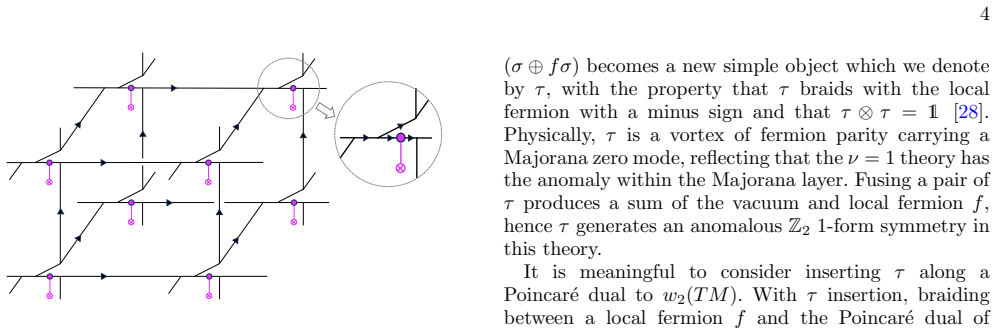
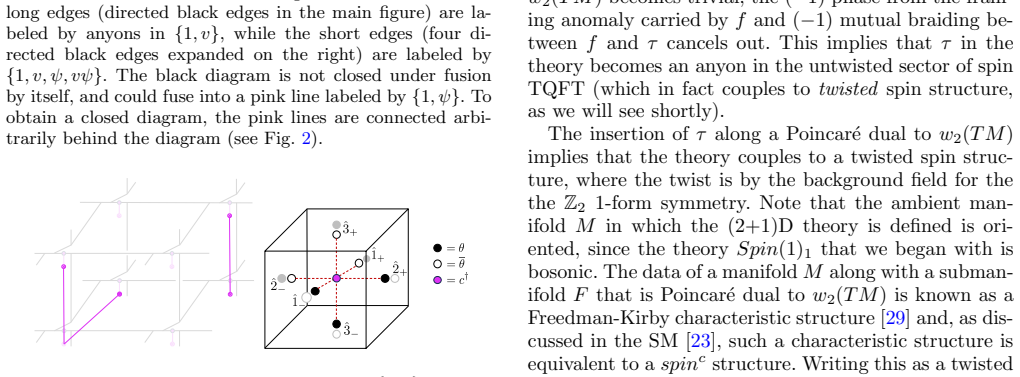
Technically one needs to be careful about the anomaly: it is not quite given to us by just this setup alone, but extra data that one must provide. Supplementary Material for “Sixteen-Fold Way for Fermionic Topological Orders” Ryohei Kobayashi1, Abhinav Prem2, and Matthew Yu3, 1Department of Physics, The University of Tokyo, 7-3-1 Hongo, Bunkyo-ku, Tokyo, ...
2026
-
[50]
This construction follows the path-integral formulation of Grassmann variables on triangulations developed in Refs
Review of the Grassmann integral We review the Grassmann integralσ(M d, Bd−1), defined in terms of Grassmann variables on a triangulated man- ifold. This construction follows the path-integral formulation of Grassmann variables on triangulations developed in Refs. [5, 13, 18, 35]. Throughout this discussion,M d is a closed triangulatedd-manifold equipped ...
-
[51]
Properties of the Grassmann integral The above Grassmann integral satisfies the following quadratic property: σ(B)σ(B ′) =σ(B+B ′)(−1) R B∪d−2B′ ,(A14) which is directly derived by using anti-commutation relation of Grassmann variables on each Boltzmann weight u(∆d) [18]. This quadratic property implies that the Grassmann integral is not invariant under g...
-
[52]
The (3+1)D topological response atν= 2 is given by Zν=2(C, ξ) =z ξ d ˆC 2 ! ·exp 2πi 8 Z M ˆC∪ ˆC+ ˆC∪ 1 d ˆC (A20) where ˆCis aZ 8 lift of theZ 2 gauge fieldC
Coupling to twisted spin structure One can couple the Grassmann integral to the twisted spin structuredξ=w 2+C, and define a theory that depends on the twisted spin structure: zξ(B) =σ(B)·(−1) R ξ∪B .(A18) This theory has an ’t Hooft anomaly given by the response (−1) R Sq 2B+B∪C .(A19) 4.ν= 2theory Now we are ready to describe the path integral of theν= ...
-
[53]
As described in the main text, the termσ(B, C) is a version of the Grassmann integral reviewed in Sec
Gauge invariance of ground state wave function We first need to check that the ground state wave function |Ψ⟩= X C∈Z 2( ˆT,Z 2) ZWW(B, C)|C⟩ edges ⊗σ(B, C)|0⟩ F ,(B1) is invariant under gauge transformations ofB→B+dχ, therefore has a well-defined expression. As described in the main text, the termσ(B, C) is a version of the Grassmann integral reviewed in ...
-
[54]
neigh- borhood
Detailed description of Hamiltonian terms Now we describe the local Hamiltonians of the Walker-Wang type lattice model introduced in the main text, Hν=2 =− X v Pv − X p Pp .(B3) The definitions of these operators are similar to those for the Levin-Wen string-net models [37]. First of all, the term Pv on each (black or pink) fusion vertex is a projector th...
-
[55]
The plaquettes on thexyplane atz= 0 give the boundary, which is the same geometry as the gapped boundary condition of the standard Walker-Wang model [26]
Surface topological order The gapped boundary of this model is simply obtained by locating the cubic lattice on the Euclidean lattice and truncating the lattice toz≤0. The plaquettes on thexyplane atz= 0 give the boundary, which is the same geometry as the gapped boundary condition of the standard Walker-Wang model [26]. The ground state wave function is ...
-
[56]
There exists an oriented submanifoldFthat is Poincar´ e dual toωif and only if the mapω:M→K(A, n)lifts across the Thom class mapU:M SO n →K(A, n)to a mapM→M SO n
LetAbe a finite abelian group andω∈H n(M;A). There exists an oriented submanifoldFthat is Poincar´ e dual toωif and only if the mapω:M→K(A, n)lifts across the Thom class mapU:M SO n →K(A, n)to a mapM→M SO n
-
[57]
There exists a (not necessarily oriented) submanifold that is Poincar´ e dual toωif and only if the mapω:M→K(Z/2, n)lifts across the Thom class mapU:M O n →K(Z/2, n)to a mapM→M O n
Letω∈H n(M;Z/2). There exists a (not necessarily oriented) submanifold that is Poincar´ e dual toωif and only if the mapω:M→K(Z/2, n)lifts across the Thom class mapU:M O n →K(Z/2, n)to a mapM→M O n. In our construction of the (2+1)D theories atν= 1, it was important that an anyon was inserted along a codimension-2 manifold that is Poincar´ e dual tow 2(T ...
-
[58]
The fact that the integral lift ofCexists is due to thespin c nature of the pair (M, F ˆC)
-
[59]
The tangent bundle ofMdecomposes alongFasT F⊕ν F
There is a mapRthat restricts (M, F)→F, with the normal bundleν F →Fremembering howFwas embedded inM. The tangent bundle ofMdecomposes alongFasT F⊕ν F . The classw 2(T M) restricts to the trivial class onM\F, and therefore the restriction ofw 2(T M) toFis equal tow 2(νF ). This meansw 2(T F) = 0 andFis spin
-
[60]
Fermionize
The Freedman-Kirby characteristic structures has the property that there is noξ-structure onMthat restricts to theξ-structure onM\F. Ifξis a spin structure then the surfaceF ˆC is the obstruction for extending a spin structure onM\FtoM. The fact that the integral lift ofCexists (which is used before Eq. (3)) is a special property of the fact that the 4-ma...
-
[61]
Let Γ :M→ bXwhereMis a spin 3-manifold, such that Γ ∗κ=D
For our purposes we take such a superspace to be bX= \B2ZD 2 . Let Γ :M→ bXwhereMis a spin 3-manifold, such that Γ ∗κ=D. An element of Fun( \B2ZD 2 ,Θ fd) 15 is a (2+1)D TQFT withZ 2 1-form symmetry whose background field is given byD, and the TQFT can couple to twisted spin structure where the twisting is given byD. Given this set up we now consider the ...
discussion (0)
Sign in with ORCID, Apple, or X to comment. Anyone can read and Pith papers without signing in.