REVIEW 1 major objections 1 minor 1 cited by
Electromagnetism from two matter spaces: mutual helicity and the nondegenerate completion
T0 review · 1 major / 1 minor · reviewed 2026-06-27 · grok-4.3
Pith's one-line read Generic electromagnetism arises as the minimal completion of two degenerate matter-space flows through their mutual helicity.
desk verdict Two independent matter-space flows recover the mutual helicity term and let a variational principle reach the full sourced Maxwell equation under a kernel condition, but that condition's generality is not obviously guaranteed. read the letter →
The pith
A machine-rendered reading of the paper's core claim, the machinery that carries it, and where it could break.
The reading
What carries the argument
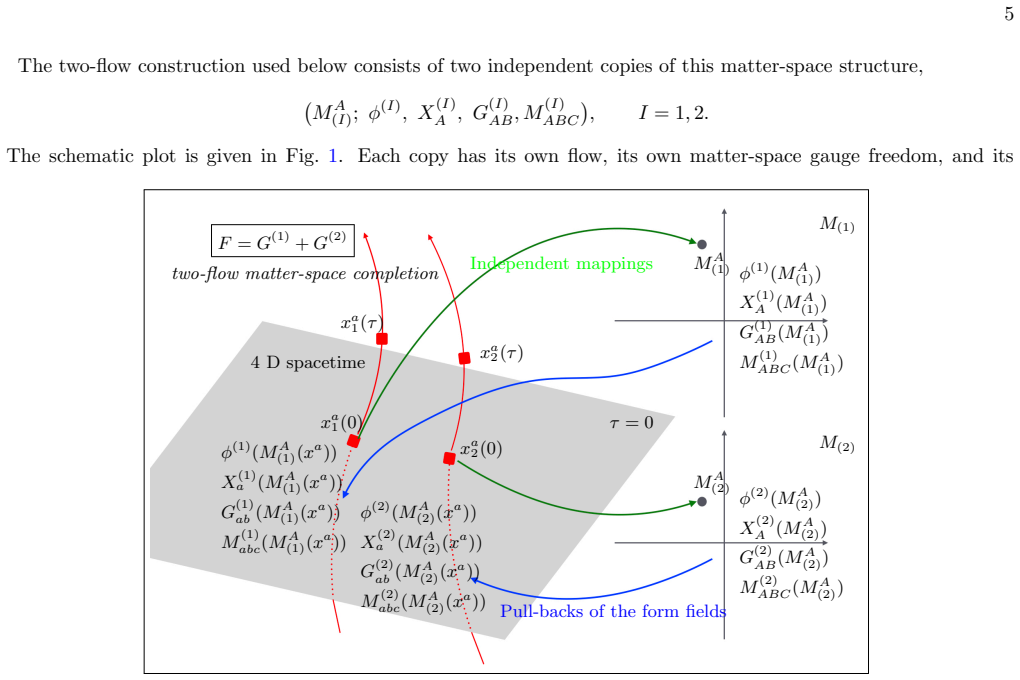
The sum F = G^(1) + G^(2) of two pull-backs from independent matter spaces, with the mutual helicity given by the wedge product between them.
What would settle it
A calculation showing a nondegenerate electromagnetic configuration where the two matter-space kernels have nontrivial intersection yet the equations still hold, or where mutual helicity is zero but F wedge F is not.
Extended reading notes
Core claim
Generic Maxwell fields are represented by two independent matter-space flows where each sector field G^(I) is the pull-back of a two-form from its three-dimensional matter space, so that each satisfies G^(I) wedge G^(I) equals zero while the total F equals G^(1) plus G^(2) satisfies F wedge F equals 2 G^(1) wedge G^(2). The total helicity decomposes into self-helicity terms and a mutual term whose exterior derivative is F wedge F. A variational principle for the total field recovers the sourced Maxwell equation when the sector kernels intersect trivially. Thus generic electromagnetism is the minimal coupled completion of two individually degenerate matter-space sectors.
Load-bearing premise
The kernels of the two sector variations must intersect trivially for their combination to produce the complete sourced Maxwell equation.
Editorial extensions
If this is right
- The total helicity includes a mutual term whose exterior derivative yields F wedge F.
- A vanishing mutual helicity implies the field lies in the degenerate sector.
- The sourced Maxwell equation follows from varying the two matter spaces.
- Nondegenerate fields necessarily carry nontrivial mutual helicity.
Reading between the lines
- This decomposition may suggest similar completions for other field theories using multiple matter spaces.
- Connections could exist to helicity conservation in ideal MHD or fluid dynamics.
- Explicit examples of mutual helicity in known solutions like electromagnetic waves could be computed to illustrate the structure.
Signed reviews
Editorial analysis
A structured set of objections, weighed in public.
Referee Report
Summary. The paper claims that generic (nondegenerate) Maxwell fields F can be reconstructed as the sum F = G^{(1)} + G^{(2)} of two pull-backs from independent three-dimensional matter spaces. Each G^{(I)} satisfies G^{(I)} ∧ G^{(I)} = 0, while the cross term supplies the invariant F ∧ F = 2 G^{(1)} ∧ G^{(2)}, interpreted as mutual helicity. A variational principle on the two flows is asserted to recover the sourced Maxwell equation d ⋆ F = J whenever the kernels of the two flows intersect trivially.
Significance. If the construction and the variational derivation are complete, the work supplies a geometric mechanism for extending the one-flow (necessarily degenerate) matter-space formulation to full electromagnetism by isolating the nondegenerate sector in an inter-flow mutual-helicity term. The absence of free parameters and the explicit decomposition of helicity are positive features.
major comments (1)
- [Abstract] Abstract: the central claim that the two independent matter-space variations 'combine into the full sourced Maxwell equation whenever the sector kernels intersect trivially' is load-bearing for the assertion of a generic reconstruction. The manuscript must show either that, for any nondegenerate F (F ∧ F ≠ 0), flows can always be chosen so that the kernels intersect trivially, or that the trivial-intersection condition is automatically satisfied once the pull-backs sum to the given F. Without this step the reconstruction remains conditional rather than generic.
minor comments (1)
- Notation: the superscript (I) on G^{(I)} and the precise definition of the pull-back maps should be stated explicitly at first use to avoid ambiguity between the two flows.
Simulated Author's Rebuttal
We thank the referee for the careful reading and for highlighting the importance of establishing genericity. We address the single major comment below.
read point-by-point responses
-
Referee: [Abstract] Abstract: the central claim that the two independent matter-space variations 'combine into the full sourced Maxwell equation whenever the sector kernels intersect trivially' is load-bearing for the assertion of a generic reconstruction. The manuscript must show either that, for any nondegenerate F (F ∧ F ≠ 0), flows can always be chosen so that the kernels intersect trivially, or that the trivial-intersection condition is automatically satisfied once the pull-backs sum to the given F. Without this step the reconstruction remains conditional rather than generic.
Authors: We agree that the manuscript as written presents the variational recovery of the sourced Maxwell equation under the additional assumption of trivial kernel intersection, which leaves the claim of a fully generic reconstruction incomplete. In the revised manuscript we will add an explicit construction demonstrating that, for any nondegenerate F with F ∧ F ≠ 0, two independent matter-space flows can always be chosen so that their pull-backs sum to F and their kernels intersect only at the zero section. The construction proceeds by decomposing the support of F into regions where the two-form is nondegenerate and selecting the generating vector fields of the flows to be linearly independent on the common kernel; this choice is always possible locally and can be glued globally on a suitable cover. With this addition the two variations combine into d ⋆ F = J without further restrictions, rendering the reconstruction unconditional for the nondegenerate sector. revision: yes
Circularity Check
No significant circularity; construction is self-contained
full rationale
The paper defines the electromagnetic field strength explicitly as the sum of two independent pull-backs F = G^(1) + G^(2) from separate matter-space flows, each satisfying G^(I) ∧ G^(I) = 0 by the pull-back property. The mutual term 2G^(1) ∧ G^(2) is then identified with F ∧ F and interpreted as mutual helicity. The variational principle is introduced directly on this composite structure and stated to yield the sourced Maxwell equation under the auxiliary condition that the sector kernels intersect trivially. No parameter is fitted to data and then relabeled as a prediction, no result is defined in terms of itself, and no load-bearing step reduces to a self-citation whose content is presupposed. The derivation therefore proceeds outward from the stated geometric definitions without circular reduction.
Assumptions & free parameters
assumptions (2)
- domain assumption The electromagnetic field strength is the pull-back of a two-form on a three-dimensional matter space.
- domain assumption The kernels of the two sector distributions intersect trivially so that the two variations combine into the full Maxwell equation.
Cite this review
Pith. "Pith review of Electromagnetism from two matter spaces: mutual helicity and the nondegenerate completion." pith.science (2026). https://pith.science/paper/VL6QXYJC
@misc{pith2026260608917,
  author       = {Pith},
  title        = {Pith review of: Electromagnetism from two matter spaces: mutual helicity and the nondegenerate completion},
  year         = {2026},
  howpublished = {\url{https://pith.science/paper/VL6QXYJC}},
  note         = {Machine review of arXiv:2606.08917}
}
abstract
We show that generic Maxwell fields can be represented within the matter-space framework by introducing two independent matter-space flows. In the one-flow formulation the electromagnetic field strength is the pull-back of a two-form on a three-dimensional matter space and therefore satisfies $F\wedge F=0$, so that a single flow captures only a degenerate, helicity-carrying sector. The minimal completion is obtained by writing $$F=G^{(1)}+G^{(2)},$$ where each sector field $G^{(I)}$ is the pull-back of a matter-space two-form from an independent flow. Each sector is individually degenerate, $G^{(I)}\wedge G^{(I)}=0$, while the full field satisfies $F\wedge F=2G^{(1)}\wedge G^{(2)}$; the invariant excluded by the one-flow theory is thus recovered as an inter-flow quantity. We interpret this structure in terms of mutual helicity: the total helicity decomposes into two self-helicity contributions and a mutual term whose exterior derivative is $F\wedge F$. Hence a configuration with vanishing mutual helicity lies in the degenerate sector, whereas a nondegenerate Maxwell field necessarily carries a nontrivial mutual helicity. A variational principle for the total field recovers the sourced Maxwell equation, the two matter-space variations combining into the full equation whenever the sector kernels intersect trivially. Generic electromagnetism is thereby reconstructed as the minimal coupled completion of two individually degenerate matter-space sectors.
Figures
Forward citations
Cited by 1 Pith paper
-
Collective modes and screening in an electric-magnetic dual plasma
Derives stable transverse EM branches set by electric and magnetic plasma frequencies, entrainment-induced avoided crossings in longitudinal sector with stability condition κ²<1, and a magnetically neutral branch wher...
Reference graph
Works this paper leans on
-
[1]
Electromagnetism from relativistic fluid dynamics,
J. Ho, H.-C. Kim, J. Lee and Y. Yun, “Electromagnetism from relativistic fluid dynamics,”Class. Quantum Grav.43, 095016 (2026), doi:10.1088/1361-6382/ae60be
-
[2]
Relativistic fluid dy- namics: Physics for many different scales,
N. Andersson and G. L. Comer, “Relativistic fluid dynamics: physics for many different scales,”Living Rev. Relativ.10, 1 (2007), doi:10.12942/lrr-2007-1
-
[3]
Elastic perturbation theory in general relativity and a variation principle for a rotating solid star,
B. Carter, “Elastic perturbation theory in general relativity and a variation principle for a rotating solid star,”Commun. Math. Phys.30, 261–286 (1973)
1973
-
[4]
Covariant theory of conductivity in ideal fluid or solid media,
B. Carter, “Covariant theory of conductivity in ideal fluid or solid media,” inRelativistic Fluid Dynamics, Lecture Notes in Mathematics, Vol. 1385 (Springer, Berlin, 1989), pp. 1–64
1989
-
[5]
I. Robinson, “Null electromagnetic fields,”J. Math. Phys.2, 290–291 (1961), doi:10.1063/1.1703712. 17
-
[6]
On the canonical form of the electromagnetic field,
L. Stazi, “On the canonical form of the electromagnetic field,”Ann. Univ. Ferrara52, 127–135 (2006), doi:10.1007/s11565- 006-0011-8
-
[7]
Penrose and W
R. Penrose and W. Rindler,Spinors and Space-Time, Volume 1: Two-Spinor Calculus and Relativistic Fields(Cambridge University Press, Cambridge, 1984)
1984
-
[8]
Solutions of the Maxwell and Yang-Mills equations associated with Hopf fibrings,
A. Trautman, “Solutions of the Maxwell and Yang-Mills equations associated with Hopf fibrings,”Int. J. Theor. Phys.16, 561–565 (1977), doi:10.1007/BF01811088
Show all 31 references
-
[9]
A topological theory of the electromagnetic field,
A. F. Ra˜ nada, “A topological theory of the electromagnetic field,”Lett. Math. Phys.18, 97–106 (1989), doi:10.1007/BF00401864
1989 doi
-
[10]
Magnetic helicity: What is it and what is it good for?
J. M. Finn and T. M. Antonsen, “Magnetic helicity: What is it and what is it good for?”Comments Plasma Phys. Controlled Fusion9, 111–126 (1985)
1985
-
[11]
Introduction to magnetic helicity,
M. A. Berger, “Introduction to magnetic helicity,”Plasma Phys. Control. Fusion41, B167–B175 (1999), doi:10.1088/0741- 3335/41/12B/312
1999 doi
-
[12]
Dual electromagnetism: helicity, spin, momentum and angular momentum,
K. Y. Bliokh, A. Y. Bekshaev and F. Nori, “Dual electromagnetism: helicity, spin, momentum and angular momentum,” New J. Phys.15, 033026 (2013), doi:10.1088/1367-2630/15/3/033026
2013 doi
-
[13]
The helicity of the electromagnetic field and its physical meaning,
G. N. Afanasiev and Yu. P. Stepanovsky, “The helicity of the electromagnetic field and its physical meaning,”Il Nuovo Cimento A109, 271–279 (1996), doi:10.1007/BF02731015
1996 doi
-
[14]
The topological properties of magnetic helicity,
M. A. Berger and G. B. Field, “The topological properties of magnetic helicity,”J. Fluid Mech.147, 133–148 (1984), doi:10.1017/S0022112084002019
1984 doi
-
[15]
On self and mutual winding helicity,
S. Candelaresi, G. Hornig, D. MacTaggart and R. D. Simitev, “On self and mutual winding helicity,”Phys. Plasmas28, 082902 (2021), doi:10.1063/5.0055683
2021 doi
-
[16]
Disentangling the entangled linkages of relative magnetic helicity,
P. W. Schuck and M. G. Linton, “Disentangling the entangled linkages of relative magnetic helicity,”Astrophys. J.945, 67 (2023), arXiv:2309.07776
2023
-
[17]
Axial-vector vertex in spinor electrodynamics,
S. L. Adler, “Axial-vector vertex in spinor electrodynamics,”Phys. Rev.177, 2426–2438 (1969), doi:10.1103/PhysRev.177.2426
1969 doi
-
[18]
A PCAC puzzle:π 0 →γγin theσ-model,
J. S. Bell and R. Jackiw, “A PCAC puzzle:π 0 →γγin theσ-model,”Nuovo Cim. A60, 47–61 (1969), doi:10.1007/BF02823296
1969 doi
-
[19]
The degree of knottedness of tangled vortex lines,
H. K. Moffatt, “The degree of knottedness of tangled vortex lines,”J. Fluid Mech.35, 117–129 (1969), doi:10.1017/S0022112069000991
1969 doi
-
[20]
Tying knots in light fields,
H. Kedia, I. Bialynicki-Birula, D. Peralta-Salas and W. T. M. Irvine, “Tying knots in light fields,”Phys. Rev. Lett.111, 150404 (2013), doi:10.1103/PhysRevLett.111.150404
2013 doi
-
[21]
Linked and knotted beams of light,
W. T. M. Irvine and D. Bouwmeester, “Linked and knotted beams of light,”Nature Phys.4, 716–720 (2008), doi:10.1038/nphys1056
2008 doi
-
[22]
Linked and knotted beams of light, conservation of helicity and the flow of null electromagnetic fields,
W. T. M. Irvine, “Linked and knotted beams of light, conservation of helicity and the flow of null electromagnetic fields,” arXiv:1110.5408 [physics.optics]
-
[23]
Null electromagnetic fields from dilatation and rotation transformations of the Hopfion,
M. Array´ as and J. L. Trueba, “Null electromagnetic fields from dilatation and rotation transformations of the Hopfion,” Symmetry11, 1105 (2019), doi:10.3390/sym11091105
2019 doi
-
[24]
Heat conduction in general relativity,
H.-C. Kim and Y. Lee, “Heat conduction in general relativity,”Class. Quantum Grav.39, 245011 (2022), doi:10.1088/1361- 6382/aca1a1, arXiv:2206.09555 [gr-qc]
2022 doi
-
[25]
Steady heat conduction in general relativity,
H.-C. Kim, “Steady heat conduction in general relativity,”Prog. Theor. Exp. Phys.2023, 053A02 (2023), doi:10.1093/ptep/ptad062, arXiv:2302.03291 [gr-qc]
2023 doi
-
[26]
Inflation-produced, large-scale magnetic fields,
M. S. Turner and L. M. Widrow, “Inflation-produced, large-scale magnetic fields,”Phys. Rev. D37, 2743–2754 (1988), doi:10.1103/PhysRevD.37.2743
1988 doi
-
[27]
Primordial magnetic fields from pseudo-Goldstone bosons,
W. D. Garretson, G. B. Field and S. M. Carroll, “Primordial magnetic fields from pseudo-Goldstone bosons,”Phys. Rev. D46, 5346–5351 (1992), doi:10.1103/PhysRevD.46.5346
1992 doi
- [28]
- [29]
-
[30]
Self-consistent evolution of magnetic fields and chiral asymmetry in the early Universe,
A. Boyarsky, J. Fr¨ ohlich and O. Ruchayskiy, “Self-consistent evolution of magnetic fields and chiral asymmetry in the early Universe,”Phys. Rev. Lett.108, 031301 (2012), doi:10.1103/PhysRevLett.108.031301, arXiv:1109.3350 [astro-ph.CO]
- [31]
Reviewed June 27, 2026 · model on record in the stance chip above.
Discussion (0). Continue with ORCID to comment.