REVIEW 4 major objections 5 minor 2 cited by
ChatGen: Automatic Text-to-Image Generation From FreeStyle Chatting
T0 review · 4 major / 5 minor · reviewed 2026-08-12 · deepseek-v4-flash
Pith's one-line read ChatGen-Evo treats automatic text-to-image generation as a three-step reasoning task—prompt writing, model selection, and argument configuration—and trains a multimodal LLM stage by stage to outperform direct supervised fine-tuning on the…
desk verdict A serious benchmark and training recipe for automatic T2I, but the synthetic freestyle inputs and missing external baselines keep the transfer claims unproven. read the letter →
The pith
A machine-rendered reading of the paper's core claim, the machinery that carries it, and where it could break.
The reading
What carries the argument
The load-bearing mechanism is the multi-stage evolution strategy with ModelToken embeddings. In Stage 1, a task prefix preserves the model's existing abilities while it learns prompt rewriting. In Stage 2, each candidate image model is represented as a special token whose embedding is the only trainable parameter, so model selection becomes a single next-token prediction without disturbing earlier skills. In Stage 3, argument configuration is done training-free by showing the selected model's demonstrations in context. The strategy's point is to replace one-shot output supervision with stage-level supervision, so each skill is learned under targeted feedback.
What would settle it
Gather a set of genuine user requests from non-expert participants asked to describe images in their own words, run the trained model on them, and compare step-wise accuracy and final image quality against the same model's scores on ChatGenBench's synthesized inputs; a substantial drop would falsify the assumption that the synthetic chat distribution represents real users.
Extended reading notes
Core claim
On its own terms, the paper claims that Automatic T2I—letting a user describe an image in natural, conversational language and receiving the finished image without touching any settings—is a solvable multi-step reasoning task. The proposed method, ChatGen-Evo, trains a multimodal language model in three stages: it learns to rewrite freestyle chat into professional image prompts, then to select the right specialized image model through learned model tokens, and finally to configure generation arguments using in-context demonstrations from that model. On the introduced benchmark, this staged approach at two billion parameters reaches a Unified Metric (the normalized average of FID, CLIP score, human-preference score, and image reward) of 65.9 in the supervised setting, above the 60.7 scored by an eight-billion-parameter model trained with direct supervised fine-tuning, and it also wins pairwise human comparisons. Ablations show that prompt quality strongly influences model-selection accuracy, which in turn shapes argument configuration, evidence for the paper's multi-step reasoning view.
Load-bearing premise
The load-bearing premise is that the LLM-generated role-play chatting inputs in ChatGenBench faithfully mimic how real users phrase image requests; if real-world freestyle chat differs in style, ambiguity, or multimodal usage, the measured performance may not transfer.
Editorial extensions
If this is right
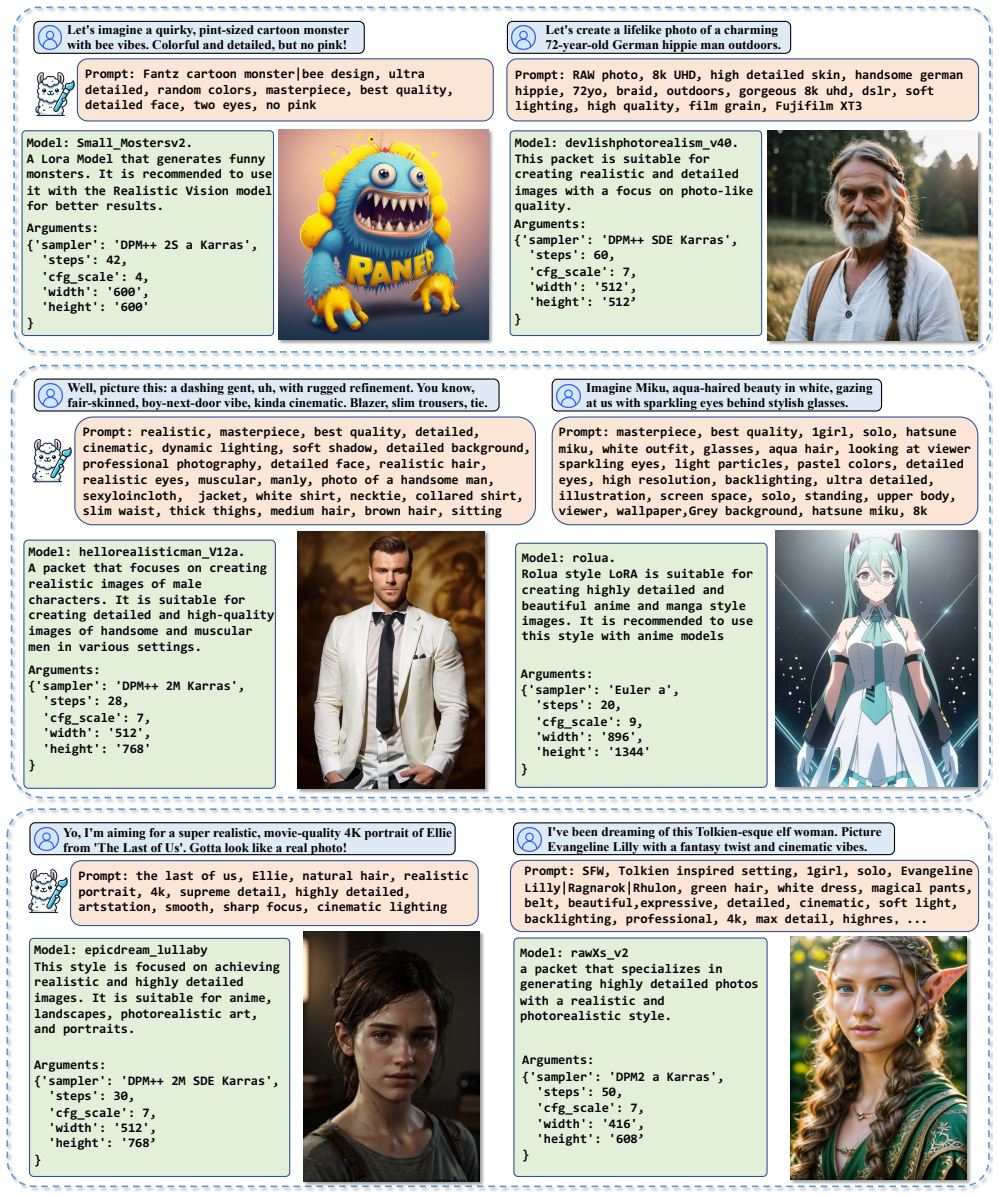
- Users of such a system would no longer need prompt engineering: a single sentence like 'anime girl with white and black hair, seen from behind, wearing a game-character outfit' can be expanded into a professional prompt, routed to the right model, and given working sampler, step, and CFG settings.
- Because model selection is encoded as lightweight per-model tokens, extending the system to new image models requires adding tokens and retraining only the token embeddings, which is cheaper than full fine-tuning.
- The benchmark's step-wise metrics make it possible to pinpoint which automation step fails, and the paper's ablations show that prompt quality is the upstream bottleneck: better prompts raise model-selection accuracy from 32.8% to 55.3%.
- In few-shot conditions, prompt rewriting transfers well while model selection and argument configuration degrade, so improving selection and configuration for rare models is the next bottleneck.
Reading between the lines
- Editorial inference: because the benchmark's freestyle inputs are synthetic role-play, real deployments are likely to encounter distribution shift; collecting organic chat logs and measuring the gap would be a natural next validation.
- Editorial inference: the three-step decomposition (prompt, model, arguments) is one possible factorization; future work could test alternative decompositions such as content versus style, negative prompts, or iterative refinement, which may allocate reasoning effort differently.
- Editorial inference: the finding that multimodal inputs outperform text-only ones hints that input types compete for the model's reasoning budget; a system that actively asks the user for a reference image when the request is ambiguous could improve automation.
Signed reviews
Editorial analysis
A structured set of objections, weighed in public.
Referee Report
Summary. The paper introduces the task of Automatic Text-to-Image (T2I) generation, where a system takes a freestyle chat input and produces a refined prompt, a suitable T2I model, and appropriate generation arguments. It proposes ChatGenBench, a benchmark built from 44,881 human-validated Civitai demonstrations, with 330,970 LLM-generated freestyle inputs covering single, multimodal, and history-based queries. The paper also proposes ChatGen-Evo, a three-stage training strategy: prompt-writing SFT, model selection via learnable ModelToken embeddings, and training-free argument configuration via in-context learning. Experiments on ChatGenBench show that ChatGen-Evo (2B) outperforms direct SFT baselines ChatGen-Base (2B-8B) on step-wise accuracy and image quality, including a Unified Metric of 65.9 vs 60.7 in the supervised setting.
Significance. The paper addresses a practically important problem and the proposed benchmark is larger and more comprehensive than prior work (e.g., DABench, DiffusionGPT) in terms of the number of models, input types, and step-wise evaluation. The multi-stage evolution strategy is a sensible design, and the ModelToken mechanism for model selection is an interesting contribution. If the benchmark inputs are representative and the metrics are well-defined, the paper provides a valuable testbed for automatic T2I. However, the synthetic nature of the freestyle inputs and the undefined normalization of the Unified Metric currently limit the external validity and reproducibility of the central claims.
major comments (4)
- [Section 3.1.2] The benchmark's freestyle user inputs are generated by an LLM role-play procedure that converts each ground-truth demonstration into a short, colloquial query, with the instruction to 'Remove any obvious details that non-professional users would avoid' and to be 'as brief as possible.' The paper provides no evidence that this synthetic distribution matches real user behavior. Because all training, evaluation, and the human preference study in Sec. 4.2.2 sample from this same distribution, the claimed advantage of ChatGen-Evo over ChatGen-Base (Table 4) may not transfer to real-world freestyle chatting. Please either validate the synthetic inputs against a small corpus of real user queries (e.g., from an existing T2I interaction log) or present a careful analysis of the distribution's properties and discuss the limitations.
- [Section 4.1, Eq. (6)] The Unified Metric is computed as the average of four normalized scores, but the normalization procedure is not defined. The text says 'Each of above scores are normalized to the range [0,1]' without specifying whether this is min-max scaling, and if so, over which dataset or split, or whether it is done per row. Since Table 4 and the central claim rely on the Unified Metric, the current description is insufficient for reproducibility and could make the relative ranking sensitive to the normalization choices. Please provide the exact normalization formula and the statistics used.
- [Section 4] The experimental results are reported as single point estimates with no error bars, confidence intervals, or significance tests. The claim that ChatGen-Evo 'significantly' outperforms baselines is therefore not statistically supported, especially for metrics with small margins (e.g., CLIP Score 72.9 vs 70.7 in the supervised setting). Reporting multiple seeds or providing significance tests would strengthen the conclusions.
- [Section 3.1.3] The benchmark construction includes 'LLM-Based Evaluation' and 'Manual Verification' filters that select inputs on the basis of 'chatting tone.' This may introduce a selection bias toward inputs that are easy for LLMs to recognize and convert, making the benchmark easier than real user language. The paper should analyze the difficulty distribution of the synthetic inputs (e.g., length, vocabulary diversity, presence of ambiguous or irrelevant content) and compare it with any available real-world data, or at least acknowledge this as a limitation.
minor comments (5)
- [Section 2.2] The sentence 'Recently, LLMs have also begun to be applied to image generation' is repeated verbatim; please remove the duplicate. Also, 'However, the above methods still require specialized prompt inputs' should read 'these methods' or 'the aforementioned methods'.
- [Section 3.2.1, Eq. (1)] The notation '∗<t' is not standard; please clarify that it denotes the output tokens before position t.
- [Section 4.2.2] The human evaluation lacks details on the number and background of participants, the exact instructions, and how ties were resolved. Also, Figure 4 appears to have rendering issues in the provided text (the '/uni...' sequences); the figure should be legible in the final version.
- [Table 4] In the few-shot setting, the Baseline row has 'Selection Acc' and 'Config Acc' marked as '-'; please clarify why the baseline is not applicable to those steps (it uses a single model and fixed arguments).
- [Table 6] In the ablation table, the 'Step Score' column mixes different metrics (Prompt BERTScore, Selection Accuracy, Configuration Accuracy) depending on the stage; consider clarifying this in the table caption or in the text.
Circularity Check
ChatGenBench's freestyle inputs are LLM paraphrases of the ground-truth outputs, making the benchmark's input distribution self-referential; the multi-stage training chain itself is otherwise non-circular.
-
self definitional
[Sec. 3.1.2 (LLM-Driven Role-Play for Chatting Generation), Eq. (2) Stage 1, Sec. 4.2.2 Human Evaluation]
"Please merge the following prompt and model information into a single freestyle query. Remove any obvious details that non-professional users would avoid. Make it similar to what non-professional users may write. The converted single-text query should be colloquial and as brief as possible."
ChatGenBench's 'freestyle user inputs' are generated by an LLM that is given the ground-truth prompt and model information and instructed to merge them into a single colloquial query. Training then optimizes P(p|c') in Eq. (2), and the test set is produced by the same role-play procedure. The input c' is therefore defined as a paraphrase of the very output p the model is supposed to predict. Evaluation on this benchmark measures how well a model inverts the specific LLM role-play transformation, not how well it handles independent real-user phrasing. The human study in Sec. 4.2.2 samples from this same synthetic distribution, so it does not break the self-referential loop.
full rationale
The paper's internal derivation chain is largely self-contained: ChatGen-Base and ChatGen-Evo are trained with standard conditional language-modeling objectives (Eqs. 1-3), model selection is a learned token classification over a frozen backbone, and argument configuration is in-context learning from demonstrations. Evaluation metrics compare against human-validated Civitai demonstrations, and no fitted parameter is renamed as a prediction. The self-citations to prior work (e.g., [15] for token learning) are inspirational rather than load-bearing. The one significant circularity concern is the benchmark's freestyle-input construction: Sec. 3.1.2 reverse-engineers the user query from the ground-truth prompt/model via LLM role-play, so train and test inputs are generated from the target outputs. This makes the benchmark's 'freestyle chatting' distribution self-referential and weakens real-world transfer claims, but it does not make the comparative ranking on ChatGenBench itself true by construction, since models can still fail at the paraphrase-inversion task. A moderate score of 3 reflects this partial, benchmark-level circularity rather than a fully forced derivation.
Assumptions & free parameters
free parameters (4)
- ModelToken embedding matrix =
6807 x d
- LLM role-play temperature =
0.9
- BERTScore filtering threshold =
0.8
- Training hyperparameters =
LR 4e-5, weight decay 1.0, 5 epochs
assumptions (3)
- domain assumption Civitai community demonstrations are high-quality ground truth for prompts, models, and arguments.
- ad hoc to paper LLM role-play generated freestyle inputs are representative of real user chatting behavior.
- domain assumption BERTScore, FID, CLIP Score, HPS v2, and ImageReward are valid proxies for image quality and user satisfaction.
Cite this review
Pith. "Pith review of ChatGen: Automatic Text-to-Image Generation From FreeStyle Chatting." pith.science (2026). https://pith.science/paper/VM4NGDJL
@misc{pith2026241117176,
  author       = {Pith},
  title        = {Pith review of: ChatGen: Automatic Text-to-Image Generation From FreeStyle Chatting},
  year         = {2026},
  howpublished = {\url{https://pith.science/paper/VM4NGDJL}},
  note         = {Machine review of arXiv:2411.17176}
}
read the original abstract
Despite the significant advancements in text-to-image (T2I) generative models, users often face a trial-and-error challenge in practical scenarios. This challenge arises from the complexity and uncertainty of tedious steps such as crafting suitable prompts, selecting appropriate models, and configuring specific arguments, making users resort to labor-intensive attempts for desired images. This paper proposes Automatic T2I generation, which aims to automate these tedious steps, allowing users to simply describe their needs in a freestyle chatting way. To systematically study this problem, we first introduce ChatGenBench, a novel benchmark designed for Automatic T2I. It features high-quality paired data with diverse freestyle inputs, enabling comprehensive evaluation of automatic T2I models across all steps. Additionally, recognizing Automatic T2I as a complex multi-step reasoning task, we propose ChatGen-Evo, a multi-stage evolution strategy that progressively equips models with essential automation skills. Through extensive evaluation across step-wise accuracy and image quality, ChatGen-Evo significantly enhances performance over various baselines. Our evaluation also uncovers valuable insights for advancing automatic T2I. All our data, code, and models will be available in \url{https://chengyou-jia.github.io/ChatGen-Home}
Figures


Figures from the paper (5 more)




Forward citations
Cited by 2 Pith papers
-
MultiRef: Controllable Image Generation with Multiple Visual References
MultiRef-bench shows that current image generators that accept multiple visual references still fail to combine them reliably, with the best tested model OmniGen reaching only 66.6% synthetic and 79.0% real-world alig...
-
Multi-Modal Dataset Distillation in the Wild
MDW distills noisy image-text data into small clean synthetic sets using learnable soft matching probabilities, Grad-CAM guided pixel weighting, and a noise-tolerant negative match loss.
Reference graph
Works this paper leans on
-
[1]
Improving image generation with better captions
James Betker, Gabriel Goh, Li Jing, Tim Brooks, Jianfeng Wang, Linjie Li, Long Ouyang, Juntang Zhuang, Joyce Lee, Yufei Guo, Wesam Manassra, Prafulla Dhariwal, Casey Chu, and Yunxin Jiao. Improving image generation with better captions. 2023. 1, 2, 8
work page 2023
-
[2]
In- structpix2pix: Learning to follow image editing instructions
Tim Brooks, Aleksander Holynski, and Alexei A Efros. In- structpix2pix: Learning to follow image editing instructions. In Proceedings of the IEEE/CVF Conference on Computer Vision and Pattern Recognition, pages 18392–18402, 2023. 2
2023
-
[3]
Language models are few-shot learners
Tom B Brown. Language models are few-shot learners. arXiv preprint arXiv:2005.14165, 2020. 2
arXiv 2005
-
[4]
Beautifulprompt: Towards auto- matic prompt engineering for text-to-image synthesis
Tingfeng Cao, Chengyu Wang, Bingyan Liu, Ziheng Wu, Jinhui Zhu, and Jun Huang. Beautifulprompt: Towards auto- matic prompt engineering for text-to-image synthesis. arXiv preprint arXiv:2311.06752, 2023. 2, 4
arXiv 2023
-
[5]
How far are we to gpt-4v? closing the gap to commercial multimodal models with open-source suites
Zhe Chen, Weiyun Wang, Hao Tian, Shenglong Ye, Zhang- wei Gao, Erfei Cui, Wenwen Tong, Kongzhi Hu, Jiapeng Luo, Zheng Ma, et al. How far are we to gpt-4v? closing the gap to commercial multimodal models with open-source suites. arXiv preprint arXiv:2404.16821, 2024. 6
arXiv 2024
-
[6]
Civitai. Civitai. https://civitai.com/, 2022. 1, 3
work page 2022
-
[7]
Dreamllm: Synergistic multimodal com- prehension and creation
Runpei Dong, Chunrui Han, Yuang Peng, Zekun Qi, Zheng Ge, Jinrong Yang, Liang Zhao, Jianjian Sun, Hongyu Zhou, Haoran Wei, et al. Dreamllm: Synergistic multimodal com- prehension and creation. arXiv preprint arXiv:2309.11499,
- [8]
Show all 49 references
-
[9]
Ranni: Taming text-to-image diffu- sion for accurate instruction following
Yutong Feng, Biao Gong, Di Chen, Yujun Shen, Yu Liu, and Jingren Zhou. Ranni: Taming text-to-image diffu- sion for accurate instruction following. In Proceedings of the IEEE/CVF Conference on Computer Vision and Pattern Recognition, pages 4744–4753, 2024. 2
2024
-
[10]
Toolkengpt: Augmenting frozen language models with mas- sive tools via tool embeddings
Shibo Hao, Tianyang Liu, Zhen Wang, and Zhiting Hu. Toolkengpt: Augmenting frozen language models with mas- sive tools via tool embeddings. Advances in neural informa- tion processing systems, 36, 2024. 5
2024
-
[11]
Clipscore: A reference-free evaluation met- ric for image captioning
Jack Hessel, Ari Holtzman, Maxwell Forbes, Ronan Le Bras, and Yejin Choi. Clipscore: A reference-free evaluation met- ric for image captioning. In Empirical Methods in Natural Language Processing (EMNLP), 2021. 6
2021
-
[12]
Gans trained by a two time-scale update rule converge to a local nash equilib- rium
Martin Heusel, Hubert Ramsauer, Thomas Unterthiner, Bernhard Nessler, and Sepp Hochreiter. Gans trained by a two time-scale update rule converge to a local nash equilib- rium. Advances in neural information processing systems , 30, 2017. 6
2017
-
[13]
Denoising dif- fusion probabilistic models
Jonathan Ho, Ajay Jain, and Pieter Abbeel. Denoising dif- fusion probabilistic models. Advances in neural information processing systems, 33:6840–6851, 2020. 2
2020
-
[14]
Ssmg: Spatial-semantic map guided diffusion model for free-form layout-to-image generation
Chengyou Jia, Minnan Luo, Zhuohang Dang, Guang Dai, Xiaojun Chang, Mengmeng Wang, and Jingdong Wang. Ssmg: Spatial-semantic map guided diffusion model for free-form layout-to-image generation. In Proceedings of the AAAI Conference on Artificial Intelligence, pages 2480– 2488, 2024. 2
2024
-
[15]
Agentstore: Scalable integration of heterogeneous agents as specialized generalist computer assistant
Chengyou Jia, Minnan Luo, Zhuohang Dang, Qiushi Sun, Fangzhi Xu, Junlin Hu, Tianbao Xie, and Zhiyong Wu. Agentstore: Scalable integration of heterogeneous agents as specialized generalist computer assistant. arXiv preprint arXiv:2410.18603, 2024. 5
-
[16]
Imagic: Text-based real image editing with diffusion models
Bahjat Kawar, Shiran Zada, Oran Lang, Omer Tov, Huiwen Chang, Tali Dekel, Inbar Mosseri, and Michal Irani. Imagic: Text-based real image editing with diffusion models. InPro- ceedings of the IEEE/CVF Conference on Computer Vision and Pattern Recognition, pages 6007–6017, 2023. 2
2023
-
[17]
Multi-concept customization of text-to-image diffusion
Nupur Kumari, Bingliang Zhang, Richard Zhang, Eli Shechtman, and Jun-Yan Zhu. Multi-concept customization of text-to-image diffusion. In Proceedings of the IEEE/CVF Conference on Computer Vision and Pattern Recognition , pages 1931–1941, 2023. 2
1931
-
[18]
Blip-diffusion: Pre- trained subject representation for controllable text-to-image generation and editing
Dongxu Li, Junnan Li, and Steven Hoi. Blip-diffusion: Pre- trained subject representation for controllable text-to-image generation and editing. Advances in Neural Information Pro- cessing Systems, 36, 2024. 2
2024
-
[19]
Gligen: Open-set grounded text-to-image generation
Yuheng Li, Haotian Liu, Qingyang Wu, Fangzhou Mu, Jian- wei Yang, Jianfeng Gao, Chunyuan Li, and Yong Jae Lee. Gligen: Open-set grounded text-to-image generation. InPro- ceedings of the IEEE/CVF Conference on Computer Vision and Pattern Recognition, pages 22511–22521, 2023. 2
2023
-
[20]
Llm- grounded diffusion: Enhancing prompt understanding of text-to-image diffusion models with large language models
Long Lian, Boyi Li, Adam Yala, and Trevor Darrell. Llm- grounded diffusion: Enhancing prompt understanding of text-to-image diffusion models with large language models. arXiv preprint arXiv:2305.13655, 2023. 2
2023 arXiv
-
[21]
Let’s verify step by step
Hunter Lightman, Vineet Kosaraju, Yura Burda, Harri Ed- wards, Bowen Baker, Teddy Lee, Jan Leike, John Schulman, Ilya Sutskever, and Karl Cobbe. Let’s verify step by step. arXiv preprint arXiv:2305.20050, 2023. 5
2023 arXiv
-
[22]
An empirical study of catastrophic forgetting in large language models during continual fine-tuning
Yun Luo, Zhen Yang, Fandong Meng, Yafu Li, Jie Zhou, and Yue Zhang. An empirical study of catastrophic forgetting in large language models during continual fine-tuning. arXiv preprint arXiv:2308.08747, 2023. 5
2023 arXiv
-
[23]
Glide: Towards photorealis- tic image generation and editing with text-guided diffusion models
Alexander Quinn Nichol, Prafulla Dhariwal, Aditya Ramesh, Pranav Shyam, Pamela Mishkin, Bob Mcgrew, Ilya Sutskever, and Mark Chen. Glide: Towards photorealis- tic image generation and editing with text-guided diffusion models. In International Conference on Machine Learning (I...
2022
-
[24]
Chatgpt, 2022
OpenAI. Chatgpt, 2022. Large language model. 2
2022
-
[25]
Learning to reason with llms
OpenAI. Learning to reason with llms. https : //openai.com/index/learning- to- reason- with-llms/, 2024. Accessed: 2024-11-06. 2, 5, 7
2024
-
[26]
Gorilla: Large language model connected with massive apis
Shishir G Patil, Tianjun Zhang, Xin Wang, and Joseph E Gonzalez. Gorilla: Large language model connected with massive apis. arXiv preprint arXiv:2305.15334, 2023. 2
2023 arXiv
-
[27]
Scalable diffusion models with transformers
William Peebles and Saining Xie. Scalable diffusion models with transformers. In Proceedings of the IEEE/CVF Inter- national Conference on Computer Vision, pages 4195–4205,
-
[28]
Diffusiongpt: Llm-driven text-to-image generation system
Jie Qin, Jie Wu, Weifeng Chen, Yuxi Ren, Huixia Li, Hefeng Wu, Xuefeng Xiao, Rui Wang, and Shilei Wen. Diffusiongpt: Llm-driven text-to-image generation system. arXiv preprint arXiv:2401.10061, 2024. 2, 4 13
2024
-
[29]
Toolllm: Facilitating large language models to master 16000+ real-world apis
Yujia Qin, Shihao Liang, Yining Ye, Kunlun Zhu, Lan Yan, Yaxi Lu, Yankai Lin, Xin Cong, Xiangru Tang, Bill Qian, et al. Toolllm: Facilitating large language models to master 16000+ real-world apis. arXiv preprint arXiv:2307.16789 ,
-
[30]
Learning transferable visual models from natural language supervi- sion
Alec Radford, Jong Wook Kim, Chris Hallacy, Aditya Ramesh, Gabriel Goh, Sandhini Agarwal, Girish Sastry, Amanda Askell, Pamela Mishkin, Jack Clark, et al. Learning transferable visual models from natural language supervi- sion. In International conference on machine learning, ...
2021
-
[31]
Hierarchical text-conditional image gener- ation with clip latents
Aditya Ramesh, Prafulla Dhariwal, Alex Nichol, Casey Chu, and Mark Chen. Hierarchical text-conditional image gener- ation with clip latents. arXiv preprint arXiv:2204.06125, 1 (2):3, 2022. 1, 2
2022 arXiv
-
[32]
High-resolution image synthesis with latent diffusion models
Robin Rombach, Andreas Blattmann, Dominik Lorenz, Patrick Esser, and Bj ¨orn Ommer. High-resolution image synthesis with latent diffusion models. In Proceedings of the IEEE/CVF conference on computer vision and pattern recognition, pages 10684–10695, 2022. 1, 2
2022
-
[33]
Dreambooth: Fine tuning text-to-image diffusion models for subject-driven generation
Nataniel Ruiz, Yuanzhen Li, Varun Jampani, Yael Pritch, Michael Rubinstein, and Kfir Aberman. Dreambooth: Fine tuning text-to-image diffusion models for subject-driven generation. In Proceedings of the IEEE/CVF conference on computer vision and pattern recognition , pages 2250...
2023
-
[34]
Denoising diffusion implicit models
Jiaming Song, Chenlin Meng, and Stefano Ermon. Denoising diffusion implicit models. arXiv preprint arXiv:2010.02502, 2020. 2
2010 arXiv
-
[35]
spacy: Industrial-strength natural language process- ing in python
SpaCy. spacy: Industrial-strength natural language process- ing in python. https://spacy.io/, 2015. 4
2015
-
[36]
Omost github page, 2024
Omost Team. Omost github page, 2024. 2
2024
-
[37]
Llama: Open and efficient foundation language models
Hugo Touvron, Thibaut Lavril, Gautier Izacard, Xavier Martinet, Marie-Anne Lachaux, Timoth´ee Lacroix, Baptiste Rozi`ere, Naman Goyal, Eric Hambro, Faisal Azhar, et al. Llama: Open and efficient foundation language models. arXiv preprint arXiv:2302.13971, 2023. 2
2023 arXiv
-
[38]
Diffchat: Learning to chat with text-to- image synthesis models for interactive image creation.arXiv preprint arXiv:2403.04997, 2024
Jiapeng Wang, Chengyu Wang, Tingfeng Cao, Jun Huang, and Lianwen Jin. Diffchat: Learning to chat with text-to- image synthesis models for interactive image creation.arXiv preprint arXiv:2403.04997, 2024. 2, 4
2024 arXiv
-
[39]
Genartist: Multimodal llm as an agent for unified image gen- eration and editing
Zhenyu Wang, Aoxue Li, Zhenguo Li, and Xihui Liu. Genartist: Multimodal llm as an agent for unified image gen- eration and editing. arXiv preprint arXiv:2407.05600, 2024. 2
2024 arXiv
-
[40]
Chain-of-thought prompting elicits reasoning in large lan- guage models
Jason Wei, Xuezhi Wang, Dale Schuurmans, Maarten Bosma, Fei Xia, Ed Chi, Quoc V Le, Denny Zhou, et al. Chain-of-thought prompting elicits reasoning in large lan- guage models. Advances in neural information processing systems, 35:24824–24837, 2022. 5, 7
2022
-
[41]
Human preference score v2: A solid benchmark for evaluating human preferences of text-to-image synthesis
Xiaoshi Wu, Yiming Hao, Keqiang Sun, Yixiong Chen, Feng Zhu, Rui Zhao, and Hongsheng Li. Human preference score v2: A solid benchmark for evaluating human preferences of text-to-image synthesis. arXiv preprint arXiv:2306.09341 ,
-
[42]
Imagere- ward: Learning and evaluating human preferences for text- to-image generation
Jiazheng Xu, Xiao Liu, Yuchen Wu, Yuxuan Tong, Qinkai Li, Ming Ding, Jie Tang, and Yuxiao Dong. Imagere- ward: Learning and evaluating human preferences for text- to-image generation. arXiv preprint arXiv:2304.05977 ,
-
[43]
Mastering text-to-image dif- fusion: Recaptioning, planning, and generating with multi- modal llms
Ling Yang, Zhaochen Yu, Chenlin Meng, Minkai Xu, Ste- fano Ermon, and CUI Bin. Mastering text-to-image dif- fusion: Recaptioning, planning, and generating with multi- modal llms. In Forty-first International Conference on Ma- chine Learning, 2024. 2
2024
-
[44]
Gpt4tools: Teaching large language model to use tools via self-instruction
Rui Yang, Lin Song, Yanwei Li, Sijie Zhao, Yixiao Ge, Xiu Li, and Ying Shan. Gpt4tools: Teaching large language model to use tools via self-instruction. Advances in Neural Information Processing Systems, 36, 2024. 2
2024
-
[45]
React: Synergizing reasoning and acting in language models
Shunyu Yao, Jeffrey Zhao, Dian Yu, Nan Du, Izhak Shafran, Karthik Narasimhan, and Yuan Cao. React: Synergizing reasoning and acting in language models. arXiv preprint arXiv:2210.03629, 2022. 2
2022 arXiv
-
[46]
Tree of thoughts: Deliberate problem solving with large language models
Shunyu Yao, Dian Yu, Jeffrey Zhao, Izhak Shafran, Tom Griffiths, Yuan Cao, and Karthik Narasimhan. Tree of thoughts: Deliberate problem solving with large language models. Advances in Neural Information Processing Sys- tems, 36, 2024. 7
2024
-
[47]
Adding conditional control to text-to-image diffusion models
Lvmin Zhang, Anyi Rao, and Maneesh Agrawala. Adding conditional control to text-to-image diffusion models. In Proceedings of the IEEE/CVF International Conference on Computer Vision, pages 3836–3847, 2023. 2
2023
-
[48]
Bertscore: Evaluating text gener- ation with bert
Tianyi Zhang, Varsha Kishore, Felix Wu, Kilian Q Wein- berger, and Yoav Artzi. Bertscore: Evaluating text gener- ation with bert. In International Conference on Learning Representations. 3, 6
-
[49]
Diffagent: Fast and accurate text-to-image api selection with large lan- guage model
Lirui Zhao, Yue Yang, Kaipeng Zhang, Wenqi Shao, Yuxin Zhang, Yu Qiao, Ping Luo, and Rongrong Ji. Diffagent: Fast and accurate text-to-image api selection with large lan- guage model. In Proceedings of the IEEE/CVF Conference on Computer Vision and Pattern Recognition , pages ...
2024
Reviewed August 12, 2026 · model on record in the stance chip above.
Discussion (0). Continue with ORCID to comment.