REVIEW 3 major objections 4 minor 15 references
Differentiable Product Quantization for End-to-End Embedding Compression
T0 review · 3 major / 4 minor · reviewed 2026-08-14 · deepseek-v4-flash
Pith's one-line read Differentiable product quantization learns discrete embedding codes end-to-end and compresses embedding layers 14-238x without task-performance loss.
desk verdict Genuine embedding-compression method with plausible 14–238× layer-level gains; headline overstates model-level savings because decoder embeddings stay uncompressed. read the letter →
The pith
A machine-rendered reading of the paper's core claim, the machinery that carries it, and where it could break.
The reading
What carries the argument
The central mechanism is product quantization over embeddings, with the $D$ code dimensions and $K$ centroids per dimension defining a codebook in $\{1,\dots,K\}^{n\times D}$. The discretization function $\varphi$ assigns each query vector's $j$-th subspace to the nearest key row, and the reverse function $\rho$ concatenates the value rows indexed by those assignments. Differentiability is carried by two approximations: DPQ-SX replaces the argmax with a softmax (forward temperature 0, backward temperature 1), and DPQ-VQ ties the key and value matrices and pushes gradients through the nearest centroid using the straight-through estimator, with a commitment loss that keeps centroids at the mean of their assigned queries. A full-rank proposition (one-hot codebook full rank, value submatrices full rank, and $KD \geq d$) guarantees the compressed embedding matrix keeps the same rank as the original, so capacity is not lost by the discretization.
What would settle it
Construct a synthetic language-modeling task over a small vocabulary whose ground-truth embeddings are random full-rank vectors mixed by a dense orthogonal rotation, so no assignment of coordinates to $D$ independent subspaces can approximate them well. Train the full-embedding baseline and DPQ at the paper's reported compression ratios (for example, $K=32$, $D=128$ on a 10k vocabulary); if DPQ's perplexity falls clearly below the baseline while the full model is unaffected, the Cartesian-product premise is falsified.
Extended reading notes
Core claim
DPQ treats embedding compression as a quantization problem and then reverses the quantization. Each token's embedding is reconstructed by splitting the vector into $D$ subspaces, assigning each subspace to one of $K$ learned centroids in a key matrix, and concatenating the corresponding rows from a value matrix. The selected assignments form a discrete $K$-way code of length $D$; at inference only the codebook and value matrix are stored. Since the arg-min selection is non-differentiable, DPQ-SX relaxes it with a forward argmax / backward softmax trick, while DPQ-VQ uses a straight-through pass to the nearest centroid. The paper's central empirical discovery is that this scheme, trained end-to-end, matches the full embedding baseline in perplexity, BLEU, and accuracy while cutting embedding storage by one to two orders of magnitude, on the ten datasets tested and in BERT pre-training.
Load-bearing premise
The load-bearing premise is that each embedding vector is well approximated by choosing one of $K$ centroids independently in each of $D$ subspaces; if the meaning a task needs lives in correlations across subspaces, the discrete code cannot capture it and the reported parity with full embeddings would not generalize.
Editorial extensions
If this is right
- DPQ can replace any existing embedding layer without changing the rest of the network; inference is just codebook lookup and concatenation, so there is no added inference cost.
- The compression ratio formula $CR = 32nd/(nD \log_2 K + 32Kd)$ means storage grows only logarithmically with vocabulary size, so larger vocabularies make DPQ comparatively cheaper.
- The learned codes are discrete fingerprints: the paper's code study shows semantically related words share code dimensions, and nearest neighbours of reconstructed embeddings remain similar to those of full embeddings.
- Single-stage end-to-end training removes the distillation stage needed by prior discrete-code compression methods.
- In BERT pre-training with DPQ-SX at $K=32$, $D=128$, the embedding table is compressed 37x while downstream task scores remain competitive.
Reading between the lines
- A natural extension, not tested in the paper, is to apply DPQ to recommender-system and knowledge-graph embeddings, where vocabularies are far larger than in the NLP datasets studied; the compression formula predicts even larger absolute savings there.
- The paper's observation that DPQ-SX concentrates codes on a few centroids per group suggests the effective codebook may be much smaller than $K^D$; one could test whether pruning unused codes achieves further compression without retraining.
- The two variants fail in complementary regimes (softmax approximation degrades as $K$ grows; centroid approximation degrades as subspace dimension grows), so a hybrid that switches or blends the two gradient estimates might extend the usable $K$-$D$ operating range.
Signed reviews
Editorial analysis
A structured set of objections, weighed in public.
Referee Report
Summary. The paper proposes differentiable product quantization (DPQ), a modular replacement for embedding layers. A raw embedding is quantized to a K-way D-dimensional discrete code using product keys, and the code is converted back by concatenating sub-vectors selected from product values. Two differentiable approximations are presented: DPQ-SX, which uses a temperature-based softmax straight-through estimator, and DPQ-VQ, which uses a centroid-based straight-through estimator with tied key/value matrices. The method is evaluated on language modeling, machine translation, text classification, and BERT pre-training/fine-tuning, reporting compression ratios between 14x and 238x at roughly matched task performance.
Significance. If the reported results hold, DPQ would be a practical and simple method for input-embedding compression: it is end-to-end trainable, requires no distillation, adds negligible inference cost, and on the reported tasks matches full embeddings. The manuscript has concrete strengths: it releases code, evaluates on ten datasets across three language tasks, and includes a BERT pre-training/fine-tuning experiment with standard deviations. The full-rank expressiveness result, while incomplete as stated, is a reasonable attempt to justify representational capacity. The main concerns are the scope of the compression metric and the lack of repeated runs for the headline numbers.
major comments (3)
- [Section 3, Eq. (CR); Tables 3, 5, 8] The reported compression ratios count only the input embedding table on the encoder side. The paper explicitly states that 'we keep the decoder embedding layer (i.e. output softmax layer) as is,' so for the PTB LSTM, the seq2seq models, and the Transformer baselines, the output projection remains an additional n-by-d matrix (and the Transformer also has decoder input embeddings). The actual model-level memory saving is therefore much smaller than the headline 14-238x ratios. The abstract and conclusion should qualify the claim as compression of the input embedding table, and the paper should report total embedding-memory and total model-size savings for at least the main configurations.
- [Section 3.1, Table 3] For each dataset the authors select the configuration that gives the best task-performance/compression trade-off, and no repeated runs are reported for the ten datasets; only the BERT experiments in Table 7 include standard deviations. Differences such as 83.2 vs 83.4 PPL or 25.3 vs 25.4 BLEU are within typical run-to-run variability, so the claim of 'negligible or no performance cost' is not statistically supported. At least three seeds or confidence intervals for the headline 10-dataset results, along with a description of the configuration-selection protocol, are needed.
- [Appendix A, proof of Proposition 1] The inference that 'B and U are full rank and KD >= d implies H = BU is full rank' is not generally valid. Full rank of a non-square matrix does not guarantee that the kernel of B is trivial or that the image of U avoids the kernel of B. For example, with KD=3, d=2, n=2, B=[[1,1,1],[0,0,1]] is full row rank and U=[[1,0],[-1,0],[0,1]] is full column rank, but BU has rank 1. The proposition should specify whether B is assumed to be full column rank or full row rank and add the missing rank-nullity condition. Moreover, Figure 5 in Appendix C.1 shows that for DPQ-SX some codes are unused, which makes the one-hot matrix B not full column rank in the reported configurations; the theoretical guarantee therefore does not apply to the empirical setting.
minor comments (4)
- [Section 2.1] The heading 'Differentiable Production Quantization' appears to contain a typo; it should be 'Product Quantization'.
- [Section 2.1 and Algorithm 1] The notation V in R^{K x D x (d/D)} in Algorithm 1 is confusing; V is more naturally described as a list of D matrices V^{(j)} in R^{K x (d/D)}.
- [Section 2.4 and Table 3] The paper says the authors search over subspace-sharing and use it if there is no performance drop, but the per-dataset configurations (K, D, and whether subspace-sharing is used) are not reported in Table 3. Reporting these values would substantially improve reproducibility.
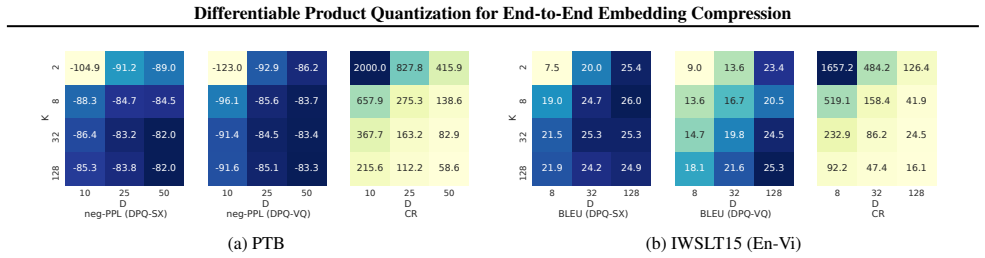
- [Section 3.3, Figure 3] The heat-maps combine K and D values but do not show which of the two DPQ instantiations is used or whether subspace-sharing is enabled; adding this information would make the trade-off analysis easier to interpret.
Circularity Check
No significant circularity: DPQ's compression ratios and task performance are empirically self-contained and not derived from its own inputs.
full rationale
The paper's central claims—compression ratio and task performance—are established by direct parameter-count arithmetic and by empirical evaluation against full-embedding baselines and prior compression baselines, not by fitting a parameter and then predicting a closely related quantity. The compression ratio formula CR = 32nd/(nD log2 K + 32Kd) is a definitional bit-counting identity for the proposed encoding, not a prediction. Task metrics (perplexity, BLEU, accuracy) are measured on held-out data after end-to-end training with the DPQ layer replacing the input embedding, so the reported gains are not statistically forced by construction. The expressiveness result (Proposition 1) is a standalone linear-algebra statement with a proof in Appendix A; it does not presuppose the empirical outcome. The only self-citations are to the authors' prior work (Chen et al. 2018b) as a motivation and as a baseline, and those citations are not used as the load-bearing justification for DPQ's own compression or performance claims; the paper's comparisons against Shu'17, Chen'18, scalar/PQ/low-rank baselines, and standard full-embedding models provide independent empirical grounding. The explicit scope note in Section 3 that the decoder/softmax embedding is kept uncompressed is a limitation on the breadth of the empirical claim, but it is not a circularity: the reported numbers are honestly labeled as applying to the encoder-side embedding table. No equation in the paper reduces to its own input, no fitted constant is renamed as a prediction, and no uniqueness theorem or ansatz is imported via self-citation. The non-finding of circularity is therefore appropriate.
Assumptions & free parameters
free parameters (4)
- K (number of centroids per group) =
Varies per dataset; e.g., K=32 for BERT and WMT19
- D (code length) =
Varies per dataset; e.g., D=128 for BERT and WMT19
- subspace_sharing =
Boolean; used if no performance drop
- regularization coefficient for Lreg =
Unspecified
assumptions (3)
- domain assumption The embedding space can be well-approximated by a Cartesian product of D independent subspaces, each quantized with K centroids (Eq. 2).
- domain assumption Surrogate gradients from the softmax relaxation (Eq. 5) or straight-through estimator (Eq. 7) provide useful directions for optimizing the discrete codes.
- standard math Standard linear algebra facts about block-diagonal matrices and full-rank products hold (Appendix A).
Cite this review
Pith. "Pith review of Differentiable Product Quantization for End-to-End Embedding Compression." pith.science (2026). https://pith.science/paper/VW5WES4F
@misc{pith2026190809756,
  author       = {Pith},
  title        = {Pith review of: Differentiable Product Quantization for End-to-End Embedding Compression},
  year         = {2026},
  howpublished = {\url{https://pith.science/paper/VW5WES4F}},
  note         = {Machine review of arXiv:1908.09756}
}
abstract
Embedding layers are commonly used to map discrete symbols into continuous embedding vectors that reflect their semantic meanings. Despite their effectiveness, the number of parameters in an embedding layer increases linearly with the number of symbols and poses a critical challenge on memory and storage constraints. In this work, we propose a generic and end-to-end learnable compression framework termed differentiable product quantization (DPQ). We present two instantiations of DPQ that leverage different approximation techniques to enable differentiability in end-to-end learning. Our method can readily serve as a drop-in alternative for any existing embedding layer. Empirically, DPQ offers significant compression ratios (14-238$\times$) at negligible or no performance cost on 10 datasets across three different language tasks.
Figures


Figures from the paper (3 more)


Reference graph
Works this paper leans on
-
[6]
Categorical repa- rameterization with gumbel-softmax
Jang, E., Gu, S., and Poole, B. Categorical repa- rameterization with gumbel-softmax. arXiv preprint arXiv:1611.01144,
-
[7]
Fast decoding in sequence models using discrete latent variables
Kaiser, Ł., Roy, A., Vaswani, A., Parmar, N., Bengio, S., Uszkoreit, J., and Shazeer, N. Fast decoding in sequence models using discrete latent variables. arXiv preprint arXiv:1803.03382,
-
[9]
Efficient estimation of word representations in vector space
Mikolov, T., Chen, K., Corrado, G., and Dean, J. Efficient estimation of word representations in vector space. arXiv preprint arXiv:1301.3781,
-
[10]
Neural machine translation of rare words with subword units
Sennrich, R., Haddow, B., and Birch, A. Neural machine translation of rare words with subword units. arXiv preprint arXiv:1508.07909,
-
[11]
Shu, R. and Nakayama, H. Compressing word embeddings via deep compositional code learning. arXiv preprint arXiv:1711.01068,
-
[12]
Recurrent neural network regularization
Differentiable Product Quantization for End-to-End Embedding Compression Zaremba, W., Sutskever, I., and Vinyals, O. Recurrent neural network regularization. arXiv preprint arXiv:1409.2329,
-
[13]
Differentiable Product Quantization for End-to-End Embedding Compression A. Proof of Proposition 1 Proof. We first re-parameterize both the codebook C and the Value matrix V as follows. The original codebook is C∈{ 1,··· ,K}n×D, and we turn each code bit, which is an integer in{1,··· ,K}, into a small one-hot vector of length-K. This results in the new bin...
work page 2018
-
[14]
with a context window size of 256 tokens. All models were trained with a batch size of 2048 sentences for 250k steps, and with the SM3 optimizer (Anil et al.,
Show all 15 references
-
[1024]
For the DPQ experiments, we used DPQ-SX with no subspace-sharing, D = 128 andK = 32, and exactly the same configurations and hyperparameters as in our baseline
We used the same optimizer (Adam) and learning rate schedule as described in (Devlin et al., 2018). For the DPQ experiments, we used DPQ-SX with no subspace-sharing, D = 128 andK = 32, and exactly the same configurations and hyperparameters as in our baseline. C. Code Study C.1...
2018
-
[2009]
and Richardson, J
Kudo, T. and Richardson, J. Sentencepiece: A simple and language independent subword tokenizer and detokenizer for neural text processing. In Proceedings of the 2018 Conference on Empirical Methods in Natural Language Processing: System Demonstrations, pp. 66–71,
2018
-
[2013]
Adaptive mixture of low-rank factorizations for compact neural modeling
Chen, T., Lin, J., Lin, T., Han, S., Wang, C., and Zhou, D. Adaptive mixture of low-rank factorizations for compact neural modeling. Neural Information Processing Systems (CDNNRIA workshop), 2018a. Chen, T., Min, M. R., and Sun, Y . Learning k-way d- dimensional discrete codes...
-
[2015]
G., Zhu, M., Chen, B., Kalenichenko, D., Wang, W., Weyand, T., Andreetto, M., and Adam, H
Howard, A. G., Zhu, M., Chen, B., Kalenichenko, D., Wang, W., Weyand, T., Andreetto, M., and Adam, H. Mobilenets: Efficient convolutional neural networks for mobile vision applications. arXiv preprint arXiv:1704.04861,
-
[2017]
and Szegedy, C
Ioffe, S. and Szegedy, C. Batch normalization: Accelerating deep network training by reducing internal covariate shift. arXiv preprint arXiv:1502.03167,
-
[2018]
Han, S., Mao, H., and Dally, W. J. Deep compres- sion: Compressing deep neural networks with pruning, trained quantization and huffman coding. arXiv preprint arXiv:1510.00149,
-
[2019]
Estimating or propagating gradients through stochastic neurons for con- ditional computation
Bengio, Y ., Léonard, N., and Courville, A. Estimating or propagating gradients through stochastic neurons for con- ditional computation. arXiv preprint arXiv:1308.3432,
Reviewed August 14, 2026 · model on record in the stance chip above.
Discussion (0). Continue with ORCID to comment.