HALO II: Constraining Hubble constant H₀ through continuum delay fitting of Fairall 9
Pith reviewed 2026-06-26 03:42 UTC · model grok-4.3
The pith
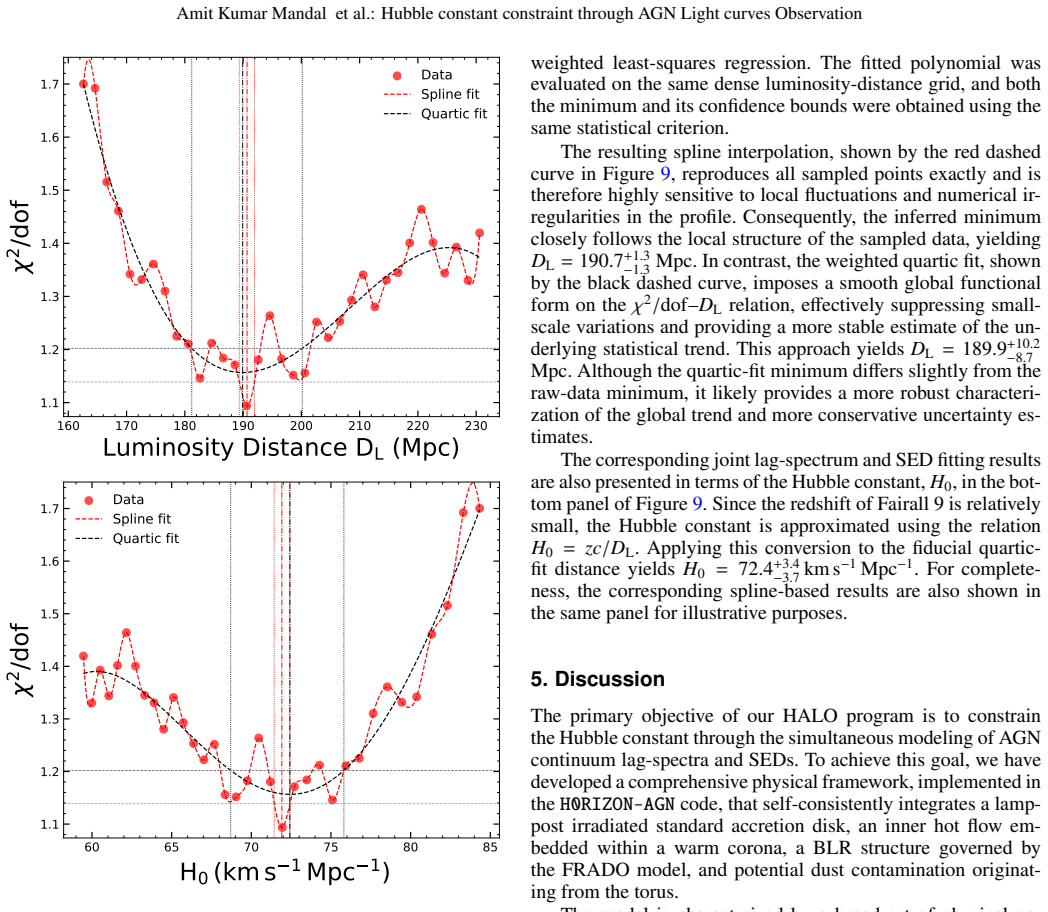
Continuum time delays and SED modeling in Fairall 9 yield H0 = 72.4 km s^{-1} Mpc^{-1} independent of the cosmic distance ladder.
A machine-rendered reading of the paper's core claim, the machinery that carries it, and where it could break.
Core claim
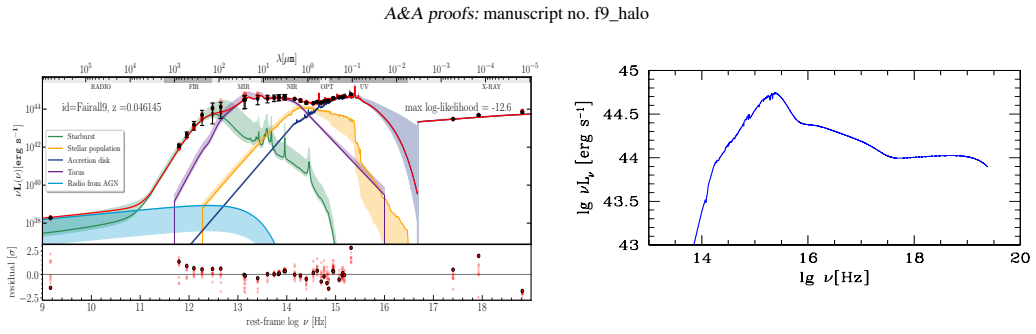
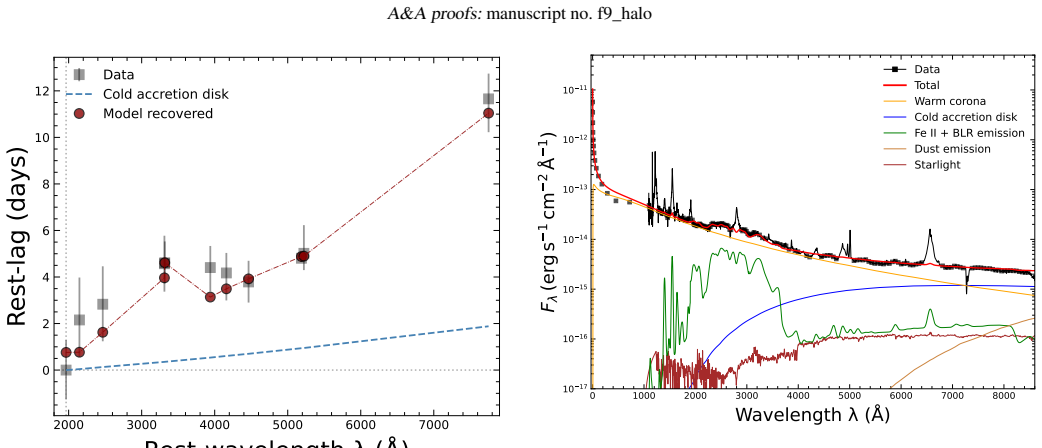
Through the simultaneous modeling of the continuum lag-spectrum and the broadband SED of Fairall 9 using the H0RIZON-AGN model that incorporates radiation reprocessing in the cold accretion disk, a Hubble constant of H0=72.4_{-3.7}^{+3.4} km s^{-1} Mpc^{-1} is derived, showing that this method can deliver independent H0 measurements at approximately 5 percent precision from one object.
What carries the argument
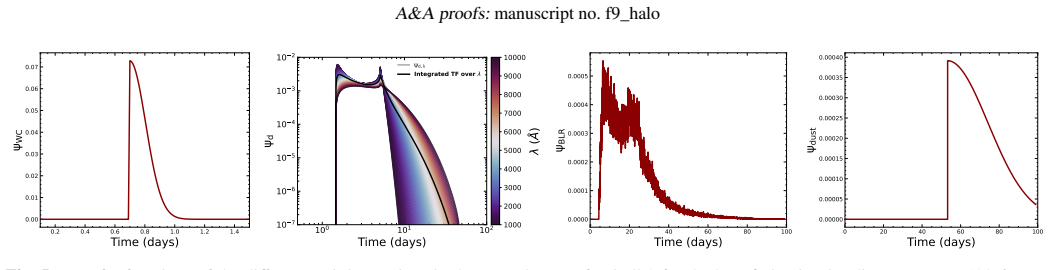
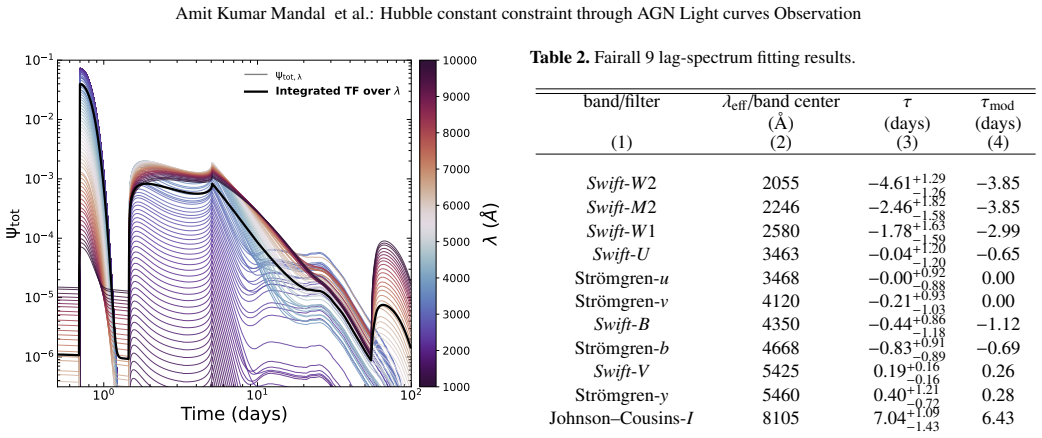
The H0RIZON-AGN model, which predicts continuum time delays by simulating radiation reprocessing in the accretion disk and is fitted jointly to the lag spectrum and SED.
If this is right
- The method supplies an H0 measurement entirely free from cosmic distance ladder systematics and cross-calibrations.
- A single source already reaches 5 percent precision, indicating that samples of many AGNs can push uncertainty below 1 percent.
- Data from the Vera Rubin Observatory are expected to enable this technique as a competitive probe of the Hubble tension.
- The derived H0 remains consistent with both early- and late-Universe values inside current error bars.
Where Pith is reading between the lines
- Repeating the analysis on a statistical sample of AGNs would test whether Fairall 9 is typical or whether source-to-source variations affect the inferred H0.
- Incorporating additional observables such as line reverberation or X-ray lags could tighten the model constraints without changing the core distance inference.
- If the method scales cleanly, it offers a route to map H0 across redshift using the same class of objects at different look-back times.
Load-bearing premise
The H0RIZON-AGN model correctly captures all dominant effects of radiation reprocessing in the cold accretion disk for Fairall 9 with no significant unmodeled systematics such as disk winds or non-standard temperature profiles.
What would settle it
An independent geometric distance to Fairall 9 that produces an H0 value outside the reported 72.4_{-3.7}^{+3.4} range when combined with the observed lags would falsify the central claim.
Figures
read the original abstract
The Hubble tension remains one of the most significant unresolved problems in modern cosmology. A key question is whether it may arise from underestimated systematic uncertainties in the different measurement techniques. In this context, new independent methods are of exceptional importance. We therefore pursue a novel approach to determining the Hubble constant, $H_{0}$ based on continuum time delay and spectral energy distribution (SED) modeling in active galactic nuclei (AGNs). Unlike conventional techniques, this method is entirely independent of the cosmic distance ladder and does not require cross-calibration against other distance indicators. As a result, it enables a direct determination of $H_{0}$, free from the arbitrary normalizations that often affect indirect measurements. We conducted a dedicated monitoring campaign of the Seyfert galaxy Fairall 9 and further developed the {\tt H0RIZON-AGN} model to interpret the resulting observations. The model incorporates the effects of radiation reprocessing in the surrounding cold accretion disk, enabling a more realistic description of the observed continuum delays. Through the simultaneous modeling of the continuum lag-spectrum and the broadband SED of Fairall 9, we derived a Hubble constant of $H_{0}=72.4_{-3.7}^{+3.4} \, \rm km \, s^{-1} \, Mpc^{-1}$. Achieving a measurement precision of approximately 5% from a single source demonstrates the considerable potential of this method for independent determinations of the Hubble constant. Our determination of $H_{0}$ is broadly consistent, within the current uncertainties, with both early- and late-Universe measurements. Future applications of the method to larger datasets, particularly those provided by the Vera Rubin Observatory, are expected to reduce the uncertainty to below 1%, thereby establishing this approach as a powerful independent probe of the Hubble tension.
Editorial analysis
A structured set of objections, weighed in public.
Referee Report
Summary. The manuscript presents a new method to measure the Hubble constant H0 independently of the cosmic distance ladder by jointly fitting the continuum lag spectrum and broadband SED of the Seyfert galaxy Fairall 9 using the H0RIZON-AGN model, which incorporates radiation reprocessing in a cold accretion disk. From a dedicated monitoring campaign, the authors derive H0 = 72.4_{-3.7}^{+3.4} km s^{-1} Mpc^{-1} at approximately 5% precision and note consistency with both early- and late-Universe measurements, with potential for sub-1% precision using larger samples from future surveys.
Significance. If the H0RIZON-AGN model assumptions hold without significant unmodeled systematics, the result provides a genuinely independent cosmological probe at useful precision from a single AGN. The approach avoids cross-calibration issues and could become a valuable addition to Hubble tension studies once applied to larger datasets. The dedicated monitoring and model development are positive steps toward falsifiable, geometry-based distance estimates.
major comments (1)
- [H0RIZON-AGN model description and fitting procedure] The central H0 result is obtained by fitting the H0RIZON-AGN model (including luminosity distance via H0) to the observed lags and SED. The model assumes reprocessing occurs only in a standard thin disk with temperature profile and response function fully specified by the free parameters (BH mass, accretion rate, inclination, H0). If Fairall 9 has disk winds, non-standard radial temperature index, or inclination-dependent scattering, the predicted lag spectrum will be offset, biasing the inferred distance (and H0) at a level comparable to the quoted uncertainty. No validation against hydrodynamic simulations or a second AGN with independent geometric distance is reported.
minor comments (1)
- [Abstract] The abstract and introduction would benefit from an explicit statement of the key model assumptions (e.g., thin-disk temperature profile, neglect of winds) so readers can immediately assess the scope of the claim.
Simulated Author's Rebuttal
We thank the referee for their constructive review and for acknowledging the potential of this independent approach to measuring H0. We respond to the major comment below.
read point-by-point responses
-
Referee: [H0RIZON-AGN model description and fitting procedure] The central H0 result is obtained by fitting the H0RIZON-AGN model (including luminosity distance via H0) to the observed lags and SED. The model assumes reprocessing occurs only in a standard thin disk with temperature profile and response function fully specified by the free parameters (BH mass, accretion rate, inclination, H0). If Fairall 9 has disk winds, non-standard radial temperature index, or inclination-dependent scattering, the predicted lag spectrum will be offset, biasing the inferred distance (and H0) at a level comparable to the quoted uncertainty. No validation against hydrodynamic simulations or a second AGN with independent geometric distance is reported.
Authors: We agree that the H0RIZON-AGN model is constructed under the standard thin-disk reprocessing assumptions, with the temperature profile and response function set by the free parameters (black-hole mass, accretion rate, inclination, and H0) as described in the manuscript. We acknowledge that unaccounted effects such as disk winds, a non-standard radial temperature index, or inclination-dependent scattering could shift the predicted lag spectrum and thereby bias the inferred luminosity distance and H0 at a level comparable to the reported uncertainty. In the revised manuscript we have added an explicit discussion of these model assumptions and the possible impact of such deviations. Regarding validation, the present work constitutes the first application of the method to a single source. We do not report comparisons against hydrodynamic simulations or against a second AGN possessing an independent geometric distance; such tests lie outside the scope of this initial demonstration and are reserved for future studies with expanded samples. revision: partial
- Validation of the H0RIZON-AGN model against hydrodynamic simulations or application to a second AGN with an independent geometric distance measurement
Circularity Check
No significant circularity; H0 obtained via standard model fit to external data
full rationale
The paper derives H0 by jointly fitting the H0RIZON-AGN model parameters (including distance) to the observed continuum lag spectrum and broadband SED of Fairall 9. This is a direct parameter estimation from independent observational inputs using a physical reprocessing model, not a reduction of the claimed result to its own inputs by construction. No self-definitional equations, fitted subsets renamed as predictions, or load-bearing self-citations appear in the provided text. The method is presented as independent of the distance ladder, with the output H0 value arising from the data fit rather than being presupposed.
Axiom & Free-Parameter Ledger
free parameters (2)
- H0 =
72.4
- accretion-disk model parameters (BH mass, accretion rate, inclination)
axioms (1)
- domain assumption Radiation reprocessing in a cold, standard accretion disk fully accounts for the observed continuum lags and SED shape in Fairall 9.
Reference graph
Works this paper leans on
-
[1]
Microlensing of Strongly Lensed Quasars. , keywords =. doi:10.1007/s11214-024-01043-8 , archivePrefix =. 2312.00931 , primaryClass =
-
[2]
Reconciling the Quasar Microlensing Disc Size Problem with a Wind Model of Active Galactic Nucleus
Reconciling the quasar microlensing disc size problem with a wind model of active galactic nucleus. , keywords =. doi:10.1093/mnras/sty3245 , archivePrefix =. 1806.08496 , primaryClass =
work page internal anchor Pith review Pith/arXiv arXiv doi:10.1093/mnras/sty3245
-
[3]
Gravitational Lensing Size Scales for Quasars
Gravitational lensing size scales for quasars. Astronomische Nachrichten , keywords =. doi:10.1002/asna.201612313 , archivePrefix =. 1509.05375 , primaryClass =
work page internal anchor Pith review Pith/arXiv arXiv doi:10.1002/asna.201612313
-
[4]
Sizes and Temperature Profiles of Quasar Accretion Disks from Chromatic Microlensing
Sizes and Temperature Profiles of Quasar Accretion Disks from Chromatic Microlensing. , keywords =. doi:10.1088/0004-637X/729/1/34 , archivePrefix =. 1007.1665 , primaryClass =
work page internal anchor Pith review Pith/arXiv arXiv doi:10.1088/0004-637x/729/1/34
-
[5]
Rubin Observatory Legacy Survey of Space and Time: Source Classification and Galaxy Properties
Spectral Energy Distributions in Three Deep-drilling Fields of the Vera C. Rubin Observatory Legacy Survey of Space and Time: Source Classification and Galaxy Properties. , keywords =. doi:10.3847/1538-4365/ac7bdf , archivePrefix =. 2206.06432 , primaryClass =
-
[6]
The Sloan Digital Sky Survey Reverberation Mapping Project: Accretion Disk Sizes from Continuum Lags. , keywords =. doi:10.3847/1538-4357/ab2638 , archivePrefix =. 1806.08360 , primaryClass =
-
[7]
The LSST Era of Supermassive Black Hole Accretion Disk Reverberation Mapping. , keywords =. doi:10.3847/1538-4365/ac88ce , archivePrefix =. 2208.06203 , primaryClass =
-
[8]
Modeling the Infrared Reverberation Response of the Circumnuclear Dusty Torus in AGNs: An Investigation of Torus Response Functions. , keywords =. doi:10.3847/1538-4357/ab6aa1 , archivePrefix =. 2002.12823 , primaryClass =
-
[9]
Modeling the Infrared Reverberation Response of the Circumnuclear Dusty Torus in AGNs: The Effects of Cloud Orientation and Anisotropic Illumination. , keywords =. doi:10.3847/1538-4357/aa7687 , archivePrefix =. 1709.07011 , primaryClass =
work page internal anchor Pith review Pith/arXiv arXiv doi:10.3847/1538-4357/aa7687
-
[10]
Reverberation Measurements of the Inner Radius of the Dust Torus in Nearby Seyfert 1 Galaxies
Reverberation Measurements of the Inner Radius of the Dust Torus in Nearby Seyfert 1 Galaxies. , keywords =. doi:10.1086/499326 , archivePrefix =. astro-ph/0511697 , primaryClass =
work page internal anchor Pith review Pith/arXiv arXiv doi:10.1086/499326
-
[11]
and Rodney, Steven and Treu, Tommaso and Oguri, Masamune and Chen, Wenlei and Zitrin, Adi and Birrer, Simon and Bonvin, Vivien and Dessart, Luc and Diego, Jose M
Kelly, Patrick L. and Rodney, Steven and Treu, Tommaso and Oguri, Masamune and Chen, Wenlei and Zitrin, Adi and Birrer, Simon and Bonvin, Vivien and Dessart, Luc and Diego, Jose M. and Filippenko, Alexei V. and Foley, Ryan J. and others , title =. Science , year =
-
[12]
H0LiCOW - XIII. A 2.4 per cent measurement of H _ 0 from lensed quasars: 5.3 tension between early- and late-Universe probes. , keywords =. doi:10.1093/mnras/stz3094 , archivePrefix =. 1907.04869 , primaryClass =
-
[13]
What controls the Fe II strength in active galactic nuclei?
What Controls the Fe II Strength in Active Galactic Nuclei?. , keywords =. doi:10.1088/0004-637X/736/2/86 , archivePrefix =. 0903.5020 , primaryClass =
work page internal anchor Pith review Pith/arXiv arXiv doi:10.1088/0004-637x/736/2/86
-
[14]
Searching for the Physical Drivers of the Eigenvector 1 Correlation Space
Searching for the Physical Drivers of the Eigenvector 1 Correlation Space. , keywords =. doi:10.1086/322286 , archivePrefix =. astro-ph/0105343 , primaryClass =
work page internal anchor Pith review Pith/arXiv arXiv doi:10.1086/322286
-
[15]
Modeling Fe II Emission and Revised Fe II (UV) Empirical Templates for the Seyfert 1 Galaxy I Zw 1. , keywords =. doi:10.1086/525557 , adsurl =
-
[16]
Reverberation Measurements of the Inner Radius of the Dust Torus in 17 Seyfert Galaxies
Reverberation Measurements of the Inner Radius of the Dust Torus in 17 Seyfert Galaxies. , keywords =. doi:10.1088/0004-637X/788/2/159 , archivePrefix =. 1406.2078 , primaryClass =
work page internal anchor Pith review Pith/arXiv arXiv doi:10.1088/0004-637x/788/2/159 2078
-
[17]
Revisiting the Dust Torus Size Luminosity Relation Based on a Uniform Reverberation-mapping Analysis. , keywords =. doi:10.3847/1538-4357/ad414d , archivePrefix =. 2403.01885 , primaryClass =
-
[18]
Rapid luminosity decline and subsequent reformation of the innermost dust distribution in the changing-look AGN Mrk 590. , keywords =. doi:10.1093/mnras/stz3397 , archivePrefix =. 1904.08946 , primaryClass =
-
[19]
AGN Dusty Tori. II. Observational Implications of Clumpiness. , keywords =. doi:10.1086/590483 , archivePrefix =. 0806.0512 , primaryClass =
work page internal anchor Pith review Pith/arXiv arXiv doi:10.1086/590483
-
[20]
Modeling the Central Supermassive Black Hole Mass of Quasars via the LSTM Approach. , keywords =. doi:10.3847/1538-4357/ace03f , archivePrefix =. 2301.01459 , primaryClass =
-
[21]
AGN Dusty Tori. I. Handling of Clumpy Media. , keywords =. doi:10.1086/590482 , archivePrefix =. 0806.0511 , primaryClass =
work page internal anchor Pith review Pith/arXiv arXiv doi:10.1086/590482
-
[22]
Dust reverberation mapping and light-curve modelling of Zw229-015. , keywords =. doi:10.1093/mnras/stac2529 , archivePrefix =. 2209.01409 , primaryClass =
-
[23]
Photometric continuum reverberation mapping of Fairall 9
HALO: I. Photometric continuum reverberation mapping of Fairall 9. , keywords =. doi:10.1051/0004-6361/202557795 , archivePrefix =. 2512.13296 , primaryClass =
-
[24]
Connecting the X-Ray/UV Variability of Fairall 9 with NICER: A Possible Warm Corona. , keywords =. doi:10.3847/1538-4357/ad8dc2 , archivePrefix =. 2410.21432 , primaryClass =
-
[25]
Astronomische Nachrichten , keywords =
Minimum X-ray source size of the on-axis corona in AGN. Astronomische Nachrichten , keywords =. doi:10.1002/asna.201612327 , adsurl =
-
[26]
Universal spectral shape of high accretion rate AGN
Universal spectral shape of high accretion rate AGN. , keywords =. doi:10.1051/0004-6361:20031441 , archivePrefix =. astro-ph/0309242 , primaryClass =
work page internal anchor Pith review Pith/arXiv arXiv doi:10.1051/0004-6361:20031441
-
[27]
X-ray view of dissipative warm corona in active galactic nuclei. , keywords =. doi:10.1051/0004-6361/202450111 , archivePrefix =. 2406.14378 , primaryClass =
-
[28]
The broad-band view of the bare Seyfert PG 1426+015: relativistic reflection, the soft excess, and the importance of oxygen. , keywords =. doi:10.1093/mnras/staf1545 , archivePrefix =. 2509.13411 , primaryClass =
-
[29]
Two per cent measurement of $H_0$ from Cepheids alone
1.8 per cent measurement of H _ 0 from Cepheids alone. , keywords =. doi:10.1093/mnras/staf2260 , archivePrefix =. 2509.09665 , primaryClass =
work page internal anchor Pith review Pith/arXiv arXiv doi:10.1093/mnras/staf2260
-
[30]
The subtle statistics of the distance ladder: On the distance prior and selection effects. arXiv e-prints , keywords =. doi:10.48550/arXiv.2511.03394 , archivePrefix =. 2511.03394 , primaryClass =
-
[31]
The Manticore Project I: a digital twin of our cosmic neighbourhood from Bayesian field-level analysis. , keywords =. doi:10.1093/mnras/staf767 , archivePrefix =. 2505.10682 , primaryClass =
-
[32]
Unveiling energy pathways in AGN accretion flows with the warm corona model for the soft excess. , keywords =. doi:10.1093/mnras/stae944 , archivePrefix =. 2404.03040 , primaryClass =
-
[33]
The Binary Ballet: Mapping Local Expansion Around M81 & M82. arXiv e-prints , keywords =. doi:10.48550/arXiv.2510.24840 , archivePrefix =. 2510.24840 , primaryClass =
-
[34]
Alignment with DESI BAO and signs of a non-accelerating universe
Strong progenitor age bias in supernova cosmology ─ II. Alignment with DESI BAO and signs of a non-accelerating universe. , keywords =. doi:10.1093/mnras/staf1685 , archivePrefix =. 2510.13121 , primaryClass =
-
[35]
The Local Distance Network: a community consensus report on the measurement of the Hubble constant at 1\. arXiv e-prints , keywords =. doi:10.48550/arXiv.2510.23823 , archivePrefix =. 2510.23823 , primaryClass =
work page internal anchor Pith review Pith/arXiv arXiv doi:10.48550/arxiv.2510.23823
-
[36]
The Seoul National University AGN Monitoring Project. III. H Lag Measurements of 32 Luminous Active Galactic Nuclei and the High-luminosity End of the Size Luminosity Relation. , keywords =. doi:10.3847/1538-4357/ad132f , archivePrefix =. 2311.15518 , primaryClass =
-
[37]
The Disk Plus (Failed) Wind System of 3C 47: A Story of Accretion Disks and Binary Black Holes. arXiv e-prints , keywords =. doi:10.48550/arXiv.2510.01972 , archivePrefix =. 2510.01972 , primaryClass =
-
[38]
Cosmology with supernova Encore in the strong lensing cluster MACS J0138-2155: Lens model comparison and H0 measurement. arXiv e-prints , keywords =. doi:10.48550/arXiv.2509.12319 , archivePrefix =. 2509.12319 , primaryClass =
work page internal anchor Pith review Pith/arXiv arXiv doi:10.48550/arxiv.2509.12319
-
[39]
Reflection Features in the X-Ray Spectrum of Fairall 9 and Implications for Tests of General Relativity. , keywords =. doi:10.3847/1538-4357/ab917a , archivePrefix =. 2004.11542 , primaryClass =
-
[40]
An XMM-Newton view of the `bare' nucleus of Fairall 9. , keywords =. doi:10.1111/j.1365-2966.2011.18834.x , archivePrefix =. 1104.0044 , primaryClass =
-
[41]
Broad line region and black hole mass of PKS 1510-089 from spectroscopic reverberation mapping. , keywords =. doi:10.1051/0004-6361/202038324 , archivePrefix =. 2007.07672 , primaryClass =
-
[42]
X-ray/UV/optical variability of NGC 4593 with Swift: reprocessing of X-rays by an extended reprocessor. , keywords =. doi:10.1093/mnras/sty1983 , archivePrefix =. 1712.04852 , primaryClass =
work page internal anchor Pith review Pith/arXiv arXiv doi:10.1093/mnras/sty1983
-
[43]
Supermassive Black Holes with High Accretion Rates in Active Galactic Nuclei. VIII. Structure of the Broad-line Region and Mass of the Central Black Hole in Mrk 142. , keywords =. doi:10.3847/1538-4357/aaee6b , archivePrefix =. 1811.06302 , primaryClass =
work page internal anchor Pith review Pith/arXiv arXiv doi:10.3847/1538-4357/aaee6b
-
[44]
Reverberation Mapping Measurements of Black Hole Masses in Six Local Seyfert Galaxies
Reverberation Mapping Measurements of Black Hole Masses in Six Local Seyfert Galaxies. , keywords =. doi:10.1088/0004-637X/721/1/715 , archivePrefix =. 1006.4160 , primaryClass =
work page internal anchor Pith review Pith/arXiv arXiv doi:10.1088/0004-637x/721/1/715
-
[45]
UV-Optical Disk Reverberation Lags despite a Faint X-Ray Corona in the Active Galactic Nucleus Mrk 335. , keywords =. doi:10.3847/1538-4357/acbcd3 , archivePrefix =. 2302.07342 , primaryClass =
-
[46]
AGN STORM 2. XII. Ground-based Optical Photometry and Lag Measurements of Mrk 817. , keywords =. doi:10.3847/1538-4357/ae6103 , archivePrefix =. 2605.02875 , primaryClass =
work page internal anchor Pith review Pith/arXiv arXiv doi:10.3847/1538-4357/ae6103
-
[47]
Accretion disc reverberation mapping in a high-redshift quasar. , keywords =. doi:10.1051/0004-6361/202555421 , archivePrefix =. 2508.00209 , primaryClass =
-
[48]
The unusually red delay spectrum of the low-mass black hole AGN NGC 4051 as revealed by intensive continuum reverberation mapping with the Las Cumbres Observatory. , keywords =. doi:10.1093/mnras/stag642 , archivePrefix =. 2604.01405 , primaryClass =
-
[49]
Continuum Reverberation Mapping of Mrk 876 over Three Years with Remote Robotic Observatories. , keywords =. doi:10.3847/1538-4357/ace342 , archivePrefix =. 2307.02630 , primaryClass =
-
[50]
Testing super-eddington accretion on to a supermassive black hole: reverberation mapping of PG 1119+120. , keywords =. doi:10.1093/mnras/stad1409 , archivePrefix =. 2302.09370 , primaryClass =
-
[51]
On the nature of the continuum reverberation of X-ray/UV and optical emission of IRAS 09149-6206. , keywords =. doi:10.1093/mnras/stad2483 , archivePrefix =. 2308.05433 , primaryClass =
-
[52]
Photometric reverberation mapping of 3C120
Photometric reverberation mapping of 3C 120. , keywords =. doi:10.1051/0004-6361/201219107 , archivePrefix =. 1303.3506 , primaryClass =
work page internal anchor Pith review Pith/arXiv arXiv doi:10.1051/0004-6361/201219107
-
[53]
arXiv e-prints , keywords =
Departures from Standard Disk Predictions in Intensive Ground-Based Monitoring of Three AGN. arXiv e-prints , keywords =
-
[54]
Steps toward Determination of the Size and Structure of the Broad-Line Region in Active Galactic Nuclei. X. Variability of Fairall 9 from Optical Data. , keywords =. doi:10.1086/313046 , adsurl =
-
[55]
Steps toward Determination of the Size and Structure of the Broad-Line Region in Active Galactic Nuclei. IX. Ultraviolet Observations of Fairall 9. , keywords =. doi:10.1086/312996 , adsurl =
-
[56]
Revisiting the H Size Luminosity Relation Using a Uniform Reverberation-mapping Analysis. , keywords =. doi:10.3847/1538-4365/ad74f2 , archivePrefix =. 2408.15872 , primaryClass =
-
[57]
The Size of the Continuum Emission Region and Its Scaling Relations with Active Galactic Nucleus Luminosity and the Broad-line Region Size. , keywords =. doi:10.3847/1538-4357/adc56e , archivePrefix =. 2502.19184 , primaryClass =
-
[58]
Modeling the Time Variability of SDSS Stripe 82 Quasars as a Damped Random Walk
Modeling the Time Variability of SDSS Stripe 82 Quasars as a Damped Random Walk. , keywords =. doi:10.1088/0004-637X/721/2/1014 , archivePrefix =. 1004.0276 , primaryClass =
work page internal anchor Pith review Pith/arXiv arXiv doi:10.1088/0004-637x/721/2/1014
-
[59]
Bayesian analysis of quasar light curves with a running optimal average: new time delay measurements of COSMOGRAIL gravitationally lensed quasars. , keywords =. doi:10.1093/mnras/stab2832 , archivePrefix =. 2107.12318 , primaryClass =
-
[62]
Central Masses and Broad-Line Region Sizes of Active Galactic Nuclei. I. Comparing the Photoionization and Reverberation Techniques. , eprint =. doi:10.1086/308017 , adsurl =
-
[63]
PyCCF: Python Cross Correlation Function for reverberation mapping studies
-
[64]
On Uncertainties in Cross-Correlation Lags and the Reality of Wavelength-dependent Continuum Lags in Active Galactic Nuclei. , keywords =. doi:10.1086/316177 , archivePrefix =. astro-ph/9802103 , primaryClass =
work page internal anchor Pith review Pith/arXiv arXiv doi:10.1086/316177
-
[65]
The accuracy of cross-correlation estimates of quasar emission-line region sizes. , keywords =. doi:10.1086/191216 , adsurl =
-
[66]
Line variations in quasars and Seyfert galaxies. , keywords =. doi:10.1086/164238 , adsurl =
-
[67]
Disentangling the optical AGN and host-galaxy luminosity with a probabilistic flux variation gradient. , keywords =. doi:10.1051/0004-6361/202141710 , archivePrefix =. 2109.03619 , primaryClass =
-
[68]
Nature Astronomy , year = 2019, month = jan, volume =
Direct evidence of non-disk optical continuum emission around an active black hole. Nature Astronomy , year = 2019, month = jan, volume =. doi:10.1038/s41550-018-0659-x , adsurl =
-
[69]
Long-Term Optical Continuum Color Variability of Nearby Active Galactic Nuclei
Long-Term Optical Continuum Color Variability of Nearby Active Galactic Nuclei. , keywords =. doi:10.1088/0004-637X/711/1/461 , archivePrefix =. 1001.5162 , primaryClass =
work page internal anchor Pith review Pith/arXiv arXiv doi:10.1088/0004-637x/711/1/461
-
[70]
Automatized Photometric Monitoring of Active Galactic Nuclei with the 46cm Telescope of the Wise Observatory. , keywords =. doi:10.1088/1538-3873/aa7a55 , archivePrefix =. 1706.05463 , primaryClass =
work page internal anchor Pith review Pith/arXiv arXiv doi:10.1088/1538-3873/aa7a55
-
[71]
Maps of Dust IR Emission for Use in Estimation of Reddening and CMBR Foregrounds
Maps of Dust Infrared Emission for Use in Estimation of Reddening and Cosmic Microwave Background Radiation Foregrounds. , keywords =. doi:10.1086/305772 , archivePrefix =. astro-ph/9710327 , primaryClass =
work page internal anchor Pith review Pith/arXiv arXiv doi:10.1086/305772
-
[72]
Measuring Reddening with Sloan Digital Sky Survey Stellar Spectra and Recalibrating SFD. , keywords =. doi:10.1088/0004-637X/737/2/103 , archivePrefix =. 1012.4804 , primaryClass =
work page internal anchor Pith review Pith/arXiv arXiv doi:10.1088/0004-637x/737/2/103
-
[73]
Optical atmospheric extinction over Cerro Paranal
Optical atmospheric extinction over Cerro Paranal. , keywords =. doi:10.1051/0004-6361/201015537 , archivePrefix =. 1011.6156 , primaryClass =
work page internal anchor Pith review Pith/arXiv arXiv doi:10.1051/0004-6361/201015537
-
[74]
Space Telescope and Optical Reverberation Mapping Project. III. Optical Continuum Emission and Broadband Time Delays in NGC 5548. , keywords =. doi:10.3847/0004-637X/821/1/56 , archivePrefix =. 1510.05648 , primaryClass =
work page internal anchor Pith review Pith/arXiv arXiv doi:10.3847/0004-637x/821/1/56
-
[75]
On characterizing the variability properties of X-ray light curves from active galaxies. , keywords =. doi:10.1046/j.1365-2966.2003.07042.x , archivePrefix =. astro-ph/0307420 , primaryClass =
-
[76]
Estimation of the size and structure of the broad line region using Bayesian approach. , keywords =. doi:10.1093/mnras/stab012 , archivePrefix =. 2101.00802 , primaryClass =
-
[77]
X-Ray Spectral Variability and Rapid Variability of the Soft X-Ray Spectrum Seyfert 1 Galaxies Arakelian 564 and Ton S180. , eprint =. doi:10.1086/323779 , adsurl =
-
[78]
AGN Coronae Through A Jet Perspective
AGN Coronae through a Jet Perspective. , keywords =. doi:10.3847/1538-4357/835/2/226 , archivePrefix =. 1612.07784 , primaryClass =
work page internal anchor Pith review Pith/arXiv arXiv doi:10.3847/1538-4357/835/2/226
-
[79]
Broad-line region physical conditions along the quasar eigenvector 1 sequence. , keywords =. doi:10.1111/j.1365-2966.2010.17357.x , archivePrefix =. 1007.3187 , primaryClass =
-
[80]
Estimating black hole masses: Accretion disk fitting versus reverberation mapping and single epoch. , keywords =. doi:10.1051/0004-6361/201936218 , archivePrefix =. 1907.00986 , primaryClass =
-
[81]
arXiv e-prints , keywords =
Temperature Fluctuations in Quasar Accretion Discs from Spectroscopic Monitoring Data. arXiv e-prints , keywords =
-
[82]
Negative Lags on the Viscous Timescale in Quasar Photometry and Prospects for Detecting More with LSST. , keywords =. doi:10.3847/1538-4357/ace7d2 , archivePrefix =. 2306.05455 , primaryClass =
discussion (0)
Sign in with ORCID, Apple, or X to comment. Anyone can read and Pith papers without signing in.