REVIEW 3 major objections 5 minor 25 references
This paper derives the first analytic formula for Rényi entanglement asymmetry in an interacting equilibrium spin chain with explicitly broken U(1), expressing the asymmetry constant directly through the static susceptibility of the broken
Reviewed by Pith at T0; open to challenge. T0 means a machine referee read the full paper against a public rubric. the ladder, T0–T4 →
T0 review · deepseek-v4-flash
2026-08-01 01:50 UTC pith:VZ5ZLMHS
load-bearing objection First analytic equilibrium entanglement asymmetry for an interacting gapped spin chain with broken U(1), built from a sine-Gordon sum rule and validated three ways; the load-bearing replica-uniformity proof sits in the SM and should be checked. the 3 major comments →
Entanglement asymmetry in the gapped XYZ spin-frac12 chain
The pith
A machine-rendered reading of the paper's core claim, the machinery that carries it, and where it could break.
Core claim
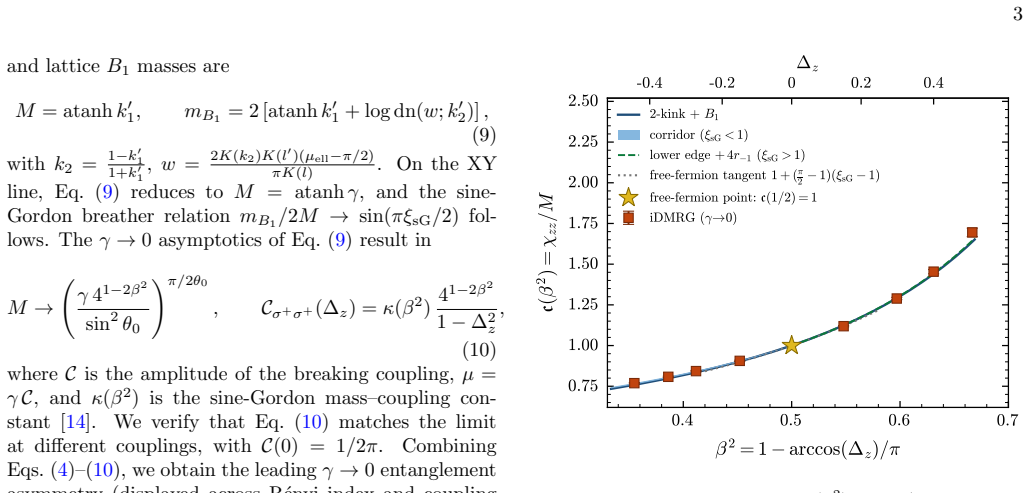
For a large interval of length ℓ in the gapped XYZ chain, the paper establishes the master formula ΔS_A^(n)(ℓ) = ½ log(πℓ χzz) + log n/[2(n−1)] + O(1/(Mℓ)), where χzz is the static susceptibility of the broken σz charge and M is the kink mass. It then evaluates the universal ratio c(β²) = χzz/M in the sine-Gordon scaling limit, obtaining a lower bound from the two-kink plus first-breather form-factor channels, a two-sided corridor for the multi-particle tail on the attractive side, and a tangent law at the free-fermion point: c(β²) = 1 + (π/2 − 1)(ξ_sG − 1) + O((ξ_sG − 1)²). The multi-particle tail is identified with a four-kink term that vanishes quadratically away from the free-fermion poi
What carries the argument
The central mechanism is a charged-moment identity, proved for fermionic Gaussian states and injective matrix-product ground states, which identifies the curvature of the charged moment with the static susceptibility χzz of the broken charge. A replica-separation uniformity statement for the phase-dressed transfer operator forces the n-dependence log n/[2(n−1)] through a Gaussian integral over the cycle-graph Laplacian. The susceptibility is then evaluated by a sine-Gordon non-conservation sum rule: the two-kink and one-breather form factors provide a lower bound on c(β²), while two moment sum rules confine the leftover multi-particle contribution to a corridor. Exact lattice masses from the
Load-bearing premise
The formula stands or falls on the assumption that the phase-dressed transfer operator of the replicated chain has a single leading eigenvalue entering one replica at a time; if that replica-separation uniformity fails, neither the log-length coefficient nor the n-dependent offset is forced.
What would settle it
In the same tensor-network setup, compute the difference ΔS_A^(3)(ℓ) − ΔS_A^(2)(ℓ) for a long interval at a fixed interacting point; the master formula predicts that this difference approaches log 3/4 − log 2/2 plus a constant independent of ℓ up to O(1/(Mℓ)) corrections. A residual ℓ-dependence, or an offset that moves with the anisotropy γ, would falsify the replica-separation uniformity assumption.
If this is right
- The additive constants of ΔS_A^(n)(ℓ) are fixed for every Rényi index, so measuring the asymmetry at one interval length determines the entire large-ℓ curve.
- The offset log n/[2(n−1)] is independent of the model parameters, making the n-dependence a universal signature of the single-eigenvalue replica mechanism.
- Because χzz controls the asymmetry amplitude, the static susceptibility of the broken charge can be extracted from entanglement data without applying an external field or charge perturbation.
- The tangent law at the free-fermion point and the quadratic onset of the four-kink tail single out that point as a special marginal locus where the asymmetry constant is exactly 1.
- The master formula provides the equilibrium baseline against which post-quench asymmetries and quantum-Mpemba-type effects in this chain should be compared.
Where Pith is reading between the lines
- Beyond the paper: if the charged-moment identity and replica-separation uniformity hold for other gapped symmetry-broken ground states with a single dominant transfer eigenvalue, the same structure—half log ℓ plus a susceptibility constant plus an n-only offset—would extend to other integrable and non-integrable chains, making χzz/M a general asymmetry amplitude.
- Beyond the paper: the quadratic vanishing of the multi-particle tail at the free-fermion point suggests a measurable cusp or softening in the asymmetry constant as the marginal point is approached; high-resolution probes of the charge structure factor could look for it.
- Beyond the paper: measuring ΔS_A^(n)(ℓ) at two Rényi indices in a cold-atom quantum gas microscope could isolate χzz directly from entanglement data, offering a route to detect symmetry breaking without coupling to the broken charge.
Editorial analysis
A structured set of objections, weighed in public.
Referee Report
Summary. The manuscript studies the Rényi entanglement asymmetry ΔS_A^(n) of a large interval in the gapped U(1)-breaking phase of the XYZ spin-1/2 chain. The central result is Eq. (4), which states that ΔS_A^(n)(ℓ) = ½ log(πℓ χ_zz) + log n/[2(n−1)] + O(1/(Mℓ)), where χ_zz is the static susceptibility of the broken charge and M is the kink mass. The coefficient c(β²)=χ_zz/M is evaluated in the sine-Gordon limit through a non-conservation sum rule using Lukyanov form factors: the two-kink and one-breather channels provide a lower bound (Eqs. (5)–(6)), two moment sum rules confine the multi-particle remainder to a two-sided corridor on the attractive side (Eq. (7)), and a four-kink estimate is used near the free-fermion point. The kink mass is taken from the Baxter/JKM exact lattice solution, and iDMRG simulations validate the master formula by direct charge-projector and charged-moment constructions.
Significance. If correct, the paper provides the first analytic equilibrium entanglement asymmetry for an interacting model with explicitly broken U(1), going beyond free-fermion results and the perturbative critical XXZ calculation. The manuscript has clear strengths: the master formula is cross-checked by three independent routes (free-fermion transfer matrix, direct variance/inversion of c1, and the n=2/3 combination c1^(2)−c1^(3)=½log2−¼log3), the lattice masses are exact from Baxter/JKM, and the iMPS validation uses directly measured correlator sums and an exact mass rather than a fit to the formula being tested. The code and data are deposited. The main reservations concern the depth of the proof of the central MPS identities, the treatment of two repulsive-side data points that fall below the claimed lower bound, and the unquantified four-kink amplitude.
major comments (3)
- [Section 2, after Eq. (3)] Eq. (4) rests on two MPS identities: V=Var(Q_A)[1+O(ℓ^-1)] and the replica-separation uniformity V_d=V for every integer n≥2. The main text states these with proofs deferred to SM Secs. 1.1–1.2. The one-sentence justification that the leading phase-dressed eigenvalue enters the replicated moment 'one replica at a time' is a structural spectral claim. If wrong, the coefficient of log ℓ could acquire n-dependence and the offset log n/[2(n-1)] would not be forced. The n=2 and n=3 difference tests only the offset difference; a common n-dependent rescaling would preserve that difference, so current numerics do not isolate this assumption. The published version should give a self-contained derivation of both identities, since this is load-bearing for Eq. (4).
- [Section 5, Numerical Validation] The iDMRG determinations at ξ_sG=1.212 and 1.4813 fall below the two-kink+B1 lower bound. The text ascribes this to γ→0 extrapolation systematics without a quantitative model. Because the extrapolation on the repulsive side is long and the deviations are in the direction that weakens the bound, the claim that the bound is satisfied to within combined uncertainty cannot be checked from the presented data. Please provide the extrapolation-error model, show the raw γ-dependence, or explicitly lower the status of the repulsive-side bound/corridor claims.
- [Section 3, four-kink estimate after Eq. (7)] The amplitude A≈0.08 is described as a Monte-Carlo estimate of the leading four-kink form factor, but no error bar, integration parameters, or independent cross-check is given. The statement that this estimate captures the small excess seen near the free-fermion point is used quantitatively to support the tail, and the bound A≥4A^-1≈0.012 also relies on the same quantity. An uncertainty and a description of the evaluation are necessary before this can count as evidence; otherwise it should be flagged as an illustrative estimate.
minor comments (5)
- [Section 3, around Eq. (7)] The text says 'Two moment sum rules make this deficit two-sided', but Eq. (7) gives a two-sided bound only for ξ_sG<1; on the repulsive side it is one-sided (c_tail ≥ 4r_-1). Please rephrase to avoid overstating the constraint on the repulsive side.
- [Section 4, Eq. (10)] The symbols C_σ+σ+(Δz) and κ(β²) are used without definition in the main text. Please define the amplitude of the breaking coupling and the sine-Gordon mass–coupling constant explicitly, and clarify the relation between C and C_σ+σ+.
- [Section 5, charged-moment construction] The phrase 'the α=±π(σz-string) region of the circle average' is unexplained. Define the operator and why its contribution is exponentially suppressed.
- [Eqs. (5) and (9)] Check notation: in Eq. (5), the denominator of F(θ) should be parenthesized as (cosh θ + iπ/(2ξ_sG)); in Eq. (9), 'atanh k′_1' is unclear. Use a standard notation with an explicitly indicated argument.
- [Introduction, first paragraph] 'One Néel-x vacuum' should be clarified: the ground state is twofold degenerate in the U(1)-broken phase. State which member is chosen and whether the asymmetry is independent of this choice.
Circularity Check
No circularity: the master formula is derived from independent analytic inputs and validated against distinct iDMRG-observed quantities.
full rationale
The derivation chain is not circular. The susceptibility chi_zz is evaluated from sine-Gordon form factors (Lukyanov, Fehér–Takács) and the kink mass M from the Baxter/JKM solution; neither input is fitted to the target asymmetry. The iDMRG validation uses directly measured correlator sums, the exact mass from Eq. (9), and independently constructed charged moments, not the master formula being tested. The only deferred items (V=Var(Q_A) and V_d=V) are structural identities asserted for Gaussian/injective-MPS ground states with proofs in the SM; they may be assumptions that could fail, but the text does not define the target result through them, and no main-text equation reduces Eq. (4) to a fit or to a self-citation. The small four-kink amplitude A is estimated perturbatively/Monte-Carlo and separately bounded, and it does not enter the central two-kink+B1 lower bound. There are no self-citations by the author; all external form-factor, mass, and vacuum-expectation-value inputs are independent. The two repulsive iDMRG points lying below the bound are explicitly attributed to gamma→0 extrapolation systematics rather than used as theory input. No circular step can be exhibited with the required quote-and-reduction standard, so the appropriate score is 0.
Axiom & Free-Parameter Ledger
free parameters (2)
- four-kink amplitude A =
≈0.08 (Monte-Carlo estimate)
- γ→0 extrapolation fit coefficients =
not quoted (spread sets quoted errors)
axioms (5)
- domain assumption Scaling limit of the γ-perturbed XXZ/XYZ chain is sine-Gordon with β²=1−arccos(∆z)/π and ξsG=β²/(1−β²).
- domain assumption The breaking vertex e^{iβϕ} carries charge q=2 and coupling µ=γC; C and kink mass M come from the Baxter/JKM exact solution (Eqs. (9)–(10)).
- domain assumption Lukyanov's two-soliton and one-breather form factors, with F as the minimal CDD solution, are the correct matrix elements of sinβϕ.
- domain assumption For injective MPS with a gapped transfer matrix, V=Var(Q_A) and the replica-separation uniformity V_d=V hold for every integer n≥2.
- domain assumption Equation-of-motion/Hellmann–Feynman identity eliminating Gβ in favour of M and µ, equivalent to known sine-Gordon bulk energy.
read the original abstract
The entanglement asymmetry measures how strongly a symmetry is broken inside a subsystem. Analytic results at equilibrium have so far covered free theories and, perturbatively, the critical XXZ chain. We compute the R\'enyi entanglement asymmetries of a large interval in the gapped, $U(1)$-breaking phase of the interacting XYZ chain. The calculation combines three ingredients. A charged-moment identity, which we prove for fermionic Gaussian and for injective matrix-product ground states, ties the asymmetry to the static susceptibility of the broken charge. A non-conservation sum rule then evaluates the susceptibility from sine-Gordon form factors, its two-kink and one-breather channels providing a lower bound on the universal amplitude. The Baxter--Johnson--Krinsky--McCoy solution supplies the kink mass for different couplings. Infinite-system density-matrix renormalization group simulations built on these masses reproduce the master formula.
Figures


Reference graph
Works this paper leans on
-
[1]
F. Ares, S. Murciano, and P. Calabrese, Nat. Commun. 14, 2036 (2023), arXiv:2207.14693
Pith/arXiv arXiv 2036
-
[2]
F. Ares, P. Calabrese, and S. Murciano, Nat. Rev. Phys. 7, 451 (2025), arXiv:2502.08087
Pith/arXiv arXiv 2025
-
[3]
C. Rylands, K. Klobas, F. Ares, P. Calabrese, S. Mur- ciano, and B. Bertini, Phys. Rev. Lett.133, 010401 (2024), arXiv:2310.04419
Pith/arXiv arXiv 2024
-
[4]
L. K. Joshiet al., Phys. Rev. Lett.133, 010402 (2024), arXiv:2401.04270
Pith/arXiv arXiv 2024
-
[5]
S. Murciano, F. Ares, I. Klich, and P. Calabrese, J. Stat. Mech. , 013103 (2024), arXiv:2310.07513
Pith/arXiv arXiv 2024
-
[6]
F. Ferro, F. Ares, and P. Calabrese, J. Stat. Mech. , 023101 (2024), arXiv:2307.06902
Pith/arXiv arXiv 2024
-
[7]
M. Lastres, S. Murciano, F. Ares, and P. Calabrese, J. Stat. Mech. , 013107 (2025), arXiv:2407.06427
Pith/arXiv arXiv 2025
-
[8]
M. Fossati, F. Ares, J. Dubail, and P. Calabrese, J. High Energy Phys.05(2024), 059, arXiv:2402.03446
Pith/arXiv arXiv 2024
-
[9]
L. Capizzi and M. Mazzoni, J. High Energy Phys.12 (2023), 144, arXiv:2307.12127
Pith/arXiv arXiv 2023
-
[10]
D. X. Horv´ ath, P. Calabrese, and O. A. Castro-Alvaredo, SciPost Phys.12, 088 (2022), arXiv:2105.13982
Pith/arXiv arXiv 2022
-
[11]
B. J. J. Khor, D. M. K¨ urk¸ c¨ uoglu, T. J. Hobbs, G. N. Perdue, and I. Klich, Quantum8, 1462 (2024), arXiv:2312.08601
Pith/arXiv arXiv 2024
-
[12]
S. Lukyanov, Mod. Phys. Lett. A12, 2543 (1997), arXiv:hep-th/9703190
Pith/arXiv arXiv 1997
-
[13]
G. Feh´ er and G. Tak´ acs, Nucl. Phys. B852, 441 (2011), arXiv:1106.1901
Pith/arXiv arXiv 2011
-
[14]
A. B. Zamolodchikov, Int. J. Mod. Phys. A10, 1125 (1995). 5 4 8 16 32 64 ℓ 0.25 0.50 0.75 1.00 1.25 1.50 1.75 2.00 ∆ S (n) A (ℓ) (a) (∆ z, γ) = (0.3, 0.2) 0 1 2 1/(Mℓ) 0.0 0.1 0.2 δn(ℓ) n = 2 n = 3 n = 5 n → 1 -0.4 -0.2 0 0.2 0.4 0.6 ∆ z 0.4 0.5 0.6 0.7 β2 = 1 − arccos(∆ z)/π 1.8 2.0 2.2 2.4 ∆ S (n) A (ℓM = 8) (b) n = 2 n = 3 n = 5 n → 1 FIG. 2. The R´ en...
1995
-
[15]
C. Destri and H. J. de Vega, Nucl. Phys. B438, 413 (1995), arXiv:hep-th/9407117
Pith/arXiv arXiv 1995
-
[16]
S. Lukyanov and A. Zamolodchikov, Nucl. Phys. B493, 571 (1997), arXiv:hep-th/9611238
Pith/arXiv arXiv 1997
-
[17]
J. D. Johnson, S. Krinsky, and B. M. McCoy, Phys. Rev. A8, 2526 (1973)
1973
-
[18]
R. J. Baxter,Exactly Solved Models in Statistical Me- chanics(Academic Press, London, 1982)
1982
-
[19]
E. Ercolessi, S. Evangelisti, F. Franchini, and F. Ra- vanini, Phys. Rev. B85, 115428 (2012), arXiv:1201.6367
Pith/arXiv arXiv 2012
-
[20]
E. Ercolessi, S. Evangelisti, F. Franchini, and F. Ra- vanini, Phys. Rev. B83, 012402 (2011), arXiv:1008.3892
Pith/arXiv arXiv 2011
-
[21]
E. Ercolessi, S. Evangelisti, and F. Ravanini, Phys. Lett. A374, 2101 (2010), arXiv:0905.4000
Pith/arXiv arXiv 2010
-
[22]
J. Hauschild and F. Pollmann, SciPost Phys. Lect. Notes , 5 (2018), arXiv:1805.00055
Pith/arXiv arXiv 2018
- [23]
-
[24]
Seiberg, Prog
N. Seiberg, Prog. Theor. Phys. Suppl.102, 319 (1990)
1990
-
[25]
C. Rylands, E. Vernier, and P. Calabrese, J. Stat. Mech. , 123102 (2024), arXiv:2409.08735
Pith/arXiv arXiv 2024
discussion (0)
Sign in with ORCID, Apple, or X to comment. Anyone can read and Pith papers without signing in.