Recursive QLSTM with Dynamic Variational Quantum Circuit Adaptation
Pith reviewed 2026-06-26 08:10 UTC · model grok-4.3
The pith
Recursive QLSTM uses metacore constructions to process time series of varying lengths more effectively than fixed QLSTM.
A machine-rendered reading of the paper's core claim, the machinery that carries it, and where it could break.
Core claim
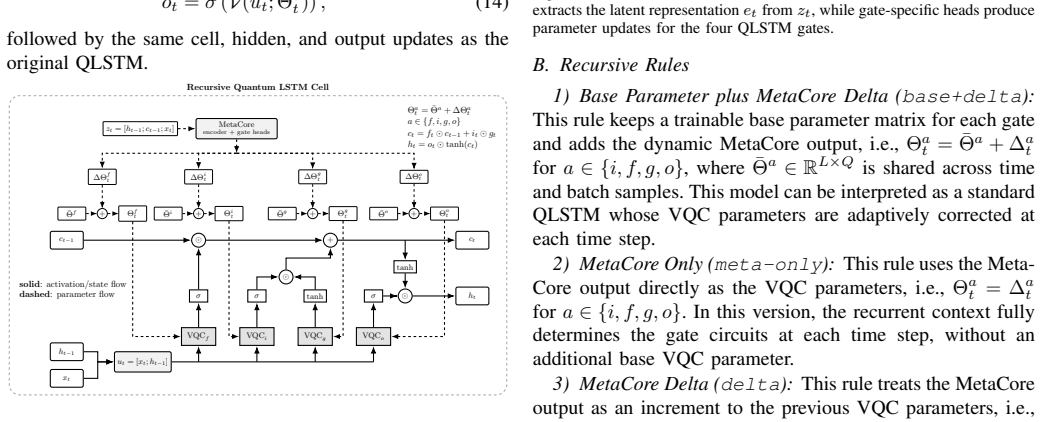
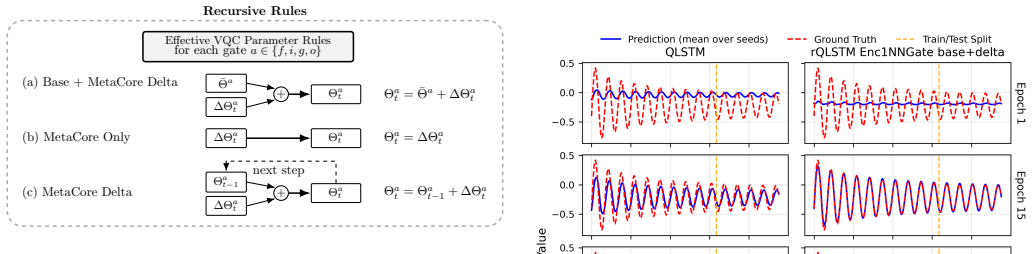
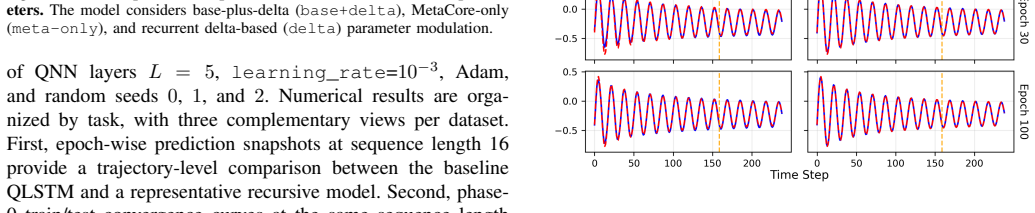
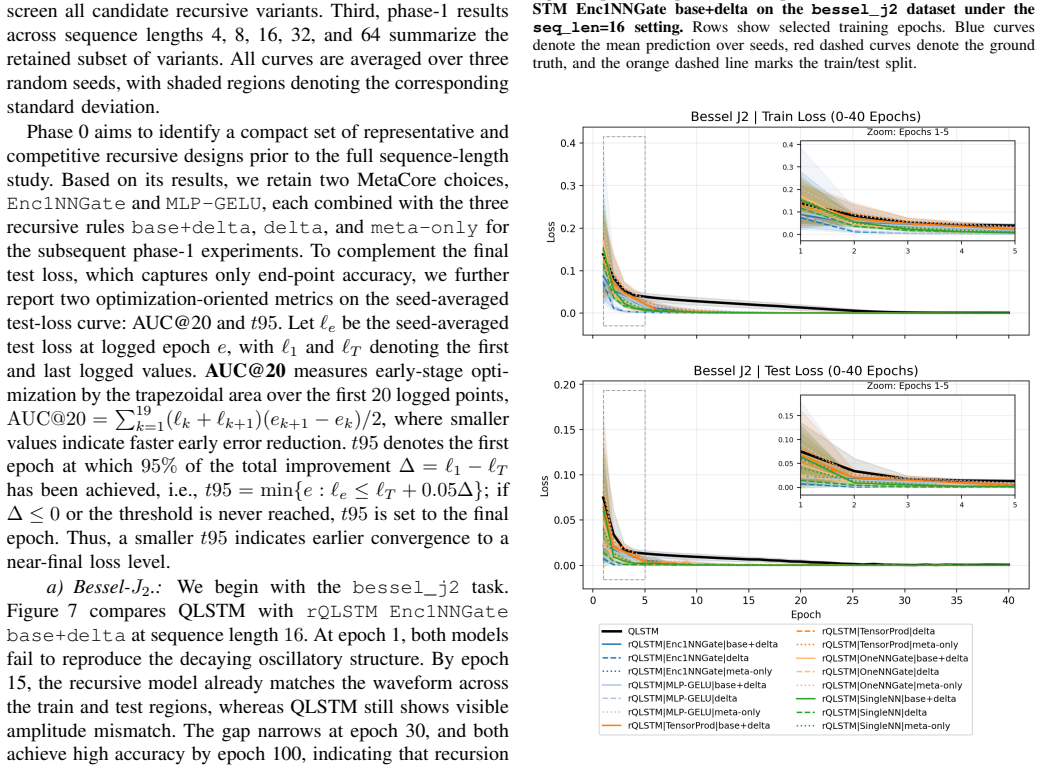
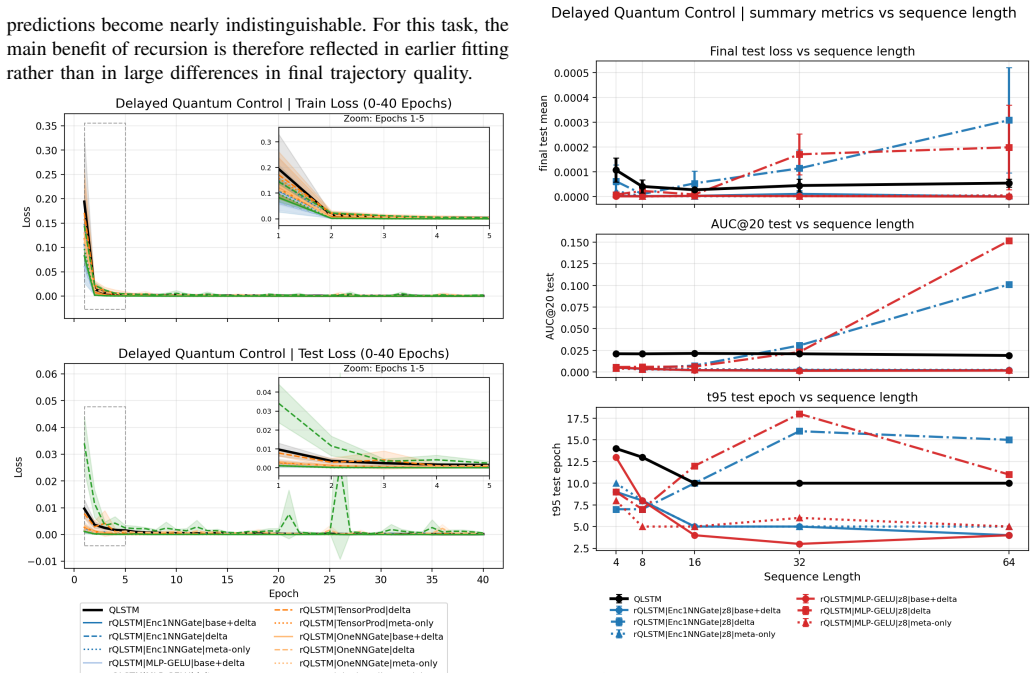
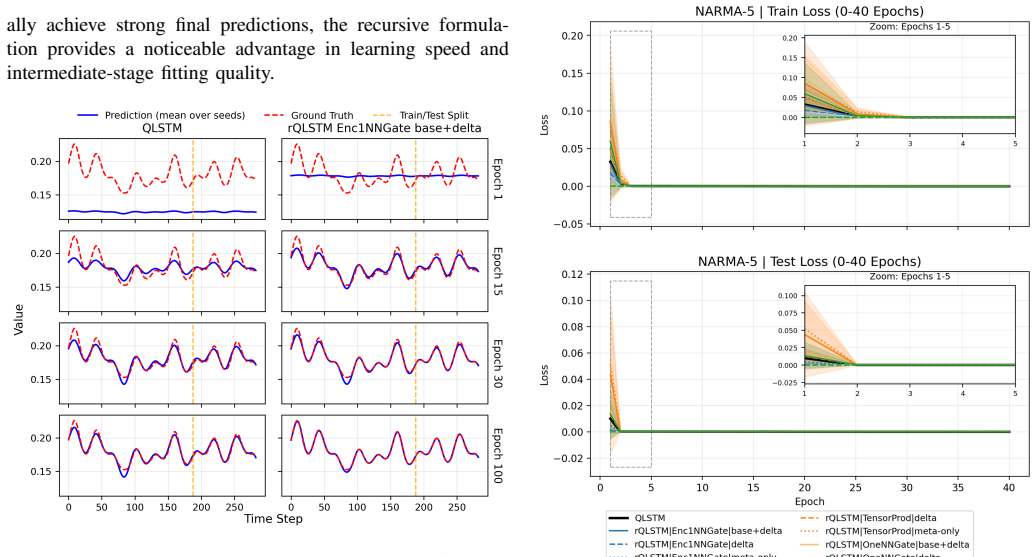
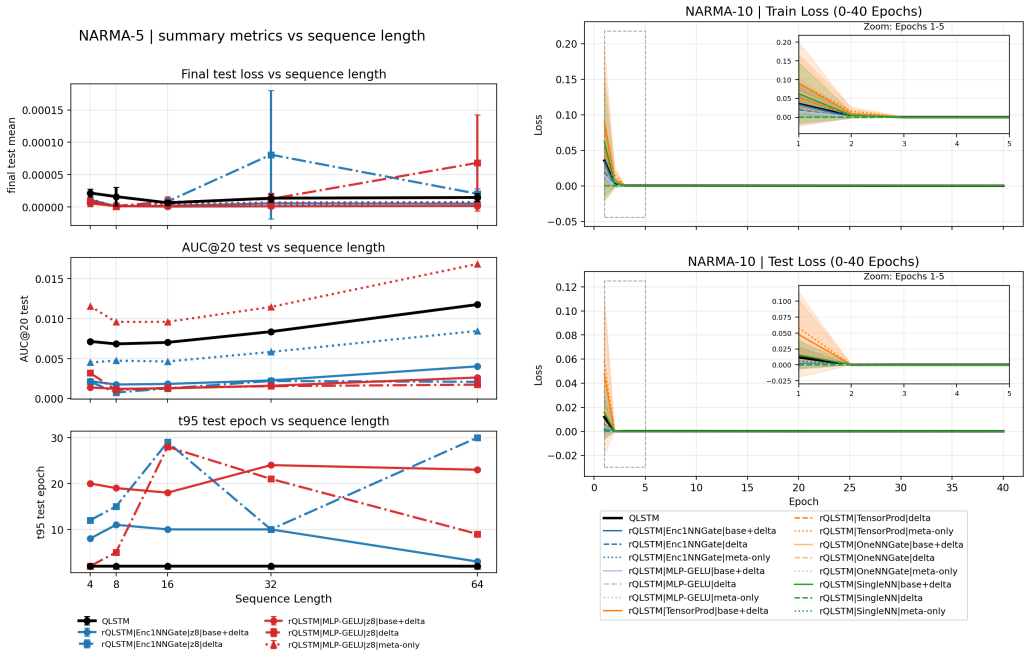
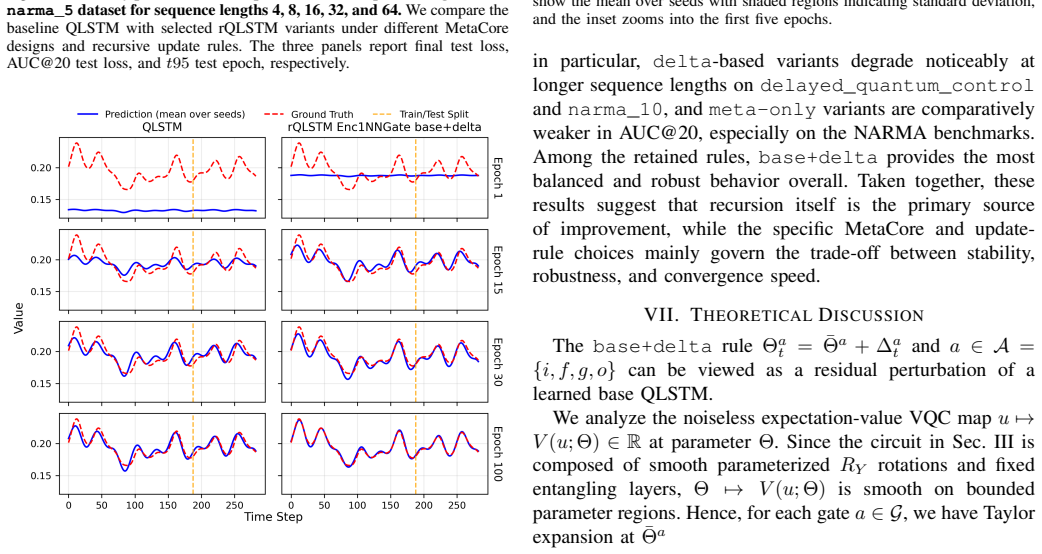
Recursive QLSTM extends QLSTM through metacore-based recursive constructions. Numerical experiments under varying input lengths, metacore designs, and recursive rules select the best architecture, while theoretical arguments establish that the recursive structure improves temporal information propagation and enhances learning performance for sequences of different lengths.
What carries the argument
Metacore-based recursive constructions that allow dynamic adaptation of variational quantum circuits within the QLSTM framework.
If this is right
- The selected recursive architecture improves learning on tested sequence lengths compared with other variants.
- Different recursive rules can be chosen to tune temporal information flow for specific tasks.
- The model supplies a single flexible framework that covers input time series of many lengths without separate redesigns.
- Theoretical reasoning links the recursive structure directly to better propagation of temporal features.
Where Pith is reading between the lines
- The same metacore recursion pattern could be tried on other quantum recurrent architectures such as quantum RNNs.
- If noise scaling stays favorable, the approach might support practical deployment on longer sequences using current quantum hardware.
- It points toward a general route for making quantum sequence models scale with input size through structural repetition rather than added parameters.
Load-bearing premise
The variational quantum circuits realizing the recursive constructions keep depth and noise manageable as sequence length grows.
What would settle it
Numerical runs on longer sequences showing that required circuit depth produces noise levels that erase any performance gain over non-recursive QLSTM.
Figures
read the original abstract
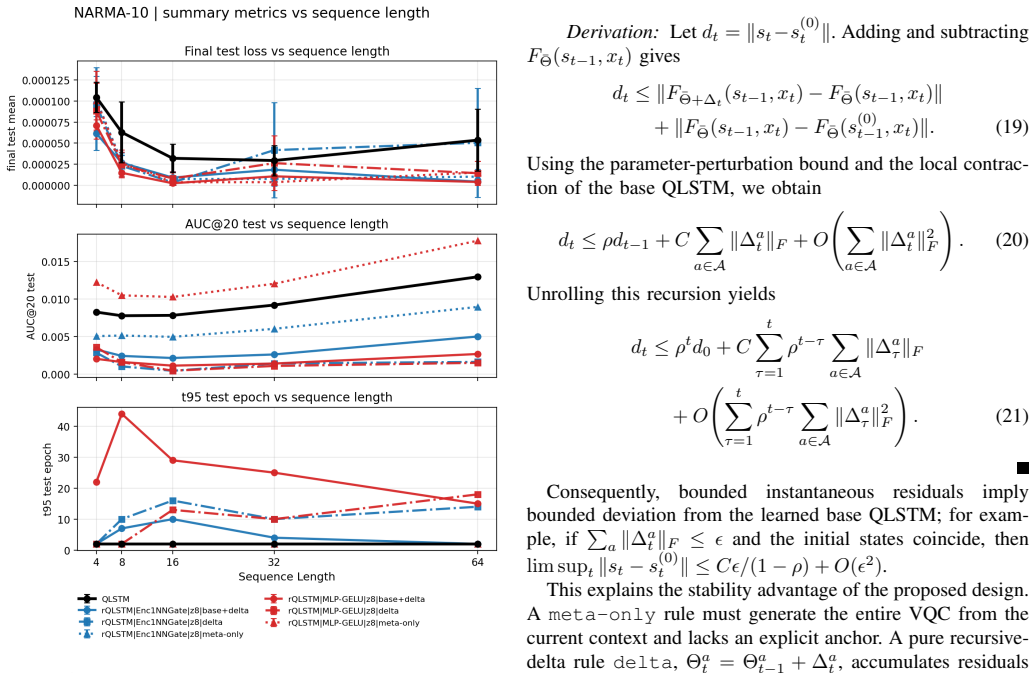
Recent advances in quantum computing and machine learning have motivated the development of quantum models for sequential data processing. In this paper, we propose a Recursive Quantum Long Short-Term Memory model, or Recursive QLSTM, which extends QLSTM through metacore-based recursive constructions. We numerically test the model under different input sequence lengths, metacore designs, and recursive rules, and identify the best-performing architecture among these variants. For this selected model, we further provide theoretical arguments explaining why its recursive structure improves temporal information propagation and enhances learning performance. Our results suggest that Recursive QLSTM offers a flexible and effective framework for quantum recurrent learning over input time series of various lengths.
Editorial analysis
A structured set of objections, weighed in public.
Referee Report
Summary. The manuscript proposes Recursive QLSTM, extending standard QLSTM via metacore-based recursive constructions for processing input time series of varying lengths. It reports numerical tests over different sequence lengths, metacore designs, and recursive rules to select the best variant, followed by theoretical arguments that the recursive structure improves temporal information propagation and learning performance.
Significance. If the numerical results and theoretical arguments hold under realistic conditions, the work could supply a flexible quantum recurrent architecture. The explicit comparison of multiple metacore and recursion variants is a strength, as is the attempt to link recursion to better information flow. However, the central claim of practicality for sequences of various lengths rests on unverified scaling behavior.
major comments (1)
- [Abstract] Abstract: the numerical tests are described as covering 'different input sequence lengths' yet give no indication that depth scaling, error accumulation, or hardware noise models were included. This directly affects the load-bearing assumption that metacore recursion remains NISQ-feasible as sequence length grows, as noted in the stress-test concern.
Simulated Author's Rebuttal
We thank the referee for the constructive feedback. We address the concern about the abstract's description of the numerical tests below and will revise the manuscript accordingly.
read point-by-point responses
-
Referee: [Abstract] Abstract: the numerical tests are described as covering 'different input sequence lengths' yet give no indication that depth scaling, error accumulation, or hardware noise models were included. This directly affects the load-bearing assumption that metacore recursion remains NISQ-feasible as sequence length grows, as noted in the stress-test concern.
Authors: We agree that the abstract does not explicitly state the ideal nature of the simulations. Our numerical experiments test the Recursive QLSTM variants on classical emulators of the quantum circuits for varying sequence lengths, metacore designs, and recursive rules, but these are noiseless simulations that do not include hardware noise models, explicit depth scaling studies, or error accumulation analysis. The central claims rest on these ideal-case results plus theoretical arguments for improved temporal information propagation via the recursive structure; we do not claim verified NISQ feasibility or scaling behavior for growing sequence lengths under realistic noise. To address the concern, we will revise the abstract to specify that the tests are performed under ideal conditions without noise models. This clarification will be incorporated in the revised version. revision: yes
Circularity Check
No circularity in derivation chain
full rationale
The paper introduces Recursive QLSTM via metacore-based recursion, performs numerical tests across sequence lengths and variants to select a best architecture, and then supplies separate theoretical arguments for improved temporal propagation in that architecture. No equations, predictions, or uniqueness claims are shown to reduce by construction to fitted inputs, self-citations, or prior ansatzes from the same authors. The numerical experiments and theoretical explanations remain independent of each other, with the former serving as empirical selection and the latter as explanatory support rather than tautological restatement.
Axiom & Free-Parameter Ledger
Reference graph
Works this paper leans on
-
[1]
M. A. Nielsen and I. L. Chuang,Quantum Computation and Quantum Information, 10th ed. Cambridge University Press, 2010. [Online]. Available: https://doi.org/10.1017/CBO9780511976667
-
[2]
K. Bharti, A. Cervera-Lierta, T. H. Kyaw, T. Haug, S. Alperin- Lea, A. Anand, M. Degroote, H. Heimonen, J. S. Kottmann, T. Menke, W.-K. Mok, S. Sim, L.-C. Kwek, and A. Aspuru-Guzik, “Noisy intermediate-scale quantum algorithms,”Reviews of Modern Physics, vol. 94, no. 1, p. 015004, 2022. [Online]. Available: https://doi.org/10.1103/RevModPhys.94.015004
-
[3]
Cerezo, Andrew Arrasmith, Ryan Babbush, Simon C
M. Cerezo, A. Arrasmith, R. Babbush, S. C. Benjamin, S. Endo, K. Fujii, J. R. McClean, K. Mitarai, X. Yuan, L. Cincio, and P. J. Coles, “Variational quantum algorithms,”Nature Reviews Physics, vol. 3, no. 9, pp. 625–644, 2021. [Online]. Available: https://doi.org/10.1038/s42254-021-00348-9
-
[4]
K. Mitarai, M. Negoro, M. Kitagawa, and K. Fujii, “Quantum circuit learning,”Physical Review A, vol. 98, no. 3, p. 032309, 2018. [Online]. Available: https://doi.org/10.1103/PhysRevA.98.032309
-
[5]
Cavity electro-optic circuit for microwave-to-optical conversion in the quantum ground state
M. Schuld, A. Bocharov, K. M. Svore, and N. Wiebe, “Circuit- centric quantum classifiers,”Physical Review A, vol. 101, no. 3, p. 032308, 2020. [Online]. Available: https://doi.org/10.1103/PhysRevA. 101.032308
-
[6]
Quantum convolutional neural network for classical data classification,
T. Hur, L. Kim, and D. K. Park, “Quantum convolutional neural network for classical data classification,”Quantum Machine Intelligence, vol. 4, no. 1, p. 3, 2022
2022
-
[7]
Validating large-scale quantum ma- chine learning: Efficient simulation of quantum support vector machines using tensor networks,
K.-C. Chen, T.-Y . Li, Y .-Y . Wang, S. See, C.-C. Wang, R. Wille, N.-Y . Chen, A.-C. Yang, and C.-Y . Lin, “Validating large-scale quantum ma- chine learning: Efficient simulation of quantum support vector machines using tensor networks,”Machine Learning: Science and Technology, vol. 6, no. 1, p. 015047, 2025
2025
-
[8]
S. Y .-C. Chen, S. Yoo, and Y .-L. L. Fang, “Quantum long short-term memory,” inICASSP 2022 - 2022 IEEE International Conference on Acoustics, Speech and Signal Processing (ICASSP). IEEE, 2022, pp. 8622–8626. [Online]. Available: https://doi.org/10.1109/ICASSP43922. 2022.9747369
-
[9]
Quantum recurrent neural networks for sequential learning,
Y . Li, Z. Wang, R. Han, S. Shi, J. Li, R. Shang, H. Zheng, G. Zhong, and Y . Gu, “Quantum recurrent neural networks for sequential learning,” Neural Networks, vol. 166, pp. 148–161, 2023. [Online]. Available: https://doi.org/10.1016/j.neunet.2023.07.003
-
[10]
Enhancing and Adversarial: Improve ASR with Speaker Labels
S. S. Li, X. Zhang, S. Zhou, H. Shu, R. Liang, H. Liu, and L. P. Garcia, “Pqlm-multilingual decentralized portable quantum language model,” in ICASSP 2023-2023 IEEE International Conference on Acoustics, Speech and Signal Processing (ICASSP). IEEE, 2023, pp. 1–5. [Online]. Available: https://doi.org/10.1109/ICASSP49357.2023.10095215
-
[11]
Variational quantum circuits for deep reinforcement learning,
S. Y .-C. Chen, C.-H. H. Yang, J. Qi, P.-Y . Chen, X. Ma, and H.-S. Goan, “Variational quantum circuits for deep reinforcement learning,” IEEE access, vol. 8, pp. 141 007–141 024, 2020. [Online]. Available: https://doi.org/10.1109/ACCESS.2020.3010470
-
[12]
Enhancing and Adversarial: Improve ASR with Speaker Labels
S. Y .-C. Chen, “Quantum deep recurrent reinforcement learning,” in ICASSP 2023-2023 IEEE International Conference on Acoustics, Speech and Signal Processing (ICASSP). IEEE, 2023, pp. 1–5. [Online]. Available: https://doi.org/10.1109/ICASSP49357.2023.10096981
-
[13]
A survey on quantum reinforcement learning,
N. Meyer, C. Ufrecht, M. Periyasamy, D. D. Scherer, A. Plinge, and C. Mutschler, “A survey on quantum reinforcement learning,” arXiv preprint arXiv:2211.03464, 2022. [Online]. Available: https: //doi.org/10.48550/arXiv.2211.03464
-
[14]
Quantum-train- based distributed multi-agent reinforcement learning,
K.-C. Chen, S. Y .-C. Chen, C.-Y . Liu, and K. K. Leung, “Quantum-train- based distributed multi-agent reinforcement learning,” in2025 IEEE Symposium for Multidisciplinary Computational Intelligence Incubators (MCII Companion). IEEE, 2025, pp. 1–5
2025
-
[15]
The dawn of quantum natural language processing,
R. Di Sipio, J.-H. Huang, S. Y .-C. Chen, S. Mangini, and M. Worring, “The dawn of quantum natural language processing,” inICASSP 2022-2022 IEEE International Conference on Acoustics, Speech and Signal Processing (ICASSP). IEEE, 2022, pp. 8612–8616. [Online]. Available: https://doi.org/10.1109/ICASSP43922.2022.9747675
-
[16]
J. Stein, I. Christ, N. Kraus, M. B. Mansky, R. M ¨uller, and C. Linnhoff-Popien, “Applying qnlp to sentiment analysis in finance,” in2023 IEEE International Conference on Quantum Computing and Engineering (QCE), vol. 2. IEEE, 2023, pp. 20–25. [Online]. Available: https://doi.org/10.1109/QCE57702.2023.10178
-
[17]
Lstm-qgan: Scalable nisq generative adversarial network,
C. Chu, A. Hastak, and F. Chen, “Lstm-qgan: Scalable nisq generative adversarial network,” inICASSP 2025-2025 IEEE International Conference on Acoustics, Speech and Signal Processing (ICASSP). IEEE, 2025, pp. 1–5. [Online]. Available: https://doi.org/10.1109/ ICASSP49660.2025.10888847
arXiv 2025
-
[18]
Quantum kernel-based long short-term memory for climate time-series forecasting,
Y .-C. Hsu, N.-Y . Chen, T.-Y . Li, P.-H. H. Lee, and K.-C. Chen, “Quantum kernel-based long short-term memory for climate time-series forecasting,” in2025 International Conference on Quantum Communica- tions, Networking, and Computing (QCNC). IEEE, 2025, pp. 421–426
2025
-
[19]
Toward large-scale distributed quantum long short-term memory with modular quantum computers,
K.-C. Chen, S. Y .-C. Chen, C.-Y . Liu, and K. K. Leung, “Toward large-scale distributed quantum long short-term memory with modular quantum computers,” in2025 International Wireless Communications and Mobile Computing (IWCMC). IEEE, 2025, pp. 337–342
2025
-
[20]
Recurrent networks and NARMA modeling,
J. Connor, L. E. Atlas, and D. R. Martin, “Recurrent networks and NARMA modeling,” inAdvances in Neural Information Processing Systems, vol. 4, 1991, pp. 301–308. [Online]. Available: https://proceedings.neurips.cc/paper files/paper/ 1991/hash/5ef0b4eba35ab2d6180b0bca7e46b6f9-Abstract.html
1991
-
[21]
Neural Computation 9(8), 1735–1780 (1997) https://doi.org/10.1162/neco.1997.9.8.1735
S. Hochreiter and J. Schmidhuber, “Long short-term memory,”Neural Computation, vol. 9, no. 8, pp. 1735–1780, 1997. [Online]. Available: https://doi.org/10.1162/neco.1997.9.8.1735
-
[22]
Time-series forecasting with deep learning: a survey,
B. Lim and S. Zohren, “Time-series forecasting with deep learning: a survey,”Philosophical Transactions of the Royal Society A: Mathematical, Physical and Engineering Sciences, vol. 379, no. 2194, p. 20200209, 2021. [Online]. Available: https://doi.org/10.1098/rsta. 2020.0209
-
[23]
J. Biamonte, P. Wittek, N. Pancotti, P. Rebentrost, N. Wiebe, and S. Lloyd, “Quantum machine learning,”Nature, vol. 549, no. 7671, pp. 195–202, 2017. [Online]. Available: https://doi.org/10.1038/nature23474
-
[24]
Parameterized quantum circuits as machine learning models , volume=
M. Benedetti, E. Lloyd, S. Sack, and M. Fiorentini, “Parameterized quantum circuits as machine learning models,”Quantum Science and Technology, vol. 4, no. 4, p. 043001, 2019. [Online]. Available: https://doi.org/10.1088/2058-9565/ab4eb5
-
[25]
McClean, Sergio Boixo, Vadim N
J. R. McClean, S. Boixo, V . N. Smelyanskiy, R. Babbush, and H. Neven, “Barren plateaus in quantum neural network training landscapes,”Nature Communications, vol. 9, no. 1, p. 4812, 2018. [Online]. Available: https://doi.org/10.1038/s41467-018-07090-4
-
[26]
S. Sim, P. D. Johnson, and A. Aspuru-Guzik, “Expressibility and entangling capability of parameterized quantum circuits for hybrid quantum-classical algorithms,”Advanced Quantum Technologies, vol. 2, no. 12, p. 1900070, 2019. [Online]. Available: https: //doi.org/10.1002/qute.201900070
-
[27]
A. Abbas, D. Sutter, C. Zoufal, A. Lucchi, A. Figalli, and S. Woerner, “The power of quantum neural networks,”Nature Computational Science, vol. 1, no. 6, pp. 403–409, 2021. [Online]. Available: https://doi.org/10.1038/s43588-021-00084-1
-
[28]
Connecting ansatz expressibility to gradient magnitudes and barren plateaus,
Z. Holmes, K. Sharma, M. Cerezo, and P. J. Coles, “Connecting ansatz expressibility to gradient magnitudes and barren plateaus,” PRX Quantum, vol. 3, no. 1, p. 010313, 2022. [Online]. Available: https://doi.org/10.1103/PRXQuantum.3.010313
-
[29]
Data re-uploading for a universal quantum classifier,
A. P ´erez-Salinas, A. Cervera-Lierta, E. Gil-Fuster, and J. I. Latorre, “Data re-uploading for a universal quantum classifier,”Quantum, vol. 4, p. 226, 2020. [Online]. Available: https://doi.org/10.22331/ q-2020-02-06-226
2020
-
[30]
Effect of data encoding on the expressive power of variational quantum-machine-learning models,
M. Schuld, R. Sweke, and J. J. Meyer, “Effect of data encoding on the expressive power of variational quantum-machine-learning models,” Physical Review A, vol. 103, no. 3, p. 032430, 2021. [Online]. Available: https://doi.org/10.1103/PhysRevA.103.032430
-
[31]
Neural quantum embedding via deterministic quantum computation with one qubit,
H. Liu, T. Hur, S. Zhang, L. Che, X. Long, X. Wang, K. Huang, Y .-a. Fan, Y . Zheng, Y . Feng, Y . Zhou, J. Ng, X. Nie, D. K. Park, and D. Lu, “Neural quantum embedding via deterministic quantum computation with one qubit,”Physical Review Letters, vol. 135, no. 8, p. 080603,
-
[32]
Available: https://doi.org/10.1103/y8wr-yml4
[Online]. Available: https://doi.org/10.1103/y8wr-yml4
-
[33]
Recurrent quantum neural networks,
J. Bausch, “Recurrent quantum neural networks,” inAd- vances in Neural Information Processing Systems, vol. 33. Curran Associates, Inc., 2020, pp. 1368–1379. [On- line]. Available: https://proceedings.neurips.cc/paper files/paper/2020/ file/0ec96be397dd6d3cf2fecb4a2d627c1c-Paper.pdf
2020
-
[34]
Learning temporal data with a variational quantum recurrent neural network,
Y . Takaki, K. Mitarai, M. Negoro, K. Fujii, and M. Kitagawa, “Learning temporal data with a variational quantum recurrent neural network,”Physical Review A, vol. 103, no. 5, p. 052414, 2021. [Online]. Available: https://doi.org/10.1103/PhysRevA.103.052414
-
[35]
Harnessing disordered-ensemble quantum dynamics for machine learning,
K. Fujii and K. Nakajima, “Harnessing disordered-ensemble quantum dynamics for machine learning,”Physical Review Applied, vol. 8, no. 2, p. 024030, 2017. [Online]. Available: https://doi.org/10.1103/ PhysRevApplied.8.024030
2017
-
[36]
Rapid training of quantum recurrent neural networks,
M. Siemaszko, A. Buraczewski, B. Le Saux, and M. Stobi ´nska, “Rapid training of quantum recurrent neural networks,”Quantum Machine Intelligence, vol. 5, no. 2, p. 31, 2023. [Online]. Available: https://doi.org/10.1007/s42484-023-00117-0
-
[37]
Quantum reservoir computing using arrays of rydberg atoms,
R. Araiza Bravo, K. Najafi, X. Gao, and S. F. Yelin, “Quantum reservoir computing using arrays of rydberg atoms,”PRX Quantum, vol. 3, no. 3, p. 030325, 2022. [Online]. Available: https://doi.org/10. 1103/PRXQuantum.3.030325
2022
-
[38]
Time-series quantum reservoir computing with weak and projective measurements,
P. Mujal, R. Mart ´ınez-Pe˜na, G. L. Giorgi, M. C. Soriano, and R. Zambrini, “Time-series quantum reservoir computing with weak and projective measurements,”npj Quantum Information, vol. 9, no. 1, p. 16,
-
[39]
Available: https://doi.org/10.1038/s41534-023-00682-z
[Online]. Available: https://doi.org/10.1038/s41534-023-00682-z
-
[40]
Overcoming the coherence time barrier in quantum machine learning on temporal data,
F. Hu, S. A. Khan, N. T. Bronn, G. Angelatos, G. E. Rowlands, G. J. Ribeill, and H. E. T ¨ureci, “Overcoming the coherence time barrier in quantum machine learning on temporal data,”Nature Communications, vol. 15, no. 1, p. 7491, 2024. [Online]. Available: https://doi.org/10.1038/s41467-024-51162-7
-
[41]
From quantum feature maps to quantum reservoir computing: an applicative perspective,
C. Gyurik, F. Wudarski, E. J. Philip, A. Sannia, H. Sadeghi, O. Kyriienko, D. Venturelli, and A. A. Gentile, “From quantum feature maps to quantum reservoir computing: an applicative perspective,” Philosophical Transactions of the Royal Society A: Mathematical, Physical and Engineering Sciences, vol. 384, no. 2315, p. 20250085,
-
[42]
Available: https://doi.org/10.1098/rsta.2025.0085
[Online]. Available: https://doi.org/10.1098/rsta.2025.0085
-
[43]
Density matrix emulation of quantum recurrent neural networks for multivariate time series prediction,
J. D. Viqueira, D. Fa ´ılde, M. M. Juane, A. G ´omez, and D. Mera, “Density matrix emulation of quantum recurrent neural networks for multivariate time series prediction,”Machine Learning: Science and Technology, vol. 6, no. 1, p. 015023, 2025
2025
-
[44]
Hybrid quantum-classical recurrent neural networks for time series prediction,
A. Ceschini, A. Rosato, and M. Panella, “Hybrid quantum-classical recurrent neural networks for time series prediction,” in2022 International Joint Conference on Neural Networks (IJCNN). IEEE, 2022, pp. 1–8. [Online]. Available: https://doi.org/10.1109/IJCNN55064. 2022.9892441
-
[45]
Quantum long short-term memory (QLSTM) vs. classical LSTM in time series forecasting: a comparative study in solar power forecasting,
S. Z. Khan, N. Muzammil, S. Ghafoor, H. Khan, S. M. H. Zaidi, A. J. Aljohani, and I. Aziz, “Quantum long short-term memory (QLSTM) vs. classical LSTM in time series forecasting: a comparative study in solar power forecasting,”Frontiers in Physics, vol. 12, p. 1439180,
-
[46]
Available: https://doi.org/10.3389/fphy.2024.1439180
[Online]. Available: https://doi.org/10.3389/fphy.2024.1439180
-
[47]
K. Kea, D. Kim, C. Huot, T.-K. Kim, and Y . Han, “A hybrid quantum- classical model for stock price prediction using quantum-enhanced long short-term memory,”Entropy, vol. 26, no. 11, p. 954, 2024. [Online]. Available: https://doi.org/10.3390/e26110954
-
[48]
Quantum recurrent neural networks: Predicting the dynamics of oscillatory and chaotic systems,
Y . Chen and A. Khaliq, “Quantum recurrent neural networks: Predicting the dynamics of oscillatory and chaotic systems,”Algorithms, vol. 17, no. 4, p. 163, 2024. [Online]. Available: https://doi.org/10.3390/ a17040163
2024
-
[49]
Y .-C. Hsu, J.-C. Jiang, C.-H. Lin, W.-T. Chen, K.-C. Peng, P. Tiwari, S. Y .-C. Chen, and E.-J. Kuo, “Federated quantum kernel-based long short-term memory for human activity recognition,” in2025 IEEE International Conference on Quantum Computing and Engineering (QCE), vol. 2. IEEE, 2025, pp. 54–58. [Online]. Available: https://doi.org/10.1109/QCE65121.2...
-
[50]
QKAN-LSTM: Quantum- inspired Kolmogorov-Arnold long short-term memory,
Y .-C. Hsu, J.-C. Jiang, C.-H. Lin, K.-C. Peng, N.-Y . Chen, S. Y .-C. Chen, E.-J. Kuo, and H.-S. Goan, “QKAN-LSTM: Quantum- inspired Kolmogorov-Arnold long short-term memory,” 2025. [Online]. Available: https://arxiv.org/abs/2512.05049
arXiv 2025
-
[51]
Quantum variational activation functions empower Kolmogorov-Arnold networks,
J.-C. Jiang, Y .-C. Huang, T. Chen, and H.-S. Goan, “Quantum variational activation functions empower Kolmogorov-Arnold networks,”arXiv preprint arXiv:2509.14026, 2025. [Online]. Available: https://arxiv.org/ abs/2509.14026
arXiv 2025
-
[52]
Learning to control fast-weight memories: An alternative to dynamic recurrent networks,
J. Schmidhuber, “Learning to control fast-weight memories: An alternative to dynamic recurrent networks,”Neural Computation, vol. 4, no. 1, pp. 131–139, 1992. [Online]. Available: https: //doi.org/10.1162/neco.1992.4.1.131
-
[53]
Using fast weights to attend to the recent past,
J. Ba, G. E. Hinton, V . Mnih, J. Z. Leibo, and C. Ionescu, “Using fast weights to attend to the recent past,” inAdvances in Neural Information Processing Systems, vol. 29, 2016. [Online]. Available: https://proceedings.neurips.cc/paper files/paper/ 2016/hash/9f44e956e3a2b7b5598c625fcc802c36-Abstract.html
2016
-
[54]
Learning to learn by gradient descent by gradient descent,
M. Andrychowicz, M. Denil, S. G ´omez, M. W. Hoffman, D. Pfau, T. Schaul, B. Shillingford, and N. de Freitas, “Learning to learn by gradient descent by gradient descent,” inAdvances in Neural Information Processing Systems, vol. 29, 2016, pp. 3981–3989. [Online]. Available: https://papers.nips.cc/paper files/paper/2016/hash/ fb87582825f9d28a8d42c5e5e5e8b2...
2016
-
[55]
Optimization as a model for few-shot learning,
S. Ravi and H. Larochelle, “Optimization as a model for few-shot learning,” inInternational Conference on Learning Representations,
-
[56]
Available: https://openreview.net/forum?id=rJY0-Kcll
[Online]. Available: https://openreview.net/forum?id=rJY0-Kcll
-
[57]
Hypernetworks,
D. Ha, A. M. Dai, and Q. V . Le, “Hypernetworks,” inInternational Conference on Learning Representations, 2017. [Online]. Available: https://openreview.net/forum?id=rkpACe1lx
2017
-
[58]
Meta networks,
T. Munkhdalai and H. Yu, “Meta networks,” inProceedings of the 34th International Conference on Machine Learning, ser. Proceedings of Machine Learning Research, vol. 70. PMLR, 2017, pp. 2554–2563. [Online]. Available: https://proceedings.mlr.press/v70/munkhdalai17a. html
2017
-
[59]
Learning feed-forward one-shot learners,
L. Bertinetto, J. F. Henriques, J. Valmadre, P. Torr, and A. Vedaldi, “Learning feed-forward one-shot learners,” inAdvances in Neural Information Processing Systems, vol. 29, 2016, pp. 523–531. [Online]. Available: https://papers.nips.cc/paper files/paper/2016/hash/ 839ab46820b524afda05122893c2fe8e-Abstract.html
2016
-
[60]
Dynamic filter networks,
X. Jia, B. De Brabandere, T. Tuytelaars, and L. Van Gool, “Dynamic filter networks,” inAdvances in Neural In- formation Processing Systems, vol. 29, 2016. [Online]. Available: https://proceedings.neurips.cc/paper files/paper/2016/hash/ 8bf1211fd4b7b94528899de0a43b9fb3-Abstract.html
2016
-
[61]
Condconv: Conditionally parameterized convolutions for efficient inference,
B. Yang, G. Bender, Q. V . Le, and J. Ngiam, “Condconv: Conditionally parameterized convolutions for efficient inference,” inAdvances in Neural Information Processing Systems, vol. 32, 2019, pp. 1307–1318. [Online]. Available: https://papers.nips.cc/paper files/paper/2019/hash/ f2201f5191c4e92cc5af043eebfd0946-Abstract.html
2019
-
[62]
Learning to program variational quantum circuits with fast weights,
S. Y .-C. Chen, “Learning to program variational quantum circuits with fast weights,” in2024 International Joint Conference on Neural Networks (IJCNN), 2024, pp. 1–9
2024
-
[63]
Quantum artificial intelligence: From quantum neural networks to self-programming architectures [feature],
——, “Quantum artificial intelligence: From quantum neural networks to self-programming architectures [feature],”IEEE Circuits and Systems Magazine, vol. 26, no. 1, pp. 41–66, 2026
2026
-
[64]
Differentiable quantum architecture search,
S.-X. Zhang, C.-Y . Hsieh, S. Zhang, and H. Yao, “Differentiable quantum architecture search,”Quantum Science and Technology, vol. 7, no. 4, p. 045023, 2022. [Online]. Available: https://doi.org/10.1088/ 2058-9565/ac87cd
2022
-
[65]
Quantum architecture search via deep reinforcement learning,
E.-J. Kuo, Y .-L. L. Fang, and S. Y .-C. Chen, “Quantum architecture search via deep reinforcement learning,” 2021. [Online]. Available: https://arxiv.org/abs/2104.07715
arXiv 2021
-
[66]
Quantum circuit architecture search for variational quantum algorithms,
Y . Du, T. Huang, S. You, M.-H. Hsieh, and D. Tao, “Quantum circuit architecture search for variational quantum algorithms,”npj Quantum Information, vol. 8, p. 62, 2022. [Online]. Available: https://doi.org/10.1038/s41534-022-00570-y
-
[67]
QuantumDARTS: Differentiable quantum architecture search for variational quantum algorithms,
W. Wu, G. Yan, X. Lu, K. Pan, and J. Yan, “QuantumDARTS: Differentiable quantum architecture search for variational quantum algorithms,” inProceedings of the 40th International Conference on Machine Learning, ser. Proceedings of Machine Learning Research, vol. 202. PMLR, 2023, pp. 37 745–37 764. [Online]. Available: https://proceedings.mlr.press/v202/wu23v.html
2023
-
[68]
H. Wang, Y . Ding, J. Gu, Z. Li, Y . Lin, D. Z. Pan, F. T. Chong, and S. Han, “QuantumNAS: Noise-adaptive search for robust quantum circuits,” in2022 IEEE International Symposium on High-Performance Computer Architecture (HPCA). IEEE, 2022, pp. 692–708. [Online]. Available: https://doi.org/10.1109/HPCA53966.2022.00057
-
[69]
S. Y .-C. Chen, “Differentiable quantum architecture search in asynchronous quantum reinforcement learning,” in2024 IEEE International Conference on Quantum Computing and Engineering (QCE), vol. 1, 2024, pp. 1516–1524. [Online]. Available: https://doi.org/10.1109/QCE60285.2024.00178
-
[70]
Reservoir computing via quantum recurrent neural networks,
S. Y .-C. Chen, D. Fry, A. Deshmukh, V . Rastunkov, and C. Stefanski, “Reservoir computing via quantum recurrent neural networks,” arXiv preprint arXiv:2211.02612, 2022. [Online]. Available: https: //doi.org/10.48550/arXiv.2211.02612
-
[71]
S. Y .-C. Chen, C.-Y . Liu, K.-C. Chen, W.-J. Huang, Y .-J. Chang, and W.-H. Huang, “Differentiable quantum architecture search in quantum-enhanced neural network parameter generation,” in2025 IEEE International Conference on Quantum Computing and Engineering (QCE), vol. 1. IEEE, 2025, pp. 1525–1535. [Online]. Available: https://doi.org/10.1109/QCE65121.2...
discussion (0)
Sign in with ORCID, Apple, or X to comment. Anyone can read and Pith papers without signing in.