REVIEW 2 major objections 4 minor 13 cited by
Quantifying mixed-state entanglement via partial transpose and realignment moments
T0 review · 2 major / 4 minor · reviewed 2026-08-06 · deepseek-v4-flash
Pith's one-line read This paper introduces families of measurable entanglement witnesses, the $p_\alpha$-negativity and $r_\alpha$-negativity, and proves that they give rigorous lower bounds on the standard partial-transpose negativity and on the robustness…
desk verdict Strong central witness construction, but the circuit-depth certification claim is contradicted by the paper's own Appendix G error analysis. read the letter →
The pith
A machine-rendered reading of the paper's core claim, the machinery that carries it, and where it could break.
The reading
What carries the argument
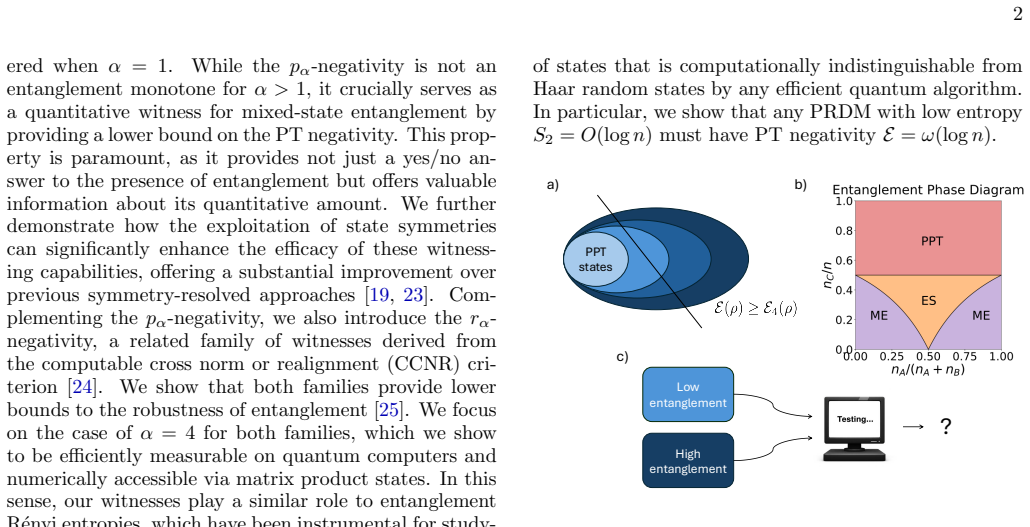
The load-bearing object is the $p_\alpha$-negativity $E_\alpha(\rho)=\frac{1}{2-\alpha}[\ln(\tilde p_\alpha)+(\alpha-1)S_2(\rho)]$, with $\tilde p_\alpha=\operatorname{tr}(|\rho^\Gamma|^\alpha)$; the measurable special case is $E_4(\rho)=\frac12\ln(p_2^3/p_4)$. The identity carrying the argument is $E_\alpha=\frac12(H_{\alpha/2}(q)-S_2(\rho))$ for the probability distribution $q_i=\lambda_i^2/p_2$, which turns the classical R\'enyi ordering into the bound $E_\alpha\le E(\rho)$ for $\alpha\ge1$, with saturation for flat $|\lambda_i|$. On the realignment side, $C_\alpha(\rho)=\frac{1}{2-\alpha}[\ln r_\alpha+(\alpha-1)S_2(\rho)]$ satisfies $C_\alpha\le C(\rho)$, and $C(\rho)\le\ln(2R(\rho)+1)$ connects it to the robustness of entanglement. The measurement protocols, SWAP tests for $p_4$ and constant-depth Bell measurements for $r_4$, are what make the bound operational.
What would settle it
Compute, for a concrete 4-design state ensemble at moderate $n$ in the entanglement-saturation phase (for example $n_A=4$, $n_B=4$, $n_C=2$), the average of $E_4$ and compare it with the predicted leading value $\frac12(n_{AB}-n_C)\ln2$; a mismatch beyond finite-size corrections would refute the claim that any 4-design has the same phase diagram, just as a single state with $E_4(\rho)>E(\rho)$ would falsify the central inequality.
Extended reading notes
Core claim
The paper's central claim is that low-order moments of the partial transpose, which are experimentally accessible, determine quantitative information about the full entanglement negativity. For a bipartite state $\rho$ with partial transpose eigenvalues $\lambda_i$, define $p_\alpha = \operatorname{tr}((\rho^\Gamma)^\alpha)$ and $E_\alpha(\rho)$ as above. Writing $q_i=\lambda_i^2/p_2$, one has $E_\alpha=\frac12(H_{\alpha/2}(q)-S_2(\rho))$, and the monotonicity of classical R\'enyi entropies yields $E_\alpha\le E_1=E(\rho)$ for $\alpha\ge1$. Thus $E_\alpha$ is a quantitative witness: it never overestimates the true negativity and is positive only for entangled states. The $\alpha=4$ instance is singled out because $p_4$ can be estimated with a four-copy SWAP test, and the paper establishes that this single number reproduces the leading-order Haar-random-state negativity in all three entanglement phases, a statement that carries over to any state 4-design. The analogous realignment witnesses $C_\alpha$ bound the CCNR negativity and therefore the robustness of entanglement, and $C_4$ is measurable with constant-depth Clifford circuits.
Load-bearing premise
The load-bearing premise is that the Haar-average PT-moment formula quoted from Ref. [36], including its thermodynamic-limit form, is correct, since the phase-diagram and 4-design claims rest entirely on it; the algorithmic applications additionally assume the state is only weakly mixed, $S_2=O(\log n)$.
Editorial extensions
If this is right
- For any $n$-qubit state with $S_2=O(\log n)$, the paper gives a polynomial-copy algorithm that distinguishes $E=O(\log n)$ from $E=\omega(\log n)$, a task previously known only for pure states.
- Measuring $E_4$ certifies the minimal depth of a noisy circuit preparing $\rho$: $d\ge E_4/(|\partial A|\ln2)$, extending depth certification from noiseless to weakly mixed states.
- Any pseudorandom density matrix with $S_2=O(\log n)$ must have PT negativity $\omega(\log n)$, and the pseudoentanglement gap in this regime is limited to $f=\Theta(n)$ versus $g=\omega(\log n)$.
- The leading-order Haar-random entanglement phase diagram, with its PPT, entanglement-saturation, and maximally entangled phases, is determined by $E_4$ alone and therefore holds for any state 4-design.
- $E_4$ and $C_4$ can be computed in polynomial time for matrix product states and matrix product operators, enabling mixed-state entanglement studies in extensive many-body systems.
Reading between the lines
- Because $E_4$ already saturates the negativity bounds for Haar-random and stabilizer states, it is a natural order parameter for entanglement phase transitions in monitored or noisy random circuits, where full negativity is intractable.
- The 4-design corollary suggests a practical experiment: prepare an approximate 4-design, measure $E_4$ across bipartitions, and read off the expected phase; deviations would reveal how far the ensemble is from Haar behavior in its entanglement properties.
- The symmetry-resolved witnesses could be combined with charge-resolved SWAP tests to detect entanglement in disconnected intervals and symmetry sectors of disordered or conserved systems, going beyond the translation-invariant examples shown.
- The finding that entropy is needed to hide entanglement suggests an information-theoretic resource trade-off: any cryptographic protocol built on pseudoentanglement must inject $\omega(\log n)$ entropy, which may conflict with other purity requirements; this is an implication the paper leaves implicit.
Editorial analysis
A structured set of objections, weighed in public.
Referee Report
Summary. The paper introduces two families of quantitative entanglement witnesses for mixed states, the pα-negativity and the rα-negativity, built from partial transpose and realignment moments. The central analytical result is that Eα(ρ) ≤ E(ρ) for α ≥ 1, where E is the PT negativity, so that the fourth-moment quantity E4 provides a measurable lower bound on the PT negativity. On this basis the authors develop algorithms for entanglement testing, Schmidt-rank and operator-Schmidt-rank testing, circuit-depth certification, bounds on pseudoentanglement and pseudorandom density matrices, a determination of the Haar-random-state entanglement phase diagram from E4 alone, MPS/MPO algorithms for the witnesses, and numerical studies in many-body systems. The paper is ambitious and contains many separate results, several of which are interesting and appear sound.
Significance. If the results hold, this is a substantial contribution. The inequality Eα ≤ E is simple, rigorous, and parameter-free, and it gives a concrete operational meaning to measurable PT-moment quantities. The phase-diagram argument is notable because it avoids self-averaging assumptions and yields a corollary for arbitrary state 4-designs. The MPS/MPO algorithms and the crypto-related bounds on pseudoentanglement are also valuable. However, the circuit-depth certification claim contains an internal inconsistency with the paper's own error analysis, which is load-bearing for an advertised application. The other main results appear independent of that issue and, apart from a typo in Proposition 2, are presented with convincing proof sketches.
major comments (2)
- [Section VI and Appendix G, Eq. (G6)] The claim that E4(ρ)=ω(log n) allows certification of circuit depth d=ω(log n) with polynomially many measurements is contradicted by the error analysis in Appendix G. For any state with S2(ρ)=O(log n) and E4(ρ)=ω(log n), we have p4 = exp(−2E4−3S2) = 2^{−ω(log n)}. With L=n^{2c+1} SWAP tests the additive error is ε=n^{−c}, so with high probability p̂4 ≤ p4 + ε ≤ O(n^{−c}). Then −ln(p̂4+ε) ≤ c ln n + O(1), and, using p̂2−ε ≥ 1/poly(n), the certified depth in Eq. (G6) is at most O(log n). Thus the estimator cannot certify d=ω(log n) in the advertised regime. This is an internal inconsistency between Section VI and Appendix G, not a disagreement with external consensus. The statement should be corrected, for example by claiming certification of an O(log n) lower bound only, or by providing a multiplicative-precision estimator with a valid sample complexity.
- [Section VII, Proposition 2 and its proof] The proof of Proposition 2 as printed is inconsistent with the proposition statement. The proposition claims a pseudoentanglement gap of at most f(n)=Θ(n) versus g(n)=ω(log n), but the proof assumes high-entanglement f(n)=Θ(log n). With that assumption, both ensembles have E=O(log n), so Theorem 1 does not apply and the claimed contradiction does not follow. If the intended assumption is f(n)=Θ(n), the proof goes through via Theorem 1, but the displayed formula must be corrected. As written, the proposition is not proved.
minor comments (4)
- [Appendix A, after Eq. (A5)] The text states that p2 = −tr(ρ²); the sign is wrong, since p2 = tr(ρ²) is the purity.
- [Theorem 3, statement] The theorem says the algorithm uses O(r²) copies of |ψ⟩, but the state in question is the mixed state ρ; this should say copies of ρ.
- [Section VIII A, Eqs. (48)–(49)] The displayed upper bound is split across Eq. (48) and Eq. (49) with the equation number placed in the middle of the expression; the formatting should be fixed to avoid ambiguity.
- [Appendix G, last paragraph] The sentence 'd ≥ −ω(log n)' is confusing; a trivial bound should be stated as O(1) or 'no non-trivial bound', not as a negative superlogarithmic quantity.
Circularity Check
No significant circularity: the main bounds and phase-diagram results are derived in-paper from PT/realignment moments and external Haar-moment formulas, with only non-load-bearing self-citations.
full rationale
I walked the derivation chain and found no step where a predicted quantity reduces to an input by construction. The central inequality E_alpha(ρ) ≤ E(ρ) (Eq. 14) is proven directly from the Rényi-entropy monotonicity of the normalized squared PT spectrum; E_1 = E holds by definition, so the bound is a derived theorem rather than a fitted or self-referential statement. The p4-negativity E4 is defined from p2 and p4, and its role as a lower bound on PT negativity follows from the same in-paper proof, not from a citation. The Haar-random phase diagram is established by separately bounding E_H[E4] from below and E_H[E] from above, using the external Haar-moment formula Eq. (46) from Ref. [36] plus Jensen inequalities and the Appendix C upper bound; no imported uniqueness claim is used. The entanglement-testing and pseudoentanglement results use E4 and purity measurements as distinguishing statistics, and the PRDM proof is a contradiction argument that compares p4 against the Haar/GHSE value, again grounded in Eq. (46) and the in-paper measurement Fact A.1. The authors do cite their own prior work: Ref. [32] supplies PRDM/GHSE definitions and the complementary S2=ω(log n) hardness/gap results, and Ref. [81] is mentioned only as a complement. These citations are not load-bearing for the new S2=O(log n) claims, which are proven independently. I note separately that the circuit-depth certification claim in Section VI appears to be in tension with the additive-error analysis in Appendix G, but that is a correctness/internal-consistency concern, not a circularity: the estimator is not defined in terms of the certified depth. Overall, the paper's predictions do not collapse into their inputs; the score reflects only the presence of minor, non-load-bearing self-citations.
Assumptions & free parameters
assumptions (8)
- standard math Peres-Horodecki PPT criterion: separable states have positive partial transpose
- standard math CCNR criterion: separable states satisfy ||Rρ||1 ≤ 1
- standard math Monotonicity of classical Renyi entropy H_a ≥ H_b for a < b
- domain assumption Haar average of PT moments, Eq. (46), from Ref. [36]
- domain assumption Stabilizer states decompose into GHZ, Bell, and product states (Bravyi et al., Ref. [74])
- standard math Eckart-Young theorem for maximum overlap with rank-r states
- standard math PT negativity is monotone under partial trace
- domain assumption Efficient SWAP test and Bell measurement circuits exist for estimating p4 and r4
Cite this review
Pith. "Pith review of Quantifying mixed-state entanglement via partial transpose and realignment moments." pith.science (2026). https://pith.science/paper/WG2C4WHN
@misc{pith2026250713840,
  author       = {Pith},
  title        = {Pith review of: Quantifying mixed-state entanglement via partial transpose and realignment moments},
  year         = {2026},
  howpublished = {\url{https://pith.science/paper/WG2C4WHN}},
  note         = {Machine review of arXiv:2507.13840}
}
read the original abstract
Entanglement plays a crucial role in quantum information science and many-body physics, yet quantifying it in mixed quantum many-body systems has remained a notoriously difficult problem. Here, we introduce families of quantitative entanglement witnesses, constructed from partial transpose and realignment moments, which provide rigorous bounds on entanglement monotones. Our witnesses can be efficiently measured using SWAP tests or variants of Bell measurements, thus making them directly implementable on current hardware. Leveraging our witnesses, we present several novel results on entanglement properties of mixed states, both in quantum information and many-body physics. We develop efficient algorithms to test whether mixed states with bounded entropy have low or high entanglement, which previously was only possible for pure states. We also provide an efficient algorithm to test the Schmidt rank using only two-copy measurements, and to test the operator Schmidt rank using four-copy measurements. Further, our witnesses enable robust certification of quantum circuit depth even in the presence of noise, a task which so far has been limited to noiseless circuits only. Finally, we show that the entanglement phase diagram of Haar random states, quantified by the partial transpose negativity, can be fully established solely by computing our witness, a result that also applies to any state 4-design. Our witnesses can also be efficiently computed for matrix product states, thus enabling the characterization of entanglement in extensive many-body systems. Finally, we make progress on the entanglement required for quantum cryptography, establishing rigorous limits on pseudoentanglement and pseudorandom density matrices with bounded entropy. Our work opens new avenues for quantifying entanglement in large and noisy quantum systems.
Figures


Figures from the paper (3 more)


Forward citations
Cited by 13 Pith papers
-
Spin chirality across quantum state copies detects hidden entanglement
The moment difference between partial transpose and purity equals a spin-chirality correlator, enabling a spectral classifier that detects bound entanglement with 99.9% recall at zero false positives.
-
Triangle Criterion: a mixed-state magic criterion with applications in distillation and detection
The Triangle Criterion detects mixed-state magic, proves multi-qubit distillation is strictly stronger than single-qubit schemes, and identifies a purity bound plus undetectable unfaithful magic states.
-
Tensor invariants for multipartite entanglement classification
Trace-invariants of colored graphs fully label LU orbits of HT multipartite states, completely characterize their LO preorder via weight-function divisibility, and yield large-N combinatorial distinctions from Haar-ra...
-
Unitary Designs from Doped Matchgate Circuits
Doped matchgate circuits achieve approximate parity-preserving 2-designs in polylogarithmic depth using a sparse number of non-Gaussian gates, with the design formation mapped exactly to a birth-death Markov chain.
-
Fermionic non-Gaussianity via Bell sampling: monotones and efficient quantum algorithms
Defines bridge degree monotone for fermionic non-Gaussianity from Bell-sampling eigenvalues of Lambda, shows non-increase under Gaussian protocols for stronger no-go theorems, and gives polynomial-sample tests for Gau...
-
Practical Tests and Witnesses of Fermionic non-Gaussianity
Fermionic non-Gaussianity can be tested with O(n²/ϵ²) two-copy Bell shots or O(n³/ϵ⁴) single-copy shots and certified in noisy mixed states by a purity-corrected covariance witness.
-
Practical Tests and Witnesses of Fermionic non-Gaussianity
Introduces practical witnesses of fermionic non-Gaussianity via antiflatness from covariance matrices, with two efficient measurement protocols, a purity-corrected version for mixed states, and experimental results on...
-
Detecting entanglement from few partial transpose moments and their decay via weight enumerators
Any three PT moments of orders k<l<m certify NPT entanglement if p_l > p_k^x p_m^{1-x}, and Stieltjes-m equals PPT when ρ^Γ has at most (m+1)/2 distinct eigenvalues.
-
Computable fermionic non-Gaussianity from the covariance matrix
Introduces occupation number entropies (Tsallis) and natural-orbital participation entropies (Renyi) as computable convex resource monotones for fermionic non-Gaussianity from the covariance matrix.
-
Simultaneous Estimation of Partial-Transpose Moments with Active Memory Independent of the Moment Order
A qubit-reuse protocol estimates partial-transpose moments p_2 to p_K simultaneously to additive error ε using O(K log K / ε²) copies and at most 2n+1 active qubits independent of K, with matching Ω(K/ε²) lower bounds.
-
Detecting entanglement from few partial transpose moments and their decay via weight enumerators
Entanglement is certified if any three PT moments satisfy p_l > p_k^x p_m^{1-x} with x=(m-l)/(m-k), and quantum weight enumerators describe moment decay under local noise.
-
Mixed-State Phase Transitions in Measurement-Dressed Imaginary-Time Evolution
Alternating imaginary-time evolution with projective measurements drives stationary mixed states of 1D Ising and 2D Heisenberg models through phase transitions with apparently new critical exponents.
-
Operational detection of Wigner negativity in arbitrary quantum states from few copies
Framework deriving hierarchies of Wigner negativity witnesses from L_p-norm, log-convexity, and Hankel-matrix constraints on moments, plus multicopy parity observables for estimation from few copies, demonstrated via ...
Reference graph
Works this paper leans on
-
[1]
Horodecki, P
R. Horodecki, P. Horodecki, M. Horodecki, and K. Horodecki, Reviews of Modern Physics 81, 865–942 (2009)
2009
-
[2]
Amico, R
L. Amico, R. Fazio, A. Osterloh, and V. Vedral, Rev. Mod. Phys. 80, 517 (2008)
2008
-
[3]
Vidal, Journal of Modern Optics 47, 355–376 (2000)
G. Vidal, Journal of Modern Optics 47, 355–376 (2000)
2000
-
[4]
Preskill, Quantum 2, 79 (2018)
J. Preskill, Quantum 2, 79 (2018)
2018
-
[5]
K. Bharti, A. Cervera-Lierta, T. H. Kyaw, T. Haug, S. Alperin-Lea, A. Anand, M. Degroote, H. Heimonen, J. S. Kottmann, T. Menke, W.-K. Mok, S. Sim, L.- C. Kwek, and A. Aspuru-Guzik, Reviews of Modern Physics 94 (2022), 10.1103/revmodphys.94.015004
-
[6]
Peres, Physical Review Letters 77, 1413–1415 (1996)
A. Peres, Physical Review Letters 77, 1413–1415 (1996)
1996
-
[7]
Horodecki, P
M. Horodecki, P. Horodecki, and R. Horodecki, Physics Letters A 223, 1–8 (1996)
1996
-
[8]
G. Vidal and R. F. Werner, Physical Review A 65 (2002), 10.1103/physreva.65.032314
Show all 102 references
-
[9]
M. B. Plenio, Physical Review Letters 95 (2005), 10.1103/physrevlett.95.090503
2005 doi
-
[10]
Calabrese, J
P. Calabrese, J. Cardy, and E. Tonni, Physical Review Letters 109 (2012), 10.1103/physrevlett.109.130502
2012 doi
-
[11]
Calabrese, J
P. Calabrese, J. Cardy, and E. Tonni, Journal of Physics A: Mathematical and Theoretical 48, 015006 (2014)
2014
-
[12]
Y. A. Lee and G. Vidal, Physical Review A 88 (2013), 10.1103/physreva.88.042318
2013 doi
-
[13]
Castelnovo, Physical Review A 88 (2013), 10.1103/physreva.88.042319
C. Castelnovo, Physical Review A 88 (2013), 10.1103/physreva.88.042319
2013 doi
-
[14]
Hart and C
O. Hart and C. Castelnovo, Physical Review B 97 (2018), 10.1103/physrevb.97.144410
2018 doi
-
[15]
Eisler and Z
V. Eisler and Z. Zimbor´ as, New Journal of Physics 16, 123020 (2014)
2014
-
[16]
Wen, P.-Y
X. Wen, P.-Y. Chang, and S. Ryu, Journal of High Energy Physics 2016 (2016), 10.1007/jhep09(2016)012
2016 doi
-
[17]
Ruggiero, V
P. Ruggiero, V. Alba, and P. Calabrese, Physical Re- view B 94 (2016), 10.1103/physrevb.94.195121
2016 doi
-
[19]
Neven, J
A. Neven, J. Carrasco, V. Vitale, C. Kokail, A. Elben, M. Dalmonte, P. Calabrese, P. Zoller, B. Vermersch, R. Kueng, and B. Kraus, npj Quantum Information 7 (2021), 10.1038/s41534-021-00487-y
2021 doi
-
[20]
X.-D. Yu, S. Imai, and O. G¨ uhne, Physical Review Letters 127 (2021), 10.1103/physrevlett.127.060504
2021 doi
-
[22]
Eisert, F
J. Eisert, F. G. Brandao, and K. M. Audenaert, New Journal of Physics 9, 46 (2007)
2007
-
[24]
Chen and L.-A
K. Chen and L.-A. Wu, Quantum Info. Comput. 3, 193–202 (2003)
2003
-
[25]
Vidal and R
G. Vidal and R. Tarrach, Physical Review A 59, 141–155 (1999)
1999
-
[27]
Y.-M. Ding, Y. Tang, Z. Wang, Z. Wang, B.-B. Mao, and Z. Yan, arXiv:2409.10273 (2024)
2024 arXiv
-
[28]
Wu, T.-C
K.-H. Wu, T.-C. Lu, C.-M. Chung, Y.-J. Kao, and T. Grover, Phys. Rev. Lett. 125, 140603 (2020)
2020
-
[29]
Wang and X
F.-H. Wang and X. Y. Xu, Nature Communications 16, 2637 (2025)
2025
-
[30]
E. Wybo, M. Knap, and F. Pollmann, physica status solidi (b) 259 (2021), 10.1002/pssb.202100161
2021 doi
-
[31]
A. L. Shaw, Z. Chen, J. Choi, D. K. Mark, P. Scholl, R. Finkelstein, A. Elben, S. Choi, and M. Endres, Na- ture 628, 71–77 (2024)
2024
-
[32]
Bansal, W.-K
N. Bansal, W.-K. Mok, K. Bharti, D. E. Koh, and T. Haug, PRX Quantum 6, 020322 (2025)
2025
-
[33]
Ji, Y.-K
Z. Ji, Y.-K. Liu, and F. Song, in Annual International Cryptology Conference (Springer, 2018) pp. 126–152
2018
-
[34]
Aaronson, A
S. Aaronson, A. Bouland, B. Fefferman, S. Ghosh, U. Vazirani, C. Zhang, and Z. Zhou, arXiv preprint arXiv:2211.00747 (2022)
2022 arXiv
-
[35]
T. Haug, K. Bharti, and D. E. Koh, Quantum 9, 1759 (2025). 17
2025
-
[36]
Shapourian, S
H. Shapourian, S. Liu, J. Kudler-Flam, and A. Vish- wanath, PRX Quantum 2 (2021), 10.1103/prxquan- tum.2.030347
2021 doi
-
[37]
Gottesman, Stabilizer codes and quantum error cor- rection
D. Gottesman, Stabilizer codes and quantum error cor- rection. Caltech Ph. D , Ph.D. thesis, Thesis, eprint: quant-ph/9705052 (1997)
1997 arXiv
- [38]
-
[39]
Gottesman, Phys
D. Gottesman, Phys. Rev. A 57, 127 (1998)
1998
-
[40]
Aaronson and D
S. Aaronson and D. Gottesman, Phys. Rev. A 70, 052328 (2004)
2004
-
[41]
A. K. Ekert, C. M. Alves, D. K. Oi, M. Horodecki, P. Horodecki, and L. C. Kwek, Physical review letters 88, 217901 (2002)
2002
-
[42]
Carrasco, M
J. Carrasco, M. Votto, V. Vitale, C. Kokail, A. Neven, P. Zoller, B. Vermersch, and B. Kraus, Physical Review A 109 (2024), 10.1103/physreva.109.012422
2024 doi
-
[43]
Yin and Z
C. Yin and Z. Liu, Physical Review Letters 130 (2023), 10.1103/physrevlett.130.131601
2023 doi
- [44]
- [45]
-
[46]
Shapira, Y
D. Shapira, Y. Shimoni, and O. Biham, Physical Re- view A—Atomic, Molecular, and Optical Physics 73, 044301 (2006)
2006
-
[47]
Streltsov, H
A. Streltsov, H. Kampermann, and D. Bruß, New Jour- nal of Physics 12, 123004 (2010)
2010
-
[48]
L. Chen, M. Aulbach, and M. Hajduˇ sek, Physical Re- view A 89, 042305 (2014)
2014
-
[49]
Jozsa, Journal of Modern Optics 41, 2315–2323 (1994)
R. Jozsa, Journal of Modern Optics 41, 2315–2323 (1994)
1994
-
[50]
H. A. Carteret, Physical Review Letters 94 (2005), 10.1103/physrevlett.94.040502
2005 doi
-
[52]
Huang, R
H.-Y. Huang, R. Kueng, and J. Preskill, Nature Physics 16, 1050–1057 (2020)
2020
-
[54]
Brydges, A
T. Brydges, A. Elben, P. Jurcevic, B. Vermersch, C. Maier, B. P. Lanyon, P. Zoller, R. Blatt, and C. F. Roos, Science 364, 260–263 (2019)
2019
-
[55]
Cornfeld, M
E. Cornfeld, M. Goldstein, and E. Sela, Physical Review A 98 (2018), 10.1103/physreva.98.032302
2018 doi
-
[56]
Prosen and I
T. Prosen and I. Piˇ zorn, Physical Review A 76 (2007), 10.1103/physreva.76.032316
2007 doi
-
[57]
Zanardi, Phys
P. Zanardi, Phys. Rev. A 63, 040304 (2001)
2001
-
[58]
Schuch, M
N. Schuch, M. M. Wolf, F. Verstraete, and J. I. Cirac, Phys. Rev. Lett. 100, 030504 (2008)
2008
-
[59]
J. I. Cirac, D. P´ erez-Garc ´ ıa, N. Schuch, and F. Verstraete, Reviews of Modern Physics 93 (2021), 10.1103/revmodphys.93.045003
2021 doi
-
[60]
Buhrman, L
H. Buhrman, L. Fortnow, I. Newman, and H. R¨ ohrig, SIAM Journal on Computing 37, 1387 (2008)
2008
- [61]
-
[62]
Weak fourier-schur sampling, the hidden subgroup problem, and the quantum collision problem,
A. M. Childs, A. W. Harrow, and P. Wocjan, “Weak fourier-schur sampling, the hidden subgroup problem, and the quantum collision problem,” in STACS 2007 (Springer Berlin Heidelberg, 2007) p. 598–609
2007
-
[63]
Wang, C.-S
X. Wang, C.-S. Yu, and X. Yi, Physics Letters A 373, 58–60 (2008)
2008
-
[64]
Hangleiter and M
D. Hangleiter and M. J. Gullans, Phys. Rev. Lett. 133, 020601 (2024)
2024
-
[65]
Brakerski, R
Z. Brakerski, R. Canetti, and L. Qian, in 14th In- novations in Theoretical Computer Science Conference (ITCS 2023) , Leibniz International Proceedings in In- formatics (LIPIcs), Vol. 251, edited by Y. Tauman Kalai (Schloss Dagstuhl – Leibniz-Zentrum f¨ ur Informatik, Dagstuhl...
2023
-
[66]
A. B. Grilo and ´A. Y´ ang¨ uez, arXiv preprint arXiv:2504.15025 (2025)
2025 arXiv
-
[67]
Fukuda and P
M. Fukuda and P. ´Sniady, Journal of Mathematical Physics 54 (2013), 10.1063/1.4799440
2013 doi
-
[69]
AUBRUN, Random Matrices: Theory and Applica- tions 01, 1250001 (2012)
G. AUBRUN, Random Matrices: Theory and Applica- tions 01, 1250001 (2012)
2012
-
[70]
Aubrun, S
G. Aubrun, S. J. Szarek, and D. Ye, Communications on Pure and Applied Mathematics 67, 129–171 (2013)
2013
-
[71]
Aubrun, S
G. Aubrun, S. J. Szarek, and D. Ye, Physical Review A 85 (2012), 10.1103/physreva.85.030302
2012 doi
-
[72]
D. N. Page, Physical Review Letters 71, 1291–1294 (1993)
1993
-
[74]
Bravyi, D
S. Bravyi, D. Fattal, and D. Gottesman, Journal of Mathematical Physics 47 (2006), 10.1063/1.2203431
2006 doi
-
[75]
S. Sang, Y. Li, T. Zhou, X. Chen, T. H. Hsieh, and M. P. Fisher, PRX Quantum 2 (2021), 10.1103/prxquantum.2.030313
2021 doi
-
[76]
H. Zhu, R. Kueng, M. Grassl, and D. Gross, arXiv:1609.08172 (2016)
2016 arXiv
-
[77]
A. M. Dalzell, N. Hunter-Jones, and F. G. S. L. Brand˜ ao, arxiv:2111.14907 (2021)
2021 arXiv
-
[78]
Di Francesco, P
P. Di Francesco, P. Mathieu, and D. S´ en´ echal, Con- formal field theory , Graduate texts in contemporary physics (Springer, New York, NY, 1997)
1997
-
[79]
N. E. Sherman, T. Devakul, M. B. Hastings, and R. R. P. Singh, Physical Review E 93 (2016), 10.1103/physreve.93.022128
2016 doi
-
[80]
T. Haug, N. Bansal, W.-K. Mok, D. E. Koh, and K. Bharti, arXiv preprint arXiv:2501.00951 (2025)
2025 arXiv
- [81]
-
[82]
T. Liu, S. Liu, H. Li, H. Li, K. Huang, Z. Xiang, X. Song, K. Xu, D. Zheng, and H. Fan, Nature Communications 14 (2023), 10.1038/s41467-023-37511-y
2023 doi
-
[83]
Nahum, J
A. Nahum, J. Ruhman, S. Vijay, and J. Haah, Physical Review X 7 (2017), 10.1103/physrevx.7.031016
2017 doi
-
[84]
Weinstein, Y
Z. Weinstein, Y. Bao, and E. Altman, Physical Review Letters 129 (2022), 10.1103/physrevlett.129.080501
2022 doi
-
[86]
Liu, M.-R
S. Liu, M.-R. Li, S.-X. Zhang, and S.-K. Jian, Physical Review Letters 132 (2024), 10.1103/phys- revlett.132.240402
2024 doi
-
[87]
Qian and J
D. Qian and J. Wang, Physical Review Letters 134 (2025), 10.1103/physrevlett.134.020403
2025 doi
-
[88]
Lu and T
T.-C. Lu and T. Grover, Physical Review Research 2 (2020), 10.1103/physrevresearch.2.043345
2020 doi
-
[89]
T.-C. Lu, T. H. Hsieh, and T. Grover, Physical Review Letters 125 (2020), 10.1103/physrevlett.125.116801. 18
2020 doi
-
[90]
Shapourian, K
H. Shapourian, K. Shiozaki, and S. Ryu, Physical Re- view B 95 (2017), 10.1103/physrevb.95.165101
2017 doi
-
[91]
Shapourian and S
H. Shapourian and S. Ryu, Physical Review A 99 (2019), 10.1103/physreva.99.022310
2019 doi
-
[92]
J. C. Garcia-Escartin and P. Chamorro-Posada, Physi- cal Review A 87, 052330 (2013)
2013
-
[93]
Dutta and T
S. Dutta and T. Faulkner, Journal of High Energy Physics 2021 (2021), 10.1007/jhep03(2021)178
2021 doi
-
[94]
M. A. Nielsen and I. L. Chuang, Quantum Computation and Quantum Information: 10th Anniversary Edition (Cambridge University Press, 2011)
2011
-
[95]
S. L. Braunstein, Physics Letters A 219, 169 (1996)
1996
-
[96]
M. J. Hall, Physics Letters A 242, 123 (1998)
1998
-
[97]
Zyczkowski and H.-J
K. Zyczkowski and H.-J. Sommers, Journal of Physics A: Mathematical and General 34, 7111 (2001)
2001
-
[98]
Eckart and G
C. Eckart and G. Young, Psychometrika 1, 211–218 (1936)
1936
-
[99]
O’Donnell and J
R. O’Donnell and J. Wright, in Proceedings of the forty- seventh annual ACM symposium on Theory of Comput- ing, STOC ’15 (ACM, 2015) p. 529–538
2015
-
[100]
Lovitz and A
B. Lovitz and A. Lowe, arxiv:2410.21417 (2024)
2024
-
[101]
Bertini, K
B. Bertini, K. Klobas, and T.-C. Lu, Physical Review Letters 129 (2022), 10.1103/physrevlett.129.140503
2022 doi
-
[102]
Aubrun and I
G. Aubrun and I. Nechita, Journal of Mathematical Physics 53 (2012), 10.1063/1.4759115
2012 doi
-
[103]
Ruggiero, V
P. Ruggiero, V. Alba, and P. Calabrese, Physical Re- view B 94 (2016), 10.1103/physrevb.94.035152
2016 doi
-
[104]
Tirrito, P
E. Tirrito, P. S. Tarabunga, G. Lami, T. Chanda, L. Leone, S. F. Oliviero, M. Dalmonte, M. Collura, and A. Hamma, Physical Review A 109, L040401 (2024). 19 Appendix We provide proofs and additional details supporting the claims in the main text. A. Efficient algorithm to measu...
2024
-
[105]
Efficiently preparable: There exists an efficient quantum algorithm G such that G(1κ, k, m) = ρk,m
-
[106]
(H2) For m = 0, one recovers PRS [33], while for m = ω(log n), PRDMs are computationally indistinguishable from the maximally mixed state [32, 80]
Computational indistinguishability: t = poly( n) copies of ρk,m are computationally indistinguishable (for any quantum polynomial time adversary A) from the GHSE ηn,m Pr k←K [A(ρ⊗t k,m) = 1] − Pr ρ←ηn,m [A(ρ⊗t) = 1] = negl(n). (H2) For m = 0, one recovers PRS [33], while for m...
-
[107]
Efficient Preparation: Given k, ρk (or σk, respectively) is efficiently preparable by a uniform, poly-sized quantum circuit
-
[108]
Pseudoentanglement: With probability ≥ 1 − 1/poly(n) over the choice of k, the PT negativity E(ρ) and fidelity of separability DF(ρ) for ρk (or σk, respectively) is Θ(f (n)) (or Θ(g(n)), respectively)
-
[109]
That is, for any poly-time quantum algorithm A, we have that Pr k [A(ρ⊗poly(n) k ) = 1] − Pr k [A(σ⊗poly(n) k ) = 1] = negl(n)
Indistinguishability: For any polynomial p(n), no poly-time quantum algorithm can distinguish between the ensembles of poly(n) copies with more than negligible probability. That is, for any poly-time quantum algorithm A, we have that Pr k [A(ρ⊗poly(n) k ) = 1] − Pr k [A(σ⊗poly...
-
[110]
(I3), we thus have the inequality r4 r2 2 ≤ FO r (ρ) ≤ r rr4 r2 2
From Eq. (I3), we thus have the inequality r4 r2 2 ≤ FO r (ρ) ≤ r rr4 r2 2 . (J4) With this bound, we can now provide an efficient algorithm to test the operator Schmidt rank by measuring r4 and r2. Theorem J.1 (Efficient testing of operator Schmidt rank) . Let ρ be an n-qubit...
-
[111]
(K1), we obtain EH[E] ≃ EH[Eα] ≃ 0
Combining EH[Eα(ρ)] ≤ EH[E(ρ)] and the third upper bound in Eq. (K1), we obtain EH[E] ≃ EH[Eα] ≃ 0. (K2) In the ES phase, where nC < nAB and both nA < N/2 and nB < N/2, one gets in the thermodynamic limit EH[pα] ≃ CkLAB (LABLC)α/2 for even integer α, where Ck = 2k k /(k + 1) i...
Reviewed August 6, 2026 · model on record in the stance chip above.
Discussion (0). Sign in to comment.