REVIEW 3 major objections 3 minor 84 references
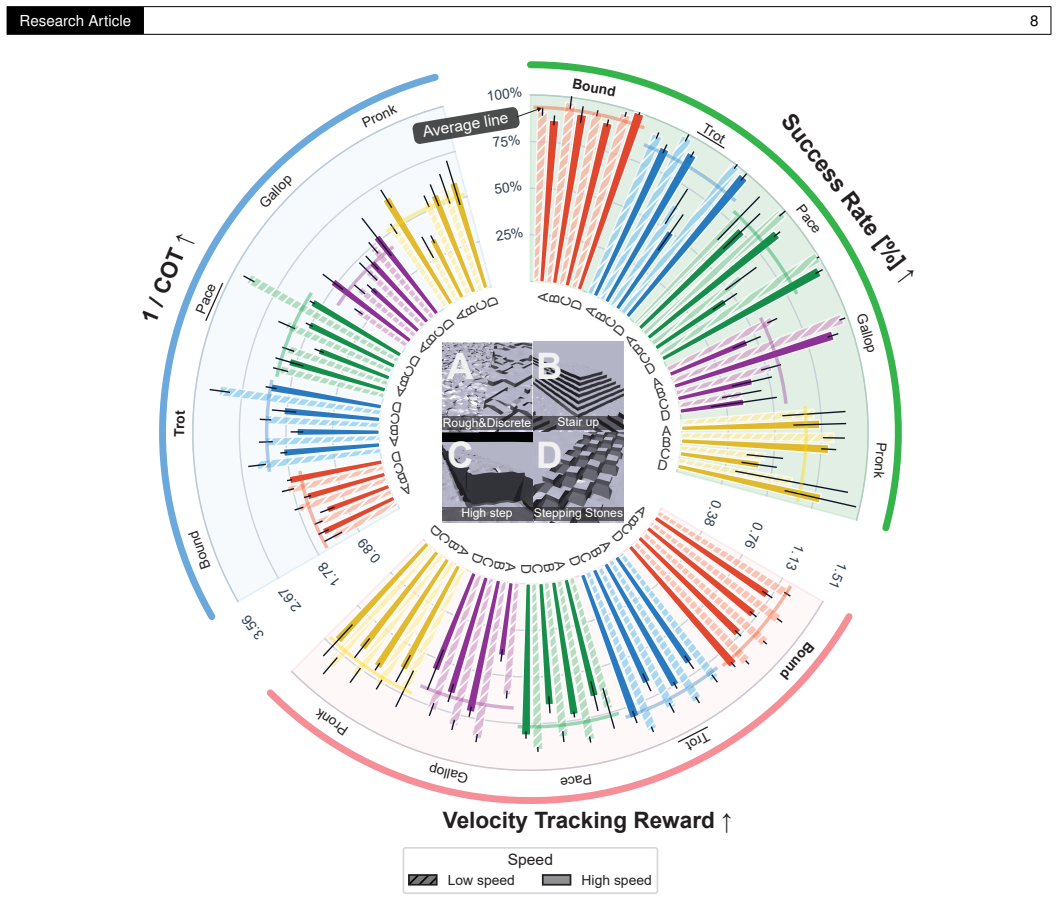
A single onboard neural-network policy can run, jump, climb, and land on unstructured terrain at up to 6 meters per second, choosing gaits and skills on its own from camera and LiDAR inputs.
Reviewed by Pith at T0; open to challenge. T0 means a machine referee read the full paper against a public rubric. the ladder, T0–T4 →
A single onboard policy trained with 2D trajectory-optimization priors, transformer latent actions, and reinforcement learning enables a quadruped to autonomously select gaits and traverse unstructured terrain at up to 6 m/s.
T0 review reviewed 2026-08-02 challenge →
load-bearing objection A real architecture advance with convincing ablations; treat the headline real-world speeds as demo footage, not measured claims. the 3 major comments →
Agile perceptive multi-skill locomotion for quadrupedal robots in the wild
The pith
A machine-rendered reading of the paper's core claim, the machinery that carries it, and where it could break.
The reading
Core claim
One onboard policy autonomously selects trot or bound and switches skills to traverse real-world stairs, hurdles, stepping stones, gaps, logs, and high steps, with zero-shot sim-to-real transfer. Peak instantaneous speeds reach 4.25 m/s over a 60 cm step and 6 m/s descending a three-step stair, using only depth, LiDAR, and onboard compute. The enabler is a 2D trajectory-optimization dataset (15.5 hours of motion generated in 8 minutes) that trains a transformer VAE and two frozen gait-specific torque decoders; RL then adds a 12-dimensional auxiliary action and 2 Hz gait selection. Without the decoder torque, success collapses from 94.6% to 2.9% in simulation, indicating the prior is non-redu
What carries the argument
The APT module is the load-bearing component: a transformer-based variational autoencoder trained on 180,000 2D sagittal-plane trajectories generated by trajectory optimization with single rigid body dynamics and polynomial ground-reaction-force profiles. It produces a 16-dimensional latent state code and two gait-specific torque decoders (trot, bound), which stay frozen during RL. The policy outputs a 29-dimensional action: a latent action decoded by the chosen decoder, a 12-dimensional auxiliary action interpreted as a PD target, and a gait-selection logit switched at 2 Hz. The final joint torque is the decoder torque plus the auxiliary refinement, so the pretrained decoder supplies feedfo
Load-bearing premise
The load-bearing premise is that a torque decoder pretrained on flat-ground 2D sagittal-plane motions still provides an indispensable, non-redundant action prior for 3D obstacle traversal; if that flat data cannot cover the dynamics needed on uneven terrain, the auxiliary action would have to do all the work, which the paper's own ablation says is not possible.
What would settle it
On the real robot, on the same high-step course used in simulation, rerun the deployment with the pretrained decoder torque set to zero while keeping the auxiliary PD action active. The paper's simulation ablation predicts success dropping from 94.6% to 2.9%; if the robot instead clears the obstacles more than half the time, the claim that the 2D trajectory-optimization prior is non-redundant is falsified.
If this is right
- If correct, high-speed multi-skill locomotion can be obtained without animal motion-capture data or online trajectory optimization during learning.
- The pretrained torque decoder is the dominant control signal; removing it collapses simulated success on high-step terrain from 94.6% to 2.9%.
- The same 2D flat-ground dataset supports multiple gaits and smooth autonomous switching, so skill diversity can come from cheap data rather than hand-tuned transition logic.
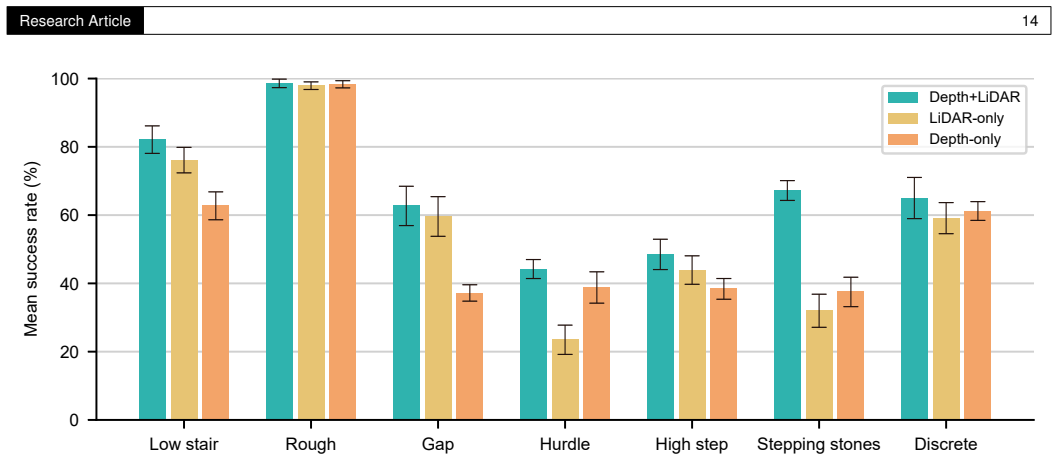
- Depth plus long-range LiDAR, distilled from a privileged height-map teacher, is sufficient for zero-shot real-world perception; neither modality alone matches both.
- The architecture is robot-agnostic and can be repurposed for other embodiments, per the paper's preliminary demonstrations.
Where Pith is reading between the lines
- Because the pretrained torque prior is 2D sagittal-plane data, the same pipeline will likely need 3D or lateral motion data before fast turning and side-stepping reach the same agility; the paper states these as future directions.
- The peak-speed numbers are instantaneous, measured around jumps and drop-downs, not sustained cruising speeds; they index dynamic capability rather than average traversal speed.
- A practical co-design constraint surfaced in the paper: the LiDAR failed under impacts exceeding 10 g, so the vibration absorber was not optional; further speed gains may demand sensor-hardware changes as much as algorithmic ones.
- The equivalence the paper shows between direct feedforward torque and an equivalent PD target suggests the contribution is the learned torque prior itself, not the control representation, so other robot controllers could adopt the same prior.
Editorial analysis
A structured set of objections, weighed in public.
Referee Report
Summary. The paper introduces APT-RL, a three-phase pipeline for quadruped locomotion: (1) generate large-scale 2D flat-ground motion datasets with trajectory optimization using a single rigid-body model and Bézier ground-reaction forces, (2) learn a Transformer-VAE latent space and gait-specific torque decoders, and (3) train an RL policy that outputs a latent action decoded to feedforward torque plus an auxiliary PD action, with a trainable gait-selection logit, followed by distillation from privileged height maps to onboard depth+LiDAR perception. The authors claim that the resulting single onboard policy autonomously selects gaits and motor skills, achieves zero-shot sim-to-real transfer, and enables high-speed traversal of stairs, steps, gaps, logs, and rough terrain, with reported instantaneous peak speeds of 4.25 m/s and 6 m/s on a stair drop. The central technical thesis is that 2D TO data provide a non-redundant torque prior for 3D agile locomotion.
Significance. If the real-world claims hold, this is a substantial advance: it would show that a flat-ground 2D trajectory-optimization prior, a shared latent action space, and a jointly learned auxiliary action can replace hierarchical skill selection and external motion capture, while enabling perceptive high-speed multi-skill locomotion in unstructured environments. The simulation evidence is genuinely strong in several respects: the ablations are well-structured (three seeds, 300 agents, AMP/HRL baselines, sensor ablation), and the feedforward-torque ablation (Fig. S8) directly supports the central mechanism, with success collapsing from 94.6% to 2.9% when the pretrained torque is removed. The data generation is unusually fast (180,000 trajectories in about 8 minutes), and the authors deposit data and figure-generation code in Zenodo, which supports reproducibility. The main gap is the real-world evidence: the headline speeds and robustness claims rest on single successful trials without attempt counts, failure rates, or uncertainty quantification, and the sim-to-real perception pipeline contains unquantified preprocessing steps.
major comments (3)
- [Materials and Methods: 'Distillation of exteroception latent using teacher-student framework'; Supplementary Hardware im] The headline quantitative claims (4.25 m/s and 6 m/s instantaneous peak speeds, and robust traversal of diverse obstacles) rest on single successful trials. The Statistical Analysis section explicitly states that no hypothesis tests, p-values, or confidence intervals were computed, and Fig. S2 shows a single camera-tracked trial for the 4.25 m/s claim. The 6 m/s value is derived by low-pass filtering body velocity relative to contact feet at 60 Hz, a method that can overestimate inertial speed during impact or slippery landings. No attempt counts or failure counts are reported for the urban, wild, or indoor deployments. This is load-bearing because the paper's central claim is 'robust traversal' and 'instantaneous peak speeds' in the real world. Please report the number of trials, success/failure counts, and a validated speed measurement (e.g., motion capture, GNSS, or an independent ine
- [Results: 'Fast perceptive quadruped locomotion...'; Fig. 1; Fig. 3] The zero-shot sim-to-real claim is qualified by an unquantified domain gap. The paper states that native LiDAR raycasting was unavailable in the simulator, so training used a 2.5D heightmap, and deployment required custom preprocessing to convert real LiDAR data into the simulated format. In addition, the custom mechanical vibration absorber is described as 'critical' for LiDAR stability during high-speed running, but its effect on measurement quality or downstream policy performance is not evaluated. This matters because the claim is that the policy operates 'using only onboard LiDAR, a depth camera, and onboard computation' in zero-shot fashion. Without quantifying how faithful the LiDAR preprocessing is and how sensor stability varies with the absorber, the perception module's contribution to the real-world robustness claim is unestablished. Please add a quantitative evaluation of the
- [Discussion; Fig. S8; Fig. S9] The narrative repeatedly states that the robot 'successfully traversed' or 'completed' courses and 'robustly' traversed diverse obstacles, but no success rates, failure counts, or repeat-run data are given for the real-world courses. For a paper whose central claim is 'robust traversal of diverse obstacles,' the absence of any repeated-run statistics in the physical world is a significant gap. The simulation ablations (Figs. 6C, 7, 8) are informative, but they do not by themselves establish real-world robustness. I ask the authors to provide a table of real-world runs per terrain type, including failures and near-failures, or to soften the language to 'demonstrated on single successful trials.'
minor comments (3)
- [Materials and Methods: 'Reinforcement learning...'] Minor typo: 'enabling smooth, high-speed multi-skill locomotion in deployed policy' should be 'in the deployed policy' or 'in deployment.'
- [Supplementary: 'Ablation study: Feedforward torque contribution'] The control law τ_input = τ_dec + PD(auxiliary) is later shown in Fig. S9 to be algebraically equivalent to a PD controller with a shifted reference. This is fine, but the main text describes the pretrained torque as the dominant 'non-redundant' component; the equivalence means the claim should be phrased as 'the pretrained signal is non-redundant as a reference/feedforward term,' not necessarily as a raw torque. Please clarify this nuance in the main text.
- [Supplementary: 'Ablation study: Dataset size...'] The ablation labels are not all self-explanatory. For example, 'Ours w/o latent RL policy' uses a pretrained encoder to map observations to latent actions, which is not an RL policy; please clarify the exact replacement in the caption or main text.
Circularity Check
No meaningful circularity: central empirical claims are validated by external baselines and ablations; only minor self-citations in TO/hardware tooling.
full rationale
The derivation chain is self-contained rather than circular. TO-generated 2D data (Eqs. 1-2) are produced by the paper's own impulse-scale optimization; TVAE and gait decoders are trained with reconstruction losses; the RL policy is optimized in 3D Isaac Gym with PPO and uses the frozen decoder only as a prior (τ_input = τ_dec + k_p(...) - k_d(·)); and the deployed student is distilled from a teacher with DAgger. None of these stages fits a parameter to the final real-world speed or success claims and then re-predicts it. The load-bearing ablations are genuine external checks: scaling τ_dec to 0 collapses success to 2.9% vs 94.6% at full scale (Fig. S8), and comparisons to AMP, vanilla RL, and HRL-with-residual are independent baselines. Self-citations appear for the 2D TO method (refs 13,15) and for the KAIST HOUND platform (ref 19), but both are tool/hardware inputs specified by in-text equations or prior platform design, not self-referential support that forces the claimed result. The supplement's algebraic PD-target equivalence (q_ref = a_scale·a_aux + τ_dec/k_p) is explicitly admitted as an identity, not a prediction, so it does not make the central claim definitional. The Statistical Analysis section states 'no statistical hypothesis tests, p-values, or confidence intervals were computed'; this limits confidence in the headline 4.25 and 6 m/s real-world measurements and in the zero-shot claim given the LiDAR preprocessing and vibration absorber, but it is an uncertainty/certainty issue rather than circularity. Overall, no step reduces by construction to its own inputs.
Axiom & Free-Parameter Ledger
free parameters (7)
- TO periodicity cost weights λ1, λ2 =
λ1=0.5; λ2=1.0 (bound), 0.0 (trot)
- PD gains kp, kd and auxiliary action scale ascale =
kp=80, kd=2, ascale=0.2
- TVAE latent dimension and KL weight =
dim(z)=16, λ_KL=0.1
- RL exploration hyperparameters =
entropy coef 0.001; latent KL coef 2.5e-6; PPO lr 3e-4; batch 204800
- Reward weights in Table S3 =
See Table S3
- Gait-selection period =
2 Hz (0.5 s hold)
- Curriculum difficulty schedule =
10 levels + 2 flat levels; terrain parameter ranges in Supp.
axioms (6)
- domain assumption A 2D sagittal-plane single rigid-body model with Bézier ground-reaction forces captures salient full-body dynamics for quadruped locomotion.
- standard math Momentum conservation over the gait cycle (Eq. 1) is sufficient to produce physically valid periodic trot/bound trajectories.
- domain assumption Isaac Gym's simulated contacts, actuator models, and terrain interactions are faithful enough for zero-shot sim-to-real transfer without explicit domain randomization.
- domain assumption Teacher-student distillation via DAgger+BPTT transfers the privileged exteroceptive encoder to a student operating on real depth images and 2D LiDAR.
- ad hoc to paper The pretrained flat-ground 2D torque decoders remain a non-redundant action prior for 3D obstacle skills, with the auxiliary action covering only residual effects.
- domain assumption Gait switching at 2 Hz with a 0.5 s hold and a boolean trigger is sufficient for stable transitions at speeds up to 7 m/s.
Cite this review
Pith. "Pith review of Agile perceptive multi-skill locomotion for quadrupedal robots in the wild." pith.science (2026). https://pith.science/paper/WOKFTDVY
@misc{pith2026260713579,
  author       = {Pith},
  title        = {Pith review of: Agile perceptive multi-skill locomotion for quadrupedal robots in the wild},
  year         = {2026},
  howpublished = {\url{https://pith.science/paper/WOKFTDVY}},
  note         = {Machine review of arXiv:2607.13579}
}
read the original abstract
Enabling quadrupedal robots to traverse complex terrains-from rugged outdoor environments to urban landscapes-requires seamless integration of multiple motor skills, smooth transitions between gaits, and high-speed perceptive locomotion using only onboard sensors. We present APT-RL (Action Pretrained Transformer-based Reinforcement Learning), a unified framework that enables multi-skill locomotion to achieve high-speed traversal in complex environments through autonomous skill transitions utilizing only onboard perception and computation. Our approach generates large-scale, feature-rich 2D motion datasets through trajectory optimization with simplified dynamics. These datasets enable training of diverse, reusable locomotion skills that transfer effectively to a real quadruped robot operating on complex uneven terrains. The resulting high-quality skills serve as strong priors for efficient learning of complex downstream tasks and extend naturally to 3D environments, enabling smooth, high-speed multi-skill locomotion in deployed policy. Real-world experiments demonstrate the framework's capabilities: the robot performs agile maneuvers through complex indoor obstacles and outdoor wild environments, including dynamic drop-down maneuvers that reach instantaneous peak speeds of up to 6 meters per second. A single onboard policy enables robust traversal of diverse obstacles, including stairs, hurdles, stepping stones, gaps, and fallen branches, demonstrating the versatility and effectiveness of our approach.
Figures




Reference graph
Works this paper leans on
-
[1]
D. F . Hoyt, C. R. Taylor, Gait and the energetics of locomotion in horses. Nature292(5820), 239–240 (1981)
1981
-
[2]
A. N. Wimberly, G. J. Slater, M. C. Granatosky, Evolutionary history of quadrupedal walking gaits shows mammalian release from locomotor constraint.Proceedings of the Royal Society B288(1957), 20210937 (2021)
1957
-
[3]
Martin, C
C. Martin, C. Diederich, F . Verheggen, Cadaver Dogs and the Deathly Hallows—A Survey and literature review on selection and training procedure.Animals10(7), 1219 (2020)
2020
-
[4]
Fenton, The use of dogs in search, rescue and recovery.Journal of Wilderness Medicine3(3), 292–300 (1992)
V. Fenton, The use of dogs in search, rescue and recovery.Journal of Wilderness Medicine3(3), 292–300 (1992)
1992
-
[5]
K. E. Jones, K. Dashfield, A. B. Downend, C. M. Otto, Search-and- rescue dogs: an overview for veterinarians.Journal of the American Veterinary Medical Association225(6), 854–860 (2004)
2004
-
[6]
A. J. Ijspeert, Central pattern generators for locomotion control in animals and robots: a review.Neural networks21(4), 642–653 (2008)
2008
-
[7]
S. A. Burden, T. Libby, K. Jayaram, S. Sponberg, J. M. Donelan, Why animals can outrun robots.Science Robotics9(89), eadi9754 (2024)
2024
-
[8]
Kalakrishnan, J
M. Kalakrishnan, J. Buchli, P . Pastor, M. Mistry, S. Schaal, Fast, robust quadruped locomotion over challenging terrain, inIEEE International Conference on Robotics and Automation(IEEE) (2010), pp. 2665– 2670
2010
-
[9]
Semini, N
C. Semini, N. G. Tsagarakis, E. Guglielmino, M. Focchi, F . Cannella, D. G. Caldwell, Design of HyQ–a hydraulically and electrically actu- ated quadruped robot.Proceedings of the Institution of Mechanical Engineers, Part I: Journal of Systems and Control Engineering225(6), 831–849 (2011)
2011
-
[10]
Hutter, C
M. Hutter, C. Gehring, M. Bloesch, M. A. Hoepflinger, C. D. Remy, R. Siegwart, StarlETH: A compliant quadrupedal robot for fast, efficient, and versatile locomotion, inAdaptive mobile robotics(World Scientific), pp. 483–490 (2012)
2012
-
[11]
D. J. Hyun, S. Seok, J. Lee, S. Kim, High speed trot-running: Imple- mentation of a hierarchical controller using proprioceptive impedance control on the MIT Cheetah.The International Journal of Robotics Research33(11), 1417–1445 (2014)
2014
-
[12]
H.-W. Park, P . M. Wensing, S. Kim, Online Planning for Autonomous Running Jumps Over Obstacles in High-Speed Quadrupeds, in Robotics: Science and Systems(RSS Foundation) (2015)
2015
-
[13]
H.-W. Park, S. Park, S. Kim, Variable-speed quadrupedal bounding using impulse planning: Untethered high-speed 3d running of MIT Cheetah 2, inIEEE international conference on Robotics and automa- tion (ICRA)(IEEE) (2015), pp. 5163–5170
2015
-
[14]
Hutter, C
M. Hutter, C. Gehring, D. Jud, A. Lauber, C. D. Bellicoso, V. Tsou- nis, J. Hwangbo, K. Bodie, P . Fankhauser, M. Bloesch, R. Diethelm, S. Bachmann, A. Melzer, M. Hoepflinger, ANYmal-a highly mobile and dynamic quadrupedal robot, inIEEE/RSJ international conference on intelligent robots and systems (IROS)(IEEE) (2016), pp. 38–44
2016
-
[15]
H.-W. Park, P . M. Wensing, S. Kim, High-speed bounding with the MIT Cheetah 2: Control design and experiments.The International Journal of Robotics Research36(2), 167–192 (2017)
2017
-
[16]
Hong, J.-H
S. Hong, J.-H. Kim, H.-W. Park, Real-time constrained nonlinear model predictive control on SO (3) for dynamic legged locomotion, inIEEE/RSJ International Conference on Intelligent Robots and Sys- tems (IROS)(IEEE) (2020), pp. 3982–3989
2020
-
[17]
Y . Ding, A. Pandala, C. Li, Y .-H. Shin, H.-W. Park, Representation-free model predictive control for dynamic motions in quadrupeds.IEEE Transactions on Robotics37(4), 1154–1171 (2021)
2021
-
[18]
S. Hong, Y . Um, J. Park, H.-W. Park, Agile and versatile climbing on ferromagnetic surfaces with a quadrupedal robot.Science Robotics 7(73), eadd1017 (2022)
2022
-
[19]
Y .-H. Shin, S. Hong, S. Woo, J. Choe, H. Son, G. Kim, J.-H. Kim, K. Lee, J. Hwangbo, H.-W. Park, Design of KAIST HOUND, a quadruped robot platform for fast and efficient locomotion with mixed-integer nonlinear optimization of a gear train, inInternational Conference on Robotics and Automation (ICRA)(IEEE) (2022), pp. 6614–6620
2022
-
[20]
Grandia, F
R. Grandia, F . Jenelten, S. Y ang, F . Farshidian, M. Hutter, Perceptive locomotion through nonlinear model-predictive control.IEEE Transac- tions on Robotics39(5), 3402–3421 (2023)
2023
-
[21]
G. Kim, D. Kang, J.-H. Kim, S. Hong, H.-W. Park, Contact-implicit Model Predictive Control: Controlling diverse quadruped motions without pre- planned contact modes or trajectories.The International Journal of Robotics Research44(3), 486–510 (2025)
2025
-
[22]
J. Tan, T. Zhang, E. Coumans, A. Iscen, Y . Bai, D. Hafner, S. Bohez, V. Vanhoucke, Sim-to-real: Learning agile locomotion for quadruped robots, inRobotics: Science and Systems(RSS Foundation) (2018)
2018
-
[23]
Iscen, K
A. Iscen, K. Caluwaerts, J. Tan, T. Zhang, E. Coumans, V. Sindhwani, V. Vanhoucke, Policies modulating trajectory generators, inConference on Robot Learning(PMLR) (2018), pp. 916–926
2018
-
[24]
Hwangbo, J
J. Hwangbo, J. Lee, A. Dosovitskiy, D. Bellicoso, V. Tsounis, V. Koltun, M. Hutter, Learning agile and dynamic motor skills for legged robots. Science Robotics4(26), eaau5872 (2019)
2019
-
[25]
Shin, T.-G
Y .-H. Shin, T.-G. Song, G. Ji, H.-W. Park, Reinforcement Learning for High-Speed Quadrupedal Locomotion With Motor Operating Region Constraints: Mitigating Motor Model Discrepancies through Torque Clip- ping in Realistic Motor Operating Region.IEEE Robotics & Automation Magazine(2024)
2024
-
[26]
J. Lee, J. Hwangbo, L. Wellhausen, V. Koltun, M. Hutter, Learning quadrupedal locomotion over challenging terrain.Science robotics 5(47), eabc5986 (2020)
2020
-
[27]
G. Ji, J. Mun, H. Kim, J. Hwangbo, Concurrent training of a control policy and a state estimator for dynamic and robust legged locomotion. IEEE Robotics and Automation Letters7(2), 4630–4637 (2022)
2022
-
[28]
S. Choi, G. Ji, J. Park, H. Kim, J. Mun, J. H. Lee, J. Hwangbo, Learn- ing quadrupedal locomotion on deformable terrain.Science Robotics 8(74), eade2256 (2023)
2023
-
[29]
I. M. A. Nahrendra, B. Yu, H. Myung, DreamWaQ: Learning robust quadrupedal locomotion with implicit terrain imagination via deep rein- forcement learning, inIEEE International Conference on Robotics and Automation (ICRA)(IEEE) (2023), pp. 5078–5084
2023
-
[30]
S. Chen, B. Zhang, M. W. Mueller, A. Rai, K. Sreenath, Learning torque control for quadrupedal locomotion, inIEEE-RAS International Conference on Humanoid Robots (Humanoids)(IEEE) (2023), pp. 1–8
2023
-
[31]
G. Kim, Y .-H. Lee, H.-W. Park, A Learning Framework for Diverse Legged Robot Locomotion Using Barrier-Based Style Rewards.arXiv preprint arXiv:2409.15780(2024)
Pith/arXiv arXiv 2024
-
[32]
G. B. Margolis, G. Y ang, K. Paigwar, T. Chen, P . Agrawal, Rapid locomo- tion via reinforcement learning.The International Journal of Robotics Research43(4), 572–587 (2024)
2024
-
[33]
Y . Kim, H. Oh, J. Lee, J. Choi, G. Ji, M. Jung, D. Y oum, J. Hwangbo, Not Only Rewards but Also Constraints: Applications on Legged Robot Locomotion.IEEE Transactions on Robotics40, 2984–3003 (2024)
2024
-
[34]
W. Yu, J. Tan, C. K. Liu, G. Turk, Preparing for the unknown: Learning a universal policy with online system identification, inRobotics: Science and Systems(RSS Foundation) (2017)
2017
-
[35]
Kumar, Z
A. Kumar, Z. Fu, D. Pathak, J. Malik, RMA: Rapid Motor Adaptation for Legged Robots, inRobotics: Science and Systems(RSS Foundation) (2021)
2021
-
[36]
Rudin, D
N. Rudin, D. Hoeller, P . Reist, M. Hutter, Learning to walk in minutes using massively parallel deep reinforcement learning, inConference on Robot Learning(PMLR) (2022), pp. 91–100
2022
-
[37]
T. Miki, J. Lee, J. Hwangbo, L. Wellhausen, V. Koltun, M. Hutter, Learn- ing robust perceptive locomotion for quadrupedal robots in the wild. Science robotics7(62), eabk2822 (2022)
2022
-
[38]
T. Miki, J. Lee, L. Wellhausen, M. Hutter, Learning to walk in con- fined spaces using 3d representation.arXiv preprint arXiv:2403.00187 (2024)
Pith/arXiv arXiv 2024
-
[39]
S. Luo, S. Li, R. Yu, Z. Wang, J. Wu, Q. Zhu, PIE: Parkour With Implicit- Explicit Learning Framework for Legged Robots.IEEE Robotics and Automation Letters9(11), 9986–9993 (2024)
2024
-
[40]
Made Aswin Nahrendra, B
I. Made Aswin Nahrendra, B. Yu, M. Oh, D. Lee, S. Lee, H. Lee, H. Lim, H. Myung, Obstacle-Aware Quadrupedal Locomotion With Resilient Multi-Modal Reinforcement Learning.arXiv e-printspp. arXiv–2409 (2024)
2024
-
[41]
Bellegarda, A
G. Bellegarda, A. Ijspeert, CPG-RL: Learning central pattern genera- tors for quadruped locomotion.IEEE Robotics and Automation Letters Research Article 18 7(4), 12547–12554 (2022)
2022
-
[42]
Y . Jin, X. Liu, Y . Shao, H. Wang, W. Y ang, High-speed quadrupedal locomotion by imitation-relaxation reinforcement learning.Nature Ma- chine Intelligence4(12), 1198–1208 (2022)
2022
-
[43]
Zhuang, Z
Z. Zhuang, Z. Fu, J. Wang, C. G. Atkeson, S. Schwertfeger, C. Finn, H. Zhao, Robot Parkour Learning, inConference on Robot Learning (CoRL)(2023)
2023
-
[44]
Cheng, K
X. Cheng, K. Shi, A. Agarwal, D. Pathak, Extreme parkour with legged robots, inIEEE International Conference on Robotics and Automation (ICRA)(2024)
2024
-
[45]
Hoeller, N
D. Hoeller, N. Rudin, D. Sako, M. Hutter, ANYmal Parkour: Learn- ing agile navigation for quadrupedal robots.Science Robotics9(88), eadi7566 (2024)
2024
-
[46]
H. Kim, H. Oh, J. Park, Y . Kim, D. Y oum, M. Jung, M. Lee, J. Hwangbo, High-speed control and navigation for quadrupedal robots on complex and discrete terrain.Science Robotics10(102), eads6192 (2025)
2025
-
[47]
X. B. Peng, Z. Ma, P . Abbeel, S. Levine, A. Kanazawa, AMP: Adver- sarial motion priors for stylized physics-based character control.ACM Transactions on Graphics (ToG)40(4), 1–20 (2021)
2021
-
[48]
Escontrela, X
A. Escontrela, X. B. Peng, W. Yu, T. Zhang, A. Iscen, K. Goldberg, P . Abbeel, Adversarial motion priors make good substitutes for complex reward functions, inIEEE/RSJ International Conference on Intelligent Robots and Systems (IROS)(IEEE) (2022), pp. 25–32
2022
-
[49]
L. Han, Q. Zhu, J. Sheng, C. Zhang, T. Li, Y . Zhang, H. Zhang, Y . Liu, C. Zhou, R. Zhao, J. Li, Y . Zhang, R. Wang, W. Chi, X. Li, Y . Zhu, L. Xiang, X. Teng, Z. Zhang, Lifelike agility and play in quadrupedal robots using reinforcement learning and generative pre-trained models. Nature Machine Intelligencepp. 1–12 (2024)
2024
-
[50]
Brakel, S
P . Brakel, S. Bohez, L. Hasenclever, N. Heess, K. Bousmalis, Learn- ing coordinated terrain-adaptive locomotion by imitating a centroidal dynamics planner, inIEEE/RSJ International Conference on Intelligent Robots and Systems (IROS)(IEEE) (2022), pp. 10335–10342
2022
-
[51]
Fuchioka, Z
Y . Fuchioka, Z. Xie, M. Van de Panne, OPT -Mimic: Imitation of opti- mized trajectories for dynamic quadruped behaviors, inIEEE Interna- tional Conference on Robotics and Automation (ICRA)(IEEE) (2023), pp. 5092–5098
2023
-
[52]
D. Kang, J. Cheng, M. Zamora, F . Zargarbashi, S. Coros, Rl+ Model- based control: Using on-demand optimal control to learn versatile legged locomotion.IEEE Robotics and Automation Letters8(10), 6619–6626 (2023)
2023
-
[53]
J. Wu, G. Xin, C. Qi, Y . Xue, Learning robust and agile legged locomo- tion using adversarial motion priors.IEEE Robotics and Automation Letters8(8), 4975–4982 (2023)
2023
-
[54]
Jenelten, J
F . Jenelten, J. He, F . Farshidian, M. Hutter, DTC: Deep Tracking Control. Science Robotics9(86), eadh5401 (2024)
2024
-
[55]
A. G. Barto, S. Mahadevan, Recent advances in hierarchical reinforce- ment learning.Discrete event dynamic systems13, 341–379 (2003)
2003
-
[56]
Shazeer, A
N. Shazeer, A. Mirhoseini, K. Maziarz, A. Davis, Q. Le, G. Hinton, J. Dean, Outrageously Large Neural Networks: The Sparsely-Gated Mixture-of-Experts Layer, inInternational Conference on Learning Representations(2017)
2017
-
[57]
Y ang, K
C. Y ang, K. Yuan, Q. Zhu, W. Yu, Z. Li, Multi-expert learning of adaptive legged locomotion.Science Robotics5(49), eabb2174 (2020)
2020
-
[58]
Shafiee, G
M. Shafiee, G. Bellegarda, A. Ijspeert, Viability leads to the emer- gence of gait transitions in learning agile quadrupedal locomotion on challenging terrains.Nature Communications15(1), 3073 (2024)
2024
-
[59]
Bellegarda, M
G. Bellegarda, M. Shafiee, A. Ijspeert, Allgaits: Learning all quadruped gaits and transitions, inInternational Conference on Robotics and Automation (ICRA)(IEEE) (2025), pp. 15929–15935
2025
-
[60]
Owaki, A
D. Owaki, A. Ishiguro, A quadruped robot exhibiting spontaneous gait transitions from walking to trotting to galloping.Scientific reports7(1), 277 (2017)
2017
-
[61]
Hasenclever, F
L. Hasenclever, F . Pardo, R. Hadsell, N. Heess, J. Merel, CoMic: Com- plementary task learning & mimicry for reusable skills, inInternational Conference on Machine Learning(PMLR) (2020), pp. 4105–4115
2020
-
[62]
S. Liu, G. Lever, Z. Wang, J. Merel, S. M. A. Eslami, D. Hennes, W. M. Czarnecki, Y . Tassa, S. Omidshafiei, A. Abdolmaleki, N. Y . Siegel, L. Hasenclever, L. Marris, S. Tunyasuvunakool, H. F . Song, M. Wulfmeier, P . Muller, T. Haarnoja, B. Tracey, K. Tuyls, T. Graepel, N. Heess, From motor control to team play in simulated humanoid football.Science Robo...
2022
-
[63]
X. B. Peng, Y . Guo, L. Halper, S. Levine, S. Fidler, ASE: Large-scale reusable adversarial skill embeddings for physically simulated charac- ters.ACM Transactions On Graphics (TOG)41(4), 1–17 (2022)
2022
-
[64]
Z. Luo, J. Cao, J. Merel, A. Winkler, J. Huang, K. M. Kitani, W. Xu, Uni- versal Humanoid Motion Representations for Physics-Based Control, inInternational Conference on Learning Representations(2023)
2023
-
[65]
S. Bohez, S. Tunyasuvunakool, P . Brakel, F . Sadeghi, L. Hasenclever, Y . Tassa, E. Parisotto, J. Humplik, T. Haarnoja, R. Hafner, M. Wulfmeier, M. Neunert, B. Moran, N. Siegel, A. Huber, F . Romano, N. Batchelor, F . Casarini, J. Merel, R. Hadsell, N. Heess, Imitate and repurpose: Learning reusable robot movement skills from human and animal be- haviors...
Pith/arXiv arXiv 2022
-
[66]
A. L. Mitchell, W. X. Merkt, M. Geisert, S. Gangapurwala, M. Engelcke, O. P . Jones, I. Havoutis, I. Posner, VAE-Loco: Versatile quadruped locomotion by learning a disentangled gait representation.IEEE Trans- actions on Robotics39(5), 3805–3820 (2023)
2023
-
[67]
J. Wu, Y . Xue, C. Qi, Learning multiple gaits within latent space for quadruped robots.arXiv preprint arXiv:2308.03014(2023)
Pith/arXiv arXiv 2023
-
[68]
A. L. Mitchell, W. Merkt, A. Papatheodorou, I. Havoutis, I. Posner, Gaitor: Learning a Unified Representation Across Gaits for Real-World Quadruped Locomotion, inConference on Robot Learning(PMLR) (2024)
2024
-
[69]
J.-G. Kang, D. Lee, S. Han, A Highly Maneuverable Flying Squirrel Drone with Controllable Foldable Wings, inIEEE/RSJ International Conference on Intelligent Robots and Systems (IROS)(IEEE) (2023), pp. 6652–6659
2023
-
[70]
Petrovich, M
M. Petrovich, M. J. Black, G. Varol, Action-Conditioned 3D human mo- tion synthesis with transformer VAE, inProceedings of the IEEE/CVF International Conference on Computer Vision(2021), pp. 10985– 10995
2021
-
[71]
T. Silver, K. Allen, J. Tenenbaum, L. Kaelbling, Residual policy learning. arXiv preprint arXiv:1812.06298(2018)
Pith/arXiv arXiv 2018
-
[72]
Johannink, S
T. Johannink, S. Bahl, A. Nair, J. Luo, A. Kumar, M. Loskyll, J. A. Ojea, E. Solowjow, S. Levine, Residual reinforcement learning for robot control, inInternational Conference on Robotics and Automation (ICRA)(IEEE) (2019), pp. 6023–6029
2019
-
[73]
V. Makoviychuk, L. Wawrzyniak, Y . Guo, M. Lu, K. Storey, M. Macklin, D. Hoeller, N. Rudin, A. Allshire, A. Handa, G. State, Isaac gym: High performance gpu-based physics simulation for robot learning.arXiv preprint arXiv:2108.10470(2021)
Pith/arXiv arXiv 2021
-
[74]
J. Schulman, F . Wolski, P . Dhariwal, A. Radford, O. Klimov, Proximal policy optimization algorithms.arXiv preprint arXiv:1707.06347(2017)
Pith/arXiv arXiv 2017
-
[75]
Agarwal, A
A. Agarwal, A. Kumar, J. Malik, D. Pathak, Legged locomotion in challenging terrains using egocentric vision, inConference on robot learning(PMLR) (2023), pp. 403–415
2023
-
[76]
Kareer, N
S. Kareer, N. Y okoyama, D. Batra, S. Ha, J. Truong, ViNL: Visual naviga- tion and locomotion over obstacles, inIEEE International Conference on Robotics and Automation (ICRA)(IEEE) (2023), pp. 2018–2024
2023
-
[77]
Y ang, G
R. Y ang, G. Y ang, X. Wang, Neural volumetric memory for visual locomotion control, inProceedings of the IEEE/CVF Conference on Computer Vision and Pattern Recognition(2023), pp. 1430–1440
2023
-
[78]
S. Ross, G. Gordon, J. A. Bagnell, A reduction of imitation learning and structured prediction to no-regret online learning, inProceedings of the International Conference on Artificial Intelligence and Statistics (JMLR Workshop and Conference Proceedings) (2011), pp. 627–635
2011
-
[79]
Accessed 7 May 2026
Morvélo Bicycle Apparel, Trail Dogs, Y ouTube video (2017), https: //www.youtube.com/watch?v=w5y6f3dOp00, licensed under a Creative Commons Attribution License (CC BY). Accessed 7 May 2026
2017
-
[80]
youtube.com/watch?v=kqnB76cQSd0, licensed under a Creative Com- mons Attribution License (CC BY)
FOX Sports, Check out the best of the 2019 WKC Masters Agility Championship | FOX SPORTS, Y ouTube video (2019), https://www. youtube.com/watch?v=kqnB76cQSd0, licensed under a Creative Com- mons Attribution License (CC BY). Accessed 7 May 2026
2019
This paper was first reviewed by deepseek-v4-flash on August 2, 2026.
discussion (0)
Sign in with ORCID, Apple, or X to comment. Anyone can read and Pith papers without signing in.