Infrared Safety from ZX-Diagrams: A Categorical Proof of Soft-QED as Open Quantum System
Pith reviewed 2026-06-30 06:12 UTC · model grok-4.3
The pith
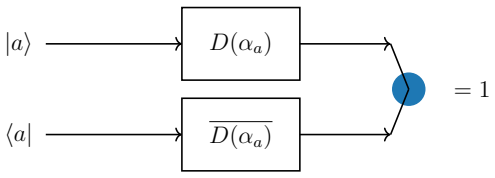
The equal-history normalization of soft-photon effects in QED follows from one identity in the discard ZX-calculus.
A machine-rendered reading of the paper's core claim, the machinery that carries it, and where it could break.
Core claim
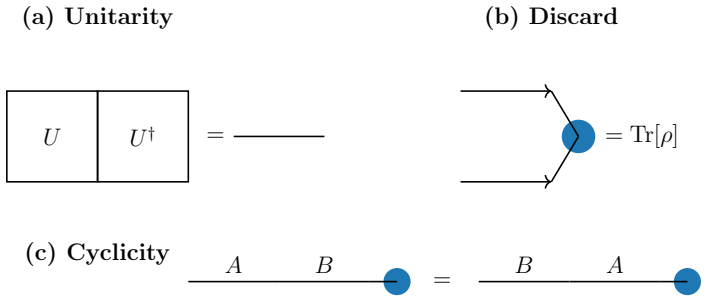
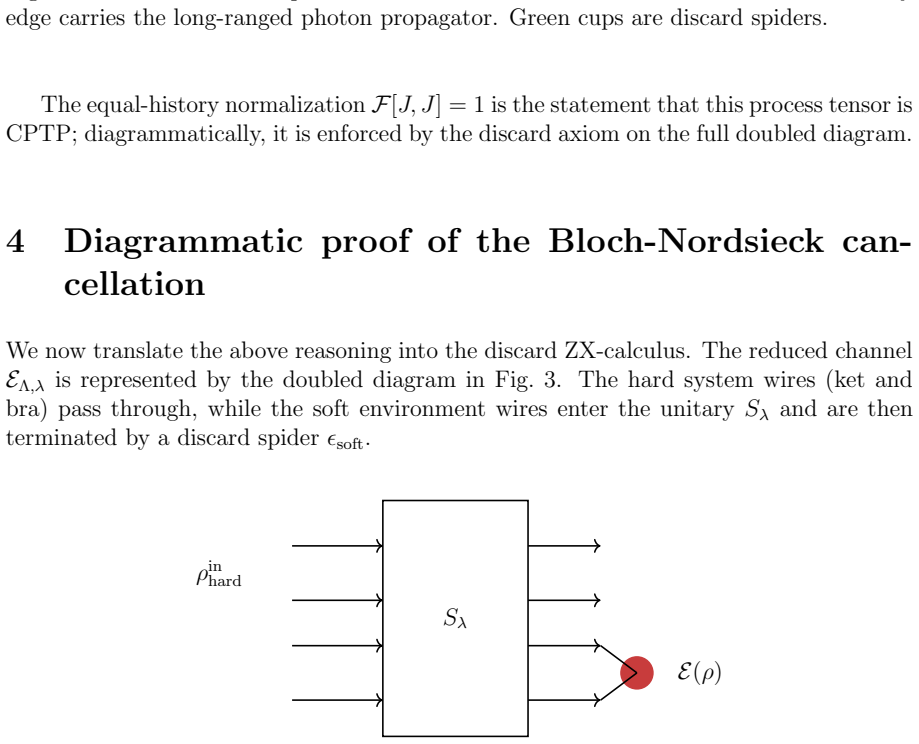
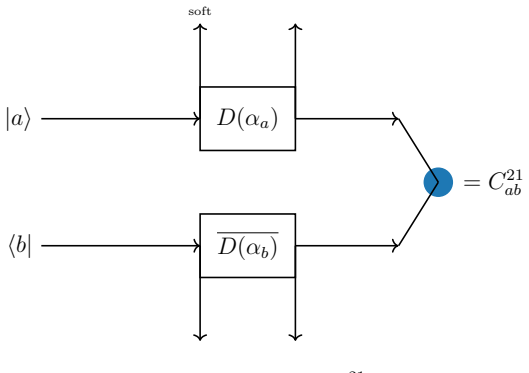
In the discard ZX-calculus the normalization condition F[J,J]=1 of the soft-photon influence functional is expressed by the doubled controlled-displacement diagram, which reduces exactly to the identity wire when the unitarity, cyclicity and discard rules are applied. This single diagrammatic identity therefore establishes that the reduced dynamics of the hard system is a CPTP map, confirming the Bloch-Nordsieck cancellation without additional infrared assumptions. For off-diagonal hard-state matrix elements the same diagram yields the coherent-state overlap, and the soft-shell coarse graining becomes a CPTP Schur channel whose infinitesimal generator is the Lindblad operator built from eiko
What carries the argument
The doubled displacement diagram in the discard ZX-calculus, which encodes the equal-history normalization F[J,J]=1 and collapses to the bare wire.
If this is right
- The reduced dynamics on hard particles and photons is a completely positive trace-preserving map.
- Off-diagonal elements of the hard density matrix acquire a coherent-state overlap that accounts for soft-cloud decoherence.
- The soft-shell coarse graining is realized as a CPTP Schur channel whose infinitesimal limit produces the exact Lindblad generator with eikonal jump operators.
- A local certification pipeline verifies trace preservation for non-Markovian process tensors in constant time.
Where Pith is reading between the lines
- The same diagrammatic reduction may apply to infrared problems in other gauge theories once an analogous controlled-displacement representation is available.
- The CPTP certification pipeline could be used to check trace preservation in larger open-system simulations that employ ZX or tensor-network representations.
Load-bearing premise
The soft-photon theorem can be used to replace the full S-matrix by a controlled displacement operator whose influence functional obeys the ZX-calculus rules.
What would settle it
An explicit evaluation of the influence functional F[J,J] that deviates from unity for any choice of currents that can be represented by ZX diagrams would falsify the claim.
Figures
read the original abstract
The discard ZX-calculus, a diagrammatic language for mixed-state quantum mechanics, is used to give a nonperturbative, categorical proof of the Bloch-Nordsieck cancellation of infrared divergences in QED. Soft photons are treated as an open quantum system: the resolved charged particles and hard photons form the system, while photons below a detector resolution form the environment. The reduced hard channel is a completely positive trace-preserving (CPTP) map, and the soft-photon theorem replaces the full S-matrix by a controlled displacement operator whose Feynman-Vernon influence functional satisfies the equal-history normalization ${\cal F}[J,J]=1 $. In the ZX-calculus, this normalization is a single diagrammatic identity: the doubled displacement diagram collapses to the bare wire under the unitarity, cyclicity, and discard rules. The proof therefore serves as a categorical consistency check on the open-system treatment of soft QED given in a companion paper; it confirms that the physical derivation is logically complete and free of hidden assumptions about the infrared limit. For off-diagonal hard-state elements, the same diagram yields the coherent-state overlap, giving a first-principles account of soft-cloud decoherence. The soft-shell coarse graining is then constructed as a CPTP Schur channel whose infinitesimal limit produces the exact Lindblad generator with jump operators determined by the eikonal emission amplitudes. Finally, a local CPTP-certification pipeline is developed for non-Markovian process tensors, enabling constant-time verification of trace preservation in open quantum simulations. The framework bridges categorical quantum semantics, non-equilibrium field theory, and practical open-system compilation.
Editorial analysis
A structured set of objections, weighed in public.
Referee Report
Summary. The paper claims to deliver a nonperturbative categorical proof of the Bloch-Nordsieck cancellation in QED by modeling soft photons as an open quantum system within the discard ZX-calculus. The resolved hard particles form the system and soft photons the environment; the soft-photon theorem replaces the S-matrix by a controlled displacement operator whose Feynman-Vernon influence functional satisfies F[J,J]=1. This normalization is asserted to follow from a single diagrammatic identity in which the doubled displacement diagram collapses to the bare wire under unitarity, cyclicity and discard rules alone. The same identity yields coherent-state overlaps for off-diagonal elements, and the construction is extended to a CPTP Schur channel whose Lindblad limit recovers the eikonal jump operators. The work is framed as a consistency check on the open-system treatment given in a companion paper.
Significance. If the explicit ZX-diagram reduction and the faithful encoding of the infinite-mode soft environment inside the ZX generators can be supplied without additional IR-limit assumptions, the result would supply a genuinely categorical, nonperturbative account of infrared safety and soft-cloud decoherence. It would also furnish a concrete bridge between categorical quantum semantics and non-equilibrium QFT together with a practical CPTP-certification pipeline for process tensors. At present the significance is difficult to assess because the central identity is stated but not derived in the manuscript.
major comments (3)
- [Abstract] Abstract: the claim that 'this normalization is a single diagrammatic identity' is not accompanied by the doubled controlled-displacement diagram or by the explicit sequence of unitarity, cyclicity and discard rewrites that reduce it to the bare wire. Without these steps the asserted proof cannot be verified from the text.
- [Abstract] Abstract and § on the soft-photon theorem: the mapping from the physical displacement operator (defined via the soft-photon theorem and eikonal amplitudes) to the ZX generators is asserted rather than constructed; no syntax is given for the continuum of soft modes or the detector-resolution cutoff, so it remains unclear whether the collapse derives the IR cancellation or imports it.
- [Abstract] The framing as a 'categorical consistency check' on the companion paper creates a circularity risk: the ZX rules are applied to an operator whose definition already encodes the physical IR cancellation that the diagram is supposed to prove.
minor comments (1)
- [Abstract] The final paragraph introduces a 'local CPTP-certification pipeline' for non-Markovian process tensors but supplies neither the algorithm nor any verification example.
Simulated Author's Rebuttal
We thank the referee for the thorough review and valuable suggestions. We address each of the major comments point by point below, agreeing where revisions are needed to enhance the clarity of the proof.
read point-by-point responses
-
Referee: [Abstract] Abstract: the claim that 'this normalization is a single diagrammatic identity' is not accompanied by the doubled controlled-displacement diagram or by the explicit sequence of unitarity, cyclicity and discard rewrites that reduce it to the bare wire. Without these steps the asserted proof cannot be verified from the text.
Authors: We concur that the absence of the explicit diagram and rewrite sequence hinders verification. The revised manuscript will include the doubled controlled-displacement diagram along with a detailed, step-by-step application of the unitarity, cyclicity, and discard rules demonstrating its reduction to the bare wire. This will be placed prominently in the abstract and the relevant section to make the categorical proof fully transparent. revision: yes
-
Referee: [Abstract] Abstract and § on the soft-photon theorem: the mapping from the physical displacement operator (defined via the soft-photon theorem and eikonal amplitudes) to the ZX generators is asserted rather than constructed; no syntax is given for the continuum of soft modes or the detector-resolution cutoff, so it remains unclear whether the collapse derives the IR cancellation or imports it.
Authors: We acknowledge that the mapping is presented at a high level in the current manuscript. In the revision, we will provide a detailed construction of the mapping from the physical displacement operator to the ZX generators, including explicit syntax for the continuum of soft modes and the detector-resolution cutoff. This will demonstrate that the diagrammatic collapse derives the IR cancellation from the ZX rules applied to the eikonal amplitudes. revision: yes
-
Referee: [Abstract] The framing as a 'categorical consistency check' on the companion paper creates a circularity risk: the ZX rules are applied to an operator whose definition already encodes the physical IR cancellation that the diagram is supposed to prove.
Authors: The concern regarding circularity is understandable but does not apply here. The companion paper employs conventional QFT techniques to establish the open-system formulation and invokes the soft-photon theorem as a standard result. The current work then demonstrates, using only the axioms of the discard ZX-calculus, that the influence functional satisfies F[J,J]=1. This constitutes an independent categorical verification that the physical construction is consistent with the diagrammatic rules, without relying on additional IR assumptions. The operator is defined physically, but the normalization is proven diagrammatically. revision: no
Circularity Check
Central normalization identity framed as consistency check on same-author companion paper
specific steps
-
self citation load bearing
[Abstract]
"The proof therefore serves as a categorical consistency check on the open-system treatment of soft QED given in a companion paper; it confirms that the physical derivation is logically complete and free of hidden assumptions about the infrared limit."
The paper's central result (Bloch-Nordsieck cancellation via ZX identity) is justified only as confirming the author's own prior physical treatment; the diagrammatic collapse is thereby load-bearing on the companion work rather than providing independent categorical derivation of the IR safety.
full rationale
The abstract explicitly positions the ZX-diagrammatic proof as a 'categorical consistency check' on the open-system treatment from a companion paper by the same author. The setup assumes the soft-photon theorem replaces the S-matrix by a controlled displacement operator whose influence functional satisfies F[J,J]=1, then asserts this normalization is a single diagrammatic identity under ZX rules. While ZX rules themselves are external, the load-bearing step that the physical QED system obeys these rules without further IR-limit assumptions reduces the 'first-principles' claim to confirmation of the prior physical derivation. No explicit equations showing encoding of continuum soft modes or eikonal amplitudes into ZX generators are supplied in the provided text, so the collapse may import rather than derive the cancellation. This meets the self-citation load-bearing pattern with one clear quote; other steps remain independent.
Axiom & Free-Parameter Ledger
axioms (2)
- domain assumption ZX-calculus rules (unitarity, cyclicity, discard) apply directly to the mixed-state dynamics of QED
- domain assumption The Feynman-Vernon influence functional of soft photons satisfies F[J,J]=1 by the soft-photon theorem
invented entities (1)
-
soft-photon environment
no independent evidence
Forward citations
Cited by 1 Pith paper
-
Type IIB Axion--Dilaton Wormholes and the BPS Limit Hessian
In the axion charge sector of Type IIB, the E=0 BPS instanton has a physical Hessian that factorizes as Q dagger Q, interpreted as an endpoint theorem beyond stability for E>0 wormholes, with separation of throat from...
Reference graph
Works this paper leans on
-
[1]
V. V. Sudakov,Vertex parts at very high energies in quantum electrodynamics,Sov. Phys. JETP3, 65 (1956)
1956
-
[2]
Bloch and A
F. Bloch and A. Nordsieck,Note on the Radiation Field of the Electron,Phys. Rev. 52, 54 (1937)
1937
-
[3]
D. R. Yennie, S. C. Frautschi, and H. Suura,The infrared divergence phenomena and high-energy processes,Ann. Phys. (N.Y.)13, 379 (1961)
1961
-
[4]
Breuer and F
H.-P. Breuer and F. Petruccione,The Theory of Open Quantum Systems(Oxford University Press, 2002)
2002
-
[5]
Carney et al.,Infrared quantum information,Phys
D. Carney et al.,Infrared quantum information,Phys. Rev. Lett.119, 180502 (2017)
2017
-
[6]
Gomez, R
C. Gomez, R. Letschka, and S. Zell,Infrared divergences and quantum coherence, Eur. Phys. J. C78, 610 (2018)
2018
-
[7]
T.N. Tomaras and N. Toumbas,IR dynamics and entanglement entropy, Phys. Rev. D101, 065006 (2020), arXiv:1910.07847; A. Irakleous, T.N. Tomaras and N. Toum- bas,Soft photon radiation and entanglement, Eur. Phys. J. C81, 1045 (2021), arXiv:2105.11858
-
[8]
Schwinger,Brownian Motion of a Quantum Oscillator,J
J. Schwinger,Brownian Motion of a Quantum Oscillator,J. Math. Phys.2, 407 (1961)
1961
-
[9]
L. V. Keldysh,Diagram Technique for Nonequilibrium Processes,Sov. Phys. JETP 20, 1018 (1965)
1965
-
[10]
K. C. Chou et al.,Equilibrium and Nonequilibrium Formalisms Made Unified,Phys. Rep.118, 1 (1985)
1985
-
[11]
R. P. Feynman and F. L. Vernon,The theory of a general quantum system interacting with a linear dissipative system,Ann. Phys.24, 118 (1963)
1963
-
[12]
Weinberg,Infrared photons and gravitons,Phys
S. Weinberg,Infrared photons and gravitons,Phys. Rev.140, B516 (1965)
1965
-
[13]
T. W. B. Kibble,Coherent soft-photon states and infrared divergences,J. Math. Phys. 9, 315 (1968)
1968
-
[14]
Soft QED as Open Quantum System: Infrared Cancellation and Soft-Shell Coarse Graining
S.-J. Rey,Soft QED as Open Quantum System: Infrared Cancellation and Soft-Shell Coarse Graining, arXiv:2606.27498
work page internal anchor Pith review Pith/arXiv arXiv
-
[15]
Coecke and R
B. Coecke and R. Duncan,Interacting Quantum Observables: Categorical Algebra and Diagrammatics,New J. Phys.13, 043016 (2011)
2011
-
[16]
van de Wetering,Completeness of the ZX-calculus for Pure Qubit Stabilizer Quan- tum Mechanics,Phys
J. van de Wetering,Completeness of the ZX-calculus for Pure Qubit Stabilizer Quan- tum Mechanics,Phys. Rev. Lett.124, 110401 (2020). 14
2020
-
[17]
M. Backens et al.,Completeness of the ZX-calculus for Pure Qubit Stabilizer Quan- tum Mechanics, arXiv:2103.06484
-
[18]
F. A. Pollock et al.,Non-Markovian quantum processes: Complete framework and efficient characterization, Phys. Rev. A97, 012127 (2018)
2018
-
[19]
P. Gorantla, S.-H. Shao, and N. Tantivasadakarn.Tensor networks for noninvertible symmetries in 3+ 1 d and beyond,Physical Review X 15, 041006 (2025); D.-C. Lu, F. Xu, and Y.-Z. You.Strange correlator and string order parameter for non-invertible symmetry protected topological phases in 1+ 1d,arXiv preprint arXiv:2505.00673 (2025); D.-C. Lu, A. Chatterjee...
-
[20]
arXiv preprint arXiv:1904.04735 (2019)
A. Kissinger and J. van de Wetering,PyZX: Large Scale Automated Diagrammatic Reasoning, arXiv:1904.04735
-
[21]
Shaping boundaries to control and transport topological defects in colloidal nematic liquid crystals
G. Wong, R.A. Shaikh, W. Donnelly,A Ribbon ZX Calculus for Yang-Mills Theories, arXiv:2506.18664 [hep-th] (2025). 15
work page internal anchor Pith review Pith/arXiv arXiv 2025
discussion (0)
Sign in with ORCID, Apple, or X to comment. Anyone can read and Pith papers without signing in.