REVIEW 4 major objections 2 minor 9 references
Smarter and Cheaper at Once: Byte-Exact KV-Cache Grafting Turns a Frozen Small Model into a Verified-Knowledge Flywheel
T0 review · 4 major / 2 minor · reviewed 2026-08-02 · deepseek-v4-flash
Pith's one-line read Byte-exact KV-cache graft lifts a frozen 12B from 80% to 93.3% on AIME
desk verdict Honest and well-scoped, but the byte-exactness invariant is unmeasured on the H100 that produced the headline transfer results, and the promised hash trail is not actually in the paper. read the letter →
The pith
A machine-rendered reading of the paper's core claim, the machinery that carries it, and where it could break.
The reading
What carries the argument
The load-bearing object is the byte-exact KV-state graft: capture the key/value attention state produced by a model reading a prompt, persist it as a file, and install it into a fresh context at its original position, so the grafted forward pass reproduces the fresh forward pass byte-for-byte. The exactness depends on restoring the block at its own absolute position, the only regime where 32-bit rotary position embeddings are numerically consistent, and on a pinned deterministic configuration that makes back-to-back fresh computations themselves bit-identical. Around this, the flywheel protocol (solve, verify, deposit, route, graft) turns verified solutions into reusable state blocks.
What would settle it
Run the paper's SHA-256 byte-equality test on the H100 where the byte-level gate was not measured, with the same pinned deterministic configuration and a frozen Gemma-4-31B: any byte mismatch between grafted and fresh logits would show byte-exactness is not portable across architectures, and a nonzero fresh-vs-fresh KL inside the engine would break the zero floor on which every exactness claim is read.
Extended reading notes
Core claim
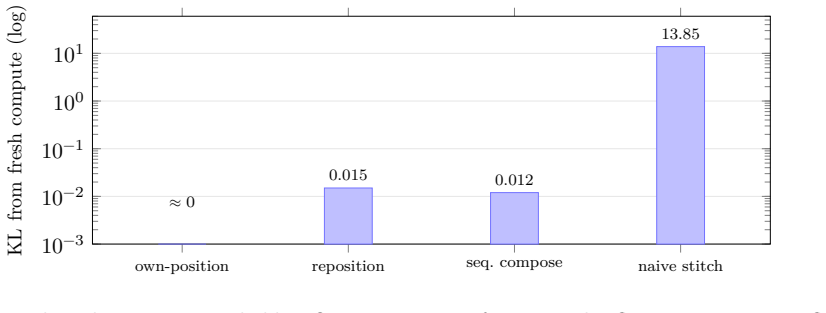
The core discovery is that exact, persistent KV-state reuse is attainable, not merely approximate reuse. Under a pinned deterministic configuration, the paper measures that a grafted logit vector equals a fresh computation to the byte (SHA-256 identical), with zero KL and no argmax flips across fifty samples. It further finds that this exactness holds only at the block's own position: because 32-bit floating-point rotary position encoding does not obey the trigonometric identity bit-exactly, relocating a block to another offset introduces a residual that is entirely the base model's own position-sensitivity, not a graft error. Own-position graft is therefore the unique numerically exact oper
Load-bearing premise
The load-bearing premise is that a restored KV block is byte-for-byte identical to a fresh computation; this has been measured only under a pinned deterministic configuration and only on Blackwell targets at the byte level, so if that exactness fails on other hardware or in ordinary nondeterministic serving, the capability and cost claims stop being attributable to exact knowledge reuse.
Editorial extensions
If this is right
- If byte-exact grafting holds on a given architecture, verified knowledge can be paid for once and reused indefinitely without changing weights or accelerator memory.
- A frozen small model's capability can exceed its own and larger siblings' published scores purely through cached verified state, so benchmark capability is not bound by parameter count alone.
- Recurring and hard problems can drop from hundreds of thousands of decode tokens to a handful per answer, shifting serving economics from per-call prefill to one-time deposit plus cheap graft.
- Context windows can be decoupled from accelerator memory: a 32k slot can access millions of stored tokens on disk at constant per-access cost.
- Within the same architecture, learned state becomes a copyable asset that can be moved between machines with no re-solve and no loss.
Reading between the lines
- Editorial inference: byte-exactness is demonstrated on Blackwell targets, while the strongest transfer scores on Hopper were validated functionally; those scores should be read as resting on functional exactness until a Hopper byte-level gate is measured.
- Editorial inference: if exactness is relaxed even slightly, the capability attribution (smarter versus drifted approximation) breaks down, so the method's usefulness is gated by determinism guarantees that ordinary production serving may not provide.
- Editorial inference: the position-relocation residual is tied to 32-bit rotary arithmetic; testing whether higher-precision or differently factorized rotary kernels remove that residual could decide whether byte-exact multi-block composition is ever attainable.
- Editorial inference: applying the same flywheel to models with non-rotary or non-floating-point position encodings might permit exact positional relocation, which would substantially widen the method beyond this paper's forced own-position regime.
Editorial analysis
A structured set of objections, weighed in public.
Referee Report
Summary. The paper describes Taliesin, a proprietary engine that captures the KV state of a frozen LLM at a given position, persists it as a disk artifact, and later restores it into a fresh inference context. The central claim is that, under a pinned deterministic configuration, the grafted computation is byte-for-byte identical to a fresh computation: SHA-256 equality of logit bytes, zero KL divergence, and 100% argmax agreement. Around this claim the paper builds a 'verify-then-cache' flywheel in which verified solutions are deposited as KV blocks and later retrieved by graft. The reported results include a 12B AIME 2025 improvement from 80.0% to 93.3% after grafting an eight-entry library; recurrence of eight previously unsolved problems in 61 total decode tokens versus 401,026 tokens for the base model; an 87x widening of a usable context store at zero extra accelerator memory; and, on an H100 with a frozen 31B, held-out transfer 7/7 and a full-30 system score of 100%. The engine is closed; all measurements are claimed to be backed by committed SHA-256 hashes of inputs and outputs.
Significance. If the byte-exactness claim holds, the work is significant: it would demonstrate that verified knowledge can be added to a frozen model as exact state rather than as weight updates or token-level retrieval, with a striking cost saving. The paper is unusually candid in several respects: it reports a pre-registered B200 replay, a Wilson interval on routing accuracy, an explicit energy-sampling caveat, a withdrawn claim about positional composition, and a list of honest negatives. No fitted parameters are involved, and the reported numbers are internally coherent. However, the closed engine and the absence of shipped artifacts mean the central guarantee cannot currently be independently checked.
major comments (4)
- [§4.9, §4.10, §5.2] The load-bearing attribution fails on the platform that carries the headline capability result. §5.2 states that without byte equality the capability results would be confounded by drift. Yet the held-out transfer 7/7 and the full-system 30/30 in §4.9 were measured on an H100, where the paper explicitly says the byte-level gate was not measured (abstract; §4.10; negative #3 in §4.13). §3.2 and §4.13 further state that byte equality is within-architecture. There is therefore no evidence that the H100 graft is byte-exact, and the transfer results could in principle be produced by lossy state reuse or benign drift. Please either add an H100 byte-exactness measurement under the deterministic configuration, or explicitly restrict the H100 capability claims to 'functionally correct' and state that exactness-based attribution is unverified on Hopper.
- [§4.11] The section title claims the learned state is a 'byte-exact, carriable asset', but the H100-to-H100 evidence is block-file SHA-256 equality plus functional 8/8 graft behavior. File digest equality implies only that the files were copied verbatim; it does not imply that the restored logits are byte-identical to a fresh H100 computation, which the paper says was not measured on Hopper. Either add an H100 grafted-vs-fresh logit comparison or soften the portability claim to 'file-identical and functionally portable' for Hopper.
- [§5.4 / Reproducibility statement] The reproducibility construction is promised but not delivered. The text states that every input and output was SHA-256 committed and that result files contain raw generations and solver code sufficient to re-check scoring without the engine. However, the submission contains no hash digests, no data files, and no code; all byte-exactness comparisons are executable only with the proprietary Merlin/Taliesin suite. Consequently, the central measurements are not actually auditable by a reader. Please include the committed digests and representative raw outputs, or state plainly that the central claims are not independently reproducible from the submission.
- [§4.2] The claim that own-position graft is the 'unique numerically exact operating point' and that 'no view, kernel, or angle patch' can make the trigonometric identity cancel exactly is a universal statement about any engine and any implementation, but the evidence is a set of measurements on one proprietary engine and one model family. The floating-point argument is plausible, but a general impossibility claim needs a formal proof or explicit scope restriction. Please either supply that proof or rephrase the conclusion as a property of the tested configuration rather than a universal bound.
minor comments (2)
- [§3.4, §4.5] The AIME anchors are vendor-reported scores on AIME 2026 while the evaluation set is AIME 2025. The paper states this caveat, but the abstract and Figure 3 present the 93.3% versus 89.2% comparison without that qualifier. A one-line reminder in the abstract or figure caption would prevent misreading.
- [Figure 2] The own-position bar is drawn at the axis floor (near 10^-3) although the reported value is about 10^-27. The caption explains this, but the visual is misleading; annotate the bar with 'below axis floor' or use a break in the axis.
Circularity Check
No circularity: byte-exactness is measured, transfer is genuinely held out, and the author self-citations are not load-bearing.
full rationale
The paper's central claim is empirical rather than definitional. Byte-exactness is defined as SHA-256 equality with a fresh computation (Sec. 3.2) and then tested against that reference on a two-layer fixture, on Gemma-4-12B on consumer Blackwell, and on Gemma-4-31B on a B200 (Secs. 4.1, 4.10). The pre-registered B200 replay included a falsifiable prediction whose magnitude was wrong, which is evidence the result was not fitted after the fact. The 'own-position unique exact point' claim (Sec. 4.2) is supported by a graft-free control comparing fresh-prefill position sensitivity, not by assuming the graft: the residual at nonzero offsets is attributed to the base model's floating-point position-sensitivity, and the grafted-versus-fresh divergence is shown to match the fresh-at-0-versus-fresh-at-M divergence. This is a comparison of independent arms, not a definitional equivalence. Capability gains are measured against external benchmarks (AIME 2025, LiveBench), and the transfer split is held out with no question overlap (Secs. 4.7, 4.9). The two companion-paper self-citations (Sec. 1) describe the ancillary deposit path and are not used to justify byte-exactness or the capability results. The paper's own limitations flag the real evidential gap: on the H100, the platform carrying the headline 31B transfer and 100% system results, 'the byte-level gate was not measured' (Sec. 4.9, negative #3 in Sec. 4.13). That is a support gap that weakens attribution of those gains to exact injection, but it is not circularity: the claim is not derived from itself, and the paper explicitly does not count H100 among the byte-exact targets. Similarly, the closed-engine self-comparison floor raises reproducibility and trust concerns, but it is a control rather than a definition that forces the measured equality. No fitted parameter is renamed as a prediction, and no load-bearing step reduces to a self-citation or to the paper's own prior work.
Assumptions & free parameters
assumptions (5)
- domain assumption Two fresh computations of the same input under GGML_DETERMINISTIC=1 and CUBLAS_WORKSPACE_CONFIG=:4096:8 are bit-identical (self-comparison floor exactly zero).
- domain assumption The graft-free control identifies the full positional residual: fresh-0-vs-fresh-M KL (≈0.014) equals grafted-vs-fresh residual (≈0.015), so the graft engine itself contributes nothing.
- domain assumption Vendor AIME-2026 model-card scores (77.5% for 12B, 89.2% for 31B) are informative anchors for an AIME-2025 evaluation.
- domain assumption Enabling a full-size KV cache for windowed layers restores exact resumption of a sliding-window attention model.
- domain assumption Byte-exactness at the graft position implies byte-identical behavior for the entire continuation (deterministic rollout).
invented entities (3)
-
Taliesin (byte-exact KV graft engine)
-
Galahad (verify-then-cache flywheel loop)
-
Merlin (deduplication/hashing engine)
Cite this review
Pith. "Pith review of Smarter and Cheaper at Once: Byte-Exact KV-Cache Grafting Turns a Frozen Small Model into a Verified-Knowledge Flywheel." pith.science (2026). https://pith.science/paper/WSWEBNRW
@misc{pith2026260714431,
  author       = {Pith},
  title        = {Pith review of: Smarter and Cheaper at Once: Byte-Exact KV-Cache Grafting Turns a Frozen Small Model into a Verified-Knowledge Flywheel},
  year         = {2026},
  howpublished = {\url{https://pith.science/paper/WSWEBNRW}},
  note         = {Machine review of arXiv:2607.14431}
}
read the original abstract
We report a way to make a frozen small language model both more capable and dramatically cheaper at once, without changing any weights. Verified knowledge is deposited once as a byte-exact key-value (KV) state artifact and later restored, by graft, into a fresh inference context. The restore is bit-exact: under a pinned deterministic configuration, the grafted logits are byte-for-byte identical to a fresh computation (SHA-256 equality), with zero KL divergence and 100% argmax agreement over fifty samples. We show that own-position graft is the unique numerically exact operating point on a model with floating-point rotary encoding, and we verify byte-exactness on two model scales (12B, 31B) and two GPU targets, one through a pre-registered replay. On AIME 2025, a frozen Gemma-4-12B moves from 80.0% to 93.3% once a verified solution library is grafted, above its own 77.5% and its 31B sibling's 89.2% published anchors. On the recurring case, eight problems the base model never solves within a 401,026-token budget are answered from cached verified solutions in 61 total decode tokens, a factor of 6,574 fewer tokens and about 8,700x less energy; the capability claim proper rests on held-out transfer (7 of 7 at 31B). The same byte-exact store widens usable context from 32,768 to 2,854,766 tokens at zero extra accelerator memory, and moves byte-identical between machines of the same architecture. We describe the system at the behavior level; the engine is proprietary, and every reported number is backed by committed input and output hashes so the scoring can be re-checked without it.
Figures


Figures from the paper (1 more)

Reference graph
Works this paper leans on
-
[4]
LMCache: An Efficient KV Cache Layer for Enterprise-Scale LLM Inference
arXiv:2310.07240. • Y. Liu, Y. Cheng, H. Li, et al. “LMCache: An Efficient KV Cache Layer for Enterprise-Scale LLM Inference. ” arXiv:2510.09665,
-
[7]
LiveBench: A Challenging, Contamination-Free LLM Benchmark
arXiv:2203.11171. • C. White, S. Dooley, M. Roberts, et al. “LiveBench: A Challenging, Contamination-Free LLM Benchmark. ” arXiv:2406.19314,
-
[8]
CacheBlend: Fast Large Language Model Serving for RAG with Cached Knowledge Fusion
• J. Yao, H. Li, Y. Liu, et al. “CacheBlend: Fast Large Language Model Serving for RAG with Cached Knowledge Fusion. ” arXiv:2405.16444, 2024 (EuroSys, 2025). • L. Zheng, L. Yin, Z. Xie, et al. “SGLang: Efficient Execution of Structured Language Model Programs. ” NeurIPS,
arXiv 2024
-
[9]
arXiv:2312.07104. 19
-
[2021]
Energy and Policy Considerations for Deep Learning in NLP
• E. Strubell, A. Ganesh, A. McCallum. “Energy and Policy Considerations for Deep Learning in NLP. ” ACL, 2019 (aclanthology.org/P19-1355). • X. Wang, J. Wei, D. Schuurmans, et al. “Self-Consistency Improves Chain of Thought Rea- soning in Language Models. ” ICLR,
2019
-
[2023]
Quantifying the Carbon Emissions of Machine Learning
arXiv:2309.06180. • A. Lacoste, A. Luccioni, V. Schmidt, T. Dandres. “Quantifying the Carbon Emissions of Machine Learning. ” arXiv:1910.09700,
arXiv 1910
-
[2024]
arXiv:2311.04934. • Google DeepMind. “Gemma 4 model card. ” https://ai.google.dev/gemma/docs/core/model_ card_4, 2026 (retrieved July 2026). Reports the AIME 2026 no-tools scores used as anchors in Section 3.4 and the January 2025 pretraining cutoff. • W. Kwon, Z. Li, S. Zhuang, et al. “Efficient Memory Management for Large Language Model Serving with Page...
arXiv 2026
-
[2025]
• llm-d and KServe. Open-source model-serving and KV-cache infrastructure projects. https: //llm-d.ai; https://kserve.github.io/website. • Qwen Team (Alibaba Group). “Qwen3.6-35B-A3B” model card. https://huggingface.co/Q wen/Qwen3.6-35B-A3B , 2026 (retrieved July 2026). Reports the AIME 2026 no-tools score used as an anchor in Section 3.4. • S. Schelpe. “...
arXiv 2026
Show all 9 references
-
[2026]
Spanner: Google’s Globally-Distributed Database
arXiv:2606.13097. • J. C. Corbett, J. Dean, M. Epstein, et al. “Spanner: Google’s Globally-Distributed Database. ” USENIX OSDI, 2012 (also ACM Transactions on Computer Systems 31(3), 2013). • I. Gim, G. Chen, S.-s. Lee, N. Sarda, A. Khandelwal. “Prompt Cache: Modular Attention...
2012 arXiv
Reviewed August 2, 2026 · model on record in the stance chip above.
Discussion (0). Sign in to comment.