Constraints on Late-Time Flaring from Luminous Fast Blue Optical Transients using the Transiting Exoplanet Survey Satellite and the Zwicky Transient Facility
Pith reviewed 2026-06-27 02:47 UTC · model grok-4.3
The pith
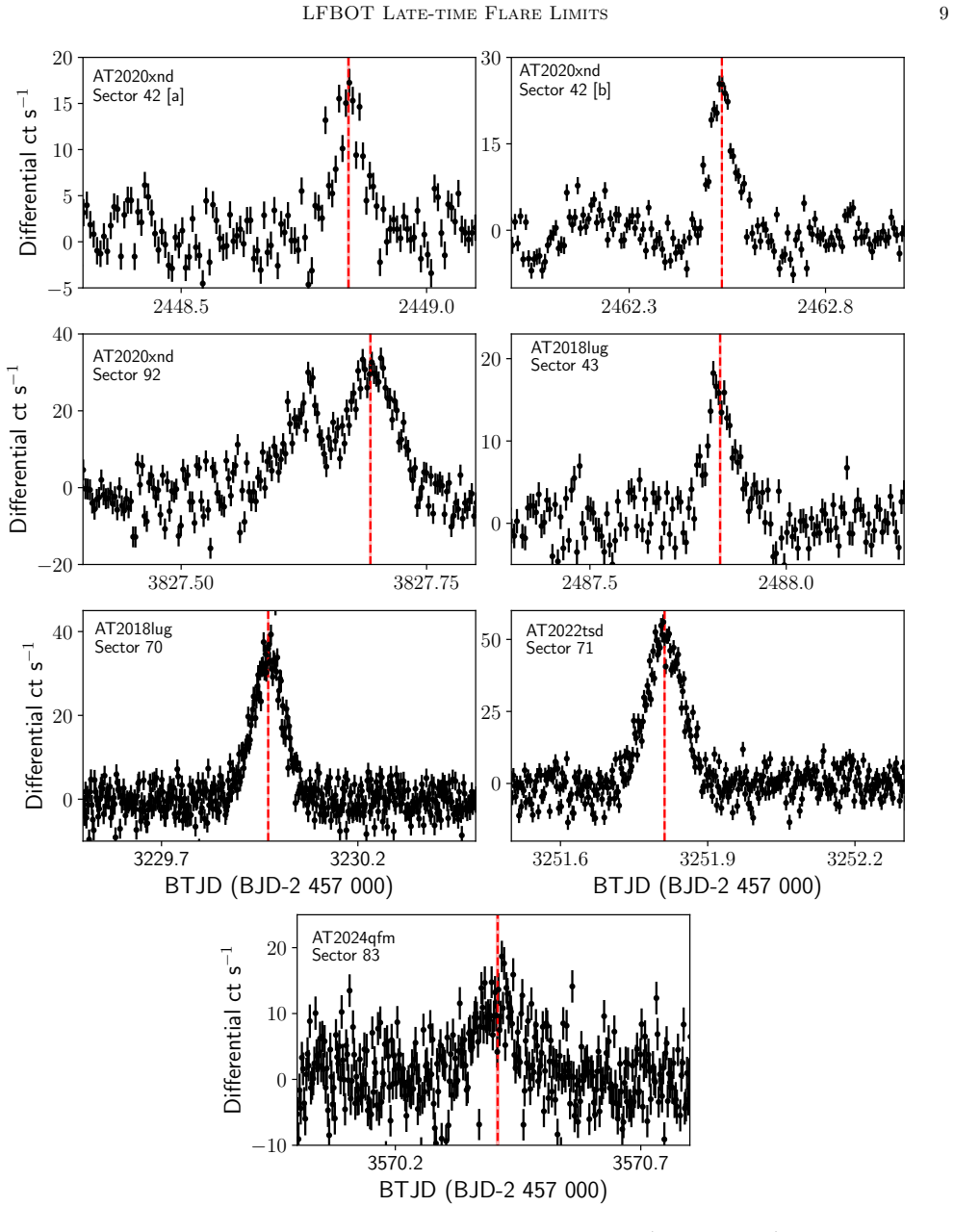
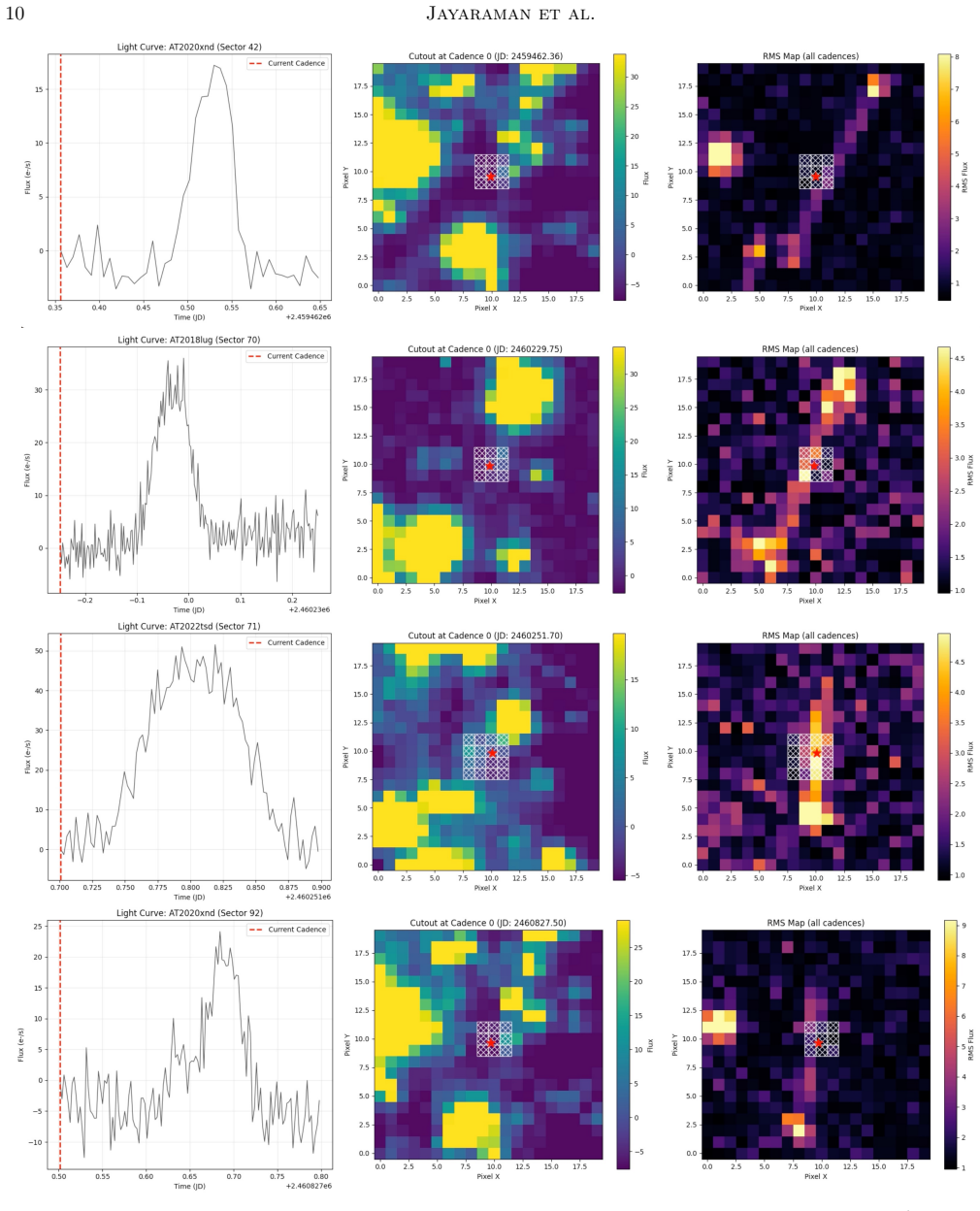
Attributing seven TESS signals to solar system objects rules out repeated flares like those in AT2022tsd for other LFBOTs and at later epochs in AT2022tsd itself.
A machine-rendered reading of the paper's core claim, the machinery that carries it, and where it could break.
Core claim
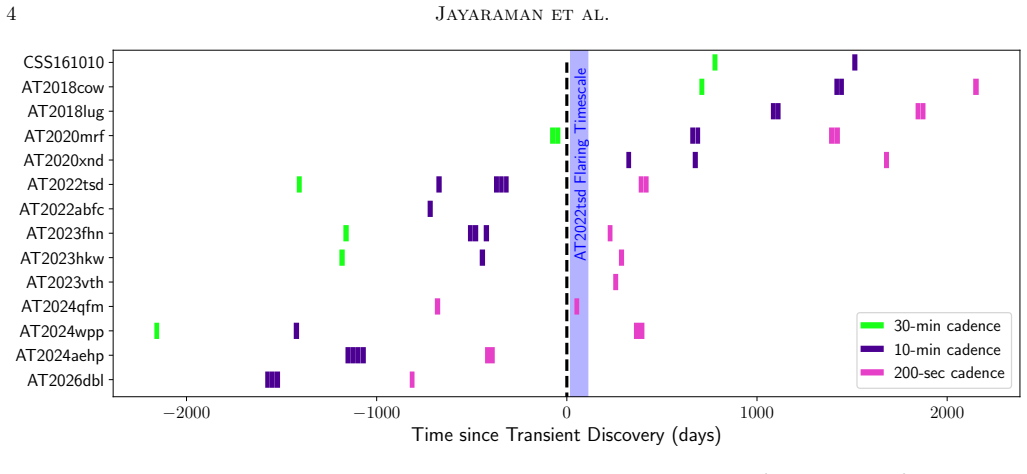
Assuming all seven detected flare-like signals arise from solar system objects, the TESS observations rule out flaring with a similar timescale (40-65 d) and luminosity (νLν∼10^43 erg s^−1) as in AT2022tsd for the LFBOT AT2024qfm, while for AT2022tsd itself they rule out flares between 380-430 d after the initial transient that were as luminous as the earlier flares; this indicates the engine power in AT2022tsd declined or shut off on a timescale of hundreds of days, and no late-time activity is detectable thousands of days after AT2018cow.
What carries the argument
Attribution of all seven TESS flare-like signals to solar system objects crossing the aperture, which supplies the upper limits on intrinsic LFBOT flaring.
If this is right
- Flares matching the 40-65 d timescale and 10^43 erg s^-1 luminosity of AT2022tsd are excluded for AT2024qfm.
- Equally luminous flares are excluded for AT2022tsd in the 380-430 d window after its initial outburst.
- No detectable activity exists thousands of days after AT2018cow.
- The non-detections translate into quantitative limits on the duty cycle of such short flares.
- Ongoing and upcoming high-cadence wide-field surveys should be able to detect a calculable number of minutes-duration flares if any remain.
Where Pith is reading between the lines
- If the solar-system-object assignment is correct, the central engines of most LFBOTs do not repeat the early flaring behavior of AT2022tsd on the probed timescales.
- The apparent shut-off within hundreds of days favors engine models that naturally lose power rather than remain constant.
- High-cadence surveys will provide a direct test of whether any residual flaring duty cycle survives at later times.
Load-bearing premise
All seven detected flare-like signals are produced by solar system objects rather than by the LFBOTs themselves.
What would settle it
A minutes-duration flare at an LFBOT sky position whose motion and brightness cannot be matched to any solar system object would invalidate the upper limits on engine activity.
Figures
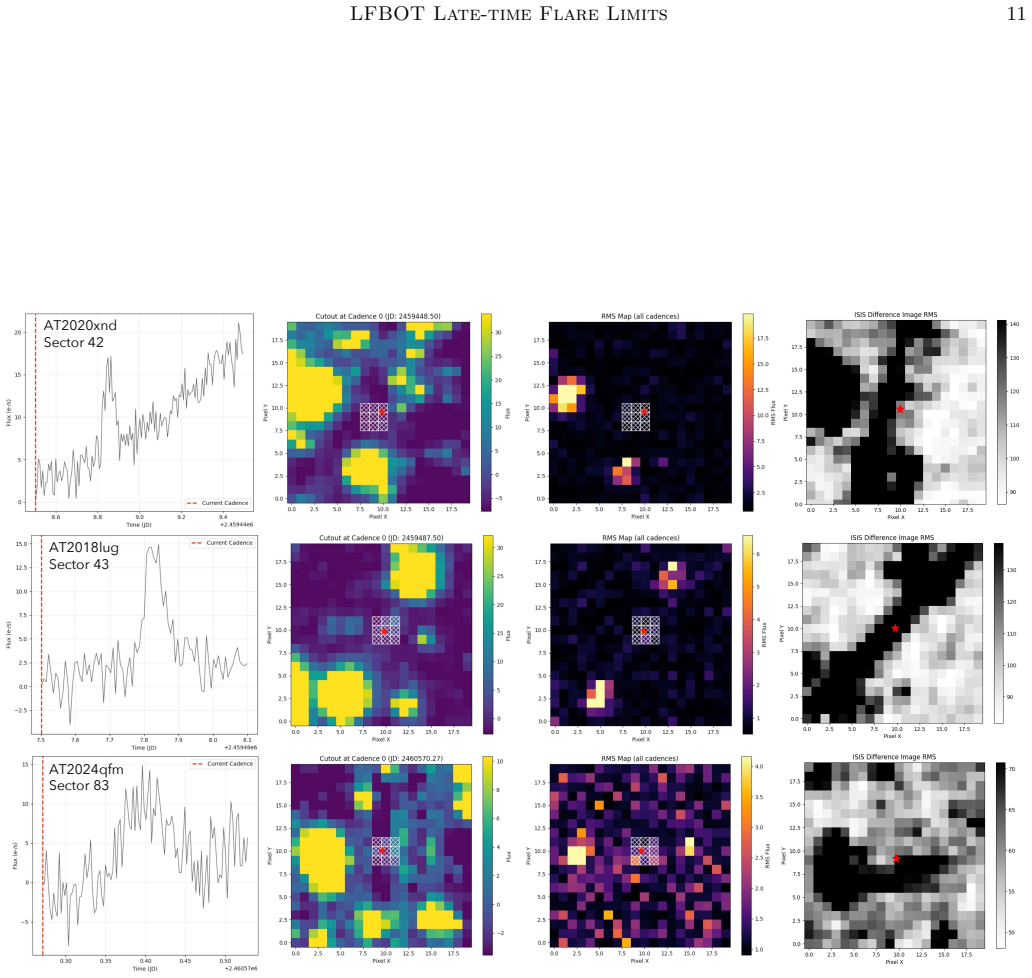
read the original abstract
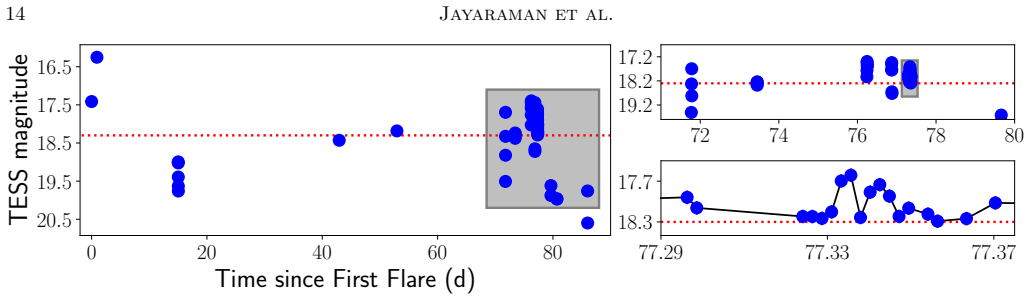
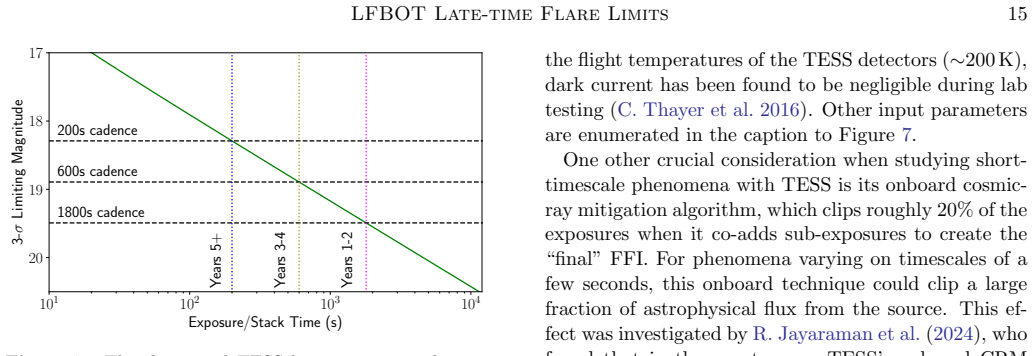
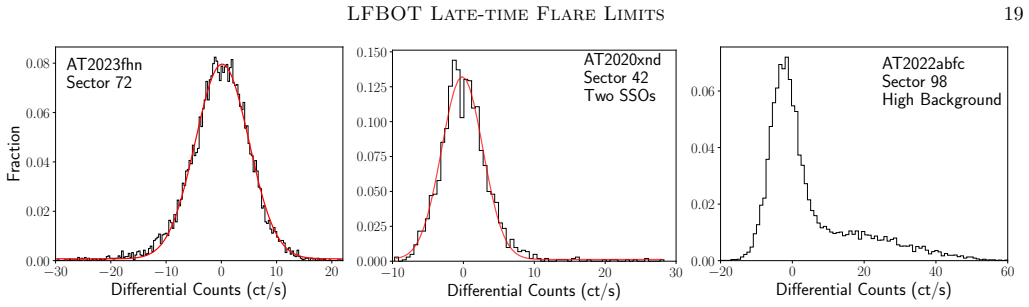
The Luminous Fast Blue Optical Transient (LFBOT) AT2022tsd exhibited minutes-timescale optical flares in the tens of days following the initial transient event, likely due to a central engine -- either an accreting black hole or a magnetar. In this paper, we use data from the Transiting Exoplanet Survey Satellite (TESS) and the Zwicky Transient Facility (ZTF) to constrain the occurrence of similar flares in the 12 (of 14) known LFBOTs that had observational coverage with TESS from tens of days to thousands of days after the transient's initial emission. We find seven flare-like signals at the locations of four unique LFBOTs; all seven can likely be attributed to a solar system object (SSO) moving through the TESS aperture. Assuming all seven flares arise from SSOs, for the LFBOT AT2024qfm we rule out flaring with a similar timescale (40--65 d) and luminosity ($\nu L_\nu\sim10^{43}$ erg s$^{-1}$) as in AT2022tsd, while for AT2022tsd itself we rule out flares between 380--430 d after the initial transient that were as luminous as the earlier flares. This observation suggests that the engine power in AT2022tsd declined or shut off on a timescale of hundreds of days. We also find that there is no late-time activity detectable in TESS thousands of days after the prototype LFBOT, AT2018cow. We discuss our constraints on the duty cycle of such flaring and then present estimates for the number of minutes-duration flares detectable with ongoing and upcoming high-cadence ($\ll1$ d) wide-field surveys.
Editorial analysis
A structured set of objections, weighed in public.
Referee Report
Summary. The paper analyzes TESS and ZTF observations of 12 LFBOTs to search for late-time optical flares similar to those seen in AT2022tsd (minutes-duration, ~10^43 erg/s). Seven flare-like signals are detected at the positions of four LFBOTs but attributed to solar system objects (SSOs) passing through the TESS aperture. After this attribution, the authors derive upper limits ruling out similar flares at 40-65 days post-transient for AT2024qfm and at 380-430 days for AT2022tsd itself, implying a decline or shutdown of the central engine on hundreds-of-days timescales. Additional non-detections at thousands of days for AT2018cow are reported, along with duty-cycle constraints and forecasts for future high-cadence surveys.
Significance. If the SSO attribution holds, the work supplies the first quantitative late-time constraints on LFBOT central-engine activity beyond the initial weeks, directly testing whether the flaring engine in AT2022tsd persists or decays. The TESS high-cadence coverage is well-suited to the minutes-timescale phenomenon, and the survey predictions are a useful forward-looking contribution.
major comments (1)
- [flare detection and attribution section] The section describing flare detection and attribution (near the discussion of the seven signals): The claim that all seven flare-like signals 'can likely be attributed' to SSOs is load-bearing for the headline non-detection limits and the inference of engine decline in AT2022tsd. The manuscript must supply the concrete, quantitative criteria (proper-motion measurements, expected SSO surface density within the aperture, multi-epoch astrometry, or likelihood ratios) used to reject an LFBOT origin for each signal; without these, the upper limits on flares at 40-65 d (AT2024qfm) and 380-430 d (AT2022tsd) cannot be evaluated.
Simulated Author's Rebuttal
We thank the referee for their careful review and for recognizing the significance of the late-time constraints on LFBOT central engines. We address the single major comment below.
read point-by-point responses
-
Referee: [flare detection and attribution section] The section describing flare detection and attribution (near the discussion of the seven signals): The claim that all seven flare-like signals 'can likely be attributed' to SSOs is load-bearing for the headline non-detection limits and the inference of engine decline in AT2022tsd. The manuscript must supply the concrete, quantitative criteria (proper-motion measurements, expected SSO surface density within the aperture, multi-epoch astrometry, or likelihood ratios) used to reject an LFBOT origin for each signal; without these, the upper limits on flares at 40-65 d (AT2024qfm) and 380-430 d (AT2022tsd) cannot be evaluated.
Authors: We agree that the attribution of the seven signals is central to the non-detection limits and that the current description is insufficiently quantitative. In the revised manuscript we will expand the relevant section to list, for each of the seven signals, the specific criteria applied: (i) measured proper motion from the TESS 2-minute cadence time series, (ii) comparison of the observed rate to the expected SSO surface density within the TESS aperture at the relevant ecliptic latitude, and (iii) consistency (or lack thereof) with multi-epoch astrometric positions when available. These additions will be presented in a new table or enumerated list so that the rejection of an LFBOT origin can be evaluated directly. The underlying data products and analysis code will also be made available. This revision does not change the reported upper limits but makes their foundation transparent. revision: yes
Circularity Check
No significant circularity; upper limits follow directly from non-detections after contaminant attribution
full rationale
The paper performs a standard observational analysis: it identifies seven flare-like signals in TESS data at LFBOT locations, attributes them to SSOs based on motion and context, and then computes upper limits on intrinsic flaring under that assumption. No equations, parameters, or predictions reduce to fitted inputs by construction. No self-citations are invoked as load-bearing uniqueness theorems. The attribution step is an explicit assumption enabling the limits, but it does not create a self-definitional or self-referential loop within the derivation. The result is self-contained against external data and does not rename known results or smuggle ansatzes.
Axiom & Free-Parameter Ledger
axioms (1)
- domain assumption TESS and ZTF photometry and astrometry reliably distinguish transient locations from solar system object crossings at the reported cadences
Reference graph
Works this paper leans on
-
[1]
Alard, C., & Lupton, R. H. 1998, ApJ, 503, 325, doi: 10.1086/305984
-
[2]
Arcavi, I., Wolf, W. M., Howell, D. A., et al. 2016, ApJ, 819, 35, doi: 10.3847/0004-637X/819/1/35 LFBOT Late-time Flare Limits21 Astropy Collaboration, Robitaille, T. P., Tollerud, E. J., et al. 2013, A&A, 558, A33, doi: 10.1051/0004-6361/201322068 Astropy Collaboration, Price-Whelan, A. M., Sip˝ ocz, B. M., et al. 2018, AJ, 156, 123, doi: 10.3847/1538-3...
-
[3]
Bellm, E. C., Kulkarni, S. R., Graham, M. J., et al. 2019, PASP, 131, 018002, doi: 10.1088/1538-3873/aaecbe
-
[4]
Ben-Ami, S., Ofek, E. O., Polishook, D., et al. 2023, PASP, 135, 085002, doi: 10.1088/1538-3873/aceb30
-
[5]
2006, in Astronomical Society of the Pacific Conference Series, Vol
Berthier, J., Vachier, F., Thuillot, W., et al. 2006, in Astronomical Society of the Pacific Conference Series, Vol. 351, Astronomical Data Analysis Software and Systems XV, ed. C. Gabriel, C. Arviset, D. Ponz, & S. Enrique, 367–+
2006
-
[6]
Bohlin, R. C. 2014, AJ, 147, 127, doi: 10.1088/0004-6256/147/6/127
-
[7]
E., Phillip, C., Fleming, S
Brasseur, C. E., Phillip, C., Fleming, S. W., Mullally, S. E., & White, R. L. 2019, Astrocut: Tools for creating cutouts of TESS images,, Astrophysics Source Code Library, record ascl:1905.007 http://ascl.net/1905.007
2019
-
[8]
Bright, J. S., Margutti, R., Matthews, D., et al. 2022, ApJ, 926, 112, doi: 10.3847/1538-4357/ac4506
-
[9]
J., Levine, A., Fausnaugh, M., et al
Burke, C. J., Levine, A., Fausnaugh, M., et al. 2020, TESS-Point: High precision TESS pointing tool,, Astrophysics Source Code Library, record ascl:2003.001 http://ascl.net/2003.001
2020
-
[10]
Chambers, K. C., Magnier, E. A., Metcalfe, N., et al. 2016, arXiv e-prints, arXiv:1612.05560, doi: 10.48550/arXiv.1612.05560
work page internal anchor Pith review Pith/arXiv arXiv doi:10.48550/arxiv.1612.05560 2016
-
[11]
Chen, Y., Drout, M. R., Piro, A. L., et al. 2023, ApJ, 955, 43, doi: 10.3847/1538-4357/ace964
-
[12]
Chrimes, A. A., Jonker, P. G., Levan, A. J., & Mummery, A. 2026, A&A, 706, A327, doi: 10.1051/0004-6361/202557545
-
[13]
Coppejans, D. L., Margutti, R., Terreran, G., et al. 2020, ApJL, 895, L23, doi: 10.3847/2041-8213/ab8cc7
-
[14]
Coughlin, M. W., Bloom, J. S., Nir, G., et al. 2023, ApJS, 267, 31, doi: 10.3847/1538-4365/acdee1
-
[15]
Dekany, R., Smith, R. M., Riddle, R., et al. 2020, PASP, 132, 038001, doi: 10.1088/1538-3873/ab4ca2
-
[16]
R., Chornock, R., Soderberg, A
Drout, M. R., Chornock, R., Soderberg, A. M., et al. 2014, ApJ, 794, 23, doi: 10.1088/0004-637X/794/1/23
-
[17]
2020, Research Notes of the American Astronomical Society, 4, 251, doi: 10.3847/2515-5172/abd63a
Vanderspek, R. 2020, Research Notes of the American Astronomical Society, 4, 251, doi: 10.3847/2515-5172/abd63a
-
[18]
Fausnaugh, M. M., Vallely, P. J., Kochanek, C. S., et al. 2021, ApJ, 908, 51, doi: 10.3847/1538-4357/abcd42
-
[19]
Fausnaugh, M. M., Vallely, P. J., Tucker, M. A., et al. 2023, ApJ, 956, 108, doi: 10.3847/1538-4357/aceaef
-
[20]
Fox, O. D., & Smith, N. 2019, MNRAS, 488, 3772, doi: 10.1093/mnras/stz1925
-
[21]
2021, in American Astronomical Society Meeting Abstracts, Vol
Gal-Yam, A. 2021, in American Astronomical Society Meeting Abstracts, Vol. 237, American Astronomical Society Meeting Abstracts #237, 423.05
2021
-
[22]
1986, ApJ, 303, 336, doi: 10.1086/164079
Gehrels, N. 1986, ApJ, 303, 336, doi: 10.1086/164079
-
[23]
The Astronomical Journal , author =
Ginsburg, A., Sip˝ ocz, B. M., Brasseur, C. E., et al. 2019, AJ, 157, 98, doi: 10.3847/1538-3881/aafc33
-
[24]
Goldstein, A., Connaughton, V., Briggs, M. S., & Burns, E. 2016, ApJ, 818, 18, doi: 10.3847/0004-637X/818/1/18
-
[25]
Govreen-Segal, T., Nakar, E., Hotokezaka, K., Irwin, C. M., & Quataert, E. 2026, arXiv e-prints, arXiv:2601.18887. https://arxiv.org/abs/2601.18887
arXiv 2026
-
[26]
Graham, M. J., Kulkarni, S. R., Bellm, E. C., et al. 2019, PASP, 131, 078001, doi: 10.1088/1538-3873/ab006c G¨ unther, M. N., Zhan, Z., Seager, S., et al. 2020, AJ, 159, 60, doi: 10.3847/1538-3881/ab5d3a Guti´ errez, C. P., Mattila, S., Lundqvist, P., et al. 2024, ApJ, 977, 162, doi: 10.3847/1538-4357/ad89a5
-
[27]
Harris, C. R., Millman, K. J., van der Walt, S. J., et al. 2020, Nature, 585, 357, doi: 10.1038/s41586-020-2649-2
-
[28]
Ho, A. Y. Q., Phinney, E. S., Ravi, V., et al. 2019, ApJ, 871, 73, doi: 10.3847/1538-4357/aaf473
-
[29]
Ho, A. Y. Q., Perley, D. A., Kulkarni, S. R., et al. 2020, ApJ, 895, 49, doi: 10.3847/1538-4357/ab8bcf
-
[30]
Ho, A. Y. Q., Perley, D. A., Gal-Yam, A., et al. 2023a, ApJ, 949, 120, doi: 10.3847/1538-4357/acc533
-
[31]
Ho, A. Y. Q., Perley, D. A., Chen, P., et al. 2023b, Nature, 623, 927, doi: 10.1038/s41586-023-06673-6
-
[32]
Hunter, J. D. 2007, Computing in Science & Engineering, 9, 90, doi: 10.1109/MCSE.2007.55
-
[33]
Inkenhaag, A., Levan, A. J., Mummery, A., & Jonker, P. G. 2025, MNRAS, 544, L108, doi: 10.1093/mnrasl/slaf107
-
[34]
2019, Nature Astronomy, 3, 697, doi: 10.1038/s41550-019-0854-4 Ivezi´ c,ˇZ., Kahn, S
Inserra, C. 2019, Nature Astronomy, 3, 697, doi: 10.1038/s41550-019-0854-4 Ivezi´ c,ˇZ., Kahn, S. M., Tyson, J. A., et al. 2019, ApJ, 873, 111, doi: 10.3847/1538-4357/ab042c
-
[35]
Jayaraman, R., Fausnaugh, M., Ricker, G. R., Vanderspek, R., & Mo, G. 2024, ApJ, 972, 162, doi: 10.3847/1538-4357/ad5e7b
-
[36]
O., Krassilchtchikov, A., et al
Konno, R., Ofek, E. O., Krassilchtchikov, A., et al. 2026, arXiv e-prints, arXiv:2604.27921. https://arxiv.org/abs/2604.27921
Pith/arXiv arXiv 2026
-
[37]
2019, Acta Astronautica, 160, 46, doi: 10.1016/j.actaastro.2019.04.016
Vanderspek, R. 2019, Acta Astronautica, 160, 46, doi: 10.1016/j.actaastro.2019.04.016
-
[38]
Law, N. M., Corbett, H., Galliher, N. W., et al. 2022, PASP, 134, 035003, doi: 10.1088/1538-3873/ac4811 22Jayaraman et al
-
[39]
2026, ApJL, 997, L10, doi: 10.3847/2041-8213/ae2910 Lightkurve Collaboration, Cardoso, J
LeBaron, N., Margutti, R., Chornock, R., et al. 2026, ApJL, 997, L10, doi: 10.3847/2041-8213/ae2910 Lightkurve Collaboration, Cardoso, J. V. d. M., Hedges, C., et al. 2018, Lightkurve: Kepler and TESS time series analysis in Python,, Astrophysics Source Code Library http://ascl.net/1812.013
-
[40]
Margutti, R., Metzger, B. D., Chornock, R., et al. 2019, ApJ, 872, 18, doi: 10.3847/1538-4357/aafa01
-
[41]
Masci, F. J., Laher, R. R., Rusholme, B., et al. 2019, PASP, 131, 018003, doi: 10.1088/1538-3873/aae8ac
work page internal anchor Pith review doi:10.1088/1538-3873/aae8ac 2019
-
[42]
Masci, F. J., Laher, R. R., Rusholme, B., et al. 2023, arXiv e-prints, arXiv:2305.16279, doi: 10.48550/arXiv.2305.16279
-
[43]
Matsumoto, T., & Metzger, B. D. 2022, ApJ, 936, 114, doi: 10.3847/1538-4357/ac892c
-
[44]
Matthews, D., Margutti, R., Metzger, B. D., et al. 2023, Research Notes of the American Astronomical Society, 7, 126, doi: 10.3847/2515-5172/acdde1
-
[45]
Maund, J. R., H¨ oflich, P. A., Steele, I. A., et al. 2023, MNRAS, 521, 3323, doi: 10.1093/mnras/stad539
-
[46]
Metzger, B. D. 2022, ApJ, 932, 84, doi: 10.3847/1538-4357/ac6d59
-
[47]
Migliori, G., Margutti, R., Metzger, B. D., et al. 2024, ApJL, 963, L24, doi: 10.3847/2041-8213/ad2764
-
[48]
2023, ApJL, 948, L3, doi: 10.3847/2041-8213/acca70 Mr´ oz, P., Otarola, A., Prince, T
Mo, G., Jayaraman, R., Fausnaugh, M., et al. 2023, ApJL, 948, L3, doi: 10.3847/2041-8213/acca70 Mr´ oz, P., Otarola, A., Prince, T. A., et al. 2022, ApJL, 924, L30, doi: 10.3847/2041-8213/ac470a
-
[49]
Nayana, A. J., & Chandra, P. 2021, ApJL, 912, L9, doi: 10.3847/2041-8213/abed55
-
[50]
J., Margutti, R., Wiston, E., et al
Nayana, A. J., Margutti, R., Wiston, E., et al. 2025, arXiv e-prints, arXiv:2509.00952, doi: 10.48550/arXiv.2509.00952
-
[51]
Ofek, E. O., Rabinak, I., Neill, J. D., et al. 2010, ApJ, 724, 1396, doi: 10.1088/0004-637X/724/2/1396
-
[52]
Ofek, E. O., Sullivan, M., Shaviv, N. J., et al. 2014, ApJ, 789, 104, doi: 10.1088/0004-637X/789/2/104
-
[53]
O., Ben-Ami, S., Polishook, D., et al
Ofek, E. O., Ben-Ami, S., Polishook, D., et al. 2023a, PASP, 135, 065001, doi: 10.1088/1538-3873/acd8f0
-
[54]
O., Shvartzvald, Y., Sharon, A., et al
Ofek, E. O., Shvartzvald, Y., Sharon, A., et al. 2023b, PASP, 135, 124502, doi: 10.1088/1538-3873/ad0977
-
[55]
O., Ozer, L., Konno, R., et al
Ofek, E. O., Ozer, L., Konno, R., et al. 2025, arXiv e-prints, arXiv:2508.18359, doi: 10.48550/arXiv.2508.18359
-
[56]
B., Zaguri, Y., Perdelwitz, V., et al
Ogunwale, B. B., Zaguri, Y., Perdelwitz, V., et al. 2025, A&A, 704, A317, doi: 10.1051/0004-6361/202555521
-
[57]
Pasham, D. R., Ho, W. C. G., Alston, W., et al. 2021, Nature Astronomy, 6, 249, doi: 10.1038/s41550-021-01524-8
-
[58]
Perley, D. A., Mazzali, P. A., Yan, L., et al. 2019, MNRAS, 484, 1031, doi: 10.1093/mnras/sty3420
-
[59]
Perley, D. A., Ho, A. Y. Q., Yao, Y., et al. 2021, MNRAS, 508, 5138, doi: 10.1093/mnras/stab2785
-
[60]
AT2024wpp: An Extremely Luminous Fast Ultraviolet Transient Powered by Accretion onto a Black Hole
Perley, D. A., Ho, A. Y. Q., McGrath, Z., et al. 2026, arXiv e-prints, arXiv:2601.03337, doi: 10.48550/arXiv.2601.03337 Planck Collaboration, Aghanim, N., Akrami, Y., et al. 2020, A&A, 641, A6, doi: 10.1051/0004-6361/201833910
work page internal anchor Pith review Pith/arXiv arXiv doi:10.48550/arxiv.2601.03337 2026
-
[61]
Prentice, S. J., Maguire, K., Smartt, S. J., et al. 2018, ApJL, 865, L3, doi: 10.3847/2041-8213/aadd90
-
[62]
2018, MNRAS, 481, 894, doi: 10.1093/mnras/sty2309
Pursiainen, M., Childress, M., Smith, M., et al. 2018, MNRAS, 481, 894, doi: 10.1093/mnras/sty2309
-
[63]
Pursiainen, M., Killestein, T. L., Kuncarayakti, H., et al. 2025, MNRAS, 537, 3298, doi: 10.1093/mnras/staf232
-
[64]
Quataert, E., & Kasen, D. 2012, MNRAS, 419, L1, doi: 10.1111/j.1745-3933.2011.01151.x10.1086/141928
work page doi:10.1111/j.1745-3933.2011.01151.x10.1086/141928 2012
-
[65]
Quataert, E., Lecoanet, D., & Coughlin, E. R. 2019, MNRAS, 485, L83, doi: 10.1093/mnrasl/slz031
-
[66]
Rest, A., Garnavich, P. M., Khatami, D., et al. 2018, Nature Astronomy, 2, 307, doi: 10.1038/s41550-018-0423-2
-
[67]
Ricker, G. R., Winn, J. N., Vanderspek, R., et al. 2015, Journal of Astronomical Telescopes, Instruments, and Systems, 1, 014003, doi: 10.1117/1.JATIS.1.1.014003
work page internal anchor Pith review doi:10.1117/1.jatis.1.1.014003 2015
-
[68]
2025, AJ, 170, 186, doi: 10.3847/1538-3881/adf21b
Roxburgh, H., Ridden-Harper, R., Moore, A., et al. 2025, AJ, 170, 186, doi: 10.3847/1538-3881/adf21b
-
[69]
Sagiv, I., Gal-Yam, A., Ofek, E. O., et al. 2014, AJ, 147, 79, doi: 10.1088/0004-6256/147/4/79
-
[70]
Measuring Reddening with SDSS Stellar Spectra and Recalibrating SFD
Schlafly, E. F., & Finkbeiner, D. P. 2011, ApJ, 737, 103, doi: 10.1088/0004-637X/737/2/103
work page internal anchor Pith review doi:10.1088/0004-637x/737/2/103 2011
-
[71]
Sevilla, C., Ho, A. Y. Q., J., N. A., et al. 2026, arXiv e-prints, arXiv:2601.18926. https://arxiv.org/abs/2601.18926
arXiv 2026
-
[72]
W., Young, D
Shingles, L., Smith, K. W., Young, D. R., et al. 2021, Transient Name Server AstroNote, 7, 1
2021
-
[73]
2024, ApJ, 964, 74, doi: 10.3847/1538-4357/ad2704
Shvartzvald, Y., Waxman, E., Gal-Yam, A., et al. 2024, ApJ, 964, 74, doi: 10.3847/1538-4357/ad2704
-
[74]
Smith, K. W., Smartt, S. J., Young, D. R., et al. 2020, PASP, 132, 085002, doi: 10.1088/1538-3873/ab936e
-
[75]
Strotjohann, N. L., Ofek, E. O., Gal-Yam, A., et al. 2015, ApJ, 811, 117, doi: 10.1088/0004-637X/811/2/117
-
[76]
Strotjohann, N. L., Ofek, E. O., Gal-Yam, A., et al. 2021, ApJ, 907, 99, doi: 10.3847/1538-4357/abd032 STScI Development Team. 2018, synphot: Synthetic photometry using Astropy,, Astrophysics Source Code Library, record ascl:1811.001 http://ascl.net/1811.001
-
[77]
Sun, N.-C., Maund, J. R., Crowther, P. A., & Liu, L.-D. 2022, MNRAS, 512, L66, doi: 10.1093/mnrasl/slac023
-
[78]
2016, ApJ, 819, 5, doi: 10.3847/0004-637X/819/1/5 LFBOT Late-time Flare Limits23
Tanaka, M., Tominaga, N., Morokuma, T., et al. 2016, ApJ, 819, 5, doi: 10.3847/0004-637X/819/1/5 LFBOT Late-time Flare Limits23
-
[79]
2016, in Society of Photo-Optical Instrumentation Engineers (SPIE) Conference Series, Vol
Thayer, C., Villasenor, J., Kissel, S., et al. 2016, in Society of Photo-Optical Instrumentation Engineers (SPIE) Conference Series, Vol. 9904, Space Telescopes and Instrumentation 2016: Optical, Infrared, and Millimeter Wave, ed. H. A. MacEwen, G. G. Fazio, M. Lystrup, N. Batalha, N. Siegler, & E. C. Tong, 99042X, doi: 10.1117/12.2232886
-
[80]
Tonry, J. L., Denneau, L., Heinze, A. N., et al. 2018, PASP, 130, 064505, doi: 10.1088/1538-3873/aabadf
work page internal anchor Pith review doi:10.1088/1538-3873/aabadf 2018
discussion (0)
Sign in with ORCID, Apple, or X to comment. Anyone can read and Pith papers without signing in.