REVIEW 3 major objections 8 minor 48 references
Self-supervised Monocular Depth and Pose Estimation for Endoscopy with Latent Priors
T0 review · 3 major / 8 minor · reviewed 2026-08-12 · deepseek-v4-flash
Pith's one-line read Adding a generative latent bank and VAE pose regularization lifts self-supervised endoscopic depth and pose to state-of-the-art accuracy on SimCol and EndoSLAM.
desk verdict The SOTA claim is unverifiable without a stated train/test split; the VAE is also under-specified, but the split is the load-bearing issue. read the letter →
The pith
A machine-rendered reading of the paper's core claim, the machinery that carries it, and where it could break.
The reading
What carries the argument
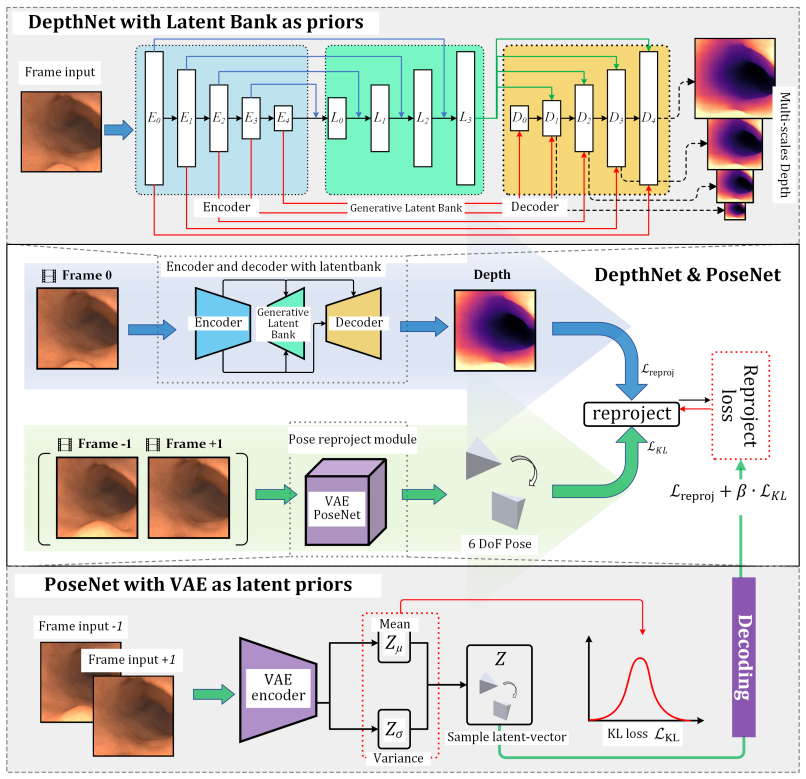
The two load-bearing mechanisms are (1) a Generative Latent Bank—a StyleGAN-style generator pretrained on natural-scene depth maps with a Wasserstein GAN objective, then frozen and inserted between the depth encoder and decoder, where encoder features act as prompts via adaptive instance normalization to retrieve realistic depth priors—and (2) a VAE-constrained PoseNet, where the pose encoder outputs a distribution over the relative pose between adjacent frames, the reprojection operation is the decoder, and a KL-divergence term $KL(q(z_{\text{pos}})\|N(0,I))$ regularizes the pose transitions. Together they turn an otherwise purely photometric self-supervised loop into one that is also conditioned on prior knowledge of what depth maps and what camera motions in a narrow lumen should look like.
What would settle it
Train the identical architecture with the KL-divergence term replaced by an ordinary L2 penalty on the pose vector and no sampling; if pose and depth errors on SimCol and EndoSLAM are unchanged, the VAE framing is not the operative mechanism that produces the reported gains.
Extended reading notes
Core claim
On the paper's own terms, the central claim is that a self-supervised Monodepth2-style reprojection loop, when augmented with a Generative Latent Bank and a VAE-constrained PoseNet, produces state-of-the-art depth and pose estimates in endoscopic scenes. The DepthNet is conditioned by a StyleGAN-like generator pretrained on natural depth images; its encoder features act as prompts that retrieve structured depth 'atoms' from the frozen latent bank, which are fused into the decoder via adaptive instance normalization. The PoseNet is reframed as a variational autoencoder in which the predicted 6-DoF pose transition is treated as a latent variable, the reprojection algorithm acts as the decoder, and a KL divergence to a standard Gaussian prior regularizes pose scale and smoothness. The paper reports consistent gains across the synthetic SimCol colon datasets and the EndoSLAM colon, small-intestine, and porcine datasets, and its ablations attribute the improvement to both modules.
Load-bearing premise
The load-bearing premise is that the pose branch is genuinely a variational autoencoder; the paper never defines the posterior distribution over poses (no mean/variance outputs, no reparameterization, no beta value), so the claimed VAE mechanism could in practice reduce to an L2 penalty on the 6-DoF pose vector.
Editorial extensions
If this is right
- Monocular endoscopy can achieve state-of-the-art depth and pose accuracy with no ground-truth depth or pose labels, using priors learned from natural-scene depth data and smooth-motion assumptions.
- The depth branch becomes less dependent on synthetic endoscopic training data, since its prior comes from abundant natural depth scenes adapted through the self-supervised loop.
- The pose branch's z-axis regularization directly counters the dominant forward-motion drift in colonoscopy, yielding curved, anatomically plausible camera trajectories instead of exaggerated linear ones.
- Because depth and pose share the reprojection loss, improvements in either module propagate to the other, so the two tasks reinforce each other during training.
- On real porcine endoscopic video, the method reports substantially lower pose error than the baselines, suggesting the framework may transfer beyond synthetic data.
Reading between the lines
- The paper leaves the VAE posterior unspecified; if the pose encoder is deterministic and the KL term acts as an L2 penalty, the 'VAE' naming is a framing choice rather than a generative model, and the gains might be reproducible with standard weight decay.
- The latent bank's pretraining on SceneNet RGB-D (indoor synthetic depths) suggests that natural indoor depth priors transfer to the GI tract better than endoscopic synthetic data alone; ablating the pretraining source would test this directly.
- The z-axis stabilizing effect of the pose KL term could generalize to other narrow-lumen navigation tasks (bronchoscopy, ureteroscopy, capsule endoscopy), where forward motion dominates and trajectory curvature is clinically informative.
- Because the KL term acts on the scale of the 6-DoF pose vector, it may also reduce the global scale ambiguity of the reconstructed 3D map; comparing reconstructed trajectories against CT-derived ground truth would quantify this.
Editorial analysis
A structured set of objections, weighed in public.
Referee Report
Summary. The paper proposes a self-supervised monocular depth and pose estimation framework for endoscopy. Depth estimation uses a StyleGAN-like Generative Latent Bank pretrained on SceneNet RGB-D and injected into a DepthNet encoder-decoder; pose estimation is reformulated as a VAE-like model in which the pose encoder's outputs are treated as latent variables and regularized by a KL divergence toward a standard Gaussian. The full pipeline is trained with a reprojection loss following Monodepth2. Experiments on SimCol and EndoSLAM compare against Monodepth2, MonoViT, DualRefine, Lite-Mono, and Depth Pro, reporting lower depth errors and pose errors, with ablations showing contributions of both proposed components.
Significance. The paper addresses an important problem: accurate depth and pose estimation in monocular endoscopy. The proposed components, a generative latent bank trained on natural depth scenes and a pose regularizer based on a Gaussian prior, are reasonable and the empirical results, if valid, would represent a useful step over published self-supervised baselines. The strengths are the use of external public benchmarks, a clear self-supervised setup, and ablation studies for both components. However, the missing specification of the training split and the under-specified VAE formulation prevent the reader from verifying the central state-of-the-art claim. The paper contains no machine-checked proofs, but the evaluation is reproducible in principle once the protocol is clarified.
major comments (3)
- [4.1] The datasets section describes only test material: "three trajectories in Synthetic colon I and II are combined as a test set, while Synthetic colon III serves as a test set," and for EndoSLAM the synthetic videos "were used as test sets." It never states which trajectories or scenes are used to train the depth and pose networks in the self-supervised phase. Because the framework is self-supervised, the networks must be trained on video sequences from these datasets (or from some other endoscopic data); without sequence-level train/test split information, the reader cannot exclude that test trajectories appeared in training or that baselines were evaluated under a different protocol (e.g., released weights vs. retraining). Please report the exact scene/trajectory IDs used for training and testing, and state how each baseline was adapted to the same split.
- [3.2 and Eq. (2)] The loss contains the term KL(q(z_pos)||N(0,I)) but q(z_pos) is never defined. The paper does not specify whether Epos outputs a mean and a variance, what family q belongs to, how sampling is performed (e.g., reparameterization), or the value of beta. As written, the "VAE-constrained PoseNet" could be interpreted as an L2 penalty on the 6-DoF pose vector, which would not be a variational autoencoder. This is load-bearing for the claimed contribution; please define the posterior, the prior, the sampling procedure, and the KL weight, and if the implementation differs from a true VAE, describe the actual loss used.
- [Table 1] Several entries in Table 1 appear to be transcription errors with identical values across different thresholds: MonoViT on SimCol-I,II has δ<1.25^2 = 0.952 and δ<1.25^3 = 0.952; Lite-Mono on EndoSLAM Colon has δ<1.25 = 0.421 and δ<1.25^2 = 0.421; Ours on EndoSLAM Small Intestine has δ<1.25 = 0.648 and δ<1.25^2 = 0.648. Since this table is the primary evidence for the claimed state-of-the-art depth performance, these values must be corrected and the table regenerated before the comparison can be assessed.
minor comments (8)
- [1] In the introductory paragraph describing the self-supervised loop, "reprojected adjacent frames are wrapped to predict the current frame" should read "warped."
- [3.2] The text contains the typo "pose chamges" instead of "pose changes."
- [4.1] The number of frames in SceneNet RGB-D is stated as "more than 15,000," but the original SceneNet RGB-D dataset contains 5 million images; please correct the figure or clarify which subset was used.
- [4.4] The text says "Table shows the results" without a table number, and the reported "relative improvement of 0.369/0.056 and 0.385/0.003" is not explained; please clarify the numerators and denominators.
- [Tables 1-3] Table headers contain "Y ear" instead of "Year," and "Simcol" is inconsistently capitalized (SimCol appears elsewhere).
- [4.2] The phrase "training epoch of 20" should be "20 epochs," and "an initial learning rate of1e−4" has a missing space.
- [3.2] The paper does not state whether the pose encoder receives the current frame and the adjacent frame concatenated (as in Monodepth2) or a single frame; please clarify.
- [4.3] Depth Pro is evaluated via transfer learning (pretrained weights applied directly), while the other baselines are presumably trained on the datasets; this protocol difference should be explicitly discussed in the comparison.
Circularity Check
No circularity found: the novel components are stipulated priors or external transfer modules, and the evaluation is against external benchmark data.
full rationale
The paper's central claims are empirical comparisons on the external SimCol and EndoSLAM benchmarks, not derivations from fitted constants or self-defined targets. The Generative Latent Bank is pretrained on SceneNet RGB-D and then frozen during self-supervised training, so it is a transferred prior rather than a circular input. The VAE-constrained PoseNet adds a KL regularization term as a stipulated prior on pose transitions; even though q(z_pos) is under-specified, the KL term is an additional loss component rather than a quantity fitted to the benchmark outputs. No step in the paper reduces an output to its own input by construction, and no load-bearing self-citation chain is used to forbid alternative methods. The paper's own Sec. 6 limitation about the absence of real clinical ground truth is a scope limitation, not circularity. The lack of a stated train/test split and the incomplete VAE parameterization are reproducibility concerns, but they do not make any prediction equivalent to the method's inputs.
Assumptions & free parameters
free parameters (2)
- beta (KL weight) =
Not reported
- gamma (gradient penalty weight) =
Not reported
assumptions (4)
- domain assumption A StyleGAN-like generator pretrained on SceneNet RGB-D depth maps learns a latent bank of realistic depth scenes that transfers to endoscopy.
- domain assumption Pose transitions during colonoscopy are gentle and can be regularized by a standard Gaussian prior over the 6-DoF pose vector.
- domain assumption The synthetic test sets in SimCol and EndoSLAM are representative of real endoscopic depth and pose distributions.
- domain assumption Monodepth2-style photometric reprojection provides a sufficient self-supervised signal for joint depth and pose learning in endoscopy.
Cite this review
Pith. "Pith review of Self-supervised Monocular Depth and Pose Estimation for Endoscopy with Latent Priors." pith.science (2026). https://pith.science/paper/WYXWE6SJ
@misc{pith2026241117790,
  author       = {Pith},
  title        = {Pith review of: Self-supervised Monocular Depth and Pose Estimation for Endoscopy with Latent Priors},
  year         = {2026},
  howpublished = {\url{https://pith.science/paper/WYXWE6SJ}},
  note         = {Machine review of arXiv:2411.17790}
}
read the original abstract
Accurate 3D mapping in endoscopy enables quantitative, holistic lesion characterization within the gastrointestinal (GI) tract, requiring reliable depth and pose estimation. However, endoscopy systems are monocular, and existing methods relying on synthetic datasets or complex models often lack generalizability in challenging endoscopic conditions. We propose a robust self-supervised monocular depth and pose estimation framework that incorporates a Generative Latent Bank and a Variational Autoencoder (VAE). The Generative Latent Bank leverages extensive depth scenes from natural images to condition the depth network, enhancing realism and robustness of depth predictions through latent feature priors. For pose estimation, we reformulate it within a VAE framework, treating pose transitions as latent variables to regularize scale, stabilize z-axis prominence, and improve x-y sensitivity. This dual refinement pipeline enables accurate depth and pose predictions, effectively addressing the GI tract's complex textures and lighting. Extensive evaluations on SimCol and EndoSLAM datasets confirm our framework's superior performance over published self-supervised methods in endoscopic depth and pose estimation.
Figures


Figures from the paper (2 more)


Reference graph
Works this paper leans on
-
[1]
Wasserstein generative adversarial networks
Martin Arjovsky, Soumith Chintala, and L ´eon Bottou. Wasserstein generative adversarial networks. In Interna- tional conference on machine learning , pages 214–223. PMLR, 2017. 4
work page 2017
-
[2]
Antyanta Bangunharcana, Ahmed Magd, and Kyung-Soo Kim. Dualrefine: Self-supervised depth and pose estima- tion through iterative epipolar sampling and refinement to- ward equilibrium. In Proceedings of the IEEE/CVF Con- ference on Computer Vision and Pattern Recognition, pages 726–738, 2023. 2, 6
work page 2023
-
[3]
Diagnosis and treatment of metastatic colorectal cancer: a review
Leah H Biller and Deborah Schrag. Diagnosis and treatment of metastatic colorectal cancer: a review. Jama, 325(7):669– 685, 2021. 1
work page 2021
-
[4]
Colonoscopy 3d video dataset with paired depth from 2d-3d registration
Taylor L Bobrow, Mayank Golhar, Rohan Vijayan, Venkata S Akshintala, Juan R Garcia, and Nicholas J Durr. Colonoscopy 3d video dataset with paired depth from 2d-3d registration. Medical image analysis, 90:102956, 2023. 1
work page 2023
-
[5]
Aleksei Bochkovskii, Ama ¨el Delaunoy, Hugo Germain, Marcel Santos, Yichao Zhou, Stephan R. Richter, and Vladlen Koltun. Depth pro: Sharp monocular metric depth in less than a second. arXiv, 2024. 1, 6
work page 2024
-
[6]
Effect of colonoscopy screening on risks of col- orectal cancer and related death
Michael Bretthauer, Magnus Løberg, Paulina Wieszczy, Mette Kalager, Louise Emilsson, Kjetil Garborg, Maciej Rupinski, Evelien Dekker, Manon Spaander, Marek Buga- jski, et al. Effect of colonoscopy screening on risks of col- orectal cancer and related death. New England Journal of Medicine, 387(17):1547–1556, 2022. 1
work page 2022
-
[7]
Unsupervised monocular depth and ego-motion learning with structure and semantics
Vincent Casser, Soeren Pirk, Reza Mahjourian, and Anelia Angelova. Unsupervised monocular depth and ego-motion learning with structure and semantics. In Proceedings of the IEEE/CVF Conference on Computer Vision and Pattern Recognition Workshops, pages 0–0, 2019. 2
work page 2019
-
[8]
Glean: Generative latent bank for large-factor image super-resolution
Kelvin CK Chan, Xintao Wang, Xiangyu Xu, Jinwei Gu, and Chen Change Loy. Glean: Generative latent bank for large-factor image super-resolution. In Proceedings of the IEEE/CVF conference on computer vision and pattern recognition, pages 14245–14254, 2021. 2, 3
work page 2021
Show all 48 references
-
[9]
Depth estimation for colonoscopy images with self- supervised learning from videos
Kai Cheng, Yiting Ma, Bin Sun, Yang Li, and Xuejin Chen. Depth estimation for colonoscopy images with self- supervised learning from videos. In Medical Image Com- puting and Computer Assisted Intervention–MICCAI 2021: 24th International Conference, Strasbourg, France, Septem- ...
2021
-
[10]
Predicting depth, surface nor- mals and semantic labels with a common multi-scale con- volutional architecture
David Eigen and Rob Fergus. Predicting depth, surface nor- mals and semantic labels with a common multi-scale con- volutional architecture. In Proceedings of the IEEE inter- national conference on computer vision , pages 2650–2658,
-
[11]
Depth map prediction from a single image using a multi-scale deep net- work
David Eigen, Christian Puhrsch, and Rob Fergus. Depth map prediction from a single image using a multi-scale deep net- work. Advances in neural information processing systems , 27, 2014. 2, 6
2014
-
[12]
Deep ordinal regression net- work for monocular depth estimation
Huan Fu, Mingming Gong, Chaohui Wang, Kayhan Bat- manghelich, and Dacheng Tao. Deep ordinal regression net- work for monocular depth estimation. In Proceedings of the IEEE conference on computer vision and pattern recogni- tion, pages 2002–2011, 2018. 2
2002
-
[13]
Unsupervised monocular depth estimation with left- right consistency
Cl ´ement Godard, Oisin Mac Aodha, and Gabriel J Bros- tow. Unsupervised monocular depth estimation with left- right consistency. In Proceedings of the IEEE conference on computer vision and pattern recognition, pages 270–279,
-
[14]
Digging into self-supervised monocular depth estimation
Cl ´ement Godard, Oisin Mac Aodha, Michael Firman, and Gabriel J Brostow. Digging into self-supervised monocular depth estimation. In Proceedings of the IEEE/CVF inter- national conference on computer vision , pages 3828–3838,
-
[15]
Improved training of wasserstein gans
Ishaan Gulrajani, Faruk Ahmed, Martin Arjovsky, Vincent Dumoulin, and Aaron C Courville. Improved training of wasserstein gans. Advances in neural information processing systems, 30, 2017. 4
2017
-
[16]
beta-vae: Learning basic visual concepts with a constrained variational framework
Irina Higgins, Loic Matthey, Arka Pal, Christopher P Burgess, Xavier Glorot, Matthew M Botvinick, Shakir Mo- hamed, and Alexander Lerchner. beta-vae: Learning basic visual concepts with a constrained variational framework. ICLR (Poster), 3, 2017. 2
2017
-
[17]
3d reconstruction of virtual colon structures from colonoscopy images
DongHo Hong, Wallapak Tavanapong, Johnny Wong, JungHwan Oh, and Piet C De Groen. 3d reconstruction of virtual colon structures from colonoscopy images. Comput- erized Medical Imaging and Graphics , 38(1):22–33, 2014. 1
2014
-
[18]
Arbitrary style transfer in real-time with adaptive instance normalization
Xun Huang and Serge Belongie. Arbitrary style transfer in real-time with adaptive instance normalization. In Proceed- ings of the IEEE international conference on computer vi- sion, pages 1501–1510, 2017. 3
2017
-
[19]
Unsupervised monocular depth estima- tion for colonoscope system using feedback network
Seung-Jun Hwang, Sung-Jun Park, Gyu-Min Kim, and Joong-Hwan Baek. Unsupervised monocular depth estima- tion for colonoscope system using feedback network. Sen- sors, 21(8):2691, 2021. 2
2021
-
[20]
Fine- grained semantics-aware representation enhancement for self-supervised monocular depth estimation
Hyunyoung Jung, Eunhyeok Park, and Sungjoo Yoo. Fine- grained semantics-aware representation enhancement for self-supervised monocular depth estimation. In Proceedings of the IEEE/CVF International Conference on Computer Vi- sion, pages 12642–12652, 2021. 2
2021
-
[21]
A style-based generator architecture for generative adversarial networks
Tero Karras, Samuli Laine, and Timo Aila. A style-based generator architecture for generative adversarial networks. In Proceedings of the IEEE/CVF conference on computer vi- sion and pattern recognition, pages 4401–4410, 2019. 2, 3
2019
-
[22]
Semi-supervised learning with deep gen- erative models
Durk P Kingma, Shakir Mohamed, Danilo Jimenez Rezende, and Max Welling. Semi-supervised learning with deep gen- erative models. Advances in neural information processing systems, 27, 2014. 2
2014
-
[23]
Syndistnet: Self-supervised monocular fisheye camera distance estima- tion synergized with semantic segmentation for autonomous driving
Varun Ravi Kumar, Marvin Klingner, Senthil Yogamani, Ste- fan Milz, Tim Fingscheidt, and Patrick Mader. Syndistnet: Self-supervised monocular fisheye camera distance estima- tion synergized with semantic segmentation for autonomous driving. In Proceedings of the IEEE/CVF winte...
2021
-
[24]
Deeper depth prediction with fully convolutional residual networks
Iro Laina, Christian Rupprecht, Vasileios Belagiannis, Fed- erico Tombari, and Nassir Navab. Deeper depth prediction with fully convolutional residual networks. In 2016 Fourth international conference on 3D vision (3DV) , pages 239–
2016
-
[25]
From big to small: Multi-scale local planar guidance for monocular depth estimation
Jin Han Lee, Myung-Kyu Han, Dong Wook Ko, and Il Hong Suh. From big to small: Multi-scale local planar guidance for monocular depth estimation. arXiv preprint arXiv:1907.10326, 2019. 2
1907 arXiv
-
[26]
Depth and surface normal estimation from monocular images using regression on deep features and hi- erarchical crfs
Bo Li, Chunhua Shen, Yuchao Dai, Anton Van Den Hengel, and Mingyi He. Depth and surface normal estimation from monocular images using regression on deep features and hi- erarchical crfs. In Proceedings of the IEEE conference on computer vision and pattern recognition, pages 1119–1127,
-
[27]
Deep attention-based classification net- work for robust depth prediction
Ruibo Li, Ke Xian, Chunhua Shen, Zhiguo Cao, Hao Lu, and Lingxiao Hang. Deep attention-based classification net- work for robust depth prediction. InComputer Vision–ACCV 2018: 14th Asian Conference on Computer Vision, Perth, Australia, December 2–6, 2018, Revised Selected Pape...
2018
-
[28]
Learning depth from single monocular images using deep convolutional neural fields
Fayao Liu, Chunhua Shen, Guosheng Lin, and Ian Reid. Learning depth from single monocular images using deep convolutional neural fields. IEEE transactions on pattern analysis and machine intelligence, 38(10):2024–2039, 2015. 2
2024
-
[29]
Self-supervised monocular depth estimation for gastrointestinal endoscopy
Yuying Liu and Siyang Zuo. Self-supervised monocular depth estimation for gastrointestinal endoscopy. Computer Methods and Programs in Biomedicine , 238:107619, 2023. 1, 2
2023
-
[30]
Real-time 3d re- construction of colonoscopic surfaces for determining miss- ing regions
Ruibin Ma, Rui Wang, Stephen Pizer, Julian Rosenman, Sarah K McGill, and Jan-Michael Frahm. Real-time 3d re- construction of colonoscopic surfaces for determining miss- ing regions. In Medical Image Computing and Computer As- sisted Intervention–MICCAI 2019: 22nd International...
2019
-
[31]
Deep learning and conditional random fields-based depth estimation and topo- graphical reconstruction from conventional endoscopy.Med- ical image analysis, 48:230–243, 2018
Faisal Mahmood and Nicholas J Durr. Deep learning and conditional random fields-based depth estimation and topo- graphical reconstruction from conventional endoscopy.Med- ical image analysis, 48:230–243, 2018. 2
2018
-
[32]
Polyp segmentation and classification using predicted depth from monocular en- doscopy
Faisal Mahmood, Ziyun Yang, Richard Chen, Daniel Bor- ders, Wenhao Xu, and Nicholas J Durr. Polyp segmentation and classification using predicted depth from monocular en- doscopy. In Medical Imaging 2019: Computer-Aided Diag- nosis, pages 268–272. SPIE, 2019. 2
2019
-
[33]
Monoprob: Self-supervised monocular depth estimation with interpretable uncertainty
R ´emi Marsal, Florian Chabot, Angelique Loesch, William Grolleau, and Hichem Sahbi. Monoprob: Self-supervised monocular depth estimation with interpretable uncertainty. In Proceedings of the IEEE/CVF Winter Conference on Ap- plications of Computer Vision, pages 3637–3646, 2024. 2
2024
-
[34]
A 3d measuring endoscope for hand-guided operation
Steffen Matthias, Markus K ¨astner, and Eduard Reithmeier. A 3d measuring endoscope for hand-guided operation. Mea- surement Science and Technology, 29(9):094001, 2018. 2
2018
-
[35]
Scenenet rgb-d: 5m photorealistic im- ages of synthetic indoor trajectories with ground truth
John McCormac, Ankur Handa, Stefan Leutenegger, and Andrew J Davison. Scenenet rgb-d: 5m photorealistic im- ages of synthetic indoor trajectories with ground truth. arXiv preprint arXiv:1612.05079, 2016. 6
2016 arXiv
-
[36]
Endoslam dataset and an unsupervised monocular visual odometry and depth estimation approach for endoscopic videos
Kutsev Bengisu Ozyoruk, Guliz Irem Gokceler, Taylor L Bobrow, Gulfize Coskun, Kagan Incetan, Yasin Almali- oglu, Faisal Mahmood, Eva Curto, Luis Perdigoto, Ma- rina Oliveira, et al. Endoslam dataset and an unsupervised monocular visual odometry and depth estimation approach fo...
-
[37]
On the uncertainty of self-supervised monocular depth estimation
Matteo Poggi, Filippo Aleotti, Fabio Tosi, and Stefano Mat- toccia. On the uncertainty of self-supervised monocular depth estimation. In Proceedings of the IEEE/CVF Con- ference on Computer Vision and Pattern Recognition, pages 3227–3237, 2020. 2
2020
-
[38]
Im- plicit domain adaptation with conditional generative adver- sarial networks for depth prediction in endoscopy
Anita Rau, PJ Eddie Edwards, Omer F Ahmad, Paul Riordan, Mirek Janatka, Laurence B Lovat, and Danail Stoyanov. Im- plicit domain adaptation with conditional generative adver- sarial networks for depth prediction in endoscopy. Interna- tional journal of computer assisted radiol...
2019
-
[39]
Simcol3d—3d reconstruction during colonoscopy challenge
Anita Rau, Sophia Bano, Yueming Jin, Pablo Azagra, Javier Morlana, Rawen Kader, Edward Sanderson, Bog- dan J Matuszewski, Jae Young Lee, Dong-Jae Lee, et al. Simcol3d—3d reconstruction during colonoscopy challenge. Medical Image Analysis, 96:103195, 2024. 5, 6
2024
-
[40]
Learning depth from monocular videos using direct methods
Chaoyang Wang, Jos ´e Miguel Buenaposada, Rui Zhu, and Simon Lucey. Learning depth from monocular videos using direct methods. In Proceedings of the IEEE conference on computer vision and pattern recognition, pages 2022–2030,
2022
-
[41]
Learning-based depth and pose estimation for monocular endoscope with loss generalization
Aji Resindra Widya, Yusuke Monno, Masatoshi Okutomi, Sho Suzuki, Takuji Gotoda, and Kenji Miki. Learning-based depth and pose estimation for monocular endoscope with loss generalization. In 2021 43rd Annual International Con- ference of the IEEE Engineering in Medicine & Biolo...
2021
-
[42]
Depth anything: Unleashing the power of large-scale unlabeled data
Lihe Yang, Bingyi Kang, Zilong Huang, Xiaogang Xu, Jiashi Feng, and Hengshuang Zhao. Depth anything: Unleashing the power of large-scale unlabeled data. In CVPR, 2024. 1
2024
-
[43]
D3vo: Deep depth, deep pose and deep uncer- tainty for monocular visual odometry
Nan Yang, Lukas von Stumberg, Rui Wang, and Daniel Cremers. D3vo: Deep depth, deep pose and deep uncer- tainty for monocular visual odometry. In Proceedings of the IEEE/CVF conference on computer vision and pattern recognition, pages 1281–1292, 2020. 2
2020
-
[44]
Unsuper- vised learning of geometry with edge-aware depth-normal consistency
Z Yang, P Wang, W Xu, L Zhao, and R Nevatia. Unsuper- vised learning of geometry with edge-aware depth-normal consistency. arxiv 2017. arXiv preprint arXiv:1711.03665, 2 (5). 2
2017 arXiv
-
[45]
Lego: Learning edge with geometry all at once by watching videos
Zhenheng Yang, Peng Wang, Yang Wang, Wei Xu, and Ram Nevatia. Lego: Learning edge with geometry all at once by watching videos. In Proceedings of the IEEE conference on computer vision and pattern recognition, pages 225–234,
-
[46]
Colonoscopic image synthesis with generative adversarial network for enhanced detection of sessile serrated lesions us- ing convolutional neural network
Dan Yoon, Hyoun-Joong Kong, Byeong Soo Kim, Woo Sang Cho, Jung Chan Lee, Minwoo Cho, Min Hyuk Lim, Sun Young Yang, Seon Hee Lim, Jooyoung Lee, et al. Colonoscopic image synthesis with generative adversarial network for enhanced detection of sessile serrated lesions us- ing con...
2022
-
[47]
Lite-mono: A lightweight cnn and transformer architecture for self-supervised monocular depth estimation
Ning Zhang, Francesco Nex, George V osselman, and Nor- man Kerle. Lite-mono: A lightweight cnn and transformer architecture for self-supervised monocular depth estimation. In Proceedings of the IEEE/CVF Conference on Computer Vision and Pattern Recognition, pages 18537–18546, ...
2023
-
[48]
Monovit: Self-supervised monocular depth estimation with a vision transformer
Chaoqiang Zhao, Youmin Zhang, Matteo Poggi, Fabio Tosi, Xianda Guo, Zheng Zhu, Guan Huang, Yang Tang, and Ste- fano Mattoccia. Monovit: Self-supervised monocular depth estimation with a vision transformer. In 2022 international conference on 3D vision (3DV), pages 668–678. IEE...
2022
Reviewed August 12, 2026 · model on record in the stance chip above.
Discussion (0). Continue with ORCID to comment.