Energy-Resolved Limits on Orbital X-ray Polarization Modulation in Cygnus X-1
Pith reviewed 2026-07-01 01:27 UTC · model grok-4.3
The pith
No significant orbital or half-orbital modulation appears in Cygnus X-1 X-ray polarization after hardness correction.
A machine-rendered reading of the paper's core claim, the machinery that carries it, and where it could break.
Core claim
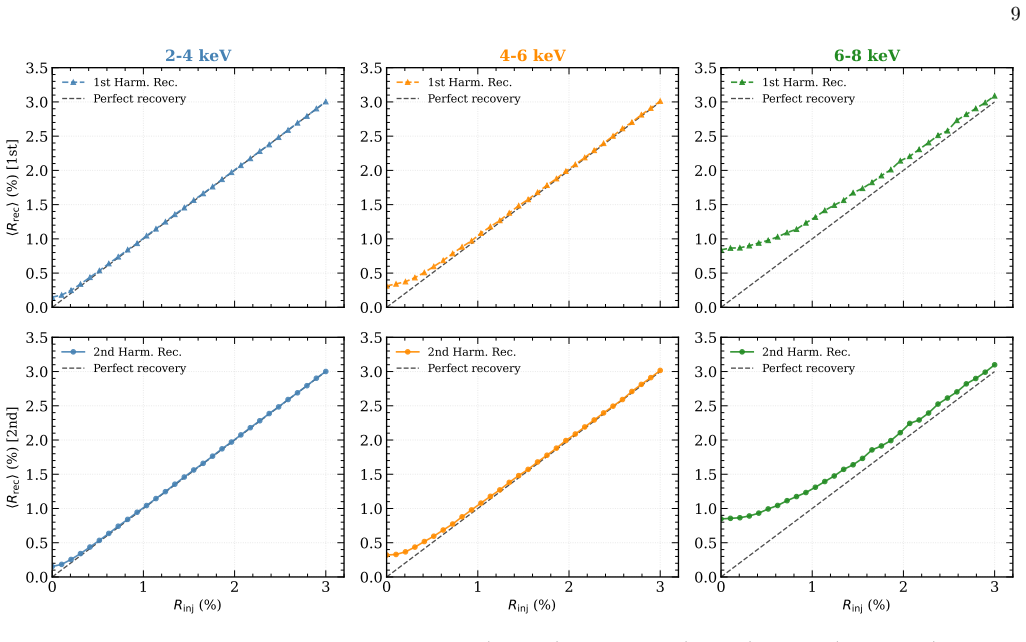
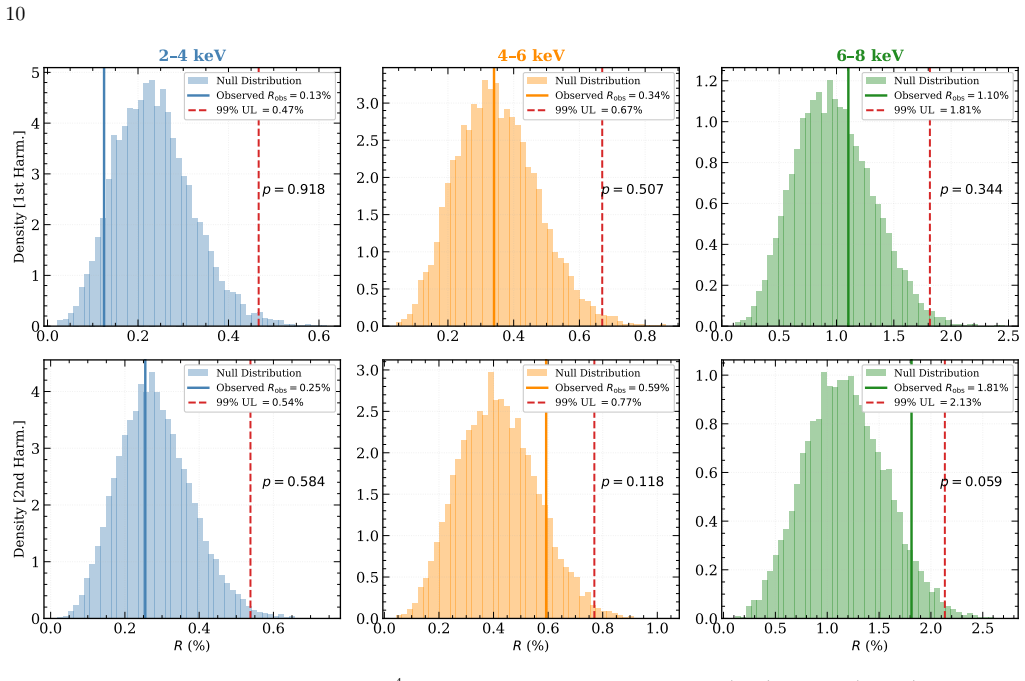
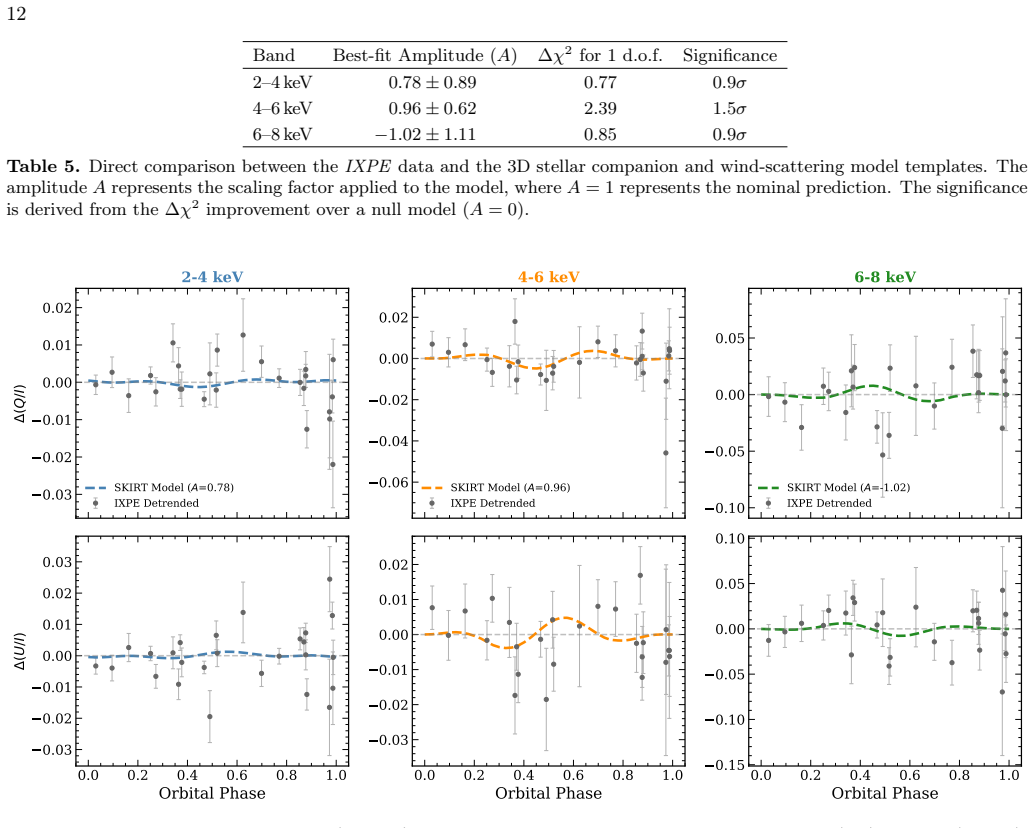
After removing the spectral hardness trend, neither approach reveals statistically significant orbital modulation: permutation tests yield p > 0.01 in all bands, with 99% confidence upper limits of 0.47%, 0.67%, and 1.81% on the P_orb amplitude and 0.54%, 0.77%, and 2.13% on the P_orb/2 amplitude in the 2-4 keV, 4-6 keV, and 6-8 keV bands, respectively. The best-fit stellar companion and wind-scattering amplitude scaling factors in the three bands of A = 0.78±0.89, 0.96±0.62, and −1.02±1.11 are consistent with a null result. These non-detections are sensitivity-limited, as the predicted stellar companion and wind-scattering RMS amplitudes in the three bands of ≈0.10%, ≈0.33%, and ≈0.49% are
What carries the argument
Simultaneous harmonic regression that decouples linear correlations of normalized Stokes parameters with spectral hardness ratio, together with direct fitting of 3D Monte Carlo radiative-transfer templates for stellar-companion and wind scattering.
If this is right
- Additional exposure is required to reach the predicted signal amplitudes of roughly 0.1–0.5% RMS.
- Once the predicted modulation is detected, its energy dependence can constrain the density and geometry of the focused stellar wind.
- The same regression-plus-template approach can be applied to other black-hole X-ray binaries observed by IXPE.
- Current data already exclude modulation amplitudes larger than the stated percentages at 99% confidence in each band.
Where Pith is reading between the lines
- If the linear hardness correlation persists in future data, the same correction technique will remain essential for isolating orbital signals.
- The limits provide a quantitative benchmark for the exposure needed to test wind-scattering predictions in high-mass X-ray binaries generally.
- A non-detection at current sensitivity leaves open whether the actual scattering amplitudes are smaller than modeled or simply remain below the noise floor.
- Extending the analysis to include phase-resolved spectral fitting could further tighten constraints on wind parameters even before modulation is detected.
Load-bearing premise
The normalized Stokes parameters correlate linearly with the spectral hardness ratio in all three energy bands, allowing the regression to fully separate spectral variability from any orbital modulation signal.
What would settle it
Detection of P_orb or P_orb/2 polarization amplitude above the reported 99% upper limits (for example, >0.47% in the 2-4 keV band) at p < 0.01 in new or reprocessed IXPE data would falsify the non-detection result.
Figures
read the original abstract
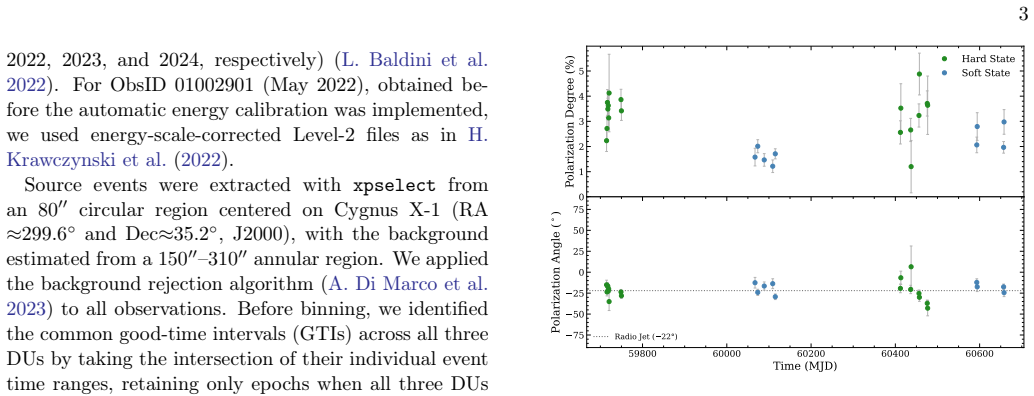
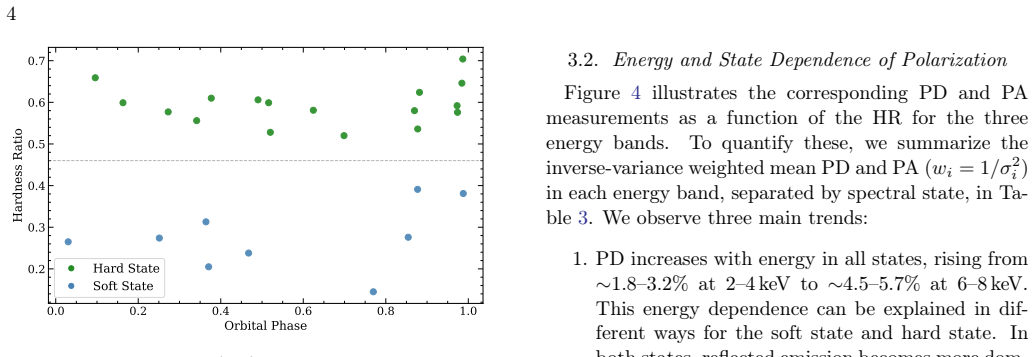
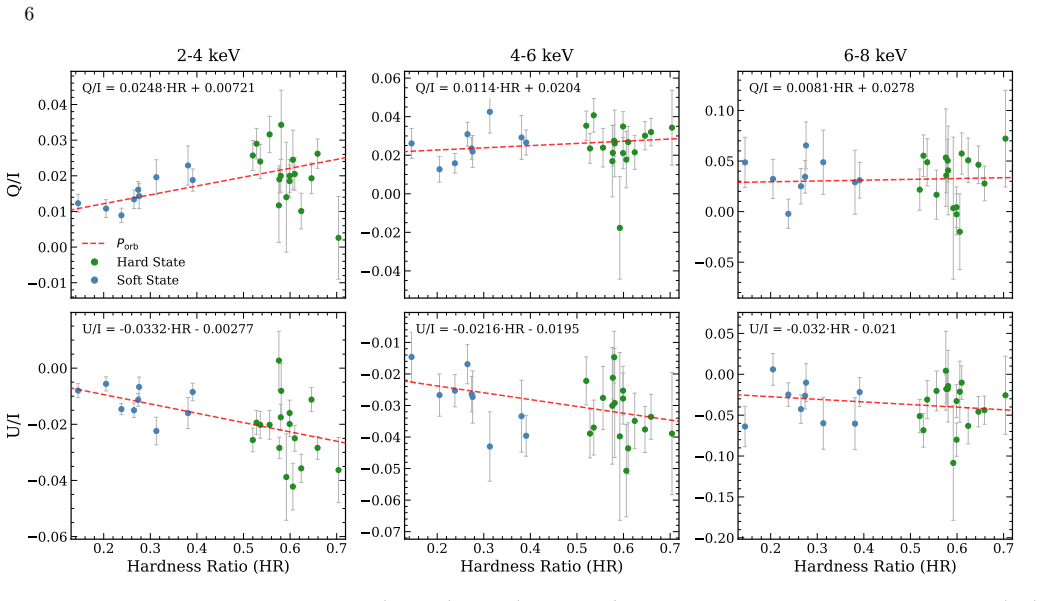
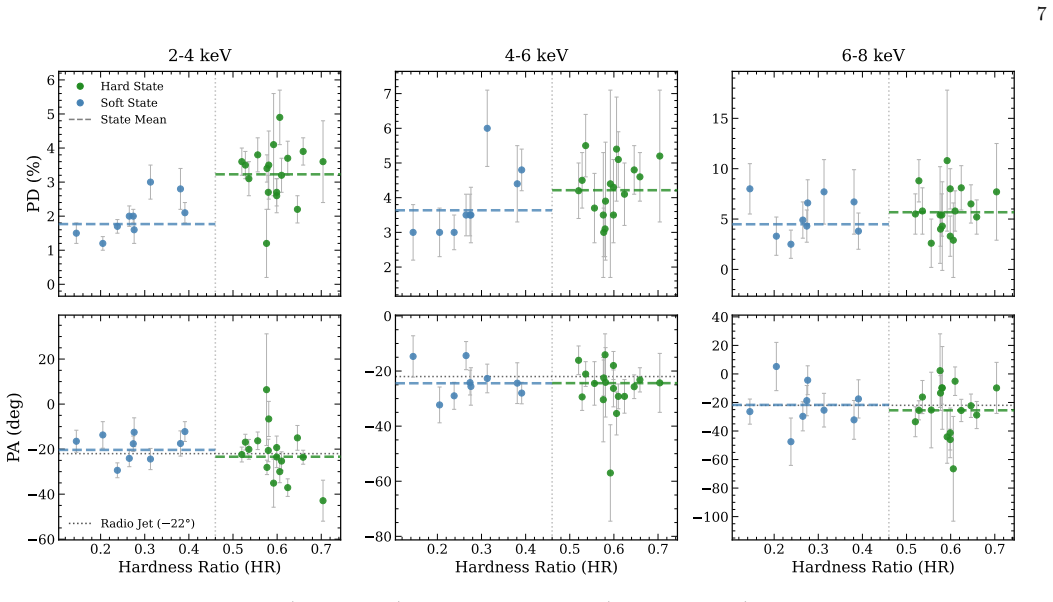
Reflection off the companion star and its focused stellar wind is predicted to modulate the X-ray polarization of black hole X-ray binaries at half the orbital period ($P_{\rm orb}/2$), with an energy-dependent amplitude. We test this prediction against all publicly available IXPE observations of Cygnus X-1, comprising 26 one-day bins from 12 observation IDs spanning 2022-2024. Since the normalized Stokes parameters correlate linearly with the spectral hardness ratio in all three energy bands (2-4, 4-6, and 6-8 keV), we employ a simultaneous harmonic regression that decouples spectral variability from orbital modulation at both $P_{\rm orb}/2$ and $P_{\rm orb}$, complemented by direct fitting of 3D Monte Carlo radiative transfer stellar companion and wind-scattering templates. After removing the spectral hardness trend, neither approach reveals statistically significant orbital modulation: permutation tests yield $p > 0.01$ in all bands, with 99% confidence upper limits of 0.47%, 0.67%, and 1.81% on the $P_{\rm orb}$ amplitude and 0.54%, 0.77%, and 2.13% on the $P_{\rm orb}/2$ amplitude in the 2-4 keV, 4-6 keV, and 6-8 keV bands, respectively. The best-fit stellar companion and wind-scattering amplitude scaling factors in the three bands of $A = $ 0.78$\pm$0.89, 0.96$\pm$0.62, and $-$1.02$\pm$1.11 are consistent with a null result. These non-detections are sensitivity-limited, as the predicted stellar companion and wind-scattering RMS amplitudes in the three bands of $\approx$0.10%, $\approx$0.33%, and $\approx$0.49% are at or below the statistical noise floor of $\sim$0.15%, $\sim$0.31%, and $\sim$0.84%. We quantify the additional exposure required to detect the predicted signal and constrain the wind physics.
Editorial analysis
A structured set of objections, weighed in public.
Referee Report
Summary. The paper analyzes all publicly available IXPE observations of Cygnus X-1 (26 one-day bins from 12 observation IDs, 2022-2024) to test predictions of orbital X-ray polarization modulation at P_orb/2 (and P_orb) arising from reflection off the companion star and focused stellar wind. After noting linear correlations between normalized Stokes parameters and spectral hardness ratio in the 2-4, 4-6, and 6-8 keV bands, the authors apply simultaneous harmonic regression to decouple spectral variability from orbital signals, supplemented by direct fits of 3D Monte Carlo radiative-transfer templates for stellar-companion and wind-scattering contributions. Permutation tests yield p > 0.01 in all bands, producing 99% upper limits of 0.47%/0.54%, 0.67%/0.77%, and 1.81%/2.13% on the P_orb and P_orb/2 amplitudes, respectively; the fitted scaling factors A are consistent with zero. The non-detections are attributed to sensitivity limits, and the additional exposure needed to reach the predicted RMS amplitudes (~0.10-0.49%) is quantified.
Significance. If the result holds, the work supplies the first energy-resolved observational upper limits on the predicted orbital polarization modulation in a canonical black-hole X-ray binary, demonstrating that current IXPE data are sensitivity-limited rather than in tension with the stellar-wind reflection model. The combination of permutation tests on hardness-detrended data and external Monte Carlo template fitting provides a reproducible, non-circular statistical framework. Quantifying the exposure required to detect the signal offers concrete guidance for future observations and for constraining wind clumping or geometry parameters.
major comments (1)
- [section introducing the simultaneous harmonic regression] The central analysis rests on the premise that normalized Stokes parameters correlate linearly with the hardness ratio in each band, allowing the simultaneous harmonic regression to fully remove spectral variability before periodicity testing. While the abstract states that the correlation exists, the manuscript does not appear to report the correlation coefficients, residual scatter after the linear fit, or any diagnostic plots; without these, it is difficult to judge whether the detrending is complete or whether unmodeled non-linear residuals could bias the p-values or upper limits.
minor comments (2)
- The 26 one-day bins are drawn from 12 observation IDs; a table listing the ObsIDs, exposure times, and mean hardness ratios per bin would improve reproducibility and allow readers to assess any post-selection effects.
- The reported scaling factors A = 0.78±0.89, 0.96±0.62, -1.02±1.11 are stated to be consistent with a null result, but the text does not explicitly compare their uncertainties to the predicted RMS amplitudes (~0.10%, 0.33%, 0.49%) to illustrate the sensitivity floor.
Simulated Author's Rebuttal
We thank the referee for the positive evaluation and constructive feedback. We address the single major comment below.
read point-by-point responses
-
Referee: [section introducing the simultaneous harmonic regression] The central analysis rests on the premise that normalized Stokes parameters correlate linearly with the hardness ratio in each band, allowing the simultaneous harmonic regression to fully remove spectral variability before periodicity testing. While the abstract states that the correlation exists, the manuscript does not appear to report the correlation coefficients, residual scatter after the linear fit, or any diagnostic plots; without these, it is difficult to judge whether the detrending is complete or whether unmodeled non-linear residuals could bias the p-values or upper limits.
Authors: We agree that the manuscript would be strengthened by explicitly reporting the correlation coefficients, residual statistics, and diagnostic information to allow readers to evaluate the linearity assumption and completeness of the detrending. In the revised version we will add these details (Pearson r values per band, residual RMS after the linear fit, and a supplementary figure showing the data, fits, and residuals) in the section describing the simultaneous harmonic regression. This addition will confirm that any residual non-linearity is negligible relative to the statistical uncertainties and does not affect the reported p-values or upper limits. revision: yes
Circularity Check
No significant circularity identified
full rationale
The paper's central result is a null detection of orbital polarization modulation after applying an empirical linear detrending of normalized Stokes parameters against observed spectral hardness ratio, followed by permutation tests and external Monte Carlo template fits to derive upper limits. The linearity relation is presented as a data-driven observation used to justify the regression step, not as a definitional premise that forces the outcome. The fitted scaling factors A are reported as results (consistent with zero) rather than inputs that define the claimed limits by construction. No self-citations, uniqueness theorems, or ansatzes from prior author work are invoked as load-bearing elements in the provided text. The statistical procedure is externally falsifiable via the permutation tests and remains independent of the target null result.
Axiom & Free-Parameter Ledger
free parameters (1)
- amplitude scaling factor A =
0.78±0.89 (2-4 keV), 0.96±0.62 (4-6 keV), -1.02±1.11 (6-8 keV)
axioms (1)
- domain assumption Normalized Stokes parameters correlate linearly with spectral hardness ratio in each energy band
Reference graph
Works this paper leans on
-
[1]
2024, A&A, 688, A220, doi: 10.1051/0004-6361/202450131 Astropy Collaboration, Robitaille, T
Ahlberg, V., Kravtsov, V., & Poutanen, J. 2024, A&A, 688, A220, doi: 10.1051/0004-6361/202450131 Astropy Collaboration, Robitaille, T. P., Tollerud, E. J., et al. 2013, A&A, 558, A33, doi: 10.1051/0004-6361/201322068 Astropy Collaboration, Price-Whelan, A. M., Sipőcz, B. M., et al. 2018, AJ, 156, 123, doi: 10.3847/1538-3881/aabc4f Astropy Collaboration, P...
-
[2]
Baldini, L., Bucciantini, N., Lalla, N. D., et al. 2022, SoftwareX, 19, 101194, doi: https://doi.org/10.1016/j.softx.2022.101194
-
[3]
2024, in Recent Progress on Gravity Tests: Challenges and Future Perspectives, ed
Bambi, C. 2024, in Recent Progress on Gravity Tests: Challenges and Future Perspectives, ed. C. Bambi & A. Cárdenas-Avendaño (Singapore: Springer Nature Singapore), 149–182, doi: 10.1007/978-981-97-2871-8_5 Bałucińska-Church, M., Church, M. J., Charles, P. A., et al. 2000, Monthly Notices of the Royal Astronomical Society, 311, 861, doi: 10.1046/j.1365-87...
-
[4]
An Improved Orbital Ephemeris for Cygnus X-1
Brocksopp, C., Tarasov, A. E., Lyuty, V. M., & Roche, P. 1999, A&A, 343, 861, doi: 10.48550/arXiv.astro-ph/9812077
work page internal anchor Pith review Pith/arXiv arXiv doi:10.48550/arxiv.astro-ph/9812077 1999
-
[5]
C., McLean, I
Brown, J. C., McLean, I. S., & Emslie, A. G. 1978, A&A, 68, 415
1978
-
[6]
2020, Astronomy and Computing, 31, 100381, doi: 10.1016/j.ascom.2020.100381
Camps, P., & Baes, M. 2020, Astronomy and Computing, 31, 100381, doi: 10.1016/j.ascom.2020.100381
-
[7]
Clarke, D., Stewart, B. G., Schwarz, H. E., & Brooks, A. 1983, A&A, 126, 260 Di Marco, A., Soffitta, P., Costa, E., et al. 2023, The Astronomical Journal, 165, 143, doi: 10.3847/1538-3881/acba0f
-
[8]
2011, International Journal of Modern Physics D, 20, 2755, doi: 10.1142/S0218271811020779
Done, C. 2011, International Journal of Modern Physics D, 20, 2755, doi: 10.1142/S0218271811020779
-
[9]
Done, C., Gierliński, M., & Kubota, A. 2007, A&A Rv, 15, 1, doi: 10.1007/s00159-007-0006-1 Dovčiak, M., Muleri, F., Goosmann, R. W., Karas, V., &
-
[10]
Matt, G. 2011, The Astrophysical Journal, 731, 75, doi: 10.1088/0004-637X/731/1/75 Dovčiak, M., Podgorný, J., Svoboda, J., et al. 2024, Galaxies, 12, doi: 10.3390/galaxies12050054
-
[11]
Gies, D. R., & Bolton, C. T. 1986a, ApJ, 304, 371, doi: 10.1086/164171
-
[12]
Gies, D. R., & Bolton, C. T. 1986b, ApJ, 304, 389, doi: 10.1086/164172
-
[13]
Good, P. I. 2005, Permutation, Parametric, and Bootstrap Tests of Hypotheses, 3rd edn. (New York, NY: Springer Science & Business Media)
2005
-
[14]
2013, A&A, 554, A88, doi: 10.1051/0004-6361/201321128 15
Grinberg, V., Hell, N., Pottschmidt, K., et al. 2013, A&A, 554, A88, doi: 10.1051/0004-6361/201321128 15
-
[15]
Hanke, M., Wilms, J., Nowak, M. A., et al. 2009, The Astrophysical Journal, 690, 330, doi: 10.1088/0004-637X/690/1/330
-
[16]
R., et al., 2020, @doi [Nature] 10.1038/s41586-020-2649-2 , 585, 357
Harris, C. R., Millman, K. J., van der Walt, S. J., et al. 2020, Nature, 585, 357, doi: 10.1038/s41586-020-2649-2
-
[17]
Hunter, J. D. 2007, Computing in Science & Engineering, 9, 90, doi: 10.1109/MCSE.2007.55
-
[18]
2024, Monthly Notices of the Royal Astronomical Society, 527, 10837, doi: 10.1093/mnras/stad3961
Jana, A., & Chang, H.-K. 2024, Monthly Notices of the Royal Astronomical Society, 527, 10837, doi: 10.1093/mnras/stad3961
-
[19]
2015, Astroparticle Physics, 68, 45, doi: https://doi.org/10.1016/j.astropartphys.2015.02.007
Kislat, F., Clark, B., Beilicke, M., & Krawczynski, H. 2015, Astroparticle Physics, 68, 45, doi: https://doi.org/10.1016/j.astropartphys.2015.02.007
-
[20]
Kravtsov, V., Berdyugin, A. V., Piirola, V., et al. 2020, A&A, 643, A170, doi: 10.1051/0004-6361/202038745
-
[21]
2025, Astronomy & Astrophysics, 701, A115, doi: 10.1051/0004-6361/202555411
Kravtsov, V., Bocharova, A., Veledina, A., et al. 2025, Astronomy & Astrophysics, 701, A115, doi: 10.1051/0004-6361/202555411
-
[22]
2012, ApJ, 754, 133, doi: 10.1088/0004-637X/754/2/133
Krawczynski, H. 2012, ApJ, 754, 133, doi: 10.1088/0004-637X/754/2/133
-
[23]
2022, ApJ, 934, 4, doi: 10.3847/1538-4357/ac7725
Krawczynski, H., & Beheshtipour, B. 2022, ApJ, 934, 4, doi: 10.3847/1538-4357/ac7725
-
[24]
2022, Science, 378, 650, doi: 10.1126/science.add5399
Krawczynski, H., Muleri, F., Dovčiak, M., et al. 2022, Science, 378, 650, doi: 10.1126/science.add5399
-
[25]
Leahy, D. A. 1987, A&A, 180, 275
1987
-
[26]
Lomb, N. R. 1976, Ap&SS, 39, 447, doi: 10.1007/BF00648343
-
[27]
2026, MNRAS, 545, staf1933, doi: 10.1093/mnras/staf1933
Majumder, S., Kushwaha, A., Singh, S., et al. 2026, MNRAS, 545, staf1933, doi: 10.1093/mnras/staf1933
-
[28]
Miller-Jones, J. C. A., Bahramian, A., Orosz, J. A., et al. 2021, Science, 371, 1046, doi: 10.1126/science.abb3363 Miškovičová, I., Hell, N., Hanke, M., et al. 2016, A&A, 590, A114, doi: 10.1051/0004-6361/201322490
-
[29]
2005, Science, 307, 77, doi: 10.1126/science.1105746 O’brien, R
Narayan, R., & Quataert, E. 2005, Science, 307, 77, doi: 10.1126/science.1105746 O’brien, R. M. 2007, Quality & Quantity, 41, 673, doi: 10.1007/s11135-006-9018-6
-
[30]
Poutanen, J., Zdziarski, A. A., & Ibragimov, A. 2008, Monthly Notices of the Royal Astronomical Society, 389, 1427, doi: 10.1111/j.1365-2966.2008.13666.x
-
[31]
Reynolds, C. S. 2021, ARA&A, 59, 117, doi: 10.1146/annurev-astro-112420-035022
-
[32]
Scargle, J. D. 1982, ApJ, 263, 835, doi: 10.1086/160554
-
[33]
Schnittman, J. D., & Krolik, J. H. 2009, The Astrophysical Journal, 701, 1175, doi: 10.1088/0004-637X/701/2/1175
-
[34]
Schnittman, J. D., & Krolik, J. H. 2010, ApJ, 712, 908, doi: 10.1088/0004-637X/712/2/908
-
[35]
Steiner, J. F., Nathan, E., Hu, K., et al. 2024, The Astrophysical Journal Letters, 969, L30, doi: 10.3847/2041-8213/ad58e4 Vander Meulen, B., Camps, P., Savić, Ð., et al. 2024, A&A, 689, A297, doi: 10.1051/0004-6361/202450773 Vander Meulen, B., Camps, P., Stalevski, M., & Baes, M. 2023, A&A, 674, A123, doi: 10.1051/0004-6361/202245783 Vander Meulen, B., ...
-
[36]
doi:10.1038/s41592-019-0686-2 , eprint =
Virtanen, P., Gommers, R., Oliphant, T. E., et al. 2020, Nature Methods, 17, 261, doi: 10.1038/s41592-019-0686-2
-
[37]
Weisskopf, M. C., Silver, E. H., Kestenbaum, H. L., Long, K. S., & Novick, R. 1978, ApJL, 220, L117, doi: 10.1086/182648
-
[38]
C., Soffitta, P., Baldini, L., et al
Weisskopf, M. C., Soffitta, P., Baldini, L., et al. 2022, Journal of Astronomical Telescopes, Instruments, and Systems, 8, 026002, doi: 10.1117/1.JATIS.8.2.026002
-
[39]
2022, MNRAS, 515, 2882, doi: 10.1093/mnras/stac1937
Zhang, W., Dovčiak, M., Bursa, M., et al. 2022, MNRAS, 515, 2882, doi: 10.1093/mnras/stac1937
discussion (0)
Sign in with ORCID, Apple, or X to comment. Anyone can read and Pith papers without signing in.