REVIEW 4 major objections 5 minor 1 cited by
Split Learning in Computer Vision for Semantic Segmentation Delay Minimization
T0 review · 4 major / 5 minor · reviewed 2026-08-11 · deepseek-v4-flash
Pith's one-line read The paper proposes split learning for semantic segmentation, optimizing the cut layer, bandwidth, and server compute together to minimize worst-case inference delay, with low-complexity heuristics that stay near-optimal.
desk verdict A competent, CV-specific split-learning resource allocation paper whose main flaws are an unjustified 'optimal' label on the joint optimization and a numerical evaluation built on the same delay model it optimizes. read the letter →
The pith
A machine-rendered reading of the paper's core claim, the machinery that carries it, and where it could break.
The reading
What carries the argument
The central object is the bottleneck module (BM), a two-branch block of convolution and pooling layers whose outputs are added, which forms the atomic unit that cannot be split internally. The delay formula $J_{k,l}$ (transmission plus local computation plus server computation for device $k$ cut at module $l$) carries the argument, since every optimization is built on minimizing its maximum. The solution machinery is alternating optimization that decomposes the non-convex problem into a convex resource-allocation subproblem and a low-cost cut-layer search; for fixed bandwidth, Lemma 1 reduces the resource allocation to finding one root of a monotone function, and for the queue case Lemma 2 justifies the heuristic that moves bandwidth from the first break to the last break of the server queue.
What would settle it
Run ENet on a 1024x2048 image with an actual edge device and central server, split at every bottleneck module, and compare the measured end-to-end delay to $J_{k,l}$ in Eq. (2) using the paper's parameters; if the fastest measured cut layer differs from the layer that minimizes the model, the missing term (overlap, loading, or protocol overhead) invalidates the optimization.
Extended reading notes
Core claim
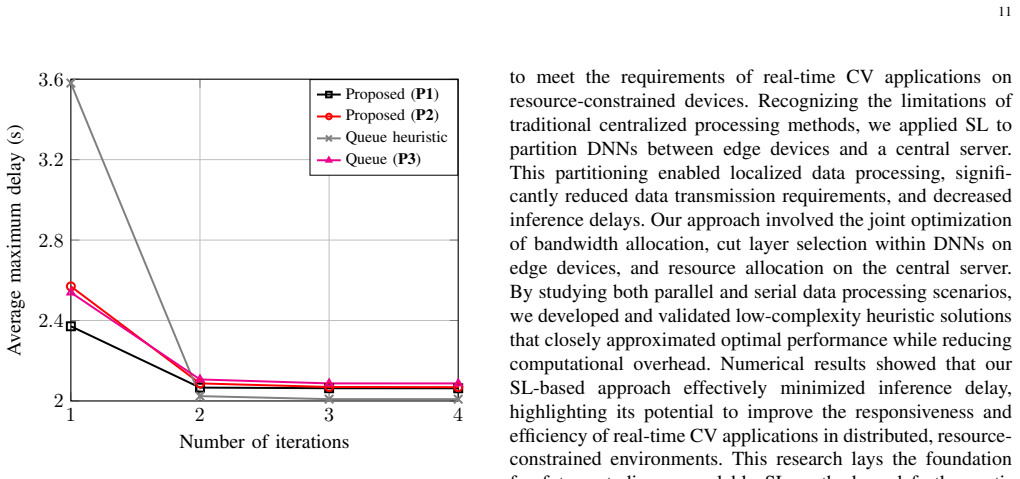
The discovery is a slicing policy for semantic segmentation CNNs that respects their bottleneck-module structure: a device can split its DNN only at the boundary of a bottleneck module, and when it splits before the upsampling part it must also transmit the MaxPooling indices needed for unpooling. For this setting the paper formulates the inference delay minimization as a min-max problem over binary cut-layer variables, per-device bandwidth, and server processing shares, and shows it can be solved by alternating optimization as a convex problem plus a simple binary search. In the parallel-processing case, fixing the bandwidth yields a closed-form resource allocation via inference-time equality among devices, with Lemma 1 guaranteeing a feasible root. In the serial-processing case, the paper characterizes the server queue by its breaks and proves (Lemma 2) that reallocating bandwidth from the first break to the last break strictly reduces total delay. Numerical results with ENet on 1024x2048 images show the proposed policies reduce average maximum delay compared to no-split and min-data baselines across device counts, transmit power, bandwidth, and server resources.
Load-bearing premise
The entire optimization assumes that total inference delay equals local compute time plus transmission time plus server compute time, with no overlap, no fixed model-loading or memory overhead, and no queueing effects beyond the FIFO model; if real systems have such overheads, the predicted best split point may not be the fastest one.
Editorial extensions
If this is right
- Under the paper's delay model, the optimal split point is not the module that minimizes transmitted data once server-side contention is significant.
- The fixed-bandwidth scheme (P2) matches the full optimization's delay with far lower complexity, O(2K) versus O((2K)^3.5).
- For a small number of devices, the serial queue heuristic gives the lowest delay because it dedicates full server capacity per device; for larger K, parallel processing wins.
- Always transmitting raw pixels or always running the whole model on the device, represented by the first-layer policies, yields the highest delays in the numerical study.
Reading between the lines
- The same bottleneck-module slicing model could be applied to other dense prediction tasks such as depth estimation or optical flow, where encoder-decoder architectures also have downsampling and upsampling BMs with index data.
- Because the privacy argument for index data is incidental, a natural testable extension is whether an adversary given the intermediate tensor but not the indices can reconstruct the input; if not, the policy adds a free confidentiality layer.
- The queue-break analysis suggests a more general scheduling principle: in a fixed-order FIFO server, shifting bandwidth from early arrivals to late arrivals can eliminate idle gaps, which could be ported to multi-stage inference pipelines beyond segmentation.
Signed reviews
Editorial analysis
A structured set of objections, weighed in public.
Referee Report
Summary. The paper proposes split learning (SL) for delay minimization in semantic segmentation inference over wireless edge networks. It models a CNN as a sequence of bottleneck modules (BMs), allows each device to choose a cut layer, and jointly optimizes bandwidth allocation, cut-layer selection, and server processing resource allocation. Two server processing scenarios are considered: parallel processing (P1, P2) and serial processing with a queue (P3 plus a heuristic, Algorithm 1). The authors derive closed-form resource allocation conditions for the fixed-bandwidth parallel case (Lemma 1), a queue-bandwidth reallocation heuristic justified by Lemma 2, and compare all schemes via Monte Carlo simulations under Rayleigh fading. The central claim is that the proposed SL-based policies reduce inference delay relative to no-split (first-layer) and min-data baselines under the stated delay model.
Significance. If the technical derivations were complete and the optimality claims properly supported, the paper would contribute a useful resource-allocation framework for a practically relevant problem: split inference for semantic segmentation at the edge. The paper's strengths include a detailed workload model for CNN BMs with FLOPS formulas (Tables I and II), explicit treatment of the extra unpooling-index data in semantic segmentation (Section III), and a complexity comparison of all proposed schemes (Table III). It also provides a closed-form solution structure for the fixed-bandwidth parallel problem via Lemma 1. However, the significance is currently diminished by three load-bearing issues: the 'optimal' label on P1 is not justified, the P3 layer-selection step is not derived, and the lemma supporting the serial heuristic has proof gaps. The numerical evaluation is entirely model-based, so the paper's empirical claims are demonstrations rather than independent validations.
major comments (4)
- [Section IV-A and Section V] The paper labels P1 as 'the optimal policy' in Section V and uses it as the benchmark against all other schemes, but the alternating optimization described in Section IV-A has no global-optimality proof. P1 is a nonconvex mixed-integer problem; the proposed method is block coordinate descent that alternates between a convex resource-allocation step and a greedy binary layer-selection step. The text states that 'repeating this process until the iterative procedure converges yields a solution to the original general problem,' but no stationarity condition, fixed-point characterization, or convergence-to-a-global-optimum argument is provided. Consequently, the claim that P2 'achieves the same performance as P1' is only a claim about a particular algorithmic fixed point, not about the true minimum of P1. I recommend either proving global optimality under the problem's structure or, more realistically, weakening the 'optimal' terminology throughout and validating against exhaustive search or a lower bound for small K.
- [Section IV-B1] The solution method for P3 is not actually derived. The text says that 'using alternating optimization between ak,l, Bk, we can derive an optimal solution to (P3) by iteratively solving a convex optimization problem and searching for the l∗-th layer that minimizes all sequences Ck,l∗, ∀k ∈ K.' This step is not a correct decomposition of P3: the objective contains max_k sum_l ak,l Ck,l plus sum_k sum_l ak,l Fk,l/fmax, and the second term couples the layer choices of different devices through the sum of server workloads. There is no reason a common l∗ minimizes all Ck,l simultaneously, and even if one existed, it would not account for the Fk,l coupling. For fixed Bk, the binary subproblem is therefore not separable in the way described. This is load-bearing because the 'Queue (P3)' curves in the numerical section are obtained from a procedure that has not been specified precisely. Please provide a full derivation of the binary layer-selection step, or explicitly state that P3 is solved by a heuristic and describe its actual implementation.
- [Appendix A / Lemma 2] Lemma 2 and its proof have gaps that matter for Algorithm 1's theoretical basis. First, the lemma assumes M ≥ 3 but does not state the additional implicit condition max{M} < K, even though the proof uses the device at position max{M}+1 when defining the M2 and M3 configurations. Second, the chain of equalities in (15) is not justified: after removing min{M} and max{M} and adding min{M}−1, the last break of M1 is not necessarily at max{M}−1, and the equality I_{max{M}−1} = C_{max{M1}} is not established. Since Algorithm 1's delay-reduction argument relies directly on Lemma 2, the proof needs to be corrected or the lemma restated with the missing hypotheses. If the lemma cannot be repaired, the heuristic should be presented as purely empirical.
- [Section III, Eq. (2), and Section V] The numerical results evaluate the same additive delay model (local compute + transmission + server compute) that the optimization problems are designed to minimize. The paper does not include any measurement, trace, or independent simulator to validate Eq. (2) against real semantic-segmentation inference. As a result, the statement in the abstract and conclusions that SL 'effectively reduces inference delay' is at present a self-consistency check rather than an empirical finding. I recommend adding an explicit statement that all results are computed under the analytical model of Eq. (2), and ideally a sensitivity analysis with respect to fixed overheads, model-loading time, and possible overlap between computation and communication, so that the reader can judge the robustness of the proposed policies.
minor comments (5)
- [Section IV, P1 constraint C3] The constraint C3 in P1 is written as 'sum_l ak,l = 1, ∀l ∈ {1,...,L}' but the universal quantifier should be over k (devices), not l. The same typo appears in P2 and P3.
- [Section IV-C] In the complexity analysis, the text says 'identify the minimum of each Ck,l, ∀ ∈ {1, · · ·, L}' where the index k is missing from the universal quantifier.
- [Section II] There is a typo 'downsmapling' in the description of downsampling/upsampling; it should be 'downsampling'.
- [Section V, Fig. 6 discussion] The sentence 'the former uses optimal bandwidth allocation but not optimal resource allocation at the server' appears to conflate P1 and P2: P1 optimizes both bandwidth and server resources, while P2 fixes bandwidth. Please clarify which policy is meant and why the server-resource allocation is said to be suboptimal.
- [Section V, Fig. 8 discussion] The text refers to 'shared learning policies' in the discussion of Fig. 8; this should be 'split learning policies.'
Circularity Check
No significant circularity: the delay model in Eq. (2) is an explicit modeling assumption, P1-P3 genuinely minimize that objective, and the only self-citation (Ref. [9]) is non-load-bearing introduction background; within-model evaluation is a validation limitation, not a circular step.
full rationale
The paper's derivation chain is self-contained. The inference-delay model is stated directly in Eq. (2) as the sum of local compute, transmission (including the unpooling index data tau_k,l), and server compute, and the optimization problems P1-P3 minimize that explicit objective; no parameter is fitted to data and then renamed as a prediction. The split-layer selection genuinely searches the binary variables a_k,l over L=30 bottleneck-module positions per device, and the numerical conclusions are parameter-dependent rather than forced: Fig. 4 reports that the optimal layer coincides with the minimum-data layer for small K and shifts away as K grows, and Fig. 7 reports a regime where immediate transmission is optimal, behavior that would be impossible if the 'SL reduces delay' claim were hard-wired into the model. The convex resource-allocation step and the binary layer-selection step are solved by standard arguments, and Lemma 1's feasibility/uniqueness proof and Lemma 2's queue-ordering proof are given in the paper rather than imported. The only self-citation (Ref. [9], same research group, cited for the general definition of split learning in the introduction) is background and is not load-bearing for any equation, algorithm, or benchmark. Two concerns remain, both belonging to correctness risk rather than circularity: (i) the numerical 'demonstration' that SL reduces delay evaluates the proposed policies under the same additive delay model that the algorithms optimize, so the reported improvement is a within-model optimization gap and not an external measurement; and (ii) P1 is solved by alternating optimization with no global-optimality or stationarity proof, so labeling P1 'the optimal policy' in Section V overstates what the algorithm guarantees. Neither concern exhibits a specific reduction of a derived result to its own inputs. Score 2 reflects only the presence of the minor, non-load-bearing self-citation.
Assumptions & free parameters
free parameters (2)
- Simulation parameter set (Table IV) =
D_{k,1}=192 Mbit, Btot=200 MHz, fk=30 GFLOPS, fmax=300 GFLOPS, Pk=1 W, d=50 m, n=2.4, K=10, L=30
- Per-BM ENet workloads and output sizes (W_{k,l}, D_{k,l}, tau_{k,l}) =
not provided
assumptions (7)
- standard math Shannon capacity rate with no protocol overhead or retransmission.
- domain assumption Total delay equals local compute plus transmission plus server compute, with no overlap and no memory or model-loading overhead.
- domain assumption The central server holds all device DNN instances and can resume processing from any bottleneck module.
- domain assumption Cut points are restricted to bottleneck-module boundaries because BMs cannot be split internally.
- ad hoc to paper Alternating optimization reaches the global optimum of P1 despite binary variables and nonconvexity.
- ad hoc to paper P3 layer selection is solved by searching for a common l* that minimizes all C_{k,l*} sequences, which ignores coupling through the sum of server workloads F_{k,l}/fmax.
- ad hoc to paper Lemma 2 requires the last break not to occur at the final device, meaning max{M} < K.
Cite this review
Pith. "Pith review of Split Learning in Computer Vision for Semantic Segmentation Delay Minimization." pith.science (2026). https://pith.science/paper/XKINH4HU
@misc{pith2026241214272,
  author       = {Pith},
  title        = {Pith review of: Split Learning in Computer Vision for Semantic Segmentation Delay Minimization},
  year         = {2026},
  howpublished = {\url{https://pith.science/paper/XKINH4HU}},
  note         = {Machine review of arXiv:2412.14272}
}
read the original abstract
In this paper, we propose a novel approach to minimize the inference delay in semantic segmentation using split learning (SL), tailored to the needs of real-time computer vision (CV) applications for resource-constrained devices. Semantic segmentation is essential for applications such as autonomous vehicles and smart city infrastructure, but faces significant latency challenges due to high computational and communication loads. Traditional centralized processing methods are inefficient for such scenarios, often resulting in unacceptable inference delays. SL offers a promising alternative by partitioning deep neural networks (DNNs) between edge devices and a central server, enabling localized data processing and reducing the amount of data required for transmission. Our contribution includes the joint optimization of bandwidth allocation, cut layer selection of the edge devices' DNN, and the central server's processing resource allocation. We investigate both parallel and serial data processing scenarios and propose low-complexity heuristic solutions that maintain near-optimal performance while reducing computational requirements. Numerical results show that our approach effectively reduces inference delay, demonstrating the potential of SL for improving real-time CV applications in dynamic, resource-constrained environments.
Figures


Figures from the paper (5 more)


Forward citations
Cited by 1 Pith paper
-
Learning Obfuscations Of LLM Embedding Sequences: Stained Glass Transform
A learned stochastic embedding obfuscator, the Stained Glass Transform, is claimed to reduce mutual information between prompts and their server-side representations while preserving LLM utility.
Reference graph
Works this paper leans on
-
[27]
A bargaining game for personalized, energy efficient split learning over wireless networks,
M. Kim, A. DeRieux, and W. Saad, “A bargaining game for personalized, energy efficient split learning over wireless networks,” in Proc. IEEE Wireless Communications and Networking Conference (WCNC) , 2023, pp. 1–6
work page 2023
-
[29]
Split learning over wireless networks: Parallel design and resource management,
W. Wu, M. Li, K. Qu, C. Zhou, X. Shen, W. Zhuang, X. Li, and W. Shi, “Split learning over wireless networks: Parallel design and resource management,” IEEE J. Sel. Areas Commun. , vol. 41, no. 4, pp. 1051– 1066, 2023
2023
-
[1]
Computer vision in the metaverse,
K. G. Nalbant and S ¸. Uyanık, “Computer vision in the metaverse,” Journal of Metaverse , vol. 1, no. 1, pp. 9–12, 2021
work page 2021
-
[2]
Real-time semantic segmen- tation: A brief survey and comparative study in remote sensing,
C. Broni-Bediako, J. Xia, and N. Yokoya, “Real-time semantic segmen- tation: A brief survey and comparative study in remote sensing,” IEEE Geosci. Remote Sens. Mag. , 2023
work page 2023
-
[3]
U-Net: Convolutional net- works for biomedical image segmentation,
O. Ronneberger, P. Fischer, and T. Brox, “U-Net: Convolutional net- works for biomedical image segmentation,” in Proc. Medical Image Computing and Computer-Assisted Intervention (MICCAI) , 2015, pp. 234–241
work page 2015
-
[4]
ENet: A deep neural network architecture for real-time semantic segmentation,
A. Paszke, A. Chaurasia, S. Kim, and E. Culurciello, “ENet: A deep neural network architecture for real-time semantic segmentation,” 2016. [Online]. Available: https://arxiv.org/abs/1606.02147
arXiv 2016
-
[5]
L.-C. Chen, G. Papandreou, I. Kokkinos, K. Murphy, and A. L. Yuille, “DeepLab: Semantic image segmentation with deep convolutional nets, atrous convolution, and fully connected CRFs,” IEEE Trans. Pattern Anal. Mach. Intell. , vol. 40, no. 4, pp. 834–848, 2018
work page 2018
-
[6]
Adaptive resource optimized edge federated learning in real-time image sensing classifications,
P. Tam, S. Math, C. Nam, and S. Kim, “Adaptive resource optimized edge federated learning in real-time image sensing classifications,” IEEE J. Sel. Top. Appl. Earth Obs. Remote Sens. , vol. 14, pp. 10 929–10 940, 2021
work page 2021
Show all 31 references
-
[7]
Split federated learning for 6G enabled-networks: Requirements, challenges and future directions,
H. Hafi, B. Brik, P. A. Frangoudis, A. Ksentini, and M. Bagaa, “Split federated learning for 6G enabled-networks: Requirements, challenges and future directions,” IEEE Access, 2024
2024
-
[8]
Towards network- accelerated ML-based distributed computer vision systems,
H. Siddique, M. Neves, C. Kuzniar, and I. Haque, “Towards network- accelerated ML-based distributed computer vision systems,” in Proc. IEEE 27th International Conference on Parallel and Distributed Systems (ICPADS), 2021, pp. 122–129
2021
-
[9]
Multiple access in the era of distributed computing and edge intelligence,
N. G. Evgenidis, N. A. Mitsiou, V . I. Koutsioumpa, S. A. Tegos, P. D. Diamantoulakis, and G. K. Karagiannidis, “Multiple access in the era of distributed computing and edge intelligence,” Proc. IEEE, pp. 1–30, 2024
2024
-
[10]
Fully convolutional networks for semantic segmentation,
E. Shelhamer, J. Long, and T. Darrell, “Fully convolutional networks for semantic segmentation,” IEEE Trans. Pattern Anal. Mach. Intell. , vol. 39, no. 4, pp. 640–651, 2017
2017
-
[11]
SegNet: A deep convolutional encoder-decoder architecture for image segmentation,
V . Badrinarayanan, A. Kendall, and R. Cipolla, “SegNet: A deep convolutional encoder-decoder architecture for image segmentation,” IEEE Trans. Pattern Anal. Mach. Intell., vol. 39, no. 12, pp. 2481–2495, 2017
2017
-
[12]
Encoder- decoder with atrous separable convolution for semantic image segmenta- tion,
L.-C. Chen, Y . Zhu, G. Papandreou, F. Schroff, and H. Adam, “Encoder- decoder with atrous separable convolution for semantic image segmenta- tion,” in Proc. European Conference on Computer Vision (ECCV), 2018
2018
-
[13]
RefineNet: Multi-path re- finement networks for high-resolution semantic segmentation,
G. Lin, A. Milan, C. Shen, and I. Reid, “RefineNet: Multi-path re- finement networks for high-resolution semantic segmentation,” in Proc. IEEE Conference on Computer Vision and Pattern Recognition (CVPR) , 2017, pp. 5168–5177
2017
-
[14]
ERFNet: Efficient residual factorized ConvNet for real-time semantic segmenta- tion,
E. Romera, J. M. ´Alvarez, L. M. Bergasa, and R. Arroyo, “ERFNet: Efficient residual factorized ConvNet for real-time semantic segmenta- tion,” IEEE Trans. Intell. Transp. Syst. , vol. 19, no. 1, pp. 263–272, 2018
2018
-
[15]
FedCV: A federated learning framework for diverse computer vision tasks,
C. He, A. D. Shah, Z. Tang, D. Fan, A. N. Sivashunmugam, K. Bhogaraju, M. Shimpi, L. Shen, X. Chu, M. Soltanolkotabi, and S. Avestimehr, “FedCV: A federated learning framework for diverse computer vision tasks,” 2021. [Online]. Available: https://arxiv.org/abs/2111.11066
2021 arXiv
-
[16]
Federated learning in computer vision,
D. Shenaj, G. Rizzoli, and P. Zanuttigh, “Federated learning in computer vision,” IEEE Access, vol. 11, pp. 94 863–94 884, 2023
2023
-
[17]
Fedvision: An online visual object detection platform powered by federated learning,
Y . Liu, A. Huang, Y . Luo, H. Huang, Y . Liu, Y . Chen, L. Feng, T. Chen, H. Yu, and Q. Yang, “Fedvision: An online visual object detection platform powered by federated learning,” in Proc. AAAI Conference on Artificial Intelligence, vol. 34, no. 08, 2020, pp. 13 172–13 179
2020
-
[18]
Federated learning for vision-and-language grounding problems,
F. Liu, X. Wu, S. Ge, W. Fan, and Y . Zou, “Federated learning for vision-and-language grounding problems,” in Proc. AAAI Conference on Artificial Intelligence , vol. 34, no. 07, 2020, pp. 11 572–11 579
2020
-
[19]
SplitNN,
OpenMind, “SplitNN,” 2020. [Online]. Available: https://blog. openmined.org/tag/splitnn/
2020
-
[20]
Split Neural Networks on PySyft,
A. J. Hall, “Split Neural Networks on PySyft,”
-
[21]
Acuratio,
Acuratio, “Acuratio,” 2020. [Online]. Available: https://www.acuratio. com
2020
-
[22]
Communication- Efficient Multimodal Split Learning for mmWave Received Power Prediction,
Y . Koda, M. C. Lee, T. Nishio, and M. Morikura, “Communication- Efficient Multimodal Split Learning for mmWave Received Power Prediction,” IEEE Commun. Lett. , vol. 24, no. 6, pp. 1284–1288, 2020
2020
-
[23]
Split Learning for collaborative deep learning in healthcare,
M. G. Poirot, P. Vepakomma, K. Chang, J. Kalpathy-Cramer, R. Gupta, and R. Raskar, “Split Learning for collaborative deep learning in healthcare,” 2019. [Online]. Available: https://arxiv.org/abs/1912.12115
2019 arXiv
-
[24]
Detailed comparison of communication efficiency of split learning and federated learning,
A. Singh, P. Vepakomma, O. Gupta, and R. Raskar, “Detailed comparison of communication efficiency of split learning and federated learning,” 2019. [Online]. Available: https://arxiv.org/abs/1909.09145
2019 arXiv
-
[25]
Splitfed: When federated learning meets split learning,
C. Thapa, P. C. M. Arachchige, S. Camtepe, and L. Sun, “Splitfed: When federated learning meets split learning,” in Proc. AAAI Conference on Artificial Intelligence, vol. 36, no. 8, 2022, pp. 8485–8493
2022
-
[26]
HiveMind: Towards cellular native machine learning model splitting,
S. Wang, X. Zhang, H. Uchiyama, and H. Matsuda, “HiveMind: Towards cellular native machine learning model splitting,” IEEE J. Sel. Areas Commun., vol. 40, no. 2, pp. 626–640, 2021
2021
-
[28]
Communication- efficient vertically split inference via over-the-air computation,
P. Yang, D. Wen, Q. Zeng, T. Wang, and Y . Shi, “Communication- efficient vertically split inference via over-the-air computation,” in Proc. IEEE 24th International Workshop on Signal Processing Advances in Wireless Communications (SPAWC), 2023, pp. 1–5
2023
-
[30]
Linear programming in O([n3/ln n] L) operations,
K. M. Anstreicher, “Linear programming in O([n3/ln n] L) operations,” SIAM Journal on Optimization , vol. 9, no. 4, pp. 803–812, 1999
1999
-
[2020]
Available: https://medium.com/analytics-vidhya/ split-neural-networks-on-pysyft-ed2abf6385c0
[Online]. Available: https://medium.com/analytics-vidhya/ split-neural-networks-on-pysyft-ed2abf6385c0
Reviewed August 11, 2026 · model on record in the stance chip above.
Discussion (0). Continue with ORCID to comment.