REVIEW 3 major objections 4 minor 35 references
A flux-tunable fluxonium circuit operated as a Λ-system can detect the timelike Unruh effect, with a predicted 10% ground-state population shift in 530 ns.
Reviewed by Pith at T0; open to challenge. T0 means a machine referee read the full paper against a public rubric. the ladder, T0–T4 →
A frequency-chirped fluxonium Λ-system is predicted to accumulate a geometric phase from the timelike Unruh effect, shifting its ground-state population by ~10% within 530 ns.
T0 review reviewed 2026-08-01 challenge →
load-bearing objection Plausible circuit design for a timelike-Unruh Λ-detector, but the 10% signal estimate rests on an unchecked chirped master equation and a factor-2π timing ambiguity. the 3 major comments →
Can a quantum circuit detect the Unruh effect?
The pith
A machine-rendered reading of the paper's core claim, the machinery that carries it, and where it could break.
The reading
Core claim
The paper claims that a flux-tunable fluxonium circuit—a superconducting qubit with two quasi-degenerate ground states and a tunable excited state, forming an effective Λ-system—can serve as a practical detector for the timelike Unruh effect. When the excited-state transition frequency is chirped between 4.4 and 6.2 GHz in Minkowski time (following the conformal-time scaling t = a^{-1}e^{aη}), the bright subspace of the detector accumulates a geometric phase whose temperature dependence is set by the timelike Unruh temperature T = ℏa/2πk_B. Simulating the open-system master equation with a/ω = 0.34 and spontaneous emission Γ ≈ 10^{-4}ω, the ground-state population shifts by about 10% over 25
What carries the argument
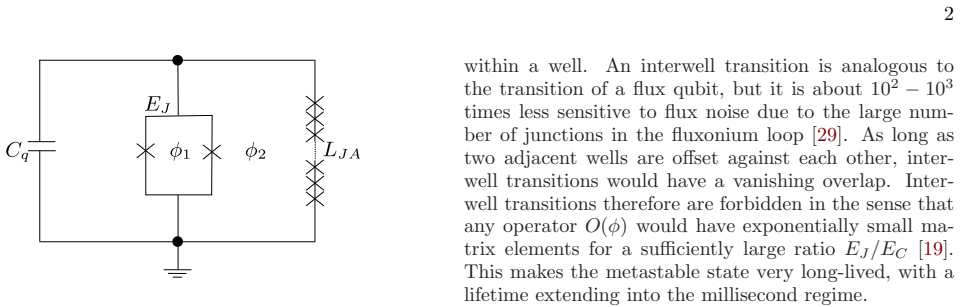
The central object is the Λ-detector: a three-level system with two quasi-degenerate ground states coupled only through a shared excited state, implemented in a fluxonium circuit with a flux-tunable split junction. The detector is placed on the worldline (η,0) in the future or past Rindler light cone, where Minkowski time is t = a^{-1}e^{aη}; tuning the excited-state frequency as ω_M(t) ∝ 1/t corresponds to a static detector in conformal time, and the Minkowski vacuum appears thermal at T = ℏa/2πk_B. The bright subspace accumulates a geometric (Berry-like) phase β, which is read out through the ground-state population P1(η) using the mixed-state geometric-phase formula. The amplification mec
Load-bearing premise
The differential measurement assumes that the flux-modulation drive itself produces no ground-state population dynamics—that the chirped run and the unmodulated run differ only by the Unruh-induced geometric phase, not by drive-induced heating, non-adiabatic transitions, or flux-noise transitions.
What would settle it
Perform the identical 25-quasicycle flux chirp with the detector prepared in the dark state |−⟩, which by construction does not couple to the field: a nonzero population shift in that run would indicate drive-induced dynamics beyond the Unruh effect, invalidating the differential protocol.
If this is right
- A ~10% ground-state population shift within ~530 ns makes the timelike Unruh effect observable in a superconducting circuit experiment.
- The Λ-detector's geometric-phase readout gives roughly three orders of magnitude higher sensitivity than a two-level Unruh–DeWitt detector.
- The same circuit can be repurposed as a quantum thermometer or for quantum non-demolition measurements, as the authors note.
- The differential protocol (modulated versus unmodulated flux) isolates the Unruh contribution from background dynamics, provided drive-induced effects are negligible.
- The predicted signal is robust at the fluxonium sweet spot, with dark-state dephasing changing the result by less than 1%.
Where Pith is reading between the lines
- If the detection works, the same Λ-geometric-phase readout could be adapted to probe other vacuum or dynamical effects (e.g., dynamical Casimir radiation) by engineering the appropriate frequency chirp.
- Because the protocol alternates the sign of a each quasicycle, reversing the chirp order should yield the same population shift magnitude—a simple symmetry check the experiment could perform.
- The strongest uncontrolled assumption is that the flux chirp itself does not populate the ground states; an auxiliary experiment with the detector in the dark state |−⟩ would test this directly.
- One could vary the number of quasicycles n and verify that the population shift follows the exponential and geometric-phase scaling in the paper's expression for P1(η), giving a quantitative falsification test.
Editorial analysis
A structured set of objections, weighed in public.
Referee Report
Summary. The paper proposes a flux-tunable fluxonium circuit operated as a Λ-system as a practical detector for the timelike Unruh effect. The excited-state transition frequency is chirped between 4.4 and 6.2 GHz over 25 quasicycles (~530 ns of Minkowski time), so that the detector follows the conformal-time scaling required to accumulate a geometric phase associated with the timelike Unruh effect. Using an open-system master equation and the geometric-phase formalism from the authors' earlier work, the paper predicts a ground-state population shift of order 10% and claims a three-order-of-magnitude sensitivity improvement over a two-level Unruh–DeWitt detector.
Significance. If the prediction holds, the paper would provide a concrete, near-term superconducting-circuit platform for testing a nontrivial quantum-field-theoretic effect. The manuscript has genuine strengths: the fluxonium parameters are taken from the experimental literature; the transition-dipole structure (vanishing ⟨g2|φ|g1⟩, allowed |gi⟩↔|e⟩ dipoles) is checked numerically; the sweet-spot condition φ2 = π − φJ is derived; and the quoted 10% number is internally consistent with Eq. (13) for the stated parameters. The main new contribution is the specific circuit architecture and the chirped-protocol estimate, rather than the timelike-Unruh or geometric-phase formalism itself, which largely follows Refs. [7,16,31]. The central claim is plausible but is not yet established because the model used for the simulation omits potentially dominant dynamics of the actual driven circuit and because an internal timing inconsistency affects the magnitude of the predicted signal.
major comments (3)
- [Experimental protocol; Eq. (4); Supp. Eq. (S37); Fig. 3 caption] The simulation applies the fixed-frequency, constant-parameter Lindblad equation (Eq. 4 / Supp. Eq. S23, with dephasing added in Supp. Eq. S37) to a protocol in which the transition frequency is chirped between 4.4 and 6.2 GHz over 25 quasicycles. This master equation does not include non-adiabatic transitions during the rapid chirps, drive-induced excitation or heating, or flux-noise-induced transitions. The 'no Unruh' control is an unmodulated run, so the differential quantity ΔP1 does not cancel drive-induced dynamics unless the drive itself produces zero population change. The Fig. 3 caption assertion 'If there is no Unruh effect, there will be no change in population' is exactly this unproven assumption. This is load-bearing: if the modulation drive alone moves the ground-state population by a fraction comparable to 0.1, the 10% signal cannot be attributed to the timelike Unruh effe
- [Eq. (16) and 'Experimental protocol' (factor-2π quasicycle ambiguity)] The manuscript states that each quasicycle corresponds to conformal time η ∈ [0, 2π/ω] (main text and Supp. Fig. S1), but Eq. (16) with n = 25, ω_i^M/2π = 4.4 GHz, and a/ω = 0.34 yields t_c ≈ 530 ns only if each quasicycle has Δη = 1/ω. The two conventions differ by a factor 2π. Since the geometric phase and the population shift depend on the total conformal time, the numerical prediction O(ΔP1) ≈ 0.1 is ambiguous. The paper must adopt one convention consistently and recompute all quoted numbers, including the two-level comparison and the timing profile in Fig. S1.
- [Supp. Sec. I; Eq. (S10); transition rate in the chirped protocol] The Unruh transition rate P(ω) in Eq. (S10) is derived for a detector on a single conformal worldline with constant a and fixed ω, and the Markov/rotating-wave approximation is assumed. In the proposed experiment, ω_M(t) is swept continuously and the sign of a is alternated every quasicycle, so the detector does not follow a single global FP light-cone trajectory. The paper does not provide an adiabaticity or Markov-validity analysis; with bath correlation time 1/a ≈ 0.09 ns and conformal period 2π/ω ≈ 0.2 ns, these approximations are not obviously justified. The authors should either justify the constant-rate master equation for the chirped, sign-alternated protocol or simulate the time-dependent Hamiltonian directly.
minor comments (4)
- [Eq. (16) and surrounding text] The sign of the frequency ratio appears inconsistent: with ω_i^M/2π = 4.4 GHz and ω_f^M/2π = 6.2 GHz, ω_i^M/ω_f^M = e^{-a/ω} ≈ e^{-0.34}, whereas the text writes ω_f^M/ω_i^M = e^{-a/ω}. Please correct this notational direction.
- [Supp. Fig. S1 caption] The caption refers to 'Eq. (17)', but the relevant equation appears to be Eq. (16) in the main text. Please fix the cross-reference.
- [Experimental protocol] The notation P1(0,η), P1(a,η), δP1(η), and ΔP1(η) is confusing as written. Define each quantity explicitly and distinguish the population at time η from the population change relative to η = 0.
- [Introduction and related work] Ref. [17] is described as reporting observation of the timelike Unruh effect in a trapped-ion implementation. The manuscript should briefly explain how the proposed circuit experiment relates to that claim and whether the two approaches test the same physics.
Circularity Check
No significant circularity: the population-shift prediction is a forward computation from a derived Unruh response function; self-citations are rederived in the Supplementary Information, and the protocol/control issues are correctness concerns, not circular reductions.
full rationale
The derivation is self-contained: the transition rate P(ω) in Eq. (9) is obtained in Supp. Sec. I directly from the regularized Wightman function on the future/past light cone (S6–S10), producing the standard thermal response with T = ℏa/(2πkB). The population formula Eq. (13) is the explicit solution of the Lindblad master equation Eq. (4)/S23, with A and B computed from P(ω); no parameter is fitted to force the quoted O(0.1) shift. The unmodulated/modulated difference ΔP1 is a control construction: both runs share spontaneous emission and dephasing, so the difference isolates the a-dependent part of the model. The statement in the Fig. 3 caption that no Unruh effect implies no population change is true within the model because the master equation deliberately omits drive-induced transitions; that is an experimental modeling limitation and a potential correctness risk, not a circular reduction. The self-cited prior work (refs. 7, 16, 31) supplies the framework, but the key formulas are rederived in the Supplementary Information, so the central prediction does not reduce to an unverified self-citation. The factor-2π ambiguity between Eq. (16) and the stated quasicycle definition is an internal timing inconsistency to be corrected, not a circularity.
Axiom & Free-Parameter Ledger
free parameters (7)
- a/ω (Unruh temperature scale) =
0.34
- Spontaneous emission rate Γ =
≈ 10⁻⁴ω ≈ 3×10⁶ s⁻¹ at 5 GHz
- Initial-state angles ϑ, θ =
p− ≈ 0.2 (cos²(ϑ/2)=0.2); θ = π/2
- Dark-state dephasing rate γφ− =
≈ 10⁴ s⁻¹
- Bright–dark energy splitting δω =
0.06 GHz
- Circuit energies and asymmetry (EJΣ, EC, EL, d) =
27.5, 0.55, 0.72 GHz, 0.13
- Quasicycle count n =
25
axioms (6)
- domain assumption Timelike-Unruh thermal response: a detector on the worldline (η,0) responds as a thermal bath at T = ℏa/2πkB with P(ω) = (Γ/2)(1+a²/ω²)(1+coth(πω/a)) (Olson–Ralph [7,31]; derived in Supp. Sec. I).
- domain assumption The Λ-system is governed by the Lindblad master equation (4)/(S23) with rates P(±ω) and a completely dark |−⟩ state.
- standard math Mixed-state geometric phase formula β = arg Σ√(p_i(0)p_i(T))⟨p_i(0)|p_i(T)⟩exp(−∫⟨p_i|ṗ_i⟩dη) applies (Tong et al. [30]).
- ad hoc to paper Static-rate adiabaticity: rates P(±ω) evaluated at fixed ω remain valid while ω is chirped across 4.4–6.2 GHz; the conformal factor e^{aη} is exactly compensated by the Wightman function (Supp. Eq. S11).
- domain assumption Low-temperature limit A ≈ B, giving Γ2 = Γ1/2 = P(ω)/2.
- ad hoc to paper The population shift ΔP1 is independent of the sign of a when θ = π/2, justifying sign-alternation each quasicycle.
Cite this review
Pith. "Pith review of Can a quantum circuit detect the Unruh effect?." pith.science (2026). https://pith.science/paper/XLI56ELC
@misc{pith2026260724836,
  author       = {Pith},
  title        = {Pith review of: Can a quantum circuit detect the Unruh effect?},
  year         = {2026},
  howpublished = {\url{https://pith.science/paper/XLI56ELC}},
  note         = {Machine review of arXiv:2607.24836}
}
abstract
The Unruh effect predicts that an accelerating observer perceives the Minkowski vacuum as a thermal bath, yet direct detection remains experimentally inaccessible. Its timelike counterpart, arising from the entanglement of massless fields between the future and past light cones, offers a more feasible route but requires a detector whose transition frequency follows a specific conformal-time scaling. We propose and analyze a practical implementation of such a detector using superconducting fluxonium circuits, which naturally provide two quasi-degenerate ground states and a tunable excited state, forming an effective $\Lambda$-system. By modulating the excited-state transition frequency in Minkowski time, the detector accumulates a geometric phase associated with the timelike Unruh effect. Open-system simulations predict $\sim 10\%$ shift in the ground-state population within $530$ ns, representing a three-order-of-magnitude sensitivity enhancement over two-level Unruh-DeWitt detectors. These results establish a realistic quantum-circuit platform for experimentally probing the timelike Unruh effect and, more broadly, for testing fundamental nature of quantum fields using engineered quantum systems.
Figures


Reference graph
Works this paper leans on
-
[1]
N. D. Birrell and P. C. W. Davies, Quantum Fields in Curved Space , Cambridge Monographs on Mathematical Physics (Cambridge University Press, Cambridge, UK, 1982)
1982
-
[2]
L. E. Parker and D. Toms, Quantum Field Theory in Curved Spacetime: Quantized Field and Gravity , Cam- bridge Monographs on Mathematical Physics (Cambridge University Press, 2009)
2009
-
[3]
By monitoring the change in the ground state pop- ulation of the Λ-detector, one therefore measures the Unruh temperature
From this figure, we infer that over 25-quasicycle evolutions in FP time (corresponding to approximately 530 ns in Minkowski time), the ground state population shifts by about ten percent, O(∆P1 ) ≈ 0.1, due to the Unruh effect. By monitoring the change in the ground state pop- ulation of the Λ-detector, one therefore measures the Unruh temperature. Owing t...
-
[4]
L. C. B. Crispino, A. Higuchi, and G. E. A. Matsas, Rev. Mod. Phys. 80, 787 (2008) , arXiv:0710.5373 [gr-qc]
Pith/arXiv arXiv 2008
-
[5]
D. W. Sciama, P. Candelas, and D. Deutsch, Adv. Phys. 30, 327 (1981)
1981
-
[6]
V. L. Ginzburg and V. P. Frolov, Soviet Physics Uspekhi 30, 1073 (1987)
1987
-
[7]
W. G. Unruh, Phys. Rev. D 14, 870 (1976) . 6
1976
-
[8]
A. Higuchi, S. Iso, K. Ueda, and K. Yamamoto, Phys. Rev. D 96, 083531 (2017) , arXiv:1709.05757 [hep-th]
Pith/arXiv arXiv 2017
-
[9]
B. S. Dewitt, in General Relativity-An Einstein Centenary Survey (1979)
1979
-
[10]
P. C. W. Davies, J. Phys. A 8, 609 (1975)
1975
-
[11]
S. J. Olson and T. C. Ralph, Phys. Rev. Lett. 106, 110404 (2011), arXiv:1003.0720 [quant-ph]
Pith/arXiv arXiv 2011
-
[12]
II for de- tails)
(see Supplementary Information Sec. II for de- tails). The advantage of using the Λ-system is that its geometric phase can be determined by monitoring the ground state population P1(η) = ⟨g1|ρ(η)|g1⟩. The ex- pression for the ground state population as it evolves in the thermal bath is P1(η) = 1 2 ( 1 − sin2 ϑ 2e−2Aηf (η) ) + 1 2e−(A−B)η sinϑ sinθ 2 cosβ(...
-
[13]
Thus, one switches the sign of a every quasi- cycle and the frequency of the system oscillates between ωi M and ωf M
is independent of the sign of a when θ = π/2. Thus, one switches the sign of a every quasi- cycle and the frequency of the system oscillates between ωi M and ωf M . Additionally, we take the spontaneous de- cay rate Γ to be approximately 10 −4ω [ 25]. Experimental protocol– To detect the timelike Unruh effect in a superconducting circuit, we implement a fo...
-
[14]
Sj¨ oqvist,Physics 1, 35 (2008)
E. Sj¨ oqvist,Physics 1, 35 (2008)
2008
-
[15]
E. Martin-Martinez, I. Fuentes, and R. B. Mann, Phys. Rev. Lett. 107, 131301 (2011) , arXiv:1012.2208 [quan- t-ph]
Pith/arXiv arXiv 2011
-
[16]
S1 for de- tails)
(see Fig. S1 for de- tails). Over this interval, the energy levels undergo ap- proximately 25-quasicycles evolutions, where each quasi- cycle corresponds to an evolution in conformal time from η = 0 to η = 2π/ω. A plot of the shift in ground state population as a result of the Unruh effect is shown in Fig
-
[17]
J. Hu and H. Yu, Phys. Rev. A 85, 032105 (2012) , arXiv:1203.5869 [quant-ph]
Pith/arXiv arXiv 2012
-
[18]
Pancharatnam, Proc
S. Pancharatnam, Proc. Indian Acad. Sci. A 44, 247 (1956)
1956
-
[19]
M. V. Berry, Proceedings of the Royal Society of London Series A 392, 45 (1984)
1984
-
[20]
J. Q. Quach, T. C. Ralph, and W. J. Munro, Phys. Rev. Lett. 129, 160401 (2022) , arXiv:2112.00898 [gr-qc]
Pith/arXiv arXiv 2022
-
[21]
Z. Luo, Y. Li, X. Zhao, Z. Xie, Z. Tian, and Y. Lin, arXiv e-prints , arXiv:2510.24163 (2025) , arXiv:2510.24163 [quant-ph]
arXiv 2025
-
[22]
Novikov, T
S. Novikov, T. Sweeney, J. E. Robinson, S. P. Pre- maratne, B. Suri, F. C. Wellstood, and B. S. Palmer, Na- ture Physics 12, 75 (2016)
2016
-
[23]
Earnest, S
N. Earnest, S. Chakram, Y. Lu, N. Irons, R. K. Naik, N. Leung, L. E. Ocola, D. A. Czaplewski, B. Baker, J. Lawrence, J. Koch, and D. I. Schuster, Physical review letters 120 15 , 150504 (2017)
2017
-
[24]
P. Krantz, M. Kjaergaard, F. Yan, T. P. Orlando, S. Gus- tavsson, and W. D. Oliver, Applied Physics Reviews 6, 021318 (2019) , arXiv:1904.06560 [quant-ph]
Pith/arXiv arXiv 2019
-
[25]
M. Kjaergaard, M. E. Schwartz, J. Braum¨ uller, P. Krantz, J. I.-J. Wang, S. Gustavsson, and W. D. Oliver, Physics 11, 369 (2020) , arXiv:1905.13641 [quant-ph]
Pith/arXiv arXiv 2020
-
[26]
J. Koch, T. M. Yu, J. Gambetta, A. A. Houck, D. I. Schuster, J. Majer, A. Blais, M. H. Devoret, S. M. Girvin, and R. J. Schoelkopf, Phys. Rev. A 76, 042319 (2007) , arXiv:cond-mat/0703002
Pith/arXiv arXiv 2007
-
[27]
T. P. Orlando, J. E. Mooij, L. Tian, C. H. van der Wal, L. S. Levitov, S. Lloyd, and J. J. Mazo, Phys. Rev. B 60, 15398 (1999) , arXiv:cond-mat/9908283 [cond-mat]
Pith/arXiv arXiv 1999
-
[28]
V. E. Manucharyan, J. Koch, L. I. Glazman, and M. H. Devoret, Science 326, 113 (2009) , arXiv:0906.0831 [cond– mat.mes-hall]
Pith/arXiv arXiv 2009
-
[29]
L. B. Nguyen, Y.-H. Lin, A. Somoroff, R. Mencia, N. Grabon, and V. E. Manucharyan, Physical Review X 9, 041041 (2019) , arXiv:1810.11006 [quant-ph]
Pith/arXiv arXiv 2019
-
[30]
W. M. Strickland, B. H. Elfeky, L. Baker, A. Maiani, J. Lee, I. Levy, J. Issokson, A. Vrajitoarea, and J. Sha- bani, PRX Quantum 6, 010326 (2025) , arXiv:2406.09002 [cond-mat.mes-hall]
arXiv 2025
-
[31]
M. T. Bell, I. A. Sadovskyy, L. B. Ioffe, A. Y. Kitaev, and M. E. Gershenson, Phys. Rev. Lett. 109, 137003 (2012) , arXiv:1206.0307 [cond-mat.supr-con]
Pith/arXiv arXiv 2012
-
[32]
N. A. Masluk, I. M. Pop, A. Kamal, Z. K. Minev, and M. H. Devoret, Physical review letters 109 13 , 137002 (2012)
2012
-
[33]
Y.-H. Lin, L. B. Nguyen, N. Grabon, J. F. S. Miguel, N. Pankratova, and V. E. Manucharyan, Physical review letters 120 15 , 150503 (2017)
2017
-
[34]
D. M. Tong, E. Sj¨ oqvist, L. C. Kwek, and C. H. Oh,Phys. Rev. Lett. 93, 080405 (2004) , arXiv:quant-ph/0405092 [quant-ph]
Pith/arXiv arXiv 2004
-
[35]
S. J. Olson and T. C. Ralph, Phys. Rev. A 85, 012306 (2012), arXiv:1101.2565 [quant-ph] . 1 Supplementary Information: Can a quantum circuit detect th e Unruh effect? I. TIMELIKE UNRUH EFFECT We consider the Unruh-Dewitt detector, which is the simplest particle detector model. The detector-field in- teraction of such a detector in worldline (η, 0) is descri...
Pith/arXiv arXiv 2012
This paper was first reviewed by deepseek-v4-flash on August 1, 2026.
discussion (0)
Sign in with ORCID, Apple, or X to comment. Anyone can read and Pith papers without signing in.