REVIEW 4 major objections 4 minor 75 references
Strengthening the coupling between string-forming and current-carrier fields suppresses a string network's gravitational-wave emission at small scales and boosts it at large scales — a signature for future high-frequency detectors.
Reviewed by Pith at T0; open to challenge. T0 means a machine referee read the full paper against a public rubric. the ladder, T0–T4 →
T0 review · deepseek-v4-flash
2026-08-01 02:46 UTC pith:XLR354A3
load-bearing objection First lattice field-theory GW calculation for superconducting strings, with a plausible coupling-dependent spectral shape; needs realizations and initial-condition checks before the claim is solid. the 4 major comments →
Gravitational Waves from Superconducting Cosmic Strings
The pith
A machine-rendered reading of the paper's core claim, the machinery that carries it, and where it could break.
Core claim
The central claim is that the coupling constant λ_Φσ between the string-forming field Φ and the current-carrier field σ changes the shape of the gravitational-wave power spectrum of a superconducting cosmic-string network: as λ_Φσ grows, the spectrum is suppressed at small scales (around k ~ 10η, the string-width scale) and enhanced at large scales. The mechanism is condensation — the effective symmetry-breaking scale η_eff² = η² − (2λ_Φσ/λ_Φ)|σ|² drops where σ condenses near the core, lowering the string tension and weakening string-sourced emission, while the condensate's own energy momentum dominates on large scales. The paper further claims this is the first lattice simulation of gravita
What carries the argument
The load-bearing setup is the U(1)_local × U(1)_global field theory with potential U = (λ_Φ/4)(|Φ|² − η²)² + λ_Φσ(|Φ|² − η²)|σ|² + (m_σ²/2)|σ|² + (λ_σ/4)|σ|⁴, evolved on a 3D lattice in a radiation-dominated expanding box. Three elements carry the argument: (1) the split of the gravitational-wave source into a string part T^string_ij and a current-carrier part T^cc_ij = 2Re[(∂_iσ)*∂_jσ], which assigns the small-scale suppression and large-scale enhancement to different fields; (2) the condensation argument rewriting the potential to expose η_eff² = η² − (2λ_Φσ/λ_Φ)|σ|², tying the condensate to a reduced symmetry-breaking scale and string tension; and (3) a core-weighted average that isolates
Load-bearing premise
The argument stands on the assumption that the hand-chosen initial fluctuations — a Gaussian random field with amplitude A and cutoff k_cut picked by hand, evolved for only four horizons with the central coupling scan run once without realizations — faithfully represent the outcome of a cosmological phase transition, so the small-scale gravitational-wave suppression is condensate physics and not an imprint of the initialization; the paper's own caveat that its transverse-trac
What would settle it
Re-run the coupling scan (λ_Φσ = 0.30, 0.40, 0.49) with several independent realizations and with the initial-mode cutoff k_cut moved by a factor of a few, then compare the high-k end of the gravitational-wave spectra: if the small-scale suppression shifts with k_cut or varies realization to realization while the large-scale part stays flat, the claimed coupling-induced tilt is an artifact of the initial conditions rather than of the condensate.
If this is right
- A superconducting string network with strong coupling shows a high-frequency suppression of the stochastic gravitational-wave background near k ~ 10η that an ordinary Abelian-Higgs (non-superconducting) network does not, making spectral shape a diagnostic of internal string structure.
- The high- and low-frequency ends of the spectrum trace different physics: the string-forming field's effective tension sets the small-scale suppression, while the current-carrier condensate sets the large-scale enhancement.
- Because the large-scale amplitude barely changes with superconductivity, current and planned low-frequency detectors (LISA, DECIGO, BBO, ET, CE, LIGO-Virgo-KAGRA) will find it very hard to distinguish superconducting from ordinary strings; the distinguishing signal is a high-frequency, GHz-and-above program.
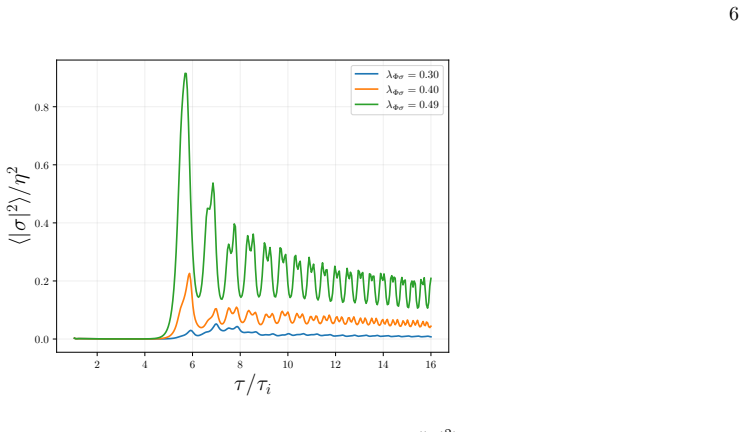
- The observed τ⁻² decay of the squared charge and current with cosmic time, explained by freely propagating massless phase modes whose comoving gradients are preserved by expansion, implies currents persist on the strings in the physical-string regime rather than being an artifact of the fat-string approximation.
Where Pith is reading between the lines
- If the tilt is real, it offers a parameter-measurement channel: because the small-to-large-scale power ratio is a monotonic function of λ_Φσ, a future high-frequency background detection could in principle constrain this coupling — provided the initial-condition sensitivity is controlled first.
- The mechanism is generic: any field condensing on a string and coupled through a |Φ|²|σ|² interaction will lower the effective symmetry-breaking scale, so analogous spectral suppressions should appear in other condensate-carrying networks (for example axion strings or dark-photon strings) — a testable prediction for lattice studies with different carrier sectors.
- With only 2–4 horizons in the box and a_f = 16, the simulation likely underestimates how far the low-frequency peak moves toward smaller k as the network approaches scaling; by the paper's own logic the large-scale enhancement should grow in a longer run, so the spectral tilt may be more pronounced in the true scaling regime than the figures show.
Editorial analysis
A structured set of objections, weighed in public.
Referee Report
Summary. This paper presents 3D lattice field-theory simulations of a U(1)_local × U(1)_global model of superconducting cosmic strings in an expanding radiation-dominated universe. The authors vary the coupling λ_Φσ between the string-forming field Φ and the current-carrier field σ, and compute the stochastic gravitational-wave spectrum sourced by the network. Their central claim is that increasing λ_Φσ changes the spectral shape: the GW power spectrum is suppressed on small scales and enhanced on large scales (Fig. 4). They attribute the small-scale suppression to a condensation-induced reduction of the effective symmetry-breaking scale (Eq. 28), and discuss detection prospects in the high-frequency band (Fig. 9). They also report convergence tests at λ_Φσ = 0.49 (Fig. 5) and a decomposition into string and current-carrier contributions (Figs. 6–7).
Significance. If the central claim holds, this would be the first lattice field-theory computation of gravitational waves from a superconducting cosmic-string network in the physical-string regime, and it would identify a coupling-dependent spectral feature that could in principle distinguish superconducting from Abelian-Higgs strings at high frequencies. The paper has notable strengths: it goes beyond the fat-string approximation used in earlier work, it separates the T_string and T_cc contributions to identify the mechanism behind the spectral modification, and it includes box-size and resolution checks as well as a five-realization average for one parameter point. However, the headline λ-dependence is currently supported by a single, un-averaged scan without error bars, and the convergence checks do not cover the λ = 0 baseline. The result is promising but not yet established to the standard needed for a robust observational claim.
major comments (4)
- [§IV C, Fig. 4] The central λ_Φσ scan is shown without any estimate of realization variance. Table I lists only N_s time steps; the only mention of multiple realizations is for Set 3 in the Fig. 5 caption. A stochastic GW background from a finite box has significant sample variance, and the monotonic ordering of the curves in Fig. 4 could be partly statistical. The authors should provide error bars or multiple-realization averages for each λ, at least for the endpoint values λ=0 and λ=0.49.
- [§III, Eq. (12); §IV C, Fig. 4] The high-frequency region where the suppression is claimed (k/η ≳ 10) coincides with the hand-imposed cutoff k_cut/η=10 of the initial power spectrum. Both Φ and σ are initialized with the same Gaussian spectrum, so T_cc initially contains power at exactly the scales that show the largest λ-dependence in Fig. 4. For λ=0, initial σ fluctuations are not depleted by condensation and can propagate freely, whereas for λ>0 they condense onto strings. No variation of A or k_cut is reported, and there is no check that the λ=0 high-k tail is converged or physical. Without this, the central spectral-shape claim is not shown to be independent of the initial-condition choice.
- [§IV C, Fig. 5; Table I] The convergence and box-size tests are performed only for λ_Φσ = 0.49. The paper's claim is about the λ-dependence of the spectrum, so the λ=0 baseline and at least one intermediate coupling need the same resolution/box checks to rule out resolution-dependent or finite-volume effects that differ between couplings. In addition, all runs terminate at a_f = 16 with L/H^{-1}_f = 2, so the low-frequency end is only about two horizons; the reported large-scale enhancement may still be a transient effect rather than a property of the scaling network. A longer run or a statement about time-convergence would strengthen the conclusion.
- [§IV C, Eq. (28)] The explanation of the small-scale suppression via an effective symmetry-breaking scale η_eff² = η² − (2λ_Φσ/λ_Φ)|σ|² is presented as the reason the string tension and hence GW emission decrease. This is a heuristic statement: the tension of a field-theory string is not simply proportional to η², and η_eff is position-dependent. If this explanation is meant to be more than interpretive, the authors should provide direct evidence, e.g. a measured decrease in the string-core width or the local potential barrier as λ_Φσ increases.
minor comments (4)
- [Table I] The entry 'Aη' is ambiguous: A is said to be a parameter chosen by hand in Eq. (12), but the table lists 'Aη = 1.0×10^{-4}'. Please clarify whether A is dimensionless and the product Aη is meant, or whether the table entry is A itself.
- [§IV A, Fig. 1] The figure caption does not state the time slices shown in each column beyond τ/τ_i = 8.5, 12.25, 16. Please add the values to the caption for clarity.
- [§IV B, Eqs. (21)–(23)] The derivation of the τ^{-2} decay assumes free massless phase modes with negligible left–right correlation. This is plausible but should be stated as an interpretive model rather than a derived consequence of the field equations, especially because the radial profile is not rigorously 'approximately unchanged' during the simulation.
- [Appendix A, Eq. (A4)] The definition of Ω_GW uses the Hubble parameter H at the time of emission, but the text does not state this explicitly in Appendix A. A short sentence clarifying that Ω_GW is evaluated at the final simulation time and then propagated with Eq. (29) would help.
Circularity Check
No significant circularity: the gravitational-wave spectra and their λ_Φσ dependence are measured from lattice simulations, not fitted to or derived from the paper's inputs.
full rationale
The paper's central claim is the observed dependence of the gravitational-wave power spectrum on λ_Φσ (Fig. 4), obtained by solving the field equations (3)–(5) and the gravitational-wave equation (10) with the numerical parameters in Table I. The spectrum is not produced by fitting any parameter to a target shape; no equation is equivalent to another by construction. The effective-symmetry-breaking-scale interpretation in Eq. (28) is a post-hoc algebraic reinterpretation of the potential and is not used to generate the spectra. The self-citations to Refs. [63] and [66] only motivate the parameter range and provide background; the central simulation result does not reduce to these citations. The possible sensitivity of the high-k tail to the hand-chosen initial power spectrum (Eq. 12) and the lack of realization averaging for the main λ_Φσ scan are legitimate robustness concerns, but they concern physical interpretation and numerical convergence, not circularity: the output is not defined in terms of the input in a way that forces the claimed spectral-shape change.
Axiom & Free-Parameter Ledger
free parameters (3)
- Initial power-spectrum amplitude A =
Aη = 1.0×10^-4 (so A = 1.0×10^-4/η)
- Initial power-spectrum cutoff k_cut =
k_cut/η = 10.0
- Coupling λ_Φσ =
0.00, 0.30, 0.40, 0.49
axioms (4)
- domain assumption The U(1)_local × U(1)_global field theory is an adequate toy model for superconducting cosmic strings and the parameter region λ_Φσ ≤ 0.49 admits stable superconducting string solutions.
- domain assumption The universe is radiation-dominated with a(τ) ∝ τ, and the linearized metric perturbation equation (Eq. 7) governs gravitational-wave production.
- domain assumption The network behavior at a_f = 16 in a box spanning only 2–4 horizons is representative of the asymptotic network evolution, and the flat spectrum can be extrapolated to lower frequencies assuming scaling behavior.
- ad hoc to paper The adiabatic/relaxation argument that Q² and J² decay as τ^-2 (Eq. 23) relies on free massless phase modes with negligible left–right correlation.
read the original abstract
We study the evolution of superconducting cosmic-string networks in a $U(1)_{\rm local}\times U(1)_{\rm global}$ field-theoretic model using three-dimensional lattice field simulations in an expanding universe. The scalar field charged under $U(1)_{\rm local}$ forms cosmic strings, while the scalar field associated with $U(1)_{\rm global}$ acts as a current carrier and condenses in their vicinity. We investigate the evolution of the string network for several values of the coupling constant between the string-forming and current-carrier fields and estimate the gravitational-wave power spectrum sourced by the resulting superconducting cosmic-string network. We find that the spectral shape depends on the coupling constant: as the interaction strength increases, the spectrum is suppressed on small scales. This feature may be probed by future high-frequency gravitational-wave observations.
Figures



Reference graph
Works this paper leans on
-
[1]
Kibble,Topology of Cosmic Domains and Strings,J
T.W.B. Kibble,Topology of Cosmic Domains and Strings,J. Phys. A9(1976) 1387
1976
-
[2]
Zurek,Cosmological Experiments in Superfluid Helium?,Nature317(1985) 505
W.H. Zurek,Cosmological Experiments in Superfluid Helium?,Nature317(1985) 505
1985
-
[3]
Previous studies have shown that this choice gives GW spectra that agree well with those obtained using lattice-based 12 ones, apart from possible differences in the UV tail [78]
Although a TT projection tensor can be constructed more consistently on a lattice by using lattice momenta, we employ the conventional continuum-based one defined above. Previous studies have shown that this choice gives GW spectra that agree well with those obtained using lattice-based 12 ones, apart from possible differences in the UV tail [78]. Therefo...
-
[4]
Vilenkin and E.P.S
A. Vilenkin and E.P.S. Shellard,Cosmic Strings and Other Topological Defects, Cambridge University Press (7, 2000)
2000
-
[5]
N.S. Manton and P. Sutcliffe,Topological solitons, Cambridge Monographs on Mathematical Physics, Cambridge University Press (2004), 10.1017/CBO9780511617034
-
[6]
E.J. Weinberg,Classical solutions in quantum field theory: Solitons and Instantons in High Energy Physics, Cambridge Monographs on Mathematical Physics, Cambridge University Press (9, 2012), 10.1017/CBO9781139017787
-
[7]
Montonen,On Solitons with an Abelian Charge in Scalar Field Theories
C. Montonen,On Solitons with an Abelian Charge in Scalar Field Theories. 1. Classical Theory and Bohr-Sommerfeld Quantization,Nucl. Phys. B112(1976) 349
1976
-
[8]
Sarkar, S.E
S. Sarkar, S.E. Trullinger and A.R. Bishop,Solitary Wave Solution for a Complex One-Dimensional Field,Phys. Lett. A 59(1976) 255
1976
-
[9]
Witten,Superconducting Strings,Nucl
E. Witten,Superconducting Strings,Nucl. Phys. B249(1985) 557
1985
-
[10]
Peter,Surface current carrying domain walls,J
P. Peter,Surface current carrying domain walls,J. Phys. A29(1996) 5125 [hep-ph/9503408]
Pith/arXiv arXiv 1996
-
[11]
K. Kasamatsu, M. Tsubota and M. Ueda,Vortices in Multicomponent Bose-Einstein Condensates,International Journal of Modern Physics B19(2005) 1835 [cond-mat/0505546]
Pith/arXiv arXiv 2005
-
[12]
M. Lilley, F. Di Marco, J. Martin and P. Peter,Nonabelian Bosonic Currents in Cosmic Strings,Phys. Rev. D82(2010) 023510 [1003.4601]
Pith/arXiv arXiv 2010
-
[13]
M. Nitta, S. Uchino and W. Vinci,Quantum Exact Non-Abelian Vortices in Non-relativistic Theories,JHEP09(2014) 098 [1311.5408]
Pith/arXiv arXiv 2014
-
[14]
Ginzburg and L.D
V.L. Ginzburg and L.D. Landau,On the Theory of superconductivity,Zh. Eksp. Teor. Fiz.20(1950) 1064
1950
-
[15]
Copeland, N
E.J. Copeland, N. Turok and M. Hindmarsh,Dynamics of Superconducting Cosmic Strings,Phys. Rev. Lett.58(1987) 1910
1987
-
[16]
Babul, T
A. Babul, T. Piran and D.N. Spergel,BOSONIC SUPERCONDUCTING COSMIC STRINGS. 1. CLASSICAL FIELD THEORY SOLUTIONS,Phys. Lett. B202(1988) 307
1988
-
[17]
Everett,New Mechanism for Superconductivity in Cosmic Strings,Phys
A.E. Everett,New Mechanism for Superconductivity in Cosmic Strings,Phys. Rev. Lett.61(1988) 1807
1988
-
[18]
Peter,Superconducting cosmic string: Equation of state for space - like and time - like current in the neutral limit, Phys
P. Peter,Superconducting cosmic string: Equation of state for space - like and time - like current in the neutral limit, Phys. Rev. D45(1992) 1091
1992
-
[19]
Peter,Influence of the electric coupling strength in current carrying cosmic strings,Phys
P. Peter,Influence of the electric coupling strength in current carrying cosmic strings,Phys. Rev. D46(1992) 3335
1992
-
[20]
Peter,Spontaneous current generation in cosmic strings,Phys
P. Peter,Spontaneous current generation in cosmic strings,Phys. Rev. D49(1994) 5052 [hep-ph/9312280]
Pith/arXiv arXiv 1994
-
[21]
Larsen,Dynamics of cosmic strings and springs: A Covariant formulation,Class
A.L. Larsen,Dynamics of cosmic strings and springs: A Covariant formulation,Class. Quant. Grav.10(1993) 1541 [hep-th/9304086]
Pith/arXiv arXiv 1993
-
[22]
A.-C. Davis and P. Peter,Cosmic strings are current carrying,Phys. Lett. B358(1995) 197 [hep-ph/9506433]
Pith/arXiv arXiv 1995
-
[23]
B. Allen, B.S. Kay and A.C. Ottewill,Long range effects of cosmic string structure,Phys. Rev. D53(1996) 6829 [gr-qc/9510058]
Pith/arXiv arXiv 1996
-
[24]
A.-C. Davis and W.B. Perkins,Generic current carrying strings,Phys. Lett. B390(1997) 107 [hep-ph/9610292]
Pith/arXiv arXiv 1997
-
[25]
T.W.B. Kibble, G. Lozano and A.J. Yates,NonAbelian string conductivity,Phys. Rev. D56(1997) 1204 [hep-ph/9701240]
Pith/arXiv arXiv 1997
-
[26]
K. Dimopoulos and A.-C. Davis,Friction domination with superconducting strings,Phys. Rev. D57(1998) 692 [hep-ph/9705302]
Pith/arXiv arXiv 1998
-
[27]
C.J.A.P. Martins and E.P.S. Shellard,Evolution of superconducting string currents,Phys. Lett. B432(1998) 58 [hep-ph/9706533]
Pith/arXiv arXiv 1998
-
[28]
Martin and P
X. Martin and P. Peter,Current-carrying string loop motion: Limits on the classical description and shocks,Phys. Rev. D61(2000) 043510
2000
-
[29]
K. Dimopoulos and A.-C. Davis,Cosmological consequences of superconducting string networks,Phys. Lett. B446(1999) 238 [hep-ph/9901250]
Pith/arXiv arXiv 1999
-
[30]
J.J. Blanco-Pillado, K.D. Olum and A. Vilenkin,Quantum tunneling of superconducting string currents,Phys. Rev. D66 (2002) 023506 [hep-ph/0202116]
Pith/arXiv arXiv 2002
-
[31]
J. Garaud and M.S. Volkov,Superconducting non-Abelian vortices in Weinberg-Salam theory – electroweak thunderbolts, Nucl. Phys. B826(2010) 174 [0906.2996]
Pith/arXiv arXiv 2010
-
[32]
M. Lilley, P. Peter and X. Martin,Coupled currents in cosmic strings,Phys. Rev. D79(2009) 103514 [0903.4328]
Pith/arXiv arXiv 2009
-
[33]
Oikonomou,Witten Index and Superconducting Strings,Mod
V.K. Oikonomou,Witten Index and Superconducting Strings,Mod. Phys. Lett. A25(2010) 2611 [1001.2433]. 13
Pith/arXiv arXiv 2010
-
[34]
A. Babeanu and B. Hartmann,Stability of superconducting strings coupled to cosmic strings,Phys. Rev. D85(2012) 023518 [1110.5497]
Pith/arXiv arXiv 2012
-
[35]
B. Hartmann, F. Michel and P. Peter,Radial excitations of current-carrying vortices,Phys. Lett. B767(2017) 354 [1608.02986]
Pith/arXiv arXiv 2017
-
[36]
B. Hartmann, F. Michel and P. Peter,Excited cosmic strings with superconducting currents,Phys. Rev. D96(2017) 123531 [1710.00738]
Pith/arXiv arXiv 2017
-
[37]
H. Fukuda, A.V. Manohar, H. Murayama and O. Telem,Axion strings are superconducting,JHEP06(2021) 052 [2010.02763]
Pith/arXiv arXiv 2021
-
[38]
Y. Abe, Y. Hamada and K. Yoshioka,Electroweak axion string and superconductivity,JHEP06(2021) 172 [2010.02834]
Pith/arXiv arXiv 2021
-
[39]
Vilenkin and T
A. Vilenkin and T. Vachaspati,Electromagnetic Radiation from Superconducting Cosmic Strings,Phys. Rev. Lett.58 (1987) 1041
1987
-
[40]
Spergel, T
D.N. Spergel, T. Piran and J. Goodman,Dynamics of Superconducting Cosmic Strings,Nucl. Phys. B291(1987) 847
1987
-
[41]
Garfinkle and T
D. Garfinkle and T. Vachaspati,Radiation From Kinky, Cuspless Cosmic Loops,Phys. Rev. D36(1987) 2229
1987
-
[42]
Copeland, D
E.J. Copeland, D. Haws, M. Hindmarsh and N. Turok,Dynamics of and Radiation From Superconducting Strings and Springs,Nucl. Phys. B306(1988) 908
1988
-
[43]
Garfinkle and T
D. Garfinkle and T. Vachaspati,FIELDS DUE TO KINKY, CUSPLESS, COSMIC LOOPS,Phys. Rev. D37(1988) 257
1988
-
[44]
J.J. Blanco-Pillado and K.D. Olum,Electromagnetic radiation from superconducting string cusps,Nucl. Phys. B599 (2001) 435 [astro-ph/0008297]
Pith/arXiv arXiv 2001
-
[45]
J.J. Blanco-Pillado, K.D. Olum and A. Vilenkin,Dynamics of superconducting strings with chiral currents,Phys. Rev. D 63(2001) 103513 [astro-ph/0004410]
Pith/arXiv arXiv 2001
-
[46]
F. Ferrer and T. Vachaspati,511-KeV photons from superconducting cosmic strings,Phys. Rev. Lett.95(2005) 261302 [astro-ph/0505063]
Pith/arXiv arXiv 2005
-
[47]
Y.-F. Cai, E. Sabancilar, D.A. Steer and T. Vachaspati,Radio Broadcasts from Superconducting Strings,Phys. Rev. D86 (2012) 043521 [1205.3170]
Pith/arXiv arXiv 2012
-
[48]
K. Miyamoto and K. Nakayama,Cosmological and astrophysical constraints on superconducting cosmic strings,JCAP07 (2013) 012 [1212.6687]
Pith/arXiv arXiv 2013
-
[49]
H. Tashiro, E. Sabancilar and T. Vachaspati,Constraints on Superconducting Cosmic Strings from Early Reionization, Phys. Rev. D85(2012) 123535 [1204.3643]
Pith/arXiv arXiv 2012
-
[50]
B. Imtiaz, R. Shi and Y.-F. Cai,Updated constraints on superconducting cosmic strings from the astronomy of fast radio bursts,Eur. Phys. J. C80(2020) 500 [2001.11149]
Pith/arXiv arXiv 2020
-
[51]
V. Berezinsky, K.D. Olum, E. Sabancilar and A. Vilenkin,UHE neutrinos from superconducting cosmic strings,Phys. Rev. D80(2009) 023014 [0901.0527]
Pith/arXiv arXiv 2009
-
[52]
Vachaspati,Cosmic Rays from Cosmic Strings with Condensates,Phys
T. Vachaspati,Cosmic Rays from Cosmic Strings with Condensates,Phys. Rev. D81(2010) 043531 [0911.2655]
Pith/arXiv arXiv 2010
-
[53]
R. Th´ eriault, J.T. Mirocha and R. Brandenberger,Global 21cm absorption signal from superconducting cosmic strings, JCAP10(2021) 046 [2105.01166]
Pith/arXiv arXiv 2021
-
[54]
B. Cyr, J. Chluba and S.K. Acharya,Constraints on the spectral signatures of superconducting cosmic strings,Mon. Not. Roy. Astron. Soc.525(2023) 2632 [2305.09816]
Pith/arXiv arXiv 2023
-
[55]
B. Cyr, J. Chluba and S.K. Acharya,Cosmic string solution to the radio synchrotron background,Phys. Rev. D109 (2024) L121301 [2308.03512]
Pith/arXiv arXiv 2024
-
[56]
S. Si, V. Mohapatra, P.k. Natwariya and A.C. Nayak,Revisiting constraints on superconducting cosmic strings in light of the dark ages global 21-cm signal,Phys. Rev. D112(2025) 083540 [2504.02947]
arXiv 2025
-
[57]
A.J. Long and L.-T. Wang,Dark Photon Dark Matter from a Network of Cosmic Strings,Phys. Rev. D99(2019) 063529 [1901.03312]
Pith/arXiv arXiv 2019
-
[58]
I.Y. Rybak and L. Sousa,Emission of gravitational waves by superconducting cosmic strings,JCAP11(2022) 024 [2209.01068]
Pith/arXiv arXiv 2022
-
[59]
I.Y. Rybak and L. Sousa,Stochastic gravitational wave background from chiral superconducting cosmic strings,Phys. Rev. D111(2025) 083502 [2412.17154]
Pith/arXiv arXiv 2025
-
[60]
C.J.A.P. Martins, P. Peter, I.Y. Rybak and E.P.S. Shellard,Generalized velocity-dependent one-scale model for current-carrying strings,Phys. Rev. D103(2021) 043538 [2011.09700]
Pith/arXiv arXiv 2021
-
[61]
C.J.A.P. Martins, P. Peter, I.Y. Rybak and E.P.S. Shellard,Charge-velocity-dependent one-scale linear model,Phys. Rev. D104(2021) 103506 [2108.03147]
Pith/arXiv arXiv 2021
-
[62]
P. Auclair, S. Blasi, V. Brdar and K. Schmitz,Gravitational waves from current-carrying cosmic strings,JCAP04 (2023) 009 [2207.03510]
Pith/arXiv arXiv 2023
-
[63]
K. Fujikura, S. Li and M. Yamaguchi,Interactions between several types of cosmic strings,JHEP12(2023) 115 [2309.05515]
Pith/arXiv arXiv 2023
-
[64]
T. Hiramatsu, Y. Sendouda, K. Takahashi, D. Yamauchi and C.-M. Yoo,Type-I cosmic string network,Phys. Rev. D88 (2013) 085021 [1307.0308]
Pith/arXiv arXiv 2013
-
[65]
Z. Zhao, L. Bian and J. Shu,Testing the Nambu–Goto approximation of cosmic string by lattice field theory simulations, Phys. Rev. D114(2026) 023539 [2507.00685]
Pith/arXiv arXiv 2026
-
[66]
J.R.C.C.C. Correia, C.J.A.P. Martins and F.C.N.Q. Pimenta,Evolution of current-carrying string networks,Phys. Lett. B855(2024) 138788 [2406.03931]
Pith/arXiv arXiv 2024
-
[67]
T. Hiramatsu, M. Lilley and D. Yamauchi,Dynamical simulations of colliding superconducting strings,JCAP06(2024) 030 [2312.16091]
Pith/arXiv arXiv 2024
-
[68]
Maggiore,Gravitational wave experiments and early universe cosmology,Phys
M. Maggiore,Gravitational wave experiments and early universe cosmology,Phys. Rept.331(2000) 283 [gr-qc/9909001]. 14 [68]KAGRA, Virgo, LIGO Scientificcollaboration,Upper limits on the isotropic gravitational-wave background from Advanced LIGO and Advanced Virgo’s third observing run,Phys. Rev. D104(2021) 022004 [2101.12130]
Pith/arXiv arXiv 2000
-
[69]
K. Schmitz,New Sensitivity Curves for Gravitational-Wave Signals from Cosmological Phase Transitions,JHEP01 (2021) 097 [2002.04615]. [70]LISAcollaboration,The LISA mission design,AIP Conf. Proc.456(1998) 11. [71]LISAcollaboration,Laser Interferometer Space Antenna,1702.00786
Pith/arXiv arXiv 2021
-
[72]
Kawamura et al.,The Japanese space gravitational wave antenna DECIGO,Class
S. Kawamura et al.,The Japanese space gravitational wave antenna DECIGO,Class. Quant. Grav.23(2006) S125
2006
-
[73]
V. Corbin and N.J. Cornish,Detecting the cosmic gravitational wave background with the big bang observer,Class. Quant. Grav.23(2006) 2435 [gr-qc/0512039]
Pith/arXiv arXiv 2006
-
[74]
Punturo et al.,The Einstein Telescope: A third-generation gravitational wave observatory,Class
M. Punturo et al.,The Einstein Telescope: A third-generation gravitational wave observatory,Class. Quant. Grav.27 (2010) 194002
2010
-
[75]
Reitze et al.,Cosmic Explorer: The U.S
D. Reitze et al.,Cosmic Explorer: The U.S. Contribution to Gravitational-Wave Astronomy beyond LIGO,Bull. Am. Astron. Soc.51(2019) 035 [1907.04833]. [76]KAGRA, LIGO Scientific, Virgocollaboration,Prospects for observing and localizing gravitational-wave transients with Advanced LIGO, Advanced Virgo and KAGRA,Living Rev. Rel.19(2016) 1 [1304.0670]
Pith/arXiv arXiv 2019
-
[77]
Aggarwal et al.,Challenges and opportunities of gravitational-wave searches above 10 kHz,Living Rev
N. Aggarwal et al.,Challenges and opportunities of gravitational-wave searches above 10 kHz,Living Rev. Rel.28(2025) 10 [2501.11723]
arXiv 2025
-
[78]
D.G. Figueroa, J. Garcia-Bellido and A. Rajantie,On the Transverse-Traceless Projection in Lattice Simulations of Gravitational Wave Production,JCAP11(2011) 015 [1110.0337]
Pith/arXiv arXiv 2011
discussion (0)
Sign in with ORCID, Apple, or X to comment. Anyone can read and Pith papers without signing in.