REVIEW 4 major objections 4 minor 57 references
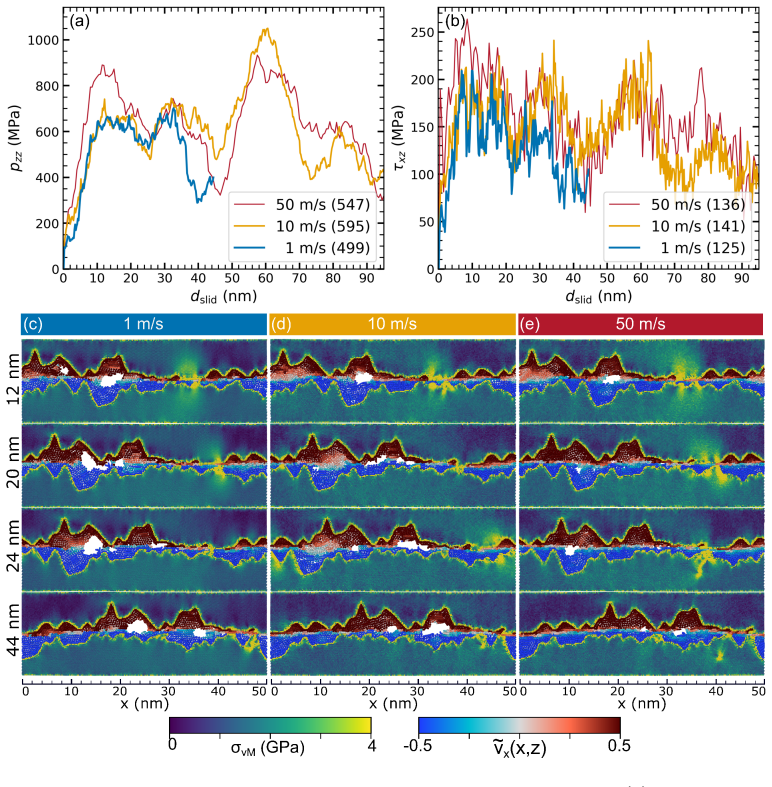
Strong confinement and steep height gradients in rough lubricated contacts make fluids slide as plugs and cavitate after asperity collisions; a two-fluid immiscible film gives the lowest friction and material transfer.
Reviewed by Pith at T0; open to challenge. T0 means a machine referee read the full paper against a public rubric. the ladder, T0–T4 →
In rough, deformable nanoscale contacts, water, n-dodecane, and their immiscible mixture exhibit plug flow and cavitation; the mixed fluid gives the lowest friction and material transfer.
T0 review reviewed 2026-08-02 challenge →
load-bearing objection A solid, honest NEMD study with a genuinely new rough-contact configuration; the central plug-flow/cavitation mechanism is plausible, but the quasi-1D cell is a real external-validity limit that the authors themselves flag. the 4 major comments →
Plug Flow and Cavitation in Rough Lubricated Contacts: Molecular Dynamics of Single- vs. Two-Component Fluids
The pith
A machine-rendered reading of the paper's core claim, the machinery that carries it, and where it could break.
The reading
Core claim
The paper's central discovery is that the lubrication state in a rough nanoscale contact is not a smooth Couette film but an event-driven competition among three configurations: a pressurized confined film, a cavitated or ruptured film, and direct or near-direct asperity engagement. After asperity collisions, the combination of strong confinement and steep height gradients makes the liquid move as a plug, with slip localized to a layer thinner than about one nanometre, and can nucleate vapor cavities. For water, cavity nucleation releases shear stress abruptly and is tied to sudden drops in normal pressure; for n-dodecane, cavities are more frequent but leave weaker friction signatures becau
What carries the argument
The argument rests on three mechanisms. Plug flow: the confined film translates almost as a rigid block, with shear concentrated in a band thinner than 1 nm, in clear violation of Couette flow. Cavitation: after an asperity collision, tensile hydrodynamic pressure nucleates a bubble that releases normal and shear stress; high-surface-tension liquids like water show sharp signatures, while low-surface-tension n-dodecane nucleates more easily but dissipates over longer times. The mixed-lubricant mechanism: an immiscible water–dodecane interface combined with opposing wall affinities reorganizes the confined film, promotes earlier mechanical accommodation, and suppresses asperity engagement. Th
Load-bearing premise
The load-bearing assumption is that the contact is effectively one-dimensional: the simulation cell is only about 1.8 nm wide with periodic boundaries, so fluid cannot flow around asperities laterally; if a wider cell allowed lateral bypass, plug flow, cavitation, and lip formation could change or disappear.
What would settle it
Run the same rough-contact simulation with the transverse width increased severalfold, or with open lateral boundaries, and check whether the mixed lubricant still shows the lowest friction and material transfer and whether plug flow persists to 1 m/s; if plug flow and lip formation vanish or the ranking reverses, the central claims are geometry-specific rather than general.
If this is right
- Continuum Reynolds- or slip-length-based descriptions are not valid for rough contacts at nanometre separations; flow is plug-like with a localized shear zone below 1 nm.
- Cavitation after asperity collisions is a nanoscale stress-release pathway that should be included in mixed-lubrication models rather than treated as a rare artifact.
- The immiscible two-fluid concept can transfer from polymer-brush systems to brush-free rough contacts, giving lower friction and reduced material transfer at low to moderate speeds.
- Friction coefficient and surface protection are decoupled: similar friction coefficients can accompany very different amounts of asperity contact, so wear and friction need separate predictions.
- At high sliding speeds the mixed lubricant can generate folding lips that detach as transient wear particles, implying speed-dependent wear mechanisms beyond simple Archard scaling.
Where Pith is reading between the lines
- If plug flow persists in wider cells, nanoscale friction may be understood as a stochastic sequence of film-rupture events, with sliding speed setting event frequency rather than viscous shear rate; this would change how Stribeck-like curves are interpreted.
- Opposing wall affinities may be a design principle for water-based lubricants: modest chemical patterning of surfaces could stabilize a water-rich/oil-rich bilayer and cut wear without polymer brushes.
- The quasi-one-dimensional cell may suppress lateral cavitation jets and fluid bypass; a wider cell could alter cavity lifetimes and make lip detachment rarer, so the ranking should be re-tested in three-dimensional rough contacts.
- The pressure-matched results suggest water's poor boundary protection stems from film instability rather than low viscosity, pointing to additives that strengthen water films as a cheaper route to aqueous lubrication.
Editorial analysis
A structured set of objections, weighed in public.
Referee Report
Summary. The paper reports non-equilibrium molecular dynamics simulations of water, n-dodecane, and an immiscible water/dodecane mixture lubricating rough, deformable copper surfaces under mixed/boundary-lubrication conditions. The authors use a long sliding direction with quasi-incommensurate, rough walls and a thin transverse cell. The central claims are: (i) strong confinement plus large height gradients produce non-Couette plug flow and cavitation triggered by asperity collisions; (ii) water shows stronger speed dependence but reduced load-bearing capacity compared with dodecane despite similar ambient viscosities; (iii) the mixed lubricant maintains plug flow to the lowest sliding velocity and exhibits the lowest friction and material transfer; and (iv) only the mixed system develops folding lips and, at high speed, transient wear particles. A spring-based boundary condition is introduced to interpolate between fixed-displacement and fixed-load control, and a pressure-matched comparison is attempted by tuning the spring stiffness.
Significance. If the findings are robust, they constitute a useful step beyond smooth-interface and single-asperity MD lubrication studies, identifying event-driven, non-Couette flow as a distinct mechanism in rough nanoscale contacts and suggesting that an immiscible two-fluid film can provide benefits without polymer brushes. The simulation protocol is standard and reasonably described: EAM copper, TIP4P water, OPLS-AA dodecane, quasi-incommensurate surfaces, multiple sliding velocities, and time-resolved stress/flow diagnostics. The paper does not fit parameters to its conclusions. However, the generality of the central mechanism and the mixed-lubricant ranking is currently conditional on a quasi-1D geometry and on a single roughness realization with no error bars. The significance is therefore real but not yet demonstrated at the level claimed in the abstract.
major comments (4)
- [§2.1.1 and Conclusion] The simulation cell is only Ly ≈ 17.8 Å wide, with roughness h(x) independent of y and periodic boundary conditions, so the system is effectively two-dimensional and fluid cannot flow around asperities laterally. The Conclusion explicitly acknowledges that a larger transverse size with roughness would allow lateral bypass. This is load-bearing because the central claims—plug-flow persistence, cavitation after asperity collisions, and the mixed lubricant's advantage in maintaining plug flow to low speeds—could be artifacts of the imposed no-bypass geometry. I request at least one wider-cell (e.g., Ly ≈ 50–100 Å) and/or a 3D roughness realization at 10 and 50 m/s, or the abstract and conclusions must be substantially tempered to present the results as a quasi-2D proof of concept.
- [§3.4 and Abstract] The abstract states that the mixed lubricant exhibits 'the lowest friction and material transfer,' but the quantitative support is weaker. In §3.4 the normalized transfer counts at ~100 nm are 0.14/0.18 atoms/MPa for the mixed case versus 0.17/0.17 for n-dodecane at 50/10 m/s, and the text explicitly says the mixed fluid provides only 'a small overall wear reduction compared to n-dodecane.' Similarly, §3.5 reports mixed friction as 'similar' to dodecane, with a reduction only at the smallest speed. The abstract's ranking is therefore overstated. Please provide a statistical comparison across independent runs or revise the claims to match the actual magnitudes.
- [§3.5, Fig. 8 and §3.4] All quantitative comparisons rest on a single trajectory per condition and a single roughness realization, with no error bars or repeat simulations. Friction-difference claims such as water rising from 0.23 at 1 m/s to 0.31 at 10 m/s, and the mixed lubricant being 'lowest,' are not testable against noise. The same issue affects wear counts, which are small and fluctuate non-monotonically. Because the mixed-lubricant ranking is a central conclusion, this is a load-bearing sampling problem. Multiple independent seeds/realizations and standard deviations (or at least representative ranges) are needed before quantitative ranking claims can be made.
- [§3.6] The pressure-matched comparison is achieved by adjusting the spring stiffness k for dodecane and the mixed fluid so that ⟨pzz⟩ approximately matches water. Since k controls the wall compliance and therefore the entire boundary condition, this is not a clean one-variable pressure match: it also changes the mechanical response of the solids. This does not invalidate the qualitative morphology discussion, but the friction-coefficient comparison in Fig. 9 should be interpreted with this coupling in mind and the residual confound should be discussed explicitly.
minor comments (4)
- [§2.2] The formula for the spring stiffness as printed appears dimensionally inconsistent: it should read k = πE*ΔA / sqrt(2πΔhLx) (missing division sign), which yields the quoted value k ≈ 0.35 N/m with the stated parameters.
- [Data Availability] The statement 'The manuscript does not report data generation' is confusing for an MD study. Please deposit input files, force-field parameters, and post-processing codes in a public repository, or at least clarify what is absent.
- [Throughout] Several typos and inconsistencies need correction, e.g., 'n−doedecane' (§3.5), 'futher' (Conclusion), 'extnet' (§3.2), and inconsistent use of 'vM' vs 'von Mises'.
- [§3.1] Cavitation is inferred from visual inspection of snapshots and pressure drops. For a quantitative claim about cavitation frequency and size, an objective void-detection algorithm (e.g., local density or Voronoi volume analysis) with time series would strengthen the paper.
Circularity Check
No significant circularity: the central claims are simulation outputs, not fitted inputs or self-cited derivations; author-overlap citations are motivational context only.
full rationale
The paper's load-bearing claims—plug flow, cavitation after asperity collisions, and the mixed-lubricant ranking—are direct outputs of non-equilibrium MD simulations. The simulation inputs are interatomic potentials, roughness geometry, boundary conditions, and an imposed sliding protocol (Sections 2.1–2.3); none of these are defined in terms of the target results. The spring stiffness k is derived from a stated elastic half-space estimate, k=πE*ΔA/√(2πΔhLx), and is not fitted to friction or wear outcomes. The pressure-matched comparison of Section 3.6 is an experimental control, not a circular reconstruction: it changes the boundary stiffness to bring ⟨pzz⟩ into agreement and then compares the resulting friction and contact morphology. The only author-overlap citations ([34,35] used to motivate the mixed brush-lubrication question) provide context rather than evidence for the present simulation results; the paper explicitly tests whether such brush behavior 'can also be realized in rough contacts without brushes' and does not use those papers' parameters or conclusions as inputs. The acknowledged limitation regarding transverse system size (Conclusion: 'A larger transverse-size along with the roughness would allow fluid domain to laterally bypass the asperity obstacles') is an external-validity caveat, not a sign that the derived quantities are built into the model. No fitted parameter is renamed as a prediction, no uniqueness theorem is imported from prior self-cited work, and no known result is merely relabeled. The paper is self-contained against its own data generation; the derivation chain is not circular.
Axiom & Free-Parameter Ledger
free parameters (5)
- spring stiffness k =
≈0.35 N/m
- wall-fluid LJ epsilon scaling (mixed system) =
2× for wetting pairs, 0.5× for complementary pairs
- water-dodecane cross-interaction scaling =
εij=1.07√εiεj, σij=0.85(σi+σj)/2
- roughness spectrum parameters =
H=0.8, q_r=4q_0, z0=5a0, nmax=Lx/(2a0)-1, clip at -a0/2
- maximum initial penetration =
≈2.7 Å
axioms (5)
- domain assumption EAM copper, TIP4P water, and OPLS-AA dodecane force fields are transferable to GPa pressures, 1–50 m/s shear, and plastic asperity contact
- domain assumption Harmonic spring coupling of outer layers with k≈0.35 N/m approximates a semi-infinite elastic wall; the factor-1.63 over-stiffness of the longest mode is acceptable
- domain assumption Modified Lorentz-Berthelot cross interactions suppress water-dodecane mixing while preserving a realistic interfacial tension
- domain assumption The thin quasi-1D cell (Ly≈17.8 Å) with periodic boundaries captures the essential asperity-interaction physics
- domain assumption Thermostat acting only in the y-direction leaves x-direction flow and stress release physically unaffected
Cite this review
Pith. "Pith review of Plug Flow and Cavitation in Rough Lubricated Contacts: Molecular Dynamics of Single- vs. Two-Component Fluids." pith.science (2026). https://pith.science/paper/XNZMTYD2
@misc{pith2026260715008,
  author       = {Pith},
  title        = {Pith review of: Plug Flow and Cavitation in Rough Lubricated Contacts: Molecular Dynamics of Single- vs. Two-Component Fluids},
  year         = {2026},
  howpublished = {\url{https://pith.science/paper/XNZMTYD2}},
  note         = {Machine review of arXiv:2607.15008}
}
abstract
We present non-equilibrium molecular dynamics simulations of lubricated sliding between rough, deformable surfaces under conditions representative of boundary and mixed lubrication. One aim is to reduce the gap between highly idealized simulations of smooth interfaces and real, rough, load-bearing contacts. Another aim is to determine whether favorable tribological properties of two-fluid lubrication reported for solvated hydrophilic-hydrophobic polymer-brush interfaces can also be realized in rough contacts without brushes. To this end, we compare aqueous (water), hydrocarbon ($n$-dodecane), which has a similar equilibrium viscosity to water at ambient conditions, and immiscible two-fluid lubrication under identical geometric conditions. For the single-component lubricants, the simulations reproduce established trends: Water shows stronger speed dependence but reduced load-bearing capacity than $n$-dodecane, despite their similar ambient viscosities. Beyond this expected behavior, the simulations reveal that the combination of strong confinement and large height gradients can cause plug flow and cavitation after asperity collisions. For a high-surface-tension liquid like water, cavitation provides a mechanism for abrupt shear-stress release observable on scales much exceeding the size of the cavity. The mixed lubricant exhibits the lowest friction and material transfer, while maintaining plug flow to the lowest sliding velocity. It is also the only system in which folding lips form, occasionally developing into transient wear particles at high speeds.
Figures




Reference graph
Works this paper leans on
-
[1]
F. P. Bowden, D. Tabor, The friction and lubrication of solids, Oxford University Press, New York, 1950
1950
-
[2]
B. N. Persson, Theory of rubber friction and contact mechanics, The Journal of Chemical Physics 115 (8) (2001) 3840–3861
2001
-
[3]
B. N. J. Persson, Functional properties of rough surfaces from an an- alytical theory of mechanical contact, MRS Bulletin 47 (12) (2022) 1211–1219.doi:10.1557/s43577-022-00472-6. URLhttp://dx.doi.org/10.1557/s43577-022-00472-6 24
-
[4]
M. H. Müser, W. B. Dapp, R. Bugnicourt, P. Sainsot, N. Lesaffre, T. A. Lubrecht, B. N. Persson, K. Harris, A. Bennett, K. Schulze, et al., Meet- ingthecontact-mechanicschallenge, TribologyLetters65(4)(2017)118
2017
-
[5]
W. B. Dapp, A. Lücke, B. N. Persson, M. H. Müser, Self-affine elas- tic contacts: percolation and leakage, Physical review letters 108 (24) (2012) 244301
2012
-
[6]
M. Scaraggi, G. Carbone, B. N. J. Persson, D. Dini, Lubrication in soft rough contacts: A novel homogenized approach. part i - theory, Soft Matter 7 (21) (2011) 10395.doi:10.1039/c1sm05128h. URLhttp://dx.doi.org/10.1039/C1SM05128H
-
[7]
M. Paggi, A. Amicarelli, P. Lenarda, Sph modelling of hydrodynamic lubrication along rough surfaces, Lubricants 7 (12) (2019) 103.doi: 10.3390/lubricants7120103. URLhttp://dx.doi.org/10.3390/lubricants7120103
-
[8]
C. Putignano, L. Afferrante, G. Carbone, G. Demelio, A new efficient numerical method for contact mechanics of rough surfaces, International Journal of Solids and Structures 49 (2) (2012) 338–343.doi:10.1016/ j.ijsolstr.2011.10.009. URLhttp://dx.doi.org/10.1016/j.ijsolstr.2011.10.009
-
[9]
C. Putignano, G. Carbone, D. Dini, Mechanics of rough contacts in elastic and viscoelastic thin layers, International Journal of Solids and Structures 69-70 (2015) 507–517.doi:10.1016/j.ijsolstr.2015.04. 034. URLhttp://dx.doi.org/10.1016/j.ijsolstr.2015.04.034
-
[10]
Q. Wang, S. Ardah, T. Reddyhoff, D. Dini, Multiscale fluid–structure interactions in compliant lubricated interfaces, International Journal of Engineering Science 227 (2026) 104619.doi:10.1016/j.ijengsci. 2026.104619. URLhttp://dx.doi.org/10.1016/j.ijengsci.2026.104619
arXiv 2026
-
[11]
R. G. Horn, J. N. Israelachvili, Direct measurement of structural forces between two surfaces in a nonpolar liquid, The Journal of Chemical Physics 75 (3) (1981) 1400–1411.doi:10.1063/1.442146. URLhttp://dx.doi.org/10.1063/1.442146 25
-
[12]
S. T. Cui, P. T. Cummings, H. D. Cochran, Molecular simulation of the transition from liquidlike to solidlike behavior in complex fluids confined to nanoscale gaps, The Journal of Chemical Physics 114 (16) (2001) 7189–7195.doi:10.1063/1.1359736. URLhttp://dx.doi.org/10.1063/1.1359736
-
[13]
H. Gao, M. H. Müser, Why liquids can appear to solidify during squeeze- out – even when they don’t, Journal of Colloid and Interface Science 562 (2020) 273–278.doi:10.1016/j.jcis.2019.10.097. URLhttp://dx.doi.org/10.1016/j.jcis.2019.10.097
-
[14]
URLhttp://dx.doi.org/10.1039/b616490k
L.Bocquet, J.-L.Barrat, Flowboundaryconditionsfromnano-tomicro- scales, Soft Matter 3 (6) (2007) 685.doi:10.1039/b616490k. URLhttp://dx.doi.org/10.1039/b616490k
doi:10.1039/b616490k 2007
-
[15]
L.-T. Kong, C. Denniston, M. H. Müser, The crucial role of chemi- cal detail for slip-boundary conditions: molecular dynamics simulations of linear oligomers between sliding aluminum surfaces, Modelling and Simulation in Materials Science and Engineering 18 (3) (2010) 034004. doi:10.1088/0965-0393/18/3/034004. URLhttp://dx.doi.org/10.1088/0965-0393/18/3/034004
-
[16]
H. Holey, P. Gumbsch, L. Pastewka, Active learning for nonparametric multiscale modeling of boundary lubrication, Science Advances 11 (37) (2025).doi:10.1126/sciadv.adx4546. URLhttp://dx.doi.org/10.1126/sciadv.adx4546
-
[17]
P. M. Lugt, G. E. Morales-Espejel, A review of elasto-hydrodynamic lubrication theory, Tribology Transactions 54 (3) (2011) 470–496
2011
-
[18]
J. P. Ewen, H. A. Spikes, D. Dini, Contributions of molecular dynamics simulations to elastohydrodynamic lubrication, Tribology Letters 69 (1) (2021) 24
2021
-
[19]
J. P. Ewen, D. Heyes, D. Dini, Advances in nonequilibrium molecular dynamics simulations of lubricants and additives, Friction 6 (4) (2018) 349–386
2018
-
[20]
Spikes, Mixed lubrication—an overview, Lubrication Science 9 (3) (1997) 221–253
H. Spikes, Mixed lubrication—an overview, Lubrication Science 9 (3) (1997) 221–253. 26
1997
-
[21]
Stephan, S
S. Stephan, S. Schmitt, H. Hasse, H. M. Urbassek, Molecular dynamics simulation of the Stribeck curve: Boundary lubrication, mixed lubri- cation, and hydrodynamic lubrication on the atomistic level, Friction 11 (12) (2023) 2342–2366
2023
-
[22]
Savio, L
D. Savio, L. Pastewka, P. Gumbsch, Boundary lubrication of heteroge- neous surfaces and the onset of cavitation in frictional contacts, Science Advances 2 (3) (2016) e1501585
2016
-
[23]
S. Eder, A. Vernes, G. Vorlaufer, G. Betz, Molecular dynamics simula- tions of mixed lubrication with smooth particle post-processing, Journal of Physics: Condensed Matter 23 (17) (2011) 175004
2011
-
[24]
L. Pastewka, A. I. Vakis, S. J. Eder, R. Aghababaei, A. Almqvist, G. Carbone, M. Chandross, D. Dini, H. J. Ehrich, J. P. Ewen, N. Menga, J.-F. Molinari, G. Moras, L. Nicola, M. Paggi, C. Putignano, M. Scaraggi, V. A. Yastrebov, M. H. Müser, Modeling in tribology: Re- cent advances, applications, and open questions, Tribology International 218 (2026) 11132...
arXiv 2026
-
[25]
M. Motezaker, S. Xiao, A. R. Khoei, J. A. Zakeri, Molecular dynamics insights into nanoscale lubrication: a comparative study of regimes, Ap- plied Physics A 130 (8) (2024).doi:10.1007/s00339-024-07712-3. URLhttp://dx.doi.org/10.1007/s00339-024-07712-3
-
[26]
M. H. Müser, Nature of mechanical instabilities and their effect on ki- netic friction, Physical Review Letters 89 (22) (2002).doi:10.1103/ physrevlett.89.224301. URLhttp://dx.doi.org/10.1103/PhysRevLett.89.224301
-
[27]
S. E. Restrepo, M. C. van Eijk, J. P. Ewen, Behaviour of n-alkanes confined between iron oxide surfaces at high pressure and shear rate: A nonequilibrium molecular dynamics study, Tribology International 137 (2019) 420–432
2019
-
[28]
Mehrnia, P
S. Mehrnia, P. F. Pelz, Tribological design by molecular dynamics simu- lation: Influence of the molecular structure on wall slip and bulk shear, Chemical Engineering & Technology 46 (1) (2023) 95–101. 27
2023
-
[29]
Barsky, M
S. Barsky, M. O. Robbins, Molecular dynamics study of slip at the interface between immiscible polymers, Physical Review E 63 (2) (2001) 021801
2001
-
[30]
L.-T. Kong, C. Denniston, M. H. Müser, Y. Qi, Non-bonded force field for the interaction between metals and organic molecules: a case study of olefins on aluminum, Physical Chemistry Chemical Physics 11 (43) (2009) 10195–10203
2009
-
[31]
H. Yao, H. Spikes, C. Matta, F. Berens, A. Kadiric, Surface fatigue behaviour of water-based lubricants, Tribology International (2026) 112214
2026
-
[32]
K. Falk, F. Sedlmeier, L. Joly, R. R. Netz, L. Bocquet, Molecular origin of fast water transport in carbon nanotube membranes: Superlubric- ity versus curvature dependent friction, Nano Letters 10 (10) (2010) 4067–4073.doi:10.1021/nl1021046. URLhttp://dx.doi.org/10.1021/nl1021046
-
[33]
J. S. Bhamra, E. M. Everhard, J. A. Bomidi, D. Dini, J. P. Ewen, Comparing the tribological performance of water-based and oil-based drilling fluids in diamond–rock contacts, Tribology Letters 72 (1) (2024) 19
2024
-
[34]
De Beer, E
S. De Beer, E. Kutnyanszky, P. M. Schön, G. J. Vancso, M. H. Müser, Solvent-induced immiscibility of polymer brushes eliminates dissipation channels, Nature communications 5 (1) (2014) 3781
2014
-
[35]
S. de Beer, M. H. Müser, Friction in (im-) miscible polymer brush sys- tems and the role of transverse polymer tilting, Macromolecules 47 (21) (2014) 7666–7673.doi:10.1021/ma501718b. URLhttp://dx.doi.org/10.1021/ma501718b
-
[36]
J. Bian, L. Nicola, On the lubrication of rough copper surfaces with graphene, Tribology International 156 (2021) 106837.doi:10.1016/j. triboint.2020.106837. URLhttp://dx.doi.org/10.1016/j.triboint.2020.106837
arXiv 2021
-
[37]
M. H. Müser, S. V. Sukhomlinov, L. Pastewka, Interatomic potentials: achievements and challenges, Advances in Physics: X 8 (1) (Nov. 2022). 28 doi:10.1080/23746149.2022.2093129. URLhttp://dx.doi.org/10.1080/23746149.2022.2093129
arXiv 2022
-
[38]
Mishin, M
Y. Mishin, M. J. Mehl, D. A. Papaconstantopoulos, A. F. Voter, J. D. Kress, Structural stability and lattice defects in copper: Ab initio, tight- binding, and embedded-atom calculations, Physical Review B 63 (22) (2001) 224106
2001
-
[39]
Gravelle, C
S. Gravelle, C. M. Alvares, J. R. Gissinger, A. Kohlmeyer, A set of tu- torials for the lammps simulation package [article v1. 0], Living Journal of Computational Molecular Science 6 (1) (2025) 3027–3027
2025
-
[40]
H.Zhang, L.Pan, X.Xie, Moleculardynamicssimulationonbehaviorsof water nanodroplets impinging on moving surfaces, Nanomaterials 12 (2) (2022) 247
2022
-
[41]
Heinz, R
H. Heinz, R. Vaia, B. Farmer, R. Naik, Accurate simulation of surfaces and interfaces of face-centered cubic metals using 12- 6 and 9- 6 lennard- jones potentials, The Journal of Physical Chemistry C 112 (44) (2008) 17281–17290
2008
-
[42]
W. L. Jorgensen, D. S. Maxwell, J. Tirado-Rives, Development and testing of the opls all-atom force field on conformational energetics and properties of organic liquids, Journal of the American Chemical Society 118 (45) (1996) 11225–11236
1996
-
[43]
Krämer, F
A. Krämer, F. C. Pickard IV, J. Huang, R. M. Venable, A. C. Simmon- ett, D. Reith, K. N. Kirschner, R. W. Pastor, B. R. Brooks, Interactions of water and alkanes: Modifying additive force fields to account for po- larization effects, Journal of Chemical Theory and Computation 15 (6) (2019) 3854–3867
2019
-
[44]
N. Grønbech-Jensen, O. Farago, A simple and effective verlet-type al- gorithm for simulating langevin dynamics, Molecular Physics 111 (8) (2013) 983–991.doi:10.1080/00268976.2012.760055. URLhttp://dx.doi.org/10.1080/00268976.2012.760055
arXiv 2013
-
[45]
N. Grønbech-Jensen, Complete set of stochastic verlet-type thermostats for correct langevin simulations, Molecular Physics 118 (8) (2019) e1662506.doi:10.1080/00268976.2019.1662506. URLhttp://dx.doi.org/10.1080/00268976.2019.1662506 29
arXiv 2019
-
[46]
A. P. Thompson, H. M. Aktulga, R. Berger, D. S. Bolintineanu, W. M. Brown, P. S. Crozier, P. J. in ’t Veld, A. Kohlmeyer, S. G. Moore, T. D. Nguyen, R. Shan, M. J. Stevens, J. Tranchida, C. Trott, S. J. Plimpton, Lammps-aflexiblesimulationtoolforparticle-basedmaterialsmodeling at the atomic, meso, and continuum scales, Computer Physics Commu- nications 27...
arXiv 2022
-
[47]
Scherge, D
M. Scherge, D. Linsler, T. Schlarb, The running-in corridor of lubricated metal–metal contacts, Wear 342 (2015) 60–64
2015
-
[48]
Baskar, G
S. Baskar, G. Sriram, Tribological behavior of journal bearing material under different lubricants., Tribology in Industry 36 (2) (2014)
2014
-
[49]
Rameshkumar, I
T. Rameshkumar, I. Rajendran, A. Latha, Investigation on the mechan- ical and tribological properties of aluminium-tin based plain bearing material, Tribology in Industry 32 (2) (2010) 3
2010
-
[50]
H. Liu, B. Zhang, N. Bader, C. Venner, G. Poll, Simplified traction prediction for highly loaded rolling/sliding ehl contacts, Tribology In- ternational 148 (2020) 106335
2020
-
[51]
Wang, Y.-B
Y.-L. Wang, Y.-B. Zhang, X. Cui, X.-L. Liang, R.-Z. Li, R.-X. Wang, S. Sharma, M.-Z. Liu, T. Gao, Z.-M. Zhou, et al., High-speed grinding: from mechanism to machine tool, Advances in Manufacturing 13 (1) (2025) 105–154
2025
-
[52]
S. S. Brenner, Tensile strength of whiskers, Journal of Applied Physics 27 (12) (1956) 1484–1491.doi:10.1063/1.1722294. URLhttp://dx.doi.org/10.1063/1.1722294
-
[53]
D. Roundy, C. R. Krenn, M. L. Cohen, J. W. Morris, Ideal shear strengths of fcc aluminum and copper, Physical Review Letters 82 (13) (1999) 2713–2716.doi:10.1103/physrevlett.82.2713. URLhttp://dx.doi.org/10.1103/PhysRevLett.82.2713
-
[54]
Reye, Zur theorie der zapfenreibung, Der Civilingenieur
T. Reye, Zur theorie der zapfenreibung, Der Civilingenieur. Neue Folge 6 (1860) 235–255
-
[55]
J. F. Archard, Contact and rubbing of flat surfaces, J. Appl. Phys. 24 (1953) 981.doi:10.1063/1.1721448. 30
-
[56]
J. L. Bentley, Multidimensional binary search trees used for associative searching, Communications of the ACM 18 (9) (1975) 509–517
1975
-
[57]
M. H. Müser, B. N. J. Persson, On the flash temperature in sliding con- tacts (2026).arXiv:2603.29547,doi:10.48550/arXiv.2603.29547. 31 Appendix A. Material for Supplementary Material Section Appendix A.1. Rotated elastic tensor Starting from the cubic stiffness tensor C= C11 C12 C12 0 0 0 C12 C11 C12 0 0 0 C12 C12 C11 0 0 0 0 0 0C 44 0 0 0 0 0 ...
This paper was first reviewed by deepseek-v4-flash on August 2, 2026.
discussion (0)
Sign in with ORCID, Apple, or X to comment. Anyone can read and Pith papers without signing in.