REVIEW 3 major objections 6 minor 3 cited by
Constraint on initial conditions of one-dimensional expanding fluids from nonlinear causality
T0 review · 3 major / 6 minor · reviewed 2026-08-11 · deepseek-v4-flash
Pith's one-line read One-dimensional expanding viscous fluids violate causality when the inverse Reynolds number is large, so hydrodynamic initial conditions are sharply constrained.
desk verdict The causality-to-initial-condition pipeline is coherent and worth taking seriously, but the headline tau0,min and e0,max numbers are off by about a factor 1.7 because Eq. (37) does not follow from the paper's own equations. read the letter →
The pith
A machine-rendered reading of the paper's core claim, the machinery that carries it, and where it could break.
The reading
What carries the argument
The central object is the BRSSS constitutive equation for the shear stress tensor, which promotes dissipative currents to dynamical variables and is the basis of the causal second-order hydrodynamic framework. The argument proceeds by translating the general necessary and sufficient conditions of nonlinear causality, obtained from the characteristic equation $\det(A^\alpha \xi_\alpha) = 0$ of the quasi-linear system, into inequalities involving the energy density $e$, pressure $p$, shear pressure $\varphi$, sound velocity $c_s^2$, shear viscosity $\eta$, and relaxation time $\tau_\pi$ in the specific one-dimensional boost-invariant flow. The inverse Reynolds number $\mathrm{Re}^{-1} = |\varphi|/(e+p)$ is the organizing variable: the causality conditions collapse into a narrow allowed band for this dimensionless measure of departure from local equilibrium, and the time evolution of $\varphi/(e+p)$ through the hydrodynamic equations determines whether a given initial condition stays causal.
What would settle it
Run a (2+1)- or (3+1)-dimensional BRSSS simulation with the same transport coefficients, starting from an initial condition the one-dimensional criterion labels acausal (for example $\tau_0 = 0.2$ fm with $\varphi_0 = 0$ at RHIC energy); if no characteristic velocity ever exceeds the speed of light during the first few fm/c, then the one-dimensional reduction, rather than the nonlinear causality conditions, produces the claimed bound.
Extended reading notes
Core claim
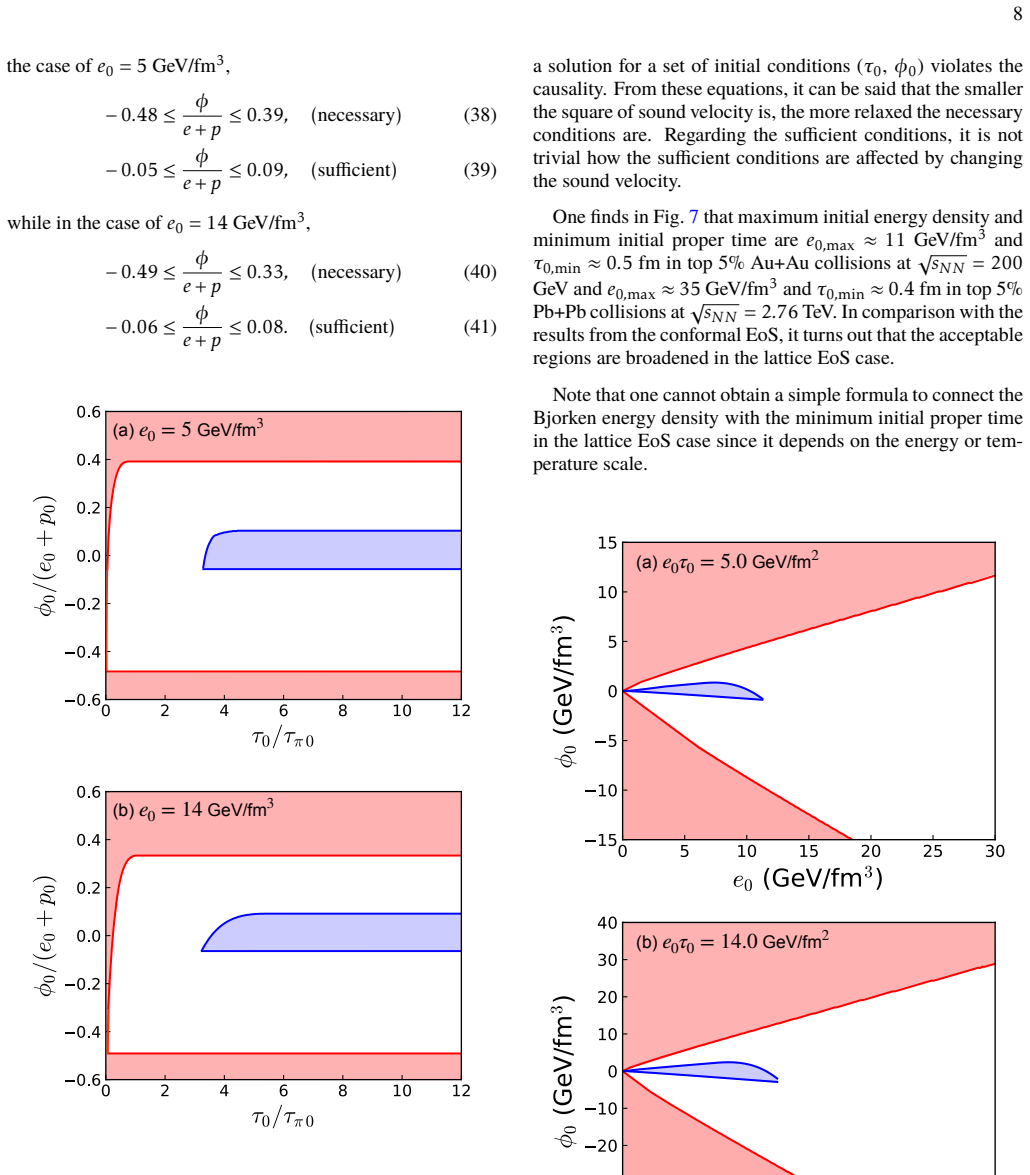
The paper's central claim is that for boost-invariant one-dimensional expansion, the BRSSS constitutive equation has a finite causal window in the inverse Reynolds number. With the conformal equation of state and the AdS/CFT transport coefficients, the necessary conditions of nonlinear causality require $-0.47 \le \varphi/(e+p) \le 0.23$, while the sufficient conditions require $-0.07 \le \varphi/(e+p) \le 0.07$; any solution that leaves this window at any time is acausal. Because a Bjorken-expanding system can be driven far from local equilibrium even from $\varphi_0 = 0$ at very early proper times, the expansion itself forces a violation unless the initial proper time is large enough. Combining the causal-region boundary with the Bjorken energy-density formula $e_0 = (1/S)\,dE_T/dy$ measured at RHIC and LHC gives, for the conformal case, $\tau_{0,\min} \approx 1$ fm and $e_{0,\max} \approx 5$ GeV/fm$^3$ at RHIC and $\tau_{0,\min} \approx 0.7$ fm and $e_{0,\max} \approx 20$ GeV/fm$^3$ at LHC; with the lattice equation of state the bounds become $\tau_{0,\min} \approx 0.5$ fm and $e_{0,\max} \approx 11$ GeV/fm$^3$ at RHIC and $\tau_{0,\min} \approx 0.4$ fm and $e_{0,\max} \approx 35$ GeV/fm$^3$ at LHC.
Load-bearing premise
The one-dimensional, boost-invariant Bjorken flow is assumed to capture the expansion rate of the earliest fluid stage in heavy-ion collisions, and the derived bounds are applied to RHIC and LHC through the Bjorken formula; if transverse expansion and finite-size gradients are important at those times, the causality constraints and the resulting $\tau_{0,\min}$ and $e_{0,\max}$ could be weaker or stronger.
Editorial extensions
If this is right
- Initial conditions for hydrodynamic simulations of heavy-ion collisions must be chosen so that the entire trajectory, not just the initial state, stays inside the causal region.
- Starting from local equilibrium at sufficiently early times is ruled out, because the large expansion rate $\partial_\mu u^\mu = 1/\tau$ drives the system out of the causal window even when $\varphi_0 = 0$.
- For a conformal equation of state with $N_f = 3$, the minimum initial proper time satisfies $\tau_{0,\min} \approx 1.6 E_0^{-1/3}$ fm with $E_0 = (1/S)\,dE_T/dy$ in GeV/fm$^2$, giving the RHIC and LHC bounds quoted above.
- The lattice equation of state broadens the acceptable region, shifting the bounds to smaller $\tau_{0,\min}$ and larger $e_{0,\max}$ than the conformal case.
- The pre-hydrodynamic stage of relativistic heavy-ion collisions must be described by a non-equilibrium framework other than the BRSSS/Müller–Israel–Stewart dissipative hydrodynamics.
Reading between the lines
- If the early expansion is genuinely three-dimensional rather than one-dimensional Bjorken flow, the expansion scalar is generally smaller at a given longitudinal proper time, so the derived bounds could weaken or strengthen depending on the velocity gradients; the 1D assumption is the main caveat in applying these numbers to real collisions.
- The gap between the necessary and sufficient conditions leaves a band of initial conditions whose causal status is undetermined; directly computing the characteristic velocities of simulated 3D flows could shrink that band and sharpen the lower bound on $\tau_0$.
- Because the bounds depend on the chosen constitutive equation and transport coefficients, repeating the analysis with other second-order hydrodynamic schemes would quantify how much of $\tau_{0,\min}$ and $e_{0,\max}$ is scheme-specific.
- The inverse-Reynolds-number criterion could be applied locally to the output of pre-equilibrium models to decide, event by event and time by time, where a causal hydrodynamic description becomes legitimate rather than assuming a single global initial time.
Signed reviews
Editorial analysis
A structured set of objections, weighed in public.
Referee Report
Summary. The manuscript analyzes the nonlinear causality conditions of Bemfica et al. (Ref. [20]) for one-dimensional boost-invariant expansion described by the BRSSS constitutive equation. After transcribing the necessary and sufficient conditions into inequalities in terms of the shear pressure φ and thermodynamic variables, the authors determine the allowed range of the inverse Reynolds number, map the causal/acausal regions in the initial-condition plane, and combine these restrictions with the measured transverse energy per rapidity at RHIC and LHC to obtain minimum initial proper times and maximum initial energy densities. For the conformal EoS with N=4 SYM transport coefficients, the reported values are τ0,min ≈ 1 fm and e0,max ≈ 5 GeV/fm^3 at RHIC and 0.7 fm and 20 GeV/fm^3 at LHC; for the lattice EoS, the corresponding numbers are about 0.5 fm and 11 GeV/fm^3 (RHIC) and 0.4 fm and 35 GeV/fm^3 (LHC). The central claim is that large inverse Reynolds numbers violate nonlinear causality, so the initial stage of heavy-ion collisions may require a non-equilibrium description.
Significance. If the central claim holds, the paper offers a new, parameter-free (in the sense of no fitting to data) constraint on hydrodynamic initial conditions that is complementary to Bayesian extraction and to attractor studies. The derivation is transparent: the causality inequalities are taken from an external group, the 1D equations are evolved explicitly, and the conformal-limit results are cross-checked against Ref. [20]. The use of measured dET/dy is a concrete falsifiable step. However, the quantitative headline numbers are affected by an arithmetic error in Sec. III C, and the heavy-ion application rests on the 1D Bjorken approximation; these issues require correction before the numbers can be used.
major comments (3)
- [§III C, Eq. (37)] The prefactor in Eq. (37) does not follow from Eqs. (34)–(36). Combining Eq. (36) (τ0,minT0,max = 5.3 Cτπ) with Eq. (35) (e = 47.5 π^2/30 T^4) and the Bjorken relation e0 = E0/τ0 gives τ0,min = (5.3 Cτπ)^{4/3} (47.5 π^2/30)^{1/3} E0^{-1/3} ≈ 2.8 E0^{-1/3} fm, with Cτπ = (2−ln2)/(2π). The reported coefficient 1.6 would correspond to τ0,minT0,max ≈ 0.74, inconsistent with Eq. (36) and with Fig. 3. Consequently, the numbers in the abstract and Sec. IV for the conformal case change to τ0,min ≈ 1.6 fm and e0,max ≈ 3.0 GeV/fm^3 for RHIC (E0 = 5 GeV/fm^2) and τ0,min ≈ 1.2 fm and e0,max ≈ 12 GeV/fm^3 for LHC (E0 = 14 GeV/fm^2). The lattice-EoS values in Sec. III D are obtained by an analogous read-out and would also shift. The qualitative conclusion that nonlinear causality constrains initial conditions is unaffected, but the quantitative claims are not justified by the stated equations.
- [§III C; §IV] The conversion from the 1D Bjorken constraints to RHIC/LHC initial conditions assumes that the early-stage expansion is effectively one-dimensional and boost invariant at the relevant times (τ0 ≈ 0.5–1.6 fm). Transverse expansion and finite-size gradients are neglected. Since the derived τ0,min and e0,max are applied to heavy-ion collisions through the Bjorken formula, this is a load-bearing premise: in a more 3D expansion, the causality constraints could be weaker or stronger. The manuscript should discuss the expected magnitude of this effect or explicitly limit the heavy-ion conclusions to the 1D approximation.
- [§II A; §III D] The quantitative bounds for the lattice EoS (Sec. III D, Figs. 6–7) use the N=4 SYM transport coefficients (5) together with a nonconformal lattice EoS. This is acknowledged in Sec. II A, but the resulting systematic uncertainty is not estimated; the lattice-EoS numbers are presented in the abstract as if they were more realistic than the conformal ones. The authors should either provide an estimate of how the bounds vary with Cη, Cτπ, Cλ or clearly flag that the numbers are only illustrative examples.
minor comments (6)
- [Eq. (34)] The notation 'E0 (GeV/fm^2) = E0/(ℏc) (1/fm^3)' is dimensionally confusing; please rewrite the unit conversion explicitly, e.g., state that in natural units with ℏc = 0.197 GeV fm, 1 GeV/fm^2 ≈ 5.07 fm^{-3}.
- [Sec. II B] The extrapolation of the lattice EoS to temperatures outside the fitted range (0.13–0.4 GeV) is stated, but its impact on the constraints is not quantified; a sentence noting that the results for very high T are extrapolations would be helpful.
- [Figs. 4, 5] The captions contain typos such as 'fmτ0=0.20' where a space is missing; please fix these typographical issues.
- [Abstract and Sec. IV] The conclusion that the initial stage needs a non-equilibrium description is stated in absolute terms; adding the qualifier 'within the 1D Bjorken approximation' would be more accurate.
- [Sec. III B] The bounds in Eqs. (31) and (32) are specific to the conformal EoS and N=4 SYM transport coefficients; this should be stated in the main text immediately after the equations, not only in the caption of Fig. 2.
- [Appendix A, Eq. (A2)] The notation f = 1 ± 1/2 Re^{-1} is slightly confusing because the sign depends on the sign of φ; it may help to write f = 1 + 3φ/(8e) explicitly.
Circularity Check
No circularity: causality bounds are external inputs and the initial-time constraints are derived, not fitted.
full rationale
The paper's central derivation chain is self-contained against external inputs. The nonlinear causality inequalities (13)-(30) are taken from the independent work of Bemfica et al. (Ref. [20]) and are re-expressed for one-dimensional Bjorken flow; they are not derived from the paper's own conclusions. The AdS/CFT transport coefficients (C_eta, C_tau_pi, C_lambda) come from Refs. [26,27], the conformal and lattice equations of state are standard external inputs, and the values e0*tau0 = 5 and 14 GeV/fm^2 come from measured dET/dy at RHIC and LHC (Refs. [37,38]). The inverse-Reynolds-number bounds (31)-(32) are outputs of plugging those coefficients into the external inequalities, not fitted targets. The minimum proper time formula (37) is obtained by combining the causality-derived ratio tau0/tau_pi ≈ 5.3 with the conformal EoS and the experimental Bjorken energy density; it is a genuine prediction rather than a restatement of an input. No load-bearing argument depends on self-citation: Ref. [20] is external, and the authors' prior works are cited only for context (e.g., core-corona modeling) or not used to fix the main result. The skeptical concern about the numerical prefactor in Eq. (37) is an arithmetic/correctness issue, not a circularity, and does not change the non-circular structure of the derivation.
Assumptions & free parameters
free parameters (2)
- HotQCD lattice EoS fit coefficients =
ct=3.8706, t0=-0.9761, an=-8.7704, bn=3.9200, dn=0.3419, ad=-1.26, bd=0.8425, dd=-0.0475
- N=4 SYM transport constants C_eta, C_tau_pi, C_lambda =
C_eta=1/(4π), C_tau_pi=(2-ln2)/(2π), C_lambda=1/(2π)
assumptions (5)
- domain assumption The nonlinear causality necessary and sufficient conditions of Ref. [20] apply to the BRSSS system used here.
- domain assumption The flow is exactly boost-invariant with Bjorken four-velocity u^mu=(t,0,0,z)/tau and no transverse gradients.
- domain assumption N=4 SYM transport coefficients provide a valid approximation for QGP even when combined with the nonconformal lattice EoS.
- domain assumption The Bjorken estimate e0=(1/(tau0 S)) dET/dy relates measured transverse energy to initial energy density.
- domain assumption The sufficient conditions, not merely the necessary conditions, define the causal initial-condition region.
Cite this review
Pith. "Pith review of Constraint on initial conditions of one-dimensional expanding fluids from nonlinear causality." pith.science (2026). https://pith.science/paper/XOFUATOR
@misc{pith2026241202405,
  author       = {Pith},
  title        = {Pith review of: Constraint on initial conditions of one-dimensional expanding fluids from nonlinear causality},
  year         = {2026},
  howpublished = {\url{https://pith.science/paper/XOFUATOR}},
  note         = {Machine review of arXiv:2412.02405}
}
read the original abstract
The initial conditions of one-dimensional expanding viscous fluids in relativistic heavy-ion collisions are scrutinized in terms of nonlinear causality of the relativistic hydrodynamic equations. Conventionally, it is believed that the matter generated in relativistic heavy-ion collisions starts to behave as a fluid all at once at some initial time. However, it is by no means trivial how soon after the first contact of two high-energy nuclei the fluid picture can be applied. It is demonstrated that one-dimensional expanding viscous fluids violate the necessary and the sufficient conditions of nonlinear causality at large departures from local equilibrium. We therefore quantify the inverse Reynolds number to justify the hydrodynamic description to be valid. The initial conditions are strictly constrained not to violate the causality conditions during the time evolution. With the help of the transverse energies per rapidity measured at RHIC and LHC, we obtain the minimum initial proper time and the maximum energy density allowed by nonlinear causality. This analysis strongly suggests that the initial stage of relativistic heavy-ion collisions needs to be described by a non-equilibrium description other than the framework of relativistic dissipative hydrodynamics.
Figures


Figures from the paper (5 more)




Forward citations
Cited by 3 Pith papers
-
Necessary and sufficient conditions of nonlinear causality in viscous anisotropic hydrodynamics
The leading-order VAH equations stay causal exactly when the three dimensionless ratios in Eq. (21) satisfy the stated chain inequalities.
-
Relativistic Dispersion Spectra across Lorentz boosted frames: Spurious modes and the enigma of causality
Rest-frame dispersion modes can be mapped into Lorentz-boosted frames through a parametric re-parametrization; the boost-generated 'spurious' roots appear exactly when the mode count is not conserved, which the author...
-
Mapping Sparse Triangular Solves to GPUs via Fine-grained Domain Decomposition
A domain-decomposition scheme sizes subdomains to GPU shared memory to remove synchronization from sparse triangular solves, reporting 10.7x and 3.2x speedups for triangular solves and ILU0-BiCGSTAB on the AMD MI210.
Reference graph
Works this paper leans on
-
[20]
F. S. Bemfica, M. M. Disconzi, V. Hoang, J. Noronha, and M. Radosz, Phys. Rev. Lett. 126, 222301 (2021), arXiv:2005.11632 [hep-th]
arXiv 2021
-
[1]
K. Yagi, T. Hatsuda, and Y. Miake, Quark-Gluon Plasma, Vol. 23 (Cambridge University Press, 2005)
work page 2005
-
[2]
T. Hirano and M. Gyulassy, Nucl. Phys. A 769, 71 (2006), arXiv:nucl-th/0506049
arXiv 2006
-
[3]
J. E. Bernhard, J. S. Moreland, S. A. Bass, J. Liu, and U. Heinz, Phys. Rev. C94, 024907 (2016), arXiv:1605.03954 [nucl-th]
arXiv 2016
-
[4]
J. E. Bernhard, J. S. Moreland, and S. A. Bass, Nature Phys.15, 1113 (2019)
2019
-
[5]
J. Auvinen, K. J. Eskola, P. Huovinen, H. Niemi, R. Paate- lainen, and P. Petreczky, Phys. Rev. C 102, 044911 (2020), arXiv:2006.12499 [nucl-th]
arXiv 2020
-
[6]
G. Nijs, W. van der Schee, U. G¨ursoy, and R. Snellings, Phys. Rev. Lett.126, 202301 (2021), arXiv:2010.15130 [nucl-th]
arXiv 2021
-
[7]
G. Nijs, W. van der Schee, U. G¨ursoy, and R. Snellings, Phys. Rev. C103, 054909 (2021), arXiv:2010.15134 [nucl-th]
arXiv 2021
Show all 72 references
-
[8]
J. E. Parkkila, A. Onnerstad, and D. J. Kim, Phys. Rev. C 104, 054904 (2021), arXiv:2106.05019 [hep-ph]
2021 arXiv
-
[9]
Everett et al
D. Everett et al. (JETSCAPE), Phys. Rev. C103, 054904 (2021), arXiv:2011.01430 [hep-ph]
2021 arXiv
-
[10]
M. R. Heffernan, C. Gale, S. Jeon, and J.-F. Paquet, (2023), arXiv:2306.09619 [nucl-th]
2023 arXiv
-
[11]
C. Shen, B. Schenke, and W. Zhao, (2023), arXiv:2310.10787 [nucl-th]
2023 arXiv
-
[12]
M ¨uller, Z
I. M ¨uller, Z. Phys.198, 329 (1967)
1967
-
[13]
Israel, Annals Phys
W. Israel, Annals Phys. 100, 310 (1976)
1976
-
[14]
Israel and J
W. Israel and J. M. Stewart, Annals Phys.118, 341 (1979)
1979
-
[15]
W. A. Hiscock and L. Lindblom, Annals Phys.151, 466 (1983)
1983
-
[16]
W. A. Hiscock and T. S. Olson, Physics Letters A 141, 125 (1989)
1989
-
[17]
G. S. Denicol, T. Kodama, T. Koide, and P. Mota, J. Phys. G35, 115102 (2008), arXiv:0807.3120 [hep-ph]
2008 arXiv
-
[18]
S. Pu, T. Koide, and D. H. Rischke, Phys. Rev. D 81, 114039 (2010), arXiv:0907.3906 [hep-ph]
2010 arXiv
-
[19]
Floerchinger and E
S. Floerchinger and E. Grossi, JHEP 08, 186 (2018), arXiv:1711.06687 [nucl-th]
2018 arXiv
-
[21]
Plumberg, D
C. Plumberg, D. Almaalol, T. Dore, J. Noronha, and J. Noronha- Hostler, Phys. Rev. C105, L061901 (2022), arXiv:2103.15889 [nucl-th]
2022 arXiv
-
[22]
Chiu and C
C. Chiu and C. Shen, Phys. Rev. C 103, 064901 (2021), arXiv:2103.09848 [nucl-th]
2021 arXiv
-
[23]
T. N. da Silva, D. D. Chinellato, A. V. Giannini, M. N. Fer- reira, G. S. Denicol, M. Hippert, M. Luzum, J. Noronha, and J. Takahashi (ExTrEMe), Phys. Rev. C 107, 044901 (2023), arXiv:2211.10561 [nucl-th]
2023 arXiv
-
[24]
Krupczak et al
R. Krupczak et al. (ExTrEMe), Phys. Rev. C 109, 034908 (2024), arXiv:2311.02210 [nucl-th]
2024 arXiv
-
[25]
T. S. Domingues, R. Krupczak, J. Noronha, T. N. da Silva, J.-F. Paquet, and M. Luzum, (2024), arXiv:2409.17127 [nucl-th]
2024 arXiv
-
[26]
Baier, P
R. Baier, P. Romatschke, D. T. Son, A. O. Starinets, and M. A. Stephanov, JHEP04, 100 (2008), arXiv:0712.2451 [hep-th]
2008 arXiv
-
[27]
Kovtun, D
P. Kovtun, D. T. Son, and A. O. Starinets, Phys. Rev. Lett. 94, 111601 (2005), arXiv:hep-th/0405231
2005 arXiv
-
[28]
Bazavov et al
A. Bazavov et al. (HotQCD), Phys. Rev. D 90, 094503 (2014), arXiv:1407.6387 [hep-lat]
2014 arXiv
-
[29]
J. D. Bjorken, Phys. Rev. D27, 140 (1983)
1983
-
[30]
M. P. Heller and M. Spalinski, Phys. Rev. Lett. 115, 072501 (2015), arXiv:1503.07514 [hep-th]
2015 arXiv
-
[31]
Baier, P
R. Baier, P. Romatschke, and U. A. Wiedemann, Phys. Rev. C 73, 064903 (2006), arXiv:hep-ph/0602249
2006 arXiv
-
[32]
Chattopadhyay and U
C. Chattopadhyay and U. W. Heinz, Phys. Lett. B 801, 135158 (2020), arXiv:1911.07765 [nucl-th]
2020 arXiv
- [33]
-
[34]
Romatschke, Phys
P. Romatschke, Phys. Rev. Lett. 120, 012301 (2018), arXiv:1704.08699 [hep-th]
2018 arXiv
-
[35]
Florkowski, M
W. Florkowski, M. P. Heller, and M. Spalinski, Rept. Prog. Phys. 81, 046001 (2018), arXiv:1707.02282 [hep-ph]
2018 arXiv
-
[36]
Jankowski and M
J. Jankowski and M. Spali ´nski, Prog. Part. Nucl. Phys. 132, 104048 (2023), arXiv:2303.09414 [nucl-th]
2023 arXiv
-
[37]
Adams et al
J. Adams et al. (STAR), Phys. Rev. C 70, 054907 (2004), arXiv:nucl-ex/0407003
2004 arXiv
-
[38]
Chatrchyan et al
S. Chatrchyan et al. (CMS), Phys. Rev. Lett.109, 152303 (2012), arXiv:1205.2488 [nucl-ex]
2012 arXiv
-
[39]
B. Betz, D. Henkel, and D. H. Rischke, Prog. Part. Nucl. Phys. 62, 556 (2009), arXiv:0812.1440 [nucl-th]
2009 arXiv
-
[40]
B. Betz, D. Henkel, and D. H. Rischke, J. Phys. G 36, 064029 (2009)
2009
-
[41]
G. S. Denicol, H. Niemi, E. Molnar, and D. H. Rischke, Phys. Rev. D 85, 114047 (2012), [Erratum: Phys.Rev.D 91, 039902 (2015)], arXiv:1202.4551 [nucl-th]
2012 arXiv
-
[42]
Monnai and T
A. Monnai and T. Hirano, Nucl. Phys. A 847, 283 (2010), arXiv:1003.3087 [nucl-th]
2010 arXiv
-
[43]
Tsumura, T
K. Tsumura, T. Kunihiro, and K. Ohnishi, Phys. Lett. B 646, 134 (2007), [Erratum: Phys.Lett.B 656, 274 (2007)], arXiv:hep- ph/0609056
2007
-
[44]
Tsumura and T
K. Tsumura and T. Kunihiro, Phys. Lett. B 690, 255 (2010), arXiv:0906.0079 [hep-ph]
2010 arXiv
-
[45]
Tsumura and T
K. Tsumura and T. Kunihiro, Phys. Rev. E 87, 053008 (2013), arXiv:1206.3913 [physics.flu-dyn]
2013 arXiv
- [46]
-
[47]
M. P. Heller, A. Kurkela, M. Spali´nski, and V. Svensson, Phys. Rev. D97, 091503 (2018), arXiv:1609.04803 [nucl-th]
2018 arXiv
-
[48]
Blaizot and L
J.-P. Blaizot and L. Yan, Phys. Lett. B 780, 283 (2018), arXiv:1712.03856 [nucl-th]
2018 arXiv
-
[49]
Behtash, C
A. Behtash, C. N. Cruz-Camacho, and M. Martinez, Phys. Rev. D 97, 044041 (2018), arXiv:1711.01745 [hep-th]
2018 arXiv
-
[50]
M. P. Heller and V. Svensson, Phys. Rev. D98, 054016 (2018), arXiv:1802.08225 [nucl-th]
2018 arXiv
-
[51]
Strickland, JHEP 12, 128 (2018), arXiv:1809.01200 [nucl- th]
M. Strickland, JHEP 12, 128 (2018), arXiv:1809.01200 [nucl- th]
2018 arXiv
-
[52]
G. S. Denicol and J. Noronha, Phys. Rev. Lett. 124, 152301 (2020), arXiv:1908.09957 [nucl-th]
2020 arXiv
-
[53]
M. P. Heller, R. Jefferson, M. Spali´nski, and V. Svensson, Phys. Rev. Lett.125, 132301 (2020), arXiv:2003.07368 [hep-th]
2020 arXiv
-
[54]
Kamata, M
S. Kamata, M. Martinez, P. Plaschke, S. Ochsenfeld, and S. Schlichting, Phys. Rev. D 102, 056003 (2020), 14 arXiv:2004.06751 [hep-ph]
2020 arXiv
-
[55]
Almaalol, A
D. Almaalol, A. Kurkela, and M. Strickland, Phys. Rev. Lett. 125, 122302 (2020), arXiv:2004.05195 [hep-ph]
2020 arXiv
-
[56]
Chattopadhyay, S
C. Chattopadhyay, S. Jaiswal, L. Du, U. Heinz, and S. Pal, Phys. Lett. B 824, 136820 (2022), arXiv:2107.05500 [nucl-th]
2022 arXiv
-
[57]
Jaiswal, J.-P
S. Jaiswal, J.-P. Blaizot, R. S. Bhalerao, Z. Chen, A. Jaiswal, and L. Yan, Phys. Rev. C106, 044912 (2022), arXiv:2208.02750 [nucl-th]
2022 arXiv
-
[58]
Brewer, W
J. Brewer, W. Ke, L. Yan, and Y. Yin, Phys. Rev. D 109, L091504 (2024), arXiv:2212.00820 [nucl-th]
2024 arXiv
-
[59]
E. M. Lifshitz and L. P. Pitaevskii, Physical Kinetics, 2nd ed., Course of Theoretical Physics, Vol. 10 (Butterworth- Heinemann, 1981)
1981
- [60]
-
[61]
Pierog, I
T. Pierog, I. Karpenko, J. M. Katzy, E. Yatsenko, and K. Werner, Phys. Rev. C92, 034906 (2015), arXiv:1306.0121 [hep-ph]
2015 arXiv
-
[62]
Werner, B
K. Werner, B. Guiot, I. Karpenko, and T. Pierog, Phys. Rev. C 89, 064903 (2014), arXiv:1312.1233 [nucl-th]
2014 arXiv
- [63]
-
[64]
Kanakubo, M
Y. Kanakubo, M. Okai, Y. Tachibana, and T. Hirano, PTEP 2018, 121D01 (2018), arXiv:1806.10329 [nucl-th]
2018 arXiv
-
[65]
Kanakubo, Y
Y. Kanakubo, Y. Tachibana, and T. Hirano, Phys. Rev. C 101, 024912 (2020), arXiv:1910.10556 [nucl-th]
2020 arXiv
-
[66]
Kanakubo, Y
Y. Kanakubo, Y. Tachibana, and T. Hirano, Phys. Rev. C 105, 024905 (2022), arXiv:2108.07943 [nucl-th]
2022 arXiv
-
[67]
Kanakubo, Y
Y. Kanakubo, Y. Tachibana, and T. Hirano, Phys. Rev. C 106, 054908 (2022), arXiv:2207.13966 [nucl-th]
2022 arXiv
- [68]
-
[69]
Murase, Causal hydrodynamic fluctuations and their effects on high-energy nuclear collisions, Ph.D
K. Murase, Causal hydrodynamic fluctuations and their effects on high-energy nuclear collisions, Ph.D. thesis, Tokyo U. (2015)
2015
-
[70]
Sakai, K
A. Sakai, K. Murase, and T. Hirano, Phys. Rev. C 102, 064903 (2020), arXiv:2003.13496 [nucl-th]
2020 arXiv
-
[71]
Sakai, K
A. Sakai, K. Murase, and T. Hirano, Phys. Lett. B 829, 137053 (2022), arXiv:2111.08963 [nucl-th]
2022 arXiv
-
[72]
Kuroki, A
K. Kuroki, A. Sakai, K. Murase, and T. Hirano, Phys. Lett. B 842, 137958 (2023), arXiv:2305.01977 [nucl-th]
2023 arXiv
Reviewed August 11, 2026 · model on record in the stance chip above.
Discussion (0). Continue with ORCID to comment.