A Fully Tunable Ultra-Low Power Current-Mode Memory Cell in Standard CMOS Technology
Pith reviewed 2026-05-20 22:42 UTC · model grok-4.3
The pith
A nine-transistor current-mode circuit in standard CMOS provides independent tuning of threshold current, hysteresis width, and output gain for bistable memory.
A machine-rendered reading of the paper's core claim, the machinery that carries it, and where it could break.
Core claim
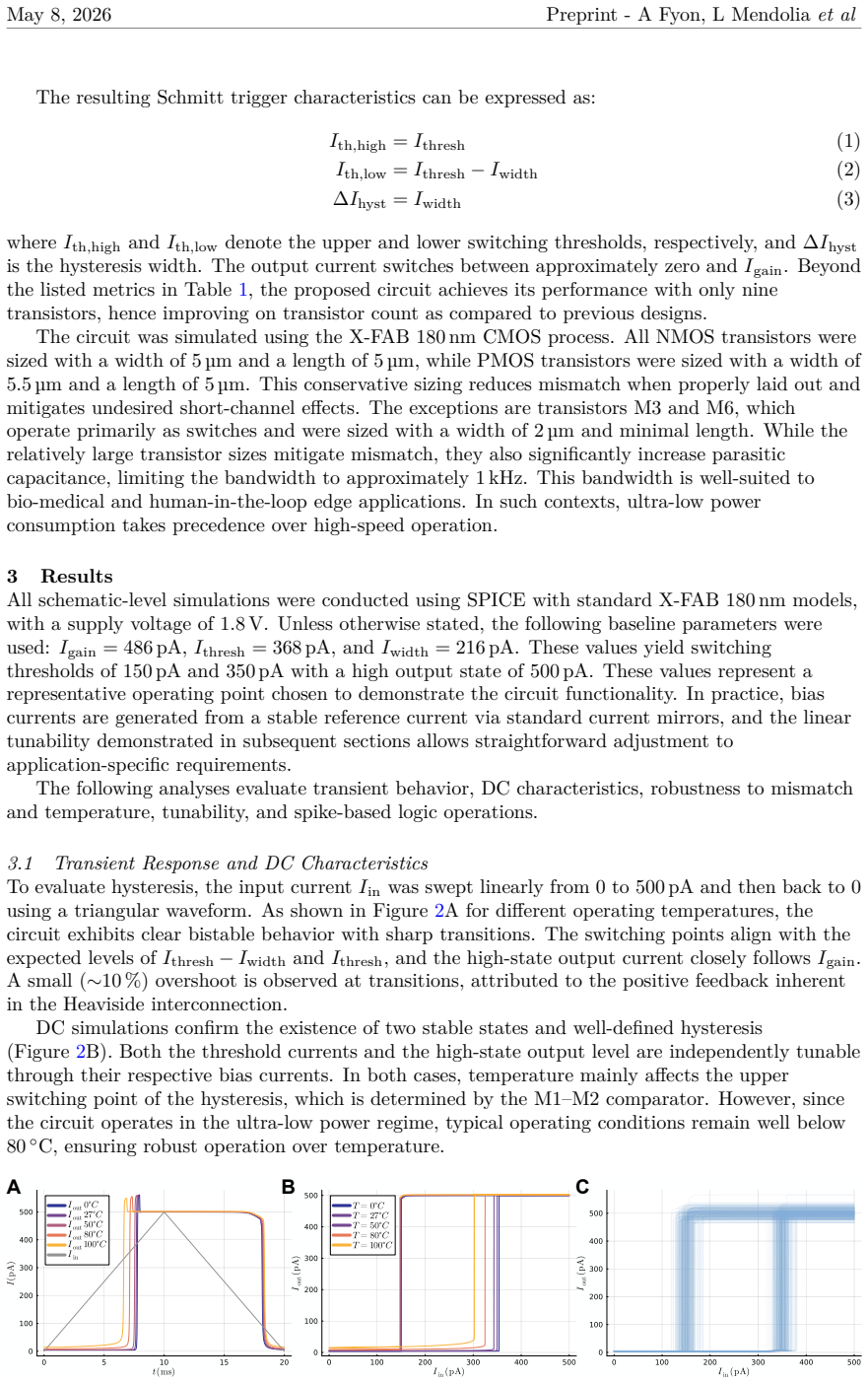
By connecting two interdependent Heaviside-like thresholding elements in a novel feedback configuration, a nine-transistor circuit in standard CMOS produces tunable bistable switching behavior in the current domain, with threshold current, hysteresis width, and output gain set independently by bias currents.
What carries the argument
A novel feedback configuration between two interdependent Heaviside-like thresholding elements that generates tunable bistable switching.
If this is right
- Spike-based logic gates can be built using three-level current encoding where the memory cell retains the polarity of the last spike indefinitely.
- The same cell serves as the primitive for Bistable Memory Recurrent Units in analog neural networks with inherent noise immunity from quantized states.
- The design enables asynchronous logic operations without temporal windowing or refresh mechanisms.
- Neuromorphic processors can integrate memory, logic, and recurrent computation using this versatile building block.
Where Pith is reading between the lines
- If the tunability holds in silicon, it could simplify the design of large-scale analog computing arrays by reducing the need for additional calibration circuits.
- The current-domain operation might allow direct interfacing with other current-mode neuromorphic components without voltage conversion overheads.
- Resilience to device mismatch as shown in simulations suggests potential for reliable operation in mass-produced chips.
- Extending the family of logic gates could lead to more complex asynchronous state machines in hardware.
Load-bearing premise
The schematic-level simulations in a 180 nm CMOS process accurately predict the behavior of fabricated chips, including stable hysteresis and tunability despite device mismatch and parasitics.
What would settle it
Fabricating the circuit in silicon and measuring that the three parameters cannot be tuned independently or that hysteresis collapses under realistic process variations would disprove the claims.
Figures



read the original abstract
This work introduces a fully tunable, ultra-low power unipolar memory cell inspired by the Schmitt-trigger comparator and designed in CMOS using only nine transistors. The proposed circuit operates entirely in the current domain and exploits a novel feedback configuration between two interdependent Heaviside-like thresholding elements to produce tunable bistable switching behavior. Its three key parameters-threshold current, hysteresis width, and output gain-are independently tunable via programmable bias currents, enabling flexibility across diverse analog computing applications. Unlike prior Schmitt-trigger designs, it simultaneously achieves current-mode operation, nanowatt-range power consumption, temperature stability, and full tunability, solely using standard MOSFET elements. Schematic-level simulations in a 180 nm CMOS process confirm robust hysteresis and resilience to device mismatch. Building on this circuit, we develop a complete family of spike-based logic gates using three-level current encoding, where the bistable memory retains the polarity of the last spike on each input indefinitely, enabling asynchronous logic operations without temporal windowing or refresh mechanisms. The same circuit also serves as the primitive for Bistable Memory Recurrent Units in analog neural networks, where the quantized hidden states provide inherent noise immunity. Together, these capabilities position the design as a versatile building block for next-generation neuromorphic processors integrating memory, logic, and recurrent computation.
Editorial analysis
A structured set of objections, weighed in public.
Referee Report
Summary. The paper introduces a nine-transistor current-mode memory cell in standard CMOS that uses a novel feedback loop between two interdependent Heaviside-like thresholding elements to realize bistable switching. The design claims independent tunability of threshold current, hysteresis width, and output gain through programmable bias currents, with schematic simulations in 180 nm CMOS demonstrating nanowatt power, temperature stability, mismatch resilience, and applications to spike-based logic gates and bistable memory recurrent units.
Significance. If the reported behavior holds in silicon, the circuit would provide a compact, fully tunable ultra-low-power primitive that integrates memory, logic, and recurrent computation for neuromorphic systems, improving on prior Schmitt-trigger memory cells by achieving current-domain operation and independent parameter control with minimal transistors. The simulation-based verification of robust hysteresis is a positive but limited strength.
major comments (2)
- [§III] §III (Simulation Results): The claims of independent control over threshold current, hysteresis width, and output gain, plus mismatch resilience, rest exclusively on schematic-level netlist simulations. No post-layout parasitic extraction or measured silicon data are presented, leaving open whether interconnect capacitances and resistances on the current-mirror and feedback nodes couple the three parameters or shrink the bistable region, directly undermining the central tunability and ultra-low-power assertions.
- [§II] §II (Circuit Topology): The novel feedback configuration is asserted to produce truly independent tuning via bias currents alone, yet the manuscript provides no small-signal or large-signal analysis deriving the three parameters as functions of the bias currents; independence is shown only by sweeping bias values in simulation, which is load-bearing for the 'fully tunable' and 'parameter-free' positioning relative to prior work.
minor comments (2)
- [Figures] Figure captions and axis labels in the simulation plots should explicitly state whether the curves include or exclude post-layout parasitics.
- [Abstract] The abstract states 'temperature stability' without referencing the specific temperature range or simulation conditions used to support this claim.
Simulated Author's Rebuttal
We thank the referee for the constructive review and positive assessment of the circuit's potential impact. We address the two major comments point by point below, proposing specific revisions to strengthen the manuscript while being transparent about current limitations.
read point-by-point responses
-
Referee: [§III] §III (Simulation Results): The claims of independent control over threshold current, hysteresis width, and output gain, plus mismatch resilience, rest exclusively on schematic-level netlist simulations. No post-layout parasitic extraction or measured silicon data are presented, leaving open whether interconnect capacitances and resistances on the current-mirror and feedback nodes couple the three parameters or shrink the bistable region, directly undermining the central tunability and ultra-low-power assertions.
Authors: We agree that schematic simulations alone leave open questions about parasitic coupling. In the revised manuscript we will add post-layout simulations with extracted parasitics from a complete layout to verify that independent tunability of the three parameters and the size of the bistable region are preserved. We will also include a short discussion of expected parasitic effects on the current-mirror and feedback nodes. Measured silicon data cannot be provided at this stage because the design has not yet been fabricated; we will explicitly note this limitation and outline plans for future tape-out and measurement. revision: partial
-
Referee: [§II] §II (Circuit Topology): The novel feedback configuration is asserted to produce truly independent tuning via bias currents alone, yet the manuscript provides no small-signal or large-signal analysis deriving the three parameters as functions of the bias currents; independence is shown only by sweeping bias values in simulation, which is load-bearing for the 'fully tunable' and 'parameter-free' positioning relative to prior work.
Authors: We accept that an analytical derivation would strengthen the claims. We will add a dedicated subsection in §II that presents a large-signal analysis of the interdependent feedback loop and derives approximate closed-form expressions for threshold current, hysteresis width, and output gain as functions of the three bias currents. These expressions will be cross-validated against the existing simulation sweeps and will clarify the degree of independence relative to earlier Schmitt-trigger memory cells. revision: yes
- Measured silicon data cannot be supplied because the circuit has only been simulated and has not been fabricated.
Circularity Check
No circularity: circuit topology verified by simulation
full rationale
The paper presents a proposed nine-transistor current-mode memory cell topology whose bistable behavior and independent tunability of threshold current, hysteresis width, and output gain are demonstrated via schematic-level simulations in 180 nm CMOS. No algebraic derivations, equations, or first-principles results are claimed that reduce to fitted parameters or self-referential inputs by construction. The design is introduced as a novel feedback configuration between thresholding elements, with performance claims resting on external simulation verification rather than internal fitting loops, self-citation chains, or renamed empirical patterns. This is a standard self-contained circuit design paper whose central claims do not collapse into their own inputs.
Axiom & Free-Parameter Ledger
free parameters (1)
- programmable bias currents
axioms (1)
- domain assumption Standard 180 nm CMOS process models accurately capture device behavior for schematic-level hysteresis analysis
Reference graph
Works this paper leans on
-
[1]
X. Ren et al. “A current-mode multiply-accumulate macro in sensing-computing fusion system for feature extraction and redundancy reduction”. In:IEEE Trans. Circuits Syst. II, Exp. Briefs(2025).doi:10.1109/tcsii.2025.3543173
-
[2]
Analog Versus Digital: Extrapolating from Electronics to Neurobiology
R. Sarpeshkar. “Analog Versus Digital: Extrapolating from Electronics to Neurobiology”. In: Neural Comput.10.7 (1998), pp. 1601–1638.doi:10.1162/089976698300017052
-
[3]
Memory devices and applications for in-memory computing
A. Sebastian et al. “Memory devices and applications for in-memory computing”. In:Nat. Nanotechnol.15.7 (2020), pp. 529–544.doi:10.1038/s41565-020-0655-z
-
[4]
In-Memory Computing with Resistive Switching Devices
D. Ielmini and H.-S. P. Wong. “In-Memory Computing with Resistive Switching Devices”. In: Nat. Electron.1.6 (2018), pp. 333–343.doi:10.1038/s41928-018-0092-2
-
[5]
Hardware implementation of memristor-based artificial neural networks
F. Aguirre et al. “Hardware implementation of memristor-based artificial neural networks”. In:Nat. Commun.15.1 (2024), p. 1974.doi:10.1038/s41467-024-45670-9
-
[6]
Challenges and trends of SRAM-based computing-in-memory for AI edge devices
C.-J. Jhang et al. “Challenges and trends of SRAM-based computing-in-memory for AI edge devices”. In:IEEE Trans. Circuits Syst. I68.5 (2021), pp. 1773–1786.doi: 10.1109/tcsi.2021.3064189
-
[7]
A review on SRAM-based computing in-memory: Circuits, functions, and applications
Z. Lin et al. “A review on SRAM-based computing in-memory: Circuits, functions, and applications”. In:J. Semicond.43.3 (2022), p. 031401.doi: 10.1088/1674-4926/43/3/031401
-
[8]
P. Mannocci et al. “A fully integrated analogue closed-loop in-memory computing accelerator based on static random-access memory”. In:Nat. Electron.(2026), pp. 1–13.doi: 10.1038/s41928-025-01549-1
-
[9]
H. Noguchi et al. “Which is the best dual-port SRAM in 45-nm process technology?—8T, 10T single end, and 10T differential”. In:2008 IEEE International Conference on Integrated Circuit Design and Technology and Tutorial. IEEE. 2008, pp. 55–58.doi: 10.1109/icicdt.2008.4567245
-
[10]
Physics for neuromorphic computing
D. Markovi´ c et al. “Physics for neuromorphic computing”. In:Nat. Rev. Phys.2.9 (2020), pp. 499–510.doi:10.1038/s42254-020-0208-2
-
[11]
Accurate deep neural network inference using computational phase-change memory
V. Joshi et al. “Accurate deep neural network inference using computational phase-change memory”. In:Nat. Commun.11.1 (2020), p. 2473.doi:10.1038/s41467-020-16108-9
-
[12]
Variability-aware memristive crossbars—a tutorial
A. P. James and L. O. Chua. “Variability-aware memristive crossbars—a tutorial”. In:IEEE Trans. Circuits Syst. II69.6 (2022), pp. 2570–2574.doi:10.1109/tcsii.2022.3169416
-
[13]
Research progress on solutions to the sneak path issue in memristor crossbar arrays
L. Shi et al. “Research progress on solutions to the sneak path issue in memristor crossbar arrays”. In:Nanoscale Adv.2.5 (2020), pp. 1811–1827.doi:10.1039/d0na00100g
-
[14]
A current-mode conductance-based silicon neuron for address-event neuromorphic systems
P. Livi and G. Indiveri. “A current-mode conductance-based silicon neuron for address-event neuromorphic systems”. In:Proc. IEEE Int. Symp. Circuits Syst. (ISCAS). 2009, pp. 2898–2901.doi:10.1109/iscas.2009.5118408. 9 May 8, 2026 Preprint - A Fyon, L Mendoliaet al
-
[15]
An ultra low power current-mode filter for neuromorphic systems and biomedical signal processing
C. Bartolozzi, S. Mitra, and G. Indiveri. “An ultra low power current-mode filter for neuromorphic systems and biomedical signal processing”. In:Proc. IEEE Biomed. Circuits Syst. Conf. (BioCAS). 2006, pp. 130–133.doi:10.1109/biocas.2006.4600325
-
[16]
2022 roadmap on neuromorphic computing and engineering
D. V. Christensen et al. “2022 roadmap on neuromorphic computing and engineering”. In: Neuromorphic Comput. Eng.2.2 (2022), p. 022501.doi:10.1088/2634-4386/ac4a83
-
[17]
Spike-based local synaptic plasticity: A survey of computational models and neuromorphic circuits
L. Khacef et al. “Spike-based local synaptic plasticity: A survey of computational models and neuromorphic circuits”. In:Neuromorphic Comput. Eng.3.4 (2023), p. 042001.doi: 10.1088/2634-4386/ad05da
-
[18]
Opportunities for neuromorphic computing algorithms and applications
C. D. Schuman et al. “Opportunities for neuromorphic computing algorithms and applications”. In:Nat. Comput. Sci.2.1 (2022), pp. 10–19.doi: 10.1038/s43588-021-00184-y
-
[19]
A. Rubino et al.Neuromorphic analog circuits for robust on-chip always-on learning in spiking neural networks. 2023. arXiv:2307.06084 [cs.NE]
-
[20]
E. Gale. “Neuromorphic computation with spiking memristors: habituation, experimental instantiation of logic gates and a novel sequence-sensitive perceptron model”. In:Faraday Discuss.213 (2019), pp. 521–551.doi:10.1039/C8FD00111A
-
[21]
A. Ayuso-Martinez et al. “Construction of a spike-based memory using neural-like logic gates based on Spiking Neural Networks on SpiNNaker”. In:IEEE Trans. Emerg. Top. Comput.11 (2023), pp. 868–881.doi:10.1109/TETC.2023.3281063
-
[22]
LogicSNN: A Unified Spiking Neural Networks Logical Operation Paradigm
L. Mo and M. Wang. “LogicSNN: A Unified Spiking Neural Networks Logical Operation Paradigm”. In:Electronics10.17 (2021), p. 2123.doi:10.3390/electronics10172123
-
[23]
Logic gates based on neuristors made from two-dimensional materials
H. Chen et al. “Logic gates based on neuristors made from two-dimensional materials”. In: Nat. Electron.4.6 (2021), pp. 399–404.doi:10.1038/s41928-021-00591-z
-
[24]
Logic-in-memory based on an atomically thin semiconductor
G. Migliato Marega et al. “Logic-in-memory based on an atomically thin semiconductor”. In: Nature587.7832 (2020), pp. 72–77.doi:10.1038/s41586-020-2861-0
-
[25]
B. L. Doki´ c. “CMOS Schmitt triggers”. In:IEE Proc. G131 (1984), pp. 197–202.doi: 10.1049/ip-g-1.1984.0037
-
[26]
I. M. Filanovsky and H. Baltes. “CMOS Schmitt trigger design”. In:IEEE Trans. Circuits Syst. I41.1 (2002), pp. 46–49.doi:10.1109/81.260219
-
[27]
CMOS adjustable Schmitt triggers
Z. Wang. “CMOS adjustable Schmitt triggers”. In:IEEE Trans. Instrum. Meas.40.3 (2002), pp. 601–605.doi:10.1109/19.87026
-
[28]
A 160 mV robust Schmitt trigger based subthreshold SRAM
J. P. Kulkarni, K. Kim, and K. Roy. “A 160 mV robust Schmitt trigger based subthreshold SRAM”. In:IEEE J. Solid-State Circuits42.10 (2007), pp. 2303–2313.doi: 10.1109/jssc.2007.897148
-
[29]
Parallelizable memory recurrent units
F. De Geeter et al.Parallelizable memory recurrent units. 2026. arXiv:2601.09495 [cs.LG]
work page internal anchor Pith review Pith/arXiv arXiv 2026
-
[30]
J. Brandoit et al.Improving the Performance and Learning Stability of Parallelizable RNNs Designed for Ultra-Low Power Applications. 2026. arXiv:2605.11855 [cs.LG]
work page internal anchor Pith review Pith/arXiv arXiv 2026
-
[31]
Hardware-Software Co-Design of Scalable, Energy-Efficient Analog Recurrent Computations
A. Fyon et al.Hardware-Software Co-Design of Scalable, Energy-Efficient Analog Recurrent Computations. 2026. arXiv:2605.15216 [cs.AR]
work page internal anchor Pith review Pith/arXiv arXiv 2026
-
[32]
M. Siripruchyanun and J. Hirunporm. “A fully/electronically controllable voltage-mode Schmitt trigger based on only single VDGA and its applications”. In:AEU - Int. J. Electron. Commun.131 (2021), p. 153602.doi:10.1016/j.aeue.2020.153602
-
[33]
M. Steyaert and W. Sansen. “Novel CMOS Schmitt trigger”. In:Electron. Lett.22.4 (1986), pp. 203–204.doi:10.1049/el:19860142
-
[34]
Novel approach to high-speed CMOS current comparators
H. Traff. “Novel approach to high-speed CMOS current comparators”. In:Electron. Lett.28.3 (1992), pp. 310–311.doi:10.1049/el:19920192
-
[35]
OTA-R Schmitt trigger with independently controllable threshold and output voltage levels
K. Kim, H.-W. Cha, and W.-S. Chung. “OTA-R Schmitt trigger with independently controllable threshold and output voltage levels”. In:Electron. Lett.33.13 (1997), pp. 1103–1105.doi:10.1049/el:19970786
-
[36]
Single CDBA-based voltage-mode bistable multivibrator and its applications
R. Pal et al. “Single CDBA-based voltage-mode bistable multivibrator and its applications”. In:Circuits Syst.6.11 (2015), pp. 237–251.doi:10.4236/cs.2015.611024
-
[37]
A novel current conveyor-based Schmitt trigger and its application as a relaxation oscillator
A. Srinivasulu. “A novel current conveyor-based Schmitt trigger and its application as a relaxation oscillator”. In:Int. J. Circuit Theory Appl.39.6 (2011), pp. 679–686.doi: 10.1002/cta.669. 10 May 8, 2026 Preprint - A Fyon, L Mendoliaet al
-
[38]
A simple fully controllable Schmitt trigger with electronic method using VDTA
M. Siripruchyanun, P. Satthaphol, and K. Payakkakul. “A simple fully controllable Schmitt trigger with electronic method using VDTA”. In:Appl. Mech. Mater.781 (2015), pp. 180–183.doi:10.4028/www.scientific.net/amm.781.180
-
[39]
Novel CMOS current Schmitt trigger
Z. Wang and W. Guggenbohl. “Novel CMOS current Schmitt trigger”. In:Electron. Lett. 24.24 (1988), pp. 1514–1516.doi:10.1049/el:19881034
-
[40]
F. Yuan. “A high-speed differential CMOS Schmitt trigger with regenerative current feedback and adjustable hysteresis”. In:Analog Integr. Circuits Signal Process.63.1 (2010), pp. 121–127.doi:10.1007/s10470-009-9374-y
-
[41]
Low-voltage subthreshold CMOS current mode circuits: Design and applications
M. A. Eldeeb et al. “Low-voltage subthreshold CMOS current mode circuits: Design and applications”. In:AEU-Int. J. Electron. Commun.82 (2017), pp. 251–264.doi: 10.1016/j.aeue.2017.08.049
-
[42]
A current-mode Schmitt trigger based on current differencing transconductance amplifier
T. Srivyshnavi and A. Srinivasulu. “A current-mode Schmitt trigger based on current differencing transconductance amplifier”. In:Proc. IEEE Int. Conf. Signal Process., Commun. Netw. (ICSCN). 2015, pp. 1–4.doi:10.1109/icscn.2015.7219884
-
[43]
Novel electronically controlled current-mode Schmitt trigger based on single active element
A. Kumar and B. Chaturvedi. “Novel electronically controlled current-mode Schmitt trigger based on single active element”. In:AEU - Int. J. Electron. Commun.82 (2017), pp. 160–166.doi:10.1016/j.aeue.2017.08.007
-
[44]
A simple current-mode Schmitt trigger employing only single MO-CTTA
P. Silapan and M. Siripruchyanun. “A simple current-mode Schmitt trigger employing only single MO-CTTA”. In:Proc. 6th IEEE Int. Conf. Electr. Eng./Electron., Comput., Telecommun. Inf. Technol. (ECTI-CON). 2009, pp. 556–559.doi: 10.1109/ecticon.2009.5137068
-
[45]
P. Silapan and M. Siripruchyanun. “Fully and electronically controllable current-mode Schmitt triggers employing only single MO-CCCDTA and their applications”. In:Analog Integr. Circuits Signal Process.68.1 (2011), pp. 111–128.doi:10.1007/s10470-010-9593-2
-
[46]
Current-mode Schmitt trigger based on ZC-current differencing transconductance amplifier
S. Madira, V. V. Reddy, and A. Srinivasulu. “Current-mode Schmitt trigger based on ZC-current differencing transconductance amplifier”. In:Proc. IEEE Int. Conf. Inventive Comput. Technol. (ICICT). 2016, pp. 1–5.doi:10.1109/inventive.2016.7823226
-
[47]
A Schmitt trigger based on DDCCTA without any passive components
R. Linitha, A. Srinivasulu, and V. V. Reddy. “A Schmitt trigger based on DDCCTA without any passive components”. In:Proc. IEEE Int. Conf. Commun. Signal Process. (ICCSP). 2015, pp. 1695–1698.doi:10.1109/iccsp.2015.7322808
- [48]
-
[49]
Mlperf tiny benchmark.arXiv preprint arXiv:2106.07597, 2021a
C. Banbury et al.MLPerf Tiny Benchmark. 2021. arXiv:2106.07597 [cs.LG]
-
[50]
MCUNet: Tiny Deep Learning on IoT Devices
J. Lin et al. “MCUNet: Tiny Deep Learning on IoT Devices”. In:Advances in Neural Information Processing Systems. Vol. 33. Virtual, 2020, pp. 11711–11722
work page 2020
-
[51]
Hello Edge: Keyword Spotting on Microcontrollers
Y. Zhang et al.Hello Edge: Keyword Spotting on Microcontrollers. 2017. arXiv:1711.07128 [cs.SD]. 11
work page internal anchor Pith review Pith/arXiv arXiv 2017
discussion (0)
Sign in with ORCID, Apple, or X to comment. Anyone can read and Pith papers without signing in.