REVIEW 1 major objections 4 minor 63 references
The exact Schwarzian-corrected AdS2 throat has no confining minimum, so holographic Wilson loops screen as −κ/L² rather than linearly.
Reviewed by Pith at T0; open to challenge. T0 means a machine referee read the full paper against a public rubric. the ladder, T0–T4 →
T0 review · grok-4.5
2026-07-12 04:45 UTC pith:XSCXEYA2
load-bearing objection Exact all-depth Schwarzian metric factor kills the truncated linear-confinement claim and gives clean algebraic Wilson-loop screening. the 1 major comments →
Exact Schwarzian Metric Factor and Holographic Wilson-Loop Screening
The pith
A machine-rendered reading of the paper's core claim, the machinery that carries it, and where it could break.
Core claim
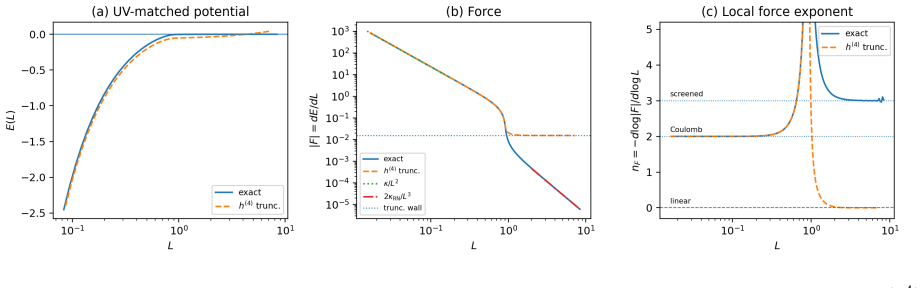
From the exact integral h(ξ)=2ξ²∫₀^∞ y³ e^{−ξ y²} coth(π y) dy, the confinement indicator G₀(ξ):=h(ξ)/ξ² is completely monotone on (0,∞) and therefore admits no finite-depth minimum. Any confining wall generated by a finite near-boundary Taylor truncation is consequently an artifact, and the rectangular Wilson loop in the exact throat screens algebraically: E(L)∼−κ_IR/L² with a closed-form coefficient fixed by the throat asymptotics.
What carries the argument
The Gaussian-weighted coth integral for the metric factor, turned by Mordell’s identity into an exact Appell–Lerch q/q*-series (with the quasimodular Eisenstein series E₂ generated by the third parametric derivative). Differentiation under the integral immediately proves complete monotonicity of G₀; the dual series isolates the nonperturbative channel invisible to any finite truncation.
Load-bearing premise
Observables are computed on the averaged metric rather than by averaging the worldsheet itself, and the throat factor is glued into the full geometry by a non-first-principles matching ansatz.
What would settle it
Construct a first-principles quantum-corrected AdS5-to-AdS2 interpolation, or evaluate the fully averaged worldsheet ⟨W[g]⟩ with the connected kernels, and check whether the effective string tension develops a positive minimum or the force exponent n_F remains near zero over an extended interval.
If this is right
- Earlier claims of a linear Cornell-like regime from truncated Schwarzian kernels do not survive in the exact throat geometry.
- The L^{−2} tail is a sharp Wilson-loop diagnostic of the semi-local (z→∞) critical infrared of extremal RN branes, distinct from thermal Debye screening.
- Only deep-IR screening is universal; intermediate-distance physics still depends on how the throat is matched to the UV.
- The same integral and complete-monotonicity argument apply to any near-extremal probe controlled by the identical Schwarzian kernel.
- Kernel fluctuations become order-one near ζ∼C, so deep-throat mean-geometry results are annealed statements; qualitative absence of confinement remains robust across moments.
Where Pith is reading between the lines
- Because the IR exponent depends on which moment of the bilocal is used to define the metric, a fully averaged worldsheet with re-extremization could produce a different power even while still screening.
- The forced appearance of E₂ from the third derivative points to a systematic resurgence link between UV Borel singularities of Schwarzian kernels and modular completion data across JT applications.
- An independent quantum dressing of the transverse dilaton sector could shift the screening exponent without restoring a confining minimum—the main structural assumption left open beyond mean-field.
- Any continuum dual of a semi-local quantum liquid at zero temperature should exhibit power-law rather than exponential heavy-quark screening, offering an independent check if such a dual is identified.
Editorial analysis
A structured set of objections, weighed in public.
Referee Report
Summary. The paper derives an exact integral representation for the Schwarzian-averaged radial metric factor h(ζ) in the AdS2 throat of an extremal RN-AdS5 black brane, reducing the known zero-temperature bilocal kernel to a Gaussian-weighted integral against coth(πy). Mordell’s identity then yields a closed Appell–Lerch q/q*-series that includes the quasimodular Eisenstein series E2 generated by the third parametric derivative. From the integral alone the authors prove that G0(ξ):=h(ξ)/ξ^{2} is completely monotone (Theorem 3), so it has no interior minimum; any confining minimum of a finite near-boundary truncation is therefore an artifact. The same asymptotics imply algebraic screening of the rectangular Wilson loop, E(L)∼-κ_IR/L^{2} with κ_IR given in closed form. Exact relative variance of the kernel and a moment-family robustness statement (Proposition 2) quantify the averaged-metric approximation, while a numerical check in a smooth matched ansatz confirms that the screened saddle remains on the physical branch.
Significance. If correct, the result cleanly resolves a qualitative claim in the recent literature: the linear quark-antiquark potential obtained from a truncated Schwarzian metric is an artifact of truncation, not a property of the exact throat. The complete-monotonicity proof is elementary, parameter-free, and rests only on positivity of the integrand; the IR coefficient κ_IR and the universal pure-throat curve are likewise closed-form. The variance analysis and moment-robustness statement make the annealed-metric caveat quantitative rather than rhetorical. The Mordell/Appell–Lerch evaluation and the appearance of E2 are of independent mathematical interest for JT/Schwarzian applications. The paper supplies reproducible quadrature details and falsifiable force-exponent diagnostics, which strengthen the claim.
major comments (1)
- The central claims (complete monotonicity of G0 and algebraic screening of the annealed Δ=1 throat) are secured by the integral representation (15) and the turning-point analysis of Sec. 4.4; they do not require the matching ansatz or the Mordell series. No load-bearing technical error was found. The only structural caveat that remains load-bearing for intermediate-distance coefficients (not for the IR exponent itself) is the non-first-principles continuation of h into the far region (Sec. 2 and Eq. (109)), which the paper already flags; a short explicit statement that all intermediate-L numbers are matching-calibrated would make the scope fully transparent.
minor comments (4)
- Sec. 3.3, Eq. (43): the reduction from the complex Mordell identity to the real q/q* form is dense; a short intermediate identity or a reference to a standard reduction of θ′′′/θ′ would help readers who wish to reproduce the E2 term.
- Fig. 7 caption and Sec. 4.5: the additive constant used to align the truncated energy curve should be stated numerically so that the force comparison is fully reproducible from the text alone.
- Notation: the same symbol h is used for both the throat factor h(ξ) and its far-region continuation h(U); a brief reminder at the first appearance of Eq. (9) would avoid momentary confusion.
- Appendix A.2: the software versions and the existence of a reproduction script are welcome; a one-line DOI or repository link (if available) would further improve long-term reproducibility.
Circularity Check
No significant circularity: exact h from the standard Schwarzian kernel, complete monotonicity from integrand positivity, and L^{-2} screening from IR endpoint analysis are independent of fitted inputs or self-citation chains.
full rationale
The derivation chain is self-contained against external benchmarks. The metric factor begins from the standard zero-temperature Schwarzian bilocal kernel of the JT literature (Eq. 7; Stanford–Witten, Mertens–Turiaci–Verlinde et al.), reduced by the classical gamma identity Γ(1+iy)Γ(1−iy)=πy/sinh(πy) to the Gaussian–coth integral (15). Mordell’s 1933 identity then supplies the Appell–Lerch/q-series form; neither step is a self-citation of the present author. Theorem 3 (complete monotonicity of G0) is a direct positivity argument under the integral sign—differentiation produces a strictly positive integrand—so the absence of an interior minimum is a proved property of that representation, not a quantity fitted or defined into existence. The IR law h∼ξ^{1/2} follows by endpoint localization of the same integral (Sec. 3.2); the turning-point analysis (Sec. 4.4) then yields E∼−κ_IR/L² with κ_IR closed-form (Eq. 108) once the physical scales C, L2, ℓx are fixed. Matching conventions and the annealed-metric frame are inherited from Liu–Yue–Nian–Zheng [24] (distinct authors) and are explicitly scoped: IR screening depends only on throat asymptotics, intermediate distances on the matching ansatz, and the paper quantifies the annealed approximation via the exact variance V(ξ) and moment-robust Proposition 2. No parameter is fitted to data and then re-predicted; no uniqueness theorem is imported from the author’s prior work; the Chern–Simons/Mordell citation [44] is only a mathematical precedent for the integral class. Score 0 is therefore the correct outcome.
Axiom & Free-Parameter Ledger
free parameters (2)
- JT heat capacity C (overall scale)
- Matching/continuation ansatz for h(U) outside the throat =
smooth RN-like f(U)=1-3/U^4+2/U^6 with h(U)=h_exact(ξ(U))
axioms (5)
- domain assumption Zero-temperature Schwarzian bilocal two-point kernel of JT gravity (Eq. 7) correctly encodes the quantum average that dresses the AdS2 metric factor.
- domain assumption Averaged-metric prescription: evaluate the Nambu–Goto functional on ⟨g⟩ rather than average the observable ⟨W[g]⟩.
- standard math Mordell’s identity for the integral M(x,θ;τ) and the standard modular properties of Appell–Lerch sums and θ11 (including θ'''11/θ'11 = −π² E2).
- domain assumption In the AdS2×T3 throat, g_xx is ζ-independent (transverse T3 volume sits in the dilaton sector and is not dressed by h).
- ad hoc to paper Far-region quantum-corrected metric is obtained by continuing the same h into the RN-AdS5 geometry via the matching conventions of [24].
read the original abstract
We evaluate exactly the radial metric factor $h(\zeta)$ generated by Schwarzian averaging in the AdS$_2$ throat of an extremal Reissner--Nordstr\"om AdS$_5$ black brane. The result is a Gaussian integral against $\coth(\pi y)$, valid at all radial depths, which Mordell's identity turns into an exact Appell--Lerch $q/q^\ast$-series representation. The dual series identifies the nonperturbative scale $e^{-\pi^2 C/\zeta}$ missed by any finite near-boundary truncation. The third parametric derivative required by the evaluation generates the quasimodular Eisenstein series $E_2$, absent from the classical Mordell identity. From the integral representation we prove that $\mathcal{G}_0(\zeta):=h(\zeta)/\zeta^2$ is completely monotone and hence has no interior minimum, so any confining minimum produced by a finite near-boundary truncation is an artifact. We also compute the exact relative variance of the Schwarzian kernel, which makes the averaged-metric approximation error quantitative and shows that the absence of a confining minimum is robust across moment-based effective geometries. Applied to the temporal rectangular Wilson loop, the exact throat gives algebraic screening, $E(L)\sim -\kappa_{\rm IR}/L^2$, the Wilson-loop diagnostic of the semi-local quantum-liquid IR of the extremal RN brane. A numerical check in a simple matched geometry confirms that the screened saddle is the dominant string configuration, and an exact-versus-truncated force comparison shows that the apparent constant-force regime of the fourth-order truncation is not a feature of the exact geometry.
Figures



Reference graph
Works this paper leans on
-
[1]
The Large N Limit of Superconformal Field Theories and Supergravity,
Juan Maldacena. The Large N Limit of Superconformal Field Theories and Supergravity,
-
[2]
Adv. Theor. Math. Phys. 2:231–252, arXiv:hep-th/9711200. 37
-
[3]
Anti-de Sitter Space and Holography, 1998
Edward Witten. Anti-de Sitter Space and Holography, 1998. Adv. Theor. Math. Phys. 2:253–291, arXiv:hep-th/9802150
Pith/arXiv arXiv 1998
-
[4]
Wilson Loops in Large N Field Theories, 1998
Juan Maldacena. Wilson Loops in Large N Field Theories, 1998. Phys. Rev. Lett. 80:4859–4862, arXiv:hep-th/9803002
Pith/arXiv arXiv 1998
-
[5]
Macroscopic Strings as Heavy Quarks: Large N Gauge Theory and Anti-de Sitter Supergravity, 2001
Soo-Jong Rey and Jung-Tay Yee. Macroscopic Strings as Heavy Quarks: Large N Gauge Theory and Anti-de Sitter Supergravity, 2001. Eur. Phys. J. C 22:379–394, arXiv:hep-th/9803001
Pith/arXiv arXiv 2001
-
[6]
Anti-de Sitter Space, Thermal Phase Transition, and Confinement in Gauge Theories, 1998
Edward Witten. Anti-de Sitter Space, Thermal Phase Transition, and Confinement in Gauge Theories, 1998. Adv. Theor. Math. Phys. 2:505–532, arXiv:hep-th/9803131
Pith/arXiv arXiv 1998
-
[7]
Andrew Chamblin, Roberto Emparan, Gary T. Horowitz, and Robert C. Myers. Charged AdS Black Holes and Catastrophic Holography, 1999. Phys. Rev. D 60:064018, arXiv:hep- th/9902170
arXiv 1999
-
[8]
Emergent Quantum Criticality, Fermi Surfaces, and AdS2, 2011
Thomas Faulkner, Hong Liu, John McGreevy, and David Vegh. Emergent Quantum Criticality, Fermi Surfaces, and AdS2, 2011. Phys. Rev. D 83:125002, arXiv:0907.2694
Pith/arXiv arXiv 2011
-
[9]
Semi-local Quantum Liquids, 2012
Nabil Iqbal, Hong Liu, and Mark Mezei. Semi-local Quantum Liquids, 2012. JHEP 04:086, arXiv:1105.4621
Pith/arXiv arXiv 2012
-
[10]
Lower Dimensional Gravity, 1985
Roman Jackiw. Lower Dimensional Gravity, 1985. Nucl. Phys. B 252:343–356
1985
-
[11]
Gravitation and Hamiltonian Structure in Two Spacetime Dimen- sions, 1983
Claudio Teitelboim. Gravitation and Hamiltonian Structure in Two Spacetime Dimen- sions, 1983. Phys. Lett. B 126:41–45
1983
-
[12]
Models of AdS 2 Backreaction and Holography,
Ahmed Almheiri and Joseph Polchinski. Models of AdS 2 Backreaction and Holography,
-
[13]
JHEP 11:014, arXiv:1402.6334
-
[14]
Remarks on the Sachdev–Ye–Kitaev Model
Juan Maldacena and Douglas Stanford. Remarks on the Sachdev–Ye–Kitaev Model. Phys. Rev. D, 94(10):106002, 2016, arXiv:1604.07818
Pith/arXiv arXiv 2016
-
[15]
Chaos in AdS 2 Holography, 2016
Kristan Jensen. Chaos in AdS 2 Holography, 2016. Phys. Rev. Lett. 117:111601, arXiv:1605.06098
Pith/arXiv arXiv 2016
-
[16]
Conformal Symmetry and Its Breaking in Two Dimensional Nearly Anti-de-Sitter Space, 2016
Juan Maldacena, Douglas Stanford, and Zhenbin Yang. Conformal Symmetry and Its Breaking in Two Dimensional Nearly Anti-de-Sitter Space, 2016. PTEP 2016:12C104, arXiv:1606.01857
Pith/arXiv arXiv 2016
-
[17]
The Quantum Gravity Dynamics of Near Extremal Black Holes, 2019
Zhenbin Yang. The Quantum Gravity Dynamics of Near Extremal Black Holes, 2019. JHEP 05:205, arXiv:1809.08647
Pith/arXiv arXiv 2019
-
[18]
Shenker, and Douglas Stanford
Phil Saad, Stephen H. Shenker, and Douglas Stanford. JT Gravity as a Matrix Integral,
-
[19]
Thomas G. Mertens and Gustavo J. Turiaci. Solvable Models of Quantum Black Holes: A Review on Jackiw–Teitelboim Gravity, 2023. Living Rev. Rel. 26(1):4, arXiv:2210.10846. 38
Pith/arXiv arXiv 2023
-
[20]
Alexei Kitaev and S. Josephine Suh. The Soft Mode in the Sachdev–Ye–Kitaev Model and Its Gravity Dual, 2018. JHEP 05:183, arXiv:1711.08467
Pith/arXiv arXiv 2018
-
[21]
Fermionic Localization of the Schwarzian Theory,
Douglas Stanford and Edward Witten. Fermionic Localization of the Schwarzian Theory,
-
[22]
JHEP 10:008, arXiv:1703.04612
-
[23]
Thomas G. Mertens, Gustavo J. Turiaci, and Herman L. Verlinde. Solving the Schwarzian via the Conformal Bootstrap, 2017. JHEP 08:136, arXiv:1705.08408
Pith/arXiv arXiv 2017
-
[24]
Thomas G. Mertens. The Schwarzian Theory – Origins, 2018. JHEP 05:036, arXiv:1801.09605
Pith/arXiv arXiv 2018
-
[25]
Andreas Blommaert, Thomas G. Mertens, and Henri Verschelde. Clocks and Rods in Jackiw–Teitelboim Quantum Gravity. JHEP, 09:060, 2019, arXiv:1902.11194
Pith/arXiv arXiv 2019
-
[26]
Luca V. Iliesiu and Gustavo J. Turiaci. The Statistical Mechanics of Near-Extremal Black Holes. JHEP, 05:145, 2021, arXiv:2003.02860
Pith/arXiv arXiv 2021
-
[27]
Quantum-Corrected Holographic Wilson Loop Expectation Values and Super-Yang-Mills Confinement, 2024
Xiao-Long Liu, Cong-Yuan Yue, Jun Nian, and Wenni Zheng. Quantum-Corrected Holographic Wilson Loop Expectation Values and Super-Yang-Mills Confinement, 2024. arXiv:2412.11107
Pith/arXiv arXiv 2024
-
[28]
Xiao-Long Liu, Jun Nian, and Leopoldo A. Pando Zayas. Quantum Corrections to Holographic Strange Metal at Low Temperature, 2024. arXiv:2410.11487
Pith/arXiv arXiv 2024
-
[29]
Pando Zayas, and Cong-Yuan Yue
Jun Nian, Leopoldo A. Pando Zayas, and Cong-Yuan Yue. Quantum Corrections in the Low-Temperature Fluid/Gravity Correspondence, 2025. arXiv:2510.15411
arXiv 2025
-
[30]
Pando Zayas and Jingchao Zhang
Leopoldo A. Pando Zayas and Jingchao Zhang. One-loop Corrected Holographic Shear Viscosity to Entropy Density Ratio at Low Temperatures, 2025. arXiv:2510.16100
arXiv 2025
-
[31]
Quantum Corrections to η/s from JT Gravity, 2025
Sera Cremonini, Li Li, Xiao-Long Liu, and Jun Nian. Quantum Corrections to η/s from JT Gravity, 2025. arXiv:2510.21602
arXiv 2025
-
[32]
Sabyasachi Maulik, Xin Meng, and Leopoldo A. Pando Zayas. Quantum-Corrected Hawking Radiation from Near-Extremal Kerr-Newman Black Holes, 2026. JHEP 02:205, arXiv:2501.08252
arXiv 2026
-
[33]
Zheng Jiang, Jun Nian, Caiying Shao, Yu Tian, and Hongbao Zhang. Quantum Gravity Corrections to Scalar Quasi-Normal Modes in Near-Extremal Reissner–Nordstr¨ om Black Holes, 2025. Phys. Rev. D 112:126019, arXiv:2506.22945
arXiv 2025
-
[34]
Blaise Gout´ eraux, David M. Ramirez, and Cl´ ement Supiot. Schwarzian Quantum Corrections to Shear Correlators of the Near-Extremal Reissner–Nordstr¨ om-AdS Black Hole, 2025. arXiv:2512.19642
Pith/arXiv arXiv 2025
-
[35]
Porfyriadis
Marios Kanargias, Elias Kiritsis, Sameer Murthy, Olga Papadoulaki, and Achilleas P. Porfyriadis. Holographic Shear Correlators at Low Temperatures, and Quantum η/s,
-
[36]
arXiv:2512.20443. 39
-
[37]
Lane, and Tung-Mow Yan
Estia Eichten, Kurt Gottfried, Toichiro Kinoshita, John Kogut, Kenneth D. Lane, and Tung-Mow Yan. Spectrum of Charmed Quark-Antiquark Bound States, 1975. Phys. Rev. Lett. 34:369–372
1975
-
[38]
Eichten, K
E. Eichten, K. Gottfried, T. Kinoshita, K. D. Lane, and T. M. Yan. Charmonium: The Model, 1978. Phys. Rev. D 17:3090
1978
-
[39]
Gunnar S. Bali. QCD Forces and Heavy Quark Bound States, 2001. Phys. Rept. 343:1–136, arXiv:hep-ph/0001312
Pith/arXiv arXiv 2001
-
[40]
Q ¯Q Potential from Strings in Curved Spacetime – Classical Results, 2000
Yoav Kinar, Eliezer Schreiber, and Jacob Sonnenschein. Q ¯Q Potential from Strings in Curved Spacetime – Classical Results, 2000. Nucl. Phys. B 566:103–125, arXiv:hep- th/9811192
arXiv 2000
-
[41]
What Does the String/Gauge Correspondence Teach Us About Wilson Loops?, 2000
Jacob Sonnenschein. What Does the String/Gauge Correspondence Teach Us About Wilson Loops?, 2000. Lecture notes, arXiv:hep-th/0003032
Pith/arXiv arXiv 2000
-
[42]
The Definite Integral R ∞ −∞ eax2+bx ecx+d dx and the Analytic Theory of Numbers, 1933
Louis Joel Mordell. The Definite Integral R ∞ −∞ eax2+bx ecx+d dx and the Analytic Theory of Numbers, 1933. Acta Math. 61:323–360
1933
-
[43]
Sander P. Zwegers. Mock Theta Functions, 2002. PhD thesis, Universiteit Utrecht, arXiv:0807.4834
Pith/arXiv arXiv 2002
-
[44]
Andrews and Bruce C
George E. Andrews and Bruce C. Berndt. Ramanujan’s Lost Notebook, Part V, 2018. Springer
2018
-
[45]
Julius Engels¨ oy, Thomas G. Mertens, and Herman Verlinde. An Investigation of AdS2 Backreaction and Holography, 2016. JHEP 07:139, arXiv:1606.03438
Pith/arXiv arXiv 2016
-
[46]
Andreas Blommaert, Thomas G. Mertens, and Henri Verschelde. The Schwarzian Theory – A Wilson Line Perspective, 2018. JHEP 12:022, arXiv:1806.07765
Pith/arXiv arXiv 2018
-
[47]
Luca V. Iliesiu, Silviu S. Pufu, Herman Verlinde, and Yifan Wang. An Exact Quantization of Jackiw–Teitelboim Gravity, 2019. JHEP 11:091, arXiv:1905.02726
Pith/arXiv arXiv 2019
-
[48]
Jorge G. Russo, Guillermo A. Silva, and Miguel Tierz. Supersymmetric U(N) Chern– Simons-Matter Theory and Phase Transitions, 2015. Commun. Math. Phys. 338:1411– 1442, arXiv:1407.4794
Pith/arXiv arXiv 2015
-
[49]
On the Perturbative Expansion of Exact Bi-Local Correlators in JT Gravity, 2021
Luca Griguolo, Jacopo Papalini, and Domenico Seminara. On the Perturbative Expansion of Exact Bi-Local Correlators in JT Gravity, 2021. JHEP 05:140, arXiv:2101.06252
Pith/arXiv arXiv 2021
-
[50]
R. B. Dingle. Asymptotic Expansions: Their Derivation and Interpretation, 1973. Academic Press
1973
-
[51]
G. H. Hardy, J. E. Littlewood, and G. P´ olya. Inequalities. Cambridge University Press, 2nd edition, 1952
1952
-
[52]
Gross, and Hirosi Ooguri
Nadav Drukker, David J. Gross, and Hirosi Ooguri. Wilson Loops and Minimal Surfaces,
-
[53]
Phys. Rev. D 60:125006, arXiv:hep-th/9904191. 40
-
[54]
David J. Gross and Hirosi Ooguri. Aspects of Large N Gauge Theory Dynamics as Seen by String Theory, 1998. Phys. Rev. D 58:106002, arXiv:hep-th/9805129
Pith/arXiv arXiv 1998
-
[55]
David V. Widder. The Laplace Transform, 1941. Princeton University Press
1941
-
[56]
Ra´ ul E. Arias and Guillermo A. Silva. Wilson Loops Stability in the Gauge/String Correspondence, 2010. JHEP 01:023, arXiv:0911.0662
Pith/arXiv arXiv 2010
-
[57]
Stability of Wilson Loops and Other Observables in Various Type IIB Backgrounds, 2024
Dimitrios Chatzis. Stability of Wilson Loops and Other Observables in Various Type IIB Backgrounds, 2024. Nucl. Phys. B 1004:116560, arXiv:2401.13637
Pith/arXiv arXiv 2024
-
[58]
Wilson Loops in the Large N Limit at Finite Temperature
Andreas Brandhuber, Nissan Itzhaki, Jacob Sonnenschein, and Shimon Yankielowicz. Wilson Loops in the Large N Limit at Finite Temperature. Phys. Lett. B, 434:36–40, 1998, arXiv:hep-th/9803137
Pith/arXiv arXiv 1998
-
[59]
Confinement and Screening via Holographic Wilson Loops, 2024
Mauro Giliberti, Ali Fatemiabhari, and Carlos N´ u˜ nez. Confinement and Screening via Holographic Wilson Loops, 2024. JHEP 11:068, arXiv:2409.04539
Pith/arXiv arXiv 2024
-
[60]
Animik Ghosh, Henry Maxfield, and Gustavo J. Turiaci. A Universal Schwarzian Sector in Two-Dimensional Conformal Field Theories, 2020. JHEP 05:104, arXiv:1912.07654
Pith/arXiv arXiv 2020
-
[61]
Replica Phase Transition with Quantum Gravity Corrections,
Jun Nian and Yuan Zhong. Replica Phase Transition with Quantum Gravity Corrections,
-
[62]
¨Uberhuber, and David K
Robert Piessens, Elise de Doncker-Kapenga, Christoph W. ¨Uberhuber, and David K. Kahaner. QUADPACK: A Subroutine Package for Automatic Integration. Springer, 1983
1983
-
[63]
F. N. Fritsch and R. E. Carlson. Monotone Piecewise Cubic Interpolation. SIAM J. Numer. Anal., 17:238–246, 1980. 41
1980
discussion (0)
Sign in with ORCID, Apple, or X to comment. Anyone can read and Pith papers without signing in.