REVIEW 2 major objections 3 minor 9 cited by
Meson Screening Masses in (2+1)-Flavor QCD
T0 review · 2 major / 3 minor · reviewed 2026-08-14 · deepseek-v4-flash
Pith's one-line read In (2+1)-flavor QCD, light vector and axial-vector screening masses become degenerate at the chiral crossover temperature, while scalar and pseudoscalar screening masses become degenerate only at about 1.3 times that temperature.
desk verdict Solid new reference data for screening masses; chiral SU(2) restoration near Tpc is robust, but the UA(1) claim at 1.3 Tpc rests on a staggered scalar channel the paper itself flags as pathological, so treat that conclusion as conditional. read the letter →
The pith
A machine-rendered reading of the paper's core claim, the machinery that carries it, and where it could break.
The reading
What carries the argument
The machinery is the screening correlator $G_\Gamma(z,T)$, whose exponential decay defines the screening mass $m_\Gamma(T)$. Degeneracies among these masses act as symmetry order parameters: vector and axial-vector degeneracy signals $SU_L(2)\times SU_R(2)$ restoration, and scalar and pseudoscalar degeneracy signals $U_A(1)$ restoration. Because the staggered scalar correlator contains an unphysical two-pion state at finite lattice spacing, the paper uses the continuum-extrapolated susceptibility difference $m_s^2(\chi_\pi-\chi_{a_0})$ as the quantitative $U_A(1)$ probe, together with a phase-space argument that the spurious decay channel closes near $T_{pc}$. Continuum limits are obtained from five lattice spacings ($N_\tau = 6,8,10,12,16$) through a combined spline interpolation in temperature and a linear extrapolation in $1/N_\tau^2$.
What would settle it
Compute the scalar and pseudoscalar screening masses at $T\simeq 200$ MeV with a fermion discretization that has no staggered two-pion artifact, such as chiral fermions, and check whether they are degenerate; a split there would push the effective $U_A(1)$ restoration temperature higher than $1.3\,T_{pc}$, while degeneracy already at $T_{pc}$ would disprove the paper's hierarchy.
Extended reading notes
Core claim
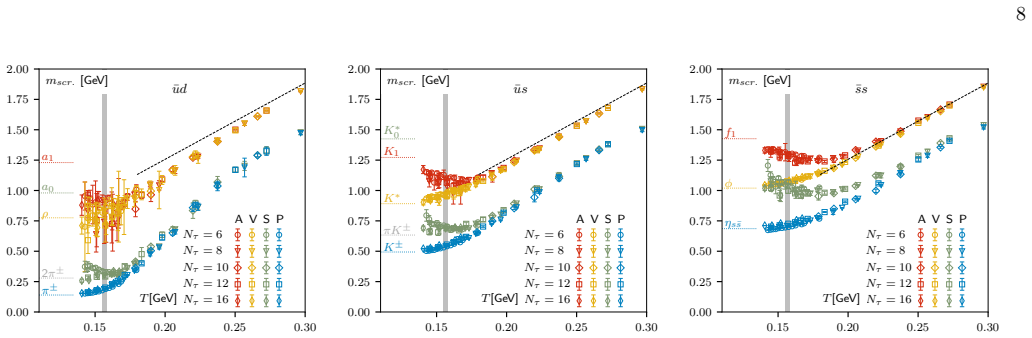
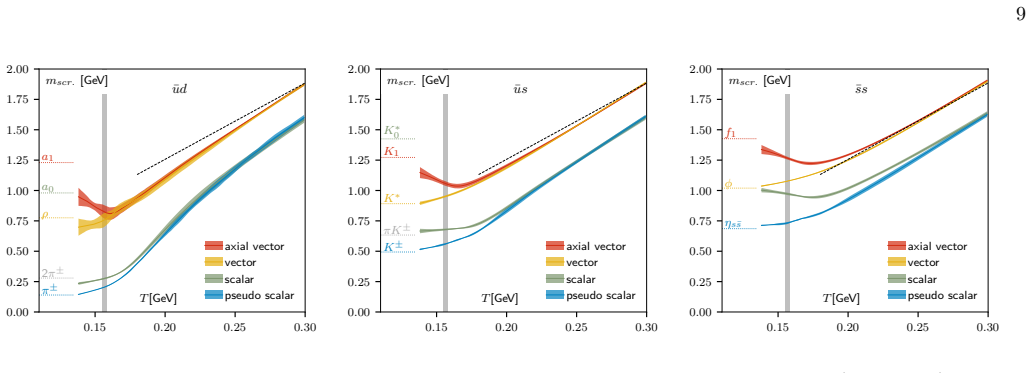
The discovery is a temperature ordering of symmetry restoration read off from continuum-extrapolated screening masses. For the light-light ($\bar{u}d$) sector, the vector ($\rho$) and axial-vector ($a_1$) screening masses become degenerate right at the pseudo-critical temperature $T_{pc}$; this is the signature of effective $SU_L(2)\times SU_R(2)$ chiral restoration. The scalar and pseudoscalar channels ($a_0$ and $\pi$), which would be degenerate under the anomalous $U_A(1)$ symmetry, become degenerate only near $T\sim 200$ MeV $\simeq 1.3\,T_{pc}$, and the continuum-extrapolated susceptibility difference $m_s^2(\chi_\pi-\chi_{a_0})$ vanishes at about that temperature. The same degeneracy sequence appears in the $\bar{u}s$ and $\bar{s}s$ sectors at progressively higher temperatures. The paper also establishes that screening masses are larger than $2\pi T$ at high temperature and that different angular-momentum channels remain split up to 2.5 GeV, concluding that the free-quark degeneracy is only approached asymptotically.
Load-bearing premise
The load-bearing assumption is that the unphysical two-pion contribution in the staggered scalar correlator does not survive the continuum limit and is kinematically closed near $T_{pc}$, so that the observed scalar-pseudoscalar splitting and the vanishing of $m_s^2(\chi_\pi-\chi_{a_0})$ at $T\simeq 200$ MeV are genuine $U_A(1)$ effects rather than lattice artifacts.
Editorial extensions
If this is right
- Effective $SU_L(2)\times SU_R(2)$ restoration in the light-light sector is realized at $T_{pc}$, while effective $U_A(1)$ restoration is delayed to $T\simeq 1.3\,T_{pc}$.
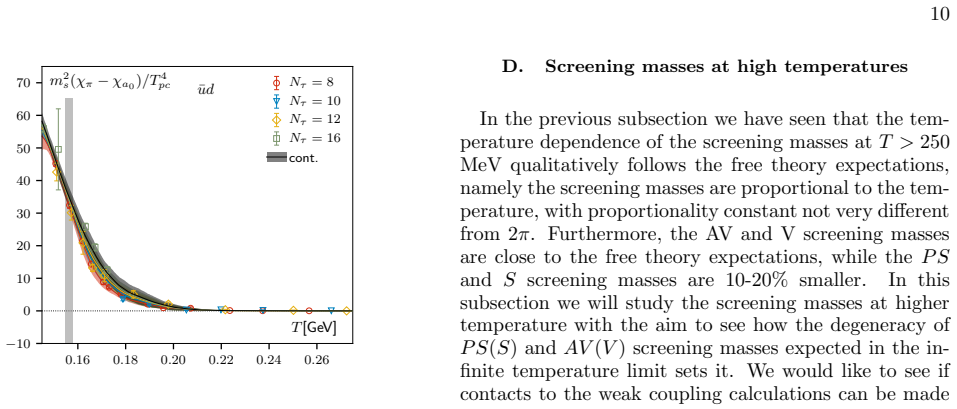
- The continuum-extrapolated, renormalized susceptibility difference $m_s^2(\chi_\pi-\chi_{a_0})$ is non-zero at the crossover and vanishes near $T\sim 200$ MeV, giving a quantitative signal for the $U_A(1)$ restoration temperature.
- In the $\bar{u}s$ and $\bar{s}s$ sectors the same degeneracies occur at higher temperatures, so heavier quark masses postpone effective symmetry restoration.
- At high temperature, screening masses overshoot $2\pi T$ and the $J=0$ and $J=1$ channels remain separated up to 2.5 GeV, so the free-theory limit is reached only asymptotically.
- The leading-order EQCD calculation gives a spin-independent, positive correction that describes the vector and axial-vector overshoot qualitatively but lies above the scalar and pseudoscalar data, so higher-order spin-dependent corrections are needed.
Reading between the lines
- This suggests that the gauge-field fluctuations responsible for $U_A(1)$ breaking survive the chiral crossover and are suppressed only around $1.3\,T_{pc}$; measuring the topological susceptibility on the same ensembles across temperature would test this directly.
- Because screening masses are extracted from spatial correlators, they reflect thermodynamics rather than pole masses; the same hierarchy in temporal correlators or spectral functions would be a stronger statement, and remains an open check.
- The mass-ordering pattern suggests a systematic extension: screening masses for charm or bottom channels along the same line of constant physics should show degeneracy temperatures that continue to rise with valence quark mass, sharpening the empirical map of symmetry restoration.
Signed reviews
Editorial analysis
A structured set of objections, weighed in public.
Referee Report
Summary. The paper presents a lattice QCD determination of mesonic screening masses in the temperature range 140 MeV to 2.5 GeV using (2+1)-flavor HISQ fermions with physical strange quark mass and light quark masses corresponding to pion masses of 140 and 160 MeV. Screening masses are extracted from spatial correlation functions for scalar, pseudoscalar, vector, and axial-vector channels in the light-light, light-strange, and strange-strange sectors, using multi-state fits with AICc-based model selection, and continuum extrapolations are performed with five lattice spacings (Nτ = 6–16) for T ≲ 1 GeV. The main physical conclusions are: (i) the ud vector and axial-vector screening masses become degenerate at or very close to Tpc, indicating effective chiral SU(2) restoration; (ii) the ud scalar and pseudoscalar screening masses become degenerate only around T ≈ 200 MeV (about 1.3 Tpc), which is interpreted as evidence for effective UA(1) restoration; and (iii) at high temperatures the screening masses overshoot the free-field value 2πT and the deviations are compared qualitatively with EQCD predictions.
Significance. If the conclusions hold, this is a valuable and fairly comprehensive lattice result. The chiral SU(2) part of the claim—vector/axial-vector degeneracy at Tpc—appears robust across lattice spacings and is supported by the continuum extrapolation; it also agrees with the broader literature. The high-temperature comparison with EQCD provides a useful benchmark, and the tabulated continuum-extrapolated screening masses in Appendix C are a useful resource for the community. The paper also contains a detailed description of a difficult multi-state fitting procedure with AICc selection, which is a strength in terms of methodological transparency. The main novelty is the UA(1) restoration temperature inferred from the scalar and pseudoscalar channels, but this is precisely the part of the analysis that is most sensitive to the known staggered-fermion artifact in the ud scalar channel. Because the paper's supporting arguments are qualitative rather than quantitative, the UA(1) conclusion must be viewed as tentative until the artifact question is resolved; the chiral SU(2) and high-temperature parts stand on their own.
major comments (2)
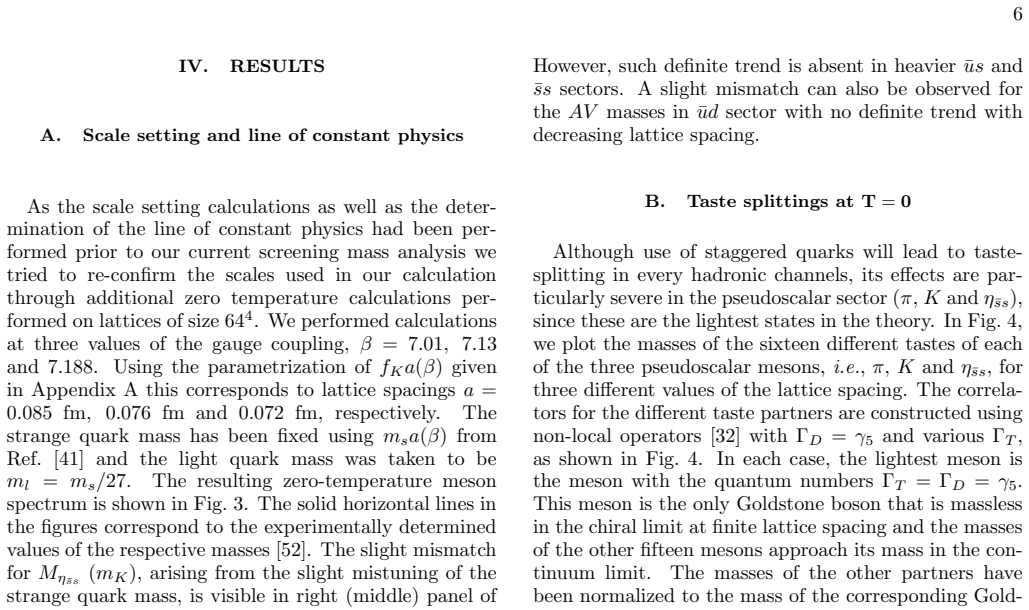
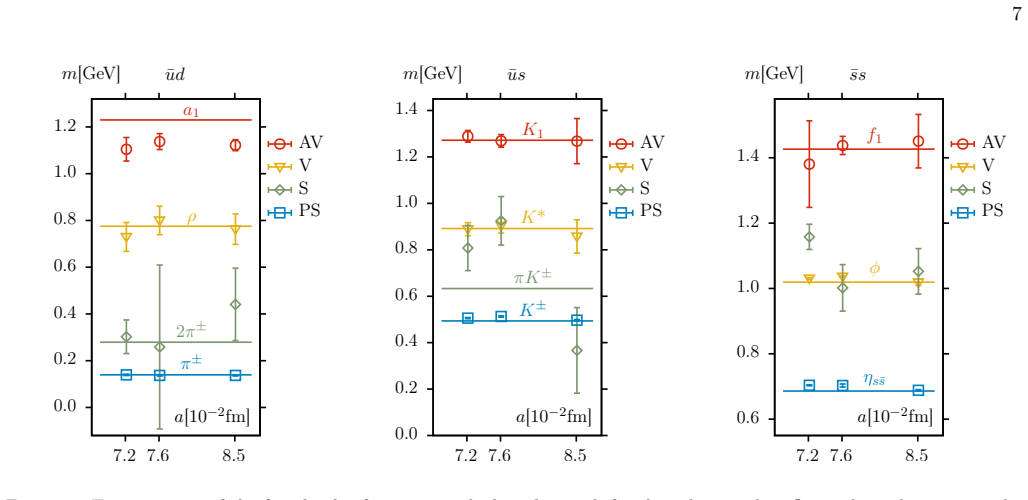
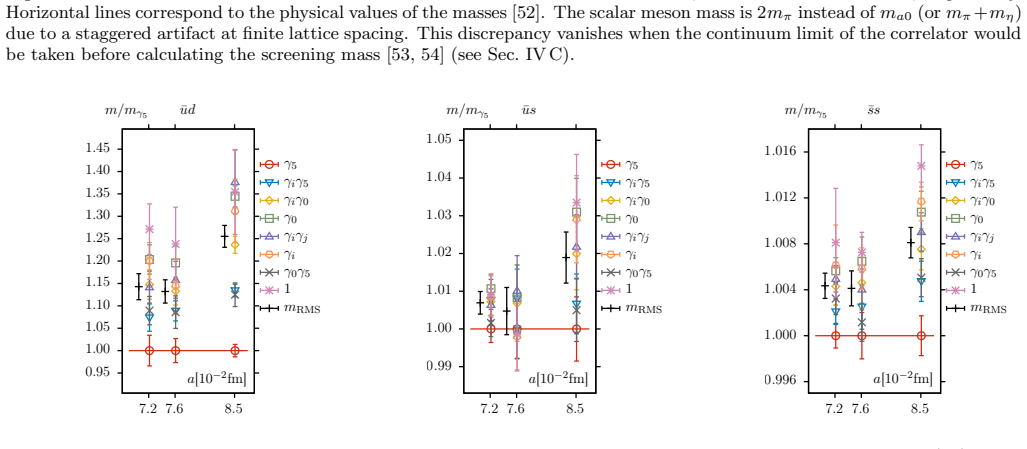
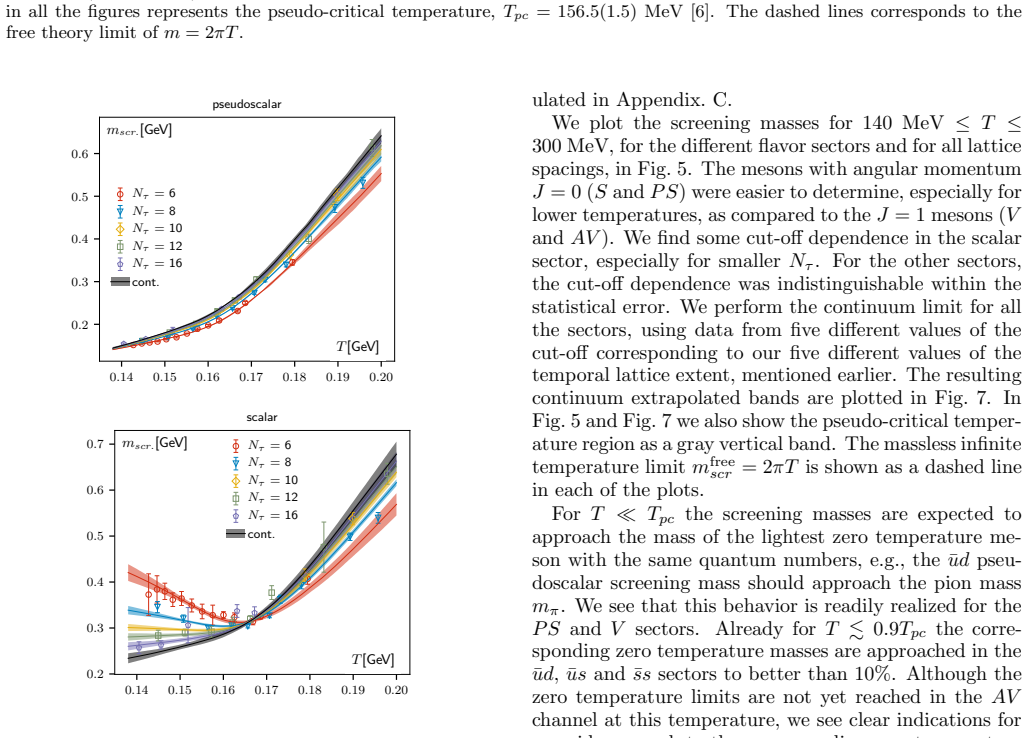
- [§IV C (Fig. 7)] The central claim of effective UA(1) restoration at about 1.3 Tpc rests on the degeneracy of the light-light scalar and pseudoscalar screening masses, but the scalar channel is the one contaminated by the unphysical two-pion state arising from staggered taste mixing. As the paper itself states in Sec. IV C and in the caption of Fig. 3, at finite lattice spacing the local M1 operator gives a mass of 2mπ rather than the physical a0, and this artifact would cancel only if the continuum limit were taken before extracting the mass. In the present analysis the mass is extracted at finite lattice spacing and then extrapolated linearly in 1/Nτ^2, so the artifact does not cancel by construction. The argument that the unphysical decay channel is 'possibly closed' around Tpc due to lack of phase space is qualitative, and no quantitative estimate is provided for the overlap of the M1 operator with the two-pion state in the T ≈ 200 MeV window. The paper should either supply such an estimate (for example by comparing with a non-staggered calculation at one or two temperatures, or by studying the correlator with the continuum limit taken before the spectral extraction) or explicitly present the S-PS degeneracy as a suggestive, but not established, signal of UA(1) restoration.
- [§IV C, Eq. (5), Fig. 8] The susceptibility difference m_s^2 (χ_π − χ_a0) is introduced as a cleaner observable for UA(1) restoration, but the paper does not demonstrate that the integrated staggered scalar susceptibility χ_a0 is free of the same two-pion taste contamination after summation over z and continuum extrapolation. The text states that this quantity has a convergent continuum limit, but no separate continuum limits of χ_π and χ_a0 are shown, and the phase-space argument used for the screening mass is not directly applicable to the integrated quantity. Since the zero crossing of the susceptibility difference at T ≈ 200 MeV is used to support the 1.3 Tpc restoration temperature, the paper should provide a quantitative check that the two-pion contribution is absent or negligible in the continuum limit of χ_a0, or should downgrade this conclusion accordingly.
minor comments (3)
- [§IV C] The sentence 'the unphysical contribution cancels out if one would take the continuum limit for the correlator first' appears to describe an analysis that is not performed here; please clarify whether this statement refers to a theoretical property of the discretization or to a check that was actually carried out on the screening masses or susceptibilities.
- [Fig. 5 and Fig. 7] The channel labels 'A V S P' at the top of each panel are not expanded in the captions; please spell out axial vector, vector, scalar, pseudoscalar.
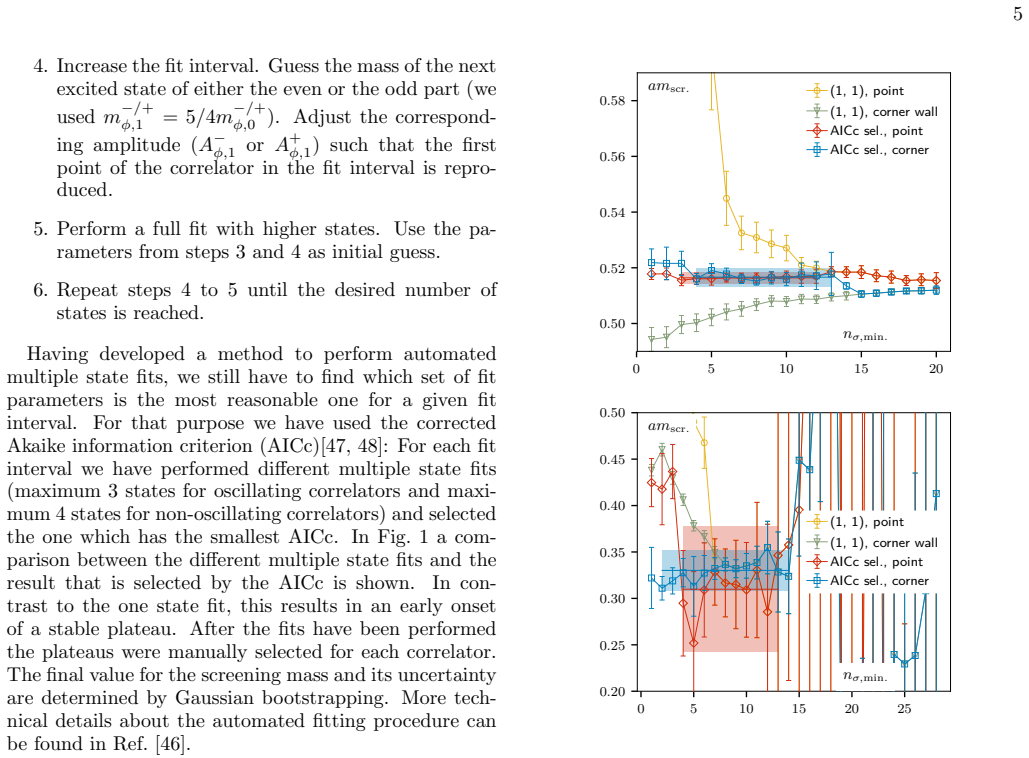
- [§III B and Fig. 1] The AICc-based fitting and plateau selection are described in the main text, but details of the fit ranges, the number of states used for each channel and temperature, and the stability checks against varying the fit interval are delegated to a PhD thesis [46]. Please provide at least a short summary of the typical fit ranges and systematic errors in the paper, so that the reader can assess the quoted uncertainties.
Circularity Check
No circular derivation loop is present: screening masses are extracted from correlation functions, the scale is fixed by fK from independent zero-temperature data, and the EQCD and overlap/domain-wall comparisons are external checks; the scalar-channel caveat is a validity concern, not a circular reduction.
full rationale
The paper's derivation chain is self-contained against external inputs. Screening masses are defined by Eq. (2) and extracted from the correlator fits of Eq. (3); the continuum extrapolation uses only the scale fKa(β) from Appendix A, whose parameters c0, c2 and d2 are fitted to zero-temperature fK measurements, not to screening masses, so no fitted input is later renamed a prediction. The central symmetry conclusions follow from comparing independently extracted masses (Fig. 7) and from the susceptibility difference m_s^2(χπ−χa0) in Eq. (5)/Fig. 8, which is a separately computed integrated correlator with its own continuum limit. The only substantial caveat—the unphysical two-pion state in the light scalar channel (Sec. IV C and Fig. 3)—is explicitly acknowledged by the authors ('the scalar can decay into two pions at finite lattice spacing'); they argue that the channel may close near Tpc and then switch to the cleaner susceptibility difference. That is a robustness/validity issue, not a circularity: the claimed UA(1) temperature is not identical by construction to any input parameter, and no Eq. X = Eq. Y reduction or fitted-parameter-as-prediction step can be exhibited. Self-citations (HotQCD Tpc [6], scale [40,41], earlier staggered screening [12], EQCD references [43,44]) supply inputs or benchmarks that are independent of the screening-mass results being reported; none carries a load-bearing uniqueness theorem. Accordingly the score is 1: self-citations are frequent but not circular.
Assumptions & free parameters
free parameters (2)
- fKa scale-fit coefficient c2 =
46049(1248)
- fKa scale-fit coefficient d2 =
3671(137)
assumptions (5)
- domain assumption The continuum limit is reached with a linear-in-1/Ntau^2 extrapolation of the screening masses after spline interpolation in T (Sec. IV C).
- domain assumption The strange quark mass is fixed via M_eta_ss = 686 MeV from the leading-order chiral perturbation relation sqrt(2m_K^2 - m_pi^2) (Sec. III A).
- domain assumption For T > 1 GeV, Ntau = 8 data alone are representative of the continuum limit because Ntau=8 agrees with the continuum extrapolation for T > 300 MeV (Sec. IV D).
- ad hoc to paper The unphysical staggered pi-pi decay in the ud scalar channel is closed near Tpc due to lack of phase space, so the S-PS degeneracy around 200 MeV can be interpreted as UA(1) restoration (Sec. IV C).
- ad hoc to paper The renormalized susceptibility difference m_s^2(chi_pi - chi_a0) has a convergent continuum limit that is not contaminated by the staggered scalar pathology (Sec. IV C, Fig. 8).
Cite this review
Pith. "Pith review of Meson Screening Masses in (2+1)-Flavor QCD." pith.science (2026). https://pith.science/paper/XTTQRT45
@misc{pith2026190809552,
  author       = {Pith},
  title        = {Pith review of: Meson Screening Masses in (2+1)-Flavor QCD},
  year         = {2026},
  howpublished = {\url{https://pith.science/paper/XTTQRT45}},
  note         = {Machine review of arXiv:1908.09552}
}
abstract
We present lattice QCD results for mesonic screening masses in the temperature range 140 MeV $\lesssim T \lesssim$ 2500 MeV. Our calculations were carried out using (2+1)-flavors of the Highly Improved Staggered Quark (HISQ) action, with a physical value for the strange quark mass and two values of the light quark mass corresponding to pion masses of 160 MeV and 140 MeV. Continuum-extrapolated results were obtained using calculations with a variety of lattice spacings corresponding to temporal lattice extents $N_\tau = 6 - 16$. We discuss the implications of these results for the effective restoration of various symmetries in the high temperature phase of QCD, as well as the approach toward the perturbative limit.
Figures

Figures from the paper (8 more)


Forward citations
Cited by 9 Pith papers
-
Leading-Order QCD Equation of State in Strong Magnetic Fields at Nonzero Baryon Chemical Potential
Continuum-estimated leading-order EoS coefficients in magnetized strangeness-neutral QCD at nonzero baryon chemical potential show temperature-band crossings in q1 and P2 and a possible sign change of the trace anomal...
-
Symmetry of screening masses of mesons in two-flavor lattice QCD at high temperatures
Using Möbius domain-wall fermions in two-flavor QCD, the authors find that vector/axial-vector and tensor/axial-tensor screening masses become degenerate above Tc, while the chiral-spin A-X splitting stays around 40 M...
-
Chiral condensates and screening masses of neutral pseudoscalar mesons from lattice QCD at physical quark masses
A continuum-estimated lattice QCD calculation shows that pi0 and K0 screening masses respond non-monotonically to magnetic fields while eta_s(s-bar) decreases monotonically, alongside magnetic catalysis and inverse ma...
-
Probing the chiral and $U(1)$ axial symmetry restoration via meson susceptibilities in holographic QCD
In a soft-wall holographic QCD model, chiral symmetry restores at ~155 MeV while the U(1) axial symmetry restores near 190 MeV — a separation the authors present despite an admitted mismatch with lattice QCD below 175 MeV.
-
Finite-size effects and scaling properties of chiral and baryon-number fluctuations
In an effective chiral model retaining only the zero field mode, finite volume smooths the transition, regulates critical fluctuations, and shifts the baryon-kurtosis peak to lower collision energies.
-
Symmetries in high-temperature lattice QCD with (u, d, s, c, b) optimal domain-wall quarks
In five-flavor lattice QCD with heavy up/down quarks, chiral symmetry restoration proceeds hierarchically from SU(2) to SU(5) with temperature, and the emergent chiral-spin symmetry windows are dominated by bottom-lig...
-
Pseudoscalar Screening Mass at Finite Temperature and Magnetic Field from Lattice QCD with Physical Quark Masses
Continuum-estimated lattice QCD screening masses of neutral pseudoscalar mesons show a magnetic-field-induced minimum for pi and K, but not for the strange eta, near the QCD transition temperature.
-
QCD Equation of State with Strong Magnetic Fields and Nonzero Baryon Density
Lattice QCD continuum estimates of leading-order baryon-density Taylor coefficients of the magnetized QCD equation of state show deviations from hadron gas and approach to a free gas at strong fields.
-
Study of symmetries in finite temperature $N_f=2$ QCD with M\"obius Domain Wall Fermions
Screening-mass measurements in N_f=2 lattice QCD with Möbius domain-wall fermions indicate SU(2)_L x SU(2)_R and axial U(1)_A restoration near T_c ~ 165 MeV, while SU(2)_CS shows no clear emergence.
Reference graph
Works this paper leans on
-
[1]
Repeat the same for the odd points (Aodd φ,0 , modd φ,0 )
At a small fit interval [ nσ,min : nσ,max = Nσ/2], perform one state fits on all even points of the cor- relator and we call the resulting fit parameters say Aeven φ,0 and meven φ,0 . Repeat the same for the odd points (Aodd φ,0 , modd φ,0 )
-
[2]
Assuming similar size of the non-oscillating and os- cillating mass, the fit parameters for the combined fit may be estimated withA− φ,0 = (Aeven φ,0 +Aodd φ,0 )/2, A+ φ,0 = ( Aeven φ,0 − Aodd φ,0 )/2 and m− φ,0 = m+ φ,0 = (meven φ,0 +modd φ,0 )/2
-
[3]
Using the parameters from step 2 as initial guess, perform a full one state fit with oscillating and non- oscillating part. 5
-
[4]
Increase the fit interval. Guess the mass of the next excited state of either the even or the odd part (we used m−/+ φ,1 = 5/4m−/+ φ,0 ). Adjust the correspond- ing amplitude ( A− φ,1 or A+ φ,1) such that the first point of the correlator in the fit interval is repro- duced
-
[5]
Use the pa- rameters from steps 3 and 4 as initial guess
Perform a full fit with higher states. Use the pa- rameters from steps 3 and 4 as initial guess
-
[6]
Repeat steps 4 to 5 until the desired number of states is reached. Having developed a method to perform automated multiple state fits, we still have to find which set of fit parameters is the most reasonable one for a given fit interval. For that purpose we have used the corrected Akaike information criterion (AICc)[47, 48]: For each fit interval we have perfo...
-
[7]
A. Andronic, P. Braun-Munzinger, K. Redlich, and J. Stachel, Nature 561, 321 (2018), arXiv:1710.09425
arXiv 2018
- [8]
Show all 80 references
-
[9]
Karsch and E
F. Karsch and E. Laermann, , In *Hwa, R.C. (ed.) et al.: Quark gluon plasma* 1 (2003), arXiv:hep-lat/0305025
2003 arXiv
-
[10]
Aarts, C
G. Aarts, C. Allton, D. De Boni, S. Hands, B. J¨ ager, C. Praki, and J.-I. Skullerud, JHEP 06, 034 (2017), arXiv:1703.09246
2017 arXiv
-
[11]
C. E. Detar and J. B. Kogut, Phys. Rev. Lett. 59, 399 (1987)
1987
-
[12]
Bazavov et al
A. Bazavov et al. (HotQCD), Phys. Lett. B795, 15 (2019), arXiv:1812.08235. 16 T [GeV] mP [GeV] mV [GeV] mS [GeV] mA [GeV] 0.132 0.50(2) 0.88(2) 0.66(3) 1.17(6) 0.136 0.51(1) 0.89(2) 0.67(3) 1.16(6) 0.140 0.519(5) 0.90(2) 0.67(2) 1.14(5) 0.144 0.527(2) 0.91(2) 0.67(2) 1.12(3) 0...
2019 arXiv
-
[13]
S. L. Adler, Phys. Rev. 177, 2426 (1969), [,241(1969)]
1969
-
[14]
J. S. Bell and R. Jackiw, Nuovo Cim. A60, 47 (1969)
1969
-
[15]
S. L. Adler and W. A. Bardeen, Phys. Rev. 182, 1517 (1969), [,268(1969)]
1969
-
[16]
D. J. Gross, R. D. Pisarski, and L. G. Yaffe, Rev. Mod. Phys. 53, 43 (1981)
1981
-
[17]
R. D. Pisarski and F. Wilczek, Phys. Rev. D29, 338 (1984)
1984
-
[18]
Cheng et al
M. Cheng et al. , Eur. Phys. J. C71, 1564 (2011), arXiv:1010.1216. T [GeV] mP [GeV] mV [GeV] mS [GeV] mA [GeV] 0.132 0.71(2) 1.026(7) 1.01(3) 1.36(5) 0.136 0.711(8) 1.032(6) 1.01(2) 1.34(5) 0.140 0.714(4) 1.040(5) 1.00(2) 1.33(4) 0.144 0.717(1) 1.048(4) 0.99(2) 1.32(3) 0.148 0...
2011 arXiv
-
[19]
H. Ohno, U. M. Heller, F. Karsch, and S. Mukher- jee, Proceedings, 30th International Symposium on Lat- tice Field Theory (Lattice 2012): Cairns, Australia, June 24-29, 2012 , PoS LA TTICE2012, 095 (2012), arXiv:1211.2591 [hep-lat]
2012 arXiv
-
[20]
V. Dick, F. Karsch, E. Laermann, S. Mukherjee, and S. Sharma, Phys. Rev. D91, 094504 (2015), arXiv:1502.06190
2015 arXiv
-
[21]
H. T. Ding et al. , Phys. Rev. Lett. 123, 062002 (2019), arXiv:1903.04801. 17
2019 arXiv
-
[22]
E. V. Shuryak, Comments Nucl. Part. Phys. 21, 235 (1994), arXiv:hep-ph/9310253
1994 arXiv
-
[23]
M. C. Birse, T. D. Cohen, and J. A. McGovern, Phys. Lett. B388, 137 (1996), arXiv:hep-ph/9608255
1996 arXiv
-
[24]
S. H. Lee and T. Hatsuda, Phys. Rev. D54, R1871 (1996), arXiv:hep-ph/9601373
1996 arXiv
-
[25]
N. J. Evans, S. D. H. Hsu, and M. Schwetz, Phys. Lett. B375, 262 (1996), arXiv:hep-ph/9601361
1996 arXiv
-
[26]
M. I. Buchoff et al. , Phys. Rev. D89, 054514 (2014), arXiv:1309.4149
2014 arXiv
- [27]
-
[28]
Suzuki, S
K. Suzuki, S. Aoki, Y. Aoki, G. Cossu, H. Fukaya, and S. Hashimoto (JLQCD) (2018) arXiv:1812.06621
2018 arXiv
-
[29]
Tomiya, G
A. Tomiya, G. Cossu, S. Aoki, H. Fukaya, S. Hashimoto, T. Kaneko, and J. Noaki, Phys. Rev. D96, 034509 (2017), [Addendum: Phys. Rev.D96,no.7,079902(2017)], arXiv:1612.01908
2017 arXiv
-
[30]
Chiu, W.-P
T.-W. Chiu, W.-P. Chen, Y.-C. Chen, H.-Y. Chou, and T.-H. Hsieh (TWQCD), PoS LA TTICE2013, 165 (2014), arXiv:1311.6220
2014 arXiv
-
[31]
Sharma, V
S. Sharma, V. Dick, F. Karsch, E. Laermann, and S. Mukherjee, Proceedings, 25th International Conference on Ultra-Relativistic Nucleus-Nucleus Collisions (Quark Matter 2015): Kobe, Japan, September 27-October 3, 2015, Nucl. Phys. A956, 793 (2016), arXiv:1602.02197 [hep-lat]
2016 arXiv
-
[32]
B. B. Brandt, A. Francis, H. B. Meyer, O. Philipsen, D. Robaina, and H. Wittig, JHEP 12, 158 (2016), arXiv:1608.06882
2016 arXiv
-
[33]
Karsch, E
F. Karsch, E. Laermann, S. Mukherjee, and P. Petreczky, Phys. Rev. D85, 114501 (2012), arXiv:1203.3770
2012 arXiv
-
[34]
Bazavov, F
A. Bazavov, F. Karsch, Y. Maezawa, S. Mukherjee, and P. Petreczky, Phys. Rev. D91, 054503 (2015), arXiv:1411.3018
2015 arXiv
-
[35]
Hashimoto, A
T. Hashimoto, A. Nakamura, and I. O. Stamatescu, Nucl. Phys. B400, 267 (1993)
1993
-
[36]
M. F. L. Golterman, Nucl. Phys. B273, 663 (1986)
1986
-
[37]
G. W. Kilcup and S. R. Sharpe, Nucl. Phys. B283, 493 (1987)
1987
-
[38]
Altmeyer, K
R. Altmeyer, K. D. Born, M. Gockeler, R. Horsley, E. Laermann, and G. Schierholz (MT(c)), Nucl. Phys. B389, 445 (1993)
1993
-
[39]
Gupta, Phys
S. Gupta, Phys. Rev. D60, 094505 (1999), arXiv:hep- lat/9903019
1999
-
[40]
G. P. Lepage, Phys. Rev. D59, 074502 (1999), arXiv:hep- lat/9809157
1999
-
[41]
Follana, Q
E. Follana, Q. Mason, C. Davies, K. Hornbostel, G. P. Lepage, J. Shigemitsu, H. Trottier, and K. Wong (HPQCD, UKQCD), Phys. Rev. D75, 054502 (2007), arXiv:hep-lat/0610092
2007 arXiv
- [42]
- [43]
-
[44]
Bazavov and P
A. Bazavov and P. Petreczky (HotQCD), PoS LA T- TICE2010, 169 (2010), arXiv:1012.1257
2010 arXiv
-
[45]
Follana, C
E. Follana, C. T. H. Davies, G. P. Lepage, and J. Shigemitsu (HPQCD, UKQCD), Phys. Rev. Lett.100, 062002 (2008), arXiv:0706.1726
2008 arXiv
- [46]
- [47]
- [48]
-
[49]
Bazavov, N
A. Bazavov, N. Brambilla, H. T. Ding, P. Petreczky, H. P. Schadler, A. Vairo, and J. H. Weber, Phys. Rev. D93, 114502 (2016), arXiv:1603.06637
2016 arXiv
-
[50]
Bazavov, N
A. Bazavov, N. Brambilla, P. Petreczky, A. Vairo, and J. H. Weber (TUMQCD), Phys. Rev. D98, 054511 (2018), arXiv:1804.10600
2018 arXiv
-
[51]
Hegde, PoS LA TTICE2011, 014 (2011), arXiv:1112.0364
P. Hegde, PoS LA TTICE2011, 014 (2011), arXiv:1112.0364
2011 arXiv
-
[52]
Sandmeyer, (PhD thesis 2019), 10.4119/unibi/2936264
H. Sandmeyer, (PhD thesis 2019), 10.4119/unibi/2936264
2019
-
[53]
Akaike, IEEE Transactions on Automatic Control 19, 716 (1974)
H. Akaike, IEEE Transactions on Automatic Control 19, 716 (1974)
1974
-
[54]
J. E. Cavanaugh, Statistics & Probability Letters 33, 201 (1997)
1997
-
[55]
C. W. Bernard, M. C. Ogilvie, T. A. DeGrand, C. E. DeTar, S. A. Gottlieb, A. Krasnitz, R. L. Sugar, and D. Toussaint, Phys. Rev. Lett. 68, 2125 (1992)
1992
-
[56]
C. W. Bernard, T. Blum, T. A. DeGrand, C. E. De- tar, S. A. Gottlieb, A. Krasnitz, R. L. Sugar, and D. Toussaint, Phys. Rev. D48, 4419 (1993), arXiv:hep- lat/9305023
1993
-
[57]
C. W. Bernard, T. Burch, K. Orginos, D. Toussaint, T. A. DeGrand, C. E. Detar, S. Datta, S. A. Gottlieb, U. M. Heller, and R. Sugar, Phys. Rev. D64, 054506 (2001), arXiv:hep-lat/0104002
2001 arXiv
-
[58]
Tanabashi et al
M. Tanabashi et al. (Particle Data Group), Phys. Rev. D98, 030001 (2018)
2018
-
[59]
Prelovsek, Phys
S. Prelovsek, Phys. Rev. D73, 014506 (2006), arXiv:hep- lat/0510080
2006
-
[60]
Prelovsek, C
S. Prelovsek, C. Dawson, T. Izubuchi, K. Orginos, and A. Soni, Phys. Rev. D70, 094503 (2004), arXiv:hep- lat/0407037
2004
-
[61]
Bernard, C
C. Bernard, C. E. DeTar, Z. Fu, and S. Prelovsek, Phys. Rev. D76, 094504 (2007), arXiv:0707.2402
2007 arXiv
-
[62]
Lee and S
W.-J. Lee and S. R. Sharpe, Phys. Rev. D60, 114503 (1999), arXiv:hep-lat/9905023
1999 arXiv
-
[63]
Aarts, C
G. Aarts, C. Allton, D. de Boni, S. Hands, B. J¨ ager, C. Praki, and J.-I. Skullerud, (2017), 10.1051/epj- conf/201817114005, [EPJ Web Conf.171,14005(2018)], arXiv:1710.00566
2017
-
[64]
Datta, S
S. Datta, S. Gupta, M. Padmanath, J. Maiti, and N. Mathur, JHEP 02, 145 (2013), arXiv:1212.2927
2013 arXiv
-
[65]
S. Aoki, H. Fukaya, and Y. Taniguchi, Phys. Rev. D86, 114512 (2012), arXiv:1209.2061
2012 arXiv
-
[66]
Suzuki, S
K. Suzuki, S. Aoki, Y. Aoki, G. Cossu, H. Fukaya, and S. Hashimoto (JLQCD), EPJ Web Conf. 175, 07025 (2018), arXiv:1711.09239
2018 arXiv
-
[67]
C. E. Detar and J. B. Kogut, Phys. Rev. D36, 2828 (1987)
1987
-
[68]
K. D. Born, S. Gupta, A. Irback, F. Karsch, E. Laer- mann, B. Petersson, and H. Satz (MT(c)), Phys. Rev. Lett. 67, 302 (1991)
1991
-
[69]
Banerjee, R
D. Banerjee, R. V. Gavai, and S. Gupta, Phys. Rev. D83, 074510 (2011), arXiv:1102.4465
2011 arXiv
- [70]
- [71]
-
[72]
B. B. Brandt, A. Francis, M. Laine, and H. B. Meyer, JHEP 05, 117 (2014), arXiv:1404.2404
2014 arXiv
-
[73]
Braaten and A
E. Braaten and A. Nieto, Phys. Rev. D53, 3421 (1996), arXiv:hep-ph/9510408. 18
1996 arXiv
-
[74]
Bazavov, H
A. Bazavov, H. T. Ding, P. Hegde, F. Karsch, C. Miao, S. Mukherjee, P. Petreczky, C. Schmidt, and A. Velytsky, Phys. Rev. D88, 094021 (2013), arXiv:1309.2317
2013 arXiv
-
[75]
H. T. Ding, S. Mukherjee, H. Ohno, P. Petreczky, and H. P. Schadler, Phys. Rev. D92, 074043 (2015), arXiv:1507.06637
2015 arXiv
-
[76]
V. Koch, E. V. Shuryak, G. E. Brown, and A. D. Jackson, Phys. Rev. D46, 3169 (1992), [Erratum: Phys. Rev.D47,2157(1993)], arXiv:hep-ph/9204236
1992 arXiv
-
[77]
E. V. Shuryak, Rev. Mod. Phys. 65, 1 (1993)
1993
- [78]
- [79]
-
[80]
Rohrhofer, Y
C. Rohrhofer, Y. Aoki, G. Cossu, H. Fukaya, C. Gat- tringer, L. Ya. Glozman, S. Hashimoto, C. B. Lang, and S. Prelovsek, Phys. Rev. D100, 014502 (2019), arXiv:1902.03191
2019 arXiv
Reviewed August 14, 2026 · model on record in the stance chip above.
Discussion (0). Continue with ORCID to comment.