Quantum Memory in Scalar-Induced Gravitational Waves
Pith reviewed 2026-06-26 12:05 UTC · model grok-4.3
The pith
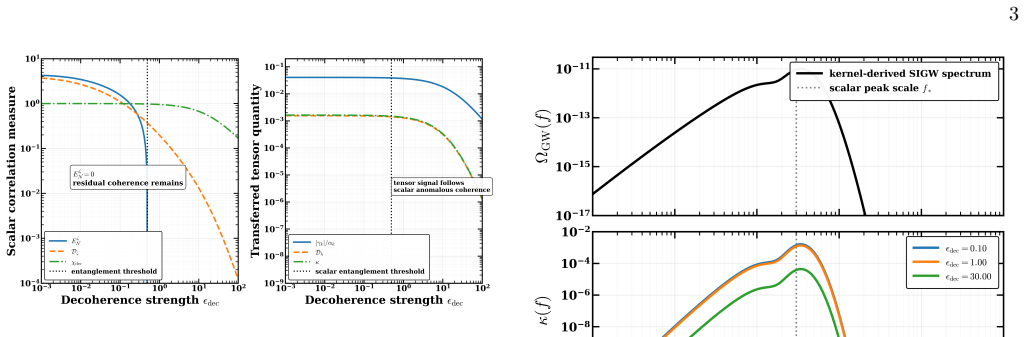
Residual quantum coherence from scalar perturbations transfers to induced tensor gravitational waves, generating tensor discord and connected covariances after scalar entanglement vanishes.
A machine-rendered reading of the paper's core claim, the machinery that carries it, and where it could break.
Core claim
The paper establishes transfer relations between the scalar anomalous coherence and the covariance matrix of induced tensor modes. For a localized scalar power spectrum, the ordinary tensor power is sourced by scalar power contractions, whereas the opposite-mode tensor coherence is sourced by scalar anomalous-coherence contractions. This coherence can generate nonzero tensor discord and a connected tensor-power covariance even after scalar entanglement has vanished. The connected covariance and phase-sensitive strain correlations are identified as probes of primordial quantum coherence in secondary gravitational-wave backgrounds, with possible relevance for future space-based interferometers
What carries the argument
Transfer relations between scalar anomalous coherence and the tensor covariance matrix, which map scalar coherence contractions onto tensor coherence terms.
If this is right
- Nonzero tensor discord appears in the induced gravitational wave background.
- A connected tensor-power covariance is generated from the transferred coherence.
- Phase-sensitive strain correlations act as probes of primordial quantum coherence.
- These signals have possible relevance for future space-based interferometers and pulsar timing arrays.
Where Pith is reading between the lines
- Standard classical models of scalar-induced gravitational waves would be incomplete if initial states retain anomalous coherence.
- The same transfer mechanism might apply to other secondary signals generated from quantum scalar modes in cosmology.
- Data analysis for pulsar timing arrays could be extended to search for correlation patterns beyond the usual power spectrum.
Load-bearing premise
The initial scalar perturbations are described by a decohered two-mode Gaussian state whose anomalous coherence survives long enough to source the induced tensor modes.
What would settle it
Detection of nonzero connected tensor-power covariance or phase-sensitive strain correlations in the stochastic gravitational wave background that match the predicted scalar anomalous-coherence contractions but cannot be reproduced by classical scalar power alone.
Figures
read the original abstract
Scalar-induced gravitational waves are usually treated as a classical stochastic background sourced by phase-random curvature perturbations. We show that this description can miss residual quantum information. Starting from a decohered two-mode Gaussian scalar state, we derive explicit transfer relations between the scalar anomalous coherence and the covariance matrix of induced tensor modes. For a localized scalar power spectrum, the ordinary tensor power is sourced by scalar power contractions, whereas the opposite-mode tensor coherence is sourced by scalar anomalous-coherence contractions. This coherence can generate nonzero tensor discord and a connected tensor-power covariance even after scalar entanglement has vanished. We identify the connected covariance and phase-sensitive strain correlations as probes of primordial quantum coherence in secondary gravitational-wave backgrounds, and discuss their possible relevance for future space-based interferometers and pulsar timing arrays.
Editorial analysis
A structured set of objections, weighed in public.
Referee Report
Summary. The paper claims that scalar-induced gravitational waves, typically treated as a classical stochastic background, can retain residual quantum information. Starting from a decohered two-mode Gaussian scalar state, explicit transfer relations are derived showing that ordinary tensor power is sourced by scalar power contractions while opposite-mode tensor coherence is sourced by scalar anomalous-coherence contractions. This leads to nonzero tensor discord and a connected tensor-power covariance even after scalar entanglement has vanished. The connected covariance and phase-sensitive strain correlations are identified as potential probes of primordial quantum coherence, with relevance to future space-based interferometers and pulsar timing arrays.
Significance. If the transfer relations and resulting discord/covariance hold under the stated initial-state assumption, the result would be significant for distinguishing quantum from classical descriptions of induced gravitational waves. The forward derivation from an explicitly stated decohered two-mode Gaussian state (with anomalous coherence surviving to source tensor modes) to falsifiable observables is a strength; no free parameters or fitted quantities are introduced. This opens a concrete path to testing quantum memory effects in secondary GW backgrounds.
minor comments (2)
- The abstract refers to 'explicit transfer relations' and 'covariance matrix elements' but does not display the relations or the decoherence model; including the key equations (e.g., the mapping from scalar anomalous coherence to tensor coherence) in the main text or an appendix would strengthen verifiability.
- The localized scalar power spectrum is invoked to separate ordinary power from coherence-sourced terms; a brief statement of the spectrum's functional form or width parameter would clarify the regime of validity.
Simulated Author's Rebuttal
We thank the referee for their summary of the manuscript and for recognizing the significance of deriving explicit transfer relations from a decohered two-mode Gaussian scalar state to observable tensor discord and connected covariance. No major comments were provided in the report, so we have no specific points to address point-by-point. The recommendation of 'uncertain' is noted, but without further elaboration we are unable to determine what additional clarification might be required.
Circularity Check
No significant circularity; forward derivation from explicit initial state
full rationale
The paper states its starting point explicitly as an assumed decohered two-mode Gaussian scalar state and derives transfer relations from there to tensor covariance elements. No load-bearing step reduces by construction to its own inputs, no fitted parameters are relabeled as predictions, and no self-citation chain or uniqueness theorem is invoked to force the result. The central claim is conditional on the stated initial state rather than self-referential.
Axiom & Free-Parameter Ledger
axioms (1)
- domain assumption Scalar perturbations are described by a decohered two-mode Gaussian state
Reference graph
Works this paper leans on
-
[1]
A. H. Guth, Phys. Rev. D23, 347 (1981)
1981
-
[2]
A. D. Linde, Phys. Lett. B108, 389 (1982)
1982
-
[3]
V. F. Mukhanov, H. A. Feldman, and R. H. Branden- berger, Phys. Rept.215, 203 (1992)
1992
-
[4]
D. Polarski and A. A. Starobinsky, Class. Quant. Grav. 13, 377 (1996), arXiv:gr-qc/9504030
Pith/arXiv arXiv 1996
-
[5]
C. Kiefer, D. Polarski, and A. A. Starobinsky, Int. J. Mod. Phys. D7, 455 (1998), arXiv:gr-qc/9802003
Pith/arXiv arXiv 1998
-
[6]
Schlosshauer, arXiv preprint (2014), arXiv:1404.2635 [quant-ph]
M. Schlosshauer, arXiv preprint (2014), arXiv:1404.2635 [quant-ph]
arXiv 2014
-
[7]
W. H. Zurek, Rev. Mod. Phys.75, 715 (2003), arXiv:quant-ph/0105127
Pith/arXiv arXiv 2003
-
[8]
L. Henderson and V. Vedral, J. Phys. A34, 6899 (2001), arXiv:quant-ph/0105028
Pith/arXiv arXiv 2001
-
[9]
K. Modi, A. Brodutch, H. Cable, T. Paterek, and V. Ve- dral, Rev. Mod. Phys.84, 1655 (2012), arXiv:1112.6238 [quant-ph]
Pith/arXiv arXiv 2012
-
[10]
K. N. Ananda, C. Clarkson, and D. Wands, Phys. Rev. D75, 123518 (2007), arXiv:gr-qc/0612013
Pith/arXiv arXiv 2007
-
[11]
D. Baumann, P. J. Steinhardt, K. Takahashi, and K. Ichiki, Phys. Rev. D76, 084019 (2007), arXiv:hep- th/0703290
arXiv 2007
-
[12]
R. Saito and J. Yokoyama, Phys. Rev. Lett.102, 161101 (2009), [Erratum: Phys.Rev.Lett. 107, 069901 (2011)], arXiv:0812.4339 [astro-ph]
Pith/arXiv arXiv 2009
-
[13]
Dom` enech, Universe7, 398 (2021), arXiv:2109.01398 [gr-qc]
G. Dom` enech, Universe7, 398 (2021), arXiv:2109.01398 [gr-qc]
Pith/arXiv arXiv 2021
-
[14]
Amaro-Seoaneet al., Laser Interferometer Space An- tenna (2017), arXiv:1702.00786 [astro-ph.IM]
P. Amaro-Seoaneet al., Laser Interferometer Space An- tenna (2017), arXiv:1702.00786 [astro-ph.IM]
Pith/arXiv arXiv 2017
-
[15]
Agazieet al.(NANOGrav), Astrophys
G. Agazieet al.(NANOGrav), Astrophys. J. Lett.951, L8 (2023), arXiv:2306.16213 [astro-ph.HE]
Pith/arXiv arXiv 2023
-
[16]
Antoniadiset al.(EPTA, InPTA:), Astron
J. Antoniadiset al.(EPTA, InPTA:), Astron. Astrophys. 678, A50 (2023), arXiv:2306.16214 [astro-ph.HE]
Pith/arXiv arXiv 2023
-
[17]
H. Xuet al., Res. Astron. Astrophys.23, 075024 (2023), arXiv:2306.16216 [astro-ph.HE]
Pith/arXiv arXiv 2023
discussion (0)
Sign in with ORCID, Apple, or X to comment. Anyone can read and Pith papers without signing in.