Lyrm α halos and UV continuum morphologies of Tadpole Galaxies at z> 3
Pith reviewed 2026-06-25 20:22 UTC · model grok-4.3
The pith
Extended Lyα halos surround 10 of 12 tadpole galaxies at z>3.
A machine-rendered reading of the paper's core claim, the machinery that carries it, and where it could break.
Core claim
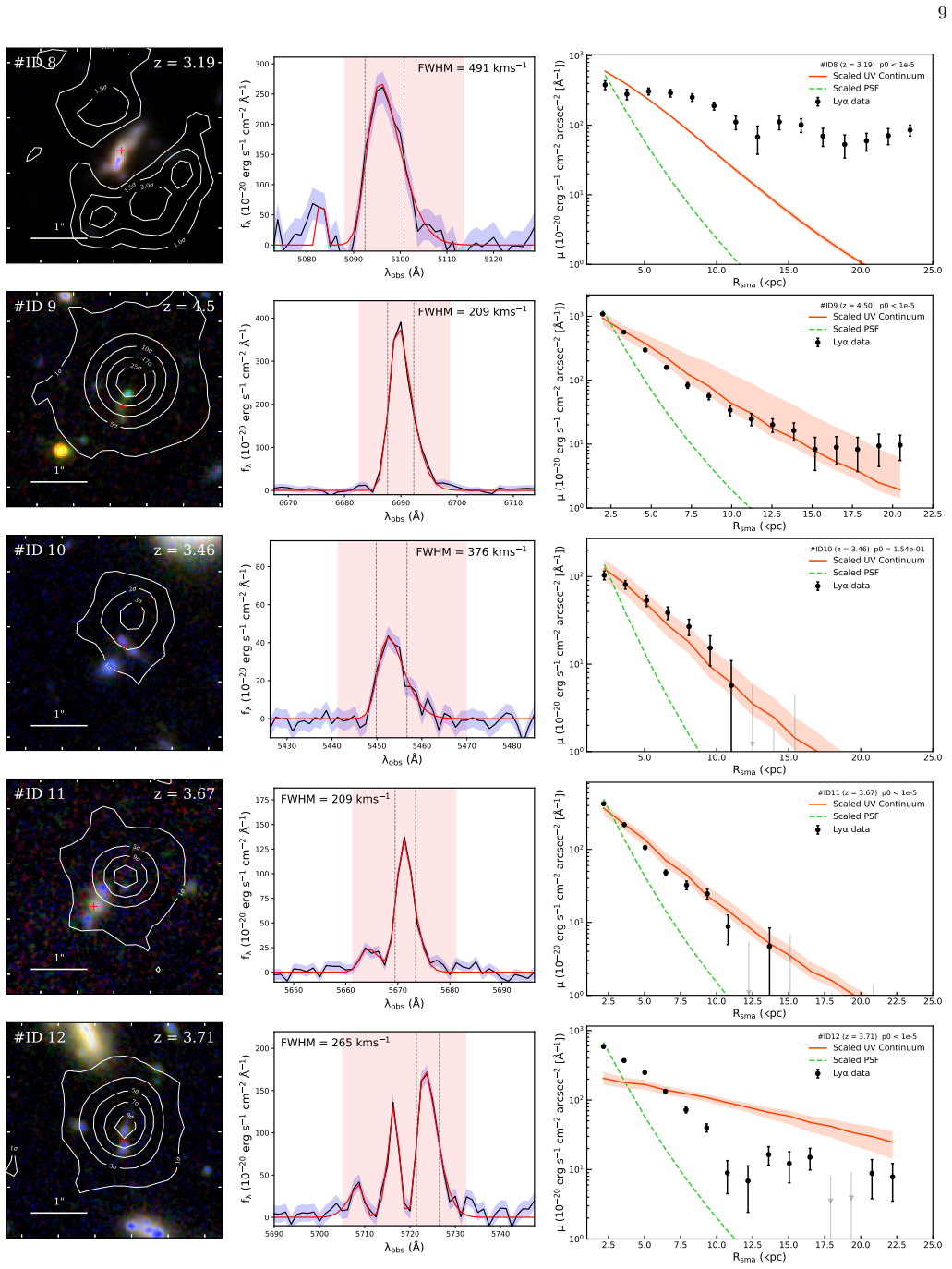
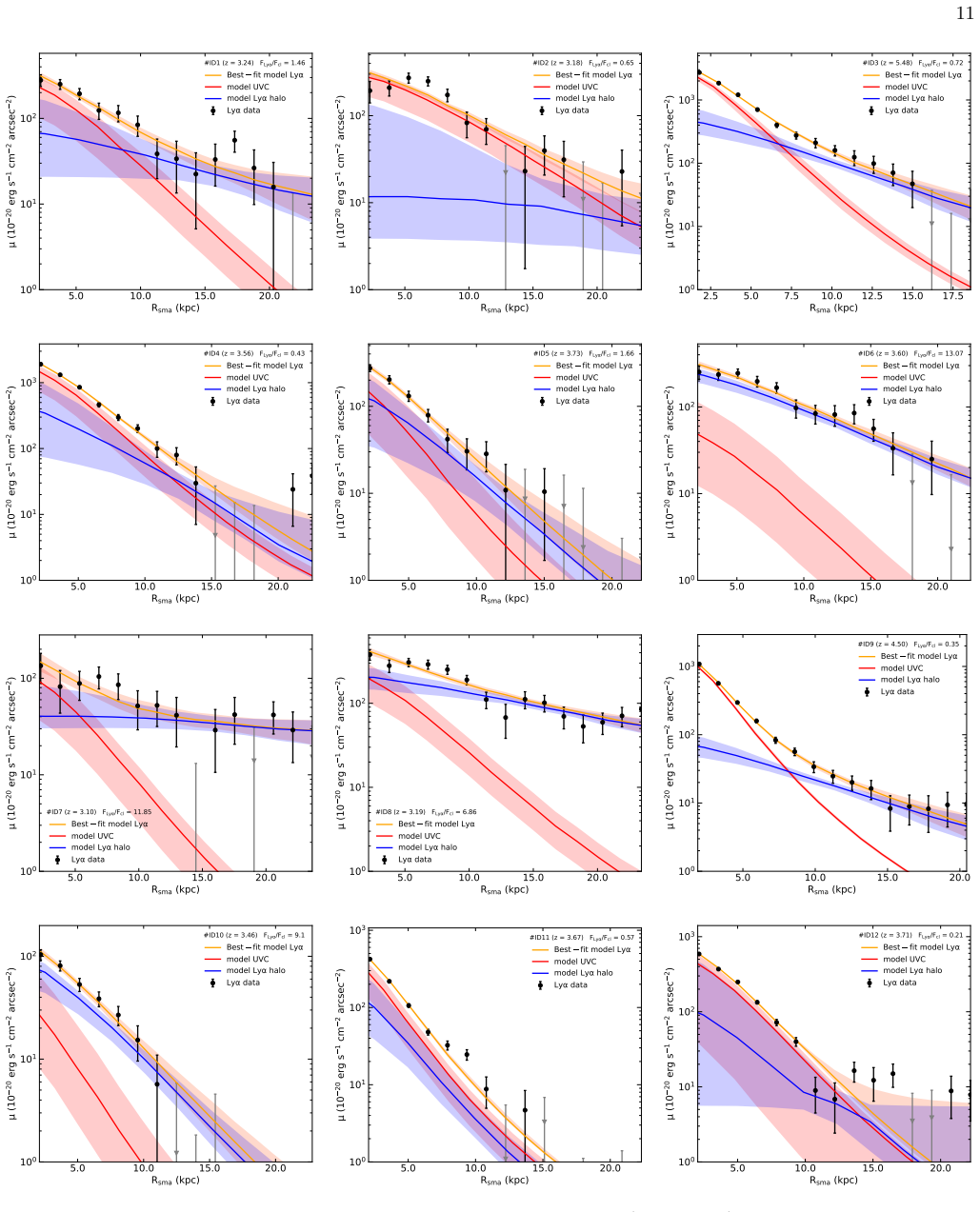
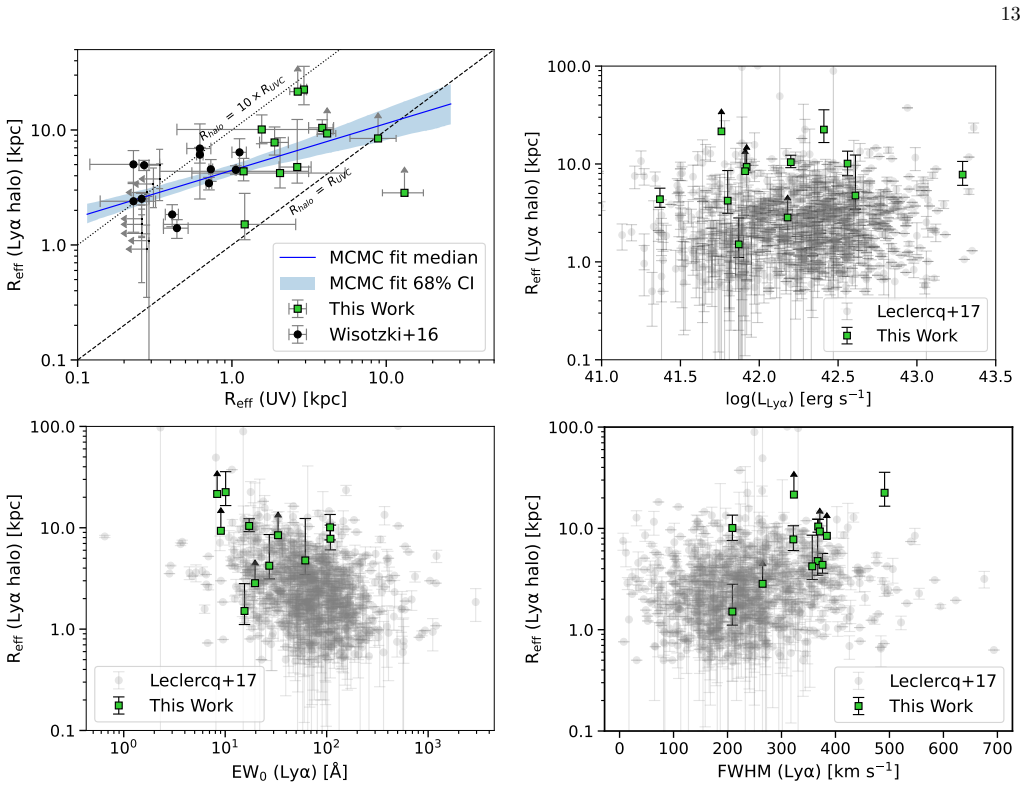
Extended Lyα halos are detected in 10 of the 12 tadpole galaxies, with the halos generally following the spatial extent of the UV continuum yet appearing more symmetric and frequently offset from the stellar component; some systems also show asymmetric outflow-like Lyα structures, indicating that the elongated morphologies influence Lyα photon transport and contribute to halo formation in the circumgalactic medium.
What carries the argument
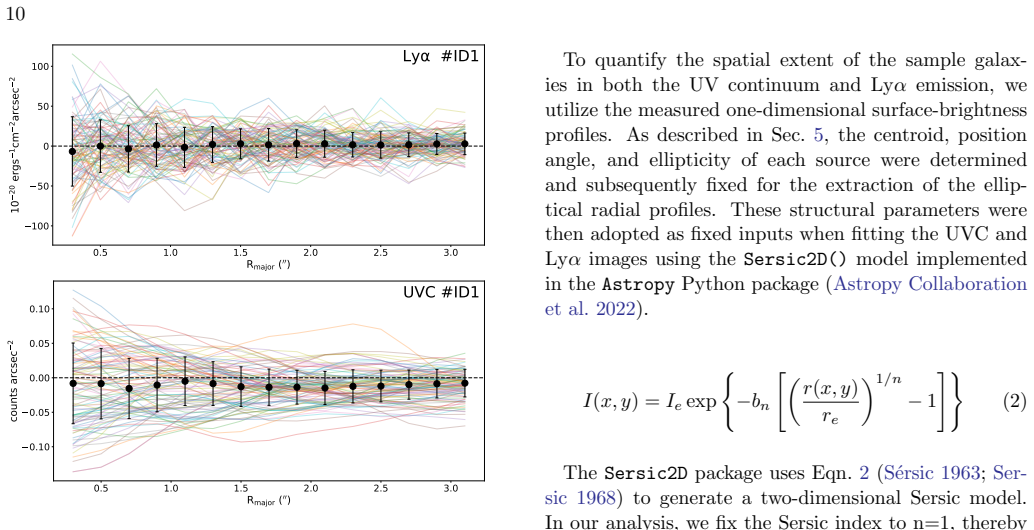
Surface brightness profiles of Lyα and UV continuum emission, built while explicitly accounting for the elongated morphologies of the tadpole galaxies to measure spatial extents and symmetries.
If this is right
- Diffuse Lyα emission is common among tadpole systems at these redshifts.
- Lyα halos are typically more symmetric than the UV continuum light and can be spatially offset from the stars.
- About 40 percent of the sample shows double-peaked Lyα line profiles.
- Some tadpole galaxies exhibit asymmetric, outflow-like Lyα structures consistent with anisotropic escape.
Where Pith is reading between the lines
- Tadpole morphologies may be one pathway by which high-redshift galaxies build the large Lyα halos seen in many surveys.
- The observed offsets between Lyα and UV peaks could mark sites where star formation occurs away from the center of the gaseous halo.
- Higher-resolution data on the same objects could test whether double-peaked profiles align with particular clump or tail features in the galaxies.
Load-bearing premise
The 12 tadpole galaxies found in the HUDF represent the broader population and their stretched shapes do not systematically affect the detection or measurement of the halos.
What would settle it
A survey of a larger set of similarly selected tadpole galaxies that finds extended Lyα halos in far fewer than 10 out of 12 cases would show the result does not hold generally.
Figures
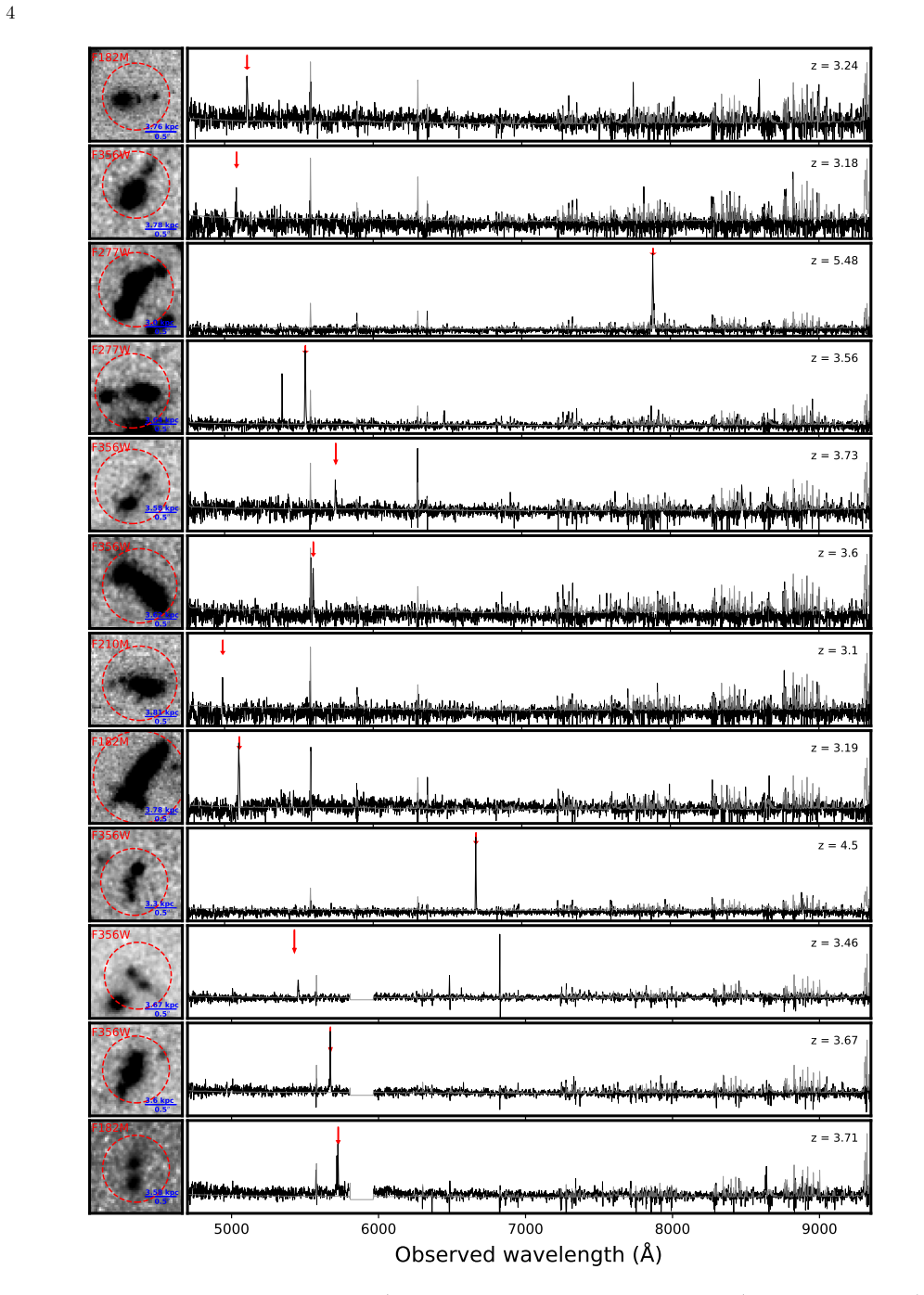
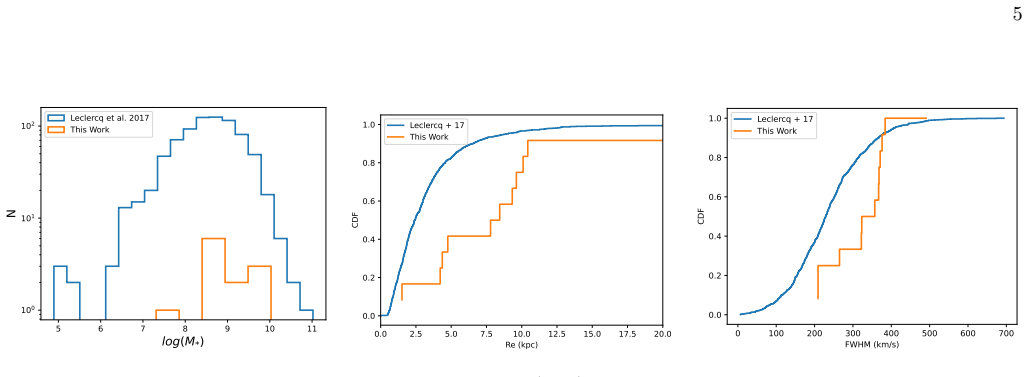
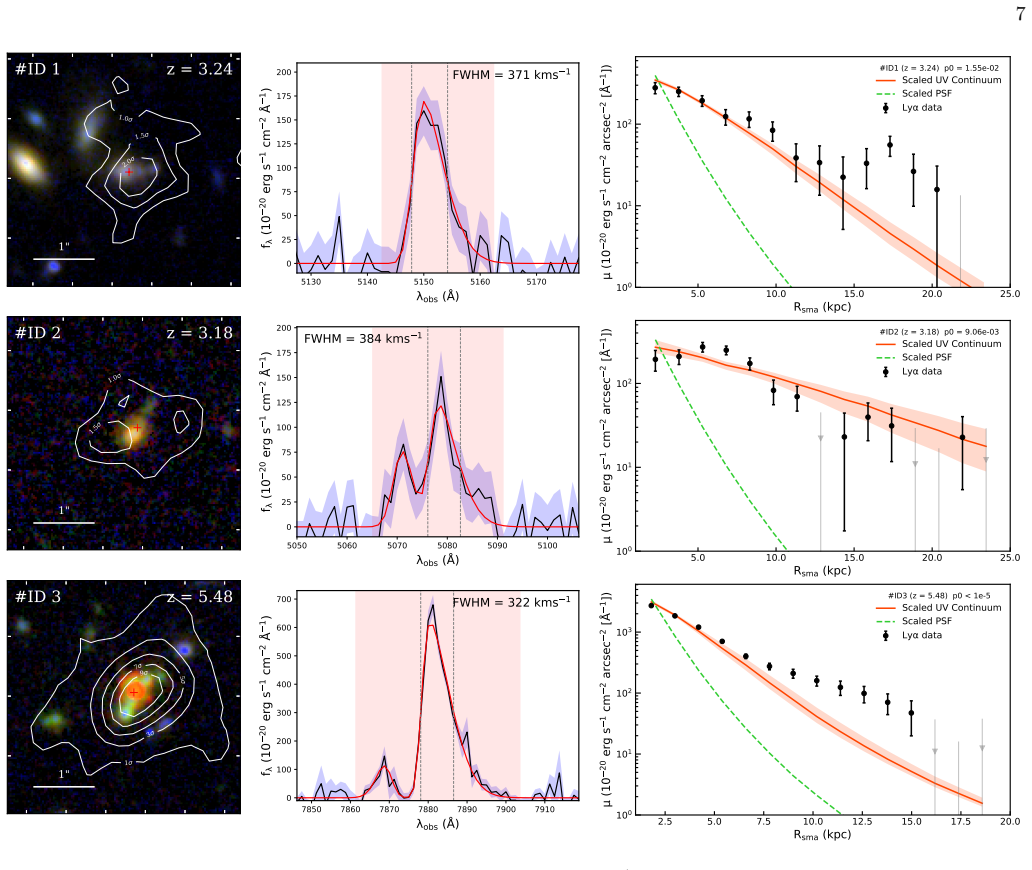
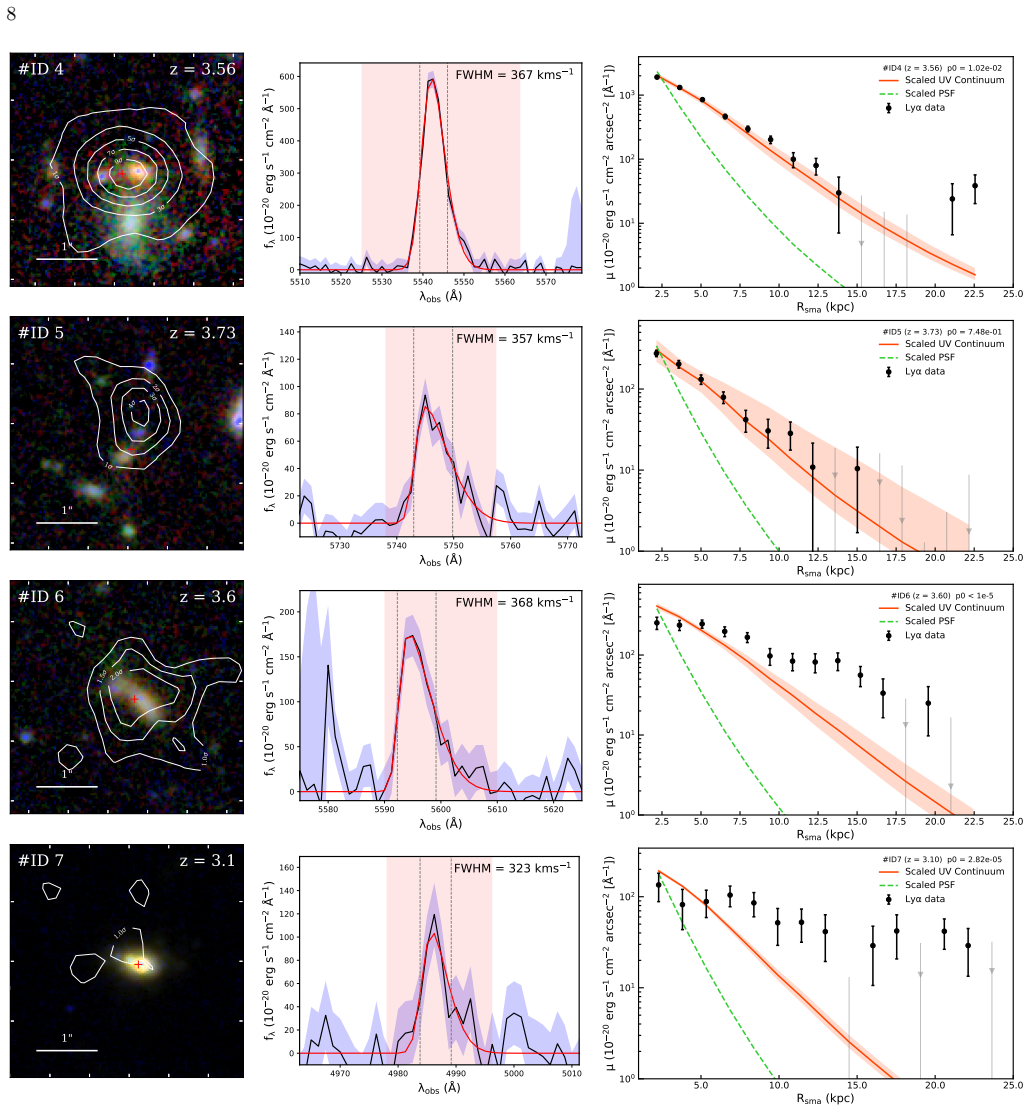
read the original abstract
Tadpole and clump-chain galaxies are a morphologically distinct population among high-redshift star-forming galaxies whose disturbed structures may influence the escape and propagation of Ly$\alpha$ photons. We investigate the Ly$\alpha$ and UV continuum properties of 12 tadpole galaxies in the redshift range of z $\sim$ 3 -- 5.5 identified in the Hubble Ultra Deep Field (HUDF) using deep MUSE observations. Accounting for their elongated morphologies, we construct surface brightness profiles and characterize the spatial extent of their Ly$\alpha$ emission. Extended Ly$\alpha$ halos are detected in 10 of the 12 galaxies, demonstrating that diffuse Ly$\alpha$ emission is common among tadpole systems. Approximately 40\% of the sample exhibits double-peaked Ly$\alpha$ profiles. While the effective radii ($\rm R_{e}$) of the Ly$\rm \alpha$ emission generally follow the spatial extent of the UV continuum, the Ly$ \rm \alpha$ halos are typically more symmetric and often exhibit spatial offsets from the stellar component. Some galaxies also display asymmetric and outflow-like Ly$\rm \alpha$ structures suggestive of anisotropic escape and complex radiative transfer effects. Together, these results suggest that the disturbed morphologies of tadpole galaxies may influence the transport of Ly$\rm \alpha$ photons and contribute to the formation of extended Ly$\rm \alpha$ halos in the circumgalactic medium.
Editorial analysis
A structured set of objections, weighed in public.
Referee Report
Summary. The manuscript reports MUSE observations of 12 tadpole galaxies at z ≈ 3–5.5 identified in the HUDF. After constructing surface brightness profiles while accounting for elongated morphologies, extended Lyα halos are detected in 10 of the 12 systems. The authors conclude that diffuse Lyα emission is common among tadpole galaxies, note that ~40% show double-peaked profiles, and describe Lyα halos as typically more symmetric with possible spatial offsets from the UV continuum, suggesting that disturbed morphologies influence Lyα transport and CGM halo formation.
Significance. If the sample is representative and the profile analysis free of systematic bias from elongation or PSF effects, the high detection fraction would provide useful observational evidence that morphological disturbances at high redshift affect Lyα photon propagation and contribute to extended halos. The work is primarily descriptive and adds to the literature on Lyα in morphologically complex star-forming galaxies, though the small sample inherently limits broad generalization.
major comments (3)
- [Results section on surface brightness profiles and halo detection] The central claim that diffuse Lyα is common among tadpoles rests on the 10/12 detection rate, yet the manuscript supplies no quantitative validation (mock recovery tests, comparison to rounder control galaxies, or sensitivity to aperture/axis-ratio choices) that the elongated-morphology corrections eliminate residual projection or PSF-mixing biases in the surface-brightness profiles. This directly affects the reliability of the reported halo sizes and detection fraction.
- [Sample selection (Introduction/Methods)] No details are provided on the parent catalog size, completeness of the tadpole selection, or tests for correlation between morphological selection and Lyα strength. Without these, it is unclear whether the 12-object HUDF sample is an unbiased draw from the tadpole population, undermining generalization of the 83% detection rate.
- [Abstract and quantitative results paragraphs] The abstract and results state detection rates and qualitative trends (e.g., Re(Lyα) following UV extent, offsets, asymmetry) but report neither error bars on the 10/12 fraction, statistical significance of the trends, nor explicit PSF corrections or profile-fitting parameters for the elongated sources. This limits independent verification of the headline result.
minor comments (2)
- [Abstract] The redshift range is stated as z ~ 3 -- 5.5; providing the exact minimum/maximum or median redshift of the sample would improve precision.
- [Discussion] Consider adding a brief comparison table or text referencing prior Lyα halo studies of more symmetric high-z galaxies to contextualize the tadpole-specific findings.
Simulated Author's Rebuttal
We thank the referee for their constructive comments, which highlight important aspects of our analysis and presentation. We address each major comment point by point below.
read point-by-point responses
-
Referee: The central claim that diffuse Lyα is common among tadpoles rests on the 10/12 detection rate, yet the manuscript supplies no quantitative validation (mock recovery tests, comparison to rounder control galaxies, or sensitivity to aperture/axis-ratio choices) that the elongated-morphology corrections eliminate residual projection or PSF-mixing biases in the surface-brightness profiles. This directly affects the reliability of the reported halo sizes and detection fraction.
Authors: We agree that quantitative validation such as mock tests would strengthen the claims. Our profiles use elliptical apertures aligned to the UV major axis to mitigate elongation effects, as noted in the Methods. We will expand this description in revision and add a sensitivity discussion to aperture and axis-ratio choices along with explicit notes on potential PSF and projection biases. Full mock recovery tests and control-sample comparisons are not included, as they exceed the scope of this small-sample descriptive study; we will state this limitation clearly. revision: partial
-
Referee: No details are provided on the parent catalog size, completeness of the tadpole selection, or tests for correlation between morphological selection and Lyα strength. Without these, it is unclear whether the 12-object HUDF sample is an unbiased draw from the tadpole population, undermining generalization of the 83% detection rate.
Authors: The 12 objects were selected via visual classification from HST imaging of the HUDF high-redshift galaxy population. We will add the approximate parent catalog size and selection criteria to the Methods section. Formal completeness calculations and Lyα-morphology correlation tests were not performed, as the work is focused on observed Lyα properties rather than selection-function characterization. We will explicitly note that the sample is not presented as statistically complete or unbiased. revision: yes
-
Referee: The abstract and results state detection rates and qualitative trends (e.g., Re(Lyα) following UV extent, offsets, asymmetry) but report neither error bars on the 10/12 fraction, statistical significance of the trends, nor explicit PSF corrections or profile-fitting parameters for the elongated sources. This limits independent verification of the headline result.
Authors: We will revise the abstract and results to report binomial uncertainties on the 10/12 fraction and to list the specific profile-fitting parameters and PSF-handling steps used. Given the sample size of 12, trends are discussed qualitatively; we will avoid implying statistical significance. These additions will allow independent verification. revision: yes
Circularity Check
No circularity: purely observational analysis with direct data-driven claims
full rationale
The manuscript reports MUSE observations of 12 tadpole galaxies selected from the HUDF, constructs surface-brightness profiles while accounting for elongated morphologies, and states the empirical detection rate of extended Lyα halos (10/12). No equations, fitted parameters, predictions, or self-citations appear in the provided text; the central result is a direct count from the observed profiles rather than any quantity defined in terms of itself or reduced by construction to prior author work. The sample-representativeness assumption is stated but is not part of a derivation chain that loops back to the same data. This is a standard observational report whose claims remain independent of the enumerated circularity patterns.
Axiom & Free-Parameter Ledger
axioms (2)
- standard math Standard flat Lambda-CDM cosmology for converting observed redshifts to physical scales
- domain assumption MUSE point-spread function and sensitivity allow reliable detection of extended emission around elongated sources
Reference graph
Works this paper leans on
-
[1]
G., van den Bergh, S., Glazebrook, K., et al
Abraham, R. G., van den Bergh, S., Glazebrook, K., et al. 1996, ApJS, 107, 1, doi: 10.1086/192352
-
[2]
Adams, T. F. 1972, ApJ, 174, 439, doi: 10.1086/151503
-
[3]
Ahn, S.-H., Lee, H.-W., & Lee, H. M. 2001, ApJ, 554, 604, doi: 10.1086/321374 Astropy Collaboration, Price-Whelan, A. M., Lim, P. L., et al. 2022, ApJ, 935, 167, doi: 10.3847/1538-4357/ac7c74
-
[4]
2016, MPDAF: MUSE Python Data Analysis Framework, Astrophysics Source Code Library, record ascl:1611.003
Shepherd, M. 2016, MPDAF: MUSE Python Data Analysis Framework, Astrophysics Source Code Library, record ascl:1611.003. http://ascl.net/1611.003
2016
-
[5]
2015, A&A, 575, A75, doi: 10.1051/0004-6361/201425419
Bacon, R., Brinchmann, J., Richard, J., et al. 2015, A&A, 575, A75, doi: 10.1051/0004-6361/201425419
-
[6]
2017, A&A, 608, A1, doi: 10.1051/0004-6361/201730833
Bacon, R., Conseil, S., Mary, D., et al. 2017, A&A, 608, A1, doi: 10.1051/0004-6361/201730833
-
[7]
2023, A&A, 670, A4, doi: 10.1051/0004-6361/202244187
Bacon, R., Brinchmann, J., Conseil, S., et al. 2023, A&A, 670, A4, doi: 10.1051/0004-6361/202244187
-
[8]
2014, A&A, 572, A74, doi: 10.1051/0004-6361/201424755
Behrens, C., & Braun, H. 2014, A&A, 572, A74, doi: 10.1051/0004-6361/201424755
-
[9]
Blumenthal, G. R., Faber, S. M., Primack, J. R., & Rees, M. J. 1984, Nature, 311, 517, doi: 10.1038/311517a0
-
[10]
Star Formation Rate Indicators
Calzetti, D. 2013, in Secular Evolution of Galaxies, ed. J. Falc´ on-Barroso & J. H. Knapen, 419, doi: 10.48550/arXiv.1208.2997
work page internal anchor Pith review Pith/arXiv arXiv doi:10.48550/arxiv.1208.2997 2013
-
[11]
Cantalupo, S., Porciani, C., Lilly, S. J., & Miniati, F. 2005, ApJ, 628, 61, doi: 10.1086/430758
-
[12]
Cappellari, M. 2002, MNRAS, 333, 400, doi: 10.1046/j.1365-8711.2002.05412.x
-
[13]
Chen, Z., Stark, D. P., Endsley, R., et al. 2023, MNRAS, 518, 5607, doi: 10.1093/mnras/stac3476
-
[14]
Cowie, L. L., Hu, E. M., & Songaila, A. 1995, AJ, 110, 1576, doi: 10.1086/117631
-
[15]
2014, PASA, 31, e040, doi: 10.1017/pasa.2014.33
Dijkstra, M. 2014, PASA, 31, e040, doi: 10.1017/pasa.2014.33
-
[16]
2006, ApJ, 649, 14, doi: 10.1086/506243
Dijkstra, M., Haiman, Z., & Spaans, M. 2006, ApJ, 649, 14, doi: 10.1086/506243
-
[17]
Dijkstra, M., & Loeb, A. 2009, MNRAS, 400, 1109, doi: 10.1111/j.1365-2966.2009.15533.x
-
[18]
B., Guiderdoni, B., Blaizot, J., et al
Drake, A. B., Guiderdoni, B., Blaizot, J., et al. 2017, MNRAS, 471, 267, doi: 10.1093/mnras/stx1515
-
[19]
J., Willott, C., Alberts, S., et al
Eisenstein, D. J., Willott, C., Alberts, S., et al. 2026, ApJS, 283, 6, doi: 10.3847/1538-4365/ae3163
-
[20]
Elmegreen, B. G., & Elmegreen, D. M. 2010, ApJ, 722, 1895, doi: 10.1088/0004-637X/722/2/1895
-
[21]
Coe, D. A. 2007, ApJ, 658, 763, doi: 10.1086/511667
-
[22]
Schaffer, M. A. 2005, ApJ, 631, 85, doi: 10.1086/432502
-
[23]
Elmegreen, D. M., Elmegreen, B. G., S´ anchez Almeida, J., et al. 2012, ApJ, 750, 95, doi: 10.1088/0004-637X/750/2/95
-
[24]
C., Dickinson, M., Giavalisco, M., et al
Ferguson, H. C., Dickinson, M., Giavalisco, M., et al. 2004, ApJL, 600, L107, doi: 10.1086/378578
-
[25]
Ferreira, L., Adams, N., Conselice, C. J., et al. 2022, ApJL, 938, L2, doi: 10.3847/2041-8213/ac947c
-
[26]
E., Winkel, B., S´ anchez Almeida, J., et al
Filho, M. E., Winkel, B., S´ anchez Almeida, J., et al. 2013, A&A, 558, A18, doi: 10.1051/0004-6361/201322098
-
[27]
Foreman-Mackey, D., Hogg, D. W., Lang, D., & Goodman, J. 2013, PASP, 125, 306, doi: 10.1086/670067
-
[28]
The Journal of Open Source Software , keywords =
Foreman-Mackey, D., Farr, W., Sinha, M., et al. 2019, The Journal of Open Source Software, 4, 1864, doi: 10.21105/joss.01864 F¨ orster Schreiber, N. M., & Wuyts, S. 2020, ARA&A, 58, 661, doi: 10.1146/annurev-astro-032620-021910
-
[29]
Harrington, J. P. 1973, MNRAS, 162, 43, doi: 10.1093/mnras/162.1.43
-
[30]
2017, A&A, 608, A10, doi: 10.1051/0004-6361/201731579
Hashimoto, T., Garel, T., Guiderdoni, B., et al. 2017, A&A, 608, A10, doi: 10.1051/0004-6361/201731579
-
[31]
2015, PASA, 32, e027, doi: 10.1017/pasa.2015.25
Hayes, M. 2015, PASA, 32, e027, doi: 10.1017/pasa.2015.25
-
[32]
2013, ApJL, 765, L27, doi: 10.1088/2041-8205/765/2/L27
Hayes, M., ¨Ostlin, G., Schaerer, D., et al. 2013, ApJL, 765, L27, doi: 10.1088/2041-8205/765/2/L27
-
[33]
Herenz, E. C., & Wisotzki, L. 2017, A&A, 602, A111, doi: 10.1051/0004-6361/201629507
-
[34]
Illingworth, G. D., Magee, D., Oesch, P. A., et al. 2013, ApJS, 209, 6, doi: 10.1088/0067-0049/209/1/6
-
[35]
K., Shimizu, I., Iwata, I., & Tanaka, M
Inoue, A. K., Shimizu, I., Iwata, I., & Tanaka, M. 2014, MNRAS, 442, 1805, doi: 10.1093/mnras/stu936
-
[36]
2025, ApJ, 989, 220, doi: 10.3847/1538-4357/adcebc
Kataria, M., Saha, K., & Elmegreen, B. 2025, ApJ, 989, 220, doi: 10.3847/1538-4357/adcebc
-
[37]
Kennicutt, Jr., R. C. 1998, ARA&A, 36, 189, doi: 10.1146/annurev.astro.36.1.189
work page internal anchor Pith review doi:10.1146/annurev.astro.36.1.189 1998
-
[38]
2000, A&A Rv, 10, 1, doi: 10.1007/s001590000005
Kunth, D., & ¨Ostlin, G. 2000, A&A Rv, 10, 1, doi: 10.1007/s001590000005
-
[39]
2017, A&A, 608, A8, doi: 10.1051/0004-6361/201731480
Leclercq, F., Bacon, R., Wisotzki, L., et al. 2017, A&A, 608, A8, doi: 10.1051/0004-6361/201731480
-
[40]
1995, ApJ, 441, 18, doi: 10.1086/175332
Madau, P. 1995, ApJ, 441, 18, doi: 10.1086/175332
-
[41]
2014, title Cosmic Star-Formation History , , 52, 415, 10.1146/annurev-astro-081811-125615
Madau, P., & Dickinson, M. 2014, ARA&A, 52, 415, doi: 10.1146/annurev-astro-081811-125615
work page internal anchor Pith review doi:10.1146/annurev-astro-081811-125615 2014
-
[42]
Matthee, J., Naidu, R. P., Brammer, G., et al. 2024, ApJ, 963, 129, doi: 10.3847/1538-4357/ad2345
-
[43]
2010, Publications of the National Astronomical Observatory of Japan, 13, 9
Miyauchi-Isobe, N., Maehara, H., & Nakajima, K. 2010, Publications of the National Astronomical Observatory of Japan, 13, 9
2010
-
[44]
2014, MNRAS, 442, 110, doi: 10.1093/mnras/stu825 16
Momose, R., Ouchi, M., Nakajima, K., et al. 2014, MNRAS, 442, 110, doi: 10.1093/mnras/stu825 16
-
[45]
B., S´ anchez Almeida, J., Aguerri, J
Morales-Luis, A. B., S´ anchez Almeida, J., Aguerri, J. A. L., & Mu˜ noz-Tu˜ n´ on, C. 2011, ApJ, 743, 77, doi: 10.1088/0004-637X/743/1/77
-
[46]
Morishita, T., Stiavelli, M., Chary, R.-R., et al. 2024, ApJ, 963, 9, doi: 10.3847/1538-4357/ad1404
-
[47]
, archivePrefix = "arXiv", eprint =
Mosleh, M., Williams, R. J., Franx, M., et al. 2012, ApJL, 756, L12, doi: 10.1088/2041-8205/756/1/L12
-
[48]
Neufeld, D. A. 1990, ApJ, 350, 216, doi: 10.1086/168375
-
[49]
Oesch, P. A., Bouwens, R. J., Carollo, C. M., et al. 2010, ApJL, 709, L21, doi: 10.1088/2041-8205/709/1/L21
-
[50]
Oke, J. B., & Gunn, J. E. 1983, ApJ, 266, 713, doi: 10.1086/160817
-
[51]
Ormerod, K., Conselice, C. J., Adams, N. J., et al. 2024, MNRAS, 527, 6110, doi: 10.1093/mnras/stad3597
-
[52]
Papaderos, P., Guseva, N. G., Izotov, Y. I., & Fricke, K. J. 2008, A&A, 491, 113, doi: 10.1051/0004-6361:200810028
-
[53]
MPDAF - A Python package for the analysis of VLT/MUSE data
Piqueras, L., Conseil, S., Shepherd, M., et al. 2017, arXiv e-prints, arXiv:1710.03554, doi: 10.48550/arXiv.1710.03554 S´ anchez Almeida, J., Morales-Luis, A. B., Mu˜ noz-Tu˜ n´ on, C., et al. 2014, ApJ, 783, 45, doi: 10.1088/0004-637X/783/1/45 S´ anchez Almeida, J., Mu˜ noz-Tu˜ n´ on, C., Elmegreen, D. M.,
work page internal anchor Pith review Pith/arXiv arXiv doi:10.48550/arxiv.1710.03554 2017
-
[54]
Elmegreen, B. G., & M´ endez-Abreu, J. 2013, ApJ, 767, 74, doi: 10.1088/0004-637X/767/1/74 S´ anchez Almeida, J., Elmegreen, B. G., Mu˜ noz-Tu˜ n´ on, C., et al. 2015, ApJL, 810, L15, doi: 10.1088/2041-8205/810/2/L15
-
[55]
Santini, P., Ferguson, H. C., Fontana, A., et al. 2015, ApJ, 801, 97, doi: 10.1088/0004-637X/801/2/97 S´ ersic, J. L. 1963, Boletin de la Asociacion Argentina de Astronomia La Plata Argentina, 6, 41
-
[56]
Sersic, J. L. 1968, Atlas de Galaxias Australes
1968
-
[57]
2019, ApJ, 871, 164, doi: 10.3847/1538-4357/aaf64b
Shibuya, T., Ouchi, M., Harikane, Y., & Nakajima, K. 2019, ApJ, 871, 164, doi: 10.3847/1538-4357/aaf64b
-
[58]
C., Bogosavljevi´ c, M., Shapley, A
Steidel, C. C., Bogosavljevi´ c, M., Shapley, A. E., et al. 2011, ApJ, 736, 160, doi: 10.1088/0004-637X/736/2/160
-
[59]
Straughn, A. N., Cohen, S. H., Ryan, R. E., et al. 2006, ApJ, 639, 724, doi: 10.1086/499576
-
[60]
Tacconi, L. J., Genzel, R., & Sternberg, A. 2020, ARA&A, 58, 157, doi: 10.1146/annurev-astro-082812-141034 van der Wel, A., Franx, M., van Dokkum, P. G., et al. 2014, ApJ, 788, 28, doi: 10.1088/0004-637X/788/1/28
-
[61]
2006, A&A, 460, 397, doi: 10.1051/0004-6361:20065554
Verhamme, A., Schaerer, D., & Maselli, A. 2006, A&A, 460, 397, doi: 10.1051/0004-6361:20065554
-
[62]
E., Ashas, M., Illingworth, G., et al
Whitaker, K. E., Ashas, M., Illingworth, G., et al. 2019, ApJS, 244, 16, doi: 10.3847/1538-4365/ab3853
-
[63]
White, S. D. M., & Rees, M. J. 1978, MNRAS, 183, 341, doi: 10.1093/mnras/183.3.341
-
[64]
AAP , archivePrefix = "arXiv", eprint =
Wisotzki, L., Bacon, R., Blaizot, J., et al. 2016, A&A, 587, A98, doi: 10.1051/0004-6361/201527384
-
[65]
2011, ApJ, 739, 62, doi: 10.1088/0004-637X/739/2/62
Zheng, Z., Cen, R., Weinberg, D., Trac, H., & Miralda-Escud´ e, J. 2011, ApJ, 739, 62, doi: 10.1088/0004-637X/739/2/62
discussion (0)
Sign in with ORCID, Apple, or X to comment. Anyone can read and Pith papers without signing in.