REVIEW 3 major objections 4 minor 30 references
History-conditioned vehicle model halves 6 m/s off-road tracking error using five minutes of real data per terrain.
Reviewed by Pith at T0; open to challenge. T0 means a machine referee read the full paper against a public rubric. the ladder, T0–T4 →
T0 review · deepseek-v4-flash
2026-08-02 05:30 UTC pith:YBWQLKY6
load-bearing objection History-conditioned architecture is the solid contribution; the synthetic-data coverage mechanism is unverified. the 3 major comments →
Adapting Generalist Vehicle Models for High-Speed MPC Across Terrains
The pith
A machine-rendered reading of the paper's core claim, the machinery that carries it, and where it could break.
Core claim
The paper introduces OptCar, a specialization recipe that takes a generalist forward kinodynamic (FKD) prediction model and adapts it to a target vehicle while preserving cross-terrain robustness. The two contributions are a history-conditioned dynamics module—a context vector computed from recent state-action pairs that conditions every block of the rollout decoder via FiLM—and a fine-tuning recipe that augments about five minutes of real driving per terrain with synthetic rollouts generated by a per-terrain dynamic bicycle model fitted to that real data. In closed-loop MPPI experiments at speeds up to 6 m/s, OptCar reduces trajectory tracking error on vegetation and dirt by roughly 55 perc
What carries the argument
The central mechanism is a learned dynamics context vector c_t: a history-to-context map g_phi compresses 250 steps of recent state-action history into a single latent vector, and a context-conditioned rollout decoder f_theta uses FiLM to modulate every transformer block with c_t. Because each candidate action sequence rolled out by MPC is conditioned on the same context, the model adapts to the active slip regime, payload, and terrain in a single forward pass, with no terrain classifier, mode switch, or online weight updates. The second load-bearing piece is the targeted fine-tuning set: each terrain's real data is used both directly and to fit a dynamic bicycle model (Eq. 4), whose synthet
Load-bearing premise
The five minutes of real driving collected per terrain must excite the same high-slip regimes that the synthetic rollouts are meant to cover; if the real data miss those regimes, the fitted bicycle model extrapolates from low-slip data and the claimed gains from targeted synthetic rollouts lose their grounding.
What would settle it
Collect five minutes of per-terrain driving using only gentle, low-slip maneuvers (e.g., near-constant speed, mild steering), then run OptCar and a real-data-only baseline at 6 m/s on the same terrain; if the full recipe no longer beats the baseline, the benefit of synthetic rollouts depends on the real data's slip-regime coverage rather than on the synthetic data itself.
If this is right
- If correct, the recipe means that minutes of per-terrain real data plus a simple system-identified simulator can close most of the accuracy gap between a generalist FKD model and a single-terrain specialist, without sacrificing cross-terrain transfer.
- History conditioning alone provides a form of online dynamics adaptation that needs no separate planner or optimization, so the same deployment stack can handle terrain changes and even out-of-distribution payload shifts such as a trailing cart.
- The gains concentrate at the highest speed tested (6 m/s), where slip dominates tracking error, suggesting the method is specifically useful in the aggressive regime where analytical bicycle models break down.
- Because the synthetic data are generated from a per-terrain identified model rather than broad domain randomization, the learned dynamics remain anchored to the target vehicle, avoiding capacity wasted on unrelated vehicles or terrains.
- The approach is compatible with real-time MPC on embedded hardware, since the context vector is computed once per planning step and reused across all candidate rollouts.
Where Pith is reading between the lines
- A natural extension is to replace the static per-terrain system identification with an online-updated bicycle model, so that the synthetic data generator tracks the vehicle's current dynamics rather than a single fitted terrain parameter set; this could extend the recipe to terrains that change within a single run.
- The paper's context-vector analysis (PCA/LDA) shows the learned representation organizes recent history by vehicle, terrain, speed, and turn direction; this suggests the same architecture could be transferred to other vehicle types by reusing the pretrained history encoder and only fine-tuning the decoder, possibly cutting adaptation data further.
- The claim that five minutes of real data suffice is conditional on those five minutes containing enough high-slip excitation; a practical check would be to record slip-state coverage during data collection and test whether the synthetic augmentation still helps when the real data are deliberately biased toward gentle driving.
- If the synthetic rollouts are only used for fine-tuning and not for deployment, the bottleneck is the fidelity of the fitted bicycle model in the high-slip regime; combining this approach with an online residual model trained on the same context vector could close the remaining gap.
Editorial analysis
A structured set of objections, weighed in public.
Referee Report
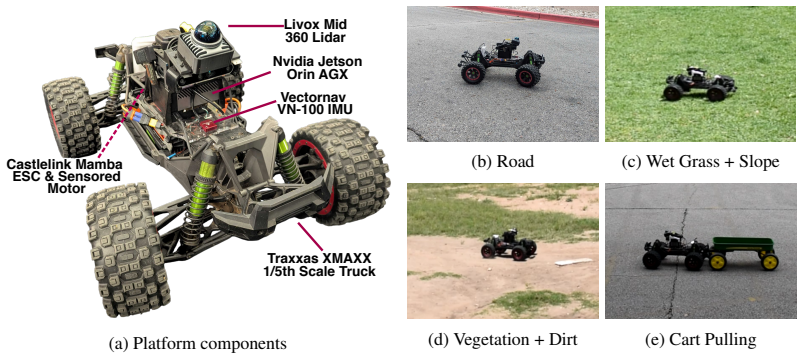
Summary. The paper proposes OptCar, a recipe for specializing a generalist forward kinodynamic (FKD) model to a target vehicle for high-speed MPC while preserving cross-terrain robustness. Two main contributions are presented: (1) a history-conditioned FKD architecture that compresses recent state-action history into a dynamics context vector c_t and conditions every decoder block on it, and (2) a fine-tuning recipe that augments roughly 5 minutes of per-terrain real data with synthetic rollouts generated by a per-terrain system-identified dynamic bicycle model (DBM), intended to cover high-slip regimes undersampled by real data. The method is evaluated in closed-loop MPPI on a 1/5-scale truck across road, wet grass+slope, vegetation+dirt, and an unseen cart-pulling task. The headline result is a roughly 55% reduction in 6 m/s trajectory tracking error on vegetation+dirt relative to a fine-tuned AnyCar baseline (Table 1: 0.348 m vs 0.776 m), competitive road performance against a 30-minute road specialist, and better accuracy on unseen terrain. The ablations (RQ2, RQ3) are well designed, but the quantitative conclusions rest on point estimates without variance or statistical tests.
Significance. If the claims hold, the paper makes a useful practical contribution: it shows a plausible path from generalist FKD foundation models to per-vehicle, per-terrain deployment with only minutes of real data, using a simple history-conditioning mechanism and targeted synthetic augmentation. The closed-loop physical experiments on three terrains plus an out-of-distribution payload are a strength, and the ablations cleanly separate the contributions of the history context and the synthetic fine-tuning. The architecture is not overly complex and the deployment is real-time on an embedded GPU. However, the central quantitative claims are not yet statistically grounded: the reported three-run experiments appear only as point estimates, and the mechanism by which synthetic rollouts improve high-slip tracking is not directly validated. The significance would be substantially strengthened by reporting variance/confidence intervals and by evidence that the synthetic generator covers the intended high-slip regime.
major comments (3)
- [§6.2.1 and Table 1] The paper states 'Each configuration is repeated three times' but reports only point estimates. The headline 55% reduction on vegetation+dirt at 6 m/s is the ratio of two numbers (0.348 vs 0.776) with no standard deviation, confidence interval, or statistical test. Without these, the reader cannot judge whether the differences are meaningful given run-to-run variability in off-road tracking. Please report per-run results, mean±SD/CI, and, where appropriate, paired comparisons across the same trajectories and conditions. This is load-bearing because every research question is evaluated on this table.
- [§4.3, Eq. (4), Eq. (21), and Table 1] The synthetic data generator relies on a DBM whose tire forces are linear (F_tire = C_t α, Eq. (21)) with no saturation. Table 1 itself shows that this same DBM used directly as the MPPI rollout model has 6 m/s TTE of 0.562 m on road, 1.356 m on wet grass, and 0.824 m on vegetation+dirt — far worse than the learned models. The claim that synthetic rollouts 'enter high-slip regions undersampled by the real data' (§4.3) is therefore not supported: no evidence is given that the 5-minute real datasets excite high-slip conditions, nor that the identified DBM is valid there. Please report the distribution of slip angles/speeds in the actual data collection, validate F_ψe against held-out real transitions at high slip, or otherwise demonstrate that the generated synthetic rollouts actually cover the intended state-action region. Otherwise the improvement of FT-RS over FT-R may stem from generic
- [§6.3 (RQ2)] The only comparison used to support the 'targeted' synthetic-data claim is OptCar FT-R vs OptCar FT-RS. To separate the effect of targeting from the effect of simply adding more data, please include a control condition with non-targeted augmentation (e.g., random noise added to real trajectories, or synthetic rollouts from a generic kinematic model). Without such a control, the contribution of the system-identification target cannot be isolated from a data-quantity effect, which weakens the paper's second contribution.
minor comments (4)
- [Table 1] Notation is inconsistent: the table uses 'OptCar+ FT-RS', 'AnyCar + FT-R', and 'OptCarFT-R' while the text uses 'OptCarFT-RS', 'AnyCar FT-R', etc. Please unify the naming.
- [Appendix E] The PCA/LDA context-vector analysis is qualitative. It would be more convincing with a quantitative separability measure or a downstream task showing that the context clusters correspond to different closed-loop behavior.
- [§5 and Eq. (6)] The MPPI cost weights (lateral error weight 15, horizon, sample count) are fixed. A short sensitivity analysis or a statement on how these were chosen would help assess robustness of the closed-loop results to controller tuning.
- [§4.3] Eq. (4) sums squared one-step transition errors without defining units or normalization. Since the state includes position, orientation, and velocities, please specify any scaling or weighting used in the least-squares objective.
Circularity Check
No significant circularity; central claims are evaluated by controlled closed-loop ablations against externally pretrained baselines.
full rationale
OptCar's central claims do not reduce to their inputs by construction. The history-conditioning contribution is isolated by comparing AnyCar FT-R (same backbone, no context) with OptCar FT-R (context added), and the real-and-synthetic recipe is isolated by comparing OptCar FT-R with OptCar FT-RS; both comparisons are evaluated by closed-loop TTE/VTE on real terrains, not by a fitted objective. The dynamic bicycle model of Eq. (4) is indeed fitted to the same 5-minute real data used for fine-tuning, but the paper explicitly does not deploy it as the MPC rollout model; it is used offline only to generate synthetic training windows, and the final learned FKD model's closed-loop error is not a re-statement of the DBM's one-step fit. No load-bearing argument rests on a self-citation: AnyCar and IKD are external baselines, and the paper's own limitations (feedforward-only adaptation, short MPC horizon, proprioceptive-only context) are honest scope statements rather than hidden inputs. The skeptic's concern that the DBM may extrapolate poorly into the high-slip 6 m/s regime is a correctness or evidence question about the synthetic-data mechanism, not a definitional equivalence, so it does not constitute circularity under the stated criteria.
Axiom & Free-Parameter Ledger
free parameters (3)
- Per-terrain DBM identified parameters ψ_e (T_w, C_a, C_t,f, C_t,r, C_r, C_d) =
not reported
- MPPI cost weights (lateral 15, w_psi, w_v) =
lateral=15; w_psi and w_v unspecified
- Synthetic rollout randomization ranges (velocity [-2,8] m/s, steering [-0.41,0.41] rad, velocity noise σ=0.2) =
as stated
axioms (4)
- domain assumption The pretrained AnyCar FKD backbone and simulation protocol transfer to the 1/5-scale target vehicle.
- domain assumption A per-terrain dynamic bicycle model fitted on 5 minutes of real data generates useful high-slip synthetic rollouts.
- ad hoc to paper The last M=250 state-action steps at 20 Hz encode the active dynamics sufficiently for future rollouts.
- domain assumption MPPI cost weights (Eq. 6) are fixed and adequate for fair comparison across all models.
invented entities (1)
-
Dynamics context vector c_t
independent evidence
read the original abstract
High-speed off-road autonomy requires precise closed-loop control for a target vehicle while remaining robust across changing terrains. Recent forward kinodynamic (FKD) prediction foundation models suggest a promising path, starting from a generalist model and specializing it to the target platform. However, effective specialization remains challenging, as it often requires substantial real-world data, and models adapted to one setting can still overfit to specific terrains or driving regimes. We present OptCar (Optimized Car), a recipe for bridging the gap from generalist to specialist FKD models that preserves cross-terrain generalization while optimizing performance for a specific vehicle. $\texttt{OptCar}$ introduces a history-conditioned dynamics adaptation module that encodes recent state-action observations into a dynamics context token, and then fine-tunes the generalist model using limited real-world data together with targeted synthetic rollouts from environment-specific system identification. In closed-loop model predictive control (MPC) experiments across three terrains and an out-of-distribution cart-pulling task, the largest gains appear at 6~m/s, the highest speed evaluated and the regime in which slip dominates tracking error. On vegetation and dirt, the most slip-diverse terrain, OptCar reduces 6~m/s trajectory tracking error by roughly 55% relative to a fine-tuned AnyCar baseline, and remains the most accurate even when an unseen cart payload changes the dynamics. With only 5 minutes of real data per terrain, OptCar is competitive on road with a specialist trained on 30 minutes of road data, and substantially outperforms it once the terrain changes.
Figures




Reference graph
Works this paper leans on
-
[1]
G. Williams, A. Aldrich, and E. A. Theodorou. Model predictive path integral control using covariance variable importance sampling.ArXiv, abs/1509.01149, 2015. URLhttps://api. semanticscholar.org/CorpusID:14146342
Pith/arXiv arXiv 2015
-
[2]
W. Xiao, H. Xue, T. Tao, D. Kalaria, J. M. Dolan, and G. Shi. Anycar to anywhere: Learning universal dynamics model for agile and adaptive mobility, 2024. URLhttps://arxiv.org/ abs/2409.15783
Pith/arXiv arXiv 2024
-
[3]
X. Xiao, J. Biswas, and P. Stone. Learning inverse kinodynamics for accurate high-speed off-road navigation on unstructured terrain.CoRR, abs/2102.12667, 2021. URLhttps:// arxiv.org/abs/2102.12667
Pith/arXiv arXiv 2021
-
[4]
H. Karnan, K. S. Sikand, P. Atreya, S. Rabiee, X. Xiao, G. Warnell, P. Stone, and J. Biswas. Vi-ikd: High-speed accurate off-road navigation using learned visual-inertial inverse kinody- namics, 2022. URLhttps://arxiv.org/abs/2203.15983
Pith/arXiv arXiv 2022
-
[5]
G. Williams, P. Drews, B. Goldfain, J. M. Rehg, and E. A. Theodorou. Information theoretic model predictive control: Theory and applications to autonomous driving, 2017. URLhttps: //arxiv.org/abs/1707.02342
Pith/arXiv arXiv 2017
-
[6]
F. Djeumou, J. Y . M. Goh, U. Topcu, and A. Balachandran. Autonomous drifting with 3 minutes of data via learned tire models, 2023. URLhttps://arxiv.org/abs/2306.06330
Pith/arXiv arXiv 2023
-
[7]
Rajamani.V ehicle Dynamics and Control
R. Rajamani.V ehicle Dynamics and Control. Mechanical Engineering Series. Springer, New York, NY , 2 edition, 2012. ISBN 978-1-4614-1433-9. doi:10.1007/978-1-4614-1433-9
-
[8]
M. Bojarski, D. D. Testa, D. Dworakowski, B. Firner, B. Flepp, P. Goyal, L. D. Jackel, M. Mon- fort, U. Muller, J. Zhang, X. Zhang, J. Zhao, and K. Zieba. End to end learning for self-driving cars, 2016. URLhttps://arxiv.org/abs/1604.07316
Pith/arXiv arXiv 2016
-
[9]
M. S. Gandhi, B. Vlahov, J. Gibson, G. Williams, and E. A. Theodorou. Robust model predic- tive path integral control: Analysis and performance guarantees.IEEE Robotics and Automa- tion Letters, 6(2):1423–1430, Apr. 2021. ISSN 2377-3774. doi:10.1109/lra.2021.3057563. URLhttp://dx.doi.org/10.1109/LRA.2021.3057563
arXiv 2021
-
[10]
J. Gibson, B. Vlahov, D. Fan, P. Spieler, D. Pastor, A. akbar Agha-mohammadi, and E. A. Theodorou. A multi-step dynamics modeling framework for autonomous driving in multiple environments, 2023. URLhttps://arxiv.org/abs/2305.02241
Pith/arXiv arXiv 2023
-
[11]
H. Lee, T. Kim, J. Mun, and W. Lee. Learning terrain-aware kinodynamic model for au- tonomous off-road rally driving with model predictive path integral control.IEEE Robotics and Automation Letters, 8(11):7663–7670, Nov. 2023. ISSN 2377-3774. doi:10.1109/lra. 2023.3318190. URLhttp://dx.doi.org/10.1109/LRA.2023.3318190
arXiv 2023
- [12]
-
[13]
H. Xue, E. L. Zhu, J. M. Dolan, and F. Borrelli. Learning model predictive control with error dynamics regression for autonomous racing. In2024 IEEE International Confer- ence on Robotics and Automation (ICRA), page 13250–13256. IEEE, May 2024. doi:10. 1109/icra57147.2024.10611628. URLhttp://dx.doi.org/10.1109/ICRA57147.2024. 10611628. 9
arXiv 2024
-
[14]
D. Kalaria, Q. Lin, and J. M. Dolan. Adaptive planning and control with time-varying tire models for autonomous racing using extreme learning machine, 2023. URLhttps://arxiv. org/abs/2303.08235
Pith/arXiv arXiv 2023
-
[15]
W. Yu, J. Tan, C. K. Liu, and G. Turk. Preparing for the unknown: Learning a universal policy with online system identification, 2017. URLhttps://arxiv.org/abs/1702.02453
Pith/arXiv arXiv 2017
-
[16]
Kumar, Z
A. Kumar, Z. Fu, D. Pathak, and J. Malik. Rma: Rapid motor adaptation for legged robots,
-
[17]
O’Connell, G
M. O’Connell, G. Shi, X. Shi, K. Azizzadenesheli, A. Anandkumar, Y . Yue, and S.-J. Chung. Neural-fly enables rapid learning for agile flight in strong winds.Science Robotics, 7(66), May
-
[18]
K. Huang, R. Rana, A. Spitzer, G. Shi, and B. Boots. Datt: Deep adaptive trajectory tracking for quadrotor control, 2023. URLhttps://arxiv.org/abs/2310.09053
Pith/arXiv arXiv 2023
-
[19]
J. Levy, J. Gibson, B. Vlahov, E. Tevere, E. Theodorou, D. Fridovich-Keil, and P. Spieler. Meta-learning online dynamics model adaptation in off-road autonomous driving, 2025. URL https://arxiv.org/abs/2504.16923
Pith/arXiv arXiv 2025
-
[20]
Y . Tsuchiya, T. Balch, P. Drews, and G. Rosman. Online adaptation of learned vehicle dynam- ics model with meta-learning approach, 2024. URLhttps://arxiv.org/abs/2409.14950
Pith/arXiv arXiv 2024
-
[21]
S. J. Wang, H. Zhu, and A. M. Johnson. Pay attention to how you drive: Safe and adaptive model-based reinforcement learning for off-road driving, 2023. URLhttps://arxiv.org/ abs/2310.08674
Pith/arXiv arXiv 2023
-
[22]
S. Zhu, A. Kimmel, K. E. Bekris, and A. Boularias. Fast model identification via physics engines for data-efficient policy search, 2018. URLhttps://arxiv.org/abs/1710.08893
Pith/arXiv arXiv 2018
-
[23]
F. Ramos, R. C. Possas, and D. Fox. Bayessim: adaptive domain randomization via probabilis- tic inference for robotics simulators, 2019. URLhttps://arxiv.org/abs/1906.01728
Pith/arXiv arXiv 2019
-
[24]
Y . Chebotar, A. Handa, V . Makoviychuk, M. Macklin, J. Issac, N. Ratliff, and D. Fox. Closing the sim-to-real loop: Adapting simulation randomization with real world experience, 2019. URLhttps://arxiv.org/abs/1810.05687
Pith/arXiv arXiv 2019
-
[25]
F. Muratore, C. Eilers, M. Gienger, and J. Peters. Data-efficient domain randomization with bayesian optimization.IEEE Robotics and Automation Letters, 6(2):911–918, Apr. 2021. ISSN 2377-3774. doi:10.1109/lra.2021.3052391. URLhttp://dx.doi.org/10.1109/ LRA.2021.3052391
arXiv 2021
-
[26]
O. Dikici, E. Ghignone, C. Hu, N. Baumann, L. Xie, A. Carron, M. Magno, and M. Corno. Learning-based on-track system identification for scaled autonomous racing in under a minute. IEEE Robotics and Automation Letters, 10(2):1984–1991, Feb. 2025. ISSN 2377-3774. doi: 10.1109/lra.2025.3527336. URLhttp://dx.doi.org/10.1109/LRA.2025.3527336
arXiv 1984
-
[27]
E. Perez, F. Strub, H. de Vries, V . Dumoulin, and A. Courville. Film: Visual reasoning with a general conditioning layer, 2017. URLhttps://arxiv.org/abs/1709.07871
Pith/arXiv arXiv 2017
-
[28]
S. Zhao, H. Zhang, P. Wang, L. Nogueira, and S. Scherer. Super odometry: Imu-centric lidar-visual-inertial estimator for challenging environments. In2021 IEEE/RSJ International Conference on Intelligent Robots and Systems (IROS), pages 8729–8736. IEEE, 2021. 10 A Architecture and Training Details Context extraction and FiLM conditioning.The per-stream his...
2021
-
[2021]
URLhttps://arxiv.org/abs/2107.04034
-
[2022]
doi:10.1126/scirobotics.abm6597
ISSN 2470-9476. doi:10.1126/scirobotics.abm6597. URLhttp://dx.doi.org/10. 1126/scirobotics.abm6597
discussion (0)
Sign in with ORCID, Apple, or X to comment. Anyone can read and Pith papers without signing in.